Bible – The Greatest Story Book Ever!

While checking out a few book shops today, by happenstance I came across a Bible entitled, Baby’s First Bible. My curiosity got the best of me and while flipping through the pages I came across a pretty interesting page. On the last picture below, the publishers describe the Bible as the greatest story book ever! I cannot disagree, the Bible has stories that rival those of Cinderella, Game of Thrones and even Harry Potter.

It’s good to see that publishers are educating kids by being honest about the veracity and reliability of the Bible.

and God knows best.

Quick Responses to Claims About the Eternal Word of God

I’ve been busy the past few days and had not noticed that Br. Yahya Snow published an article and created a video about me. The article can be read here and concerns debate challenges and the glib behaviour of some missionaries.Br. Yahya states:

Now I must say, it’s curious to see Jonathan angle for a debate with Yusuf Bux after he intimated Yusuf’s arguments are dated and weak. Admittedly, I do have reservations about some of the arguments that do come out of SA. Nevertheless, the point here is why would Jonathan decide to target Yusuf for a debate while Jonathan continually avoids Ijaz Ahmad’s debate challenges. Ijaz is a hardened apologist and debater who chooses to involve himself in technical discussions about Christian theology – it’s what he specialises in.

You see, Jonathan has come off really poorly in his interactions with experienced Muslim apologists. He struggled in his debate with Shabir Ally and struggled in his debate with Yusuf Ismail. Ijaz Ahmad and myself have corrected him and refuted him on many points over the last few months – at times on some very basic stuff highlighting his inability in dialogue with Muslims who are more experienced and aware apologetically.

We’ve corrected Jonathan McLatchie a number of times, here are some examples:

  1. Jonathan rejected the belief that God in the Bible literally inscribed revelation.
  2. Jonathan argued that Br. Khalid Yasin was a white man.
  3. Jonathan claimed that nowhere in the Qur’an does Allah say: I am God Worship me.
  4. Jonathan forgot how debates work.

I actually have quite a couple more screenshots of never before released mistakes by Jonathan. However, they will not be posted. There’s a difference between correcting a public figure and caricaturing someone, and I do not want to cross that line. On the other hand, Br. Yahya also produced a video with me responding to some missionary claims regarding the speech of God, the preservation of the Qur’an and of Jesus’s nature:

I’m not particularly fond of seeing my name and face mentioned this much. While I am thankful for the efforts many brothers have made, it’s still a bit unsettling to see my face and name everywhere. In this case though, it is a video debate and so there’s no choice but to show my face. I am appreciative of Br. Yahya’s comments regarding me and for the video he’s made. I pray that many can benefit from the work that our little community of Muslim apologists, bloggers and du’at do.

and Allah knows best.


Tony Costa – Pretending to Know Arabic

cc-2016-tc-portrait

Tony Costa

The Claims

The missionary Tony Costa recently responded to one of my articles correcting him on being dishonest about the Arabic language. What is the problem? Tony is claiming that the feminine form of أله is لت. He says:

In a commentary piece where I was reviewing a debate I had with my good friend Sadat Anwar I spoke about the daughters of Allah in the Qur’an 53:19-20. I then made this statement, “Al-Lat is actually the feminine form of ‘Al-ilah’ or ‘Allah’”

I would like to mention that I have linked to Tony’s article and I am quoting what he says so as to demonstrate to him that there is no sleight of hand at work, I’m using his words against him. In the above quote, he is making a claim about the Arabic language. He then goes on to say:

I have never pretended to know the Arabic language, nor did I make such a claim. In fact I openly admitted in my debate with Sadat Anwar that I am presently learning and studying Arabic.

How is it, that he says in one sentence he made a claim and statement about the Arabic language, and then in another he claims that he did not make such a claim? The problem is that Tony freely admits he does not know the Arabic language, yet is insistent that his derivation of the word أله in its female form is لت. This is grammatically impossible. I have explained this to Tony, yet he insists he is correct. He goes on to state:

Why would I give the morphology of the term أله when I never addressed the forms of words in Arabic?

Let’s establish some facts:

  1. Tony claims he does not know the Arabic language.
  2. Tony admits he made a claim about words in the Arabic language.
  3. Tony admits he made claims about words in the Arabic language for which he does not know the morphology of the words themselves.

In other words, someone ignorant about the Arabic language is making a claim about the Arabic language, without being able to qualify his claim using the Arabic language. To prove that he is correct, Tony then copy-pasted a few quotes from a Google Search Result he sent me via e-mail. Yes. Tony insists he is correct because he Googled a question and sent me the results. He did this in an e-mail thread with Dr. Shabir Ally, Dr. James White, Br. Yusuf Ismail, Br. Yahya Snow, Br. Yusuf Bux, Br. Paul Williams, and I corrected him in this e-mail thread. Several others corrected him and he continued to insist that he did not need to know the Arabic language to make claims about the Arabic language. As such, Tony is guilty of a number of fallacies.

The Fallacies

Special Pleading

You moved the goalposts or made up an exception when your claim was shown to be false.

After showing Tony that he was wrong in the Arabic language using Arabic lexicons, Arabic Bibles and explaining basic Arabic grammatical rules, Tony now insists he never meant to address the derivations of the word أله in Arabic, he only meant to do so in English. The problem here is that أله is not an English word, it’s an Arabic word.

Appeal to Authority

You said that because an authority thinks something, it must therefore be true.

Tony claims that his quotes in English prove his claim. Yet, this is not the case. None of these quotes demonstrate how they derive لت from أله. Just because they claim they have, does not make it true. To qualify this as true, all Tony has to do is show the derivation. Since he is unable to do that, and I have contradicted this claim by actually providing the female form, the rules of logic (proof by contradiction) render Tony wrong.

Appeal to Authority

You appealed to popularity or the fact that many people do something as an attempted form of validation.

Seven people repeating a false claim, does not make it true. It makes it wrong each and every time it is repeated. I can also go on Google and claim that at the Council of Nicaea the canon of the New Testament was decided. I can provide hundreds of quotes claiming this. Yet it isn’t true. This is common sense for some of us, not all of us.

The Correction

To begin with, in the Arabic language you derive the forms of a word using its root. This is known as morphology or Sarf (صرف). It is grammatically impossible to derive لت from أله. As previously mentioned in my original article, it’s akin to trying to derive oranges from the word range. This is grammatically impossible. Oranges comes from orange. Oranges does not come from range. This is abecedarian stuff, but Tony does not seem to grasp this concept. We therefore ask the question, what do the Arabic Bibles claim the feminine form of أله is? Millions of Arabic Christians and Jews, use the SVD Arabic Bible. All Tony has to do is go to an Arabic Bible and see what the feminine form of أله is. The Arabic Bibles do not say لت, they say إلهة. See the following examples (emphasis is mine own):

فَذَهَبَ سُلَيْمَانُ وَرَاءَ عَشْتُورَثَ إِلَهَةِ الصَّيْدُونِيِّينَ وَمَلْكُومَ رِجْسِ الْعَمُّونِيِّينَ.
1 Kings 11:5.

لأَنَّهُمْ تَرَكُونِي وَسَجَدُوا لِعَشْتُورَثَ إِلَهَةُ الصَّيْدُونِيِّينَ وَلِكَمُوشَ إِلَهِ الْمُوآبِيِّينَ وَلِمَلْكُومَ إِلَهِ بَنِي عَمُّونَ، وَلَمْ يَسْلُكُوا فِي طُرُقِي لِيَعْمَلُوا الْمُسْتَقِيمَ فِي عَيْنَيَّ وَفَرَائِضِي وَأَحْكَامِي كَدَاوُدَ أَبِيهِ.
1 Kings 11:33.

لأَنَّكُمْ أَتَيْتُمْ بِهَذَيْنِ الرَّجُلَيْنِ وَهُمَا لَيْسَا سَارِقَيْ هَيَاكِلَ وَلاَ مُجَدِّفَيْنِ عَلَى إِلَهَتِكُمْ.
Acts 19:37.

Tony, this is known as proof by contradiction. I did not need to open Google to qualify my claims as you did, I simply went to the Arabic Bible that the Coptic Church uses. Tony therefore claims that he is correct, while the Coptic Church, the Smith and Van Dyke Arabic Bible and the American Bible Society with its translation committees spanning more than 100 years are all wrong. I therefore call upon Tony to contact the Coptic Church and the American Bible Society and let them both know that their Bibles have an error in their scriptures which they have not noticed for over 100 years, but that he, a man who does not know the Arabic language is correct.

To further correct Tony, here are some lexicons. Tony, lexicons explain the roots of words, their derivations and their meanings. They are considered authorities on language. I am quite shocked that you do not know this, but I am here to help you.

Lanes Lexicon

ilah lanes lexicon1.png

ilah lanes lexicon2

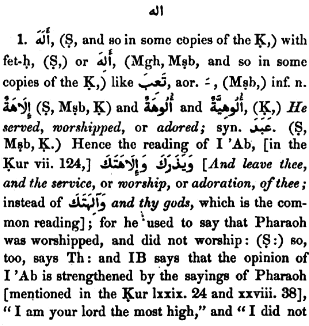
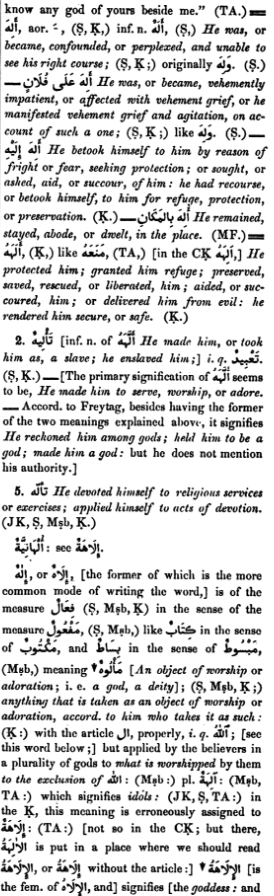
This is from page 82 of Lane’s lexicon, Tony would do well to read the last line. The plural of أله is إلهة. Next we go to لت:

lat lanes lexicon1

lat lanes lexicon2

لت has nothing to do with أله. These are two different root words. Let’s say لت is A and أله is B. Tony is trying to derive A from B, yet A and B are two root words. They are not derivatives of each other, they are root words from which their own derivatives can be formed. They have nothing to do with each other. One does not come from the other, A is not B and B is not A. A does not come from B and B does not come from A. It should be noted that these two words are 2649 pages apart, they literally have no connection with each other. If one was derived from the other, why are neither included in each other’s lexical derivatives? Next, we go to the Hans-Wehr dictionary.

Hans-Wehr

hans wehr ilah1

Again, another authority in the Arabic language, in Arabic, showing the derivatives/ morphology of the words themselves disagrees with Tony. Anyone interested in seeing the many more lexicons and dictionaries that discredit, disagree and disavow Tony Costa can click here.

Ibn Kathir

Tony makes the mistake of attributing a quote to Ibn Kathir, rather the quote literally says who it is from. Ibn Jarir. I asked Tony during our email discourse if he knew who Ibn Jarir was. Tony did not respond to that question. This is basic comprehension skills, it is not Ibn Kathir who makes the statement it is Ibn Jarir (Source):

و كانوا قد اشتقوا اسمها من اسم الله فقالوا الات

“They derived Al-Lat’s name from Allah’s Name, and made it feminine. Allah is far removed from what they ascribe to Him. It was reported that Al-Lat is pronounced Al-Lat because, according to `Abdullah bin `Abbas, Mujahid, and Ar-Rabi` bin Anas, Al-Lat was a man who used to mix Sawiq (a kind of barley mash) with water for the pilgrims during the time of Jahiliyyah. When he died, they remained next to his grave and worshipped him.”

Common sense is not common. How did they derive Al-Lat from Allah? By using a name of similar pronunciation as is stated above in Lane’s lexicon, page 2649:

“Some say that the ت is originally without tashdeed, and to denote the feminine gender: Ks used to pronounce the word in a case of pause اللاة : and Aboo Ishak says, that this is agreeable with analogy…”

They didn’t derive it from using the word for God in Arabic: أله  , they derived it by using the word لت in its form of اللاة because they sounded similar to each other. Even the narrator himself rebuffs the claim by saying:

“Allah is far removed from what they ascribe to Him.”

In other words, Tony is using  quote he does not understand, and once put into context, it completely refutes his accusations en toto.

Conclusion 

It has been proven, using basic Arabic grammar rules, Arabic lexicons, Arabic dictionaries, Arabic Bibles, the Coptic Church’s Bible and from Arab historians, that لت is impossible to get from أله. I therefore challenge Tony to eight (8) things:

  1. Using the word أله, derive the word لت.
  2. Using any Arabic source to qualify #1.
  3. To explain what grammatical rules he used to prove #1.
  4. To explain how he used the root of one word, to derive root of another completely unrelated word.
  5. To contact the Coptic Church and let them know they have got the wrong word in their Bibles.
  6. To contact the American Bible Society and let them know they have translated a word incorrectly for over 100 years and that their translation committees comprising of experts in the Arabic language have got it wrong because you found some quotes in English on Google.
  7. To explain تاء التأنيث of the noun لت.
  8. To explain where the أ and the ه disappeared when using #7.

Challenge 

I also challenge Dr. Tony Costa to a public debate in Toronto on any topic of his choosing. It is most likely that he will not respond to this challenge, as much as he will never concede his ignorance of the Arabic language led him to commit an error so embarrassing that even Arabic speaking children can tell him he’s wrong.

Second Challenge

A former Maronite Christian from Lebanon is willing to talk with Tony and explain to him why he’s wrong and why he is embarrassing himself. Tony can send me an e-mail to be put in contact with this person.

Lessons Learned

Tony accuses me of raising irrelevant arguments in responding to him. This is problematic because Tony conceded he does not know the Arabic language, therefore on what basis does he rationalize my corrections of him as being irrelevant? In any language, if we are discussing a word or term used, it is impossible to discuss its meaning, its application and its context without understanding the word itself. Especially in Arabic, we can only know the meaning of a word by going to its root, which is why Sarf (صرف) is one of the first things taught in basic Arabic. Tony sees me correcting him as an attack on his person. I want to make it clear that I am not attacking Tony in any way, however, he did make claims and I am dutifully responding to those claims. It is impossible to discuss one’s claim without first providing context. Tony is the one who made the claim in an e-mail chain, and therefore he is the one who is responded to. If Jack or Jill or Paul made such a claim, I’d also be responding to them.

One of the more disappointing realizations to have arised out of this, is that Tony admits that he is making a claim he does not understand. All he knows, is to repeat that someone has claimed al-Lat is from Allah. He does not know, nor does he care to know how or if al-Lat is derived from Allah. For an academic, he is setting a very low standard for scholarship. He is simply making a claim he does not understand and when asked to explain the claim rather than repeating it, he immediately claims he is being attacked. I’m sorry Tony but that cop-out does not work on me. I am holding you to the standard of an academic, as someone with a PhD. I demand of you the kind of scholarship that your title should befit, not the kind of scholarship that is beholden to Google Searches and parroting incorrect claims incessantly. 

Therefore, I call upon Tony to apologize for his blatant dishonesty, insults and recalcitrance. Perhaps what is most disappointing is that Tony decided to title his article by referencing my illness. He seems to take it as a joke. To me, it is not a joke. Tony’s ignorance did send me to the hospital due to my frail state. It’s no use to throw a prayer into the end of his article, after having disparaged my character and my illness in some attempt to justify his absolutely fraudulent claims about the Arabic language. In the same breath that he chastised Br. Yusuf Ismail regarding a Koine grammatical rule, he needs to also rebuke himself for his dishonesty. In the end, I forgive Tony for mocking my illness, after all, he is human.

Notified Tony of this Post and of its Challenges to Him
cc-2016-tc-commentonarticle

All I Have Left to Say is –

cc-2016-tc-micdrop

and Allah knows best.

Dividing Infinity Into Three

During a discussion on Facebook, a Christian happened to mention that God is one, infinite and indivisible. Then he mentioned God was shared by three persons. For a moment I wasn’t sure what I had read. How was it possible that God was one, infinite and indivisible, but at the same time three and divisible (shared)? I think this meme summarizes the confusion I had.

14gsga

So, any takers? How do I divide infinity into three?

and God knows best.

Tony Costa Sent Me to the Hospital

cc-2016-tc-portrait

Dr. Tony Costa – Christian Apologist

What a headline. Those are words I never thought I’d one day have to write. I’ve been interacting with Dr. Tony Costa for some time, most people would know I recently debated him last year on the topic of, Was Jesus the Son of God or Only the Prophet of God? For sometime now I’ve been ill with a severe chronic illness, this is public knowledge and people generally know that I’m quite frail most of the time. As such, any mildly strenuous physical activity leads to hospital trips where I am given pain medication and observed for some time.

Over the course of last night and this morning, I had the unfortunate experience of seeing Dr. Costa pretend to know the Arabic language. After having pointed out why he was wrong on the morphology of the term آله (Ilah), and that he was confusing it with a completely different word لت (Lat), while using three lexicons: Lane’s, Hans-Wehr and Lisan al Arab, and the Arabic Bible used by the Coptic Church: Smith & Van Dyke Arabic Bible, Dr. Costa decided he was correct despite all of these evidences proving him to be incorrect. To settle the matter, I simply asked Dr. Tony if he could kindly give me the morphology of the term آله. For anyone who has done more than one week of Arabic, you’d know how to derive the female from this root word. He was unable to do so, in fact, he outright refused to do so. Tony insisted that his finding the female of آله had nothing to do with using the root of the word.

Does that sound incredulous? I’m not kidding. Apparently Tony studied sarf (morphology) to the point where he does not use the root of words to derive their sexes and numerical forms. Considering you need to use root words to derive any other form of the word, I’m not sure what planet he believed he was on. In trying to help him and to save him from further embarrassment, I simply indicated that he was trying to get the feminine of word A (آله) using the word B (لت). I gave him a simple explanation, it’s as if he was trying to get the plural of orange, which is oranges, by using the word range. Orange has nothing to do with range. Unfortunately, without showing his morphology, or how it was possible to get the form of one noun, using a completely different noun, Tony decided he was correct. Regrettable as it was for him, several people, including myself who were included in the exchange have knowledge of the Arabic language.

This led to an endless fit of laughter lasting several hours. It’s akin to seeing a child get their ABCs wrong, and insisting they’re correct because their friends in kindergarten also recite their ABCs this way. So basic was his error, everyone knew that he was pretending to know the Arabic language. Yet he couldn’t get the female derivative of a noun. Knowing that he was pretending, we waited to see what his other replies would be. His last reply insisted that he was correct, no morphology, no explanation, nothing. To put it diplomatically, it was cringe-worthy. Due to laughing excessively, it led to me having a coughing fit, which triggered my other symptoms, thus landing me in the hospital. I’ve now been released and am back home and resting, Alhamdulillah.

This is the first time that someone’s ignorance has actually, physically hurt me. Dr. Tony Costa pretending to know Arabic and failing at it, sent me to the hospital. Thank you Tony, thank you.

If anyone would like to confirm that this story is true, one can ask Br. Yusuf Ismail, Br. Yusuf Bux, Br. Paul of Blogging Theology or Br. Yahya of The Facts About Islam.

and Allah knows best,
Br. Ijaz.

Donate to Calling Christians

Dear Readers/ Visitors,

As the website continues to grow in popularity, there exists a need for public funding. We are kindly asking that our readers contribute a small donation so that our da’wah can continue.

The debates I’ve had, continue to amass many views on YouTube and our Facebook/ E-mail correspondence continues to experience an influx of new messages on a daily basis. If you donate, your funds can help us ensure that the website remains operational for years to come. We’ll be able to purchase books for research purposes, video/ image editing software, domain name registration, subscriptions to Biblical Societies, administrative costs and much much more. Every dollar donated, can ensure that the articles we write, the debates we engage in and the pamphlets/ booklets we intend to produce can help us realise our da’wah goals.

If you do donate and would like to know how your money will be spent, send us an email after donating, either through our email address (callingchristians@gmail.com) or through our ‘Contact Us‘ page.

Donate Button with Credit Cards

A donation button has been added to the right side bar of the website, any donation amount will be accepted. Donations will be used to fund many projects, other da’wah websites, rental costs for halls (for debates), equipment (audio – visual) etc.

May Allaah ta ‘aala allow us to donate for the cause of da’wah.

wa Allaahu ‘alam.

Debate: The Bible or the Qur’an? – Sadat Anwar vs. Dr. Tony Costa

One of favourite Muslim debaters, Br. Sadat Anwar (may Allah preserve him) recently debated Dr. Tony Costa. Today the debate video has been released and suffice it to say, Br. Sadat is simply mesmerizing. He’s previously debated Alex Kerimli and Carlton McDonald, as well as one Qadiani, Ansar Raza. I strongly recommend that this debate be shared on behalf of Br. Sadat, it should be watched and studied.

Let us know what you think of Br. Sadat’s arguments.

and Allah knows best.

Review of The Study Qur’an by GF Haddad

This review by Sh. GF Haddad sums up the Muslim views on The Study Qur’an, with apt examples of its improprieties with noted attention on its appeals to and validation of the heterodox belief of perennialism.

This book is the magnum opus of Iranian University Professor of Islamic studies at George Washington University Seyyed Hossein Nasr (b. 1933), an expert on Islamic philosophy and the history of science and the heir apparent of the syncretist Frithjof Schuon (1907-1998) as head of the Maryamiyya Order, a universalist movement based on the so-called Traditionalist School. (“Traditionalism” is a Western adaptation of Hinduism that negates claims of Truth by any religion through relativizing all of them; I will refer to its ideology in this review by the term Perennialism.) It is a well-crafted, mostly North American project that lumps several works in a single hefty volume printed on extra-thin India paper: an original English rendering of the Qur’ān; a first-ever, rich anthology in English from 41 works of Quranic commentary with an embedded 42nd, original commentary on the part of Nasr, who terms it “not simply a collage of selections but a new work” (p. xliii); and the mismatched last part, 15 essays on the Qur’ān by a mixed group of academics—three of whom are also the book’s general editors— “included… at the suggestion of the publisher… the essays are in a sense a separate book… an independent work” (p. xlv).

The earliest of the tafsīr sources used is Muqātil b. Sulaymān (d. 150/767), the next to latest Muḥammad Ḥusayn Ṭabāṭabā’ī (d. 1401/1981). Thirty-one of these sources are Sunni (74%), seven twelver-Shiʿi (17%), one (al-Shawkānī) Zaydi, one (al-Zamakhsharī) Muʿtazili, one (ʿAbd al-Razzāq al-Kāshānī) Batini and of course one (Nasr) Perennialist. Abbreviations pointing to each of those commentaries are used in almost all of the abundant footnotes and the editors explicitly identify the Shiʿi sources whenever using them, making Sunni sourcing the norm. Because of its coverage, the quality of its language, the range of its exegetical material and its attractive presentation, The Study Quran is the nearest thing to a handy and accessible, integral reference-work in English on the subject. This is not saying much. Nasr is, of all the Guénon Perennialists past and present, the nearest thing to a traditional scholar; but his field is not Tafsīr, not Hadith, not Arabic philology, and not jurisprudence.

Except for the calligraphied basmala that precedes each of the translated suras and a photograph from a palimpsest muṣḥaf on p. 1619 there is of course not one jot of Qur’ān in The Study Quran, which was entirely written by Nasr, his colleagues Caner K. Dagli, Maria Massi Dakake, Joseph E. Lumbard and the essayists. This banal yet unorthodox titular confusion between the original sacred Arabic corpus and the 2007-2016 collaborative product by the same name is kept throughout the 25-page introduction. The latter discusses “the inner unity of religions,” the Christian doctrines of incarnation and transubstantiation, jafr and gematria (numerology), “polemical accounts in some apocryphal sources” of ʿAlī b. Abī Ṭālib’s alternate Qur’ān, and bibliomancy or Quranic fortune-telling (see “Fāl-nāma” in the Encyclopaedia Iranica) which consists in opening a muṣḥaf at random before choosing a course of action instead of performing the actual istikhāra prayer taught by the Prophet, upon him blessings and peace.

Beyond a perfunctory captation on “the inimitable eloquence of Quranic Arabic, which Muslims consider a miracle that no human being can ever duplicate” (p. xlii) and a brief, unsourced footnote (2:23), The Study Quran shows no knowledge of iʿjāz or the miraculous inimitability of the Quranic idiom from the perspective of Muslim philologists and exegetes, who viewed it as the foremost argument of divine origin and thus the central theme of exegesis. Ibn ʿĀshūr, one of the sources the Study Quran claims to have used, stated in the tenth prolegomenon to his Tafsīr (1:102): “A Quranic exegete is not reckoned to have passed muster as long as his commentary does not expose the aspects of eloquence in the verses it strives to explain, and the upshot of this inimitability is that the entire mission of the Prophet Muḥammad—upon him blessings and peace—was built on the stagger¬ing mir¬acle (muʿjiza) of the Qur’ān, and that its conclusive proof (ḥujja) is inseparable from that mira¬cle until the Day of resurrection.”

Nasr protests that The Study Quran is to be “excluding modernistic or fundamentalist interpretations that have appeared in parts of the Islamic world during the past two centuries” (p. xl) hence the absence of the tafsir works of Abduh, Maududi, Qutb and Maraghi; but how is one to explain, on the one hand, the absence of contemporary non-modernistic or non-fundamentalist contributions such as by Drāz, Zuḥaylī, Bint al-Shāṭi’ and Shinqīṭī and, on the other, the fact that the Perennialist ideology that pervades The Study Quran is itself very much a modernistic interpretation that has appeared in parts of the Western world during the past century? He justifies his choice of editors as “preserv[ing] diversity” because they are of both genders although all are, in his own words “from among those who had studied with me in one way or another in years past,” for the sake of “preservation of the unity of the work.” He asserts they are “all with direct experience of the Islamic world, familiarity with the traditional Islamic sciences, and mastery of classical Arabic” (pp. xl-xli). Although I do not know by what standards the latter claims are meant or under what recognized scholars of Qur’ān and Hadith any of the editors studied, Nasr included, nevertheless the translation problems on several key issues are obvious, not to mention the elephant in the room. Technical and doctrinal credentials matter in purporting to teach the ultimate source for the beliefs of two billion people in the third most widely spoken language on earth.

The Quranic translation of The Study Quran is unexceptional. Nasr adopts the same archaizing English typical of colonial India translators (and, most recently, Martin Lings) who wished to produce an equivalent of the King James Bible idiom, with “God” as the inevitable rendering of the divine Name and the similarly biblicized Englishing of the names of prophets, angels, places etc. Janna is translated not as the expected “paradise” but as the more literal “Garden” while al-nār is “the Fire” and al-jaḥīm “Hellfire.” A few Arabicisms are imposed—the untranslated terms ḥajj, ʿumra, jizya (2:196-197, 9:3, 9:29, 22:27)—along with the diehard, archaic “wont” for Sunna and (in footnotes) the Trollopian “People of the Veranda” for Ahl al-ṣuffa. The unprecedented translation of kursī as pedestal (2:255) is felicitous but no such thought shows in rendering dhālika al-kitāb as “This is the Book” (2:2), when Rāzī and Bayḍāwī showed that the demonstrative of remoteness dhālika points to Quranic magnificence and unfathomability, and should therefore be rendered as “That.” The translation of lan nu’mina laka as “we will not believe thee” (2:49) reduplicates the mistake of all previous English translations by ignoring the preposition lām (in laka), “for,” which calls, as pointed out by Ṭabarī and others, for the rendering “we will not believe just for your sake/just because you say so.”

The translation of muslimūn mostly as “submitters” (3:52, 3:64, 3:80, 11:14…) is justifiable, the latter construing the original as a nominal form, were it not for the editors’ underlying Perennialist bias which strives to separate the historical acception of islām as “the religion revealed through the Prophet of Islam” from generic “submission to God in general.” Hence the claim that “in the Quran Abraham and Jesus are also called muslim in the sense of ‘submitter’” (p. xxix, my emphasis). In reality the religion of Islam is submission sine qua non and all prophets are called Muslim with a capital from the start—and in the sense of timeless, essential Muḥammadans, followers of the Prophet Muḥammad as explicited in verse 3:81—just as all Muslims are also submitters. In addition, submission is always understood as submission to the latest prophet of the time, not to an earlier one, and so no submission remains today except that manifested in Islam. Al-Ghazālī cited in the book of naskh of his Mustaṣfā “the consensus in the agreement of the entire Community that the sacred law of Muḥammad—upon him blessings and peace—has abrogated the laws of his predecessors” while al-Nawawī in the book of ridda of his Rawḍat al-ṭālibīn stipulated, “Someone who does not believe that whoever follows another religion than Islam is an unbeliever, like the Christians, or has doubts about declaring them to be unbelievers, or considers their way to be correct, is himself a kāfir even if with that he professes Islam and believes in it.”

The Perennialist leitmotiv of the universal validity of all religions is perhaps the chief original message of The Study Quran which readers will not get anywhere else, because it is as alien to the Qur’ān and Sunna as it is alien to Islam and all other religions. This novel theme creeps in and out unsourced; it is part of what the introduction innocuously describes as “providing in some places our own commentary, which is not found… in the earlier sources” (xliv), in comments such as “most Muslims believe that these women [Mary, Fāṭima and Āsiya] lead the soul [sic] of blessed women to Paradise” (p. 143) and “Some might argue, therefore, that Jesus, by virtue of being identified as God’s Word, somehow participates (uniquely) in the Divine Creative Command” (p. 267). The latter co-Creator comment suffices to describe the effect of the Study Quran on the Perennialist School in the same terms Abū Muḥammad al-Tamīmī described the effect of Abu Yaʿlā al-Farrā’s anthropomorphist book Ibṭāl al-ta’wīlāt on the Ḥanbalī School: “He has beshat them with filth even water cannot wash away” (Ibn al-Athīr, al-Kāmil, obituaries for the year 458).

The discussion of ḥanīf (2:135) mixes up Rāzī, Ṭabarī, Orientalist views and “universal truth,” yielding an impossibly confused footnote. On pp. 31-32 the editors twist all the commentaries on verse 2:62 to make them fit into their very special reading of a single phrase in a controverted work of Ghazalī, Fayṣal al-tafriqa, in defense of their ideas. Their reduction of the Quranic condemnation of Christian doctrines as addressing only “a local sect of Christians with beliefs different from mainstream Chalcedonian Christianity” (p. 31), “those who assert the existence of three distinct gods” (p. 267), “certain sects among the Christians… such as the Jacobites and the Nestorians” (p. 316), is a revision of the Qur’ān and a woeful justification of Orthodox and Catholic Trinitarianisms. As pointed out by an earlier review […], “in the formative period, Chalcedonian Christology was not being treated any differently than other forms of Christology, and the earliest Muslims regarded it as constituting the very Trinity which the Qur’ān rebukes.” The comments from al-Rāzī to that effect cited on all the above pages show that the editors are fully aware of the fact.

This is what I called Nasr’s embedded 42nd commentary and here are some more examples of it: “There may be a third possibility often left unexplored by Muslims until recently: that one can remain a Christian while affirming the veracity of the Prophet Muhammad and of what was revealed to him” (p. 187). This was in fact the claim made by the eighth-century founder of the ʿĪsāwiyya Perso-Jewish sect and pseudo-prophet Abū ʿĪsā al-Aṣfahānī (documented by Bāqillānī, Ibn Ḥazm and other heresiographers), namely that Jesus and Muḥammad were indeed prophets, but only for the Arabs. The spotlight is on what Lombard calls “the eternal formless truth” (p. 1766, my emphasis) but never on the abrogation and supercession of pre-Muḥammadan dispensations, to deny which is atheism and blasphemy, divestiture posing as inclusivism; as a result The Study Quran ends up construing the exact opposite of the message of the Qur’ān: “The Religion of Truth can be more broadly understood to mean all revealed religions” (p. 1367), a methodical rejection of the hadith in Ṣaḥīḥ Muslim: “By the One in Whose hand is the soul of Muḥammad, there is no one among this nation, Jew or Christian, who hears of me and dies without believing in that with which I have been sent, but he will be one of the people of the Fire.”

In the above context, the editorial comment “it is the Divine Will that there be multiple religious communities, as expressed in the next line of the verse had God willed, He would have made you one community” (p. 301), although true, is the stuff of heterodoxy (in this case Jabriyya determinism) and reveals a studied confusion between the divine will (irāda) and the divine good pleasure (riḍā). It is like an amoralist saying it is also the Divine Will that evil should exist.

This Perennialist bias thrives even at the expense of Arabic grammar and syntax. The translators correctly have “the Trustworthy Spirit” for al-rūḥ al-amīn (26:193) but render rūḥ al-qudus (16:102) as “the Holy Spirit”—rather than the accurate “Spirit of holiness”—construing rūḥ as a noun and al-qudus as an adjective then adding loaded initial capitals, a blatant christianism reminiscent of the now trite “God’s baptism” for ṣibghat Allāh in 2:138 which this translation perpetuates. Arab Christian liturgies use qudus as an adjective exclusively, but the latter form is of course al-rūḥ al-qudus. Another poor choice is the limp rendering of ittaqū (beware) as “be mindful” (2:48, 2:123…) at times and “reverence” (2:189, 2:194, 49:12…) at others.

There are other serious problems of which again only a sampling can be given. In a long eight-column footnote at the beginning of the rendering of Sura 24 (“Light”) the mainstream reader will notice an accumulation of scholarly fallacies posing as arguments against the criminal penalty of stoning for the adulterer. Among these, (i) avoidance of any mention of the Consensus which has formed over this issue since the first century of Islam; (ii) ignorance of the abrogated status—also by consensus—of the restriction of the adulterers’ freedom to marry (pp. 868-869) and of the “double punishment” hadith (p. 866) for all but Hanbalis; the editors mechanically list ḥadd hadiths (pp. 865-866) without sourcing, grading or analysis, but only with a view to suggest ambiguity, conflict and contradiction over this particular issue, much in the same way that the entire book is ungrounded in jurisprudential madhhab knowledge; (iii) pointed mistranslation of the terms al-shaykh wal-shaykha in the abrogated Verse of Stoning, which here never meant “old man” and “old woman” as claimed ad nauseam, but rather “married man” and “married woman” in all the glosses. Sourcelessness is another way of purveying outlandish ideas, such as the unreferenced speculation (p. 436) by “some” that “the real crime of the people of Lot was forcible sodomy rather than consensual homosexual relations.” This is an LGBT perspective that has nothing to do with scholarship of any kind, let alone exegesis. (See on this the excellent article “Gender Identity and Same-Sex Acts in Islamic Law” by MIT Muslim Chaplain and Fawakih Academic Dean Dr. Suheil Laher.) The insertion of elliptical dots between square brackets […] in the midst of verse 41:42 suggests lost parts or missing text in the original Arabic, a gross impropriety.

All the great exegetes agreed on tafsīr as requiring mastery in the entire spectrum of the Islamic disciplines. The methodology of The Study Quran falls short of that requirement even as it mimicks the activity of tafsīr and ijtihād in many places. In terms of presenting Islam to non-Muslims in an advantageous light in the post-9/11 world, it would have been a commendable effort that filled a void. However, the fact that it is, at best, mainstream in many places and absolutely heterodox in many others makes it unrecommendable in absolute terms. Those who are looking for a truly reliable holistic digest of the mercy-oriented, reason-grounded book of law, wisdom, prophets and devotion that is the Qur’ān in light of its native principles of mass transmission, consensus, abrogation, jurisprudence and the inexhaustible troves of divinely-inspired Arabic polysemy and Prophetic directives, must keep looking.

Gibril Fouad Haddad
Universiti Brunei Darussalam-SOASCIS

This review can also be read on Amazon. Calling Christians agrees with the conclusions of this review and we strongly advise that lay-Muslims do not purchase this work. Alternatives include a translation of the Qur’an by Mufti Elias: Qur’an Made Easy, which is available for free download on Amazon. As well as the commentary of the Qur’an, Mar’iful Qur’an by Mufti Shafi Usmani, which can be read online here.

and Allah knows best.

Missionary Mishap: Jesus & Doors

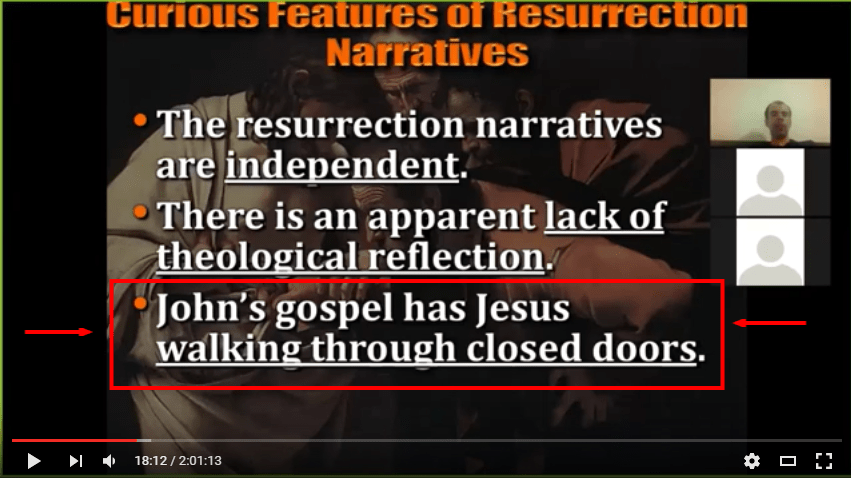
After 2000 years, one internet missionary has finally developed the ultimate argument to prove that Jesus was crucified and eventually resurrected. In a video released today, Jonathan McLatchie presented his argument. I must admit, it is extremely incredible and completely unexpected. It is amazing, that almost no one else has used this proof. Here it is:

cc-2016-jm-jesuswalkingdoors

Jonathan goes on to say that, “It is unlikely that John would have invented that.” This is irrefutable proof that Jesus was resurrected. I believe that Jonathan needs to be given a award for such thinking. He is certainly quite amusing. Job well done, Jonny!

and God knows best.

« Older Entries Recent Entries »