Author Archives: Ijaz Ahmad

Second Response to Dr. James White on John 9:38 and John 20:28

Apologies – I thought I had already posted this video to the site since it got more views than the original video that brought about the discussion in the first place! A few people duly pointed out that the second response hadn’t yet made its way to the main website and already had 4x the views of the original video. 10 days late, but here it is:

There are some interesting comments that came about due to this discussion which I’ll have to write about later on, but at the end of it all, this was a healthy discussion about New Testament Textual Criticism between a Muslim and a Christian. Not many people can fully appreciate how in-depth the discussion got, but it’s a start.

and Allah knows best.

Between Ehrman and Error

Recently on Blogging Theology I posted a video on the tenacity of the proposed ausgangstext which filled the lacuna of John 20:28. The vast majority of Muslims (expectedly) were enthusiastic about discussing the tenacity of Doubting Thomas’ alleged statement. The vast majority of Christians were not, which was also understandable. Then there were those caught in-between, educated enough to know that there had to be, or that there was more evidence behind what I had published, and there were others who were incredulous as to what that evidence could have been. Upon release of my second response video, I took a little more time, some 20 minutes and expanded on the rationale leading to the conclusions I mentioned in my first video on the topic.

Everyone knows about Dr. Ehrman’s famous statement, “copies of copies of copies of copies”. Yet the only two arguments I received in return were quite amusing. The first of which was that some people were curious as to whether Dr. Ehrman had commented on this passage or not. For some reason I have yet to discover, some Muslims’ hold on simple textual criticism of the New Testament is limited to only what Dr. Ehrman says, yet at the same time they are fully willing to simultaneously argue against his famous aforementioned quote. I duly provided a list of scholarship that not only knew of the work I gained the reference from John 20:28 on, I also provided the name of a seminary which uses the work itself, while also foregoing to mention that the scholar in question has been cited by Dr. Ehrman himself – one of the Muslims who opposed me in those comments had perhaps not yet read Dr. Ehrman’s references to this scholar (and his conclusions).

Nonetheless, the second argument I received was that no other variant of John 20:28 existed post p66, although I did point out that this was the case in Codex Bezae, as minor of a variant as it is, the challenge that not one variant exists has thoroughly been debunked (for those unread, the manuscript was eventually edited by a scribe).

bezae1

Following from this ignorant argument, was the case that since we know what every text post p66 said, then we must know what p66 itself said. This again, coming from those who agree with Dr. Ehrman’s aforementioned statement. We are therefore left with the following problem. Hence the title, Between Ehrman and Error. We have the following from the gracious Dr. Ehrman (emphasis mine own):

My point has always been (for example, in Misquoting Jesus) that we can’t know with absolute complete certainty what was said in each and every passage of the NT. That point – which I think cannot be refuted – is principally directed against fundamentalists who want to claim that every word of the Bible is inspired by God. How can we say the words were inspired if we don’t know in a lot of cases what the words were???Source.

I don’t think there’s an easy answer to these questions.  But they shouldn’t be ignored, as they ALWAYS are (in my experience) by people who want to assure us that we “know the original text in 99% of all cases.”   Really?   Which original?

If it were just up to me, I would say that the “original” is the first form of the text that was placed in circulation.  But since that in fact is not the oldest form of the text, maybe we shouldn’t call it the original. – Source.

One very interesting piece of evidence for this view involves a fact that is not widely known outside the ranks of the professional textual critics.  It is this:  new papyri manuscripts – relatively very old ones – do show up all the time (several in the past few years).  Whenever a new papyrus turns up, it almost NEVER contains a textual variant that is completely new.  The variants are almost always variants that we know about from our later manuscripts.  This shows, the argument goes, that variants were not created later.  Our later manuscripts preserved variants, they didn’t create them.  And this shows, it is argued, that all of the earlier variants are to be found even in the later manuscripts.

This is a terrific argument, and very interesting.  On the surface, it seems pretty convincing.  But in fact, in my view, it does not actually show that we have the original reading or that we can know that we do.  I will explain why in the next post. – Source.

I don’t think our New Testaments are likely ever to change much.  And I don’t think we know in a lot of places what the originals said.  Where’s the contradiction?  I’m not saying that we *know* that we have the original text in 99.9% of the passages of the NT.  I’m saying we *don’t* know – for a wide variety of reasons that I haven’t gotten into very much here.   But I’m emphasizing the word “know.”  We simply don’t know.

Do I *suspect* that most of the time we are pretty close or even there?  Yes, that would be my guess.  But it’s just a guess based on scholarly assumption and suspicion. – Source.

During those 300 years, Mark was being copied, and recopied, and recopied, by scribes.  Until we get our first full copy.  Can we know that this copy from 300 years later was 99% like the version that came directly from the pen of the author?  Of course we can’t know.  How would we know?Source.

Between Ehrman and Error. It’s really as simple as that. Dr. Ehrman used the word “guess”, I used the word “guesswork”. Dr. Ehrman used the word “suspicion”, I used the word “speculation”. Dr. Ehrman repeatedly points out that we cannot know what the original text said. He repeatedly points out that most variant units are decided on guesses and suspicion. So the question begs itself, how far are the conclusions in my video, different from that of Dr. Ehrman’s himself?

The problem presents itself, as he described regarding Mark, we don’t know what version of what copy we received. Given that basic, common sense principle, extend that to John 20:28, given that p66 is our earliest and we have no intermediate text (that is, the text between what the original author(s) wrote and the text of p66 itself), and that it has a lacuna or gap for the famous, “and my God” – then there is no way of certainty of knowing what p66 itself said or what the intermediate text(s) said, what the archetypal text said, or what the autographic text said. To require that we must need a variant before being able to dispute what a missing text says, is essentially self-refuting, the gap itself presents us with a problem, we don’t know what it said and we don’t know if any of the intermediate texts said something variable. We simply cannot know, just as Dr. Ehrman says.

So between Ehrman and Error, I agree with him, we cannot know, it involves guessing and suspicion. Those who disagree, disagree with the very goodly Dr. they appealed to in the first place and are as such, in error.

and Allah knows best.

Ijaz Responds to James White’s Video on Textual Criticism

Here is my response to Dr. White’s criticism of my video on the unreliability of the Bible. Of note are incorrect claims made on his part, conflating my statement of lacunae with his misrepresenting that statement as a ‘textual variant’ for over 40 minutes. Also his facetious and incredulous disregard for the science of higher criticism which he labeled as ‘mind reading’, along with citing or basing his arguments on misdatings of both p52 and p66.

There were a lot more errors on his end, and there was not a single rebuttal to the claims I presented and I was extremely disappointed to see negative comments about my character throughout his video despite both at the beginning and at the end of his video he said that this behaviour should not be condoned.

Moaning McLatchie

In the days following the announcement by Nabeel Qureishi about his illness (stomach cancer), this is how the Muslim apologetics world reacted:

That’s a video with hundreds of positive comments and about 18,000 views (and growing). Prayers, well wishing and general reflection on the state of apologetics. Yet, many of us were shocked to see Jonathan McLatchie’s reaction to the news. On the Dividing Line program, several of our names were mentioned, including Br. Yahya, myself and a few others. We took no note of it, there was nothing there that needed to be celebrated. It was a somber time, not a time for “scoring points” against each other or trying to use Nabeel’s illness as a means of “getting mentioned” on social media.

cc-2016-jm-mrburnsnew

Yet, in the days following Nabeel’s news, there was one person. A notorious individual, universally disliked in Hyde Park, and who has been rebuked several times in person in Newcastle itself whenever he tries to bully the Muslims doing da’wah there; who found a reason to use Nabeel’s illness as a means of promoting himself.

cc-2016-jm-dlmentions

It’s uncouth enough to like such a narcissistic post in the first place, starstruck, really? How obsessive can one be about one’s self? Yet, during this obscene display of self conceitedness, while the rest of us were busy sending well wishes to Nabeel, our friend Jonathan McLatchie found himself counting how many times he was mentioned on the Dividing Line. What kind of person counts how many times their name is mentioned in a video? Well it’s the same kind of person who thinks it’s a good idea to promote themselves by posting 10 photos of themselves just talking to someone else.

cc-2016-jm-jaypicswith-jm

I get that he might like Jay, I understand that he may like taking a picture or two of himself, but what kind of individual who abuses debate opponents post-debate and lies about attendance numbers, behaves like this?

cc-2016-jm-insults

cc-2016-jm-banmuslims1

Jonathan McLatchie is that kind of person, and that is why we in apologetics cannot take him seriously any longer.

and God knows best.

Missionary Mishap: McLatchie Loses the Plot

Once again, we find ourselves appalled at the behaviour of Jonathan McLatchie. After mocking my illness and wishing ill upon me, I continued to dialogue with him despite his negative disposition towards me. Today we had a chat that quite upset him. I questioned his dislike for the scholar Candida Moss, he asked me a question about his behaviour and when I answered his question, he once again chose to block me.

cc-2016-jm-blockijazagain1

This is the same person, who on the very day after Nabeel Qureishi made public his illness with stomach cancer, found himself on Facebook concerned with how many times Dr. James White had mentioned his name on the Dividing Line. He was much more concerned with the number of how many times his name was mentioned, while the inter-faith scene was upset with the news of Nabeel’s illness.

cc-2016-jm-dlmentions

Truly, I am tired of having to receive messages from both Christians and Muslims that have been abused by Jonathan.

cc-2016-jm-troll

There are a lot more messages like this from Jonathan and his 15 year old friend, who both have been rebuked for their abusive and intolerant behaviour online.

and God knows best.

Have Christian Scholars Abandoned the Doctrine of Biblical Inerrancy? Yes!

Our esteemed Br. Yahya Snow has published a video with Christian apologist, Dr. Michael Licona agreeing that there are contradictions, irreconcilable contradictions in the New Testament:

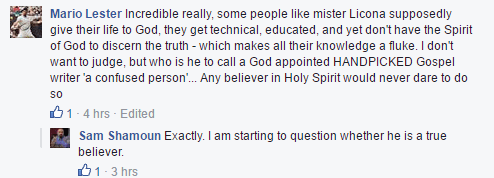
Another prominent Theology Blogging website, aptly named Blogging Theology, highlighted this and many other claims of errancy within the Bible by Dr. Licona here. To make matters worse, the infamous Christian polemicist Sam Shamoun has declared that he no longer knows whether or not Dr. Licona is a true believer:

cc-2016-ss-mikeliconanottruebeliever

Not to be outdone, his close friend and student, Robert Wells (who once threatened to massacre innocent civilians if the voices in his head told him to do so) goes a step further and declares that he doesn’t even know if Dr. Licona is a Christian at all:

cc-2016-rm-mikeliconanottruechristian

Picture taken from Blogging Theology by Paul Williams

Given that Dr. Licona has been a cornerstone for Christian apologetics, the swift excommunication of him by ardent Christians has come as a shock to the interfaith community. Have conservative Christian scholarship collectively given up on the doctrine of inerrancy? In this other recent video, that is exactly what Dr. Licona has done:

He’s not alone, even Dr. William Lane Craig has lowered the bar, so lowly, that he’s said this:

cc-2016-wlc-biblicalinerrancy

I’ve written an article on his statements here. Below is a video recording of him including the above statement and expanding on it:

At the end of the day, the sun has set on a major pillar of Christian apologetics. The view of Biblical inerrancy is quickly becoming a view of the past and Christianity of today now finds itself without certainty in scripture.

and Allah knows best.

Sam & John: Partners in Fraud?

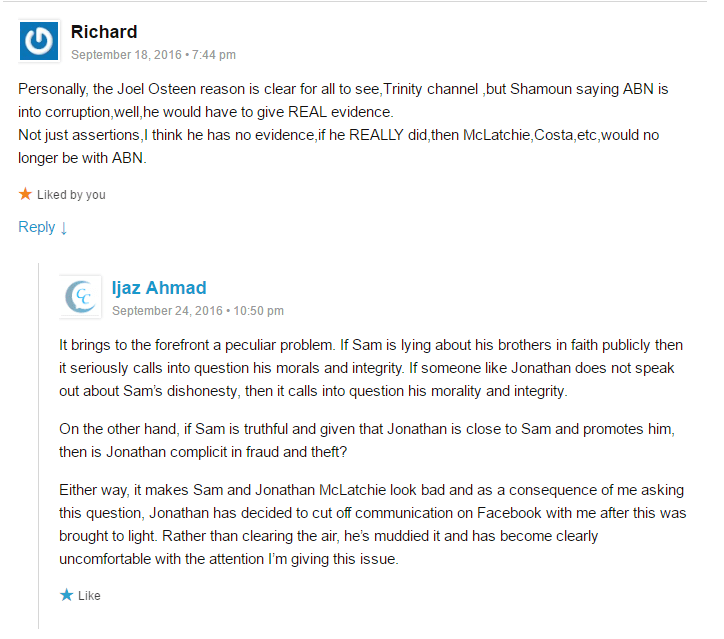
In a recent article, I brought to light claims by Sam Shamoun about theft and fraud ongoing at the Trinity Channel. I indicated that Sam’s friend, Jonathan McLatchie would know whether Sam was lying about his own Christian brothers and sisters, or if Sam was being truthful. The consequences of which project badly on both Sam and Jonathan. As it turns out, my article raised questions that many in the interfaith community have been bothered about.

cc-2016-jm-thief

Having published my article merely asking about Sam’s statements, in a fit of rage, Jonthan McLatchie, rather than clear the air on his position on this serious issue, has decided to end communication on this and similar topics with me. The question needs to be asked, if Jonathan and his friend, mentor and partner in….God knows what…are not bothered by the consequences of Sam’s claims, then why the sudden disconnect? Their silence says more than they think.

and God knows best.

Missionary Mishap: Scholar Schools McLatchie

Have you ever had a scholar who specializes in your field of interest completely discredit your grasp of the field entirely? I haven’t, most people haven’t, but Jonathan McLatchie has.

cc-2016-jm-scholarschoolsjonny

Here’s the scholar’s credentials as of 2014. Five pages worth of academic qualifications spanning multiple disciplines including Judaeo-Christian theology, history and  Biblical languages. After having explained who he was and stating his credentials, none of which Jonathan can match,  I was shocked to see that Jonathan still couldn’t figure out why a scholar with more academic credentials and study would consider Jonathan to be unqualified. Perhaps Jonathan can let us know what his theological qualifications are, how many Biblical languages he knows and how many classes at University he’s taught on Islam and Judaeo-Christianity.

Scholarship, Jonathan, has deemed you totally unqualified…and it isn’t the first time either.

and God knows best.

« Older Entries Recent Entries »