Author Archives: Ijaz Ahmad

William Lane Craig: In His Own Words

I didn’t create this video, but a Christian, apparently upset at some of the fantastic answers that WLC has provided did.

Original video: YouTube

Video Sources:

  • Clip 1: Does the Unbeliever Have to Approach the Bible as Divinely Inspired?
  • Clip 2: Dr. Craig on Collins vs Dawkins on Design of Universe.
  • Clip 3: WL Craig, PS Williams vs. A Copson, A Ahmed – Cambridge Union Society God
    Debate, Oct 2011.
  • Clip 4: Incensed Atheist Questions William Lane Craig.
  • Clip 5: Dr. Craig on Collins vs Dawkins on Design of Universe.
  • Clip 6: Incensed Atheist Questions William Lane Craig.
  • Clip 7: WL Craig, PS Williams vs. A Copson, A Ahmed – Cambridge Union Society
    God Debate, Oct 2011.
  • Clip 8: Life, the Universe and Nothing: Why is there something rather than
    nothing?

and God knows best.

The Real God of American Christianity?

By their fruit you will recognize them. – Matthew 7:16.

Take a look at a typical American Evangelical’s Facebook profile, what do you see? You’re sure to find pictures of Trump, the American flag, some anti-Muslim memes, Bible quotes and mostly political posts demonizing Muslim-Americans, Democrats and Liberals. See, there is a trend here, today’s Evangelical American Christians worship the state more than they do Jesus. That might seem like a controversial statement, but recently there have been some events that qualify this argument. In responding to a right-wing Evangelical American, Dr. James White says as follows (emphasis mines):

There is FAR more evidence in your own timeline that you have adopted a politically oriented Christianity than there is that I have adopted anything from Islam.

Steve, but when did the gospel become something you only explain to people who look like you and have the same political views?

YQ is a Muslim scholar with a large following and a large impact in the United States and abroad. Hence, when he and I talk, the resultant discussion will be useful to both Christians and Muslims in the United States and in all English speaking locales. What on earth do his political views have to do with it?

And no, Steve, I don’t see almost any concern on the part of my critics, including you, about such things. I see a lot of politics, making America great again, building walls and the like—but I see very little interest in breaking down walls of prejudice and fear and misunderstanding in confidence that what we have to give to the Muslims is the greatest thing in all the world.

Your words are disgusting, Steve. You are speaking as a political zealot, trained in the presidential election of 2015-2016, not as a minister of the gospel.

If you think Dr. White is wrong here for making those statements, then you need to watch the First Baptist Dallas’ “Freedom Sunday” service where they literally idolized and worshiped the American flag. Patheos author Jonathan Aigner, says as follows (emphasis mines):

First Baptist Church in Dallas bowed before a red, white, and blue altar yesterday.

The snare pierces the silence, and the choir and orchestra launch us into the national anthem of American Christianity, which also happens to be the national anthem of the United States.

Our opening hymn proudly proclaims, “You’re a grand old flag, you’re a high-flying flag, and forever in peace may you wave.” (This is idolatry, folks. Nothing short of it.) The fireworks explode (you read that correctly), and audience members wave their miniature flags while singing praises to a red, white, and blue cross.

You read that correctly, American Christians during a Church service…bowed to an altar with the American flag, and in place of singing hymns that traditionally glorify God, they glorified the American flag in God’s place. You’ll notice that the Patheos author literally wrote that he considered the congregation’s actions to be worship, idolatrous worship of the American flag.

Several Churches and Church leaders were very outspoken about the literal replacing of God, for America and American symbols in a Church service, we read from the Christian Post (emphasis mines):

Several critics have denounced the “idolatry” of “Freedom Sunday” worship June 25 at First Baptist Church in Dallas, pastored by Robert Jeffress, who prominently campaigned for Donald Trump during last year’s election.

The critics include Messiah College historian John Fea, a United Methodist pastor, and a Presbyterian church music minister. Click their respective links to read their perspectives, each of which is unique, but all are agreed in accusing First Baptist of “idolatry” for venerating America on “Freedom Sunday” a week before July 4.

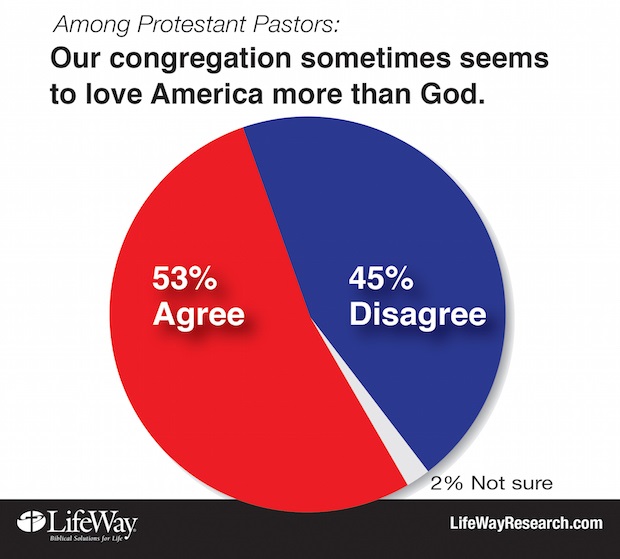
A survey by Life Way, a major American Evangelical organization, had this surprising information for us:
lifeway

A Christianity Today article goes on to say about this issue (emphasis mine):

Also worth noting, the same survey found that 53% of Protestant pastors felt that their congregations sometimes love America more than they love God.

Regardless of your view of patriotic worship services, this number should be of concern. (When we love something more than God, the Bible calls that idolatry, and that’s the last thing that Christians should want.)

So, this weekend be sure you love your country and worship God…and never confuse the two.

Back in 2010, other Christian authors began to notice this disturbing trend of American Christianity’s idolatry (emphasis mine):

I’ve been a part of numerous churches that celebrated American Independence Day with abandon: 80-foot flags hanging from the ceilings, singing the “Star Spangled Banner” and “I’m Proud to Be an American” and even— most disturbing to me as I reflect back—saying the Pledge of Allegiance during our corporate worship.

If some visitor had asked us on those Sunday just what we were worshiping, I think that might have been a very perceptive question.

Going back to Dr. James White, I noticed that folks like David Wood, Sam Shamoun, Usama Dakdok and Robert Spencer also worship America, more than they do Jesus. See, following Dr. White’s dialogue with Dr. Yasir Qadhi, Sam Shamoun went on a rampage against Dr. James White. What I quickly realised was that White was attacked for three things:

  1. Ecumenicalism (accepting some Islamic beliefs, which was a false accusation).
  2. Inviting a Muslim into a Church to speak without rebuttal (it was a dialogue about differences in beliefs).
  3. Associating with a Muslim that has ties to major American Muslim organizations.

Here’s the problem, as Dr. White himself said, many Christians chose to politicize the issue. Qadhi was labelled as a terrorist, a jihadist, someone who wants to install Shari’ah law, that he worked with extremist organizations, that in the past before changing his views he had said bad things about non-Muslims…and on and on. You may think that their issue with Dr. White was theological, but then why speak about terrorism and terrorists? Why speak about Qadhi’s association with CAIR (a Muslim-American advocacy group)? Why association Dr. Qadhi and Dr. White with liberalism and liberal political ideologies? See, while on the surface they claimed (falsely) that the disagreement with the dialogue that Dr. Qadhi and Dr. White had, was theological, it was clearly political.

Where did any of these guys speak out against the “Freedom Sunday” worship?

Where did any of these “Christian apologists” speak a single word against replacing a hymn meant to glorify God, with a song glorifying the state?

Where did any of these guys speak out when the Bible Answers Man, Hank Hanegraaff converted from Protestantism to the Greek Orthodox Church that has distinctly heretical teachings about the nature of Jesus, the nature of Mary and how salvation is attained?

Where did any of these guys speak about against ABN/ Trinity Channel for preaching false doctrines and for promoting the heretical prosperity gospel? Sam Shamoun, the genius he is, made one single Facebook post about ABN, but spent 10 months, every other day, attacking Dr. White for his dialogue with Dr. Qadhi! Where is the consistency?

By their very actions, the things that they occupy themselves with, are not theological but political.

In other words, it is clear that American Christians have a new God and it is not Jesus. The Orthodox Church of America has been founded, its God, the State (and its symbols, such as the flag and anthem), its disciples, politicized Christians such as David Wood, Sam Shamoun, Usama Dakdok and Robert Spencer.

By their fruits we now know who they worship and the State is their new God.

Missionary Mishap: High Level Apologetics

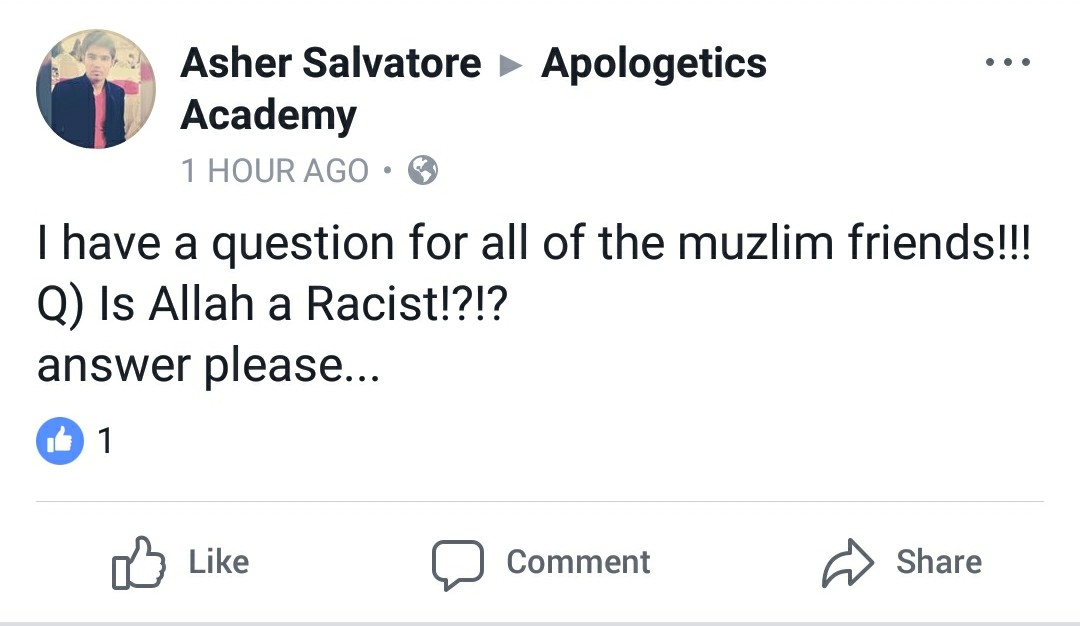
It’s practically impossible for me not to be amused by the high level of apologetics that Jonathan McLatchie’s “Apologetics” “Academy” is producing. I think this image sums up the scholastic work he’s doing with his “Academy”:

If the goal of the “academy” is to produce jaw dropping arguments like these, then I applaud Jonathan for his hard work.

Well done!

Missionary Mishap: Jonathan McLatchie at Speaker’s Corner

This should not surprise anyone, but in making his transition from debater of atheists to “critic” of Islam, to “critic” of evolution and now to “apologetics/ motivational speaker” we find Jonathan once again making erratic and frankly, silly comments about those he necessarily hates.

cc-2017-jm-muslimsatspeakerscorner1

For a quick recap, Jonathan came to Speaker’s Corner where Christians and Muslims and Jews and Atheists and Black Hebrew Israelites and folks of all ideologies have been having dialogue for decades. He didn’t have a good time at Speaker’s Corner, because after coming to the corner, he had to retract statements he had made, issue clarifications, in two cases he had to make 3 hour long videos with a 15 year old to clarify and respond to Muslims from Speaker’s Corner, instead of returning to dialogue with them face to face.

It’s therefore not odd to find him disparaging Muslims at Speaker’s Corner, mostly because in the past he has begged for, and pushed for debates with Muslims from Speaker’s Corner who want nothing to do with him because of his statements and behaviour. There is the case where he attacked the Muslim debater Darren Hamza Myatt after trying to get a debate away from Speaker’s Corner with him. There was the case where he did the same to Br. Mansur. I’ve collected some of those ridiculous comments and events by Jonathan here.

The fact remains, for a guy who hates Muslims, he sure finds it profitable to speak about them often.

and God knows best.

Jay Smith and the Keeree-Art

cc-2017-js-panderinglogo

In a recent Hyde Park encounter with Br. Muhammad Hijab, my friend and colleague, Joseph Jay Smith of Pfander, made some plainly absurd and false claims, among them:

  •  Claims that all the NT manuscripts are the same, which is demonstrably false.
  • Claims that Codex Sinaiticus has no differences with the NT of today (it has edits going into the 12th century CE, that’s 600 years after nascent Arabian Islam).
  • Claims Muslims have no Qur’anic manuscripts until the 8th century, Dr. Fedeli, Dr. Sadeghi, Dr. Tayyar would all disagree, they’ve published works contrary to this absurd claim.
  • Claims that Brubaker’s research is “new”, but is more than 3 years old.
  • Claims that Br. Hijab has never seen Brubaker’s thesis, false, as I’ve given it to him and his colleagues…3 years ago.

and God knows best.

To Confuse or Not to Confuse?

1 Corinthians is an epistle when read carefully, offers quite a few interesting arguments about the guidance of God. Today we’ll be looking at one such argument. We read as follows:

But God hath chosen the foolish things of the world to confound (καταισχυνη) the wise; and God hath chosen the weak things of the world to confound the things which are mighty; – 1 Corinthians 1:27.

We then read as follows:

For God is not the author of confusion, but of peace, as in all churches of the saints. – 1 Corinthians 14:33.

These two statements are plainly contradictory. On the first hand, we have the argument that God intentionally chose the absurd and foolish things of this world to confound (confuse) the wise. On the other hand, we have the argument that God is not the author of confusion.

Looking at 1 Corinthians 1:27, we note several things. Firstly, that the Christian (concept of) God cannot blame anyone for being guilty of rejecting the belief that God can be both man and God, that God can be both capable of suffering and all powerful, ignorant and all knowing. This is because, as the scripture says, God intentionally chose the foolish things to confuse the wise, if the wise are confused because of the foolish things, then who bears responsibility for the confusing in the first place? In this case, it would be the Christian (concept of) God. We also note that the word here for confounding or confusing is not a translational error. Many translations including the KJV, AKJV, Jubilee Bible 2000, Douay-Rheims Bible and the Webster Bible Translation all use the word “confound” in their editions for this verse. Additionally, the Greek word used here is καταισχυνη which according to Strong’s Lexicon (#2617), means:

Short Definition: I shame, disgrace, put to utter confusion
Definition: I shame, disgrace, bring to shame, put to utter confusion, frustrate.

Therefore, to appeal to claim it is a word equivocation between the words in the two passages would be incorrect, to appeal to a different translation is also incorrect and to also claim that the word does not mean confusion is also wrong.

Looking at 1 Corinthians 14:33, we see the argument that the Christian (concept of) God is not the author of confusion. To understand the context the verse is being used, we read from Barnes’ Notes on the Bible:

God is not the author of confusion – Margin, “Tumult,” or “unquietness.” His religion cannot tend to produce disorder. He is the God of peace; and his religion will tend to promote order. It is calm, peaceful, thoughtful. It is not boisterous and disorderly.

Some may argue that other interpretations refer to the confusion as women (as we find in the Jamieson-Fausset-Brown Bible commentary) or that the confusion refers to a conflict in prophecy. If the confusion is to be understood as women, it makes the verse much worse, if it refers to prophecy and the words of prophets (or those inspired by God), then the issue is not removed as Christians consider both passages above to be from inspiration and they plainly conflict which does not remove the problem but compounds it. Other commentaries have combined the two and indicated that the confusion is both moral and spiritual, as we find in the Cambridge Bible for Schools and Colleges:

for God is not the author of confusion, but of peace] Confusion; literally, unsettlement. Cf. St James 3:16. Also St Luke 21:9, where the word is rendered commotion. As in the natural, so in the moral and spiritual world, God is a God of order.

Both of these interpretations do not remove the contradiction between the passages, but affirms them, and therefore to appeal to other commentaries would not remove the issue. The contradiction stands as is.

In conclusion, if the Christian (concept of) God is not the author of moral or spiritual confusion, why would the Christian (concept of) God intentionally make the religion of Christianity both difficult and confusing?

and God knows best.

The Intolerance of Tolerance – White/ Qadhi Fallout

Catch Up to Speed: What is the White/ Qadhi Issue?

Following a two-part dialogue between Dr. James White and Dr. Yasir Qadhi, an outspoken Christian missionary by the name of Sam Shamoun began a crusade against his coreligionist, Dr. White, for holding the view that not all Muslims are hateful, intolerant, bloodthirsty terrorists. The argument made by Sam was essentially that Islam in its entirety is an intolerant religion.

There’s a problem though. A big one.

If Islam is so intolerant, then why haven’t Muslims erupted in the same anger the Christian community has, for Dr. Qadhi allowing Dr. White, a Christian, to speak about the Trinity in a Masjid (mosque, Islamic center)? So far, some in the Christian community have referred to Dr. White as an apologist for Islam, an apostate, a useful idiot for Muslims. There has been a campaign to have his events cancelled, Churches have been called with the demand that he not be allowed to speak in them. There have been endless YouTube videos, social media posts, and articles damning Dr. White for his claim that not all Muslims are evil, intolerant terrorists. All this, being done by a portion of the Christian community who believe themselves to be tolerant.

Yet where is the same outcry from the Muslim community towards Dr. Qadhi? No major Muslim speaker or apologist has condemned Dr. Qadhi for his dialogue with Dr. White. He hasn’t been called an apologist for Christianity, an apostate or a useful idiot for Christians. There has been no campaign to have his events cancelled, Masjids have not been called with the demand that he be banned from speaking in them. There have been no YouTube videos, social media posts or articles by Muslims, condemning Dr. Qadhi. Remember, Muslims are supposed to be the intolerant ones, and the Christian community is supposed to be the tolerant one, if that is the case then why are the Muslims tolerating Dr. Qadhi’s events with Dr. White?

It would therefore seem that there is an intolerance on behalf of some sections of the Christian community, towards the tolerance of the Muslim community for that interfaith dialogue. The irony here is quite palpable. Surely then, if Dr. White is wrong and the Muslim community and the Islamic faith are intolerant, then where do we find the outcry from the Muslim community?

and God knows best.

Is to Question, to Err?

One of the ways we learn is by asking questions. I don’t believe that someone should be condemned or shunned for asking a question, especially when it is a request for someone to clarify and expound upon what they are saying. This post will highlight the need for meaningful interactions between Muslim and Christian apologists. Forgoing my disagreements with my friend and colleague Jonathan McLatchie, he recently posted in a group of mines regarding a seminar he recently held.

Screenshot_20170612-082938_1

Given my history with Jonathan, one may think I would comment on his post in an antagonistic manner, but as will be seen, this is not and will not be the case. Though I may disagree with Jonathan’s arguments, I prefer to have meaningful interaction with him, rather than argue without reason. Thus, when he posted his link, I left the following respectful comment:

Screenshot_20170612-082943_1

The aim of my respectful comment was to ask my friend Jonathan to explain his reasoning. To break down his argument(s) and to give me an example to qualify his claim. This is the usual way we approach arguments, by firstly asking for the person to explain their argument, and secondly by giving our response as to why we either agree or disagree with what they have presented. As follows, this was my friend Jonathan’s response:

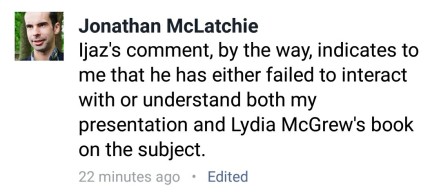
Screenshot_20170612-082955_1

I would like to thank Jonathan for his respectful reply, though I may disagree with the conclusions he had reached. In writing this article, I hope to express to Jonathan that Muslims are willing to engage with him, despite past disagreements. With respect to his comment, I am quite uncertain as to how I failed to interact with his presentation, when I asked for him to give us an example from his presentation, an argument which demonstrated his claim of “undesigned coincidences”. I can’t interact with a video seminar, but I can certainly interact by asking the person presenting the argument to illustrate and explicate their claim. Secondly, I am also uncertain as to how simply asking a question would lead one to believe that I had failed to understand the subject. I had yet to respond to an argument he had presented, therefore I’m not sure how I could fail to interact with or to misunderstand something that was not given to me.

The question for us is, is to question, to err?

I don’t believe so. In respectful and meaningful dialogue, we hope that our questions can lead to elucidation as opposed to remonstration. Should Jonathan be willing to engage with Muslims on the subject of his video, I wish him to know that Blogging Theology, Calling Christians, along with my numerous Facebook groups and pages, of which he is a member of a number of them, that they are all available for him to engage in meaningful dialogue about his arguments.

Should there be any Christian willing to take up his cause and argue on his behalf, we would most certainly be welcomed to such a proposition. I firmly do not believe in “undesigned coincidences”, primarily because of the intertextuality of the Gospels, especially in regard to their archetypes, harmonizations and literary borrowing by their authors and scribes. I have discussed this topic previously in other posts, but I am looking for new, well taught out arguments on this topic to challenge the conclusions I already hold. Thus far, I have yet to see such an argument, but then again, this is why I’m posting about it publicly. Perhaps by some undesigned coincidence, I may perhaps find someone willing to provide such an argument.

and God knows best.

The Translational History of the Qur’an and the New Testament

Does the translational history of a scripture matter? Most people don’t often consider this question, but it is very consequential with emphasis being on the transmission and understanding of scripture. While most people would consider translations to be a tool and aid for understanding scripture, the impact of a translation is often ignored. In this article, I wanted to point out some of the benefits and problems that the Qur’an and New Testament would face on this topic.

As Muslims, we believe that God revealed the Qur’an in Arabic:

Indeed, We have sent it down as an Arabic Qur’an that you might understand. – Qur’an 12:2.

We need to consider that when God reveals scripture, that He has chosen a language that would best suit His message, and that when He has chosen a message to send in a specific language, that language and its language devices need to be studied to understand all of scripture. Not all languages are equal, there are language devices that exist in one language that may not exist in another, and so to translate between these languages would raise issues. For example, let’s say you’re trying to translate a metaphor from one language to another. It’s raining cats and dogs. For an English speaker they would know that this refers to heavy rainfall, but if we translate it word for word, literally from English into Spanish, would a Spanish speaker grasp the meaning intended by the phrase? If we translate it contextually to say that it means rainfall (excluding the mention of cats and dogs), is this faithfully representing the text as it was written? Confusion can occur for example, if a Spanish reader in looking at the Spanish text sees rainfall, but when comparing with the English, they see cats and dogs. They may assume the translator made an error and omitted words thus leading to confusion. Translators often have to walk a very fine line, if they translate a phrase word for word it can lead to the loss of intended meaning (context) and if they translate contextually they can be accused of not faithfully representing the original words as they were written.

Therefore, the language of scripture matters.

Throughout Islam’s history, the Qur’an as revealed in the Arabic language has always been regarded as scripture. Translations have however been understood as interpretations of scripture and not necessarily scripture in and of itself. Translators by profession are interpreters, it’s their very job title. This distinction is very important because the Islamic tradition has always definitively defined what scripture is and what it isn’t. The Islamic tradition has always emphasized that Muslims should learn how to read the Arabic Qur’an, how to recite the Arabic Qur’an (tajweed), it is fard al ‘ayn (personally obligatory) to learn the Arabic language such that we can understand the Qur’an and the Prophetic Sunnah. I previously spoke about language devices existing in one language and not in another, an example of this is the dual noun in the Arabic language. In the English language we know of singular and plural nouns, the Arabic language has an intermediate category of nouns, dual nouns, this is not found in the English language. Muslims are taught to perform salaah (prayer) in the Arabic language and to perform the remembrance of God in the Arabic language (dhikr). Suffice it to say, one of the reasons the Qur’an has been preserved, not just merely the text itself but also the recitation and the meaning is because of the commands of God to use the Arabic language when it comes to scripture and worship, it preserves the sources of Islam as they were received by the Prophet (peace be upon him) and his companions (may God be pleased with them all).

This is not the case with the New Testament. While the earliest manuscripts of the New Testament are written in Koine Greek, for 1000 years the New Testament was only considered to be scripture in the Latin language. This would mean that for 1000 years (until the Erasmian text) Christians were not reading scripture in its original language with its original language devices but that they were reading an interpretation of the New Testament altogether. Even when the Greek reconstructions of the New Testament came into favour, Christians still relied primarily on translations. This presents many problems for the transmission and preservation of the New Testament itself. We need to ask ourselves, why would God reveal a scripture in Koine Greek, only for it to be abandoned and a translation used in its place? The fact remains that the go-to language for the New Testament, from its inception has statistically been a language other than the Koine Greek it originated in, whether that be Latin or today’s English. The problem is compounded by the fact that the Christian tradition itself has no internal mechanisms for which Christians need to rely on the language the scripture was allegedly revealed in. Consider that translations are not merely considered translations but equal with the original Koine Greek in and of itself, also consider that there is no onus on a Christian to have to learn to read Koine Greek, to have to study Koine Greek, or to have to use it in any religious practises. This is in stark contrast with Islam, God not only revealed an Arabic scripture but also placed internal mechanisms (religious practises) that encouraged and ensured that the scripture as it was revealed would be preserved and studied, as it was meant to be understood. The same cannot be said for the New Testament and so it brings into question the validity of the New Testament as scripture to begin with.

And so we return to our original question.

If God revealed scripture in a specific language, then surely there was a purpose for that. While we can account for this purpose in Islam, we cannot account for this purpose in Christianity.

Yes it is true that scripture is meant to be understood, so there is no inherent harm in translating scripture into a language so people may understand it, but there is harm in abandoning the original language of scripture altogether. At a very young age Muslims begin the practise of teaching the Arabic language but we do not find this in Christianity when it comes to Koine Greek, this has led to a significant divide in the way that Muslims and Christians understand scripture. Should you ask a Christian if it is important to learn Koine Greek, they’d tell you no. Yet when we look at their commentaries of the New Testament, we find endless translation notes and lexical explanations. If there is no need to learn the language of the New Testament, then why do these translation notes and lexical explanations exist? Seminary graduates have to learn Koine Greek to understand scripture, to be able to exegete scripture, so while the lay Christian is told that they don’t need to learn the language, their scholars and preachers who attend seminaries realise that they do have to learn Koine Greek. This cognitive dissonance when it comes to the attitudes that Christians have towards the New Testament harms the religion of Christianity. A person who relies solely on the understanding of scripture through a translation will either end up with a wrong understanding or a wrong impression of what scripture teaches. Often times we find preachers using word studies to prove doctrines based on English translations! Clearly there is a problem inherent to the Christian understanding and definition of scripture.

To demonstrate the validity of this point, let’s take for example Dr. Michael Licona’s new book, “Why Are There Differences in the Gospels?: What We Can Learn from Ancient Biography”. After specifically studying Graeco-Roman bios (biographical) literature for 7-9 years, Dr. Licona, a well-known Christian scholar and apologist, advertises his book with the claim that he has discovered a literary device used by ancient authors in biographies that explains the contradictions in the stories about the life of Jesus Christ in the New Testament. This literary device he calls, “literary spotlighting”, a device not ever named by anyone before in the some 2000 years that Graeco-Roman literature has been studied by scholars worldwide. Consider the troubling consequences of such a claim. That for 2000 years, scholars who have dedicated not merely 7-9 years of study on classical ancient works but their entire lives did not know of an important and core literary device used extensively by Graeco-Roman authors. Even worse off, is the claim that this literary device was used in scripture and not known by anyone else. How is such an absurd claim possible? It’s only possible when the language the scripture was allegedly revealed in, was ignored, discarded and abandoned. Literary devices directly affect the way we understand a language, Dr. Licona is effectively saying that for some 2000 years there has been a language device in use in scripture, that had not been identified previously. This fundamentally affects the way we understand the New Testament and at the very least demonstrates the importance of preserving a scripture in the language it was said to have been revealed in.

In the end, when Christians preach to Muslims and those of other faiths, they boldly claim that all you need to be saved is to accept Jesus Christ as Lord and Saviour. It’s only when a new Christian (or newly practising) becomes devoted to Bible study, do they find themselves being told that they should probably find a better translation, or compare translations for a better understanding, or that they need to return to the Koine Greek rendition of a passage to wholly grasp its meaning. For some, they quickly realise that the requirements of understanding scripture go beyond reading a translation and that it’s more than just accepting Jesus Christ as Lord and Saviour. It’s a lot like being signed up for a cable subscription only to discover that there are hidden fees. We do not find this problem with Islam, and so we must ask once more, if God revealed a scripture in a specific language then surely that language and learning it must matter, right?

and God knows best.


« Older Entries Recent Entries »