Tag Archives: Quran

Response to James White on Qur’an 10:94

In a short clip, spanning roughly 20 minutes long, Dr. James White sought to address my article on Qur’an 10:94. He generally had three main points of dispute:

  1. That you have to “jump” from Qur’an 10:94 to Qur’an 46:10 to understand the verse.
  2. That Qur’an 10:94 uses plural for the People of the Book but Qur’an 46:10 is singular therefore it does not apply.
  3. Islamic scholars disagree on whether Qur’an 46:10 was revealed in Makkah (earlier) or Madina (later).

On the first point, there is not a need to respond to it. One of the first rules of exegesis is to let scripture interpret scripture. I am not aware of anyone opening John 1:1, and then complaining that they have to “jump” all the way back to Genesis 1:1 for a comparison to derive further context, I don’t believe a Christian would complain that they had to “jump” (to use Dr. White’s phrase) some 43 books to understand the relation between the two passages. Perhaps he can expand on his surprise and awe of scripture being referenced in such a fashion. As per my own understanding, it is a strawman and faux criticism.

It should be noted that one often has to jump more than a dozen books or more in some cases to reference Isaiah or the Psalms when reading the New Testament, I am not aware of this being a problem until Dr. White expressed it as such.

On the second point, yes, the Qur’an does use the term “those” as in the plural but that is because there were many witnesses at that time, including but not limited to Salman al Farsi, Abdullah ibn Salam and Zaid ibn Sanah. However verse 46:10 is generally referring to one person, while Qur’an 10:94 can refer to multiple witnesses. Therefore, there is no issue here whatsoever.

On the third point, if we argue Qur’an 46:10 is earlier and is therefore a prophecy of a Person of the Book who testifies to the truth of the Qur’an, then it is a prophecy par excellence given the witnesses I mentioned above. If it was revealed in Madinah, then it confirms a truth publicly known and acknowledged, thus verifying the verse itself and the Qur’an. There is no discrepancy here and Dr. White does not seem to follow through on his own logic, he merely states he disagrees with it but does not provide any justifiable reason for making such claims.

Throughout the 20 minutes or so in which he addresses my article, he made statements regarding whether or not there is such a thing as hermeneutics for the Qur’an, while at the same time reading from a Tafseer I quoted in my article. It’s a bit like driving in my car and then asking if I have a car. In case there is any doubt, yes Dr. White, there is and it’s called ‘Uloom al Qur’an, I am fairly certain every single Tafseer books mentions this in some capacity. Perhaps you were being facetious but it came across as being quite uninformed.

and Allah knows best.

Missionary Mishap: Christians Cannot Lie

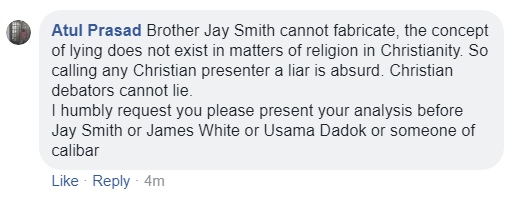
As the fall out from the debate I had with Joseph Jay Smith continues, a peculiar comment was made on my video that simply had to be addressed. The comment you are about to see, exemplifies the type of Christian that is following Joseph Jay Smith.

cc-2018-mm-jaysmithcannotlie

According to this Christian fellow, Joseph Jay Smith is a Christian, and as a Christian he cannot lie. Which means that whatever Joseph Jay Smith says, will always be true. This is the kind of intellect that Jay’s rhetoric appeals to, one of deifying humans and discarding basic logic altogether. Isn’t this what cults do? You can’t question Jay, whatever he says must be right because he said it.

Amazing.

and God knows best.

Dialogue with Jay Smith

I recently had a polite dialogue with Joseph Jay Smith of Pfander Ministries about the preservation of the Qur’an, it can be viewed here:

Alternatively, the discussion can also be viewed on Facebook.

I also asked him a question after our discussion but via text chat and well, the results were pretty spectacular:

More to come soon, by the permission of Allah.

and Allah knows best.

Textual Criticism Versus Evangelical Beliefs

There has been a trend of late where evangelical apologists are trying to normalize the cc-2018-sitenews-clashingheadsuse of textual criticism in their understanding of the New Testament. This however, leaves them in an untenable position trying to balance the divergence of textual critical axioms, arguments and evidences with those of their normative faith. This can be seen with apologists such as Dr. White, Dr. Licona and Dr. Wallace. All three are studying or have studied textual criticism to some degree and there stands a myriad of obvious issues that need be sorted out.

Consider the case of the nature of revelation itself. On a recent Dividing Line program Dr. White along with Dr. Brown chose to argue that the Greek Septuagint was stronger in its wording than the Masoretic Text and Dead Sea Scrolls were when it came to prophecies about Jesus (John Calvin notably argued the same for Paul’s use of the Septuagint and its associated divergences). The obvious issue here is that according to their own classical beliefs, the Old Testament was not revealed (and written) in Greek. Surely then, according to the confessions, it is traditionally understood that inerrancy primarily refers to the autographs. In other words, God chose the men who wrote the “books” of the Old Testament in a specific language. God chose men, again, according to their beliefs to word scripture to the best degree of accuracy and understanding possible. How is it then possible that a translation by unknown people can represent scripture better than the people that God chose to represent His teachings for Him? That does not make sense. Yet this is the position they now hold to, a position that is absolutely advantageous for Muslims doing da’wah.

Then there is the other argument of the Old Testament (as per the program responded to here), that it descended to us in various streams and that different scribes (as well as copyists) chose one variant over another because they completed the exposition of a verse better, as Dr. White referred to it, “sermonic expansion”. So there was addition to the text, addition not by the initial authors whom God chose, yet somehow this is not corruption. Odd reasoning here. Clearly cognitive dissonance at work. What then do we make of the claim that there were different streams? Yes, we agree, but did God intend to give authority to each stream? If that was the case then the later Masoretic Text would have authorial primacy and importance, rather than a translation in the form of the Septuagint that came before it, if we were to consider it with respect to chronology. Yet we find most Christian apologists referring and giving importance to the Septuagint while wholly ignoring the Latin and Samaritan texts, are those too not viable streams? Who then, gave the scribes authority to choose from those streams? Those anonymous and unknowable scribes? Again, problems arise.

What then do we make of the claim that there existed actual men within the first century by the names of Matthew, Mark, Luke and John who would be considered the initial authors? Isn’t it the case in New Testament Textual Criticism through stemmatics and philology that each Gospel is a composite work, the result of more than one author in various periods throughout history? How then can Matthew be one man and yet many, not existing at one time, but many simultaneously? Yes, I do recognize such thinking to be absurd, which is why I find it almost impossible to take anyone seriously who argues for a singular, inspired authorship, yet still accepts – at the same time – that there were multiple authors to one text as is the standard position. Yes, you are right in asking that no right thinking evangelical would accept composite authorship, yet today in the Nestle-Aland Greek New Testament, the standard critical text that the aforementioned men believe in, contains conjectural emendations. These are instances where the textual critic has decided that their version of a passage best represents the original without any manuscript evidence for their version ever having existed. Surely, today’s evangelicals don’t hold to the position that the folks on the Nestle-Aland committee are inspired by God, so wouldn’t that then confirm they accept the words of multiple people for one Gospel, rather than one individual from the 1st century? It does, yet again we arrive at a problem.

So while I am happy that today’s Christian apologists are becoming more liberal towards the New Testament and affirming the Qur’an’s claims about their attitude to Scripture, I also mourn for the aloofness that abounds otherwise.

and God knows best.

Early Review of QuranGateway.Org

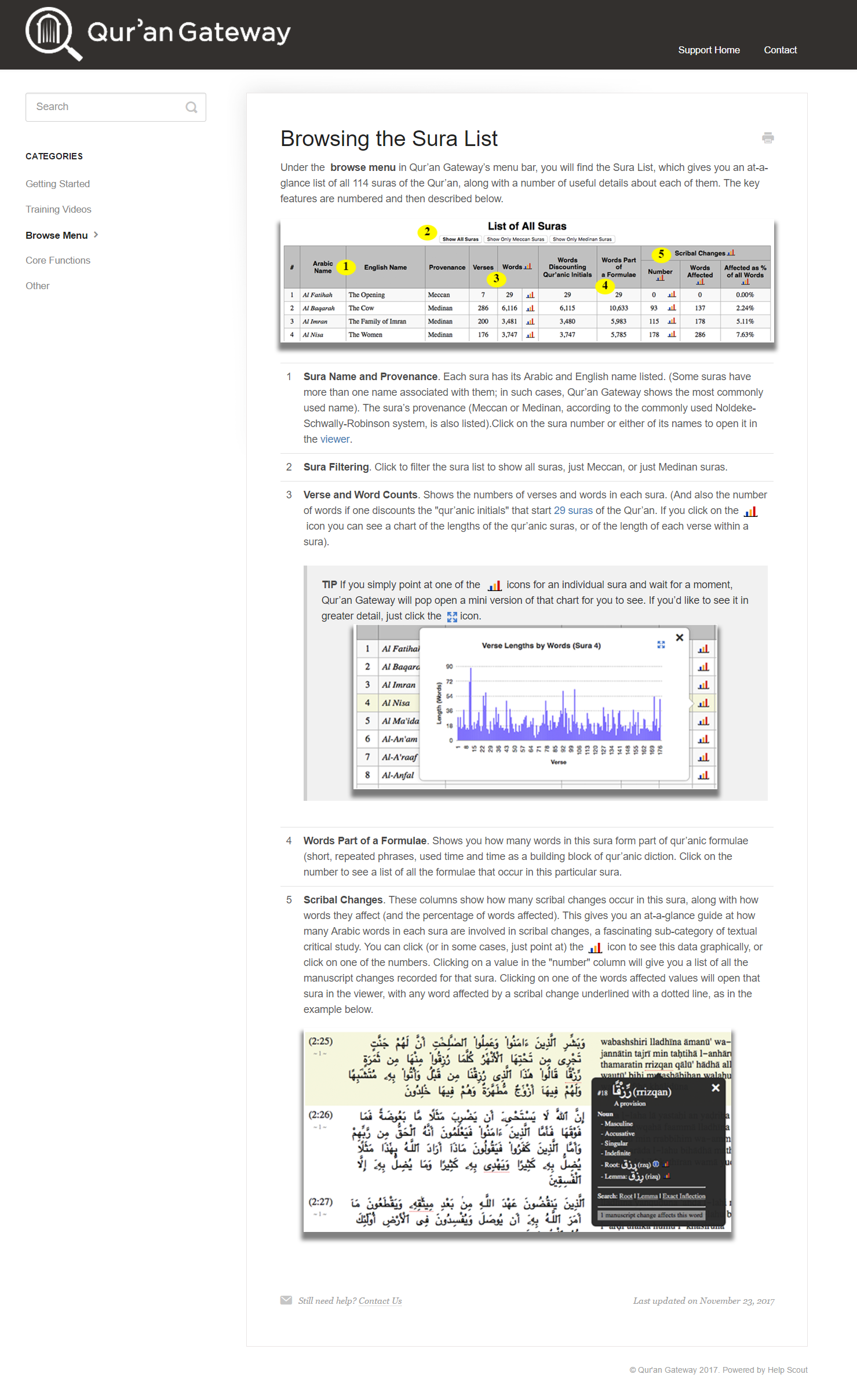
Developed in tandem by Dr. Andy Bannister and Dr. Daniel Brubaker, QuranGateway.Org aims to be an educational and research based resource for the study of manuscripts of the Qur’an. Several months ago I was able to view the website as it developed and have since been following its updates. What makes QuranGateway unique is that it provides a searchable database based on Daniel Brubaker’s PhD thesis about variants in the Qur’anic manuscript tradition. The website is also based on Dr. Bannister’s research from a few years ago on the oral formulations of the Qur’anic narratives that correlate with Biblical narratives.  In the image below, we can take a quick preview of the interface and the information generally provided on the “Browsing Surah List” help page (click to enlarge):


Quran Gateway Browsing Surah List

Based on Dr. Bannister’s analysis of themes in the Qur’an, various charts and infographs have been generated using his primary research data (click to enlarge):

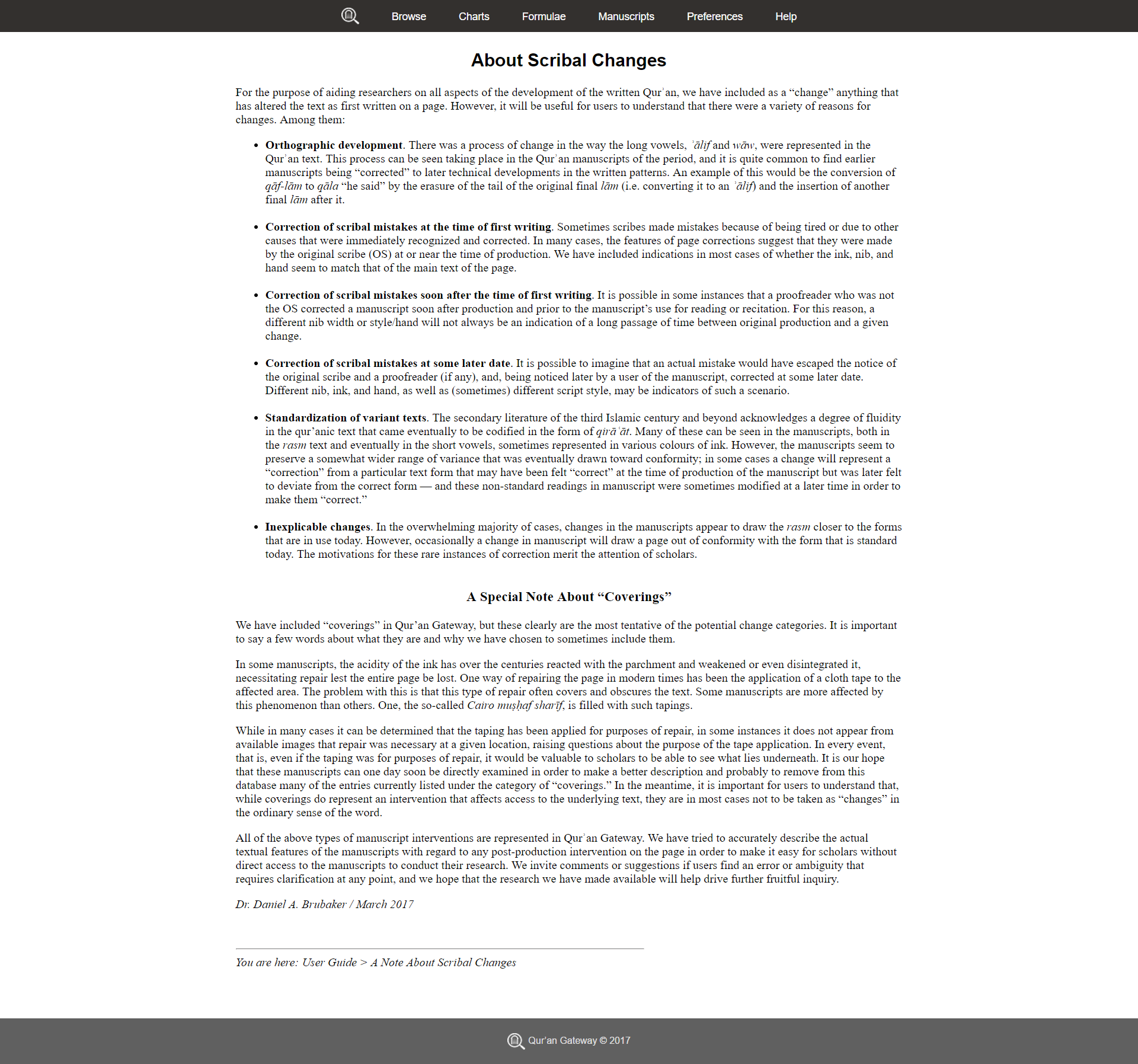
Quran Gateway Intro to ChartsOne of the main features of the website, though the functionality is erratic at times (I am not sure if it is based on incorrect data from Brubaker’s thesis or website database issues), is the ability to view some scribal changes in some early manuscripts of the Qur’an. One will note however, that the reason for such scribal changes and errors is not explicitly explained in pages that list the changes themselves. This is obviously an issue, as one has to ask, why would they list the changes without using the entirety of Brubaker’s data where it is explained that these were largely either scribal mistakes, or due to the orthographic development of the Arabic language? Hidden away on a largely obscure page, we are eventually told that the vast majority of these variants are in and of themselves, irrelevant (click to enlarge):

Quran Gateway Scribal Changes

The purpose of the website therefore seems to be confusing. On the one hand, its main emphasis seems to be twofold, themes in the Qur’an based on Dr. Bannister’s research and scribal changes based on Dr. Brubaker’s research, yet when it comes to the latter the data seems to be largely incomplete. Most of Dr. Brubaker’s analysis in his PhD thesis indicates that almost all the scribal changes cannot be found in the Qira’at literature, meaning then that they are unique issues delimited only to single manuscripts themselves, most of which were the use of the Arabic letter alif as it pertains to early Arabic orthography (see pages 29 to 30 here). This information however, seems not to have made its way to the website which is perhaps the most important information that should be included. This is because Dr. Brubaker painstakingly compared the lapsus calami and scribal idiosyncrasies with the vast array of Qira’at literature and documented his results in his thesis, which is one of the two main sources for the dataset on the website. On the one hand we are being told, here is a tool where you can search for these scribal differences, but on the other hand, here’s no contextual information based on a comparative analysis with the rest of the documented information about the varying readings in the Qur’anic tradition that we’ve already done, but we won’t give it to you.

Similarly, while the website aims to be a hub for research, it lacks on its team of scholars any Muslim scholar on the Qur’an. One of the issues here is that if the website is aiming to be a hub for objective academic research and study, and is not meant to be a polemical based Christian apologetics website, then shouldn’t there be a panel of scholars rather than merely two Christian apologists? Dr. Bannister is a Christian apologist, he leads the SOLAS CPC organization in the UK. Dr. Brubaker is also active in Christian apologetics, having used his research to help Joseph Jay Smith in a debate with Dr. Shabir Ally. This issue therefore takes credibility away from the objective based research facade that has been presented. As far as I am aware, no Muslim has been invited to preview the website itself, though the website has been previewed with various Christian groups, most recently in Toronto in December of 2017 (could’ve been November, I can’t seem to recall at this moment).

While I do look forward to using the website, the incomplete data, and lack of diverse scholarship on the panel beyond two Christian apologists presents with it serious credibility issues that need be attended to. One area of possible issue is legally, where some of the facsimiles of early manuscripts have been used without permission from their copyright holders and the rights that were allowed by atleast two organizations are now under reconsideration due to the other facsimiles being used without expressed permission and also due to the Christian apologetics inclination on the website which rather than being viewed as an objective research tool, lends credence to the website being merely a polemical tool for a specific religious group. Despite these issues, I do hope to see further development done to the website. For further information and to see the website in action, here are three videos:

and God knows best.

The Passing of Shaykh Muhammad Mustafa al ‘Azami

It is with a heavy heart that I convey the sad news of the passing away of my teacher, Sheikh Muhammad Mustafa Al-A’zami (rahimahullah).

The Sheikh was one of the world’s premier scholars of Hadith, and received his education at Dar al-‘Ulum Deoband, India (1952), al-Azhar University, Cairo (M.A., 1955),

mmazami

The Shaykh

and the University of Cambridge (Ph.D., 1966). He was Professor Emeritus at King Sa’ud University (Riyadh) where he also chaired the department of Islamic Studies.

He served as curator of the National Public Library, Qatar; Associate Professor at Umm al-Qura University (Makkah); Visiting Scholar at University of Michigan (Ann Arbor); Visiting Fellow at St. Cross College (University of Oxford); King Faisal Visiting Professor for Islamic Studies at Princeton; and Visiting Scholar at University of Colorado (Boulder). He was also an Honorary Professor at University of Wales (Lampeter).

His publications include Ageless Qur’an: A Timeless Text, The History of the Qur’anic Text, Studies in Early Hadith Literature, Hadith Methodology and Literature, On Schacht’s Origins of Muhammadan Jurisprudence, Dirasat fi al-Hadith an-Nabawi, Kuttab an-Nabi, Manhaj an-Naqd ‘ind al-Muhaddithin, and al-Muhaddithin min al-Yamamah. He had also edited numerous other works including Kitab at-Tamyiz of Imam Muslim, Muwatta of Imam Malik, Sahih Ibn Khuzaymah and Sunan Ibn Majah to name a few.
In 1980 he was the recipient of the prestigious King Faisal International Award for Islamic Studies.

In the western world, the Sheikh was best known for his critical investigation of the writings of the famous orientalists Ignác Goldziher, David Margoliouth, and Joseph Schacht.

I was fortunate to spend almost 15 years with the Sheikh learning from him and benefiting from his knowledge.

A great loss for the Muslim Ummah!

Source: Imtiyaz Damiel, Facebook.

Dialogue Video: Navigating Differences in Theology – Br. Ijaz and Mr. Alex Kerimli

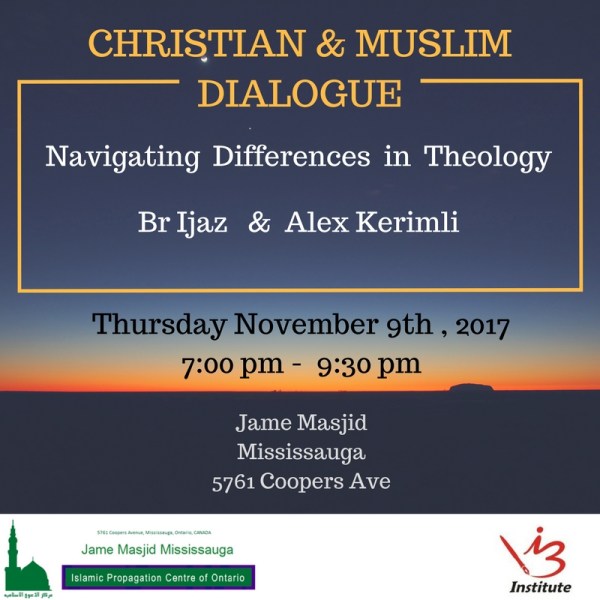
I recently had a dialogue with my friend and colleague, Mr. Alex Kerimli in Toronto. Today the video of that event is being released. The event was graciously hosted by the i3 Institute, which offers courses for young Muslims in the Greater Toronto Area.

Poster

The event went extremely well and in the end I have to say that I definitely enjoyed my time with Mr. Kerimli. We met a second time following the dialogue and had a second more informal dialogue that would be released in the near future. In the meantime, this dialogue took place in the context of a discussion I have been having with Mr. Kerimli for the past two years. It mainly revolves around the Old Testament, the New Testament and the Qur’an’s relationship with both of those books. We explore these relationships, the existence of a possible “Madinian Torah” and other fascinating questions about textual preservation in light of historical evidences.

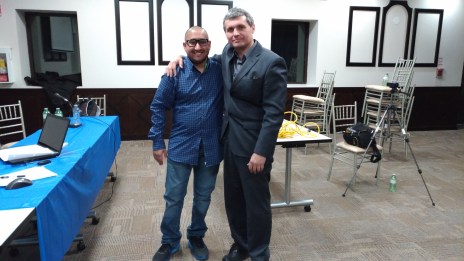
At the end of the dialogue, it was all smiles from both sides of the theological divide.

P_20171109_220234_vHDR_Auto.jpg

In addition to releasing the video of the dialogue I am also including my PowerPoint presentation slides in PDF form. There are two versions of these slides. There is the original presentation as I used it in the dialogue. Following the event I noted that there was a miscitation of a quote from Mark, instead of Mark 4:15 I accidentally put Mark 4:20. There was also another miscitation, instead of Pslam 40:6-8, I wrote Isaiah 40:6-8. Along with that error, I also clarified my use of terms in the table comparing the contents of the Shema in the Gospels and the Septuagint editions. To be fair, I am releasing both the original version with the errors and the corrected version for clarity. I will follow up with Mr. Kerimli to see if he would be willing to do the same.

Here is the dialogue video:

and Allah knows best.


Jay Smith and the Keeree-Art

cc-2017-js-panderinglogo

In a recent Hyde Park encounter with Br. Muhammad Hijab, my friend and colleague, Joseph Jay Smith of Pfander, made some plainly absurd and false claims, among them:

  •  Claims that all the NT manuscripts are the same, which is demonstrably false.
  • Claims that Codex Sinaiticus has no differences with the NT of today (it has edits going into the 12th century CE, that’s 600 years after nascent Arabian Islam).
  • Claims Muslims have no Qur’anic manuscripts until the 8th century, Dr. Fedeli, Dr. Sadeghi, Dr. Tayyar would all disagree, they’ve published works contrary to this absurd claim.
  • Claims that Brubaker’s research is “new”, but is more than 3 years old.
  • Claims that Br. Hijab has never seen Brubaker’s thesis, false, as I’ve given it to him and his colleagues…3 years ago.

and God knows best.

The Translational History of the Qur’an and the New Testament

Does the translational history of a scripture matter? Most people don’t often consider this question, but it is very consequential with emphasis being on the transmission and understanding of scripture. While most people would consider translations to be a tool and aid for understanding scripture, the impact of a translation is often ignored. In this article, I wanted to point out some of the benefits and problems that the Qur’an and New Testament would face on this topic.

As Muslims, we believe that God revealed the Qur’an in Arabic:

Indeed, We have sent it down as an Arabic Qur’an that you might understand. – Qur’an 12:2.

We need to consider that when God reveals scripture, that He has chosen a language that would best suit His message, and that when He has chosen a message to send in a specific language, that language and its language devices need to be studied to understand all of scripture. Not all languages are equal, there are language devices that exist in one language that may not exist in another, and so to translate between these languages would raise issues. For example, let’s say you’re trying to translate a metaphor from one language to another. It’s raining cats and dogs. For an English speaker they would know that this refers to heavy rainfall, but if we translate it word for word, literally from English into Spanish, would a Spanish speaker grasp the meaning intended by the phrase? If we translate it contextually to say that it means rainfall (excluding the mention of cats and dogs), is this faithfully representing the text as it was written? Confusion can occur for example, if a Spanish reader in looking at the Spanish text sees rainfall, but when comparing with the English, they see cats and dogs. They may assume the translator made an error and omitted words thus leading to confusion. Translators often have to walk a very fine line, if they translate a phrase word for word it can lead to the loss of intended meaning (context) and if they translate contextually they can be accused of not faithfully representing the original words as they were written.

Therefore, the language of scripture matters.

Throughout Islam’s history, the Qur’an as revealed in the Arabic language has always been regarded as scripture. Translations have however been understood as interpretations of scripture and not necessarily scripture in and of itself. Translators by profession are interpreters, it’s their very job title. This distinction is very important because the Islamic tradition has always definitively defined what scripture is and what it isn’t. The Islamic tradition has always emphasized that Muslims should learn how to read the Arabic Qur’an, how to recite the Arabic Qur’an (tajweed), it is fard al ‘ayn (personally obligatory) to learn the Arabic language such that we can understand the Qur’an and the Prophetic Sunnah. I previously spoke about language devices existing in one language and not in another, an example of this is the dual noun in the Arabic language. In the English language we know of singular and plural nouns, the Arabic language has an intermediate category of nouns, dual nouns, this is not found in the English language. Muslims are taught to perform salaah (prayer) in the Arabic language and to perform the remembrance of God in the Arabic language (dhikr). Suffice it to say, one of the reasons the Qur’an has been preserved, not just merely the text itself but also the recitation and the meaning is because of the commands of God to use the Arabic language when it comes to scripture and worship, it preserves the sources of Islam as they were received by the Prophet (peace be upon him) and his companions (may God be pleased with them all).

This is not the case with the New Testament. While the earliest manuscripts of the New Testament are written in Koine Greek, for 1000 years the New Testament was only considered to be scripture in the Latin language. This would mean that for 1000 years (until the Erasmian text) Christians were not reading scripture in its original language with its original language devices but that they were reading an interpretation of the New Testament altogether. Even when the Greek reconstructions of the New Testament came into favour, Christians still relied primarily on translations. This presents many problems for the transmission and preservation of the New Testament itself. We need to ask ourselves, why would God reveal a scripture in Koine Greek, only for it to be abandoned and a translation used in its place? The fact remains that the go-to language for the New Testament, from its inception has statistically been a language other than the Koine Greek it originated in, whether that be Latin or today’s English. The problem is compounded by the fact that the Christian tradition itself has no internal mechanisms for which Christians need to rely on the language the scripture was allegedly revealed in. Consider that translations are not merely considered translations but equal with the original Koine Greek in and of itself, also consider that there is no onus on a Christian to have to learn to read Koine Greek, to have to study Koine Greek, or to have to use it in any religious practises. This is in stark contrast with Islam, God not only revealed an Arabic scripture but also placed internal mechanisms (religious practises) that encouraged and ensured that the scripture as it was revealed would be preserved and studied, as it was meant to be understood. The same cannot be said for the New Testament and so it brings into question the validity of the New Testament as scripture to begin with.

And so we return to our original question.

If God revealed scripture in a specific language, then surely there was a purpose for that. While we can account for this purpose in Islam, we cannot account for this purpose in Christianity.

Yes it is true that scripture is meant to be understood, so there is no inherent harm in translating scripture into a language so people may understand it, but there is harm in abandoning the original language of scripture altogether. At a very young age Muslims begin the practise of teaching the Arabic language but we do not find this in Christianity when it comes to Koine Greek, this has led to a significant divide in the way that Muslims and Christians understand scripture. Should you ask a Christian if it is important to learn Koine Greek, they’d tell you no. Yet when we look at their commentaries of the New Testament, we find endless translation notes and lexical explanations. If there is no need to learn the language of the New Testament, then why do these translation notes and lexical explanations exist? Seminary graduates have to learn Koine Greek to understand scripture, to be able to exegete scripture, so while the lay Christian is told that they don’t need to learn the language, their scholars and preachers who attend seminaries realise that they do have to learn Koine Greek. This cognitive dissonance when it comes to the attitudes that Christians have towards the New Testament harms the religion of Christianity. A person who relies solely on the understanding of scripture through a translation will either end up with a wrong understanding or a wrong impression of what scripture teaches. Often times we find preachers using word studies to prove doctrines based on English translations! Clearly there is a problem inherent to the Christian understanding and definition of scripture.

To demonstrate the validity of this point, let’s take for example Dr. Michael Licona’s new book, “Why Are There Differences in the Gospels?: What We Can Learn from Ancient Biography”. After specifically studying Graeco-Roman bios (biographical) literature for 7-9 years, Dr. Licona, a well-known Christian scholar and apologist, advertises his book with the claim that he has discovered a literary device used by ancient authors in biographies that explains the contradictions in the stories about the life of Jesus Christ in the New Testament. This literary device he calls, “literary spotlighting”, a device not ever named by anyone before in the some 2000 years that Graeco-Roman literature has been studied by scholars worldwide. Consider the troubling consequences of such a claim. That for 2000 years, scholars who have dedicated not merely 7-9 years of study on classical ancient works but their entire lives did not know of an important and core literary device used extensively by Graeco-Roman authors. Even worse off, is the claim that this literary device was used in scripture and not known by anyone else. How is such an absurd claim possible? It’s only possible when the language the scripture was allegedly revealed in, was ignored, discarded and abandoned. Literary devices directly affect the way we understand a language, Dr. Licona is effectively saying that for some 2000 years there has been a language device in use in scripture, that had not been identified previously. This fundamentally affects the way we understand the New Testament and at the very least demonstrates the importance of preserving a scripture in the language it was said to have been revealed in.

In the end, when Christians preach to Muslims and those of other faiths, they boldly claim that all you need to be saved is to accept Jesus Christ as Lord and Saviour. It’s only when a new Christian (or newly practising) becomes devoted to Bible study, do they find themselves being told that they should probably find a better translation, or compare translations for a better understanding, or that they need to return to the Koine Greek rendition of a passage to wholly grasp its meaning. For some, they quickly realise that the requirements of understanding scripture go beyond reading a translation and that it’s more than just accepting Jesus Christ as Lord and Saviour. It’s a lot like being signed up for a cable subscription only to discover that there are hidden fees. We do not find this problem with Islam, and so we must ask once more, if God revealed a scripture in a specific language then surely that language and learning it must matter, right?

and God knows best.


The Preservation of the Qur’an Explained in Detail

Br. Adnan Rashid and Br. Mansur have delivered an exceptional lecture on the preservation of the Qur’an. Dozens upon dozens of common claims made against the Qur’an’s preservation are completely and totally refuted in what can only be described as having been done in an academic yet accessible form:

I would highly recommend this lecture for those who are interested in the Qur’an’s preservation. I would also recommend subscribing to the channel that the video is posted on, they have excellent content and even better videos will be appearing soon.

and Allah knows best.

« Older Entries Recent Entries »