Tag Archives: Sam Shamoun

Refutation: More proof that Allah worships like his creatures do

Bismillahir Rahmanir Raheem
بِسۡمِ ٱللهِ ٱلرَّحۡمَـٰنِ ٱلرَّحِيمِ ,

This article is a response to Sam Shamoun’s, “More proof that Allah worships like his creatures do“. I’m not familiar with Sam Shamoun’s personal behaviour outside of what he says about Muslims via his website, blog posts and TV shows, but something stood out in this article of his which really caught my attention. I’ve been insulted and mocked by Sam, fatwa’d by Sam, even threatened by his friends, and that’s okay. I understand that Ministering to Muslims is difficult and he’s human, so I expect him to lose patience once in a while. I’ll excuse him for those mistakes, but Sam reached a new level of superiority complex by referring to Muslims as ‘creatures’. This is not okay, this is a product of his years of anti-Islamic behaviour, that he now considers non-Christians to be ‘creatures’. As a Muslim, I am genuinely worried that Sam’s behaviour is mimicking those terrorists who in the the recent past (think: Anders Behring Breivik), who through years of anti-Muslim behaviour finally ‘snapped’ and committed mass murder. I leave Sam with some Bible passages, in the hope that he corrects his behaviour before he follows the path of his Lord (see: Luke 19:27, John 8:44-48):

 As for a fool, on that very day he makes his anger known, but he who ignores an insult is prudent. – Proverbs 12:16.

“Listen to Me, you who know righteousness, You people in whose heart is My law: Do not fear the reproach of men, Nor be afraid of their insults. – Isaiah 51:7.

Now, on to the article at hand, Sam’s declares his goal to be to:

In this article we are going to provide further proof that Allah not only worships similarly to the way his so-called righteous followers do so, but that he actually worships himself.

If we follow Sam’s rationale, then Sam must do the following:

  • Where Allah does Sujood.
  • Where Allah does Taubah (repentance).
  • Where Allah fasts.
  • Where Allah does Hajj or pay Zakaat.

This is because this is how we, as Muslims, worship Allaah ta ‘ala (God – the Exalted). However, not for one moment does Sam do this in his article, therefore although Sam declares the above as his intent, he fails to follow through on his promise. Instead, he commits some eisegesis of Qur’anic ayat, back peddles a bit, throws some insults, quotes a few of his previous articles and combines it into this article. Can’t say I expected any better, but this article seems more of an afterthought, than anything else. If you’ve read it, you’d realise how disjointed his points are, how disconnected the evidences are and most importantly, how absurd his reasoning is. Sam begins his rabid diatribe by explaining to us Muslims, something we already know, that Allaah’s word…..is Allaah’s word. The Qur’an is Allaah’s word, not the word of Muhammad [saws], or of any poet or inspired author, but the direct word of God. Sam continues by saying:

As such, Islamic orthodoxy teaches that it is the Muslim deity who is speaking the Quran, and therefore means that the one who is communicating all throughout the Islamic scripture is Allah himself.

It is important to understand that the Qur’an, literally means, “The Recitation”, therefore the Qur’an is meant to be recited, or in other words, the Qur’an is Allaah’s word which we are commanded to recite, as is seen in this ayah (the very first revealed ayah):

Recite thou in the name of thy Lord Who has created everything – Qur’an 96:1.

Or of these other ayat:

  • Read, and your Lord is the most gracious – Qur’an 96:3.
  • When thou dost read the Qur’an, seek Allah’s protection from Satan the Rejected one. – Qur’an 16:98.
  • When the Qur’an is read, listen to it with attention, and hold your peace: that ye may receive Mercy. – Qur’an 7:204.
  • Establish prayer at the decline of the sun [from its meridian] until the darkness of the night and [also] the Qur’an of dawn. Indeed, the recitation of dawn is ever witnessed. – Qur’an 17:78.
  • And is it not sufficient for them that We revealed to you the Book which is recited to them? Indeed in that is a mercy and reminder for a people who believe. – Qur’an 29:51.

Allaah also mentions the punishment of those who failed to take heed of recitation of the Qur’an:

My revelations were recited unto you, but ye used to turn back on your heels – Qur’an 23:66.

Therefore, Allaah revealed the Qur’an to us, for us to recite it (or read it) for guidance and direction. In this way, Allaah has given us something to praise and glorify Him with. Similarly, the Jews also have an ‘aliyah’ (recitation) of the Torah to praise and glorify God:

In all Jewish communities, it is considered a great merit and honor to be called to recite the blessings at the Torah. It is referred to as an aliyah,which means “ascent,” referring not just to the climb to the platform upon which the Torah is read, but also to the spiritual elevation which comes along with this opportunity. [1]

The reading of the Torah out loud, is a recitation for the congregation to hear the words of the Lord:

Traditionally, two people are not called up for the same aliyah. Jewish law requires that congregants hear every word of the Torah reading distinctly, which is difficult if two persons chant the portion simultaneously. This ruling was extended to prohibit two people from being called up to the Torah together, even if only to recite the blessings, since worshipers unable to hear the words clearly would not be permitted to respond “amen.” [2]

Therefore, both Muslims and Jews recite their ‘scripture’ or the “Word of their Lord”, as an act of reverence to God. With this having been understood, we now reach Sam’s main argument:

It needs to be stressed that these are not commands issued to others, ordering them to say these words. Rather, these statements are supposed to come directly from the mouth of Allah, so to speak.

What!? I am compelled to use this GIF to express my current emotions:

We clearly saw above in the following Qur’anic references where Muslims are commanded to recite the Qur’an or portions of the Qur’an:

  1. Qur’an 96:1.
  2. Qur’an 96:3.
  3. Qur’an 16:98.
  4. Qur’an 7:204.
  5. Qur’an 17:78.
  6. Qur’an 29:51.
  7. Qur’an 35:29.
  8. Qur’an 46:29.
  9. Qur’an 2:44.
  10. Qur’an 17:107
  11. Qur’an 15:1.
  12. Qur’an 26:69.
  13. Qur’an 84:21.
  14. Qur’an 87:6.
  15. Qur’an 23:105.
  16. Qur’an 68:15.
  17. Qur’an 73:4 which reads: “and recite the Qur’an in slow, measured rhythmic tones.”

Therefore, Sam’s argument has fallen flat on his own face, his rationale depends on the understanding that Allaah did not command us to recite the Qur’an, however through proof by contradiction, Sam’s argument has been nullified. Sam continues his fallacious reasoning by quoting Surah Fatihah and saying:

Not only is Allah praising and worshiping himself here, he even invokes himself to guide himself on the straight path in order to avoid becoming the object of his own wrath and judgment!

Sam seems to be ignoring the fact that the Qur’an is Allaah’s word, which He wants us to recite, therefore by reciting Surah Fatihah, we are praising and glorifying our Lord. Let me give another example of Sam’s inconsistency, if we were to apply his methodology to the Bible, we reach the case that it is wrong for God to praise Himself, yet, in his own scripture we read:

 After this, the word of theLORD came to Abram in a vision: “Do not be afraid, Abram. I am your shield, your very great reward. ” – Genesis 15:1.

When Abram was ninety-nine years old, theLORD appeared to him and said, “I am God Almighty ; walk before me faithfully and be blameless. – Genesis 17:1.

I am the LORD your God; consecrate yourselves and be holy, because I am holy. Do not make yourselves unclean by any creature that moves along the ground. – Leviticus 11:44.

I am the LORD, who brought you up out of Egypt to be your God; therefore be holy, because I am holy. – Leviticus 11:45.

Then all mankind will know that I, the LORD, am your Savior, your Redeemer, the Mighty One of Jacob.” – Isaiah 49:26.

You shall not bow down to them or worship them; for I, the LORD your God, am a jealous God, punishing the children for the sin of the parents to the third and fourth generation of those who hate me, – Exodus 20:5.

According to Sam’s reasoning, if God praises himself (as is demonstrated above) then this is not a true God, therefore Sam has either implicitly declared his hate for YHWH, or has explicitly declared his disdain with YHWH, either way, Sam’s argument demonizes YHWH and that’s quite remarkable. If it is that God praising Himself is wrong, then why does Sam’s God do it as well? In fact, Sam argues the following:

These statements pretty much show that Allah is a very needful deity, one that desperately needs to be loved, praised and adored, which is precisely why he created mankind and genies in the first place:

And I have not created the jinn and men except to worship me. 51:56

Which is ironic, since YHWH commands that He too, be praised and worshipped:

Then say to Pharaoh, ‘This is what the Lord says: Israel is my firstborn son, and I told you, “Let my son go, so he may worship me.” But you refused to let him go; so I will kill your firstborn son.’” – Exodus 4:22-23.

Then say to him, ‘The Lord, the God of the Hebrews, has sent me to say to you: Let my people go, so that they may worship me in the wilderness. But until now you have not listened. – Exodus 7:16.

Then the Lord said to Moses, “Go to Pharaoh and say to him, ‘This is what the Lord says: Let my people go, so that they may worship me. – Exodus 8:1.

Not only is Sam’s argument insulting to his own God, Sam is condemning his Bible and Jesus himself. I say this because if we believed as Sam believed (Jesus is a God), then Jesus who is a God, came to earth to worship Himself:

Going a little farther, he fell with his face to the ground and prayed, “My Father, if it is possible, may this cup be taken from me. Yet not as I will, but as you will.” – Matthew 26:39.

In fact, if we follow with Sam’s reasoning, God came to earth to command people to worship Him, isn’t that vain and desperate, Sam?

Jesus said to him, “Away from me, Satan! For it is written: ‘Worship the Lord your God, and serve him only.’” – Matthew 4:10.

Therefore let’s analyse all of  Sam’s arguments thus far:

  • The Qur’an does not say that it is to be recited. Debunked!
  • God commands himself to be praised and worshipped only in the Qur’an. Debunked!
  • God cannot praise Himself. Debunked!

Conclusion:

Sam’s arguments contradict Biblical teachings, demonizes YHWH, is self contradictory and he has shown abject dishonesty. This is what I personally refer to as, “Shamounian Logic“, I should probably trademark it, but then again, I don’t think it is possible to trademark human incompetence and inanity.

wa Allaahu ‘Alam,
and God knows best.

For further articles debunking, exposing Sam Shamoun, see here.

Similar Topics:

All Non-Christian Prison Chaplains Fired from Canadian Prisons

Bismillahir Rahmanir Raheem
بِسۡمِ ٱللهِ ٱلرَّحۡمَـٰنِ ٱلرَّحِيمِ ,

Persecution of non-Christians residing in Christian majority nations has reached a high point this week. Once more, we have to fight for our rights that Christians themselves enjoy. Yet, it’s not Muslims being discriminated, we’re also being joined by every other non-Christian faith! As it turns out, in Canadian prisons, all non-Christian Chaplains are being fired from their positions of counselling prisoners. It should be noted that a significant majority of Canada’s prison population is majority Christian, here are the percentages from CBC Canada:

There are nearly 15,000 inmates in federal custody and a large majority of them identify themselves as Christian:


  • 37.5% are Catholic.
  • 19.5% are Protestant.
  • 4.5% are Muslim.
  • 4% First Nations spirituality
  • 2% are Buddhist.
  • less than 1% are Jewish.
  • less than 1% are Sikh.

The article goes on to mention just how discriminatory the move is:

Figures obtained by CBC News show that before the contract cancellations — which will take effect by the end of March 2013 — there were about 80 full-time chaplains across the country and all but one are Christian. There are about 100 part-time chaplains, 20 of them non-Christian. The total cost of the chaplain program is about $6.4 million a year and it’s not clear what amount will be saved by the cancellations.

This is most likely a move to convert non-Christians to Christianity, there can be no other motive. When you have men who stare at 4 walls all day long and live day to day not knowing if another inmate can murder them, it’s significantly depressing. These men are emotionally and mentally fragile, perfect fruit for Christian Chaplain-Missionaries to, ‘spread the message’ of their human-worship centric faith.

We hope that God allows the non-Christian prisoners to be guided through their own faiths and that they are not forced into having Christianity shoved down their throats, as many of us have experienced this in the past (myself included). Please see this CBC News link for a video interview and comments by Rabbis and Imams from Canada on this depressing issue.

wa Allaahu Alam,
and Allaah knows best.

Refutation: Since Jesus has a God, how can he be God himself?

Bismillahir Rahmanir Raheem
بِسۡمِ ٱللهِ ٱلرَّحۡمَـٰنِ ٱلرَّحِيمِ ,

Question:

According to Hebrews 1:8-9 Jesus as God has a God over him. Some Christians claim that Hebrews 1:8-9 is referring to Jesus’ humanity, that as a man he has a God over him. The only problem with this position is that it would imply that Jesus as a man is being called God, which means that his humanity is being deified. How do Christians get around all these problems?*

Answer:

Sam Shamoun begins to answer this verse by firstly quoting the portion of verses that the person references:

“Long ago, at many times and in many ways, God spoke to our fathers by the prophets, but in these last days he has spoken to us by his Son, whom he appointed the heir of all things, through whom also he created the world. He is the radiance of the glory of God and the exact imprint of his nature, and he upholds the universe by the word of his power. After making purification for sins, he sat down at the right hand of the Majesty on high, having become as much superior to angels as the name he has inherited is more excellent than theirs. For to which of the angels did God ever say, ‘You are my Son, today I have begotten you’? Or again, ‘I will be to him a father, and he shall be to me a son’? And again, when he brings the firstborn into the world, he says, ‘Let all God’s angels worship him.’ Of the angels he says, ‘He makes his angels winds, and his ministers a flame of fire.’ But of the Son he says, ‘Your throne, O God, is forever and ever, the scepter of uprightness is the scepter of your kingdom. You have loved righteousness and hated wickedness; therefore God, your God, has anointed you with the oil of gladness beyond your companions.’ And, ‘You, Lord, laid the foundation of the earth in the beginning, and the heavens are the work of your hands; they will perish, but you remain; they will all wear out like a garment, like a robe you will roll them up, like a garment they will be changed. Bt you are the same, and your years will have no end.’ And to which of the angels has he ever said, ‘Sit at my right hand until I make your enemies a footstool for your feet’? Are they not all ministering spirits sent out to serve for the sake of those who are to inherit salvation? Hebrews 1:1-14*

This Epistle’s rendition by an unknown author/ traditionally referred to as the Apostle Paul, was taken from the ESV [English Standard Version] version of the Bible. All of Sam’s emphasis (bold, italics) have been left in place. To begin with, there are two renditions of the verses 8 and 9 and both are problematic for the Christian faith. One must understand that Sam has chosen this specific translation to present a certain theological view point, that is, Paul’s trinitarian doctrine, but as the questioner rightly asks, if we do abide by Paul’s theological absurdity, we still arrive at a doctrinal issue. How can God (who Sam refers to as Christ), have a God? The specific verses in question states (from Sam’s version):

But of the Son he says, ‘Your throne, O God, is forever and ever, the scepter of uprightness is the scepter of your kingdom. You have loved righteousness and hated wickedness; therefore God, your God, has anointed you with the oil of gladness beyond your companions.’  – Hebrews 1:8-9*.

We will return to Hebrews 1:8-9 momentarily, for now let’s seek to understand how Sam’s reasoning from these points he stated, make much if any sense, Sam states* due to Hebrews 1 we can conclude:

  1. Before his Incarnation as the Agent of Creation.
  2. During his Incarnation when he became the Redeemer.
  3. After his resurrection and exaltation into glory where he then began ruling on the Divine throne forever.

Agent of Creation.

Paul (alleged author*) opens this epistle with alluding to Christ as a God who has been foretold by the Prophets of old. Unfortunately, there is no reference given by Paul to any mention of a Christ who is also the Creator in the Old Testament. He does reference the Father as the creator later down in other verses, but the only actual evidences to indicate that Jesus (by name or mention) actually partook in the creation of the universe is not based on any explicit Old Testament statements. Hence why neither Sam or his Paul sought to defend but only parrot this particular sentiment.

Christ becomes the Redeemer.

God in the Old Testament in Psalms 103:3*, is described as one who forgives all sins, in Psalms 19:14 that same God is also referred to as a Redeemer, in Isaiah 41:14* the same title of the Redeemer is afforded to God and not to Christ Jesus. Therefore when Sam says Jesus became the redeemer, this presents a fundamental theological issue. If God is eternal, and Sam’s God becomes the Redeemer, as opposed to the God of the Old Testament who was always the Redeemer, then we must conclude that Sam’s God (Jesus) is not the same God of the Old Testament. For if they were the same God, then Jesus would have always had to be the Redeemer, a title eternally his, however as Sam has aptly demonstrated this is not the case and Christ unlike the God of the Old Testament, eventually accepted this title.

Christ becomes a Divine Ruler.

In Exodus 17:16*, the God of the Old Testament is described as having a throne and has deemed destruction for a people who rose against it. This is referring to the kingdom of Israel, which is also called God’s kingdom, where God’s throne (God’s promised throne to David) resides. It does not actually refer to YHWH’s throne. This can be understood with the following: God’s daughters. God does not actually have daughters but this title is to refers to a note of distinction among the believing peoples. Similarly, God’s house does not mean that God shacks up under a roof. This form of scriptural hyper-literalism can only be considered indecent and grossly inappropriate for any educated person to do. An uneducated person however is much more susceptible to eisgesis such as the aforementioned. We know that God has a heavenly throne already, as David and others mention this, one example is of that in Psalm 11:4*, similarly in Psalm 103:19. Fast forward to the 21st century and Sam Shamoun is saying that Christ after his resurrection only then took upon the throne. This again, gives credence to the belief that the God of the Old Testament (who is already established upon His throne) is different to the God who is Jesus who only accepted the glory of the throne after his (so-called) resurrection.

Thus, as it can be seen, Sam’s ‘explanation‘ or ‘response‘ to this question, still has not definitively answered it, in fact what he has done is divert from the question, all the while providing evidences for why Christ is not and cannot be considered a God. He tries to alleviate his intellectually inadequacies and theological doctrinal self suicide by then trying (keyword: trying) to do a study on Psalms 45:6-7 from where Hebrews 1:8-9 was copied. Sam states:

The author of Hebrews applied this text in reference to Jesus’ Messianic office, an office which he received by virtue of becoming a human descendant of king David after the Incarnation:

“And the angel said to her, ‘Do not be afraid, Mary, for you have found favor with God. And behold, you will conceive in your womb and bear a son, and you shall call his name Jesus. He will be great and will be called the Son of the Most High. And the Lord God will give to him the throne of his father David, and he will reign over the house of Jacob forever, and of his kingdom there will be no end.’” Luke 1:30-33

“concerning his Son, who was descended from David according to the flesh and was declared to be the Son of God in power according to the Spirit of holiness by his resurrection from the dead, Jesus Christ our Lord,” Romans 1:3-4

Putting it in another way, the writer applied Psalm 45:6-7 to Jesus in reference to his Messianic role, that as the Son of David he perfectly fulfills all the promises God made to David and his sons that theirs would be an eternal royal dynasty:

“And I will appoint a place for my people Israel and will plant them, so that they may dwell in their own place and be disturbed no more. And violent men shall afflict them no more, as formerly, from the time that I appointed judges over my people Israel. And I will give you rest from all your enemies. Moreover, the LORD declares to you that the LORD will make you a house. When your days are fulfilled and you lie down with your fathers, I will raise up your offspring after you, who shall come from your body, and I will establish his kingdom. He shall build a house for my name, and I will establish the throne of his kingdom forever. I will be to him a father, and he shall be to me a son. When he commits iniquity, I will discipline him with the rod of men, with the stripes of the sons of men, but my steadfast love will not depart from him, as I took it from Saul, whom I put away from before you.” 2 Samuel 7:10-15


The primary reason he never explicitly states that Paul is the author of Hebrews, is due to modern studies concluding that Paul’s once unquestionable authorship is now in severe doubt. Some asserting that a scribe of Paul or someone listening to one of Paul’s sermons may have authored this Epistle. Whatever the case may be, this Epistle is now a fundamental part of the Christian New Testament and plays a significant role in Christ evolving from a Messiah into a Messianic-Deity.

It should be noted, that Sam’s references to the Davidic kingdom, refers specifically to an earthly kingdom. We know it’s an earthly kingdom because as the Bible demonstrates itself, many were heirs to it:

And now, as surely as the LORD lives—he who has established me securely on the throne of my father David and has founded a dynasty for me as he promised—Adonijah shall be put to death today!” – 1 Kings 2:24*.

Solomon answered, “You have shown great kindness to your servant, my father David, because he was faithful to you and righteous and upright in heart. You have continued this great kindness to him and have given him a son to sit on his throne this very day. – 1 Kings 3:6*.

I intend, therefore, to build a temple for the Name of the LORD my God, as the LORD told my father David, when he said, ‘Your son whom I will put on the throne in your place will build the temple for my Name.’ – 1 Kings 5:5*.

David’s kingdom was to be passed on to his sons. This raises two important issues. If David’s kingdom was earthly and promised to his sons (i.e. male descendants) and this kingdom was promised to eventually become eternal:

  • How does David’s earthly throne become God’s eternal throne?
  • David’s throne was promised to his blood sons (his heirs). Jesus can be considered David’s brother since he shares the title Son of God with him, but not the title of son of David.
  • Jesus can only be considered to be a son of David, if Jesus had an earthly father, Jesus did not have a father from the lineage of David.

What’s most damning to Sam’s argument however is the following verse from which he quotes from 2 Samuel 7*:

Moreover, the LORD declares to you that the LORD will make you a house. When your days are fulfilled and you lie down with your fathers, I will raise up your offspring after you, who shall come from your body, and I will establish his kingdom. He shall build a house for my name, and I will establish the throne of his kingdom forever.

This demonstrates that David’s sons (heirs) would not inherit YHWH’s throne. As YHWH already has a throne according Psalm 103:19, also alluded to in Psalm 89:14*. The very fact that YHWH has to create a house and then, from this house a kingdom with a throne, demonstrates that this clearly never was and never will be the same throne as God’s. This leaves Sam’s evidences nothing more than the result of a poor study of the Bible, along with intentional misapplication of Biblical prophecies. Sam continues:

But since the only way Jesus could have ever fulfilled these promises is by becoming a man from the line of David this implies that Hebrews 1:8-9 has Jesus’ Incarnation and exaltation in view. After all, if Jesus hadn’t taken on a human nature he would not have become a descendant of David and could not therefore rule on the throne as his representative. Moreover, since Jesus became a true human being and will forever remain a man who sits on the throne as David’s representative, the Father became and will forever remain his God. So there is no problem with Jesus having a God over him.

I’ve already dealt with Sam’s so-called ‘prophecies’, however what’s most perplexing is that according to Sam Shamoun, if Jesus did not become a man, he could not inherit the throne. Since he believes that Jesus is YHWH and David’s throne is alluded to being God’s representative throne on earth (as those who Judge by YHWH’s laws are considered to be ruling by God, ergo God’s throne, see Psalm 82:6-7*), then how could it be that Jesus has to inherit a throne that if he was God, he would already be ruling by? Again, Sam’s inconsistent beliefs are glaringly obvious. According to Sam, Jesus came to earth to inherit God’s earthly throne (again, recall that ruling by God’s laws in God’s earthly kingdom means the ruler is like God in the sense of his judicial reach, see Psalm 82:6-7), this would then mean:

  • Sam has a God.
  • This God is the Creator.
  • This God has an eternal heavenly throne and kingdom.
  • This God Redeems and Forgives sins.
  • This God raises a chosen people and they rule by God’s laws.
  • Therefore God has an earthly Kingdom.
  • God’s kingdom is insufficient to guide the people.
  • Because the law cannot atone for the sins of the people.
  • Even though God gave those laws and can forgive any sin.
  • God comes to earth to solve the problem as a man.
  • By fulfilling a Prophecy to inherit his earthly throne.
  • This man-God-Messiah who is supposed to inherit a throne…
  • Then gets himself killed by the same nation of people he came to lead.
  • Ascends back to heaven to return to his eternal throne.
  • Makes perfect sense.                                                                     (sarcasm intended).

Sam continues by stating:

At the Incarnation Jesus did not cease to be God, but simply added an additional nature to his Divine Person.

If Sam’s God is eternally divine, how can God who is perfect, create and then add to himself? If God is perfect then adding something to God would mean:

  • God was not perfect before and is now perfect. The result being if God continues to add natures to His divine person, then this God is in perpetual improvement and thus not all powerful nor divine.

Thus far, Sam has not established a proper basis for why Jesus according to the Hebrews 1:8-9 is said to have a God. Despite his meandering, the question remains unsolved. If God who is in heaven, and according to the Trinitarian doctrine, is co-equal to the other two Persons in the Godhead, why does the Father, refer to another person as his God? If Jesus’ divine nature is being ignored, then YHWH has demeaned himself, demoted himself as he is referring to a human as his God. Sam has failed to properly answer this question, I still do not see why Jesus as a man, God or both is considered to be a God of God.

Addendum:

In objection to another verse which presents Jesus as having a God, we read:

“The one who conquers, I will make him a pillar in the temple of my God. Never shall he go out of it, and I will write on him the name of my God, and the name of the city of my God, the new Jerusalem, which comes down from my God out of heaven, and my own new name.” – Revelation 3:12.

Sam says:

What this objection erroneously assumes is that Jesus, in Revelation, is no longer man now that he is in heaven. As we noted earlier, the Holy Scriptures explicitly affirm that Jesus hasn’t ceased being human after his resurrection. In fact, the resurrection presupposes that Christ remains a true human being, albeit a glorified human at that!

Again, Sam does not solve the theological blunder. Jesus here, who is both a man and God at all times as stated by Sam, “It isn’t an either/or scenario, but a both/and situation“, means that Jesus can call upon God (himself) or be referred to as God (by himself). This is purely rhetoric and circular thinking. This demonstrates modality, when God is a man, he has a God, when God is a God he calls himself God. This ends up with the hilarious perpetual reasoning that God has a God and God will always have a God. If God has a God, then who exactly is the Most High? If God has a God, who has a God who is a God, who has a God who is a God, then at what point do we stop and ask, which one of these is the true one?

Conclusion:

In closing, Sam has once again failed to answer the question, aptly demonstrated his weak intellect and has gone above and beyond to demonstrate that his God, has a God. Quite absurd to say the least, can’t say I expected any better from him. Atleast we can agree with Sam’s statement: ” In fact, the resurrection presupposes that Christ remains a true human being, albeit a glorified human at that!”

wa Allaahu Alam,
and God knows best.
*:

  1. Sam Shamoun’s, “Since Jesus has a God, how can he be God himself?“, Answering Common Claims and Questions, Answering Islam.
  2. Hebrews 1:1-4, Ibid.
  3. Hebrews 1:1-9, Ibid.
  4. Sam Shamoun, Ibid.
  5. Got Questions’, “Who was the author of Hebrews“.
  6. Bible, Psalm 103:3.
  7. Bible, Isaiah 41:14.
  8. Bible, Exodus (Shemot) 17:16.
  9. Bible, Psalm 11:4.
  10. Bible, 1 Kings 2:24.
  11. Bible, 1 Kings 3:6.
  12. Bible, 1 Kings 5:5.
  13. Sam Shamoun’s, “Since Jesus has a God, how can he be God himself?“, 2 Samuel 7.
  14. Bible, Psalm 89:14.
  15. Bible, Psalm 82:6-7, see:

    Gill’s Exposition of the Entire BibleI have said, ye are gods,…. In the law, Exodus 21:6 or they were so by his appointment and commission; he constituted them judges and magistrates, invested them with such an office, by which they came to have this title; see Romans 13:1 , and so our Lord interprets these words, that they were gods “to whom” the word of God came, which gave them a commission and authority to exercise their office, John 10:35 , or rather “against whom” it came, pronouncing the sentence of death on them, as in Psalm 82:7 , to which the reference is; declaring, that though they were gods by office, yet were mortal men, and should die. The Targum is, “I said, as angels are ye accounted”; and so judges and civil magistrates had need to be as angels, and to have the wisdom of them; see 2 Samuel 14:20. Jarchi interprets it of angels, but magistrates are undoubtedly meant:

    and all of you are children of the most High; the Targum here again renders it,

    “the angels of the most High:”

    and so Aben Ezra explains it of them who are called the sons of God, Job 38:7 but men in power are meant, who, because of their eminency and dignity, their high office, post, and place, are so called; see Genesis 6:2.

  16. Sam Shamoun’s, “Since Jesus has a God, how can he be God himself?“, Revelation 3:12.

Refutation: If Jesus is God … was he praying to himself?

Bismillahir Rahmanir Raheem
بِسۡمِ ٱللهِ ٱلرَّحۡمَـٰنِ ٱلرَّحِيمِ ,

Question:

If Jesus is God, then who was he praying to on the cross when he said, “My God, my God, why have you forsaken me”? (Mark 15:34; Matthew 27:46) Was he praying to himself? If so, was he complaining to himself about why he had forsaken himself?

Answer:

Sam Shamoun does not actually answer this question directly. Instead he meanders back and forth about the Trinity, mentions the Crucifiction and then in the end diverts from this absurdity in his doctrine and invents a strawman, whereby he attempts to question Muslims about Allaah’s “Prayer”. In spite of all his trickery, after much searching for a decisive answer in his article, I found that he does hint at an answer, or strongly tries to imply one by stating:

The Holy Bible teaches that there are three distinct, yet inseparable Persons who exist as the one true God: the Father, the Son and the Holy Spirit. The three Persons of God, because they are personally distinct, have loving communion and dialog amongst themselves. Therefore, the Lord Jesus wasn’t praying to himself on the Cross, but was actually praying to the Person of the Father.

This ‘answer’ of sorts, actually furthers the case the question presents, it actually proves that Jesus was praying to Himself, allow me to explain. The logic flows as such:

  • Jesus is God.
  • Father is God.
  • Jesus is praying to God.
  • Since Jesus is God and he is praying to God.
  • Then he is praying to himself.

The only way this would not be circular theological reasoning, is if Jesus was not God, since this is not the case and Jesus is praying to God, and God is also Jesus, then he indeed and most certainly was praying to himself. Sam then adds insult to injury by claiming that his God, was and will forever be an equal to him, a human, a man:

Furthermore, the Holy Bible also teaches that Jesus became, and forever will remain, a true human being. It is, therefore, not surprising that Christ did what every God-fearing person is supposed to do, namely pray and worship God.

Given the above, Sam continues to persist in building the case against him, once again his argument can be represented as:

  • He says Christ is God.
  • He says Christ worships God.
  • Therefore Christ is worshipping himself.

Therefore Sam’s answer qualifies the belief that Christ was praying to himself, for if Christ is fully God, as Sam believes, then Christ was forsaking himself. Unless Sam believes that the Father who is God, can diminish the power of the Jesus-God person in the Godhead, which would then mean that they are not co-equal nor co-existent in the ‘Godhead’. Either way, Sam’s case is against Christianity. As indicated in this article, an earlier pronouncement in the book of Psalms ensures that God could not have killed Jesus, his ‘son’, specifically ‘forsaking‘ or ‘cutting off his loved ones‘:

“For the LORD loves the just and will not forsake his faithful ones. They will be protected forever, but the offspring of the wicked will be cut off;” – Bible : Psalms (37) : Verse 28.

Our modus operandi from this verse onwards is intended to imply that Jesus would be the most faithful and the most just person of his time with respect to his life and personhood, whether you consider him to be a God, a man or otherwise. Both Muslims and Christians can agree on this following excerpt from the Gospel, which attributes these words to him:

“…I judge only as I hear, and my judgment is just, for I seek not to please myself but him who sent me.” – Bible : John (5) : Verse 30.

The verses from Psalms (Tehillim) and from John (above), promote the understanding that Jesus was just because he judged according to the rule and law of God and thus since the Old Testament says that God loves and will not forsake such a person, we all can accept that Christ was loved and would not be forsaken by God. However as a Muslim reading the New Testament, the image it portrays of Christ is in opposition to the promise of Psalms as we have previously read, the Bible says:

“About the ninth hour Jesus cried out in a loud voice, “Eloi, Eloi lama sabachthani?”—which means, “My God, my God, why have you forsaken me?”  – Bible : Matthew (27) : Verse 46.

“And at the ninth hour Jesus cried out in a loud voice, “Eloi, Eloi, lama sabachthani?”—which means, “My God, my God, why have you forsaken me?” – Bible : Mark (15) : 34.

It is clear for anyone who is purely intended that these stories, depictions of a man forsaken by God, cannot be the man portrayed in John 5:30 and Psalms 37:28. Rather, it reminds of the man later spoken of in Psalms 37:28:

“…They will be protected forever, but the offspring of the wicked will be cut off;” – Bible : Psalms (37) : Verse 28.

Am I supposed to believe that Christ was a wicked man, cut off from the mercy of God? As a Muslim, it burdens my heart to have to believe that this is what someone who loves Christ could possibly believe.  In fact, even Christian scholars have purported that this alleged saying of Christ is out of his character and simply demeans him, Matthew Henry in his Commentary of the Bible, says:

“That our Lord Jesus was, in his sufferings, for a time, forsaken by his Father. So he saith himself, who we are sure was under no mistake concerning his own case. That Christ’s being forsaken of his Father was the most grievous of his sufferings, and that which he complained most of. “ – Matthew Henry’s Complete Commentary on the Bible, Matthew 27.

Therefore, not only was Christ-God forsaking himself, he made himself to suffer and he even complained to himself about himself. Mind blowing absurdity to say the least. Lastly, Sam tries to meander away from this theological conundrum by attempting to claim that Allaah prays to Himself:

The Quran says that Allah prays:

Upon them shall be prayers (salawatun) from their Lord and mercy, and they are the rightly directed. S. 2:157

He it is who sends PRAYERS on you (Arabic- yusallii alaykum), as do His angels … S. 33:43

Allah and His angels PRAY for the Prophet (Arabic- yasalluuna alan-Nabiyy): O ye that believe PRAY for him (salluu `alayhi), and salute him with all respect. S. 33:56

However this is responded to in detail by Br. Ibn Anwar in his post here on the Unveiling Christianity website. In short, Br. Ibn Anwar explains:

The following is from Lisan al-Arab authored by Ibn Mazur al-Afriqi which is one of the major reference materials for anyone persuing academic studies in Arabic:

والصلاة الدعاء والاستغفار…وصلاة الله على رسوله رحمته له وحسن ثنائه عليه وفى حديث ابن أبى آوفى آنه قال أعطانى أبى صدقة ماله فاتيت بها رسول الله صلى الله عليه وسلم فقال اللهم صل على آل أبى أوفى قال الازهرى هذه الصلاة عندى الرحمة ومنه قوله عز وجل ان الله وملا ئكته يصلون على النبى يٰأَيُّهَا ٱلَّذِينَ آمَنُواْ صَلُّواْ عَلَيْهِ وَسَلِّمُواْ تَسْلِيماً فالصلاة من الملائكة دعاء واستغفار ومن الله رحمة وبه سميت الصلاة لما فيها من الدعاء ولاستغفار وفى الحديث التحيات لله والصلوات قال أبوىبكر الصلوات معن ها الترحم وقوله تعالى ان الله وملا ئكته يصلون على النبى اى يترحمون

Al-Salah is supplication and seeking forgiveness…and the Salah of Allah upon his messenger is His blessing/mercy for him and magnification/praises  upon him. In the narration of Ibn Abi Awfa verily he said: “My father gave charity from his own wealth. Thereafter I went to the messenger of Allah with it whereby the Prophet s.a.w. said, “Oh Allah send Salah on the family of Abi Awfa.” Azhari said that this Salah in his sight means al-Rahmah(the blessing/mercy). And Allah s.w.t. says,”Verily, Allah and His angels send Salah(blessings) upon the Prophet. O you who believe, do pray Allah to bless him, and send your Salam to him in abundance.” Thus theSalah of the angels are supplication(du’a) and seeking forgiveness(for the messenger) and from Allah it is His blessing(rahmah). And it is called Salah within which is supplication and seeking for forgiveness. And in the narration on the greetings and salawat(plural of salah), Abu Bakr said, “Al-salawat means conferring blessing” and Allah said, “Verily, Allah and His angels send Salah(blessings) upon the Prophet” which means they bless him.”

Isma’il bin Hammad al-Jawhari in his Sihah Taj al-Lughah wa Sihah al-’Arabiyyah defines it as follows:

والصلاة من الله تعالى : الرحمة

“Al-Salah when it is from Allah means mercy/blessing.”

Abi Mansur Muhammad bin Ahmad al-Azhari in his massive Tahzib al-Lughah  defines it as follows:

نوما فإن لجنب المرء مضطجعا وأما حديث ابن أبى أوفى أنه قال : أعطانى أبى صدقة ماله فأتيت بها رسول الله صل الله عليه وسلم فقال : (( اللهم صل على آل أبى أوفى )) فإن هذه الصلاة عندى الرحمة , ومنه قوله جل وعز : ( إن الله وملائكته يصلون على النبى ) فالصلاة من الملائكة دعاء واستغفار , ومن الله سبحانه رحمة .

He mentions the same narration as Ibn Manzur al-Afriqi that Ibn Abi Awfa went to the Prophet s.a.w. with charity given by his father from his wealth “upon which the Prophet s.a.w. remarked, “Oh Allah, send Salah on the family of Abi Awfa.” Therefore this al-Salah with me means al-Rahmah(the blessing/mercy). And from His(Allah’s) word: “Verily, Allah and His angels send blessings on the Prophet”. Al Salah from the angels is supplication and seeking for forgiveness(for him), and from Allah s.w.t. it means blessing/mercy.””

Therefore when it is said Allaah’s ‘prayer’ it does not mean that like the God of the Bible, where he is praying to himself to save himself from himself, rather it refers to Allaah’s rahmat and barakat upon a person or group of persons by bestowing His favours (mercy) upon them as mentioned in Surah Ar Rahman:

فَبِأَيِّ آلَاءِ رَبِّكُمَا تُكَذِّبَانِ

Then which of the Blessings of your Lord will you both (jinns and men) deny?

Let’s embarrass Sam further and examine the verses he uses:

أُولَـٰئِكَ عَلَيْهِمْ صَلَوَاتٌ مِّن رَّبِّهِمْ وَرَحْمَةٌ ۖ وَأُولَـٰئِكَ هُمُ الْمُهْتَدُونَ
(2:157) – They are those on whom are the Salawat (i.e. blessings, etc.) (i.e. who are blessed and will be forgiven) from their Lord, and (they are those who) receive His Mercy, and it is they who are the guided-ones.

In the first case, the ayah he uses explicitly tells us both in the Arabic that God’s ‘prayer upon’ a people, means that His Rahma (mercy) is conveyed upon them. This as Sam admits by use of the verse (and explicitly as we will see later), does not mean God is praying to anyone. Thus this cannot be equated to the God of the Bible, whom Sam concedes was praying to himself. Let’s take a look at the next ayah he references:

هُوَ الَّذِي يُصَلِّي عَلَيْكُمْ وَمَلَائِكَتُهُ لِيُخْرِجَكُم مِّنَ الظُّلُمَاتِ إِلَى النُّورِ ۚ وَكَانَ بِالْمُؤْمِنِينَ رَحِيمًا
(33:43) – He it is Who sends Salat (His blessings) on you, and His angels too (ask Allah to bless and forgive you), that He may bring you out from darkness (of disbelief and polytheism) into light (of Belief and Islamic Monotheism). And He is Ever Most Merciful to the believers.

Once again, in the verse that Sam uses, it demonstrates to us that God’s “Salat” is His conveyance of mercy to the believers. Notice the term (يُصَلِّي عَلَيْكُمْ) which means “Prays Upon”, just as how we would pray upon a person, this would not mean praying to a person. Unless Sam believes that when he prays upon his wife or mother when she is ill, he actually means to be praying to them? If that’s the case, then he needs to study basic Grammar. Let’s now examine the last verse he references:

إِنَّ اللَّـهَ وَمَلَائِكَتَهُ يُصَلُّونَ عَلَى النَّبِيِّ
(33:56) – Allah sends His Salat (Graces, Honours, Blessings, Mercy, etc.) on the Prophet (Muhammad SAW) and also His angels too (ask Allah to bless and forgive him).

Notice once again the use of the word ( عَلَى), as aforementioned, there is a distinction between praying ‘upon’ and praying ‘to’, the word ( عَلَى), means ‘upon’. Just as in As Salaamu ‘Alaykum – the same term ( عَلَى) is used, but in the plural meaning “upon you all“. This only goes to demonstrate that Sam is both heavily deficient in both the Arabic and English languages. Lastly, Sam Shamoun concedes that when the term ‘salat’ is used in relation to Allaah, it refers to Allaah’s conveying of His mercy:

The following is a translation of an alleged prayer of Allah taken from Ibn Hisham’s Al-Sirah Al-Halabiyya:

قلت يا جبريل أيصلى ربك قال نعم قلت وما يقول قال يقول سبوح قدوس رب الملائكة والروح سبقت رحمتى غضبى

I [Muhammad] said, “O Gabriel, does your Lord pray?” He said, “Yes.” I said, “What does he say?” “This is what he says. He says: ‘Glory, holy, Lord of the angels and the Spirit. My mercy overcomes my wrath.’” (Source; translation, bold, underline and comments within brackets ours)

Another Muslim scholar made the following comments about surah 33:56 and Allah praying:

Allah makes the merit of His Prophet clear by first praying blessing on Himself, and then by the prayer of the angels, and then by commanding His slaves to pray blessing and peace on him as well. Abu Bakr ibn Furak related that one of the ‘ulama interpreted the words of the Prophet, “The coolness of my eye is in the prayer,” as meaning Allah’s prayer, that of the angels and that of his community in response to Allah’s command until the Day of Rising. The prayer of angels and men is supplication for him and that of Allah is mercy.

Therefore in Sam’s own argument he concludes for himself, that Allaah’s pray means Allaah’s conveyance of His mercy upon someone. This however, cannot be and is not equitable to the Christian God who prays to Himself, as aptly demonstrated above. This strawman argument from Sam, was only intended to distract the reader from the main question, which still remains unanswered:

If Jesus is God and Jesus prays to God, then why is Jesus praying to Himself? Sam has failed to answer this question and has only been able to demonstrate his weak Grammar and comprehension of both the Arabic and English languages. I pray and hope that Sam can one day, eventually seek to directly answer this theological conundrum.

wa Allaahu Alam,
and God knows best.

Sources:

  1. Sam Shamoun’s, “A Series of Answers to Common Questions and Claims”.
  2. Br. Ijaz Ahmad’s, “Would a Loving and Merciful God, Kill Himself/ His Own Son?
  3. Br. Ibn Anwar’s, “Does Allah pray? If yes then who does he pray to?“: Ibn Manzur al-Afriqi (2003). Lisan al-Arab, Vol. 18. Saudi Arabia: Dar ‘Alim Al-Kutub. p. 198, Abi Nasr Ismail bin Hammad al-Jawhari (1999). Al-Sihah Taj al-Lughati Wa Sihah al-’Arabiyyah, Vol. 6. Beirut, Lebanon: dar al-Kutub al-’Ilmiyyah. p. 384, Abi Mansur Muhammad bin Ahmad al-Azhari (n.d.). Tahzib al-Lughat, Vol. 17. Cairo, Egypt: Matabi’ Sabil al-Arab. p. 236.

Refutation: If Jesus is God…How can God Die?

Bismillahir Rahmanir Raheem
بِسۡمِ ٱللهِ ٱلرَّحۡمَـٰنِ ٱلرَّحِيمِ ,

Question:

If Jesus is God, how can God die? Who was running the universe those three days that Jesus was dead?

Answer:

Sam’s initial response is to redefine the meaning of the word death, he gives two meanings from the Bible:

  1. Spiritual death, “The LORD God took the man and put him in the Garden of Eden to work it and take care of it. And the LORD God commanded the man, ‘You are free to eat from any tree in the garden; but you must not eat from the tree of the knowledge of good and evil, for when you eat of it you will surely die.” –  Genesis 2:15-17.
  2. Physical death, “As the body without the spirit is dead, so faith without deeds is dead.” –  James 2:26,

Finally, he concludes:

Christ, therefore, did not cease to live when he died on the cross since, as the Holy Bible teaches, the Lord’s soul was still consciously alive during the three days his body lay in the tomb. The only way that Christ could be able to raise himself from the dead is if Christ were still consciously alive. This establishes that Christ did not cease to exist for those three days that his body remained in the grave. Both Christ’s divine nature and his human soul were still conscious during that period of time. So in answer to the question, the one true God always exists as three distinct Persons even during the entombment of Christ’s physical body. And, even as his body lay buried, Christ was alive and sovereignly sustaining the universe along with the Father and the Holy Spirit.

According to Sam Shamoun, Jesus did not die, whether physically or spiritually. If Jesus did not die, then the notion of Christ dying for our sins is a false one. See, the argument works as :

  • Christ died for your sins.
  • As a sacrificial lamb was able to atone for sins, so was Christ.

Since according to Sam Shamoun, Christ never actually died, then no atonement actually took place. Sam never really answers the question as to how God died, instead he tells us that Jesus did not actually die, at all. He gives an either or option, that is a physical or spiritual death, then he negates both options. Thus leaving us with the understanding that Christ/ “God” never died. His argument can be represented as such:

  • Christ died.
  • He could have died either a spiritual death or physical death.
  • Christ neither had a spiritual or physical death.

Which is a problem as the Bible mentions that the sacrificial lamb was to be killed and by kill, we mean be put to death i..e not alive:

 Take care of them until the fourteenth day of the month, when all the members of the community of Israel must slaughter them at twilight. – Exodus 12:6.

As an addendum, Sam must answer the question, that if the sacrificial animal does not die, i.e. there is no cessation of life, is the sacrifice valid, or must the animal die? This death as referred to in Exodus 12:6, or slaughtering of the animal/ sacrifical animal refers to a physical cessation of life. This definition can be attested to by CARM’s Theological Dictionary:

Death is understood two main ways in the Bible. First, it is used to describe the cessation of life, this can be physical or spiritual. – Death.

Either way, Sam Shamoun has put himself between a rock and a hard place:

  • Either he concedes to the fact Jesus never died (which Sam did), therefore shelving his entire faith (1 Corinthians 15:12-17).
  • Or if Jesus died (which Sam believes), then God ceased to live, therefore his God is not Ever Living, All Powerful.

wa Allaahu ‘Alam,
and God knows best.

Sam Shamoun Warns: Stay Away from Ijaz Ahmad!

Bismillahir Rahmanir Raheem
بِسۡمِ ٱللهِ ٱلرَّحۡمَـٰنِ ٱلرَّحِيمِ ,

It’s been sometime since my last run in with Sam Shamoun, after all he had fun while his friends threatened to rape me and then he had a blast insulting me. He’s gone one step further though. It seems after responding to him on his friend’s blog, along with Br. Qmark, Sam got a little more than annoyed and thus we have a new fatwa by Sam:

I’ve really got to hand it to Sam, it’s strange that he’s warning his brethren to avoid me like the plague, after and only after he’s engaged with me on that blog. What’s worse is that neither Anthony or him have as of yet, been able to respond to any of my arguments against them, which you can read here and here. It seems as if I must thank Sam Shamoun for placing a Christian missionary embargo on me. The longer he is silent against me and the more he preaches against me, the more it shows his inability to respond to my articles and refutations against his lies. Yet his embargo does not seem to be working.

For the month of August 2012, we’ve had 20 fantastic articles posted, last month we had a TV series in my native country, the website received it’s highest views ever in May, while our fan base continues to grow in the US, UK, Europe and Asia, as is testament by our growing Facebook fanpage as well. With all of our growth, I’m really not sure how well Sam’s embargo seems to be working. Whatever the case may be, I’d still like to thank the guy for disliking me that much to go so far as to personally warn his brothers in Christ to stay away from me. That most certainly is an achievement that I am proud of, thank you, Sam.

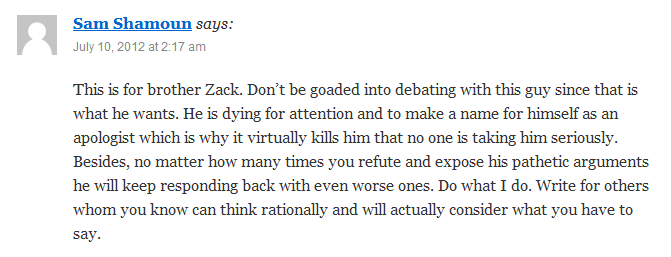
As a side note, I’m not exactly how it is that I’m dying for attention as neither Sam or any of his cronies know my real name, where I live or what I look like. If you or anyone else have ever seen a celebrity whose identity is unknown, let me or Sam know! He really has a funny idea of what fame is.

wa Allaahu Alam,
and God knows best.

Does Christianity really necessitate ransom for salvation?

Bismillahir Rahmanir Raheem
بِسۡمِ ٱللهِ ٱلرَّحۡمَـٰنِ ٱلرَّحِيمِ ,

A comparative examination of vicarious atonement and repentance in biblical light

Question Mark


Prelude


In the recent past Muslim Apologist and Speaker, Paul Williams engaged in a debate regarding the concept of Sin and Salvation in Islam and Christianity. Because the debate was very successful this made Christian Apologist Sam Shamoun to write “responses” (12 (1.)).

In doing so, Shamoun conveniently ignored scores of biblical passages which raises question whether Christianity actually require alleged death of Jesus (peace be upon him) for forgiveness of sins and subsequent salvation. We would, inshallah, document all of them in this paper for a neutral perusal.


Introduction


Jews believed in a concept of forgiveness called “Mehilah” which meant mercifulcancellation of sins without any need of indemnification or clearance of debts:


Mehilah is a technical, legal term that applies when the lender of money forgoes or waives all or part of the debt another person owes him. When applied to the consequence of sin, mehilah is the remission or cancellation of the punishment and any of the legal consequences of the sinful act.” (Forgiving the Unforgivable?)

Jews never had the concept of vicarious atonement for their sins, on the contrary, they had a lot of confidence and belief in their “Teshuva” – sincere repentance. They believed that sincere “Teshuva” is never denied by God:


“Rabbi Johanan explained:Were it not written in the text, it would be impossible for us to say such a thing; this verse teaches us that the Holy One, blessed be He, drew his tallit (prayer shawl) round Him like the prayer leader of a congregation and showed Moses the order of prayer. He said to him:“Whenever Israel sin, let them carry out this service before Me (i.e., read these passages containing the thirteen attributes of God’s mercy), and I will forgive them. And Rabbi Judah added that the verse, “Behold I make a covenant” (34:10) recorded just a few verses later, indicates that the revelation of these thirteen attributes actually formed a covenant that guaranteed that the people would never be turned away without forgiveness. This formula is the central theme of the penitential Selihot prayers recited during the High Holy Day season, culminating with Yom Kippur. (Forgiving the Unforgivable?)


From the forgoing, quite naturally, Jews never felt any real need for somebody to be hanged for their sins, contrariwise, they reclined to oft – repentance:

Essentially, God is a forgiving God who desires the repentance of sinners. Three times a day during the daily prayers, Jews recite the blessings: Bring us back, our Father, to Your Torah and bring us near, our King, to Your service. Cause us to return to You in perfect repentance. Blessed are You, God, Who desires repentance. Forgive us, our Father, for we have sinned. Pardon us, our King, for we have transgressed. For You pardon and forgive. Blessed are You, God, the gracious One Who pardons abundantly.This theme is repeated again and again throughout the liturgy. The rabbis even saw divine kindness and mercy reflected in God’s Name itself. The Tetragrammaton, YHWH, isused as God’s Name when He manifests His middat ha-rahamim (love, kindness and forgiveness), whereas Elohim is used to designate His attribute of justice.” (Forgiving the Unforgivable?)


They derived these teachings from their sacred scriptures. Consider the following biblical verses which stress on the concept of repentance and sub-sequent anticipation of forgiveness:


“Return to the LORD your God, people of Israel. Your sin has made you stumble and fall. Return to the LORD, and let this prayer be your offering to him: “Forgive all our sins and accept our prayer, and we will praise you as we have promised. Assyria can never save us. We will never again say to our idols that they are our God. O LORD, you show mercy to those who have no one else to turn to.” (Hosea 14:2)


Note assiduously that according to so called biblical prophet Hosea and his community, the prayer – (“this prayer”) – of repentance and guilt was the“offering” to God for forgiveness of sins; the “offering” was not the alleged, vicarious sacrifice of Messiah (peace be upon him).

Jews had no belief that they would be denied forgiveness if they did not believe in Jesus’ (peace be upon him) alleged death, rather, they believed that if they misuse God’s oft forgiving capacity by repeatedly sinning then their repentances would be repealed and they would not be forgiven:


“Nevertheless, despite God’s desire for repentanceHis essential capacity for mercy and His identification as a God of forgiveness, He Himself may withhold forgiveness at times. This is so when a penitent has not truly repented or if he uses the future possibility of penitence as an excuse to justify his illicit behavior, as the Mishnah, Yoma 85b, indicates, If one says, “I shall sin and repent, sin and repent,” no opportunity will be given to him to repent.23 [If one says], “I shall sin and the Day of Atonement will procure atonement for me,” the Day of Atonement procures for him no atonement.” (Forgiving the Unforgivable?)


While Jews derived their concepts of “Mehilah” – cancellation of debts and“Teshuva” – sincere repentance from Bible, as we would shortly see more of it in this paper, Saul who changed his Jewish name to Gentile Paul – contravened Jewish Scriptures to derive Gentile concepts of forgiveness through offering of flesh and blood of innocent.

Paul preached that sins would not be forgiven unless blood and flesh of Jesus (peace be upon him) is offered to God:

“And almost all things are by the law purged with blood; and without shedding of blood is no remission.” (Heb 9:22)

Grace be to you and peace from God the Father, and from our Lord Jesus Christ, Who gave himself for our sins, that he might deliver us from this present evil world, according to the will of God and our Father: (Gal 1:3-4)


In whom we have redemption through his blood, the forgiveness of sins, according to the riches of his grace; (Eph 1:7)


Looking for that blessed hope, and the glorious appearing of the great God and our Saviour Jesus Christ; Who gave himself for us, that he might redeem us from all iniquity, and purify unto himself a peculiar people, zealous of good works. (Tit 2:13-14)


And if Christ be not risen, then is our preaching vain, and your faith is also vain. (1 Co 15:14)

And, having made peace through the blood of his cross, by him to reconcile all things unto himself; by him, I say, whether they be things in earth, or things in heaven. (Col 1:20)

(King James Version, e-Sword)

In the above passages, Paul assumes that the only way sin of mankind can be forgiven and subsequent salvation can be attained, is through the blood shed of Jesus (peace be upon him).


Nevertheless, Paul by writing the above passages and Christian apologists by appealing to the above verses reject the teachings of multiple Old Testament (OT) Prophets and New Testament (NT) Prophet – Jesus (peace be upon him) himself. As we are going to see, Paul failed to realize that their (OT prophet’s) deity was less an exacting accountant and more a merciful God.


Pre – Pauline Teachings on Repentance and Forgiveness


For instance, consider the sayings of OT prophet Joel:


“But even now,” says the LORD, “repent sincerely, and return to me with fasting and weeping and mourning. Let your broken heart show your sorrow; tearing your clothes is not enough.” Come back to the LORD your GodHe is kind and full of mercy; he is patient and keeps his promise; he isalways ready to forgive and not punish. Perhaps the LORD your God will change his mind and bless you with abundant crops. Then you can offer him corn and wine. (Joel 2: 12-14)

Notice that unlike Paul who nails the forgiveness of sins on the cross, Jewish prophet Joel emphatically states that God is too kind, forgiving and considerate to accept sincere repentance and blot out sins! Joel’s God invites sinners to Himself so that He may forgive their sins! God of the OT does not need any cross to forgive sins, His mere virtue of kindness is enough amalgamated with the fasting, weeping and mourning of sinners.

Observe that God does not instruct Joel’s community to return with belief in the alleged, would-be crucifixion of Christ (peace be upon him) but with (i) fasting (ii) weeping (iii) and mourning!

In fact we do find God forgiving sins by blessing Joel’s community with abundance of crops production:

“…Have pity on your people, LORD. Do not let other nation despise us and mock us by saying, “Where is your God?’” Then the LORD showed concern for his landhe had mercy on his people. He answered them: “Now I am going to give you corn and wine and olive-oil, and you will be satisfied. Other nations will not despise you. I will remove the locust army that came from the north and will drive some of them in to the desert.” (Joel 2: 17-20)


Observe that God of the OT did not forgive Joel’s community because they believed that one day Messiah (peace be upon him) would be allegedly crucified, but they were forgiven solely on God’s mercy when they pleaded to him for “pity”.

Another noticeable point is that locusts has always been one of the means through which the God of OT has wrecked His wrath on the wrong doers,

“You will sow plenty of seed, but reap only a small harvest, because the locusts will eat your crops.” (Deuteronomy 28:38)

“All your trees and crops will be devoured by insects.” (Deuteronomy 28:42)

“I will give you back what you lost in the years when swarms of locusts ate your crops. It was I who sent this army against you.”  (Joel 2:25)


Nevertheless, God drove locusts away as a sign of His mercy and forgiveness on Joel’s community:


I will give you back what you lost in the years when swarms of locusts ate your crops. It was I who sent this army against you.” (Joel 2:25)


However, Paul’s influence makes Trinitarian apologists like Sam Shamoun claim that Christ’s (peace be upon him) vicarious death was the only way their sins can be absolved:


“In the first place, the very same Gospels, which these dawagandists pervert in order make them say something contrary to the intended meaning of the inspired authors, are the very same writings which go out of their way to affirm that Jesus’ vicarious death is both necessary and foundational for salvation.” (Was Jesus’ sacrificial death necessary for the forgiveness of sins?)

However, contrary to what Paul teaches and Shamoun’s claim, God of the OT had entirely different concepts for the forgiveness of sins and subsequent salvation.


For OT Prophets (and their community) Christ’s (peace be upon him) vicarious death was not at all required, let alone, “foundational for salvation”, since their sins were always welcomed to be forgiven as we saw above how Joel’s community was forgiven!


If Jesus’ vicarious death is (really) both necessary and foundational for salvation then how was Joel’s community forgiven without it? Seems it was not so “foundational” for them.


Consider another offer of forgiveness. This time the community of OT Prophet Ezekiel (peace be upon him) was to be forgiven without Jesus’ (peace be upon him) alleged sacrifice:


“Now, mortal man, I am making you a watchman for the nation of Israel. You must pass on to them the warnings I give you. If I announce that an evil man is going to die but you do not warn him to change his ways so that he can save his life, then he will die, still a sinner, and I will hold you responsible for his death. If you do warn an evil man and he does not stop sinning, he will die, still a sinner, but your life will be spared.”


Individual Responsibility


The LORD spoke to me. “Mortal man.” he said, “repeat to the Israelites what they are saying: We are burdened with our sins and the wrongs we have done. We are wasting away. How can we live? Tell them that as surely as I, the Sovereign LORD, am the living God, I do not enjoy seeing a sinner die. I would rather see him stop sinning and live. Israel, stop the evil you are doing. Why do you want to die?

I may warn an evil man that he is going to die, but if he stops sinning and does what is right and good – for example, if he returns the security he took for a loan or gives back what he stole – if he stops sinning andfollows the laws that give lifehe will not die, but live. I will forgive the sins he has committed, and he will live because he has done what is right and good. And your people say that what I do isn’t right! No, it’s their way that isn’t right. When a righteous man stops doing god and starts doing evil, he will die for it. When an evil man gives up sinning and does what is right and good, he has saved his life. But Israel, you say that what I do isn’t right. I am going to judge you by what you do.” (Ezekiel 33: 7-11, 14-20)


The verses teach the following:


(1)No matter how big the sins and wrongs be, “Life can be saved” or in other words, forgiveness/salvation can be achieved by (2) turning away from sins, doing good deeds and (3) following the “Law that give life”, (in other words “law” is not a “curse” as Paul erroneously assumes (c.f. Galatians 3: 13) but a blessing) and then (4) God “will forgive the sins they have committed”.


If God is/was willing to forgive even heavy burden of sins by virtue of His attribute, sinner’s repentance, acts of good deeds and obedience to Law – then was it required for Ezekiel’s community to believe in any vicarious atonement which wasallegedly going to take place thousands of years later? Or, was it required for any person to late“volunteer” himself for crucifixion for sins of others?


It is not surprising that rather than any mention of vicarious atonement, Bible compilers gave the sub-heading to these passages as “Individual Responsibility”– not Christ’s (peace be upon him) responsibility to bear the burden of others!


Another important observation is the stress on refraining from evil andencouragement to do good deeds since (5) God will “judge by what you do” – not what Christ (peace be upon him) did (or would do) for them. This also questions Paul’s self made doctrine of mere faith on cross (c.f. Romans 3: 20, 28).


Also please observe the stress that sinners should follow the LAW since it gives LIFE. No wonder we found Jesus (peace be upon him) in the New Testament obedient to the Law:


Think not that I am come to destroy the law, or the prophets: I am not come to destroy, but to fulfil. For verily I say unto you, Till heaven and earth pass, one jot or one tittle shall in no wise pass from the law, till all be fulfilled. Whosoever therefore shall break one of these least commandments, and shall teach men so, he shall be called the least in the kingdom of heaven: but whosoever shall do and teach them, the same shall be called great in the kingdom of heaven. (Mat 5:17-19, King James Version, E-Sword)


Even after the assertions of God through biblical Prophet Ezekiel (peace be upon him) and Jesus (peace be upon him), we find Paul contravening the sacred Lawsthereby contradicting Jesus (peace be upon him) also:


But that no man is justified by the law in the sight of God, it is evident: for, The just shall live by faith. (Gal 3:11)

The sting of death is sin; and the strength of sin is the LAW. (1Co 15:56)


Therefore we conclude that a man is justified by faith without the deeds of the law. (Rom 3:28)


Therefore by the deeds of the law there shall no flesh be justified in his sight: for by the law is the knowledge of sin. (Rom 3:20)


For the law made nothing perfect, but the bringing in of a better hope did; by the which we draw nigh unto God. (Heb 7:19)

(King James, e-Sword Version)


Observe that for Paul, “Law” is not just impotent but that sin gathers its viability from God’s sacred Laws! When a person (Paul) believes that Law provides viability to sins (!) then he would certainly like to do away and water down its benefits and coin a new doctrine of forgiveness through cross – even though God asserts that Law provides “life” (2.).


Another notable facet, as mentioned earlier, that God will judge mortals according to their deeds, however, Paul again infringes God. Consider the biblical verse where God stresses on personal good deeds:


But Israel, you say that what I do isn’t right. I am going to judge you by whatyou do (Ezekiel 33:20)


Compare it against Paul’s words:


Therefore we conclude that a man is justified by faith without the deeds of the law. (Rom 3:28)


Therefore by the deeds of the law there shall no flesh be justified in his sight: for by the law is the knowledge of sin. (Rom 3:20)


Hardly did Paul realized that he was even contravening his “lord and savior” since Jesus (peace be upon him) for salvation, (1.) did not place any weightage on cross (2.) gave much importance to deeds. As is illustrated from the following statements of Jesus (peace be upon him):


And, behold, one came and said unto him, Good Master, what good thing shall I do, that I may have eternal life? And he said unto him, Why callest thou me good? there is none good but one, that is, God: but if thou wilt enter into life, keep the commandmentsHe saith unto him, Which? Jesus said,Thou shalt do no murder, Thou shalt not commit adultery, Thou shalt not steal, Thou shalt not bear false witness, Honour thy father and thy mother: and, Thou shalt love thy neighbour as thyself.  (Mat 19:16-19, King James, e-Sword Version)


Observe that according to Jesus (peace be upon him), not Paul, salvation can be achieved by (i) not murdering (ii) abstinence from adultery (iii) abstinence from theft (iv) abstinence from false witnessing (v) honoring parents (vi) and loving our neighbor. Al-hamdolillah.


Starkly, Jesus (peace be upon him) did not enlist belief on his alleged cross to attain salvation which for Shamoun is “both necessary and foundational for salvation”. Seems that for Christ (peace be upon him), cross was neither necessary nor foundational for salvation!


Christians need to choose between Shamoun and Jesus (peace be upon him) – I will put my money on Jesus (peace be upon him).


No matter what God ordained, Paul always seems to contravene Him and yet he is ironically purported to be a divinely appointed “apostle”! More on this topic in our future papers, inshallah. However, for the time being we would direct readers to the following related articles:


Bible does not stop with biblical prophets Joel and Ezekiel only (peace be upon him) but even Jeremiah taught the concepts of forgiving God through repentance from sins.

In the following verses observe the ghastly sins committed by Jeremiah’s community:


But the worship of Baalthe god of shame, has made us lose flocks and herds, sons and daughters – everything that our ancestors have worked for since ancient times. We should lie down in shame and let our disgrace cover us. We and our ancestors have always sinned against the LORD our God; we have never obeyed his commands.” (Jeremiah 3:24-25)


Even after the worship of the idol – “Baal”, witness the love, mercy and forgiving capacity of God – Almighty:


“The LORD says, “People of Israel, if you want to turn, then turn back to me. If you are faithful to me and remove the idols I hate, it will be right for you to swear by my name. Then all the nations will ask me to bless them,and they will praise me.” (Jeremiah 4:1-2)


Notice that even when the Israelites acceded that they have “ALWAYS” sinned against God by worshipping others besides Him and “NEVER” ever obeyed His command, the forgiving God responded by embracing them “BACK TO HIM (SELF)”.  God had no need for Jesus’ (peace be upon him) blood to forgive even the most hideous and perennial sin of worshipping BAAL!

In fact God confirms through Jeremiah that if sinners mend their ways then He would forgive them (without any need of innocent’s blood):


“If at any time I say that I am going to uproot, break down, or destroy any nation or kingdom, but then that nation turns from its evil, I will not do what I said I would.” (Jeremiah 18:8)


The only ground on which God would not afflict punishment on the sinning nations is when it wouldturn from its evil. Starkly, God did not need the alleged cross to forgive sins.


According to yet another biblical figure, Samuel, God – The most merciful will blot out even the most heinous sin if heartily repented for:


“Samuel said to the people of Israel, “If you are going to turn to the LORD with all your hearts, you must get rid of all the foreign gods and the images of the goddess Astarte. Dedicate yourselves completely to the LORD and worship only him, and he will rescue you from the power of the Philistines.” (1 Samuel 7: 3-4)


Notice that according to Samuel (also), God “will rescue” the Israelites not because they believed Jesus (peace be upon him) would allegedly die on cross someday and subsequently their sins would be forgiven, rather, they would be forgiven if they turned from sins “with all your (their) hearts”. Thus, here again, a strong importance is laid on heartfelt repentance and God’s infinite mercy rather than any alleged cross!

In fact, at one place God explicitly says that to forgive sins He does not needsacrifices but emotions of heart:


“I do not reprimand you because of your sacrifices and the burnt – offerings you always bring me. And yet I do not need bulls from your farms…Do I eat the flesh of bulls or drink the blood of goatsLet the giving of thanks be your sacrifice to God,” (Psalms 50:8-14)


Next we have very important chapter from Psalms where in important OT prophet David (peace be upon him) not only teaches how to repent but he also puts forth the conditions how sins could be forgiven:

A Prayer for Forgiveness

Be merciful to me, O God, because of your constant loveBecause of your great mercy wipe away my sins! Wash away all my evil and make me clean from my sins. I have sinned against you – only against you – and done what you consider evil. So you are right in judging me; you are justified in condemning me. I have been evil from the day I was born; from the time I was conceived, I have been sinful. Sincerity and truth are what you require; fill my mind with your wisdom. Remove my sin and I will be clean; wash me; and I will be whiter than snow. Let me hear the sounds of joy and gladness; and though you have crushed me and broken me, I will be happy once again. Close your eyes to my sins and wipe out all my evil. Create a pure heart in me, O God, and put a new and loyal spirit in me. Do not banish me from your presence; do not take yourholy spirit away from me. Give me again the joy that comes from your salvation, and make me willing to obey you. Then I will teach sinners your commands, and they will turn back to you. Spare my life, O God, and save me, and I will gladly proclaim your righteousness. Help me to speak, Lord, and I will praise you. You do not want sacrifices, or I would offer them; you are not pleased with burnt-offerings. My sacrifice is a humble spiritO God; you will not reject a humble and repentant heart.” (Psalms 51:1-17)


Notice the reasons why David (peace be upon him) expects forgiveness from God:


(1.)  Because   of God’s constant love.

(2.)  Because of God’s great mercy.


David (peace be upon him) did not had any third reason of Jesus’ (peace be upon him) alleged, would-be, sacrifice for the forgiveness of his sins. In fact, he pleads God to “close His eyes from his sins.”


Why would David (peace be upon him) request God to “close His eyes from his sins.” if he (David) believed that Jesus’ (peace be upon him) would pay the price for his sins?  If David (peace be upon him) had ransom currency in his hand then he would look into the eyes of God (so to say) rather than pleading to Him for mercy. A request for closure of eyes is positive proof that David (peace be upon him) expected mercy rather than believing that his sins would be re-directed to Jesus (peace be upon him).


The truth of the matter is that David (peace be upon him) never believed in vicarious atonement; for him, his repentance and God’s abundant mercy was enough. As a matter of fact, rather than appealing God through Jesus’ (peace be upon him) alleged, would be sacrifice, David (peace be upon him) asserted that God does not require sacrifices but He looks out for “humble spirits” in repentance. If David (peace be upon him) believed in Christ’s (peace be upon him) would be, alleged, sacrifice then why did he assert that “my sacrifice is (my) humble spirit”?


It gets no better for apologists like Shamoun because according to ‘Christian’ Scholars of the Bible, not Jews or Muslims, the only way sinners can be saved is, not through cross, but through the forgiveness and mercy of God:


“The only hope of a sinner when crushed with the consciousness of sin is the mercy of Godand the plea for that mercy will be urged in the most earnest and impassioned language that the mind can employ. “Accordingly to thy Iovingkindness.” On the meaning of the word used here, see the notes at Psa 36:7.


(a) The “ground” of his hope was the compassion of God:

(b) the “measure” of that hope was His boundless beneficence; or, in other words, he felt that there was need of “all” the compassion of a God. (Albert Barnes’ Notes on the Bible, Psalms 51:1)


Notice that the Christian Commentator candidly accepts that the ONLY hope for sinners is mercy of God, not the alleged blood of Christ (peace be upon him). Furthermore, this hope of mercy can be achieved not through the belief in alleged cross of Christ (peace be upon him) but through mercy plea “in the most earnest and impassioned language that the mind can employ.” The candid commentator again repeats his message by stating that the “ground” for the hope of mercy is“compassion of God”, not alleged cross of Jesus (peace be upon him). All of this alludes that the forgiveness of God is indispensable than the purported, alleged cross of Messiah (peace be upon him).


Moving on with OT prophets, we find God – Almighty promising prophet Isaiah that He always grants sincere repentance (and thus obviating need of any sacrificial death!):


“I am the high and holy God, who lives for ever. I live in a high and holy place,but I also live with people who are humble and repentant, so that I can restore their confidence and hope. I gave my people life, and I will notcontinue to accuse them or be angry with them for ever. I was angry with them because of their sin and greed, and so I punished them and abandoned them. But they were stubborn and kept on going their own way. “I have seen how they acted, but I will heal them. I will lead them and help them, and I will comfort those who mourn. I offer peace to all, both near and far! I will heal my people. But evil men are like the restless sea, whose waves never stop rolling in, bringing filth and much. There is no safety for sinners,” says the LORD.” (Isaiah 57:15-21)


Notice that according to Prophet Isaiah, not “apostle” Paul, God will not abandon sinners, however, he will “heal his people” – “his people” who are “mournful” and“repentant”. If sinners can be “healed” through “mourning” and “repentance”then is Christ’s (peace be upon him) alleged death indispensible, as Paul claims?


Observe that the verse says that God will “comfort those who mourn”; it does not says “those who believe in the (alleged) would-be death of Christ (peace be upon him)!


Also notice the phrase where it says that “there is no safety for sinners” – from the context, the sinners are the ones who do not humble themselves in repentance and mourning; the verse does not refer sinners to those who do not accept future (alleged) death of Messiah (peace be upon him) like the Muslims! This yet again obviates any necessity of cross.


Not just Israelites but even Egyptians, a non-Semitic civilization with no expectation of Messiah (peace be upon him), would also be healed or in other words forgiven, if they repent:

“The LORD will punish the Egyptians, but then he will heal them. They will turn to him, and he will hear their prayers and heal them. (Isaiah 19:22)


Notice yet again that Jesus’ (peace be upon him) alleged crucifixion was not required for the forgiveness of sins and subsequent “healing”. All that Egyptians needed to do is to “turn back”, that is to repent through “prayers”, not belief in alleged would-be sacrifice of Christ (peace be upon him), and then God will forgive them.


The Psalmist also asserts that God – Almighty is merciful and ready to forgivewithout any need of Jesus’ (peace be upon him) death (!):


You are my God, so be merciful to me; I pray to you all day long. Make your servant glad, O lord, because my prayers go up to you. You are good to us and forgiving.


Proud men are coming against me, O God; a gang of cruel men is trying to kill me – people who pay no attention to you But you, O lord, are merciful and loving God, always patient, always kind and faithful. Turn to me and have mercy on me; strengthen me and save me because I serve you, just as my mother did.” (Psalm 86:3-5 & 14-17)


Here is something very interesting about this Psalmist. Notice that he requests for forgiveness and mercy not on the grounds that he has believed that Jesus (peace be upon him) would be allegedly crucified some day, rather he expects it becauseof his own good deeds of serving Him alone, as his mother did (!) and due to the merciful nature of God. This is again a positive proof that during OT age, people did not used to rely on vicarious atonement on the contrary, they used to rely on God’s mercy and their good actions much like the Muslims!


The people of Prophet Jonah (peace be upon him) – the citizens of Nineveh, deeply rooted in their sins, were also forgiven by God – Almighty, neither on the account of the smallness of their sins nor on the account of their believe in the alleged, would be, death of Christ (peace be upon him) but because of their humbleness, fasting, obedience and repentance shown to God:

“Once again the LORD spoke to Jonah. He said, “Go to Nineveh, that great city, and proclaim to the people the message I have given you.” So Jonah obeyed the LORD and went to Nineveh, a city so large that it took three days to walk through it….he proclaimed, “In forty days Nineveh will be destroyed!” The People of Nineveh believed God’s message. So they decided that everyone should fast, and all the people, from the greatest to the least, put on sackcloth to show that they had repented. When the king of Nineveh heard about it, he got up from his throne, took off his robe, put on sackcloth, and sat down in ashes. He sent out a proclamation to the people of Nineveh: “This is an order from the king and his officials: No one is to eat anything: all persons, cattle, and sheep are forbidden to eat or drink. All persons and animals must wear sackcloth. Everyone must pray earnestly to God and must give up his wicked behavior and his evil actions. Perhaps God will change his mind; perhaps he will stop being angry, and we will not die!”


Notice the actions of the Ninevites when they came to know of their imminent destruction. Unlike Trinitarian understanding, they did not cry out that we have believed that someday Messiah (peace be upon him) would be (allegedly) crucified, thus, they should be forgiven. On the other hand, they prayed earnestly, fasted, humbled themselves by wearing sackclothes so much so that even their king did so and gave up their wicked ways.


Trinitarians would expect God to proclaim that their (Ninevites’) fasting, prayer etc are useless unless they believed in Messiah’s (alleged) death (peace be upon him) since that is the only way He would forgive their sins, however, contrary to this Pauline belief, a merciful God is ready to forgive freely. As He actually did with the Ninevites:

“God saw what they did; he saw that they had given up their wicked behavior. So he changed his mind and did not punish them as he had said he would.” (Jonah 3: 1-10)


We need to ponder whether the Ninevites were forgiven due to (belief in) Christ’s (peace be upon him) alleged, would-be death or due to God’s free mercy shown on their repentance?


Jeremiah also accounts that if people would repent then God would change His mind, in other words, forgive them their sins:


“Soon after Jehoiakim son of Josiah became king of Judah, the LORD said to me, “Stand in the court of the Temple and proclaim all I have commanded you to say to the people who come from the towns of Judah to worship there. Do not leave out anything. Perhaps the people will listen and give up their ways. If they do, then I will change my mind about the destruction I plan to bring on them for all their wicked deeds. (Jeremiah 26: 1-3)


Very ironically, in the above passage God – Almighty goes out of the way to ordain His prophet to instruct people that He (God) is willing to forgive their sins (“change his mind”) if they mend their ways, compatible with Christian believe, God did not say “if they accept alleged blood of Christ (peace be upon him)”.


Also, notice the yearning and initiative in God’s behalf to forgive their sins – God is found to be reaching out to sinners willingly to forgive their sins; even after this, Trinitarians resonate blindly with Paul that the only way sins can be forgiven is through the alleged blood of Christ (peace be upon him)!

A little later, Jeremiah confirms that if people would give up sinning and repent then God WILL (positive affirmative) forgive them:

“Then I said, “The LORD sent me to proclaim everything that you heard me say against this Temple and against this city. You must change the way you are living and the things you are doing, and must obey the LORD your God. If you do, he will change his mind about the destruction that he said he would bring on you. (Jeremiah 26: 12-13)


Furthermore, in the same book of Jeremiah we find yet another instance where merciful God utterly yearning to forgive Israelites when He found them repentant on their sins:


I hear the people of Israel say in grief, LORD, we were like an untamed animal, but you taught us to obey. Bring us backwe are ready to return to you the LORD our God. We turned away from you, but soon we wanted to return. After you had punished us, we hung our heads in grief. We were ashamed and disgraced, because we sinned when we were young.’ “Israel, you are my dearest son, the child I love best. Whenever I mention your name, I think of you with love. My heart goes out to you; I will be merciful. Set up signs and mark the road; find again the way by which you left.Come back, people of Israel, come home to the towns you left. How long will you hesitate, faithless people? I have created something new and different, as different as a women protecting a man.” (Jeremiah 31:18-22)


Did you feel yearn in God’s heart (so to say) to forgive returning sinners! When Israelites humbled themselves as “untamed animal” and hung their “heads in grief” shame and disgrace, God became extremely compassionate towards this act and called them back over and over again. Being “merciful” towards them with a promise of an entirely new gift and as unique as a “women protecting a man”; no where sinners needed any belief in vicarious atonement to be freely forgiven by God!


Through yet another so called OT prophet Amos, God sets easy conditions for His free flowing forgiveness on sinners:

“I know how terrible your sins are and how many crimes you have committed.You persecute good men, take bribes, and prevent the poor from getting justice in the courts. And so, keeping quiet in such evil times is the clever thing to do!


Make it your aim to do what is right, not what is evil so that you may live. Then the LORD God Almighty really will be with you, as you claim he is. Hate what is evil, love what is right, and see that justice prevails in the courts. Perhaps the LORD will be merciful to the people of this nation who are still left alive.(Amos 5:12-15)


It is conspicuous that God would be merciful if the people of Amos were just and upright; yet again there is no need of any vicarious atonement through Jesus’ (peace be upon him) alleged death.


There is even more in the Bible. Trinitarian Apologists like Sam Shamoun who use the book of Isaiah to somehow establish vicarious atonement, conveniently ignores, if not outright discard, the following important passage from it:


Turn to the LORD and pray to him, now that he is near. Let the wicked leave their way of life and change their way of thinkingLet them turn to the LORD, our God; He is merciful and quick to forgive“My thoughts.” says the LORD, “are not like yours, and my ways are different from yours. As high as the heavens are above the earth, so high are my ways and thoughts above yours.

“My word is like the snow and the rain that come down from the sky to water the earth. They make the crops grow and provide seed for sowing and food to eat. So also will be the word that I speak – it will not fail to do what I plan for it; it will do everything I send it to do. “You will leave Babylon with joy; you will be led out of the city in peace. The mountains and hills will burst into singing, and the trees will grow where now there are briars; myrtle-trees will come up in place of thorns. This will be a sign that will last for ever, a reminder of what I, the LORD, have done.” (Isaiah 55:6-13)


It must be observed that God claims that He is MERCIFUL AND ABUNDANTLY FORGIVING (“quick to forgive”), in other words, He wants to copiously forgive returning sinners; all that sinners are needed to do is to “leave their (wicked) way of life and change their way of thinking”. God absolutely does not put any restrictions on his incessant mercy and forgiveness through sacrifice of any innocent Prophet (peace be upon him). We need to ponder that if God is willing toexcessively forgive solely on His own account then why will He need cross, blood and an innocent?


In fact, as a sign of this free out pouring forgiveness and mercy, God would grow“myrtle-trees in place of thorns” not to later nail and belittle it on the cross.


Another observable facet to the above passage is that it is human nature not to give things freely but to ask for return, however, merciful God, in the passage, boasts of his free forgiveness by proclaiming that His “ways are different from yours (humans)”.


This is an ironical response to Paul – a mortal, who thought that God like mortals would demand blood and flesh of Christ (peace be upon him) to forgive heavy yokes of oft – repeated sins resembling “give and take” policy. However, according to yet another Christian commentator, God was/is ready to forgive freely and abundantly:


“For – If any man injure you, especially if he do it greatly and frequently, you are slow and backward to forgive him. But I am ready to forgive all penitents, how many, and great, and numberless soever their sins be.” (John Wesley’s Explanatory Notes, Isaiah 55:8)


Jewish commentator Solomon Ben Isaac (Rashi) also concurs of the free and unconditional mercy:


For My thoughts are not, etc.: My laws are not like the laws of man [lit. flesh and blood]. As for you, whoever confesses in judgment is found guilty, but, as for Me, whoever confesses and gives up his evil way, is granted clemency(Source)


It can be deduced that for grant of clemency or forgiveness, unlike the understanding of vicarious atonement, one needs to:


  1. Confess his/her sins.
  2. Turn away from sins.
  3. And subsequently, receive clemency/forgiveness of sins.


In the above facts, it is hard to insert the concept of vicarious atonement through the alleged death of Messiah (peace be upon him).


From the above cited Isaiah verse, esteemed Christian Commentator Albert Barnes (also) postulates pre-requisites to avail salvation. It would be interesting to observe if he gives place to the alleged blood and cross of Christ (peace be upon him). He comments:


Let the wicked … – In this verse we are told what is necessary in order to seek God and to return to him, and the encouragement which we have to do it. The first step is for the sinner to forsake his way. He must come to a solemn pause, and resolve to abandon all his transgressions. His evil course; his vices; his corrupt practices; and his dissipated companions, must be forsaken.


And the unrighteous man – Margin, “Man of iniquity.” This is a literal translation. The address is made to all people, for all are such.


His thoughts – The Hebrew word denotes all that is the object of thought; and the idea is, that the man must abandon his plans and purposes of life. The thoughts, in the sight of a holy God, are not less important than the external deportment; and no man can obtain his favor who is not ready to abandon his erroneous opinions, his pride and vanity, his plans of evil, and his purposes of life that are opposed to God.


And let him return unto the Lord – Man, in the Scriptures, is everywhere described as having wandered away from the true God. Religion consists in returning to him for pardon, for consolation, for protection, for support. The true penitent is desirous of returning to him, as the prodigal son returned to his father’s house; the man who loves sin chooses to remain at a distance from God.


And to our God – The God of his people; the God of the speaker here. It is the language of those who have found mercy. The idea is, that he who has bestowed mercy on us, will be ready to bestow it on others. ‘We have returned to God. We have had experience of his compassion, and we have such a conviction of his overflowing mercy, that we can assure all others that if they will return to our God, he will abundantly pardon them.’ The doctrine is, that they who have found favor have a deep conviction of the abounding compassion of God, and such a sense of the fullness of his mercy, that they are disposed to offer the assurance to all others, that they may also obtain full forgiveness. Compare Rev 22:17 – ‘And let him that heareth say, Come.’


For he will abundantly pardon – Margin, as Hebrew, ‘Multiply to pardon.’ He abounds in forgiveness. This is the conviction of those who are pardoned; this is the promise of inestimable worth which is made to all who are willing to return to God. On the ground of this promise all may come to him, and none who come shall be sent empty away. (Albert Barnes’ notes on the Bible, Isaiah 55:7)


It is observable that Barnes felt no need to mention the alleged cross of Christ (peace be upon him) to forgive sins, on the contrary, he states that sinners need to return to God as the “prodigal son” returned to his father. Now, this father exacted no price from his squandered son to forgive him, rather he merely forgave him, accepted him and went out of the way to organize a feast for him!


Book of Proverbs also has the criterions for free mercy without any conditions of cross:


“You will never succeed in life if you try to hide your sins. Confess them and give them up; then God will show MERCY to you.” (Proverbs 28:13)


Once again, to have “success” one needs to (i) Confess his/her sins (ii) Turn away from them (iii) subsequently, God will show “mercy” and forgive sins.


Did you notice if God required any human sacrifice for forgiveness! Rather His forgiveness comes out “freely, fully, without any grudges” or reserves even on the most hideous of sins.


Not merely Jewish Rashi but even much celebrated Christian scholars John Gill, who does believe in vicarious atonement, agrees that God does and can forgive sinsfreely without the need any human sacrifice:


In some things there may be a likeness between the thoughts of God and the thoughts of men, as to the nature of them: thoughts are natural and essential to them both; they are within them, are internal acts, and unknown to others, till made known; but then the thoughts of men are finite and limited, whereas the thoughts of the Lord are infinite and boundless; men’s thoughts have a beginning, but the Lord’s have none; though not so much the nature as the quality of them is here intended: the thoughts of men are evil, even the imagination of their thoughts, yea, every imagination is, and that always and only so; but the thoughts of God are holy, as appears from his purposes and covenant, and all his acts of grace, in redemption, calling, and preparing his people for glory: the thoughts of men, as to the object of them, are vain, and nothing worth; their thoughts and sentiments of things are very different from the Lord’s, as about sin, concerning Christ, the truths of the Gospel, the people of God, religion, holiness, and a future state, and in reference to the business of salvation; they think they can save themselves; that their own works of righteousness are sufficient to justify them; their privileges and profession such, that they shall be saved; their wisdom, riches, and honour, a security to them from damnation: however, that their sincere obedience, with repentance for what is amiss, will entitle them to happiness: but the thoughts of God are the reverse of all this; particularly with respect to pardoning mercy their thoughts are different; carnal men think of mercy, but not of justice, and of having pardoning mercy in an absolute way, and not through Christ, and without conversion and repentance; and so this is a reason why men’s thoughts are to be forsaken, because so very unlike to the Lord’s. OR else these words are to be considered as an argument, proving that God does abundantly pardon all returning sinners; since he is not like men, backward to forgive, especially great and aggravated crimes, but is ready, free, and willing to forgive, even those of the most aggravated circumstances.


Neither are your ways my ways, saith the Lord; the ways which God prescribes and directs men to walk in are different from theirs; his are holy, theirs unholy; his are plain, theirs crooked; his are ways of light, theirs ways of darkness; his are pleasant, theirs not so, at least in the issue; his lead to life, theirs to death; and therefore there is good reason why they should leave their evil ways, and walk in his. Moreover, the ways which he takes in the salvation of men are different from those which they, naturally pursue, and especially in the pardon of sin; he pardons freely, fully, without any reserve, or private grudge, forgetting as well as forgiving.(John Gill’s Exposition of the Entire Bible, Isaiah 55:8)


It is very interesting and ironical to note that John Gill, a proponent of vicarious atonement, firstly defends forgiveness through Christ (peace be upon him), however, he continues to decidedly assert that the verse “proves” God forgives incessantly to all returning sinners (why?) since He is unlike niggardly men“backward to forgive especially GREAT and AGGRAVATED CRIMES” ; He does not pardons on the basis of someone else’s (alleged) sacrificial death but He forgives freely, fully, WITHOUT ANY RESERVE OR PRIVATE GRUDGE, keeps nothing in His mind!

As we saw that a returning sinner is forgiven freely and “FULLY” by the outpouring of a loving and merciful God then is Christ’s (peace be upon him) alleged death really required?

In fact Paul alludes that Jesus’ (peace be upon him) (alleged) death is in vain if there is free flowing and unconditional forgiveness of God:


“I refuse to reject the grace of God. But if a person is put right with God through the Law, it means that Christ died for nothing!” (Galatians 2:21)


The book of Isaiah is far from over. We quote yet another passage from it:


“Thou hast bought me no sweet cane with money, neither hast thou filled me with the fat of thy sacrifices: but thou hast made me to serve with thy sins, thou hast wearied me with thine iniquities. I, even I, am he that blotteth out thy transgressions for mine own sake, and will not remember thy sins.” (Isa 43: 24-25, King James Version, e-Sword version.)


Unlike Christian theology where sins are forgiven because of Christ’s (peace be upon him) alleged death’s sake, in the above passage, God emphatically asserts that He forgives sins of HIS OWN SAKE!


Albert Barnes provides a very unlike Christian commentary on the above verses where he puts no stress on the alleged crucifixion of Jesus (peace be upon him):


“I, even I, am he – This verse contains a gracious assurance that their sins would be blotted out, and the reason why it would be done. The pronoun ‘I’ is repeated to make it emphatic, as in Isa 43:11. Perhaps also God designs to show them the evil of the sins which are mentioned in the previous verses, by the assurance that they were committed against him who alone could forgive, and who had promised them pardon. The passage also reminds them, that it was God alone who could pardon the sins of which, as a nation, they had been guilty.


That blotteth out thy transgressions – This metaphor is taken from the custom of keeping accounts, where, when a debt is paid, the charge is blotted or cancelled. Thus God says he blotted out the sins of the Jews. He cancelled them. He forgave them. Of course, when forgiven, punishment could not be exacted, and he would treat them as pardoned; that is, as his friends.


For mine own sake – Not because you deserve it, or have any claim, or that it would not be right to punish you. Not even primarily to promote your happiness and salvation, but for my sake;


1. To show the benevolence of my character;

2. To promote my glory by your forgiveness and salvation (see Eze 36:22).


And will not remember thy sins – They shall be forgiven. Hezekiah Isa 38:17 expresses the same idea by saying ‘thou hast cast all my sins behind thy back.’ We may learn from this verse:


  1. That it is God only who can pardon sin. How vain, then, is it for man to attempt it! How wicked for man to claim the prerogative! And yet it is an essential part of the papal system that the Pope and his priests have the power of remitting the penalty of transgression.


2.     That this is done by God solely for his own sake. It is not,


(a) because we have any claim to it, for then it would not be pardon,but justice.

(b) because we have any power to compel God to forgive, for who can contend with him, and how could mere power procure pardon? It is not

(c) because we have any merit, for then also it would be justice, and we have no merit. Nor is it

(d) primarily in order that we may be happy, for our happiness is a matter not worthy to be named, compared with the honor of God. But it is solely for his own sake – to promote his glory – to show his perfections – to evince the greatness of his mercy and compassion – and to show his boundless and eternal love.


3. They who are pardoned should live to his glory, and not to themselves. For that they were forgiven, and it should be the grand purpose of their lives so to live as to show forth the goodness, compassion, and love of that merciful Being who has blotted out their sins.


4. If people are ever pardoned, they must come to God – and to God alone. They must come, not to justify themselves, but to confess their crimes. And they must come with a willingness that God should pardon them on just such terms as he pleases; at just such a time as he pleases; and solely with a view to the promotion of his own glory. Unless they have this feeling, they never can be forgiven, nor should they be forgiven.” (Albert Barnes’ Notes on the Bible, Isaiah 43:25)


There are various important details to be noted from the above exegesis. Firstly, the merciful God “blotted out, cancelled and forgave” the heinous sins of the Israelites and by doing so God not only evinced His glory (as a God of mercy), His“compassion, boundless and eternal love” but God also made the sinning Jews His “friends” and awarded them “salvation”. Did you notice the Jews wereforgiven, made friends and awarded salvation (!) without so need of belief in cross or vicarious atonement.

Secondly, Christian apologists claim that justice demanded (alleged) death of Christ (peace be upon him) since God is both merciful and just. Through Christ’s (peace be upon him) (alleged) death Christians can claim their salvation. However, God out of his “boundless mercy”, not justice, is willing to forgive sins without any claim on Him: “…because we (do not) have any claim to it, for then it would not be pardon, but justice.


Another Christian Scholar accepts that God has no other reason (of cross etc) but of His own goodness He forgives sins (!):


For mine own sake – In the pardon of sin God can draw no reason but from his own infinite goodness. (Adam Clarke’s Commentary on the Bible, Isaiah 43:25)

If the Divine God forgives out of his own “infinite goodness” then it has to obviate all econcepts of ransom offerings to God otherwise it will belittle and devoid God off his divine attribute of “INFINITE goodness”.


Till now we have seen how God shows His merciful and forgiving nature by freely and unconditionally pardoning sinners thereby obviating the eccentric notion of atonement through alleged crucifixion.


In the next section we would see those biblical verses which out rightly negates Christ (peace be upon him) taking on sins of mankind upon himself.


These set of verses teaches, as we would soon observe, that each one has a personal responsibility towards his/her sins; if a person sins then s/he personally needs to repent rather than finding a scapegoat in Jesus (peace be upon him) to pass the burden on.


Personal Responsibility – Not Christ’s (peace be upon him)


We read in Deuteronomy, Godnot a mortal Paul, providing the following Law:


“Parents are not to be put to death for crimes committed by their children, and children are not to be put to death for crimes committed by their parents; a person is to be put to death only for a crime he himself has committed.” (Deuteronomy 24:16)


“The fathers shall not be put to death for the children, neither shall the children be put to death for the fathers: every man shall be put to death for his own sin.” (Deu 24:16, King James, e-Sword version)


No stodgy passages are needed for the above limpidly clear verses. Each sinner is responsible for his own sins; he can either repent or die in that state – God will deal with him accordingly. Son cannot take Father’s sin on himself, even if he wants to! yet Christians claim that son (of man) took sins of others!

We also have a similar message in the so called book of Kings where Prophet Solomon (peace be upon him) is pleading to God:


“When a person is accused of wronging another and is brought to your altar in this Temple to take an oath that he is innocent, O LORD, listen in heaven and judge your servants. Punish the guilty one as he deserves, and acquit the one who is innocent.” (1 Kings 8: 31-32)


Finally, we have important and famous (3.)  Ezekiel (peace be upon him) verses:

“But you ask: ‘Why shouldn’t the son suffer because of his father’s sin?’The answer is that the son did what was right and good. He kept my laws and followed them carefully, and so he will certainly live. It is the one who sins who will die. A son is not to suffer because of his father’s sins, nor a father because of the sins of his son. A good man will be rewarded for doing good, and an evil man will suffer for the evil he does.

If an evil man stops sinning and keeps my laws, if he does what is right and good, he will not die; he will certainly live. All his sins will be forgiven, and he will live, because he did what is right. Do you think I enjoy seeing an evil man die?” asks the Sovereign LORD. “No, I would rather see him repent and live.” (Ezekiel 18:19-23)


Although the verses are lucidly clear, however, very important deductions are to be taken from them.


Notice that (1.) through Prophet Ezekiel (peace be upon him), God defends the notion why SON should NOT be punished for the sins of the FATHER (!)because son is/was righteous and did what was good thus, he should not bear the sins of father.


To further support His divine Law: Punishment to un-repenting guilty and Safety to innocent; God states that He will not pardon bloodshed of innocent:


“And also for the innocent blood that he shed: for he filled Jerusalem with innocent blood; which the LORD would not pardon.” (2Ki 24:4, King James Version, e-Sword)


If we apply the same principle of “Individual Responsibility” (Ezekiel 18) betweenson (Jesus) and father (Adam) then Jesus (peace be upon him) should not be afflicted for the so called “sins” of Adam (peace be upon him), especially, when God will not pardon shedding of innocent’s blood.

It is hard to reconcile that God who was resolute not to pardon bloodshed of innocent in OT era all of a sudden He completely changed His methodology to kill an innocent to pardon sins of entire human race! It raises questions whether God changed His ways or human(s) coined new doctrine!

(2.) The verse emphatically asserts that the one who has sinned is responsible; obviating any substitute to bear the sins for other. It will be against the just law of a just God to punish innocent son for the sins of the father.

(3.) However, if father repents and turns back from evil, then ALL his sins will be FORGIVEN! –  it yet again obviates the concepts of substitution for bearing of sins of others. No surprise, Bible scholars and translators sub-headed the passages as“Individual Responsibility”:

To sum up, neither is there any need of Jesus’ (peace be upon him) alleged crucifixion for bearing the sins of others nor can he take sins of others on his head because according to OT books, namely, Deuteronomy, Kings and Ezekiel:


  • Every man is responsible for his own deeds – son is not to be held accountable for father; father is not accountable for the sins of son.
  • And, there is room for repenting sinners in mercy and forgiveness of God


In fact according to OT scholars, prophet Ezekiel declined any concept of vicarious atonement:


“God’s prophet Ezekiel said that each person is held responsible for his or her own sins. The Christian idea of vicarious atonement through belief in the blood sacrifice of Jesus is a moral reversion. Mere belief is not an adequate substitute for following God’s moral and ethical instructions in the Torah. In essence, the Jewish prophet Ezekiel rejected the Christian concept of vicarious atonement.

In rabbinic thought, man does not stand before God, either as acceptable because of what he is. Rather, he successfully stands before God by being good enough. Rabbinic Judaism rejects any need for a vicarious atonement for sinMan does not have this need. Being made in the image of God, he was never separated from God. Regardless of his conduct, he has the potential of correcting his sins by returning to the proper course of action. Since we can make any needed correction ourselves, we need no mediator. In turn, if man can approach God on his own merit, God coming to man’s aid as a mediator is unnecessary. Worse than that, it would be an interference with human progress and man’s job of perfecting creation.”(Twenty-six reasons why Jews don’t believe in Jesus, Asher Norman)


Based on the law of “Individual Responsibility”, God rejected when Moses (peace be upon him) tried to vicariously bear the sins of Israelites:


Please forgive their sin; but if you won’t, then remove my name from the book in which you have written the names of your people.” The LORD answered, “It is those who have sinned against me whose names I will remove from my book. Now go, lead the people to the place I told you about. Remember that my angel will guide you, but the time is coming when I will punish these people for their sin.” (Exodus 32:32-33)


Yet Paul goes out of the way to coin a new doctrine in which Christ (peace be upon him) was somehow made to bear the sins of others:


So Christ was once offered to bear the sins of many; and unto them that look for him shall he appear the second time without sin unto salvation. (Heb 9:28)

Grace be to you and peace from God the Father, and from our Lord Jesus Christ, Who gave himself for our sins, that he might deliver us from this present evil world, according to the will of God and our Father: (Gal 1:3-4)


By writing so, Paul expects everyone to reject multiple teachings in scores of OT passages from multiple OT prophets, Jesus (peace be upon him) and God-Almighty – teachings which comes naturally acceptable to human cognizance.


We have seen over and over again that God in Old Testament is willing to pardon returning sinners and award salvation purely because of His own self and merciful nature.


Yet Paul contravenes God and claims that there cannot be any forgiveness of sins and subsequent salvation without the alleged blood shed of Jesus (peace be upon him):


“And almost all things are by the law purged with blood; and without shedding of blood is no remission.” (Heb 9:22)


Unlike what Paul taught, a just God – Allah (SWT) warns that it is another sin to commit a transgression and then try to pass the burden on an innocent:


And if anyone earns sin he earns it against his own soul: for Allah is full of knowledge and wisdom. But if anyone earns a fault or a sin and throws it on to one that is innocent He carries (on himself) (both) a falsehood and a flagrant sin. (Qur’an 4: 111-112, Yusuf Ali Translation, Al-Alim CD – Rom Version.)


Nevertheless, much like OT rendering, Allah – The Most Merciful is always willing to forgive returning sinners:


“Say: “O my Servants who have transgressed against their souls! Despair not of the Mercy of Allah: for Allah forgives all sins: for He is Oft-ForgivingMost Merciful. (Qur’an 39:53, Yusuf Ali Translation, Al-Alim CD – Rom Version.)


Conclusion, Recapitulation and Reconciliation


Christians who champion vicarious atonement should explain why Pauline verses is to be blindly believed while rejecting multiple OT verses which teaches that:


  1. God is very merciful, willing to forgive (freely) and forget, without any condition or “give and take” policy, entirely for His own sake; if at all, then He wants to see HHis creation feeling guilty and repentant.


  1. Moreover, we saw numerous instances rigged in the Bible where sinners were forgiven by God.


  1. That there is a law of “Individual Responsibility”, wherein others cannot vicariously bear for others. Thus this law obviates Jesus (peace be upon him) allegedly dying for the sins of others. We saw how God rejected Moses’ (peace be upon him) attempt for vicarious punishment.


  1. In fact, if God despises bloodshed of innocent so much so that He would notforgive it, then there has to be strong enough ground and proof to believe Paul who claims that Jesus (peace be upon him), an innocent, was killed to bear the sins of others.


  1. Prophet Ezekiel rejected vicarious atonement; Paul wants us to believe in it. It is much safer to put our money on Ezekiel – God’s chosen Jewish Prophet than Paul who never met Jesus (peace be upon him) let alone God; except that he saw some thunder and lightning in sky, converted his Jewish name Saul to Gentile one and incorporated Gentile ideas of vicarious atonement.


  1. Based on OT scriptures, traditionally, Jewish sages never harbored any concept of vicarious atonement. They never felt any need for it, given they had knowledge of God’s mercy, their repentance and man’s capability to return back to correct path denouncing sins.


Although the above facts are irreconcilable, however, it can be done. All Christians need to do is:


I.            Either reject Pauline verses as they contradict verses of multiple Jewish Prophets of OT.

II.            Or, accept Pauline verses with a condition that Jesus’ vicarious death is neither necessary nor foundational for salvation. Yet Hebrews 9:22 is to be rescinded.

III.            Or, reject teachings of multiple OT prophets and their practices which, ironically, availed them “life” and salvation.


There were numerous other OT verses which we did not quote because already much was quoted, therefore, we request Christians to ponder once again if it is worthwhile to reject vast amount of OT teachings from multiple OT prophets based on Paul’s theology.


Foot notes:

(1.)  In future installments, inshallah, we would take into account the specific Pauline verses which Shamoun used to defend vicarious atonement. However, it would be interesting to note that most of Shamoun’s arguments are inherently responded in this paper.


(2.) The import of the word “life” is to be saved from consequences of sin, punishment of hell and enjoyment of heaven:


To “have eternal life” means to be saved. The happiness of heaven is called “life,” in opposition to the pains of hell, called “death,” or an eternal dying, Rev 2:2; Rev 20:14. The one is real life, answering the purposes of living – living to the honor of God and in eternal happiness; the other is a failure of the great ends of existence – prolonged, eternal suffering, of which temporal death is but the feeble image.” (Albert Barnes’ Notes on the Bible, Matthew 19:16-30)


(3.) May Allah (SWT) reward Shaikh Ahmad Deedat for publicizing the verses.

(4.) Emphasize wherever not matching with the original is ours.

(5.) All biblical verses taken from Holy Bible, Good News Edition, Today’s English Version.

Punishing the Female Rape Victim in Islam

Bismillahir Rahmanir Raheem
بِسۡمِ ٱللهِ ٱلرَّحۡمَـٰنِ ٱلرَّحِيمِ ,

It is unfortunate that for people who profess objectivity and sincerity in their study, research and pursuit of knowledge that there continues to be a great perversion of the understanding of Islamic Shari’ah laws and its applications. Proponents of the modern secular system, or of varying theological political systems, seemingly cannot produce a consistent stance on judging the use or misuse of the Islamic Shari’ah, while wholly regarding it to be unfair, unjust and backwards. Demonstrably, it can be noted that their own justice systems produce often, curious if not peculiar judgements. In one case, a mother can be sentenced to jail for a period of 5 years, for stealing clothing from a store for her children at a value of  $102 dollars. While at the same time a Wall Street tycoon who has defrauded enough persons to make himself a billionaire, was sentence to a period of only, 11 years. What then, can we say is logical about this? Based on this one example of a judgement that is neither proportional to the crimes when compared and contrasted nor morally justifiable, can I then generalize the American justice system as being inhumane, profiteering and socially inept?

To further this discussion with more evidences relevant to the topic at hand, let’s examine sexual assault cases, in particular rape. This child rapist was sentenced to only 5 to 7 years in prison, the same amount of time as the woman who stole $102 dollars worth of goods. This rapist was sentenced to only 9 years in prison, while defrauding persons of hundreds of millions of dollars and sending families into distress, bankruptcy and insolvency will earn you the same amount of jail time. Continuing with this trend, we can deduce that according to the modern secular system, stealing and rape are upon the same field of justice. Considering these tragic acts, let’s examine the Islamic position on rape in the modern world. To rape in Islamic law is to have committed “ightisaab”, which means to forcefully transgress and take a woman’s honour from her (rape). The crime is punishable by death but doesn’t have to be punished by death, the punishment however has to be severe as to deter anyone else from attempting this crime. Therefore, there can be no equivalence between stealing and rape, a woman’s honour is not the same as stealing an apple, or clothing as it is seen in the secular justice system.

Islamic Shari’ah rule, is intended to govern a state by Islamic law, where the ulema (religious leaders) who are fuqaha (jurists), establish courts where a qadhi (judge) can make binding rulings (fatawa) on behalf of the state against a criminal and establish justice in the society. This understanding is based upon the Qur’anic statements:

“And so judge (you O Muhammad صلى الله عليه وسلم) among them by what Allaah has revealed” – [al-Maa’idah 5:49].

“And whosoever does not judge by what Allaah has revealed, such are the Kaafiroon (i.e. disbelievers — of a lesser degree as they do not act on Allaah’s Laws)” – [al-Maa’idah 5:44].

“And whosoever does not judge by that which Allaah has revealed, such are the Zaalimoon (polytheists and wrongdoers — of a lesser degree)” – [al-Maa’idah 5:45].

“And whosoever does not judge by what Allaah has revealed (then) such (people) are the Fâsiqûn [the rebellious i.e. disobedient (of a lesser degree)] to Allaah” – [al-Maa’idah 5:47].

“But no, by your Lord, they can have no Faith, until they make you (O Muhammad صلى الله عليه وسلم) judge in all disputes between them, and find in themselves no resistance against your decisions, and accept (them) with full submission” – [al-Nisa’ 4:65].

“Do they then seek the judgement of (the days of) Ignorance? And who is better in judgement than Allaah for a people who have firm Faith” – [al-Maa’idah 5:50].

To make this succinct and easy to grasp, the discussion will be broken up into several questions:

  • What do the Islamic scholars (Ulema) say on the punishment of rape?
  • Are four witnesses needed to prove rape?
  • Are women who do not wear hijab responsible for their rape?
  • Is the woman to be punished for rape?
  • Forced marriage to rapist?
  • Further reading.

What do the Islamic scholars (Ulema) say on the punishment of rape?

Yûsuf ibn `Abd Allâh ibn Muhammad Ibn `Abd al-Barr  Abû `Umar al-Namarî al-Andalusî al-Qurtubî al-Mâlikî (may Allaah be pleased with him), a prominent Islamic jurist, of whom Imam al Qurtubi cites/ references about 500 times in his tafsir has stated in Al-Istidhkâr li Madhhab `Ulamâ’ al-Amsâr fîmâ Tadammanahu al-Muwatta’ min Ma`ânî al-Ra’î wal-Athâr (“The Memorization of the Doctrine of the Scholars of the World Concerning the Juridical Opinions and the Narrations Found in Mâlik’s Muwatta'”),  7/146:

The scholars are unanimously agreed that the rapist is to be subjected to the hadd punishment if there is clear evidence against him that he deserves the hadd punishment, or if he admits to that. Otherwise, he is to be punished (i.e., if there is no proof that the hadd punishment for zina may be carried out against him because he does not confess, and there are not four witnesses, then the judge may punish him and stipulate a punishment that will deter him and others like him). There is no punishment for the woman if it is true that he forced her and overpowered her, which may be proven by her screaming and shouting for help.

Are four witnesses needed to prove rape?

Mufti Taqi Uthmani [db] in his discussion during an interview on Pakistan’s implementation of the Protection of Women Bill 2006, expounded upon his rulings and the rulings of other Islamic judges:

‎”I myself had been directly hearing cases registered under Hudood Ordinance, first as a Judge of Federal Shariah Court and then for seventeen years as a member of Shariah Appellate Bench of the Supreme Court. In this long tenure, not once did I come across a case in which a rape victim was awarded punishment simply because she was unable to present four witnesses.

In fact it was not possible to do so. First, according to the Hudood Ordinance, the condition of four witnesses only applied to enforcing the hadd for rape. Clause 10(3), which awarded the ta’zeer punishment, did not have this requirement; the crime could be proven through one witness, medical reports, and chemical analysis report. Consequently most rape criminals were awarded punishment as per this clause.

Further, a woman claiming rape could not be punished under Qazf (false accusation of zina) since Exemption 2 in Qazf Ordinance Clause 3 clearly stated that if someone approaches the legal authorities with a rape complaint, she could not be punished in case she was unable to present four witnesses.”

To compound this statement, Shaykh Faraz Rabbani (may Allaah be pleased with him) has stated:

“This is a common myth about Islamic criminal law. Rather, the four witness requirement applies only to the prescribed hadd punishment (which in the case of a married person could be death and for the non-married, 100 lashes). [Marghinani, Hidaya] This punishment is only applied in very rare cases, as is clear, and is meant to be a social deterrent, above all.

As the classical and contemporary jurists (such as Mufti Taqi Usmani) have made clear, a rapist can be convicted on lesser evidence (including scientific evidence, such as DNA tests and medical reports) for discretionary punishments. These discretionary punishments are left up to the legal system to determine.

However, it is a myth to say that Islam would in any way condone rape, or allow a rapist to go free for this terrible crime against an innocent human being and against society.”

This therefore rests the case, of the issue with 4 witnesses being needed to prove rape, indeed rape can be proven using modern scientific methods and other evidences, as seen above, as being agreed upon by Islamic fuqaha (jurists).

Are women who do not wear hijab responsible for their rape?

Mufti Muhammad Kadwa and Mufti Ebrahim Desai (may Allaah be pleased with them both) have stated:

These are two separate issues; rape and the lack of Hijaab. The rapist will be punished for his heinous crime whilst the woman will be sinful not for rape, but for failure to observe the rules of Hijaab. Failure to wear Hijaab in no way justifies the heinous crime of rape.

Is the woman to be punished for rape?

Imam Maalik (may Allaah have mercy on him) has said in Al-Muwatta’, 2/734:

In our view the man who rapes a woman, whether she is a virgin or not, if she is a free woman he must pay a “dowry” like that of her peers, …. The punishment is to be carried out on the rapist and there is no punishment for the woman who has been raped, whatever the case.

Prophet Muhammad (may Allaah’s peace and blessings be upon him) has also decreed punishments for persons who have committed rape, while freeing the woman of any punishment:

“Narrated Wa’il ibn Hujr (may Allaah be pleased with him):
When a woman went out in the time of the Prophet (peace be upon him) for prayer, a man attacked her and overpowered (raped) her. She shouted and he went off, and when a man came by, she said: That (man) did such and such to me.

And when a company of the Emigrants came by, she said: That man did such and such to me. They went and seized the man whom they thought had had intercourse with her and brought him to her. She said: Yes, this is he. Then they brought him to the Apostle of Allah (peace be upon him).

When he (the Prophet) was about to pass sentence, the man who (actually) had assaulted her stood up and said: Apostle of Allah, I am the man who did it to her.

He (the Prophet) said to her: Go away, for Allah has forgiven you. But he told the man some good words (AbuDawud said: meaning the man who was seized), and of the man who had had intercourse with her, he said: Stone him to death.”  – (Sunan Abu Dawud, Hadith #4366, Kitab al Hudud [38]).

Forced Marriage to Rapist?

While Islam punishes the rapist, we do hear of some really peculiar instances where the woman is married to the man. This has no basis in Islamic law, nor does it comply with Islamic reasoning, according to this fatwa by Mufti Ebrahim Desai [db]:

“Knowing the importance and sacredness of a marriage commitment, the boy and girl having consulted with their seniors and making Istikhaara, should make their own independent choice.

They should not be compelled to marry against their wishes as the consequences (non-compatibility, divorce, disputes, custody of children, etc.) are too ghastly to bear. Parents should not compel their children to marry against their wishes due to economic status reasons.”

As well as this fatwa by the same Mufti (Islamic Jurist):

“As an adult, you have an independent right to choose your marriage partner. You should not be forced into marrying someone against your choice. Those forcing you are guilty of depriving you of your Shar’ee right and committing a major sin,

You should simply say no if you are not confident of marrying against your choice. The consequences of forced marriages are too ghastly. There are great possibilities of a marital breakdown. That will lead to disunity among many families. The matter will be clouded even more if there is a child born through the marriage. Considering the many negative consequences of a forced marriage, you should never give in to being forced to marry against your wish. It will be you and no one else who will have to bear the burdens in future. You may forward this email to those forcing you to marry against your wishes.”

However, to contrast the Islamic position, let’s look at this excerpt from the Jewish and Christian religious text, Old Testament (Torah), Deuteronomy (Devarim), Chapter 22, Verses 28 – 29:

“If a man happens to meet a virgin who is not pledged to be married and rapes her and they are discovered, he shall pay her father fifty shekels of silver. He must marry the young woman, for he has violated her. He can never divorce her as long as he lives.”

Further Reading:
http://www.loonwatch.com/2009/12/testimony-of-rape-victim/
http://www.bismikaallahuma.org/archives/2006/does-islam-require-four-witnesses-for-rape/
http://thedebateinitiative.com/2012/03/12/is-the-shariah-inhumane-you-decide/ 

wa Allaahu Alam.
[and God knows best.]

James White’s Futility and Inconsistency

Bismillahir Rahmanir Raheem
بِسۡمِ ٱللهِ ٱلرَّحۡمَـٰنِ ٱلرَّحِيمِ ,
This video analyses James White’s evidences, his pivots during his opening statement with Br. Shabir Ally during their debate, “Did Jesus Claim Deity?”. An indepth write up to be published on Monday/ Tuesday 26th/ 27th of March fully explaining, and refuting his arguments. I was planning to write up a full response, but I’m terribly busy, please see our video response to James White instead, thanks.
wa Allaahu ‘Alam.
[and God knows best.]
« Older Entries Recent Entries »