Tag Archives: Sam Shamoun

Refutation: The Quran on Muslims Entering Hell

بِسۡمِ ٱللهِ ٱلرَّحۡمَـٰنِ ٱلرَّحِيمِ ,

Missionaries often like to claim that the Qur’an says all Muslims will go to hell. There is one Missionary/ Christian polemic who bases a significant portion of his writings on this argument. Sam Shamoun not only things that the Qur’an says this[1][2], he also claims the Qur’an contradicts itself about this particular verse[3], it reads:

And not one of you but shall pass over it: it is for thy Lord an ordinance decreed.

There are two opinions on this verse, namely:

  1. The believers and disbelievers will go across a bridge above the fire, the disbelievers will fall in (thus the bridge is the entry to the fire), and the believers will cross without punishment.
  2. The believers and disbelievers may have to enter the fire, but the believers will walk away without damage, as Abraham [alayhi as salaam] walked away from the fire of Nimrod without any mark, pain, or suffering.

Muslims are also aware that according to Sunni sources [4][5], Muslims who have less good deeds than bad, may be sent to the fire to pay for their sins, upon which they will then be allowed to enter Jannah, there acceptance into heaven dependant upon their levels of ‘Iman:

Then it will be said, ‘O Muhammad, raise your head and speak, for you will be listened to; and ask, for your will be granted (your request); and intercede, for your intercession will be accepted.’ I will say, ‘O Lord, my followers! My followers!’ And then it will be said, ‘Go and take out of Hell (Fire) all those who have faith in their hearts, equal to the weight of a barley grain.’ I will go and do so and return to praise Him with the same praises, and fall down (prostrate) before Him. Then it will be said, ‘O Muhammad, raise your head and speak, for you will be listened to, and ask, for you will be granted (your request); and intercede, for your intercession will be accepted.’ I will say, ‘O Lord, my followers! My followers!’ It will be said, ‘Go and take out of it all those who have faith in their hearts equal to the weight of a small ant or a mustard seed.’ I will go and do so and return to praise Him with the same praises, and fall down in prostration before Him. It will be said, ‘O, Muhammad, raise your head and speak, for you will be listened to, and ask, for you will be granted (your request); and intercede, for your intercession will be accepted.’ I will say, ‘O Lord, my followers!’ Then He will say, ‘Go and take out (all those) in whose hearts there is faith even to the lightest, lightest mustard seed. (Take them) out of the Fire.’ I will go and do so.”‘

From this, we understand that Muslims, even with a mustard’s seed of ‘Iman will be allowed into Jannah due to the intercession of the Prophet Muhammad [sallalahu alayhi wa sallam]. Sam Shamoun however, concludes otherwise:

These traditions demonstrate the plausibility of interpreting 19:71 to mean that every Muslim will enter hell. After all, if Allah allows bad Muslims to enter hell and then come out due to Muhammad’s intercession, then he can also allow good Muslims to enter there as well. More importantly, these hadiths do not necessarily state that Muhammad is interceding simply for bad Muslims.

Unfortunately, Sam logic betrays his arguments. These ahadith demonstrate the opposite of Sam’s claim, you will notice that the ahadith specifically mentions the level of ‘Iman of which those people in the fire possess. What happens to those with a higher level of ‘Iman? The level of ‘Iman for which those Muslims entered the fire, was equal or less than to the first mentioned criteria: a grain of barley, other narrations mention the weight of a dinar. Therefore Sam’s argument is debunked by simply understanding the hadith. Does Sam believe that Muslims will a barley’s grain of faith, are not bad Muslims? Logic contradicts Sam’s claim. Up to this point, what can we conclude?

  1. Some Muslims will not enter hell (the will cross the entrance – the bridge across hell), the fire will not burn them while they cross into heaven.
  2. Some Muslims will enter hell, these are essentially weak Muslims who have sinned, the minimum criteria is considered to have a barley grain’s worth of ‘Iman.

Sam is therefore proposing a gross generalization, in his mind he thinks that if a hadith or ayah says some Muslims go to hell, that it means all Muslims go to hell. He is essentially forcing his understanding upon the sources which directly claim otherwise as I have duly demonstrated. We will now read what some of the commentators of the Qur’an have to say:

Ibn Kathir [6] says in his Tafsir:

Ibn Jarir reported from `Abdullah that he said concerning Allah’s statement,

﴿وَإِن مِّنكُمْ إِلاَّ وَارِدُهَا﴾

(There is not one of you but will pass over it.) “The bridge over Hell is like the sharp edge of a sword. The first group to cross it will pass like a flash of lightning. The second group will pass like the wind. The third group will pass like the fastest horse. The fourth group will pass like the fastest cow. Then, the rest will pass while the angels will be saying, `O Allah save them, save them.’ ” This narration has supporting narrations similar to it from the Prophet in the Two Sahihs and other collections as well. These narrations have been related by Anas, Abu Sa`id, Abu Hurayrah, Jabir and other Companions, may Allah be pleased with them all. Ahmad also recorded that Umm Mubashshar, the wife of Zayd bin Harithah, said, “The Messenger of Allah was in the house of Hafsah when he said,

«لَا يَدْخُلُ النَّارَ أَحَدٌ شَهِدَ بَدْرًا وَالْحُدَيْبِيَّة»

(No one who was present at the battles of Badr and Hudaybiyyah (of the Muslims) will enter into the Hellfire.) Then, Hafsah said, “Doesn’t Allah say,

﴿وَإِن مِّنكُمْ إِلاَّ وَارِدُهَا﴾

(There is not one of you but will pass over it (Hell);) The Messenger of Allah replied by reciting,

﴿ثُمَّ نُنَجِّى الَّذِينَ اتَّقَواْ﴾

(Then We shall save those who had Taqwa.) In the Two Sahihs there is a Hadith reported from Az-Zuhri, from Sa`id from Abu Hurayrah that the Messenger of Allah said,

«لَا يَمُوتُ لِأَحَدٍ مِنَ الْمُسْلِمِينَ ثَلَاثَةٌ مِنَ الْوَلَدِ تَمَسُّهُ النَّارُ إِلَّا تَحِلَّةَ الْقَسَم»

(No one of the Muslims who has had three children, who all died, will be touched by the Hellfire, except for an oath that must be fulfilled.) `Abdur-Rahman bin Zayd bin Aslam commented on Allah’s statement,

﴿وَإِن مِّنكُمْ إِلاَّ وَارِدُهَا﴾

(There is not one of you but will pass over it;) “The passing of the Muslims (over the Hellfire) means their passing over a bridge that is over it. But the passing of the idolators over the Hellfire refers to their admission to the Fire.” As-Suddi reported from Murrah, from Ibn Mas`ud, that he said concerning Allah’s statement,

﴿كَانَ عَلَى رَبِّكَ حَتْماً مَّقْضِيّاً﴾

(this is with your Lord; a Hatman decree.) “An oath that must be fulfilled.” Mujahid said, “Hatman means preordainment.” Ibn Jurayj said the same. Concerning Allah’s statement,

﴿ثُمَّ نُنَجِّى الَّذِينَ اتَّقَواْ﴾

(Then We shall save those who had Taqwa. ) When all of the creatures passed over the Hellfire, and those disbelievers and the disobedient people who are destined to fall into it because of their disobedience, Allah will save the believers and the righteous people from it because of their deeds. Therefore, their passing over the bridge and their speed will be based upon their deeds that they did in this life. Then, the believers who performed major sins will be allowed intercession. The angels, the Prophets and the believers will all intercede. Thus, a large number of the sinners will be allowed to come out of Hell. The fire will have devoured much of their bodies, except the places of prostration on their faces. Their removal from the Hellfire will be due to the faith in their hearts. The first to come out will be he who has the weight of a Dinar of faith in his heart. Then, whoever has the next least amount after him. Then, whoever is next to that after him, and so forth. This will continue until the one who has the tiniest hint of faith in his heart, equal to the weight of an atom. Then, Allah will take out of the Fire whoever said “La ilaha illallah,” even one day of his entire life, even if he never performed any good deed. After this, no one will remain in the Hellfire, except those it is obligatory upon to remain in the Hellfire forever. This has been reported in many authentic Hadiths from the Messenger of Allah.

Mufti Shafi Uthmani [alayhi rahma] says in his Tafsir [7]:

This means that everybody – be he a believer or an infidel – will go across Hell. However, this does not mean that they would go to stay in it; they would only go across it. But even if the word means “entry, then the pious believers on entry into Hell will feel no discomfort because its fires will cool down and will do no harm to them. Sayyidna Abu Sumayya has related that The Holy Prophet once said that:

“Everybody whether he is a pious man or a sinner will initially enter Hell, but for the pious believers the fire will cool down just as the fire of Namrud cooled down when Sayyidna Ibrahim (A.S) was cast into it. Thereafter, the believers will be taken to Paradise.”

Tanwir al Miqbas min Tafsir Ibn ‘Abbas [8]:

(There is not one of you but shall approach it) there is not a single one of you, to the exclusion of prophets and messengers, save that he will enter it, i.e. hell. (That is a fixed ordinance of your Lord) it is a decree that must necessarily take place.

Author’s comments: This tafsir takes the second view as presented above in Maar’iful Qur’an, that if the believers do enter, no harm will come to them. 

Tafsir al Qurtubi and Tafsir at Tabari were also referenced by Sam Shamoun, but they also hold on to the second opinion as indicated in Tafsir Maar’iful Qur’an. Commenting on these tafsirs, Shaykh Gibril says [9]:

Yes, it is the madhhab of al-Hasan al-Basri, Qatada and a group of the lexicographers, strengthened by certain authentic hadiths, that the “wurud” mentioned in verse 19:71 does not denote “entering” (which is the madhhab of Ibn `Abbas and is related from him and other Companions, yet none of the 23 English translations I consulted dared translate it this way) but either “crossing over”, in order to agree with the hadith of the believers crossing the bridge over hellfire at various speeds, some like light and others slower, or “coming into sight of and approaching”.

Others said the verse refers only to the disbelievers; others said the entering of the believers is not antithetical to their safety from the greater harm therein. The Holy Prophet, upon him blessings and peace, himself explained the verse: “All people shall ‘yariduha’, then they shall be blocked from it by their works”, as narrated in the Musnad of Imam Ahmad and the Sunan of Imam al-Tirmidhi, Allah have mercy on them. The “then” can mean that they enter it first, and it can mean that they come into sight of it only, and Allah knows best.

Al-Qurtubi discussed this in his Tafsir and, more at length, in al-Tadhkira. Shaykh Muhammad al-Amin al-Shinqiti gave a magisterial treatment to this controversial issue in his great Tafsir entitled Adwa’ al-Bayan fi Idah al-Qur’an bil-Qur’an (4:436-443). In his view the Quranic context most frequently provided by other verses mentioning such wurud confirms Ibn `Abbas’s position that the meaning here is “to enter.” At the very least some will enter it, as evinced by the countless authentic hadiths on intercession, by means of which they shall be brought out in droves, and this very verse was used by Ibn `Abbas, Allah be well-pleased with him and his father, as a proof for the doctrine of Ahl al-Sunna against the Khariji Nafi` b. al-Azraq, since Kharijis believe once in, never out. The angels’ dua on that day is: “Allahumma sallim, sallim!” (grant safety) on behalf of the believers, for which we ask here and hereafter.

Summary:

Based on this, we can conclude the following –

  1. Some will cross over the bridge over the fire quickly into heaven.
  2. Some will have difficulty crossing the bridge and may approach the fire where they will not be burned by it.
  3. Some will enter the fire, be burned for a while and based on their level of ‘Iman are removed from it and enter heaven.
  4. Some will enter into it and never leave {disbelievers}.

An Alleged Contradiction:

I’m not sure if Sam Shamoun knows what the word ‘contradiction’ meant, but it is evident from his usage in the aforementioned article that he does not truly understand the meaning of the world. He claims that Qur’an 3:192 means the following:

“According to the Quran, entering the fire is a sign of a person being shamed, humiliated, disgraced by Allah. Since the Quran says that Muslims shall enter hell, this means that Allah has decreed that all Muslims must experience shame, humiliation, and disgrace!

Note the implications here:

  • Entering hell is a sign of disgrace, humiliation and shame.
  • Allah has decreed that all Muslims will enter hell.
  • Therefore, all Muslims will be disgraced, humiliated and shamed by Allah.

Allah obviously delights in humiliating his followers since he has decreed their descent into hell.”

It is strange that he only partially quoted the verse, and unlike the other verses, he did not quote a tafsir/ commentary in this case. The verse actually says [10]:

Our Lord verily whomsoever Thou makest to enter into the Fire, him Thou hast surely humiliated and for the wrong-doers there shall be no helpers.

Rather, the context of the verse is removed by the deceptive misquote by Sam Shamoun (which is expected of him). The entering of the fire as referred to in the above verse, is contextualised by the verse preceding it which reads [11]:

Those who remember Allah when standing, sitting, and on their sides, and contemplate upon the creation of the heavens and the earth (saying:) ‘Lord, You have not created these in falsehood. Exaltations to You! Guard us against the punishment of the Fire

Therefore the context is that those who will enter into the fire for punishment, will be disgraced and humiliated and those who were not entered for punishment, i.e. going over the bridge (recall: the bridge is the entrance as from the bridge you either fall into the fire or cross into heaven), will not be burned from the fire. In fact Sam made a grave error in judgement, he jumped to Qur’an 66:7-8 which reads according to Sam’s article[12]:

“… the Day that God will not permit to be humiliated the Prophet and those who believe with him… Y. Ali”

If he had stuck with a thorough reading of 3:192 and onwards, he would not have need to invent a contradiction, for the verses after it state [13]:

Our Lord, give us what You promised us by Your Messengers, and do not abase us on the Day of Resurrection. You do not break Your promise‘. And indeed their Lord answers them: ‘I do not waste the labor of any that labors among you, male or female you are from each other. And those who emigrated, and were expelled from their houses, those who suffered hurt in My way, and fought, and were killed those I shall surely acquit of their evil deeds, and I shall admit them to Gardens underneath which rivers flow’ A reward from Allah, and Allah with Him is the best reward.

According to the context of the verse, God will surely save them from humiliation by forgiving them of their sins and allowing them to enter into the heaven. Thus they are the people who will cross over the bridge into heaven. If Sam had stuck with the continuing of the verses, he would not have forced his incorrect understanding upon them. Sadly, this is the deception that missionaries like him must employ to appease his Lord. To rework and correct Sam’s argument, the true argument can thus be laid out as such:

  • Entering and being punished by the fires of hell is a sign of disgrace humiliation and shame.
  • Some Muslims will be disgraced because of their evil sins and bad deeds by the punishment of hell.
  • Therefore those evil Muslims will be shamed but eventually forgiven and sent to heaven.

In the second part of this article we will examine the case of Christians and their place in hell according to the Bible.

wa Allaahu ‘Alam.

[1] – “Will All Muslims Go to Hell”, Qur’an Contradiction, Sam Shamoun.
[2] – “The Quran on Muslims Entering Hell”, Sam Shamoun.
[3] – Qur’an 19:71.
[4] – Sahih al Bukhari, Book #93, Hadith #601. Sahih al Muslim (Ibid), Book #1, Hadith #377. Hadith Qudsi #36.
[5] – According to the Interpretation of Shaykh Salih al Munajjid, Islamqa. It is a must read in understanding this topic.
[6] – “Qur’an 19:71-72“, Tafsir Ibn Kathir, by Imam Ibn Kathir [alayhi rahma].
[7] – “Qur’an 19:71“, Tafsir Mar’iful Qur’aan, by Mufti Shafi Uthmani [alayhi rahma].
[8] – “Qur’an 19:71“, Tanwir al Miqbas min Tafsir ibn Abbas, allegedly by Ibn ‘Abbas [radi allahu anhu].
[9] – “Will the Believer Enter the Fire or Just See It?“, Seeker’s Guidance, Shaykh Gibril.
[10] – Qur’an 3:192.
[11] – Qur’an 3:191.
[12] – “The Quran on Muslims Entering Hell”, Sam Shamoun.
[13] – Qur’an 3:194-195.
Modern Christian Apologetics and Paul’s Methodology

بِسۡمِ ٱللهِ ٱلرَّحۡمَـٰنِ ٱلرَّحِيمِ ,

As of late I must admit to be reading most of the anti-Islamic Christian missionary websites. It is very important that I frequent their latest publications, so that I may acquaint myself with their newest arguments. Interestingly, I haven’t actually ever come across a new argument that an Orientalist Christian historian has not presented before. Thus to me, these websites don’t actually present something new or difficult for me to deconstruct and debunk, often times upon mere reading I can dismiss them as logically equivalent to child’s play.  However, during this time, I’ve run into some problems and I wish to highlight them. Christian apologetics in the 21st century has gone from defending Christianity[1] to attacking Islam. Therefore the very nature of Christian apologetics has drastically undergone a transformation that needs to be understood, commented on, and it is sad to see that not much attention has been given to this untimely change. It is in lieu of this trend, that I have decided to author this short piece, contrasting the methodologies employed by Paul to that of the current Evangelical movement.

The change in missionary tactics has much less to do with defending Christianity from Islamic arguments, but more to do with  presenting the dying Christian faith[2] with a life line. This method of propagating Christianity through demonizing another predominant faith is not new to the religion. Pauline literature presents a prime example as to how early Christians propagated their new faith. Christianity in its earliest stages was not monolithic, various groups competed against each other[3] to become the most dominant and eventually to be dubbed the ‘orthodox Church’. Paul was not a stranger to this competition for dominance and as such, in order to present his brand of Christianity as being the sole authentic heir to Christ’s ministry, his evangelism took a rather radical turn. When a creature is near death or threatened, an adrenaline rush kicks in, thus giving way to the fight or flight response. Christianity has largely taken the flight response (mass apostasy)[4], with most Christians in Europe identifying themselves as culturally Christian, spiritually Atheist. For those who have taken the fight response, their methodology should be dubbed the ‘Pauline Agenda‘, as this is what best describes their modus operandi in today’s world.

E.P Sander’s states concerning Paul’s writings, “In general terms, Paul’s way out of this dilemma was to connect the law with sin and to assign it a negative place in God’s plan of salvation[5]”, he continues by later saying, “But sin grasps the law away from God. It uses it to promote transgression (7:8, 11, 13), and the result is that the law kills (7:10f.). In 7:7-13 the law is still connected to sin, but sin is not attributed to God’s will.[6]” From this, we must understand that Paul’s answer to the early Jews who rejected his message and to that of the Jewish – Christians was to demonize their doctrinal stance on soteriology. In essence, their plan for salvation led to death, it led to sin and to follow this plan led to being rejected from the Kingdom of God. This is most clear when we read the following verses from Romans[7]:

“Those who live according to the flesh have their minds set on what the flesh desires; but those who live in accordance with the Spirit have their minds set on what the Spirit desires. The mind governed by the flesh is death, but the mind governed by the Spirit is life and peace. The mind governed by the flesh is hostile to God; it does not submit to God’s law, nor can it do so. Those who are in the realm of the flesh cannot please God.”

The conclusion to be derived from this, is that when Christianity is threatened from prospering, missionaries evolve their apologetics from defense to that of offense. Just as what Paul did in his writings, so too are evangelical polemecists doing today, they are creating the straw man of a common enemy to which they can propagate their unified message of Christianity against. Therefore in their minds, they are establishing Christianity as some ideology which is intellectual superior, logical and rationally sound. Instead of having to defend their religious doctrine, they create a common enemy which they perceive to be their biggest threat, demonize their enemy as being misguided and dedicate all efforts to attacking this enemy instead of defending their religion. When the enemy responds, they then respond to their enemy’s response, thereby establishing a whole field of data to which they can constantly respond to. What they have therefore done, is placed everyone’s focus on their dialogue with Muslims, while removing focus on their doctrinal deficiencies. In today’s language we label this: sleight of hand. Therefore, when we see Christians today promoting, ‘Dialogue with Muslims’, as opposed to, classes or lectures on their doctrinal conundrums (often dubbed holy mysteries), it is in an effort to establish their faith as superior to the Islamic faith without having to explain Christianity’s doctrinal conflicts, contradictions and illogicality.

Yet, in doing so, the message they have consequently conveyed can nonetheless be described as being wholly self contradicting. Before I proceed with an example, let’s examine Paul’s employing of this method. The use of this tool for Evangelism during his time has also led to confusion of his own personal doctrinal positions. E.P Sanders says[8], “All Paul’s statements cannot be harmonized into a logical whole, but each one can be understood as coming from the application of different of his central convictions to diverse problems.” In other words, while he has dedicated his time to repudiating the positions of the Jews and Jewish-Christians, he has dug himself into a precarious position. His arguments became contradictory and confusing, illogical. Similarly, we find Christian polemecists saying that the Qur’an was copied from the Bible, but at the same time the Qur’an was also copied from Greek philosophers, Jewish historical books and Gnostic writings. Either the Qur’an is a bad copy of the Bible, or it is sourced from the other aforementioned sources. They claim that the Qur’an is not copied but rather written in Syriac as opposed to Arabic, but then they claim the Qur’an was written by Uthman [ra] in Arabic after Muhammad’s [sallahu alayhi wa slaam] death. Their positions cannot be described as being sequitur, for if we were to collect them and present them as holistically sound, we would not be able to do so.

Similarly, they say that the Qur’an was authored by a mad man, yet ignore that Paul himself was plagued with a messenger of Satan while authoring the New Testament Epistles[9]. Another popular argument is that Muhammad [sallalahu alayhi wa sallam] was a murderer and war monger, while they also argue he did not exist at the same time[10]. Clearly they are in confusion, just as Paul was and their arguments cannot be consolidated into a logical whole. Their attacking of Islam is not in response to Muslim da’wah work, but it is a methodology employed to stall the ever increasing apostasy from their religion. Paul was successful in conveying his message to the Greeks who largely accepted him as an authority[11], yet in today’s world, this methodology has largely failed as the modern missionary is finding much problems with the modern Muslim. We are not ignorant of the Bible, and when 20 year old Muslims like myself can run websites and organizations dedicated to exposing their faults, clearly something is amiss. To put this into perspective, Paul’s success was at a time when most Greeks were ignorant of the new Christian faith, most regarded it correctly, as a form of Judaism. While the Jews themselves regarded it as heretical (which is of those whom Paul found little favour with). Edgar J. Godspeed emphasises on Paul’s futility to convert the Jews but the relative ease as to which the Greeks took his message[12]:

“In presenting the Christian gospel to the Greek world, Christian leaders in the first century were more and more embarrassed by the fact that the Jewish people, among whom the new faith had arisen, did not in any large numbers accept it. Christianity seems to have failed in its first campaign. Its first field was obviously the Jewish people among whom it had arisen; Jesus was their Messiah, foretold by their prophets. But his own people had refused him. What did it mean? The prophets had been full of pictures of the redeemed nation. The coming of the Messiah was to release a new program of spiritual glory for Israel. In the cherished messianic drama his appearance was to be the cue for the nation to take the stage. But the nation had not responded. The Christians joyfully accepted the Jewish scriptures as their Bible, but the prophetic program seemed to be breaking down.

Yet Christianity was not failing. It was winning an amazing success, but in the Greek, not in the Jewish, world. Christianity was, in fact, rapidly becoming a Greek religion. But this success of Christianity in the Greek world only increased the difficulty of the problem. It was nothing like what the prophets had said would happen when the Messiah came.”

Similarly, Evangelicals using Paul’s method have not found favour with Muslims, but with wavering Christians. Just as at the time of Paul, while Paul demonized the Jews as being in perpetual sin, he found favour with those outside of the Jewish faith. In modern terms, while Evangelicals demonize Muslims, they find favour with those outside of the Muslim faith. Thus, the Pauline Agenda as I have dubbed it, is clearly being utilized by our missionary friends, the parallels are too explicit to ignore. The Pauline Agenda can be broken down as such:

  1. Make a claim against an opposing religion.
  2. Allow the believers of that religion to respond.
  3. Consume their time and their congregation’s time in responding to the opposing religion’s responses.
  4. Focus on 2 and 3 while presenting a prima facie study of their doctrine to their own congregations.
  5. If doctrinal issues arise, give standard, basic, simplified responses.
  6. If doctrinal issues are taken to deeper levels, label your opponent as being misguided and satanic:
    The person without the Spirit does not accept the things that come from the Spirit of God but considers them foolishness, and cannot understand them because they are discerned only through the Spirit.

Evidently, the writing is on the wall, as is explicitly demonstrated with some of the Christian websites today, who are explicitly using this method:

  • Answering Islam.
  • Answering Muslims.
  • Calling Muslims.
  • Ministry to Muslims.

These Christian organizations are not dedicated to defending Christianity, but dedicated to attacking Islam as a last ditch effort of keeping the religion alive. Sadly, the only persons who seem interested in their message are zealot evangelicals who decry and belittle their own scholarship as liberal ignorants while staunchly swearing by the inerrancy of a muddled, interpolated and largely emendated medieval scripture. Due to their arrogant ways, when they do write about Christology, they muster illogical and overtly verbose articles that are easily dismissed and simple to denounce. Case in point, Answering Islam’s articles on the deity of Christ which I have put through simple criticism yet yielded a plethora of successes[13]. It is therefore, in the modern Christian’s best interest to remain in the fight response[14], as engaging in proper intellectual discourse of their doctrine can only lead to apostasy of their Christian brethren, thus they must occupy their congregation with attacking Islam and focus on presenting simple doctrinal teachings to them. Is the Pauline Agenda going to be successful, as it was at the time of Paul? Truthfully speaking, it was not successful at the time of Paul as he failed to convert Jews, similarly the Evangelicals are not making any significant headway into Muslim populations but in response, we Muslims are breeding more websites, da’wah groups and study sessions to refute them. The only reason Christianity spread to the extent it did was due to Constantine’s political influence, military and judicial overview. Some Christians may discredit me for making such a statement, but the Catholic Encyclopaedia states[15]:

“Constantine can rightfully claim the title of Great, for he turned the history of the world into a new course and made Christianity, which until then had suffered bloody persecution, the religion of the State.

It has consequently been asserted that Constantine favoured Christianity merely from political motives, and he has been regarded as an enlightened despot who made use of religion only to advance his policy. He certainly cannot be acquitted of grasping ambition.”

There exists no modern equivalent to Constantine today, the Pauline Agenda will not yield the results that the Evangelicals seek. How they will evolve his methodology is yet to be seen, but as their articles demonstrate, they are dependent on the writings of old and when they do embrace new theories; they cannot defend them save for being labelled inconsistent and self contradictory. In conclusion, while the methods they have employed are not new, the goals are the same, but the means are insufficient. I am unable to see any new content being produced from amongst their apologists and as can be clearly seen by any well read person, they have begun to recycle their old articles, sometimes reposting them while restating a few paragraphs and presenting them as new argumentation. Surely, they are in a sad state of affairs. The writing is on the wall for Christianity.

wa Allaahu ‘Alam.

[1] – The original reading of ‘apologist’ is not to be taken in the modern sense of ‘being sorry’. The etymology renders it as being one who defends his faith/ argument.
[2] – The latest census of religiosity in the UK shows that Christianity has fallen considerably, while Islam has risen significantly.
[3] – Galatians 2:4-5.
[4] – US Evangelicals do not understand the spiritual state of Europe. Many are spiritually atheists, Christianity means nothing to them
[5] – ‘Paul, the Law and the Jewish People’, by E.P Sanders, Kindle Edition: Location 1079-1079.
[6] – Ibid, Location 1215-1215.
[7] – Romans 8:5-8.
[8] – ‘Paul, the Law and the Jewish People’, by E.P Sanders, Kindle Edition: Location 1402-1403.
[9] – 2 Corinthians 12.
[10] – Robert Spencer’s ‘Did Muhammad Exist?
[11] – Acts 13:46-48.
[12] – ‘An Introduction to the New Testament’, by Edgar J. Godspeed, ‘Matthew’, page 158 – 159.
[13] – Our codex of responses to Answering Islam’s Sam Shamoun on Christological arguments.
[14] – The Fight or Flight theory explained, as per my usage.
[15] – ‘Constantine the Great’, in the Catholic Encyclopaedia.

Christian Missionaries on Facebook

بِسۡمِ ٱللهِ ٱلرَّحۡمَـٰنِ ٱلرَّحِيمِ ,

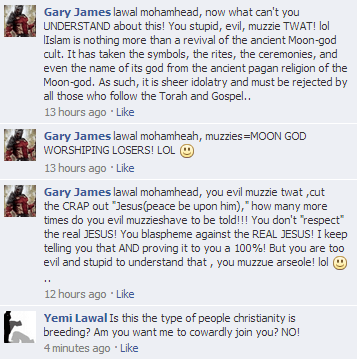
I found this conversation between a Muslim male and an Evangelical Christian on Facebook. One of them is preaching to the other, I’m sure it was one sided, but the abuses contained within are shocking to say the least. 

2  Facebook-083422


To my Muslim brother, I say stay strong, the more this Christian shows the true intents of his religion, the more us Muslims will be able to understand that they do not love us. They hate us and they hate us with a passion. I am sorry that you had to ensure such abuse from a ‘soldier of Christ’, but this is the fruit of Pastor Isang, an ally of ABN TV’s Sam Shamoun and David Wood. If you head to the Christian’s profile, you’d notice his picture is one of a crusader, they were known for massacring Muslims and Jews for a vast amount of their history. In other words, our Muslim Br. Yemi Lawal is being attacked by a Christian who not only hate him, but if provided the opportunity, would hurt him.

May Allaah ta ‘ala protect him from such evil, Ameen.

wa Allaahu ‘Alam.

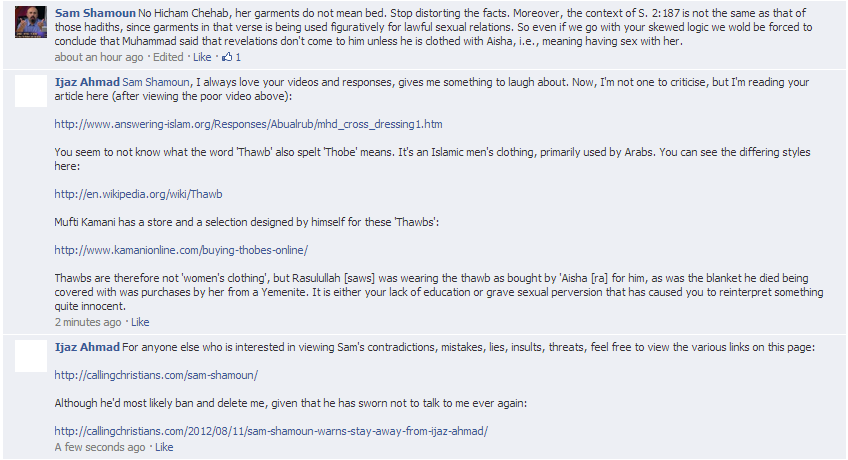
Sam Shamoun, Paul Williams and Insults.

بِسۡمِ ٱللهِ ٱلرَّحۡمَـٰنِ ٱلرَّحِيمِ ,

Yesterday I came across a post by Br. Paul Bilal Williams, a Christian apostate, Islamic convert. You can view that post here. In this post, he claims that Sam Shamoun, an author at Answering Islam had abused and insulted him. In a most professional manner, Paul expressed his discontent with Sam’s behaviour and then he provided the contents of the insult for all to see. Undoubtedly, Sam Shamoun’s intent of perusing a Muslim’s blog, is to further his cause of converting Muslims to Christianity. Despite all the claims of alleged former Muslims writing for his website, none of them have attained the popular status of any Christian convert to Islam’s status. One such example, is that of Paul Williams. Thus, there is often a lot of enmity and disdain that is often cast upon these new Muslims by Sam Shamoun and his ilk. When we read Paul’s response to Sam’s abuse, there is a clear dichotomy, whereas Sam expresses his emotions with curses, abuses and improper public decorum, it’s quite a contrasting event to see Paul’s eloquence, and mild mannered posts in response to such hate. In reading his article about Sam’s abuse, I was reminded of a verse from the Qur’an:

“O you who have believed, whoever of you should revert from his religion – Allah will bring forth [in place of them] a people He will love and who will love Him [who are] humble toward the believers, powerful against the disbelievers; they strive in the cause of Allah and do not fear the blame of a critic. That is the favor of Allah; He bestows it upon whom He wills. And Allah is all-Encompassing and Knowing.” – Qur’an 5:54.

It is striking how true God’s words are. While Sam searches to apostate Muslims, and whether he is successful at this or not has yet to be known, it is apparent that the Christians who do apostate from Christianity and turn to Islam, find themselves loving Islam, loving Allaah, who are humble in character, but their simple words cause great emotional distress for persons like Sam Shamoun. Paul strives in the way of Allaah, by speaking about his new faith and discussing his former faith in public dialogues, he often engages in discussions with Christian laymen on his blog as well, yet he most certainly, as the Qur’an says, he does not fear the blame or abuse of a critic. In this light, Sam Shamoun, his biggest critic, does not affect the temper, the decorum of our beloved brother. This incident, between Paul and Sam, therefore demonstrates the authenticity of God’s pure word as being truthful, while casting a shadow upon Sam’s incredulous nature. In fact, this form of behaviour is repeated in respect to Br. Shabir Ally who openly hugged and greeted Sam. Yet, after Sam’s glowing show of respect to him, he reverted to insulting and abusing Br. Shabir without due cause. Br. Shabir himself has never insulted or abused any Christian speaker, yet Sam saw it fit to do so to him:

Despite his writing against Islam, debating against Islam, alleged studying of Islam, after 10+ years of successive Islamophobia, he has once again proven one more verse of the Qur’an to be true:

And We have certainly diversified [the contents] in this Qur’an that mankind may be reminded, but it does not increase the disbelievers except in aversion. – Qur’an 17:41.

God mentions that those who disbelieve in the Qur’an, increase in their aversion to it, that they are blind to understanding it and they will only increase in being blind to it. After 10+ years of abusing Muslims, and falsely studying the Qur’an, Sam has only persisted in his disbelief, thus proving the Qur’an to be true. How ironic, that the same Qur’an which Sam argues against, describes him and his behaviour, as well as those he fights against, perfectly? It is indeed a telling sign of God’s mercy upon us and of His intimate knowledge of human behaviour.

wa Allaahu ‘Alam.

Refutation: Jesus said that all authority was given to him, … which means that Jesus cannot be God.

بِسۡمِ ٱللهِ ٱلرَّحۡمَـٰنِ ٱلرَّحِيمِ ,

Question:

It is reported in Matthew’s Gospel that Jesus said that all authority was given to him in heaven and earth (cf. Mat. 28:18), which means that someone else gave it to him. That someone else must be greater than Jesus, which means that Jesus cannot be God. After all, how can God be given all authority when he already has it to begin with?

Answer:

Sam’s answer is extremely similar to the others, at this point I’ve decoded the method he’s using:

  1. Claim that the person asking the question does not understand the nature of God.
  2. Claim that God can only exist in a multi-personal form.
  3. Does not prove that God is multi-personal.
  4. Since God is multi-personal, the questioner is wrong.
  5. The answer is that God does have X attribute(s) because questioner is wrong and God is multi-personal.

Therefore, Sam does not necessarily answer the question, as opposed to really denying that there could be a problem while claiming the solution to the question at hand is to repeat as many times as is possible that God is multi-personal. Now, we must understand that if God is multi-personal and for the sake of Sam’s argument I am going to accept this premise, then in order for one ‘person’ to give to another, it would have to mean that one ‘person’ possesses something that the other person does not. Sam does not explain how one person can give another person something he already has, if we are to assume that he already had it.

That is where the problem lies, Shamoun insists that Christ is God, and he claims that God already had authority:

It is true that no one outside of God can give God anything, since God is the One who owns everything and gives his creatures all that they have:

“…the Father, the Son (the Lord Jesus), and the Holy Spirit are all God, even though they are personally distinct from one another.”

“It is true that no one outside of God can give God anything, since God is the One who owns everything and gives his creatures all that they have…”

With the above having been said, if Christ is God, and God already has all possible authority/ dominion over all things, how can one God – person, give another God – person, something they both are already supposed to have. This has several ramifications, namely:

  1. Matthew 28:18 is a lie.
  2. God the Father is a Supreme God and Jesus is a lesser God missing an attribute of Power.
  3. (2) cannot be true since Christ is a full God in the Godhead which means (1) has to be true.
  4. (2) can be true since Sam admits their is a hierarchy and thus gives credence to the possibility of a lesser God.
  5. (1) and (2) can both be true as both the Bible and the Trinity are products of man.

Sam, realising the possibility of his logic being absolutely erroneous, he then tries to reason it out:

But this says absolutely nothing about God’s own inner life and internal communion. For instance, let us assume for the moment that God is a Triune Being, that there are three distinct Persons who exist as one Being. Then passages where Jesus is said to have received something from someone really pose no problem for Trinitarianism since you can have one of the divine Persons granting authority to another, or for one member of the Godhead to be in subjection to another (or to the others). After all, Christ is called God’s Son for a reason, since this relationship implies a subjection of some kind on the part of the Son to the Father. Yet, much like earthly fathers can be greater in authority than their sons without this implying that the sons are inferior beings, the divine Father giving authority to his divine Son in no way implies that the latter is not God or is an inferior Being.

I really wish that Sam would understand the meanings of the words he uses. If each person in the Godhead is co-equal, then one cannot be subject to another, as this implies that they are not co-equal, in other words, that is a contradiction. Therefore either they are co-equal to each other or they are not co-equal and are in a hierarchy. Since Sam accepts that they can be subject to each other, then they are in a hierarchy, with one God being superior to another God person. Since they are not co-equal and one is greater than the other, we can accept that the most superior God has some attribute or numerous attributes to make Him greater than the two lesser gods in the Godhead.

I can prove this, and thus prove that the latter two gods are less superior, as the Bible itself claims that God – the Father, gave another god – Christ, an attribute, the attribute of power. Thus by this verse, Matthew28:18, it subsequently proves that:

  1. Within the Trinity, there is one supreme God – the Father and two lesser gods who lack attributes the Father has.
  2. One attribute which one lesser god – Christ did not have, would have been the authority over heaven and earth which he was then gifted.

Sam then goes on to say:

“Having greater authority doesn’t necessarily mean that the person is greater in essence, or that the one who is in subjection to another is inferior in nature to the other. To assume otherwise is to make a categorical mistake, a category fallacy, treating two distinct categories (nature and authority) as if they were one and same.”

What he does not realise is that God’s nature is to be all powerful, part of being all powerful is also having authority over the heavens and earth. Since it is God’s nature to be all powerful, then it is impossible for God to not have power, also known as authority, over the heavens and earth. Thus if there exists a God which lacks this attribute, this nature, then this God can no longer be considered a God, but a lesser god or if we are monotheists, not a God at all, but subject to the power and authority of an all powerful God. He continues:

“”Then comes the end, when he delivers the kingdom to God the Father after DESTROYING every rule and every authority and power. For he must reign until he has put all his enemies under his feet. The last enemy to be destroyed is death. For ‘God has put all things in subjection under his feet.’ But when it says, ‘all things are put in subjection,’ it is plain that he is excepted who put all things in subjection under him. When all things are subjected to him, then the Son himself will also be subjected to him who put all things in subjection under him, that God may be all in all.” 1 Corinthians 15:24-28

Here is a classic example of how one member of the Godhead can give to another member something without this implying that one of them isn’t God. Note that the Father subjected all things to the Son, and that the Son gives to the Father the kingdom. Christ’s sovereignty and supremacy is clearly seen in this passage since he has the ability to destroy all other powers and authorities, bringing them into complete subjection to the Father. Thus, the Son receiving authority to rule no more disproves that he is God then the Father receiving the kingdom from his Son disproves that he is God also. Another thing to keep in mind is that, according to the Scriptures, Christ voluntarily came down from heaven in order to assume the role of a slave, a servant.”

Sam is assuming that the kingdom in the aforementioned verse does not belong to the dominion of God. This is not the case, what the verse is simply saying is that in the end, all Kingdoms would be ruled by God’s law and not by pagan, infidel (unChristian) leadership. If Sam’s former logic is what he believes to be true, then he accepts that if a nation is not ruled by a Christian under Christian laws, then that nation is not under the power, authority or dominion of God. This would mean that the King of Saudi Arabia, or Barak Obama, or Emir of the UAE were rivals to his God as they have dominion where his God is powerless, therefore Sam’s God is powerless to man. This however, is inconsistent theology, as Sam’s Bible says that all rulers, rule by God’s power, see Romans 13:1-7.

Secondly, I’m not sure whether to laugh, or cry. Shamoun seems to think, and quite absurdly so, that by the Son being able to rule an earthly Kingdom, he is showing that God has the ability to receive authority. Seeing as the Son is an inferior God (as he received authority over all things from a God with all authority over all things), why is Sam then surprised that the Son will eventually rule over a Kingdom? If he is inferior in authority and will gradually assume authority over things that God already has authority over, this does not make him a God, rather it makes him subject to God’s already established and constant power, refer once more to Romans 13:1-7, or Jesus accepting God’s authority over him in John 5:30-31. Sam then decides to prove my point by demonstrating how the inferior god – the Son, obeys commands from a Supreme authority:

While on earth, the Lord Jesus subjected himself to the authority of the Father, doing nothing of his own initiative, but only doing the very thing that the Father commanded and desired:

“And when the ten heard it, they were indignant at the two brothers. But Jesus called them to him and said, ‘You know that the rulers of the Gentiles lord it over them, and their great ones exercise authority over them. It shall not be so among you. But whoever would be great among you must be your servant, and whoever would be first among you must be your slave, even as the Son of Man came not to be served but to serve, and to give his life as a ransom for many.'” Matthew 20:24-28

“For I have come down from heaven, not to do my own will but the will of him who sent me.” John 6:38

“Have this mind among yourselves, which is yours in Christ Jesus, who, though he was in the form of God, did not count equality with God a thing to be grasped, but made himself nothing, taking the form of a servant, being born in the likeness of men. 8And being found in human form, he humbled himself by becoming obedient to the point of death, even death on a cross.” Philippians 2:5-8

Therefore, in conclusion, Sam has openly conceded to the fact that if there is a Trinity and Christ is a member of this Trinity, he is considered to be a lesser god, thereby lacking the attributes of a Supreme God – the Father. Since this is the case, Sam demonstrates the ways in which the Son subjugated himself to the power and will of an authority greater in nature and respect to him, a subject of God’s majesty. It is my understanding then, that Shamoun has not demonstrated Christ’s divinity, but he has demonstrated, and quite clearly so, explicit reasons for Christ’s human nature and lack of credence for Christ’s alleged divine nature.

wa Allaahu ‘Alam.

Refutation: Jesus says that the Father is greater than he is, proving that he is not God.

بِسۡمِ ٱللهِ ٱلرَّحۡمَـٰنِ ٱلرَّحِيمِ ,

Question:

Jesus says that the Father is greater than he is, proving that he is not God. There is no one who is greater than God.

Answer:

Sam introduces the passage upon which the question is based, it reads:

“You heard that I said to you, ‘I go away, and I will come to you ‘ If you loved Me, you would have rejoiced because I go to the Father, for the Father is greater (meizon) than I.” John 14:28

His immediate response is to confuse himself, he says and I quote:

Yet, if God is a Trinity, a Trinitarian Being (i.e. one eternal God existing in three distinct, yet inseparable Persons), then it is quite possible for one member or Person of the Godhead to be greater in some sense than the other members. It would be true that nothing outside of the Holy Trinity’s own existence could ever be greater, but this doesn’t necessarily imply that there cannot be some type of authority structure or ranking within the internal life and relationships of the Trinity itself.

Logically speaking, this form of reasoning is highly fallacious. Since each member of the Godhead is fully God, and God is perfect in each and every way, to have one God being superior to another God, has to mean that the definition and understanding of God has to change. We must accept that God is perfect, one perfect being cannot be superior to another unless one is less perfect than the other. If a being who is assumed to be a God is not absolutely perfect, then this being cannot by very definition, be considered a God. Hence for there to be a hierarchy within the Godhead, we are dealing with one superior God and two lesser Gods. This presents a theological conundrum, as it must be understood that if the first God in the hierarchy is perfect and there is a second God, then this second God is less perfect than the first, thus it logically follows that the third God would therefore be less perfect than both the first and second Gods. With this in mind, it would be best that Sam disuse the premise that their could possibly be a hierarchy within the Godhead. Notwithstanding the evidential fact that the Godhead in itself is polytheistic in nature.

Polytheistic in the sense that if God is one, then in what sense is this God, multi-personal? In what way is God considered a ‘person’ (an individual of specified character)? If I am to believe that God has specific traits, how can God then be multi-personal without increasing or decreasing His traits amongst distinct individuals, exclusive of Himself? Thus, consequentially, by this very description of God being multi-personal (i.e. the nature of the Godhead), God has been relegated to a person among other persons, therefore equating to multiple Gods. Rather, to foster a more comprehensive and accurate understanding of the Godhead in light of personhood, it would equate itself to God with gods. Seeing that I have aptly demonstrated the incredulous nature of a hierarchy within the Godhead and the illogical and polytheistic nature of the Godhead, let’s continue to examine Sam’s fallacious reasoning:

“For now, let us deal with what Jesus intended to convey to his disciples that the Father was greater than he. In the first place, the term for “greater” (Greek – meizon) does not necessarily imply one who is greater in nature or essence. It can refer to someone or something being greater in position and/or authority

Since God’s nature is to be all powerful and all perfect, how does Sam seek to qualify his statement in the response he has given? If God is perfect, then he cannot increase or decrease in position, without losing or gaining Godly traits, thus becoming a lesser God or greater god. Therefore the notion that God increasing or decreasing in position or authority means that it does not affect His nature, is highly erroneous and non-sensible. He continues:

“A careful look at the entire chapter of 14 shows the Lord Jesus claiming to have all of God’s omni-attributes:

“And I WILL DO whatever you ask IN MY NAME, so that the Son may bring glory to the Father. You may ask ME for anything in my name, AND I WILL DO IT.” John 14:13-14

Christ is capable of personally answering all prayers that are directed to him or are addressed in his name. The only way that Christ can both hear and answer all these prayers is if he is both omniscient and omnipotent!”

Sam contradicts himself. At first he claims that their is a hierarchy, now he claims Christ is equal to God. After he has spent a lengthy period demonstrating that the word meizon in Greek can be used to differentiate in power and authority, to promote the understanding that it does not refer to nature (which I have demonstrated is quite ridiculous), he then makes an about turn, negates his previous arguments and tries to demonstrate that Christ is equal to God. This is a sign of a clearly confused individual, trying to reconcile an imperfect doctrine. If Jesus does have all of God’s attributes, then how is he distinct from the person of the Father? Sam’s statement, therefore negates the logic behind the Godhead, well done Sam. On that note, let’s see what the Greek of the verse also indicates. We must be reminded that the Greek of the Biblical text, as with all other languages, has depth. Subsequent to this depth, translations are often consequent to their context. In the case of the Bible, which is a religious scripture, it is quite obvious that the Christian rendition of the text, would attempt to signify Christ’s importance and stature. However, when examining the Greek, as a Muslim, I am able to explore the depth of the text and consider alternate renditions in accordance with the definitions of the words thereby employed. It is with this in mind, that I present an alternate translation based on the Greek of the text:

“And I will do whatever you ask (αιτέω) by (εν) my (μου) authority (ονομα), so that the Son may glorify to the Father. You may ask me for certain things (τίς) by (εν) my (μου) authority (ονομα), and I will do it.” – John 14:13-14, based on the GNT of the Nestle Aland 26th Codex, by way of Strong’s Greek Lexicon.

A Christian would obviously disagree with this rendition because of his presupposed theological views. However, a person who is objective and willing to examine the text for what it is, without biased presuppositions, will be able to accept this English rendition based on the depth of the words used in the verses. This is not perverting the text, as it is normal to find one Biblical verse being rendered in various ways throughout the multitude of Bible translations available to us. In fact, Sam accepts this rendition of the words from the verse used above, as he demonstrates in this article:

I have come in My Father’s name, and you do not receive Me; if another comes in his own name, you will receive him.” John 5:43

Just as the late, renowned NT Greek grammarian and scholar, A.T. Robertson noted in his comments on Matt. 28:19:

… The use of name (onoma) here is a common one in the Septuagint and the papyri for power or authority… (Robertson’s Word Pictures of the New Testamentonline source; underline emphasis ours)

Thus, Sam’s reliance on one translation is very narrow minded and negates other interpretations of the Greek text, which removes Jesus’ alleged assumption of deity. It is clear from the Greek rendition provided above, that Christ is saying he can do only what he can, by which his authority allows him, therefore he is not omnipotent. Sam does say that Christ is capable of answering all of a Christian’s prayers, so I am going to apply the principle of proof by contradiction and challenge Sam to pray to Christ and ask for a unicorn to appear in front of me, as his rendition of the verse claims that you can ask Christ for anything and he would do it. Since this is not true, and a unicorn will not appear, it is then quite understandable that the verse’s rendition and the conclusions of which Sam has derived from it, are highly inaccurate. He continues by appealing to another verse:

“On that day you will realize that I am in my Father, and you are in me, AND I AM IN YOU. Whoever has my commands and obeys them, he is the one who loves me. He who loves me will be loved by my Father, and I too will love him and show myself to him.” John 14:20-21″

Again, with returning to the Greek of the text, Sam’s conclusions can be easily negated:

“On that day you will know that I am before/ wherewith (εν) my Father, and you are before/ wherewith (εν) me, and I am before/ wherewith (εν) you. Whoever has my commandments and obeys them, he is the one who loves me. He who loves me will be loved by my Father, and I too will love him and show myself to him”. – John 14:20-21, based on the GNT of the Nestle Aland 26th Codex, by way of Strong’s Greek Lexicon.

The word “before” is used in the sense that you are in the presence of someone (e.g. I can’t talk now, I’m before the judge), hence the inclusion of the alternate word, wherewith, meaning with a person.This makes the most sense, as Jesus would show himself to those persons and therefore will be before (in the presence of) them and the Lord. Sam makes an interesting interpretation of the verse, he says:

“Christ says that he is IN all the disciples, an impossible claim if he was only a man, or even an angel. But since Jesus is God, and since God is omnipresent, it therefore makes perfect sense for Christ to say he is able to dwell in all the believers at the same time.”

What does he mean that God will be ‘in the disciples’? Does he mean physically? Spiritually? This doesn’t prove Christ’s deity, rather it raises a rather serious theological issue, what does God mean that He will be ‘in’ us? This clearly brings to the forefront, more questions than answers, but if it is one thing Sam’s statements does in this case, it is clearly not proving Jesus’ deity. Sam continues:

“Jesus replied, ‘If anyone loves me, he will obey my teaching. My Father will love him, and WE will come to him and make OUR home with him.’” John 14:23

Both the Father and the Son make their home with all true believers! Christ is clearly claiming co-equality with the Father since he is present with every believer in the same way that the Father is!”

Sam’s logic is that if God accompanies the believers with Christ, then Christ is claiming he is co-equal to the Father. Using Sam’s logic, since the believers are going to be present with the Lord in the same way Christ is present with the Lord, then the believers are all ‘clearly claiming co-equality’ with the Father. Since the latter is nonsensical, how can the former be true? Sam’s logic is clearly infantile, if it cannot work both ways, why does he expect it to work one way? This then, manipulates the full meaning of the text beyond its intended scope. Sam spends the rest of his time trying to equate Christ with the Lord, all of which are easily explained and debunked with employing basic logic and reasoning.

One problem with Sam’s understanding, is that if Sam is promoting the belief that their is a hierarchy, why is he investing so much time into explain ways in which Christ is equal to the Father? Does he not understand how a hierarchy works? By claiming the Father can be greater than the Son, and then demonstrating how the Father is not equal to the Son, Sam is actually contradicting himself. Therefore, in light of Sam’s rivalling explanations, I must ask him, do you believe that the Son is equal to the Father or that the Son belongs in a hierarchy with the Father? The both cannot be true, as either the Son is on par with, or below or greater in rank and authority than the Father. Lastly, Sam claims:

“Thus, the Father was greater in position and rank, not in essence and nature. The questioner is, therefore, committing a categorical fallacy. He/she is confusing the category of position and rank with the category of essence and nature, erroneously assuming that if one is greater in one way, i.e. position and authority, than he/she must be greater in every way, i.e. essence and nature. In light of these clear biblical truths, such is not the case at all.”

Sam’s conclusion is beyond absurd and borders dogmatic arrogance. How can the Father’s rank not describe his essence? How can the Father be greater in rank, but equal in nature? This is like saying, in a track race, the three fastest runners are equal, but the one track runner is first, another second and another third. There clearly is a contradiction in his reasoning and the more he tries to explain it, the more he seems to put his foot in his mouth.

Think of it this way, if the Father is the exact same to the Son in essence and nature, in what way does the Father differ to be superior (greater) than the Son? Sam’s answer is that being greater means that the Son is still the same with the Father, therefore it is either that Sam does not understand the meaning of the word ‘greater’, or the word ‘hierarchy’ or he does not understand the meaning of both those words and the logic behind them. Since this is the case, consider this to be another case of Shamounian logic.

wa Allaahu ‘Alam.

Can Jesus Be the Ultimate Exemplar? [Video]

Bismillahir Rahmanir Raheem
بِسۡمِ ٱللهِ ٱلرَّحۡمَـٰنِ ٱلرَّحِيمِ ,

Mufti Abdur Rahman ibn Yusuf Mangera has an excellent video on the deification of Christ by Christians, wherein he also expounds upon the Islamic view of Jesus. It’s worth the watch, especially since the Mufti is hailed as being one of Islam’s most popular speakers and represents authentic scholarship:

Indepth, education and sensational, this lecture is simply brilliant and very informative for both the Muslim and Christian.

wa Allaahu ‘Alam,
and Allaah knows best.

Sam Shamoun Runs Away from Calling Christians

Bismillahir Rahmanir Raheem
بِسۡمِ ٱللهِ ٱلرَّحۡمَـٰنِ ٱلرَّحِيمِ ,

On the morning of Thursday 25th (2012), I decided to peruse Sam’s Facebook page. I then decided to respond to one of Sam’s intellectually devoid posts:

Unfortunately, Sam decided that he preferred not to respond and chose to delete and subsequently block me from commenting on his page. I see Christians who on a daily basis, run to Shamoun for help, they praise and glorify him, but here he is, running from Muslims. In fact, another Muslim (convert from Christianity), Br. Abdul Khaliq (read his apostasy from Christianity and acceptance of Islam here), who also began to comment on this comment thread was also blocked from further commenting. Why is Sam Shamoun afraid of discussing his beliefs and claims with Muslims? What has he to hide?

To the Christians who appeal to him, what does his behaviour demonstrate to you? Is he ‘defending’ the Gospel by running from his critics and detractors? David Wood (Sam’s buddy) who preaches ‘freedom of speech’ and who swears to defend ‘human rights’, why won’t he teach Sam to allow criticism of his uneducated statements? In fact, directly after Sam deleted my comments, he then posted a barrage of insults, abuses, curses which I have chosen not to reproduce. If you would like to see evidence of his lowly character click this link. In all honesty, I do not know Sam personally, but if this is the way he ‘preaches’,  it explains why so many Christians who have never heard Muslim arguments, come to our pages and for the first time experience a real discussion. Sam’s gestapo – like tactics can only benefit Muslims, as these same Christians of whom he shelters on his page, try to take his arguments elsewhere and are then soundly debunked, opening their hearts and minds to Islam.

Br. Abdul Khaliq is just one of many Christians who have apostated from that faith, even though they were blocked from Islam by Christian preachers like Sam, but praise be to God who gave them guidance out of the darkness they were enshrouded within. Please do see these links for further responses to Shamoun:

wa Allaahu Alam,
and Allaah knows best.

Luke 13:33 and Sam Shamoun

Bismillahir Rahmanir Raheem
بِسۡمِ ٱللهِ ٱلرَّحۡمَـٰنِ ٱلرَّحِيمِ ,

One of Br. Shabir Ally’s most famous arguments is derived from Luke 13:33, you can see him using it in this debate:

Sam Shamoun did a response to it along with a few other responses to Br. Shabir. Today I’d like to examine Sam’s ‘explanation’ and to analyse his statements, judging to see whether he has or has not rectified this theological conundrum. Sam begins by saying:

Shabir thinks that this verse is a contradiction and even proves that Jesus wasn’t killed:

“Nevertheless I must journey on today and tomorrow and the next day; for it cannot be that a prophet would perish outside of Jerusalem.”

Shabir assumes that this text clearly contradicts the fact that Jesus was crucified outside of Jerusalem.

Br. Shabir did not assume, he simply read the verse and utilized it’s clear meaning, for as Jesus allegedly says, “it cannot be that a prophet would perish outside of Jerusalem“. Meaning then, that a Prophet can only die in Jerusalem. Sam tries to answer this by stating:

In the first place, Jesus clearly says that he will be killed outside of Jerusalem:

Clearly then, Jesus contradicts his own words. His response doesn’t begin by refuting Br. Shabir’s argument, he actually initiates his explanation by debunking his own God. Brilliant work Sam. He then cites this verse and uses it as evidence that Jesus allegedly said that he would die outside of Jerusalem:

But when the tenants saw him, they said to themselves, “This is the heir; let us kill him, that the inheritance may be ours.” And they cast him out of the vineyard and killed him. What then will the owner of the vineyard do to them? He will come and destroy those tenants, and give the vineyard to others.’ When they heard this, they said, ‘God forbid!’” Luke 20:9-16

The tenants refer to the Jewish leaders and the vineyard refers to Jerusalem. In this parable, Jesus says that he, as the beloved Son, will be thrown out of the vineyard and then be killed. To put it another way, Jesus was saying that the Jewish leaders would have him killed outside of Jerusalem.

Now, I’m not sure if Sam really thought this explanation through, or if he is actively working to disprove the veracity of Christianity. There are a number of problems with Sam’s referencing and subsequent use of the aforementioned passage. Namely, that according to the parable the “Jews/ Tenants” would kill the “heir/ Jesus” for the “inheritance” and as a cause of this, the “Jews/ Tenants” would be destroyed. If Jesus came to die and the Jews fulfilled this purpose, according to this parable, God would have to kill the people that He sent to kill His son. Which is a problem, if Jesus came to die and the Jews fulfilled this purpose, why would God be angry at them? Secondly, if the “inheritance” here is the “gift of salvation”, shouldn’t God/ the Owner, be happy that they killed His son?

If I were for a moment to neglect Sam’s incompetence of dismantling his own doctrine, and to accept that Jesus predicts his death, according to Luke 13:33, shouldn’t he be killed in Jerusalem? Therefore this verse contradicts Jesus’ own words and presents severe theological faults with Christianity. Since this is the case, a methodological reinterpretation/ reading of Luke 13:33 must be undertaken to mask this scriptural blunder. Sam continues:

Now we anticipate that Shabir will say that this doesn’t resolve the problem and will wish to say that this only contradicts what Jesus said in Luke 13:33. Does it? Let us read the immediate context and see:

“Just at that time some Pharisees approached, saying to Him, “Go away, leave here, for Herod wants to kill You.’ And He said to them, ‘Go and tell that fox, “Behold, I cast out demons and perform cures today and tomorrow, and the third day I reach My goal.” Nevertheless I must journey on today and tomorrow and the next day; for it cannot be that a prophet would perish outside of Jerusalem. O Jerusalem, Jerusalem, the city that kills the prophets and stones those sent to her! How often I wanted to gather your children together, just as a hen gathers her brood under her wings, and you would not have it! Behold, your house is left to you desolate; and I say to you, you will not see Me until the time comes when you say, “BLESSED IS HE WHO COMES IN THE NAME OF THE LORD!”’” Luke 13:31-35

Luke 13 references Matthew 23 wherein it reads:

“Jerusalem, Jerusalem, you who kill the prophets and stone those sent to you, how often I have longed to gather your children together, as a hen gathers her chicks under her wings, and you were not willing. 38 Look, your house is left to you desolate.  For I tell you, you will not see me again until you say, ‘Blessed is he who comes in the name of the Lord.’”

According to these passages, the Jews of Jerusalem kill the prophets and those sent to them. Yet, Jesus was not killed by Jews or by those of Jerusalem, but by the hands of Romans, another strange predicament (as Sam later admits, Jesus died by the Gentiles and not the Jews). More interestingly, Jesus allegedly predicts that Jerusalem would welcome him as blessed and as one who has come in the Name of the Lord, yet there is no such realization according to any of the Synoptic gospels, therefore Jesus’ death is inconsistent with this prophecy, as it has yet to be fulfilled. Sam continues:

We can glean from the immediate context that Jesus was addressing the Jews who warned him about Herod’s threat. Jesus responds by basically saying that Herod can’t do anything against him since he has a goal to reach Jerusalem, and once there he will die. Now from this context we can see that Jerusalem stands for the Jewish leaders, in contrast to Herod, who will kill Jesus just as they killed the other prophets. Obviously, Jerusalem didn’t literally kill the prophets but its leaders and people did. This serves to affirm that Jesus’ point was that Herod wouldn’t be the one to condemn him to death, but the members of the Sanhedrin who were in Jerusalem.

According to Sam himself, Jesus was to die in Jerusalem and by the hands of the Jews, which he later disagrees with and argues against in his later discussion. Interestingly Sam then tries to validate his eisegesis by appealing to another false prophecy:

This is reiterated in the Matthaean parallel:

“Woe to you, scribes and Pharisees, hypocrites! For you build the tombs of the prophets and decorate the monuments of the righteous, saying, ‘If we had lived in the days of our fathers, we would not have taken part with them in shedding the blood of the prophets.’ Thus you witness against yourselves that you are sons of those who murdered the prophets. Fill up, then, the measure of your fathers. You serpents, you brood of vipers, how are you to escape being sentenced to hell? Therefore I send you prophets and wise men and scribes, some of whom YOU will kill and crucify, and some YOU will flog in your synagogues and persecute from town to town, so that ON YOU may come all the righteous blood shed on earth, from the blood of innocent Abel to the blood of Zechariah the son of Barachiah, whom YOU murdered between the sanctuary and the altar. Truly, I say to you, all these things will come upon this generation. O Jerusalem, Jerusalem, the city that kills the prophets and stones those who are sent to it! How often would I have gathered your children together as a hen gathers her brood under her wings, and you would not! See, your house is left to you desolate. For I tell you, you will not see me again, until you say, ‘Blessed is he who comes in the name of the Lord.’” Matthew 23:29-39

According to Sam’s quote, when Jesus accuses the Pharisees of murdering someone in Jerusalem, they literally killed someone in Jerusalem. That is to say Zechariah, who died within the physical delimitations of Jerusalem. So specific was Jesus’ statement, that he mentions the exact place of murder within Jerusalem, between the sanctuary and the altar:

God’s anger came on Judah and Jerusalem Although the Lord sent prophets to the people to bring them back to him, and though they testified against them, they would not listen. Then the Spirit of God came on Zechariah son of Jehoiada the priest. He stood before the people and said, “This is what God says: ‘Why do you disobey the Lord’s commands? You will not prosper.Because you have forsaken the Lord, he has forsaken you.’” But they plotted against him, and by order of the king they stoned him to death in the courtyard of the Lord’s temple. – 2 Chronicles 24.

Therefore when Jesus refers to dying in Jerusalem, he is referring to actually being killed within Jerusalem, as he himself states. Sam however, doesn’t realise this and foregoes the mentioning of a physical death within the city itself, instead he meanders off and misapplies the statements of Christ:

What Jesus was basically saying is that he could not be condemned to death by anyone other than the Jewish leaders. Jesus was obviously using Jerusalem as a metaphor for its leaders, personifying the city and blaming it for the bloodshed caused by its people, since the city is being identified with its people, specifically the Sanhedrin.

Sam seems to forget that while the Jews did vote to have Jesus ‘killed’, it was actually Pontius Pilate who accepted their vote (he did not have to) and Jesus himself was not killed by the hands of a single Jew, but by Roman soldiers. It should also be known that Sam emphasises that the city is being identified with its people, the Jews. Yet according to the crucifixion events, no blood was spilled by the Jews themselves, but by outsiders, the Romans, which according to Matthew 23 is a misapplied prophecy, as the previous deaths were literally done by the Jews. Sam then appeals to confirmation bias by running to a commonly used Christian exegesis which he quotes:

As noted Bible expositor John Gill stated:

for it cannot be that a prophet perish out of Jerusalem;
because the great sanhedrim only sat at Jerusalem, to whom it belonged to try and judge a prophet; and if found false, to condemn him, and put him to death; the rule is this;

“they do not judge, neither a tribe, nor a false prophet, nor an high priest, but by the sanhedrim of seventy and one.”

Not but that prophets sometimes perished elsewhere, as John the Baptist in Galilee; but not according to a judicial process, in which way Christ the prophet was to be cut off, nor was it common; instances of this kind were rare, and always in a violent way; and even such as were sentenced to death by the lesser sanhedrim, were brought to Jerusalem, and publicly executed there, whose crimes were of another sort; for so runs the canon;

“they do not put any one to death by the sanhedrim, which is in his city, nor by the sanhedrim in Jabneh; but they bring him to the great, sanhedrim in Jerusalem, and keep him till the feast, and put him to death on a feast day, as it is said (Deuteronomy 17:13) “and all the people shall hear and fear.””

And since Jerusalem was the place where the prophets were usually put to death, …

FOOTNOTES:

F5 Misn. Sanhedrin, c. 1. sect. 5. & T. Bab. Sanhedrin, fol. 18. 2.
F6 Misn. Sanhedrin, c. 10. sect. 4.   (Source)

John Gill’s explanation would work if it is that Zechariah’s death occurred outside of Jerusalem, however the citing by Jesus of Zechariah’s death within the city of Jerusalem, draws a parallel between his alleged death and Zechariah’s. Since this is the case, Gill’s explanation ignores this prophecy and negates, or rather, corrects Jesus’ statement. Therefore Sam, has to choose whether Jesus’ parallel with Zechariah’s death in Jerusalem is accurate or it’s inaccurate and Gill’s exposition is superior to his Lords words.

Jesus essentially affirmed this very fact, namely, that the Sanhedrin would condemn him to death, elsewhere in Luke’s Gospel:

“But He warned them and instructed them not to tell this to anyone, saying, ‘The Son of Man must suffer many things and be rejected by the elders and chief priests and scribes, and be killed and be raised up on the third day.’” Luke 9:21-22

It is evident that at this point Sam had lost the plot and began to imagine things. This verse does not foretell that the Sanhedrin would condemn Christ to death, rather it says they would reject him. Unless rejection means death, I am quite certain that Sam is making stuff up. Not that I expected any better from him. He continues:

“Then He took the twelve aside and said to them, ‘Behold, we are going up to Jerusalem, and all things which are written through the prophets about the Son of Man will be accomplished. For He will be HANDED OVER TO the Gentiles, and will be mocked and mistreated and spit upon, and after they have scourged Him, they will kill Him; and the third day He will rise again.’” Luke 18:31-33

The Sanhedrin handed Jesus over to the Gentile rulers who then mocked, mistreated, spat, scourged and killed him by crucifixion. Note the process that takes place. The Sanhedrin condemned Jesus as worthy of death, but since they couldn’t kill him themselves they proceeded to hand him over to those who had the authority to do so.

There are several problems with Sam’s explanation:

  • According to the parable about the vineyard, Jesus was to be killed by the tenants, i.e. the Jews, yet Sam concedes that this is not the case and Jesus was actually killed by the Romans.
  • According to the paralleling of Jesus’ life with Zechariah’s, Jesus was to be killed by Jews through the command of a Gentile leader in Jerusalem, rather Sam is saying Jesus was killed by Gentiles through the command of Jews outside of Jerusalem. In other words, he inverts the prediction completely to make it remotely applicable to Christ.
  • According to Jesus’ own words, Jews were to kill him, i.e. the people of Jerusalem in Matthew 23, however as Sam concedes, this is not the case as the Romans (those not from Jerusalem) killed him instead.

Every evidence that Sam has used to bolster the case for the validity of Luke 13:33 has therefore backfired on him, proving his arguments and by consequence, his scripture, to be unreliable, inconsistent and ridiculous. Sam continues:

It is therefore obvious from the preceding that there is no contradiction in the words of Jesus, but only Shabir’s misunderstanding of what Jesus meant when he referred to not perishing outside of Jerusalem. Jesus wasn’t using Jerusalem to refer to the city, but to its people, specifically to its leaders who condemned him to die.

Mr. Shamoun’s best conclusion and explanation, is to then correct Jesus’ words. Apparently, since Jesus did not say it, Sam has to say what his God could not, that Jesus wasn’t referring to Jerusalem when he said Jerusalem, but to the people of Jerusalem. This presents several problems:

  1. Why didn’t Jesus say that?
  2. If that is the case, why did Jesus say ‘Jerusalem’ and specify the Jews of ‘Jerusalem’ in Matthew 23?
  3. Lastly, those who killed Jesus were Romans, not Jews.

Sam, understanding that he has exhausted all laughable excuses, then proceeds to make one last ditch effort. Apparently ‘Jerusalem’, does not mean Jerusalem. According to Sam, ‘Jerusalem’, means, ‘a couple days distance from Jerusalem’, or in other words, Jerusalem is supposed to mean, ‘not Jerusalem’:

But even if we were to assume that Jesus was referring to the city, and not to its leadership, Shabir still has no case. As we noted, Jesus’ statements are made in a particular context, standing in Galilee, being informed by others about Herod’s intention of killing him, and says he must first go to Jerusalem. That is his purpose, and not even Herod will keep him from getting to Jerusalem and being put on trial there. Jesus isn’t talking about his exact execution place. From the perspective of standing in Galilee, in a different province, several days journey away from Jerusalem, just outside the city wall was still Jerusalem. Moreover, every city always has some land around it that belongs to the city.

Jesus draws a parallel between him and Zechariah. Jesus specifies the exact place of Zechariah’s death in Jerusalem, for which he then condemns the Jews for. Strangely, Sam is saying that Jesus did not specify his exact dying place. Yet Jesus not only explicitly mentions ‘Jerusalem’, he does so more than once and in the one event he drew a parallel, the very story he narrates is of a death within Jerusalem. Therefore Sam’s case has been proven to be inconsistent by Jesus himself. He continues:

Finally, that a text such as Luke 13:33 remains intact within the Holy Bible is an argument for the Scriptures’ veracity. It shows that Christian scribes, for the most part, tried to preserve the Scriptures as best as they could, no matter what difficulties a text may have posed to their theology and understanding.

Sam still has not clarified why Jesus, a prophet, could have died outside of Jerusalem, when he (Jesus) clearly indicated otherwise. Sam’s attempt to redefine, reinterpret and correct his God’s words are not only laughable, but this demonstrates that this is a difficulty of which the Christian faith cannot cope. Sam’s explanations can therefore be summarized as:

  • Jerusalem does not mean Jerusalem but outside of Jerusalem.
  • Death by the Jews does not mean ‘death by the Jews’, but by gentiles.
  • God kills the people for killing the Son which He sent to get killed.

None of these answer the theological conundrum of Jesus’ statement being wrong/ the Bible having a scriptural problem, but rather Sam’s explanation exacerbates the problems of the Christian text and the difficulties associated with answering Luke 13:33.

wa Allaahu ‘Alam,
and God knows best.

John 5:23 – The Sweetest Trinitarian Honey!

Visiting the darling Trinitarian argument from a neutral perspective.

Question Mark

Introduction

One of the best argument which a Trinitarian would brandish in support of Jesus’ (peace be upon him) deity is the appeal to John 5:23. The flagrantly high “Christology” in the youngest of all gospels – the gospel of John – has in it Jesus (peace be upon him) asserting that he is to be honored “just as” the Father.

Under most circumstances, Trinitarians would love to use it to worship a mere man; however, this could be done after comfortably neglecting or rejecting the (i) immediate and (ii) overall context of the Bible and (iii) the contemporary prevailing beliefs of “orthodox” Christians.

Once the verse is seen in its proper perspective either, Jesus (peace be upon him) could not be deified unless otherwise resorted to slanted exegesis; or, multiple mere mortals would also have to be deified, accordingly!

With that said, let us test the viability of one of the best Trinitarian argument!

Honor the Son in the “same way” as Father

 The following is the text used as a proof to deify Jesus (peace be upon him):

Nor does the Father himself judge anyone. He has given his Son the full right to judge, so that all will honor the Son in the same way as they honor the Father. Whoever does not honor the Son does not honor the Father who sent him. (John 5: 22-23, Good News Bible)

The following transliteration of the video clipping would prove how desperately Trinitarian apologists have been mishandling the above verse towards their polytheistic agenda:

“Why did the Father appointed his Son to be the Judge of all? All creation, all flesh. Here is the answer. Here is the reason from the lips of Jesus Christ our Lord; from the very chapter that Zakir Naik misquoted – that all my honor the Son just as they honor the Father. Let me just stop here for a moment. Notice what the Lord Jesus Christ did not say. He did not say, “the reason why the Father appointed me judge is so that everyone honors me as a prophet”. That’s not what he said. He didn’t say, “that the reason why I have been appointed judge of all is so that you can honor me as you honor the righteous or your parents or a messenger. No, he says, the reason why I judge everyone is so that everyone honors me in the same way they honor the Father. ” (Shamoun Time 07:24 – 08:14)

Before we dissect the argument for closer examination, we will make certain very important observations from the above adduced verse. These observations would sufficiently allude that the otherwise obvious “Christology” (for Trinitarians) of the verse, is not, in reality that obvious!

Observe that Jesus (peace be upon him) is to be honored the “same way” as God for the following two reasons:

1.      Father (God) has made or appointed Son (Jesus, peace be upon him) to judge on His behalf on this Earth. In other words, Jesus (peace be upon him) would be representing God’s sovereignty in this world, he has been given that privilege. In other words, the attribute of judging does not come intrinsically from him. Consequently, elsewhere in the Bible such a deferred privilege is portrayed as a non-divine act of Jesus (peace be upon him):

“If people hear my message and do not obey it, I will not judge them. I came, not to judge the world, but to save it. Those who reject me and do not accept my message have one who will judge them. The words I have spoken will be their judge on the last day! This is true, because I have not spoken on my own authority, but the Father who sent me has commanded me what I must say and speak. And I know that his command brings eternal life. What I say, then, is what the Father has told me to say.” (John 12: 47-50)

Moreover, New Testament also declares that mere Christian believers would also judge on the judgment day! This further proves that judging others was not a task to deify a candidate.

2.      Also observe that Jesus (peace be upon him) has been “sent” by Father; he was commissioned into this world. This particular act of “sending” somebody has the imports of non divine prophet-hood on the one who is send. Moreover, in biblical context such a commissioned person is yet again portrayed as somebody lesser than God. Consider the following few verses regarding Jesus (peace be upon him) as substantiation for this notion:

“Jerusalem, Jerusalem! You kill the prophets and stone the messengers God has sent you! How many times I wanted to put my arms around all your people, just as a hen gathers her chicks under her wings, but you would not let me! (Matthew 23:37)

Jesus saith unto them, My meat is to do the will of him that sent me, and to finish his work. (John 4: 34)

I can of mine own self do nothing: as I hear, I judge: and my judgment is just; because I seek not mine own will, but the will of the Father which hath sent me. (John 5:30)

Jesus answered them, and said, My doctrine is not mine, but his that sent me. (John 7:16)

And he that sent me is with me: the Father hath not left me alone; for I do always those things that please him. (John 8:29)

(King James Version)

This gives us a good picture that neither (i) judging on behalf of God as His representative nor (ii) being the one sent by God can be treated as divine phenomenon and yet we find our subject phrase – to honor Son just as Father – smack dab at the middle of  mutually opposing clauses – the two non-divine functionalities or attributes.

Therefore it still has to be enquired why the controversial subject phrase was placed in between two necessarily non-divine context. The answer to this query was “shadowed” in the Old Testament!

The way the Old Testament portrays its Prophets

Trinitarians would accept that Jesus (peace be upon him) was not merely a New Testament “God” but he was also a messianic prophet; a Davidic prophet; a royal prophet (c.f. Matthew 1:1, 17, 9:27, 13:55-57, 21: 5-9, 10-11, 45-46. Luke 1:30-32, 13:32-33, 24:18-19, John 6:14, Acts 2:22, 30)

So whatever was attributed and applicable to the Old Testament prophets, especially those who were Davidic and royal, could be applied at par for Jesus (peace be upon him) as well!  With that said let us observe very closely how the Old Testament portrayed its prophets and what was attributed to them.

1.      Davidic royal Prophets were required to be worshipped:

“Then David said to the whole assembly, ‘Bless Yahweh your God.’ And the whole assembly blessed Yahweh, the God of their fathers, and bowed their heads low and worshipped Yahweh AND the king (wayyiqadu wayyishtahawu YHWHW walammelek).” (1 Chronicles 29: 20)

“You have delivered me from the strivings of the people; You have made me the head of the nations; A people I have not known shall serve me (ya’abduni). As soon as they hear me they obey me; The foregners submit to me.” (Psalm 18: 43-44)

“Give the king your justice, O God, and your rightenouness to the royal son!…May desert tribes bow down before him, and his enemies lick the dust! …May all kings fall down before Him (wayishtahawulow); May all nations serve Him (ya’abduhu).” (Psalm 72:1,9, 11)

They will serve(wa’abadu) Yahweh their God AND David their king whom I will raise up for them.” (Jeremiah 30:9)

Notice the construction of the Old Testament “verses”: It has instructed its believers to worship and serve Yahweh and the prophet(s) in the same breath.

The “verses” do not make any qualification that God is to be worshipped the way befits Him and the worldly kings are to be honored the way which suits the mortals. In fact it does not even differentiates the word – it uses the same word “worship” while referring to both God “and” mortal kings.

Furthermore, observe the Hebrew words used for worship (and services) and compare them with the following words as used while referring to Yahweh. They are either identical or a derivative of the root word:

Serve (‘ibdu) the Lord with fear, And rejoice with trembling. Psalm 2:11

Serve (‘ibdu) the Lord with gladness; Come before His presence with singing. Acknowledge that Yahweh is God. He made us, and we are His—His people, the sheep of His pasture.” Psalm 100:2-3

“All nations whom You have made Shall come and worship (wayishtahawu) before You, O Lord (adonay), And shall glorify (wikabbadu) Your name.” Psalm 86:9

“‘From one New Moon to another and from one Sabbath to another, all flesh will come and bow down (lahishtahawot) before Me,’ says Yahweh.” Isaiah

Thus, we see that the Old Testament had a peculiarly high “prophetology” for its prophets. They were to be “worshipped” alongside Yahweh (“and”) and to express this notion Hebrew Bible uses the same root word which it uses for Yahweh.

2.      Mere prophets were praised “just as” Yahweh

The Old Testament requires its believers to exalt and praise Yahweh,

“Give to Yahweh, O families of the peoples, Give to Yahweh glory (kabod)and strength. Give to Yahweh the glory (kabod) due His name; Bring an offering, and come into His courts. Oh, worship (hishtahawu) Yahweh in the beauty of holiness! Tremble before Him, all the earth. (Psalm 96:7-9)

Let the peoples praise You, O GodLet all the peoples praise You. Oh, let the nations be glad and sing for joy! For You shall judge the people righteously, And govern the nations on earth. Selah Let the peoples praise You, O God; Let all the peoples praise You. Then the earth shall yield her increase; God, our own God, shall bless us. God shall bless us, And all the ends of the earth shall fear Him.” (Psalm 67:3-7)

Yet it also requires that mere prophets be also exalted and praised:

His glory (kabodo) is great in Your salvation; Honor and majesty You have placed upon him. For You have made him most blessed forever; You have made him exceedingly glad with Your presence.” (Psalm 21:5-6)

“So the King will greatly desire your beauty; Because He is your Lord (adonayik), worship Him (wahishtahawilow)… I will make Your name to be remembered in all generations; Therefore the people shall praise You forever and ever. (Psalm 45:11, 17)

Notice that it is not merely the usage of same Hebrew words (“Kobodo”) for glorifying prophets as was used for Yahweh but that the last verse even requires its followers to praise a mere king “forever and ever” – something which falls in the genre of divinie praise! We do not “kobod” (praise) mere mortal prophets “forever and ever”, yet, biblically these are allowed phrases without breaching its brand of monotheism.

3.      Mere prophets sharing the same title with Yahweh

In the same adduced Psalm verse (45:11, above) notice that Davidic prophet(s) was referred as “Lord” using the Hebrew word “adonayik”. Comparatively, the same word is elsewhere used for Yahweh as well:

Thus says your Lord (adonayik), Yahweh and your God, Who pleads the cause of His people: ‘See, I have taken out of your hand The cup of trembling, The dregs of the cup of My fury; You shall no longer drink it.’” Isaiah 51:22

Thus we have instance where Yahweh – the “God” of the Bible – has even shared his title with mere mortals. No wonder, Yahweh is also portrayed as sharing his throne as well:

Prophets on the Throne of God Himself:

Then Solomon sat on the throne of the Lord as king instead of David his father; and he prospered, and all Israel obeyed him. All the officials, the mighty men, and also all the sons of King David pledged allegiance to King Solomon. The Lord highly exalted Solomon in the sight of all Israel, and bestowed on him royal majesty which had not been on any king before him in Israel.” (1 Chronicles 29:23-25)

“Blessed be the Lord your God who delighted in you, setting you on His throne as king for the Lord your God; because your God loved Israel establishing them forever, therefore He made you king over them, to do justice and righteousness.” (2 Chronicles 9:8)

All of the above Old Testament verses by allowing its prophets,

  1. To be “worshipped” alongside Yahweh,
  2. To be glorified  just as Yahweh,
  3. To share same title as Yahweh,

creates good ground for correct and congenial interpretation of John 5:23. In the backdrop of foregoing Old Testament verses if Jesus (peace be upon him) asserted that son is to be honored “just as” Father then he had the Old Testament pretext in which he was asserting! He knew that the Jewish traditions allow that mere prophets be “worshipped”, “glorified” alongside Yahweh “just as” He is worshipped and glorified. Similarly, Jesus (peace be upon him) even knew that Old Testament prophets even shared Yahweh’s titles to their end and yet none of it violated any Old Testament monotheism.

Therefore, if Jesus (peace be upon him) supposedly demands “same honor” with Father then it could not possibly be taken to establish divinity for Jesus (peace be upon him) given the Old Testament framework. Yet if Trinitarians want to do it then either (i) they want to reject the overall Old Testament context in which Jesus (peace be upon him) was speaking or (ii) they have to deify multiple Old Testament prophets (or at least the royal, Davidic prophets for that reason)!

The problem does not end here with the best-argument. Consider the following section.


What did Jesus (peace be upon him) do with the “honor” he demanded? 

Even if we reject all of the Old Testament pretext to claim that because Jesus (peace be upon him) demanded “same honor” with Father, therefore, he must be divine; yet it does not help the Trinitarian agenda in any way since it is very interesting to observe what Jesus (peace be upon him) later did with the “honor” – the so assumed “divine” honor – once it was vested on him. In the following passages we explore it.

Later in the same gospel, towards the end of his life, Jesus (peace be upon him) picks up the topic of his honor and glory once again. In fact John dedicates an entire chapter towards the honor and glory of Jesus (peace be upon him). We pick it up from there:

John portrays Jesus (peace be upon him) demanding the glory which he had initially – even before the world was ever made:

After Jesus finished saying this, he looked up to heaven and said, “Father, the hour has come. Give glory to your Son, so that the Son may give glory to you. I have shown your glory on earth; I have finished the work you gave me to do. Father! Give me glory in your presence now, the same glory I had with you before the world was made. (John 17: 1, 4-5)

Trinitarian exegetes are unanimous upon it that the primordial glory of Jesus (peace be upon him) was particularly divine!

However, later in the same chapter, after praying for his followers, Jesus (peace be upon him) interestingly (or embarrassingly) gave away the same glory to his multiple disciples:

“I pray not only for them, but also for those who believe in me because of their message. I pray that they may all be one. Father! May they be in us, just as you are in me and I am in you. May they be one, so that the world will believe that you sent me. I gave them the same glory you gave me, so that they may be one, just as you and I are one: (John 17: 20-22)

Observe it once again that Jesus (peace be upon him) gave his followers the “same glory” which God vested on him. Don’t forget, verses 4 and 5 informed us that, according to Trinitarian exegesis, Jesus (peace be upon him) was seeking his “divine” primordial glory from Father!

Acknowledging the “high” status of followers, Trinitarian commentators have following to remark:

John 17:22  The glory which thou hast given me, I have given them – The glory of the only begotten shines in all the sons of God. How great is the majesty of Christians. (John Wesley’s Explanatory Notes, John 17:22)

Notice the Wesley’s exclamatory note towards the end of his comment. He exclaims about the extra high esteemed status of Christians – why? Because they enjoy thesame glory which Christ (peace be upon him) was conferred with for being the “only begotten” of the God!

It is very disturbing that within the purported realms of “monotheistic” Christianity, the supposed divine and special glory of the alleged Trinitarian god is shared with multiple mere mortals!

Another set of Trinitarian Scholars – Matthew Henry – go a step ahead of John Wesley to claim more divine qualities and positions for mere mortals which assumedly befits Christ (peace be upon him) alone:

Those that are given in common to all believers. The glory of being in covenant with the Father, and accepted of him, of being laid in his bosom, and designed for a place at his right hand, was the glory which the Father gave to the Redeemer, and he has confirmed it to the redeemed. (Matthew Henry’s Commentary on the Whole Bible, John 17:20-23)

As a proof for Jesus’ (peace be upon him) divinity, Trinitarians down the ages have been appealing to the biblical verses wherein Jesus (peace be upon him) is portrayed as “laid in God’s bosom” and “at His right hand”.

The “right hand” of the God is an exclusive, divine place suitable only for Christ (peace be upon him) appeals most Trinitarians, nevertheless, we saw above thatTrinitarian scholars had no scruple into vesting these “divine” status on mere mortals implying either (i) the “glory” of Jesus (peace be upon him) was not divine or (ii) there are numerous individuals in Trinitarian Christianity enjoying such “glory”!

Furthermore, honor of being the “redeemer” of the entire world has to be divine at least in the Trinitarian parlance yet Trinitarian scholars confirm it on multiple mere creatures! This once again establishes that honor of Jesus (peace be upon him) although special and prized but was not divine.

The problem with the best argument continues…


 Earliest “Orthodox” Beliefs 

We are now to the very last argument against Trinitarian misuse of John 5:23. In this section we would consider the writings of earliest, “orthodox”, church father Ignatius. Remember that Ignatius is as old as contemporary to gospel of John and a student of John himself!

Consider then what Ignatius had to portray about the “orthodox” belief system of theearliest Christians regarding the status of church bishops:

“Be subject to the bishop as to the commandment” (Ign. Trall. 13.2)

We are clearly obliged to look upon the bishop as the Lord himself” (Ign. Eph. 6.1)

Since the mortal “bishops” were to be seen as “Lord” himself and their commandments were to be treated at par with the Laws of Yahweh, Ignatius of Antioch gave no religious freedom to the laity:

“You should do nothing apart from the bishop” (Ign. Magn. 7.1)

On the preceding, New Testament authority Bart Ehrman rightly asserts the following:

Each Christian community had a bishop, and this bishop’s word was LAW [Mosaic]The bishop was to be followed as if he were God himself. (Bart Ehrman, Lost Christianities, p.141)

Even if we neglect that the writings of the earliest, “orthodox” church father – Ignatius as outright polytheistic yet it can still be used to fathom the then prevailing state of affairs with regards to the status of celebrated people inside church walls. If mere church bishop(s) can be viewed as “God himself” then we do not see much appeal if “Jesus” (peace be upon him) – the supposed “head of the Church” demanded merely “same honor” with Father! It was just part and parcel and legacy of “orthodox” Christianity.

Therefore, to declare Jesus (peace be upon him) as God – Almighty just because somewhere he had allegedly demanded “same honor” with Father comes more as an act desperation in the wake of absence of conclusive proofs.

Christians could not conveniently brush aside Ignatius’ writings since (i) he is the very prototype of all “orthodox” Christians (ii) a student of John (the evangelist) himself and most importantly (iii) he – the “Saint” Ignatius – considered his words to be divinely inspired. Check this out:

For even if some people have wanted to deceive me according to the flesh, the Spirit is not deceived, since it comes from God. For it knows whence it comes and where it is going, and it exposes the things that are hidden. I cried out while among you, speaking in a great voice, the voice of God, “Pay attention to the bishop and the presbytery and the deacons!” But some suspected that I said these things because I knew in advance that there was a division among you. But the one in whom I am bound is my witness that I knew it from no human source; but the Spirit was preaching, saying: “Do nothing apart from the bishop; keep your flesh as the Temple of God; love unity; flee divisions; be imitators of Jesus Christ as he is of his Father.” (Ign. Phil., 7)


Conclusion 

Our concern was to understand if there is any viability in one of the most celebrated Trinitarian argument in support of Jesus’ (peace be upon him) deity, namely, John 5:23.

In the very first place we saw that the subject verse of honoring son just as Father was placed amidst two mutually opposing phrases which essentially portray Jesus (peace be upon him) in a non divine light.

Later we realized that let alone Jesus (peace be upon him) demanding (merely) “same honor” with Father, Old Testament prophets had centuries ago enjoyed colossal privileges than that. In it, (i)they were to be worshipped alongside Yahweh (ii) they were to be glorified “same as” God so much so that (iii) they were to even share the titles and throne of God – Himself with Bible making no distinction in the construction of the sentence or the choice of words in any of the above! Furthermore (iv) contemporary (to New Testament), “orthodox” church writings declare mere Christian believers in church offices to be looked upon as “God himself” and their fleeting sayings at par with Yahweh’s own words!

If there is a lot of Trinitarian hue and cry over Jesus (peace be upon him) demanding “same honor” with God then, on the preceding biblical proofs, there should be even greater voices raised for worshipping numerous Old Testament prophets and multiple church bishops in various parts of the world and down the ages.

With that said, we request Christians to look upon the alleged Jesus’ (peace be upon him) assertion in its proper biblical perspective and come to conclusions accordingly.

Notes:

  • Unless otherwise mentioned all biblical texts courtesy Sam Shamoun. Jazakallah khair, Shamoun. May Allah (SWT) guide you towards monotheism for this service!
« Older Entries Recent Entries »