Tag Archives: debate

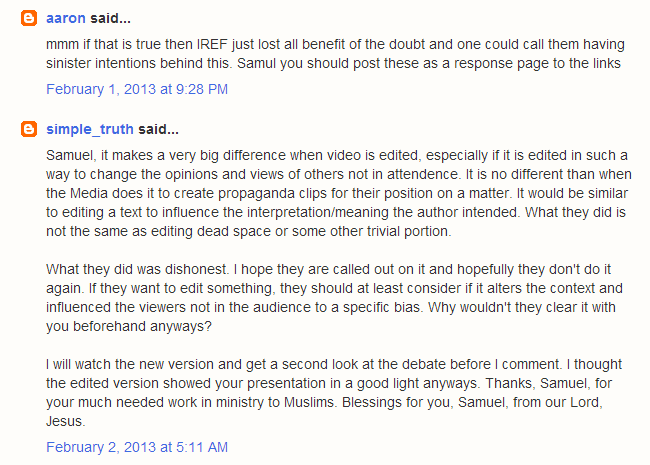
A Rejoinder to Sam Shamoun: Christian Fans on Editing of Debate Videos

بِسۡمِ ٱللهِ ٱلرَّحۡمَـٰنِ ٱلرَّحِيمِ ,

Recently the foul mouthed missionary zealot, Sam Shamoun attempted to bully me through verbal abuse during an audio discussion. Unfortunately for Sam Shamoun, his tactics backfired and brought sincere Christians to begin communications with Calling Christians. In light of the discussion, Sam Shamoun then ordered his congregational minion/ audio recorder to post an edited version of our discussion. In Sam’s edited version, his comments are moved about, some of his insults are deleted and a portion of my rebuttal to his inane ranting was removed. Many Christians defended this and praised Sam for doing this on the Youtube video page of our discussion. Yet in typical Christian hypocrisy, on David Wood’s blog, that is Sam Shamoun’s debating partner, a strange thing occurred. As it turns out the Christian Samuel Green and Br. Imran of IREF had a debate. According to Samuel Green, IREF edited portions of the debate in light of the audience’s reaction to certain points but no speaking material was changed, just audience shots. These same Christians who were applauding and accepting Sam’s edit of our discussion, are now crying foul and claiming any edit is dishonest, abhorrent and distasteful.

cc-samedit


Isn’t that hilarious? The nature of these Christians in Sam/ David’s congregation are completely hypocritical. Apparently, it’s okay for a Christian speaker to edit and manipulate a debate’s content, but to skip audience pan shots is tantamount to ‘promoting bias‘, ‘dishonest‘, ‘it makes a big difference‘, ‘influencing the meaning the author intended‘, ‘costs them the benefit of doubt‘, etc. It’s important for us Muslims to note the kind of missionaries we are dealing with. They are dirty, underhanded, deceitful and shameless. Most importantly, ‘people‘ like these will cry foul and claim victimization whenever they can to achieve emotional tendencies. Thankfully, us Muslims are not of the ilk that Sam Shamoun, et al are like. We are commanded to practise integrity and to remain on the path of righteousness and we most certainly do not need to be perverted in our speech or actions as they need to be.

wa Allaahu ‘Alam.

Debate: Sam Shamoun vs Ijaz Ahmad, “Is Masjid al Haram in Makkah?”

بِسۡمِ ٱللهِ ٱلرَّحۡمَـٰنِ ٱلرَّحِيمِ ,

I can’t necessarily call this a debate, as Sam Shamoun would ask me 5 – 6 questions, give me 10 seconds to answer and then spend 5 minutes at a time calling me names such as punk, idiot, fool, child, deceiver etc. The video length is roughly 30 minutes, in total Sam speaks for about 25 minutes and I speak for maybe 3 minutes. In the 3 minutes I was allowed to speak by Sam, I proved that Masjid al Haram is the Masjid in Makkah. You can see my write out of events here. Unfortunately, Sam did not want me to speak and simply denied everything I said while insulting me for most of the time I spent in the room with him. At the end of the video, in the final 3 minutes, Sam explains that this is a method he employs against Muslims who write against his religion. The truth is, Sam Shamoun is unable to have an intelligent discussion and that when faced with a formidable opponent, he must silence them and forbid them from speaking in response to his claims. Unfortunately for Sam, despite his petulant tactics, his rabid diatribe, his curses, mockery, insults, and abuses, I kept my cool and provided ample evidences to refute his infantile arguments, while not returning any insults to him or cutting him off from speaking as he did to me.

You can read a full read out of my arguments and Sam’s questions located here. You can watch the ‘dialogue’ below, I’ve included video annotations for viewers to take note of Sam’s deception, silly insults and 3 – 4 minute tirades after giving me at the most 20 seconds to answer a question, thereby he then spends 5 minutes insulting me:

wa Allaahu ‘Alam.

Sam Shamoun’s Recorder Won’t Release Raw Debate Audio

بِسۡمِ ٱللهِ ٱلرَّحۡمَـٰنِ ٱلرَّحِيمِ ,

sam shamoun hands

I returned to  “Why Jesus is the only way“, to see if Sam’s recorder was there. Millie Fiori was the recorder’s name. She was kind to me, I enquired about the debate recording and she did have some issues with uploading the recording. However she made it quite clear that she would not be able to upload the unedited version of the discussion. I questioned her about this and she replied that it was up to Sam Shamoun to decide if the raw audio was to be given to me or to be uploaded, but as it is she would only be uploading the edited version.

Apparently our debate lasted 30 minutes, I really thought it lasted 5 minutes so I am interested to see what the recording actually looks like after the Christian side has edited it. You can view the recording on her YouTube page located here. I can’t give an estimated time until Sam’s edited version is uploaded to the person’s page, but I will be checking regularly to see if/ when it’s uploaded at all.

jesus_facepalm

wa Allaahu ‘Alam.

Review: Jesus the Christ, Man, God or Both? – Ijaz Ahmad vs CL Edwards

Note: This is a review done by Br. Paul Bilal Williams via his website, ‘Blogging Theology‘. Br. Paul is a well established orator and debater from the United Kingdom and has studied Christianity and Islam for several years.

Jesus the Christ, Man, God or Both? – Ijaz Ahmad vs CL Edwards

A Review of the Debate by Paul Williams 

Ahmad’s opening statement threw down the gauntlet:

‘If we are to be fair and objective in our study of who the Messiah was, then we can’t work backwards, that is to start with the bias we already have and then look at the previous scriptures to justify our claims and beliefs. This is a form of revisionism.‘

He has in mind here a favourite methodology adopted by Christians: that of reading into Jewish texts their own later beliefs about Jesus. Scholars call this practice ‘eisegesis’.

Though Ahmad did not mention well known Christian apologist Dr Craig in his opening presentation, he could have called him as a witness for his defense as Dr. William Lane Craig would agree with him! Though Craig’s comments focus on Jesus’ alleged death and resurrection, they perfectly demonstrate how Christians read back into the Jewish Bible beliefs that no Jew ever held about their Messiah.

Craig writes:

‘Early Christians were convinced that Jesus’ resurrection, like his crucifixion, was, in the words of the old tradition quoted by Paul in 1 Corinthians 15. 3-5, “in accordance with the Scriptures.” In Luke’s story of Jesus’ appearance on the road to Emmaus, the risen Jesus chastises the two travelers: ” ‘Was it not necessary that the Messiah should suffer these things and enter into his glory?’ And beginning with Moses and all the prophets, he interpreted to them in all the Scriptures the things concerning himself” (Luke 24. 26-27).

The difficulty is that when we ask, “What Scriptures are they thinking of?”, we come up with sparse results. Hosea 6.2 ‘ “After two days he will revive us; on the third day he will raise us up, that we may live before him” – has been suggested because it mentions the “third day” motif found in the old formula cited by Paul.

But Hosea 6.2 is never explicitly cited by any New Testament author, much less applied to Jesus’ resurrection. In the apostolic sermons in the Acts of the Apostles, we find Psalm 16.10 interpreted in terms of Jesus’ resurrection: “For thou dost not give me up to Sheol, or let thy godly one see the Pit.” But if we look at the principal Old Testament passage cited in the Gospels with respect to Jesus’ resurrection, we find the story of Jonah and the whale. “For as Jonah was three days and three nights in the belly of the whale, so will the Son of Man be three days and three nights in the heart of the earth” (Matthew 12.40).

Now the problem for the theory in question is that nobody, especially a first century Jew, reading the story of Jonah and the whale would think that this has anything whatsoever to do with Jesus’ burial and resurrection! Similarly for Psalm 16.10; this has to do with David’s confidence that God will not allow him to see defeat and death. And as for Hosea 6.2, this has nothing to do with resurrection of the dead but with the restoration of the national fortunes of Israel.

The point is that no one who did not already have a belief in Jesus’ resurrection would find in these Scriptures any impetus to think that Jesus had been raised from the dead. To this we may add the fact that in Jewish belief the resurrection of the dead was always an event at the end of the world involving all the people, an event which obviously had not yet taken place.

Once the disciples came to believe in Jesus’ resurrection, then they could go to the Scriptures looking for verses to validate their belief and experience, and passages like Jonah and the whale and Psalm 16.10 could be re-interpreted in light of Jesus’ resurrection. But to think that the belief in Jesus’ resurrection was derived from the Old Testament is to put the cart before the horse; it gets things exactly backwards.’

***

What a stunning admission by Craig! At a stroke all those much vaunted “prophesies” in the OT about Jesus the Messiah turn out to be entirely absent from the Jewish Bible and can only be ‘discovered’ there if you artificially graft Christian beliefs onto the texts, in disregard of the original context and original meaning of the passages. But this is the standard ‘orthodox’ way Christians use the Bible to justify their beliefs.

Ahmad convincingly demonstrates that the Jewish Messiah was never considered to be divine or God at any time but was always expected to be only a man like other mortals.

Therefore the Christian belief in a Divine Messiah is unJewish and alien to the Torah. The final Prophet to mankind Muhammad (pbuh) was sent to correct these blasphemous excesses by Christians. Today 1.6 billion of his followers have learnt this lesson well.

***

A few comments on the opening statement by CL Edwards

Edwards boldly states:

After seriously studying the first century evidences concerning Christ, while being logically consistent, I had to change my position, and I now hold to the hypostatic union i.e the belief  Jesus had two natures. There is no historical proof anyone during this time held Jesus to be just a man.

He might need change his position once more as scholars have long realized that the earliest Christians did not believe Jesus was divine. Read Peter’s sermons in Acts and ask yourself did he consider Jesus to be God (see Acts 2:22 & 2:36 for example)? Read Mark’s gospel: Jesus prays to God; is ignorant about various matters; denies he is ”good”;  feels abandoned by God on the cross. Does such a man seem like God in the flesh to you?

Much of Edwards presentation is simply a list of proof texts culled from the Bible. He does not show any critical awareness of how Christology developed in the New Testament, and just how radically different Mark’s gospel is from John’s gospel in its portrayal of Jesus.

As every undergraduate in Bible studies knows, it is clear that there has been a development in the way Jesus is presented in the pages of the New Testament. Look at the earliest gospel to be written, that of Mark.

This shows us a very human figure. Here are 7 examples:

1) Jesus is a man who prays to God (1:35)

2) Jesus is unable to work miracles in his own town (6:5) – but see Matthew’s redaction of Mark in 13:57-58.

3) Jesus confesses his ignorance about the date of the End of the world (13:32).

4) Jesus did not know the identity of a woman who touched him and had to ask his   disciples for help (Mark 5:30) – but see Matthew’s redaction in 9:20-21.

5) Jesus was so irritated by the absence of figs he cursed a fig tree even though it was not the season for figs (Mark 11:14) – but see Matthew’s redaction in 21:18-22.

6) Jesus even denies that he is perfectly good (Mark 10) – but see Matthew’s redaction of Mark in 19:17.

7) Mark portrays Jesus despairing of God’s help at the crucifixion as he cries: ‘My God my God why have you abandoned me?’ (15:34) – Luke and John both omit this.

So it seems clear that in the earliest gospel Jesus does not exhibit any of the attributes of God that Jews, Christians and Muslims commonly accept: unlike God, Jesus is not all knowing; he is not omnipotent; he is not perfectly good; he is not eternal; he is notimmortal; he is not unchanging. Therefore it seems obvious that he cannot be God.

If we read the last of the four gospels to be written, the gospel of John, we move into a different world. Here Jesus seems to move effortlessly through his ministry, he is clearly portrayed as a divine figure, indeed as “God” himself.

Instead of Jesus saying in Mark’s gospel “Why do you call me good – no-one is good but God alone”, John has Jesus say: ‘Before Abraham was I am’.

In the very first chapter of the gospel according to John, the Prophet John the Baptist proclaims Jesus to be ‘The Lamb of God who takes away the sin of the world’ when he first meets him.  But in the earlier synoptic gospels, John the Baptist not only does not say this but half way through Jesus’ ministry sends messengers to Jesus asking “Are you the Messiah we’ve been expecting, or should we keep looking for someone else?” (Matthew 11:2)

So even this brief survey has shown the enormous evolution of the story of Jesus which occurred in less than two generations after Jesus was taken up by God.

Unlike in the earlier gospels of Mark, Matthew and Luke, in John Jesus speaks with a clear awareness of his divine existence with God from before his time on earth (5.19ff and 8.12ff make this clear). But the question cannot be ducked: whether the Jesus of the fourth gospel was intended to be historical, whether Jesus of Nazareth actually spoke in the terms used by John. Were the claims about Jesus in John’s gospel already in place from the beginning of Christianity? It seems hardly likely.

Few scholars today would regard John as a source for information regarding Jesus’ life and ministry in any degree comparable to the Synoptics gospels of Matthew, Mark and Luke. It is worth noting briefly the reasons why scholars think this:

One is the very different picture of Jesus’ ministry, both in the order and the significance of events and the location of Jesus’ ministry. For example, the cleansing of the temple happens at the beginning of Jesus’ ministry in John but occurs at the end of Jesus’ ministry in the synoptic gospels. A clear contradiction.

Another is the striking difference in Jesus’ style of speaking – much more discursive and theological in John, in contrast to the aphoristic and parabolic style of the Synoptic gospels. Jesus’ way of speaking is the same, whether Jesus speaks to Nicodemus, or to the woman at the well, or to his disciples, and very similar to the style of John the Baptist, and indeed very similar to the 1st Letter of John. The conclusion is unavoidable that the style is that of the author of the gospel of John rather than that of Jesus himself.  

Probably most important of all, in the synoptic gospels Jesus’ main message is the Kingdom of God and he rarely speaks of himself, whereas in John the Kingdom of God hardly features and the discourses are largely about Jesus’ own self-consciousness andself proclamation. To put it simply, in the earlier gospels Jesus does not preach about himself but God and his kingdom. In John, Jesus speaks about himself and his Father. Had the striking ‘I am’ claims of John been remembered as spoken by Jesus, how could any gospel writer have ignored them so completely as the Synoptics gospels do?

In conclusionEdwards could benefit from an introductory course in New Testament studies to bring him up to speed with what his own scholars are teaching!

Video: Jesus the Christ, Man, God or Both? – Ijaz Ahmad vs CL Edwards

بِسۡمِ ٱللهِ ٱلرَّحۡمَـٰنِ ٱلرَّحِيمِ ,

Post Debate thoughts:
https://callingchristians.com/2013/01/13/post-debate-remarks/

Debate Information:
https://callingchristians.com/2013/01/12/debate-announcement/

Video:

Feel free to leave your thoughts, suggestions and comments! I’d also like to thank CL Edwards for having the video provided so quickly. The video was taken from his website’s posting.

wa Allaahu ‘Alam!

Post Debate Remarks

بِسۡمِ ٱللهِ ٱلرَّحۡمَـٰنِ ٱلرَّحِيمِ ,

I began my preparation for this debate by watching Br. Paul Bilal William’s debates on the same topic, as well as Dr. Shabir Ally’s debate. I didn’t finish watching either debate because I became tired of the Christian arguments that were being used. They were identical. They simply went to the New Testament and the rest of the debate devolved into whose interpretation of the New Testament verses was more accurate. I realised that this was the argument that Muslims and Christians have been having for 1434 years. Whose interpretation of the same verses was more valid. After seeing this I decided that if I am to debate this topic, I would refuse to carry on this archaic tradition. It was time for something new. There are only two sources for which my opponent could have appealed to; the New Testament and the Old Testament. From this, my aim therefore was to negate the use of the New Testament, relegate my opponent to using the Old Testament and when he tried to use it, refute his claims and leave him without a foundation upon which to stand. In other words, my aim was to render my opponent as a headless chicken.

My method was as such:

  1. To be objective in our discussion we need to go to the primary source which mentions a Messiah.
  2. Hence any text after the Messiah could not be utilized if we are to be honest; thus negating both the Qur’aan and the New Testament.
  3. Ask my opponent where the Messiah is said to be YHWH or where YHWH is said to be the Messiah in the Old Testament; since neither can be found in the Old Testament, my opponent could no longer use it.

It was my intention therefore to create such a simple methodology, that by negating any foundation for my opponent to argue upon, he would be dumbfounded, confused and make horrendous mistakes. As Allaah ta ‘aala willed, it was as exactly as I planned. My opponent began his arguments with appealing to the New Testament, then by affirming the Ecumenical Creeds and lastly by placing the New Testament Christological interpretations into Old Testament verses. From the get go he fell into my hands and I enjoyed it. At one point I got bored and began shopping on Amazon and talking with Br. Nazam from London. I even commented on a few Facebook statuses. It was absolutely hilarious to hear my opponent’s first rebuttal.

Real talk, straight up, CL was dumbfounded. He cautiously took the mic and failed to use all of his time. All he did was claim that in my opening statement I did not give my rebuttal to any of his arguments. That was his entire rebuttal to my opening statement. In his rebuttal he failed to:

  • Provide any justification for using the New Testament to prove Christ’s deity.
  • Provide any justification for interpreting the Old Testament texts through a Christological proto-orthodox lens.
  • Address my critique of his methodology.

So what was the result? CL was forced into preaching about his life as an ex-Muslim. At that point we had Muslims and Christians congratulating me on a momentous victory. What was funny to me was that CL was a Muslim for exactly half of my entire lifetime and he was unable to refute me, despite doing apologetics courses. I caught him off guard, brought new arguments and completely disarmed him. He didn’t know what to do. Seriously. He spent almost two minutes praising me in his conclusion as well, he had nothing to say, he couldn’t respond to the simple logic I used. I am not being boastful or prideful, but I am happy that haqq prevailed over baatil. CL got spanked horribly. We had no question and answer session as I was still medicated due to my post-op medication. Yet I was the one who stayed for about 15 minutes after the debate to take questions. CL fled immediately. Both Christians and Muslims were shocked that he ran away immediately after the debate.

The debate will be uploaded shortly. All I have to say is, I am happy it occurred, I got a chance to demonstrate how devastating simple arguments are and I am proud to have introduced new arguments into the fray of centuries old religious discourse. It’s also the first time in world history – to my knowledge, that a debate on Christ’s deity occurred and the opposing side did not quote the New Testament once. I hope to take up another debate soon and I pray that CL sees the reality of Islam soon, Ameen.

wa Allaahu ‘Alam.

Debate Announcement

بِسۡمِ ٱللهِ ٱلرَّحۡمَـٰنِ ٱلرَّحِيمِ ,

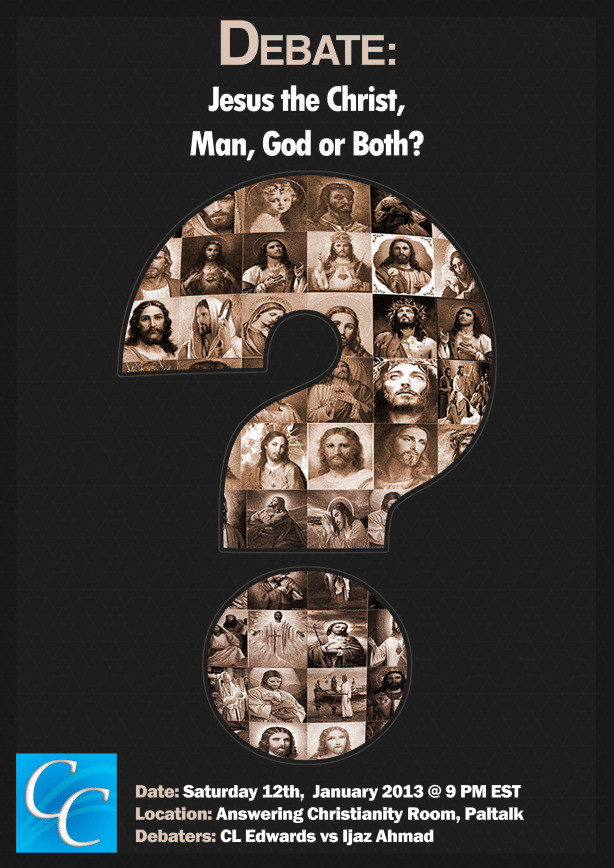
2013 is going to begin with a blast. Long time rival, CL Edwards of ‘Calling Muslims’, has opted to debate me on the personhood of Christ. The topic is, “Jesus the Christ, Man, God or Both?“. We’ll be having the debate via Paltalk Room, “Answering Christianity“, for information on the download and usage of Paltalk, click here. We’ll be having it on Saturday, 12th January (2013). It’s an oft-repeated topic, but it is the most important as well. Christ is centric to both the Islamic and Christian faiths, his position in either, as Christ is certain, but whether he is more or not is up for much discussion. I do hope to raise several interesting arguments, and some new ones as well. Allaah willing, I hope to present some fresh, new and exciting perspectives on the personhood of Jesus the Christ, ‘alayhi as salaatu wa salaam. My opponent, CL Edwards and I have had a long, but thrilling history which you can read of here. CL is an apologetics student, he’s appeared on ‘Jesus or Muhammad’ with Sam Shamoun and runs a blog on Christian apologetics. I look forward to seeing the arguments he is able to present.

As some would recall, my previous public debate incited a flurry of controversy due to my referencing of the Holy Prepuce. My opponent at that time couldn’t handle my use of historical data and decided to ‘attack‘ me with a counter claim of Allaah ta ‘aala having ‘genitals’ (far removed is He from such claims). Unfortunately for him, the information he used in his video was stolen from a Muslim website and the proprietor of website, refuted the Christian himself. Will this debate incur such controversy? I don’t know, but I do wish that it will provoke much inter-religious dialogue as the last one did, but perhaps with a little less genital talk. To find out the exact time use this easy to use website, just remember it’s 9 PM EST.

Debate-flier

wa Allaahu ‘Alam.

Debate with CL Edwards Update

بِسۡمِ ٱللهِ ٱلرَّحۡمَـٰنِ ٱلرَّحِيمِ ,

No debate is without a little controversy. A day before I had released the information about the debate, CL Edwards posted the information on his website. Later that evening I was approached by one of his friends, Antonio Santana, a Christian Missionary Polemic.


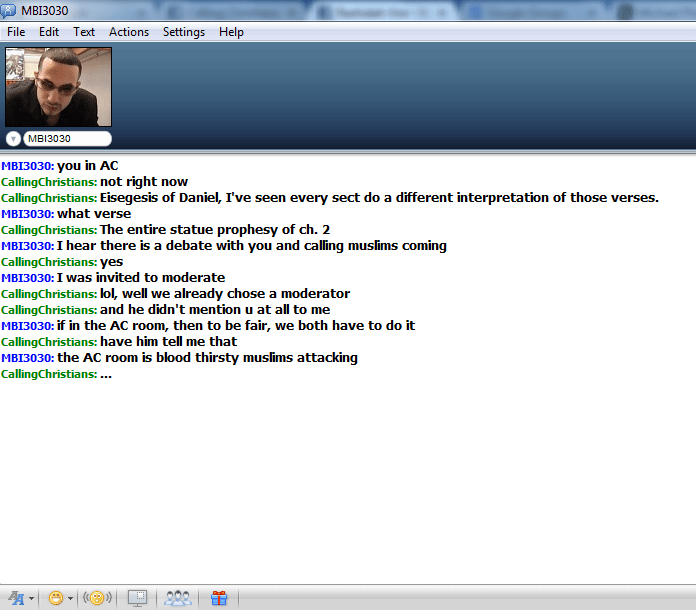
cl-debate-mbi

[Click Image to Zoom for Bigger Size]

Antonio deceptively came to ask me about a discussion in which the statue in Daniel was being discussed. I gave my opinion on this discussion and was about to exit the conversation when he brought up the debate. What was disturbing to me was the fact that he stated that CL Edwards invited him to moderate. I want to make it explicitly clear that I have all my email correspondences saved with CL and at no point in time did we discuss the possibility of Antonio (MBI3030) to be considered as a moderator. Now either it is that Antonio is lying or he is simply stirring trouble for CL.

When Antonio realised he would not get his way with me, he then insulted a significant portion of my friends by labelling them as blood thirsty Muslims. I must remind him that we Muslims do not ‘drink‘ the blood of any saviour, but he does, therefore when it comes to being blood thirsty, the label applies directly to him. I publicly call for CL Edwards to deal with his friend and proclaim that he does not endorse the violent and deceptive rhetoric of Antonio. I have agreed to debate CL, but I have not agreed to babysit his friends while they attempt to disturb our most exciting event.

wa Allaahu ‘Alam.

Debate: James White vs Sami Zataari, “Was Christ Crucified?” – Video

Bismillahir Rahmanir Raheem
بِسۡمِ ٱللهِ ٱلرَّحۡمَـٰنِ ٱلرَّحِيمِ ,

MDI has finally released their video of Sami’s debate with James. For a quick review, if you’ve ever heard James speak, then expect nothing new from him. Sami responded well, kept up with James, easily nullified James’ arguments and ran rings around the Alpha and Omega Ministry man:

wa Allaahu Alam,
and Allaah knows best.

Some Comments on James White and Adnan Rashid’s Debate

Bismillahir Rahmanir Raheem
بِسۡمِ ٱللهِ ٱلرَّحۡمَـٰنِ ٱلرَّحِيمِ ,

I was taken aback by some of James White’s arguments in yesterday’s debate with Br. Adnan Rashid, however I was pleased with the simplicity of his presentation. The topic being debated was, “Was the Qur’an or the Bible Reliably Transmitted? ” and what a show it was. James’ presentation was rather straight forward, to the point and predictable. Admittedly, he’s a seasoned orator which would impress the lay Christian, but as a person who studies the Christian scriptures and their textual history, I felt nothing but shame for James White. His arguments were borderline facetious, if not absurd and really demonstrated a lack of honesty on his part. I’m not sure if he would be willing to defend his statements, but many of his comments were dishonest to say the least. Let’s examine his main point:

  • An Uncontrolled Text is Superior to a Controlled Text.

James’ reasoning, revolved around the idea that if multiple people, at multiple places, at multiple times wrote a documents which ‘largely agreed’ with one another, the autograph would be more preserved and thus rendering the text, ‘reliably transmitted’. This view is largely held by neo-inerrantist Christian scholars such as Maurice Robinson, William Pierpont, Zane Hodges and Aruthur Farstad. There view can be summed up in this excerpt:

“from a transmissional standpoint, a single Textform would be expected to predominate among the vast majority of manuscripts in the absence of radical and well-documented upheavals in the manuscript tradition.” – Maurice Robinson, “The New Testament in the Original Greek According to the Byzantine/Majority Textform”, Preface to the 2nd Ed.

It must be understood however, that this understanding is not due to the science of textual criticism, but based on faith that God preserved the Bible, see Dr. B. Metzger and B. Ehrman, ‘The Text of the NT: It’s Transmission, Corruption and Restoration, 4th Ed, pg 219, Citation #29. Therefore James’ position is not based on sound research and study, which he alluded to, but based upon dogmas. It is with this in mind that I’d like to contest his view of preservation through ‘uncontrolled copying‘, by providing a simple example:

  • Scribe writes epistle.
  • Some time passes.
  • Later scribe copies epistle (emendations/ interpolations occur).
  • Some time passes.
  • Another scribe copies the mistakes of the previous scribe and adds mistakes of his own.
  • At this point the original epistle is lost and the autographs of the two later scribes are preserved.

The question we’d have to ask James, is which manuscript autograph would he give precedence to? Would his criteria be based upon dating or level of variance after comparison with his current New Testament codex? If it’s a combination of both, then what would be common to both manuscripts would be the errors of the first copyist and the recopied errors by the second copyist, thus leaving us with something vastly variant to the original:

In some cases the evidence will be found to be so evenly divided that it is extremely difficult to decide between two variant readings. – Dr. B. Metzger and B. Ehrman, ‘The Text of the NT: It’s Transmission, Corruption and Restoration, 4th Ed, Preface XV.

Occasionally, none of the variant readings will commend itself as original, and one will be compelled either to choose the reading that is judged to be the least unsatisfactory or to indulge in conjectural emendation. – Dr. B. Metzger and B. Ehrman, ‘The Text of the NT: It’s Transmission, Corruption and Restoration, 4th Ed, pg 343.

However, let’s say that we oppose James’ view and we examine a controlled text.

  • A Controlled Text is Superior to an Uncontrolled Text.

What if the original scribe oversaw the copying of his manuscript, and left instructions that any copy henceforth would have to be double checked with his manuscript. That’s a level of control that at the minimum preserves the text by one generation. If this method is continued, essentially all generations of copyists would be able to preserve the original scribe’s works. This is essentially what the Ijaza is in Islam. A person is given the authority to transmit knowledge/ data, because they have achieved a level of approval according to the one who has received authority from one with authority to transmit the knowledge/ data. We know that later Christianity adopted controlled textual transmission, because it better preserved the texts:

It is a striking feature of our textual record that the earliest copies we have of the various books that became the New Testament vary from one another far more widely than do the later copies, which were made under more controlled circumstances in the Middle Ages. – Dr. B. Metzger and B. Ehrman, ‘The Text of the NT: It’s Transmission, Corruption and Restoration, 4th Ed, pg 275.

The vast majority of Christian texts which have survived are from the Middle Ages:

Furthermore, the work of many ancient authors has been preserved only in manuscripts that date from the Middle Ages (sometimes the late Middle Ages), far removed from the time at which they lived and wrote. – Dr. B. Metzger and B. Ehrman, ‘The Text of the NT: It’s Transmission, Corruption and Restoration, 4th Ed, pg 275.

The end of the twentieth century saw a resurgence of interest in the Byzantine text type among those who believe that the original text is best preserved in the vast majority of witnesses produced in the Middle Ages.’ – Dr. B. Metzger and B. Ehrman, ‘The Text of the NT: It’s Transmission, Corruption and Restoration, 4th Ed, pg 218.

Therefore the correlation being that texts which are controlled, have been vastly more preserved as opposed to the earlier uncontrolled texts of which are sparse and often vastly variant with one another:

Complaints about the adulteration of texts are fairly frequent in early Christian literature. Christian texts, scriptural and nonscriptural, were no more immune than others from vicissitudes of unregulated transmission in handwritten copies. In some respects they were more vulnerable than ordinary texts, and not merely because Christian communities could not always command the most competent scribes. Although Christian writings generally aimed to express not individual viewpoints but the shared convictions and values of a group, members of the group who acted as editors and copyists must often have revised texts in accordance with their own perceptions. This temptation was stronger in connection with religious or philosophical texts than with others simply because more was at stake. A great deal of early Christian literature was composed for the purpose of advancing a particular viewpoint amid the conflicts of ideas and practices that repeatedly arose within and between Christian communities, and even documents that were not polemically conceived might nevertheless be polemically used. Any text was liable to emendation in the interest of making it more pointedly serviceable in a situation of theological controversy. – H. Y. Gamble, Books And Readers In The Early Church: A History Of Early Christian Texts, 1995, Yale University Press: New Haven & London, pp. 123-124.

It is with the above being said, I must thereby conclude that James White’s position in his debate with Br. Adnan Rashid is unscholarly, deceptive, displays a significant level of ignorance of the history and the science of textual criticism and is nothing short but a disgrace to the field of academia. I pray that God guides James White to admitting his erroneous position and that he corrects himself, sooner rather than later.

wa Allaahu Alam,
and Allaah knows best.

« Older Entries Recent Entries »