The Certainty of the Bible as the Word of God

بِسۡمِ ٱللهِ ٱلرَّحۡمَـٰنِ ٱلرَّحِيمِ ,

Have you ever heard one or more of the following expressions? “I am 100% certain that the Bible is the Word of God“, “The Bible is definitely the Words of our Lord Christ“, “We must obey the Word of the Lord“, if so, then you’ve been a victim of misinformation. Whether this is due to a form of close mindedness or simply ignorance, this is not the case and I’ll try to direct my explanation to both Christians and Muslims for the sake of understanding.

To the Christian:

Every time you’ve opened a Bible, you’ve conceded that you wholeheartedly are uncertain of the accuracy and reliability of the words contained within. 

This is because the New Testament, as of the time of John Mill’s  Novum Testamentum Græcum (Cf. 17th century Greek NT Codex) or if you prefer, from the time of Desiderius Erasmus we have the Novum Instrumentum Omne and the Complutensian Polyglot which all rely on the science of textual criticism. This is important because the science of textual criticism (in the Christian tradition) implicitly functions on the principle that the current Bible is not accurately representative of God’s inspired revelation. This is best summed by Bart Ehrman in the following words (if not him, any textual critic really):

There was an obvious problem, however, with the claim that the Bible was verbally inspired—down to its very words. As we learned at Moody in one of the first courses in the curriculum, we don’t actually have the original writings of the New Testament. What we have are copies of these writings, made years later—in most cases, many years later. Moreover, none of these copies is completely accurate, since the scribes who produced them inadvertently and/or intentionally changed them in places. All scribes did this. So rather than actually having the inspired words of the autographs (i.e., the originals) of the Bible, what we have are the error ridden copies of the autographs. One of the most pressing of all tasks, therefore, was to ascertain what the originals of the Bible said, given the circumstances that (1) they were inspired and (2) we don’t have them.

At Moody, I learned the basics of the field known as textual criticism—a technical term for the science of restoring the “original” words of a text from manuscripts that have altered them.

– Bart Ehrman, ‘Misquoting Jesus’, Page 5.

There are several problems here. How can you restore something, if you imply that what you currently have is absolute and certain to be the word of God? Thus the conclusion has to be that what you currently posses is not the word of God, and its status is neither absolute nor certain. To the contrary, I find it to be quite deceptive that some portions of the Christian intellectual community continue to repeat the mantra that the current New Testament is 99.99% accurate. This is an erratic and unfounded statement:

  • How can you judge something as being accurate, if you don’t have a 100% accurate document to compare it to?
  • Thus any figure of accuracy is therefore arbitrary and baseless.
  • How can it be 99.99% accurate, when every few years the Nestle-Aland GNT continues to replace passages and words with those from different manuscripts?
  • Following from the previous point, how can something be 99.99% accurate, if it changes every few years? This means that it was either less accurate before and it is now more accurate, otherwise the change would not have had to been made.

From this, we can now understand that any Christian who owns a Bible in his modern lifetime, accepts that the book he entrusts his faith to, solely exists on the reasoning that it is currently inaccurate and will be corrected in a newer edition sooner rather than later. If we are to be honest, then we must concede that the current Bible is inaccurate, uncertain, and not absolute. If not, then the Christian will have to present a case where the current edition of his text is not based on the comparison of a collection of autographs (original manuscripts). It is important to remember that not a single Bible is based wholly on one codex (collection) but on a collection of a vast array of Syriac, Latin, Coptic and Ethiopian manuscripts, each belonging to their own individual and distinctive codex. In conclusion, owning a Bible today demonstrates that Christians clearly do not believe for themselves that the Bible is absolutely certain to be the word of God.

wa Allaahu ‘Alam.

Strange Attributes of the New Testament “God”


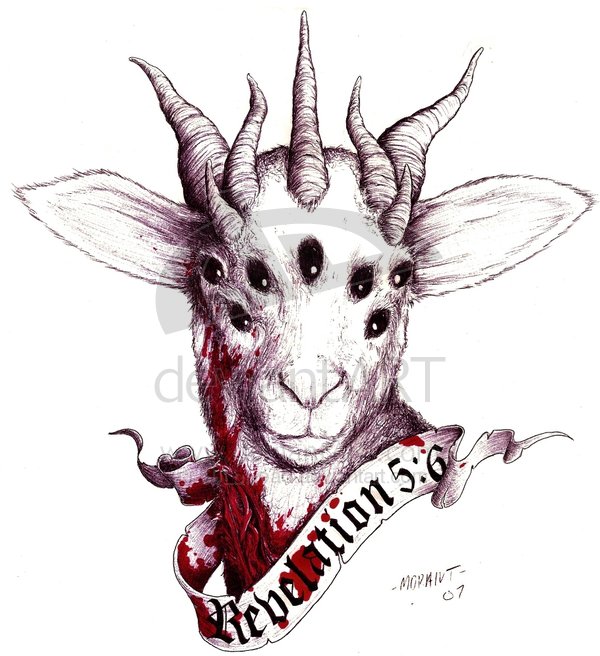
A probable portrait of the Christian "God" as described in the Book of Revelation

A probable portrait of the Christian “God” as described in the Book of Revelation

Strange Attributes of the New Testament “God”

An enquiry into Christian faith beyond mere humanization of God


Question Mark


Introduction


The Qur’an does testify that the pagans of Mecca used to believe that it was Allah (SWT) who created everything that exists,

If thou ask them, who created them, they will certainly say, Allah:

Yet ironically in the same verse Allah (SWT) imputes them to have gone astray from the truth!

If thou ask them, who created them, they will certainly say, Allah: How then are they deluded away (from the Truth)? (Qur’an 43:87)

The pagans of Mecca even believed that it was Allah (SWT) who governed the universe,


And if indeed thou ask them who it is that sends down rain from the sky, and gives life therewith to the earth after its death, they will certainly reply, “Allah!” Say, “Praise be to Allah!” But most of them understand not. (Qur’an 29:63)


Yet noticeably Allah (SWT) disregards them by stating that they “understand not”. In other words, none of their aforementioned beliefs could make them monotheists; they were still condemned as “polytheists”. This was because although it is important that Allah (SWT) is to be accepted as the Creator, Sustainer etc it is, however, not enough!

To become believers of one True God it is important that God’s attributes be not violated, i.e., we should not assign the attributes of God to any of His creatures or vice-versa. This is extremely important to maintain Gods oneness of attributes. However, unfortunately, a lot of communities have stumbled upon this violation of God’s attributes including, sadly, Christianity.

Earlier we have documented how Christianity breached God’s attributes thereby violating monotheism itself. It was with regards to God’s humanization in the form of Jesus (peace be upon him). In this paper we would further continue beyond it.


Beyond Incarnation


Christians provide a number of explanations in defense of their incarnation theory. One of the leading amongst them is the Pauline passage that Jesus (peace be upon him) gave up his divine attributes to enter into humanity (c.f. Philippians 2: 6-8). Although humanization of God is open idolatry yet we are not concerned about it in this paper. We want to look beyond it into areas which are far grotesque than mere humanization!

It is interesting to note that John happens to be the only author amongst the gospel writers who has entitled Jesus (peace be upon him) as the “Lamb” (c.f. gospel of John 1: 29, 36); however, this usage of the title is figurative. Jesus (peace be upon him) is symbolized as the sacrificial animal or the “Lamb” to be slaughtered in commemoration of the Passover ritual of the Old Testament.

However, there is one more book in the New Testament attributed to “John” – the book of Revelation – which edifies that the title “Lamb” was not only figuratively used in the New Testament; it has plain literal meanings as well. In his fanciful “visions”, John goes overboard to portray Jesus (peace be upon him) as nothing less than a pagan mythical beast:


Then I saw a Lamb standing in the centre of the throne, surrounded by the four living creatures and the elders. The Lamb appeared to have been killed. It had seven horns and seven eyes, which are the seven spirits of God that have been sent throughout the whole earth. The Lamb went and took the scroll from the right hand of the one who sits on the throne. As he did so, the four living creatures and the twenty-four elders fell down before the Lamb. Each had a harp and gold bowls filled with incense, which are the prayers of God’s people. They sang a new song:

You are worthy to take the scroll and to break open its seals. For you were killed, and by your sacrificial death you bought for God people from every tribe, language, nation and race. You have made them a kingdom of priests to serve our God, and they shall rule on earth.” Again I looked, and I heard angels, thousands and millions of them! They stood round the throne, the four living creatures, and the elders, and sang in a loud voice:…The four living creatures answered, “Amen!” And the elders fell down and worshipped. ” (Revelation 5: 6-14)

Thus, in the book of Revelation, Jesus (peace be upon him) – the assumed “God” – is morphed from a human being to a weird “seven horned, seven eyed” beast. More interestingly, this mythical creature not just stands on the magnificent Throne of God but also receives “worship” by some of the best Christians!

Christians typically understood the verse to signify Christ’s (peace be upon him) perfect power and wisdom – omnipotence and omniscience. It is because horn and eye represent power and knowledge and seven of each adds to it their respective perfections:


Seven horns – As horn is the emblem of power, and seven the number of perfection, the seven horns may denote the all-prevailing and infinite might of Jesus Christ. He can support all his friends; he can destroy all his enemies; and he can save to the uttermost all that come unto God through him.


Seven eyes – To denote his infinite knowledge and wisdom: but as these seven eyes are said to be the seven Spirits of God, they seem to denote rather his providence, in which he often employs the ministry of angels; therefore, these are said to be sent forth into all the earth. See on Rev_1:4 (note). (Revelation 5:6, Adam Clarke’s Commentary on the Bible)


Christians might interpret seven horns and seven eyes to represent “God’s” divine power and knowledge; however, to any non-Christian monotheist these can only represent bestial (beast-like) qualities unjustly and blasphemously imputed upon God.


Furthermore, even if it be accepted for the sake of argument that horns and eyes represent some divine attribute, yet a number of other body parts of a “Lamb” cannot possibly represent any “divine” attribute of God!


It is unconceivable in any sensible monotheistic purview that God would transfigure into a mythical “Lamb” and grow horns – in fact seven of them – and seven eyes and stand on the Throne of God with his neck slit and blood oozing out. Given this grotesque portrayal of New Testament “God”, how feasible is it that this was the same “God” which was worshipped by Noah, Abraham, Isaac, Jacob and others (peace be upon them all)?


New Testament’s portrayal of God as animals has not yet ended. Since the gospels, very famously, has portrayed the third person of the Christian godhead – the Holy Ghost – as a “dove”:


And the Holy Ghost descended in a bodily shape like a dove upon him, and a voice came from heaven, which said, Thou art my beloved Son; in thee I am well pleased. (Luke 3:22, King James Version)


On the foregoing, qualified Bible expositor J.P. Lange makes some very intriguing remarks:

 
In a bodily shape, like a dove.—The mention of the dove by all the four Evangelists, plainly shows, that the descent of the Spirit was usually compared, by the Baptist who saw it, and afterwards by those who related it, to the descent of a dove. It is, however, by no means necessary to infer, from the σωματικν εδος of Luke, the actual form of a dove. Luke does not say, σωματικῷ εἴδει περιστερᾶς, but ὡς περιστεράν. By supposing a ray of light to have descended from the opened heaven, gently, swiftly, and evenly, like the downward flight of a dove, and to have shone around the head of the praying Saviour for some space of time, we escape many difficulties, and obtain a representation beautiful in itself, and becoming the divine majesty. It is by no means proved, that the dove was, in the days of Jesus, regarded by the Jews as an emblem of the Holy Spirit. The very shy nature of the dove renders it difficult to conceive its descending from heaven, and abiding on a newly baptized person, even in a vision. And if ancient Christian art, exchanging the figure for the fact, constantly introduced a visible dove into every representation of the baptism, it is only probable that this unæsthetic treatment was the result of an exegetical error. Our view also will satisfactorily explain why Justin Martyr (Dial. cum Tryph. c. 88), as well as the Gospel of the Hebrews (Epiphanius, Hœres. xxx. 13), mentions a vivid ray of light as suddenly surrounding the banks of Jordan. By a very natural symbolism, light was regarded by the Jews as an emblem of the Divinity; and we can see no reason why the descent of a ray of light should not also have been compared to the descent of a dove. (Luke 3:22, Lange Commentary by J. P. Lange)


Notice that commentator Lange is not willing to admit, unlike other Bible commentators like Robertson (c.f. Robertson’s Word Picture) [1.], that the “divine God” took the form of a “dove”. For Lange, it is not “necessary” that whatever descended had “the actual form of a dove”! In fact Lange provides his reasons why “dove” should not represent Holy Spirit. For this reason he is even willing to deem traditional and historical church practice as an “exegetical error”. And we must understand Lange’s tacit uneasiness to accept the more obvious meaning of the statements!


In fact, it is for obvious idolatrous issues that Lange is more willing to accept “descent of ray of light” in place of a “dove”! Lange has very expressly indicated that he has no problems in accepting the descent of a “ray of light” (not a “dove”) upon Jesus (peace be upon him) since “light was regarded by the Jews as an emblem of the Divinity”; unlike this, “It is by no means proved, that the dove was, in the days of Jesus, regarded by the Jews as an emblem of the Holy Spirit.” And therefore, rather than accepting the obvious imports of Luke’s statement which is corroborated by all other gospels (c.f. Matthew 3:16, Mark 1:10, John 1:32), Lange chooses to go by the views of mere church father Justin Martyr and a book – Gospel of Hebrews – which he himself rejects as apocryphal! [This creates another problem that the traditional Christian understand of Holy Ghost’s transformation into a dove is not supported by one of the earliest “apostolic” father!]


Lange rather candidly admits why he chose Justin Martyr and the Gospel of Hebrews to the views of the “inspired” author(s) Luke. It was because, “By supposing a ray of light to have descended from the opened heaven, gently, swiftly, and evenly, like the downward flight of a dove, and to have shone around the head of the praying Saviour for some space of time, we escape many difficulties, and obtain a representation beautiful in itself, and becoming the divine majesty.”


It must be enquired as to why Lange faced “difficulties” when Holy Ghost – the “God” – was represented as a “dove”? Why this representation of “God” as “dove” was not “beautiful” enough for Lange but an “unaesthetic treatment”? The answer is quite obvious. No claimant of monotheism can easily accept his/her God be represented as a “dove” without finding other “explanations” out of it! And so Lange “explained”, strangely enough, that the descent of the ray of light is represented by the descent of a dove! Lange is very strangely contended enough to relate the hovering of a dove to the straight downward descent of a ray of light; and we must understand this phenomenon!


There can be one more reason why Lange finds it unpalatable to represent Holy Ghost as “dove”. It was traditionally of Satan – the first time ever, even before God – to turn into animals for achieving objectives:


Now the serpent was more subtil than any beast of the field which the LORD God had made. And he said unto the woman, Yea, hath God said, Ye shall not eat of every tree of the garden? And the woman said unto the serpent, We may eat of the fruit of the trees of the garden: But of the fruit of the tree which is in the midst of the garden, God hath said, Ye shall not eat of it, neither shall ye touch it, lest ye die. And the serpent said unto the woman, Ye shall not surely die: (Genesis 3:1-4, King James Version)


Just like the Holy Ghost was not initially a “dove” in the same way biblical Satan was not really a “serpent”; it was a “Dragon”. The book of Revelation illustrates us on it:


And the great dragon was cast out, that old serpent, called the Devil, and Satan, which deceiveth the whole world: he was cast out into the earth, and his angels were cast out with him. (Revelation 12:9)


And he laid hold on the dragon, that old serpent, which is the Devil, and Satan, and bound him a thousand years, (Revelation 20:2)  


And subsequently, using animal transformations as apparatus, which is a satanic modus operandi, could have troubled Lange to impute the same on his “God”!


Conclusion


Allah (SWT) has declared the following warning about the sin of polytheism (Arabic. Shirk – associating partners with God) very precisely in the Qur’an:


Allah forgiveth not that partners should be set up with Him; but He forgiveth anything else, to whom He pleaseth; to set up partners with Allah is to devise a sin Most heinous indeed. (Qur’an   4:48)


If associating partners with Allah (SWT) is unpardonable sin then how saved are the Christians who ascribe bestial attributes to God. It comes extremely unpleasant and grotesque to accept that the “God” of “monotheists” would stand on the Throne with the appearance of a “Lamb” with seven horns protruding his head and an equal number of eyes, and a bleeding neck for people to prostrate “worship” it! How would a “jealous” God (c.f. Exodus 34:14) react when he comes to know that He was compared to a mere “Lamb”, albeit, seven-horned and seven-eyed and a “dove”!

Yet if Christians are still monotheists by believing in multiple animal-like “Gods” then we would have to justify why pagans are pagans for their belief. A lot of pagan cults have mythical beasts as their gods and this should not, at least, differentiate them from those who call themselves “Christians”!

That is why we adjure our Christian brethren to consider this paper beyond mere apologetics. We request you earnestly to have a talk with yourselves as to how correct is the belief wherein one of the gods of the Trinitarian godhead is said to look like a lamb with seven horns and seven eyes and a bleeding neck and other one resembles a dove! If you are true to yourself then you would agree that there are gross and colossal issues herein with the Trinitarian brand of “monotheism” and that such a description of God can only come out as figments of mere human imagination with nothing divine “inspiration” behind it. Will it then be not be much safer to follow the following Qur’anic injunctions?


Say: He is Allah, the One and Only; Allah, the Eternal, Absolute;  He begetteth not, nor is He begotten; And there is none like unto Him. (Qur’an 112:4)

And,

(He is) the Creator of the heavens and the earth: He has made for you pairs from among yourselves, and pairs among cattle: by this means does He multiply you: there is nothing whatever like unto Him, and He is the One that hears and sees (all things). (Qur’an 42:11)


Footnotes:

[1.] In a bodily form (sōmatikōi eidei). Alone in Luke who has also “as a dove” (hōs peristeran) like Matthew and Mark. This probably means that the Baptist saw the vision that looked like a dove. Nothing is gained by denying the fact or possibility of the vision that looked like a dove. God manifests his power as he will. The symbolism of the dove for the Holy Spirit is intelligible. (Luke 3:22, Robertson’s Word Picture)


Notes:

  • All Qur’anic texts taken from Yusuf Ali Translation.
  • Unless otherwise mentioned, all biblical texts taken from Good News Edition.
  • We apologize if this paper has offended any sincere Christian believer. It was never our intention to hurt any feelings or jeer any belief. We respect your choices. Nevertheless, we quoted passages which are already registered in the Bible and made our arguments on it.


Did the Prophet Muhammad (peace be upon him) Intend to Commit Suicide?

Examining the charge that the Prophet Muhammad s.a.w. desired to commit suicide

by Ibn Anwar, BHsc (Hons)

Among the many nefarious attacks that are thrown at the prophet Muhammad s.a.w. none has received so scarce and miniscule a treatment as the serious charge that the Prophet Muhammad s.a.w. intended to kill himself by jumping off a cliff. This is one of the favourite charges levelled against Islam by Arab Christian polemicists. Is there any truth to it? Let us begin by reading the tradition(hadith) in question:

Waraqa said, “This is the same Namus (i.e., Gabriel, the Angel who keeps the secrets) whom Allah had sent to Moses. I wish I were young and could live up to the time when your people would turn you out.” Allah’s Apostle asked, “Will they turn me out?” Waraqa replied in the affirmative and said: “Never did a man come with something similar to what you have brought but was treated with hostility. If I should remain alive till the day when you will be turned out then I would support you strongly.” But after a few days Waraqa died and the Divine Inspiration was also paused for a while and the Prophet (peace be upon him) became so sad as we have heard(come to know) that he intended several times to throw himself from the tops of high mountains and every time he went up the top of a mountain in order to throw himself down, Gabriel would appear before him and say, “O Muhammad! You are indeed Allah’s Apostle in truth” whereupon his heart would become quiet and he would calm down and would return home. And whenever the period of the coming of the inspiration used to become long, he would do as before, but when he used to reach the top of a mountain, Gabriel would appear before him and say to him what he had said before. (Ibn ‘Abbas said regarding the meaning of: ‘He it is that Cleaves the daybreak (from the darkness)’ (6.96) that Al-Asbah. means the light of the sun during the day and the light of the moon at night). (Sahih Bukhari, Volume 9, Book 87, hadith 111).

Read more

Examining New Testament’s Prediction of Jesus’ (p) Return


More on New Testament’s Miscalculation of the End of World


Question Mark

Introduction


In one of our earlier paper we documented how the gospel traditions impute inaccurate predictions of Jesus’ (peace be upon him) second return and subsequent end of the world on him. According to Jesus (peace be upon him), end of the world was so near that some of his disciples would have remained alive to experience it.

It is now time to further that issue with the New Testament disciples of Jesus (peace be upon him). The way they interpreted, perceived and reacted to Jesus’ (peace be upon him) prediction of imminent end of the world and his second coming!

Paul’s prediction Jesus’ (p) return


It would be good if we start with Paul. While writing to the Thessalonians, Paul had the following to predict:

What we are teaching you now is the Lord’s teaching: We who are alive on the day the Lord comes will not go ahead of those who have died.” (1 Thessalonians 4:15)

It is very straight forward and obvious that Paul believed some amongst them would still remain alive on Jesus’ (peace be upon him) return! However, unfortunately, all of them are dead and Jesus (peace be upon him) is yet to return to the world!

Nevertheless, it would be fair if we also consider standard Christian understanding of the passage. Well known biblical expositor Adam Clarke reconciles as follows while dealing with the passage:

We which are alive, and remainBy the pronoun we the apostle does not intend himself, and the Thessalonians to whom he was then writing; he is speaking of the genuine Christians which shall be found on earth when Christ comes to judgment. From not considering the manner in which the apostle uses this word, some have been led to suppose that he imagined that the day of judgment would take place in that generation, and while he and the then believers at Thessalonica were in life. But it is impossible that a man, under so direct an influence of the Holy Spirit, should be permitted to make such a mistake: nay, no man in the exercise of his sober reason could have formed such an opinion; there was nothing to warrant the supposition; no premises from which it could be fairly deduced; nor indeed any thing in the circumstances of the Church, nor in the constitution of the world, that could have suggested a hint of the kind. The apostle is speaking of the thing indefinitely as to the time when it shall happen, but positively as to the Order that shall be then observed.

Read more

David Wood: Deceiver, Abomination – According to YHWH

بِسۡمِ ٱللهِ ٱلرَّحۡمَـٰنِ ٱلرَّحِيمِ ,

David Wood the Voyeur Wearing Women's Lingerie - Self Admitted Cross Dresser

David Wood the Voyeur Wearing Women’s Lingerie – Self Admitted Cross Dresser

The Bible from YHWH describes the cross dresser as :

“A woman shall not wear a man’s garment, nor shall a man put on a woman’s cloak, for whoever does these things is an abomination to the Lord your God.” – Deuteronomy 22:5.

In as much as David attempts to chastise Islam, he chooses to mock Islam by breaking the laws of YHWH. Surely, there is a moral issue in regard to such behaviour. Can David Wood justify breaking the laws of YHWH so that he could mock another faith? So blinded by disdain for Islam is he, that David is willing to sin against YHWH by becoming an abomination in his own God’s sight. As a Muslim, I am not trying to insult David, but how can he invite me to Christianity, when even he doesn’t obey the laws of the God that he wants me to worship? Foregoing the theological problems, the textual issues and the inconsistent logic of that faith. If I were to look at Christianity as David Wood has presented it, then I would have no choice but to believe that the ‘best examples from among the preachers‘ of that faith do not care about that God enough to obey His commands. That in itself demonstrates the weakest forms of belief (hypocrisy).

Let’s say I forget his cross dressing and that YHWH calls David Wood an abomination. What about the man who lies and engages in public deceit?

cc-2013-davidwoodlying

I am sure that lying and promoting deceit (even as a joke) is a sin. Let’s see what YHWH (the God of David says) about such an act:

  • Leviticus 19:11, “You shall not steal, neither deal falsely, neither lie one to another.” 

Clearly YHWH says not to do it, so what possible justification can David have for doing it? Did YHWH forget to put, ‘as a joke’ as an addendum to that particular passage?

  • Psalms 119:163, “I hate and abhor lying: but your law do I love.”

If David wants to assume the persona of his namesake, shouldn’t he try to embody the practise of hating and abhorring lying, instead of practising it? Worse yet, what kind of a man blames his wife for his own public indecencies, surely insulting his wife is against his religion?

  • Proverbs 12:22, “Lying lips are abomination to the LORD: but they that deal truly are his delight.”

Not only is David an abomination for cross dressing, he’s also an abomination for lying! This is once again from the Bible, not from any Islamic texts.

  • Proverbs 13:5, “A righteous man hates lying: but a wicked man is loathsome, and comes to shame.”

David Wood is apparently willing to forego being a righteous man to obey his wife over YHWH. Apparently obeying his wife (for whom he blames his deceit on – quite the gentleman) is greater than obeying the God that he calls me to worship.

  • Proverbs 14:5,  “A faithful witness will not lie: but a false witness will utter lies.”

This verse is quite clear, David is not a faithful witness to the God he calls us to worship, he is in fact a false witness according to the Bible. Since this is the case, we Muslims have no reason to believe any of the things he says because he is a de facto false witness in the eyes of his Lord.

Lastly, the Bible declares that a liar does not know the truth about Christ:

“I say the truth in Christ, I lie not“. – Romans 9:1.

Clearly, from this verse, we understand that David, if he knew the truth about Christ, he would have no need to lie. Since he has the need to lie, then logically speaking, the opposite is true. He has to lie because he does not know the truth about Christ. In conclusion, from his apparent public acts we can conclude that David Wood according to YHWH is an abomination for cross dressing, an abomination for lying, a false witness of Christ, an unrighteous man and he does not say the truth about Christ. Will David reply to this? Most likely not because he can’t defend hating YHWH and His laws. Atleast now he has exposed himself as nothing short of  being a hypocrite.

wa Allaahu ‘Alam.

Islam is a Religion of Works

بِسۡمِ ٱللهِ ٱلرَّحۡمَـٰنِ ٱلرَّحِيمِ ,

Originally published 21/ 23/ 2013 @ 7:03 PM.
Updated 01/ 04 /2013.

The argument is as follows:

“Islam is a religion of works, rituals, you do works to gain heaven. Christians do works because they already have salvation.”

The response is as follows:

In Islam, there are two requirements for the amal (action/ work) to be valid. Iman (faith in Allaah) and Niya (intention). So if a person does a work not to please Allaah or does a work to please others, without intending it to be for the sake of God, then his action is considered to be corrupted and thus becomes rejected by God. We read this in Jami’ al-Ulum wa al-Hikam ( جامع العلوم و الحکم)by Imam Ibn Rajab Hanbali (‘alayhi rahma). The hadith his sharh is based on, is as follows:

‘Umar b. al-Khattab narrated that the Prophet (S) said: Deeds are [a result] only of the intentions [of the actor], and an individual is [rewarded] only according to that which he intends. Therefore, whosoever has emigrated for the sake of Allah and His messenger, then his emigration was for Allah and His messenger. Whosoever emigrated for the sake of worldly gain, or a woman [whom he desires] to marry, then his emigration is for the sake of that which [moved him] to emigrate.” Narrated by Bukhari and Muslim.

This hadith has only one path to ‘Umar: Yahya b. Sa’id al-Ansari on the authority of Muhammad b. Ibrahim al-Taymi, on the authority of ‘Alqama b. Abi Waqqas al-Laythi, who narrated it from ‘Umar b. al-Khattab. Large numbers of people narrated this hadith on the authority of Yahya b. Sa’id, including Imam Malik, al-Thawri, al-Awza’i, Ibn al-Mubarak, al-Layth b. Sa’d, Hammad b. Zayd, Shu’ba, Ibn ‘Uyayna and others.

Concerning this hadith, he says (translation by Br. Mohammed Fadel):

The first question regarding this hadith is whether it refers to all actions, or only those actions whose validity requires an intention (niyya)? Thus, if it refers only to the former, it would not apply to the customary areas of human life, e.g., eating, drinking, clothes, etc., as well as transactional matters, e.g., fulfilling fiduciary duties and returning misappropriated properties. The other opinion is that the hadith refers to all actions.

(Note: Ibn Rajab attributes the first position to the later scholars whereas the second position he attributes to earlier scholars.)

The first sentence of the hadith, “innama al-a’mal bi-l-niyyat,” is a declaration that the voluntary actions of a person are a consequence only of that person’s purpose to perform the act or bring it into existence (“la taqa’ illa ‘an qasd min al-‘amil huwa sabab ‘amaliha wa wujudiha.“). The second sentence, “wa innama li-kulli imri` ma nawa,”is a declaration of religion’s judgment of the act in question (“ikbar ‘an al-hukm al-shar’i“). Thus, if the intention motivating an act is good, then performance of the act is good and the person receives its reward. As for the corrupt intention, the action it motivates is corrupt, and the person receives punishment. If the intention motivating the act is permissible, then the action is permissible, and the actor receives neither reward nor punishment. Therefore, acts in themselves, their goodness, foulness or neutrality, from the perspective of religion, are judged according to the actor’s intention that caused their existence.

Niyya is used in two senses by the scholars of Islam. The first is to distinguish some acts of worship from others, e.g., salat al-zuhr from salat al-‘asr or to distinguish acts of worship (‘ibadat) from mundane matters (‘adat). This is the primary usage of the term in the books of the fuqaha. The second usage is to distinguish an action that is performed for the sake of Allah, subhanahu wa ta’ala, from an act done for the sake of Allah and others, or just for the sake of other than Allah. This second meaning is that which is intended by the gnostics (‘arifun) in their discussions of sincerity (ikhlas) and related matters. This is the same meaning that is intended by the Pious Ancestors (al-salaf al-salih) when they use the term niyya. Thus, in the Qur`an, the speech of the Prophet (S) and the speech of the Salaf, the term niyya is synonymous, or usually so, with the term desire (irada) and related terms, e.g., ibtigha. The texts of the shar‘ testifying to this usage are too numerous to be cited in this posting, but include such verses as “Among you are those who desire (yurid) the profane world and among you are those who desire (yurid) the next,” and “You desire (turidun) the profit of the profane world but Allah desires [for you] the next,” and “Whosoever desires (yurid) the harvest of the profane world, etc.” and “Whosoever desires (yurid) the immediate [gratification of the profane world], we hasten it to him what We wish to whom We desire,” and “Do not expel those who call out to their Lord in the early morn and in the evening, who are seekers (yuridun) of His face and let not your eyes wander from them out of covetous desire (turid) of the frivolity of the profane world.”

Despite the importance of having a good niyya, and its centrality to Islam, it is among the most difficult things to achieve. Thus, Sufyan al-Thawri is reported to have said, “Nothing is more difficult for me to treat than my intention (niyya) for indeed it turns on me!” Yusuf b. Asbat said, “Purifying one’s intention from corruption is more difficult for persons than lengthy exertion (ijtihad).”

An act that is not done sincerely for the sake of Allah may be divided into parts:

The first is that which is solely for display (riya`) such that its sole motivation is to be seen by others in order to achieve a goal in the profane world, as was the case of the Hypocrites in their performance of prayer, where Allah described them as “When they join prayer, they go lazily [with the purpose] of displaying [themselves] to the people.”

At other times, an action might be partially for the sake of Allah and partially to display one’s self in front of the people.? If the desire to display one’s self arose at the origin of the action, then the action is vain. Imam Ahmad reports that the Prophet (S) said, “When Allah gathers the first [of His creation] and the last [of His creation] for that Day for which there is no doubt, a crier will call out, ‘Whosoever associated with Me another in his actions let him seek his reward from other than Allah, for Allah is the most independent of any association (fa-inna allaha aghna al-sharaka` ‘anal-shirk).”? Al-Nasa`i reported that a man asked the Prophet (S), “What is your opinion of one who fights [in the way of Allah] seeking fame [in the profane world] and reward [from Allah]?” The Prophet (S) replied, “He receives nothing [by way of reward from Allah’.” The Prophet (S) repeated this three times and then said, “Allah accepts no deeds other than those that are performed solely for His sake and by which His face is sought.” This opinion, namely, that if an act is corrupted by any desire to display one’s self (riya`) then that act is rejected, is attributed to many of the Salaf, including, ‘Ubada b. al-Samit, Abu al-Darda`, al-Hasan al-Basri, Sa’id b. al-Musayyib and others.

Therefore acts in Islam by themselves, done with Iman and the proper Niyya, are wholly rejected. If Islam was a religion of mere repetitive – robotic works, then merely doing the work would equate reward but this is clearly not the case. Therefore, the claim that Islam is a religion of works has been duly debunked.

One Muslim scholar states very succinctly:

Sahl Ibn ‘Abdillaah at-Tustaree رحمه الله said,

“The worldly life is ignorance and lifelessness except for knowledge. And all knowledge is a proof against you except for that which is acted upon. And all actions are floating particles of dust (i.e. invalid) except for those done with sincerity (i.e. for the sake of Allaah سبحانه و تعالى). So sincerity is of extreme consequence such that the action becomes complete with it.”

[al-Khateeb al-Baghdadi رحمه الله: Iqtidaa ul-‘Ilm al-‘Amal]

As for the claim that Christians do works as a consequence of their salvation, the following arguments puts this assertion to rest:

  • If works are a consequence of salvation and a person has faith but does no works, is he truly saved?
  • If the above is true (works are a consequence of salvation), then are works required to be saved?
  • If the above is false (works are not required), then why do works count as a surety of salvation?
  • If a person sins, but claims to be saved after having accepted Christ, is this a sign of not being saved?
  • If works are not needed, why are they a consequence of being saved?
  • A person does not have to be saved to do good works, i.e. Muslims do good, Hindus do good, Atheists do good, thus Christianity is not needed to do good – ergo, the premise of needing to be saved to do good is negated.

wa Allaahu ‘Alam.


Refutation: Jesus, Islam, and Atonement for Sin

بِسۡمِ ٱللهِ ٱلرَّحۡمَـٰنِ ٱلرَّحِيمِ ,

On the eve of Christianity’s most treasured period of celebration and praise, we find Christian Apologist David Wood focusing his attention on Islam.  How strange is it, that David would rather spend an occasion so dear to his religion, to talk about another religion? In light of his statements, I present a quick, concise and simple to understand response.

The verses of Qur’aan 6:164 and 17:13-15, do explicitly state that one person would not bear the sin of another. For example, if you steal a car, I will not pay the punishment for your sin of theft. However, according to Qur’aan 16:22-25, if you lead a person to sin then you will be punished for that sin because you’ve misguided that person and misguiding/ tempting a person into sin, is a sin. Say you sell a person that stolen car, you’ve lead that person to purchase a stolen vehicle without them knowing, but it is you who are responsible for selling the vehicle. Thus you bear the sin of stealing the vehicle and selling the vehicle. The one who has purchased it, does not know it is stolen so you will bear the sin of an unlawful transaction.

David Wood doesn’t seem to understand this and sees it as a contradiction, yet the Bible also promotes the belief that tempting a person into sin is sinning, as entering into temptation is a sin:

“Watch and pray that you may not enter into temptation. The spirit indeed is willing, but the flesh is weak.” – Matthew 26:41.

He then jumps to Qur’aan 29:12-13, without providing any context so as to fool the simple minded readers of his facetious blog. According to verse 12, the Quraysh told the Muslims that they should revert to paganism and they the Quraysh, would bear (willingly) the sins of the Muslims. This is substitutionary atonement, where one person pays for the sins of another by substitution. However Allaah rebukes them, rather He says that each will bear his own sin and the Quraysh will bear their sin of misguiding Muslims. Meaning then, the Muslims will bear there own sins and the Quraysh will have the added sin of trying to misguide the Muslims, i.e. tempting them to disbelief. There is again, no contradiction here, it only exists as such in the mind of David Wood.

As for the arguments he presented from the ahadith, I’ve responded to them here in great detail. The short answer being:

HellorNoHell

It’s an argument stolen from Sam Shamoun, nevertheless, the ahadith do not imply (save for a prima facie reading), that a Christian or Jew is substituted for a Muslim in the fires of hell. Rather, for a Muslim and a Christian/ Jew there is each a place for them in heaven or hell. If the Muslim goes to heaven, his place in hell is unfilled, since the Christian/ Jew (due to their kufr – disbelief) is going to hell, then that spot in hell would be occupied by a disbeliever. Nothing in either or hadith, imply that a Christian/ Jew is the substitute for any Muslim, such a case only exists in the drunken rants of David Wood.

Thus, in Islam, you bear your own sin, for you are responsible for what you do. You are also responsible for leading others into sin and will thus bear the sin of misguiding others from the truth. David says he disagrees with this type of theology, therefore I must logically conclude that David does believe he is an adult who needs to be held accountable for his grievous inhibitions and devious deeds. What’s worse is that, since David does not want to feel responsible for his own actions, he wants us to believe that God should bear the burden for our sins. This would have to mean that God is the worse sinner of all, a far cry from being a ‘Holy’ God.

Rather, we as Muslims believe in a ‘Holy God’, not a sinful God and we take full responsibility for our actions, we don’t need to blame others for our mistakes as David would want you to do.

wa Allaahu ‘Alam.

Muslims are the Guardians to Christianity’s Two Holiest Sites

بِسۡمِ ٱللهِ ٱلرَّحۡمَـٰنِ ٱلرَّحِيمِ ,

This may sound strange to most, but Muslims, yes, non-Christians are the custodians to Christianity’s holiest of sites and it has been this way for more than 12 centuries. The International Business Times says:

JERUSALEM — Every Christian knows the holiest places in Christendom are in Jerusalem. The holiest of all, the Church of the Holy Sepulchre, was erected in 325, over the site where it is believed Jesus was crucified, buried and rose from the dead.

Yet, few know that it is a Muslim who opens and closes the only door to this holiest of Christian sites.

In fact, it’s two Muslims: one man from the Joudeh family and another man from the Nuseibeh family, two Jerusalem Palestinian clans who have been the custodians of the entrance to the Holy Sepulchre since the 12th century.

Every morning, at 4:30, Adeeb Joudeh travels from his apartment outside the walls of the Old City to bring the cast-iron key to the church, just as his father and his forebears did before him.

Once there, he entrusts the key — looking like a 12-inch (30-centimeter) long iron wedge — to Wajeeh Nuseibeh, who knocks at the gate to call the priests and the pilgrims who spend the night praying inside. From inside the church, a wooden ladder is passed through a porthole to help him unlock the upper part of the enormous door.

Then, he unlocks the lower one before handing the precious key back to Joudeh. The ritual is reversed every evening at 7:30, after hundreds of tourists and pilgrims have left the church.

During holidays, such as Holy Week, which culminates Sunday with the Christian Easter, the elaborate opening and closing ceremonies take place several times a day.

Why the elaborate ritual? As often happens in Jerusalem, a city holy to several peoples and religions, there are different versions to explain why two Muslim families hold the key to the holiest site in Christendom.

“After the Muslim conquest in 637, the Caliph Omar guaranteed the Archbishop Sophronius that the Christian places of worship would be protected and so entrusted the custodianship to the Nuseibehs, a family who originated in Medina and had had relations with the Prophet Muhammad,” said Nuseibeh, a retired 63-year old electrician, while waiting in a nearby cafe to carry out his duties at the Holy Sepulchre.

“It happened again in 1187, after Saladin ended the Crusader Kingdom of Jerusalem. He chose our family again to look after the peace between the different Eastern and Western Christian confessions, which were at odds over control of the Sepulchre,” he said with a gentle smile, sitting next to his son, Obadah.

To this day, coexistence among the several Christian churches sharing the Holy Sepulchre is a delicate one. Catholic, Greek, Armenian, Coptic, Syriac, and Ethiopian Orthodox monks have resorted to fists more than once to defend their respective denomination’s rights and privileges in the church, as defined in an decree by the Ottoman Empire, known as the Status Quo of 1853.

Such impious brawls between clergy proved Saladin’s prescience 1,000 years ago, when the sultan sealed the second front gate of the church and entrusted control of the remaining entrance to neutral custodians.

The Nuseibehs claim that the Joudehs entered this story only in the 16th century, after the Ottoman Turks gained control of Palestine and decided to charge a second family with the responsibility of guarding the key.

“Yes, we share the responsibility with the Joudehs, and sometimes we argue, as happens in a family,” Nuseibeh said.

Each Maundy Thursday since the end of the 19th century, the two Muslim families give the key to the Holy Sepulchre to the local Franciscan friars, for as long as it takes to walk to the church in a procession and to open the door after the morning liturgies. When those are completed, the friars return the key to the families.

This ceremony, which confirms in practice the validity of the Muslim families’ custodianship, is repeated with the Greek and Armenian communities, on Orthodox Good Friday and Holy Saturday, respectively.

“Right now, I have in my hands the keys to Christendom’s heart. This is a very important moment for us,” said the Rev. Artemio Vitores, the Spanish Franciscan who is the vicar Custodian of the Holy Land, during the Maundy Thursday procession.

“For centuries, Christian pilgrims were denied entry to the church, or had to pay huge sums to pray on the Sepulchre,” he said, all while holding the key.

At the head of the procession, Vitores was flanked on one side by Wajeeh Nusseibeh, his son Obadah and two cousins, all of whom were equally compensated by the friars for their services with the symbolic sum of $60.

On Vitores’ other side were Adeeb Joudeh, wearing an impeccable dark gray suit, and his 19-year-old son Jawad.

For about 20 minutes, Joudeh ceded control of the only existing key to the Holy Sepulchre. While there is another key, it is broken and no longer used. The functioning key is normally kept in a small office attached to the church and is guarded by an employee of the Joudeh family.

“This key has seen Saladin and every generation of my family since 1187. To me, it’s an honor to be in charge of the holiest of Christian places,” Joudeh said, while walking the cobblestoned alley leading to the Holy Sepulchre.

He insisted on showing on his smartphone what he claimed are 165 official decrees confirming the Joudeh family’s role as custodian of the church over the centuries.

“My ancestor who was given the keys was a sheik, a highly respected person, who was not supposed to perform physical labor, such as climbing the ladder to open the gate,” Joudeh explained. “That’s why the Nuseibehs were called in to perform this duty. Unfortunately, they feel still ashamed of being just the doorkeepers.”

At the end of the procession, the key was welcomed by cheerful pilgrims waiting in front of the church.

For a few minutes, everybody stared at the solemn opening of the gate before rushing in.

Moments later, Adeeb Joudeh walked home with his son, as did Wajeeh Nuseibeh. They will come back here, time and again, at the gate of the Holy Sepulchre: two Muslims, coming in peace to bear the key to the heart of Christianity.

What a truly beautiful show of inter-faith harmony that has lasted beyond the borders of time.

wa Allaahu ‘Alam.

Were the Disciples of Jesus, Christian?

An introductory look into the New Testament “Disciples” for their bizarre relationship with their Master

Question Mark

Introduction


This is the final installment in our series of responses to Sam Shamoun for his alleged discovery of  “errors” in the Qur’an for it asserting original followers of Jesus (peace be upon him) to be “Muslims”!

To make his case, Shamoun quotes many passages from New Testament to portray belief system of the truest and sincerest disciples of Jesus (peace be upon him) to argue that such belief system could not have been endorsed by a disciple had he been Muslim! And as such, Shamoun claims, Qur’an is at historical “error” for claiming Jesus’ (peace be upon him) followers to be Muslims.

In the last part we showed that apart from well-known ‘Christian’ disciples, New Testament also contains many other followers of Jesus (peace be upon him) who came very close to the Qur’anic assertion that original followers of Jesus (peace be upon him) were Muslims and so the Qur’anic assertion cannot be outright denied even from New Testament’s point of view.

Nevertheless, because Shamoun brought up the issue of “disciples” and argued that the New Testament disciples were the original and truest disciples of Jesus (peace be upon him) therefore, in this paper, we are going to take a step further than Shamoun. Shamoun has used certain New Testament passages to portray the famous New Testament disciples of Jesus (peace be upon hm), however, as usual, he has conveniently ignored scores of other passages. We would have a fuller look into the quality of belief and loyalty that the New Testament “disciples” had for their master.

Read more

« Older Entries Recent Entries »