The Basmala in the Qur’an

bismillahirrahmanirrahim-arabic-i121.jpg

The Basmala as it is known in English as, “In the Name of God, the Most Gracious, the Most Merciful” is one of the proofs of the preservation of the Qur’an. Allow me to explain.

For every Surah except one it is included at the start, it’s excluded in only one Surah. Everyone knows this. There is no Qira’ah (recitation of the Qur’an) that deviates from this and places it at the start of Surah 9. This is peculiar because in the written tradition, if a scribe is monotonously writing the Basmala for every Surah and they have no knowledge or a little knowledge of the Qur’an, it would seem abnormal to leave it out, so from this standard we should expect to see at least one Qira’ah that includes it, yet none do. We see the opposite with the New Testament as doxologies were commonly added because of their oral use in gatherings, we find no such equivalence in the Qur’an.

All the Qira’at have the Basmala as the same. A scribe with little to no knowledge of the Qur’an could have assumed that “Raheem” was mistakenly repeated and omitted it because of “Rahman” being similar. We find no such instance of this in any of the Qira’at. However, according to scribal habits and trends observed with the New Testament, this happened all the time and is known as haplography.

Or they could have assumed another word was meant beside “Raheem” and changed it to “Razaq” to make the phraseology more diverse and “more meaningful” according to their own reasoning, yet we find no instance of this is any Qira’at.

What this teaches us is that had the Qur’an been changed like the New Testament was, we should expect to see the kind of changes I mentioned above. These deviations should have occurred at some point and became their own Qira’at or found their way into one. Yet we find no instance of this and so we must ask ourselves how the untrained and unlettered Muslim world achieved this feat, when the literate and powerful Graeco-Roman peoples had not.

One verse bears with it so much greatness that I can only use the Qur’an to describe itself, “It is not possible for this Qur’an to have been produced by anyone other than God.” – Qur’an 10:37 (translation by Dr. Mustafa KhattabThe Clear Quran).

and Allah knows best.

Ramadan Mubarak 2018

As Salaamu ‘Alaykum,

The team at Calling Christians would like to extend Ramadan greetings to our vast readership. We are thankful for your continuing support, engagement and interactions with us. We sincerely pray that this Ramadan is a source of mercy and blessings for you all, ameen.

cc-2018-media-ramadan2018

With that said, we invite everyone to read Qur’an Made Easy, an English translation by the recently deceased, Mufti A.H. Elias of South Africa. The translation with in-line commentary is free on Amazon and can be freely downloaded using the Amazon Kindle App to your PC, Android and iOS devices.

We’ll also be reading The Clear Qur’an, which is an excellent English translation by Dr. Mustafa Khattab. It can be read on this website (go to settings, choose “translations”, then, select “Dr. Mustafa Khattab”).

Throughout this month we’ll be posting material exclusive to the Qur’an as we want to focus on the Qur’an during…the month of the Qur’an.

and Allah knows best.

Missionary Mishap: The Word of God, Jesus & Islam

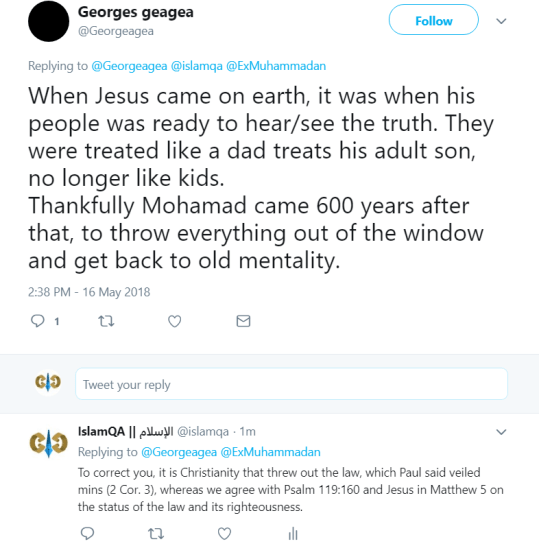
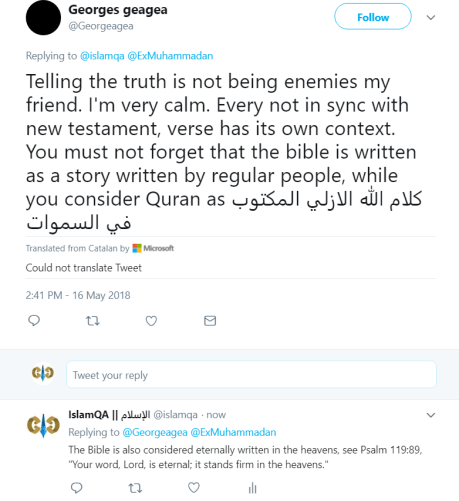
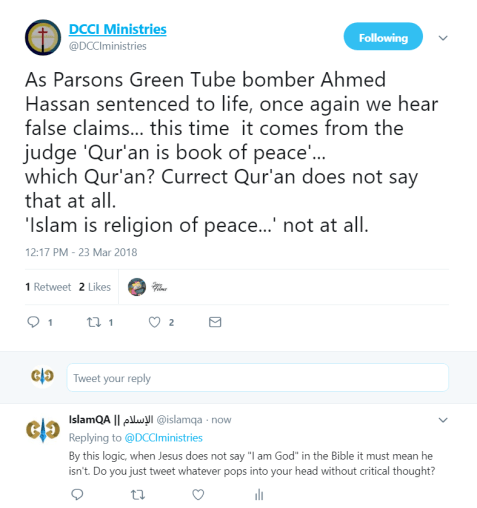
I’ve been interacting on Twitter a lot more often and occasionally I come across folks who are angry with or at Islam, and through conversation they realise they are wrong. This one Maronite Lebanese Christian is a quick example of how not knowing their own scripture and not knowing about Islam can result in an awkward dialogue.

cc-2018-mm-twitterarg1

cc-2018-mm-twitterarg2

and God knows best.

Why Do Muslims Pray for Muhammad (peace be upon him)?

Question:

Why do Muslims pray for Muhammad (peace be upon him) doesn’t that mean he needs prayers or forgiveness from God? This is a claim that often comes up in conversations with Christian missionaries.

Answer:

The primary reason we send salutations of peace and blessings upon the Prophet (peace be upon him) is due to this verse in the Qur’an:

“Indeed, Allah showers His blessings upon the Prophet, and His angels pray for him. O believers! Invoke Allah’s blessings upon him, and salute him with worthy greetings of peace.” – Qur’an 33:56 (translation by Dr. Mustafa Khattab – The Clear Qur’an).

Due to God commanding Muslims to do so, that is the most significant reason for us to convey salutations (praise) upon him. On the other hand, conveying these salutations do not necessarily imply a lack of good on his part or some moral deficiency, this can also be seen in the Lord’s Prayer in the New Testament:

“Our Father in heaven, hallowed be your name…” – Matthew 6:9 (NIV).

“Father, hallowed be your name…” – Luke 11:2 (NIV).

In these passages, “hallowed” refers to respect, honour, glory and to salute (see the Cambridge English Dictionary). No one argues that God lacks respect, honour, glory or needs our salutations, rather these praises are done out of respect, love and admiration. The same in this case applies to the Prophet (peace be upon him), he does not lack these qualities, but rather we have a deep love, admiration and respect for him that is expressed when we convey prayers upon him.

and God knows best.

Bible Passages on a Quranic Manuscript?

Given the discovery of the palimpsest text that is now up for auction at Christie’s, it should be pointed out that one of the primary reasons we do not find much manuscripts like this is because Muslims aren’t allowed to desecrate the Scriptures of the Jews and Christians.

‘O believers!’ Do not insult what they invoke besides God or they will insult God spitefully out of ignorance. – Qur’an 6:108 (translation by Dr. Mustafa Khattab).

Briefly, a palimpsest text occurs when you have a written document that has been erased/ scrubbed off, for a new writing to be written on the freshly erased surface. This involves physical removal of the written text, think of it as writing something with a pencil on a piece of paper, you then physically remove that writing by using an eraser, and then you can write whatever you want on the freshly erased surface. The same principle applies here.

We also need to remember that when you write with a pencil, it imprints on the paper, so even if you did “erase” what you had written with the pencil, the “erased text” can still be read. It’s not an exactly one to one correlation, but the same principles apply to the manuscript that has made the news.

Generally speaking, Muslims can’t and are not allowed to desecrate the Bible, so new copies of the Qur’an were written on new parchment. It is beautiful that this manuscript can show the respect that Muslims can have towards other faiths where our own scribal and scriptural traditions preserve not one religious scripture but two!

shaker

#islam #quran #peace

Quran Made Easy – Mutfi Elias Has Passed Away

Yesterday it was made aware to me that Mufti AH Elias, the person behind Quran Made Easy, an English translation of the Qur’an with inline commentary had died. Shaykh Muhammad Yasir al Hanafi posted this notice on Facebook yesterday.

Just before every Ramadan I have posted a link to his translation of the Qur’an on Amazon Kindle. Some years ago when I came across his translation, I found it to be very illuminating and so thought it would be useful for both Muslims and non-Muslims. In that regard, I sent an email asking that he discount the cost of the translation temporarily for Ramadan. Subsequently, I was surprised to see that he had made it permanently free. May Allah reward him for his kindness. You too, can download his translation for your Android, iOS phones, as well as for your PC. The Kindle App is free for all devices and an Amazon account is also free, no credit card needed.

Here’s the link to get the Qur’an translation.

Verily, it is from Allah we come and it is to Him that we return.

and Allah knows best.

The Easter Paradox

As it is Easter, I thought I’d just do a quick write up on why the Christian onto-theological model of God does not find much mileage in Islam. One of the classic go-to arguments by our Christian brothers and sisters is to argue that only the human nature suffered, not the divine nature. The reason this is argued is to circumvent the law of non-contradiction. What is the law of non-contradiction?

A cannot be A and not-A at the same time.

To circumvent this, we are told Jesus has two natures, so he suffered in one nature (the human nature or A) and didn’t suffer in another nature (the divine nature or B). On the surface this may seem like a reasonable response, until you break it down into notation form:

Jesus the Person {(divine nature), (human nature)}

In other words, Jesus, the 2nd Person of the Trinity and therefore God, can be said to have suffered, to say otherwise is to deny the personhood of Jesus in totality as the Trinitarian schema is presented to us. Calvinists in particular are fond of this argument but as RC Sproul has noted, other Christians accuse them of being Nestorians by dividing Jesus into two persons, a human person and a divine person. Those who argue in the form that Calvinists and most other popular Christian speakers do, fall prey to being declared apostates:as per the Council of Ephesus (431 CE):

If anyone distributes between the two persons or hypostases the expressions used either in the gospels or in the apostolic writings, whether they are used by the holy writers of Christ or by him about himself, and ascribes some to him as to a man, thought of separately from the Word from God, and others, as befitting God, to him as to the Word from God the Father, let him be anathema.

We can abstract this ontological model even further:

One Divine Being {(Father), (Son), (Holy Spirit)}

In this rendition, we can also say the Divine Being also suffered, as we are told each member of the Godhead is fully divine. Meme-ified we see:

cc-2018-media-easter1

And:

cc-2018-media-easter2

and God knows best.

« Older Entries Recent Entries »