Debate: Was Jesus the Son of God Or Only the Prophet of God – Br. Ijaz Ahmad & Dr. Tony Costa

We’re happy to announce that the debate video regarding the debate between Dr. Tony Costa and myself, “Was Jesus the Son of God or Only the Prophet of God?,” has been uploaded on Br. Muslim By Choice’s YouTube channel:

One YouTube user commented:

Ijaz is wonderful to listen to, a complete fresh nature of debating style from him. The Christian was not able to counter his line of thinking.

Here are some debate reviews by viewers:

and Allah knows best.

Debate: Was Jesus the Son of God Or Only the Prophet of God – Audience’s Review #2

This is the second of several audience reviews from the debate between Dr. Tony Costa and myself. The following review is from Br. Muhammad Asad (UK):


Main Points / Arguments

Dr Costa made the following points in his opening statement:

• Jesus is both God’s prophet and the Son of God

• We need to go to earliest sources to know about the historical Jesus – the New Testament documents which were composed in the 1st century. All New Testament scholars go to the New Testament writings to know about the historical Jesus

• These earliest documents are unanimous in teaching that Jesus was the Son of God. According to Dr Costa, Ijaz has to produce a 1st century document which states that Jesus was only God’s prophet and no more

• The language of “sonship” is also found in the Jewish Bible. Dr Costa gave examples of how the term “son” is applied in the Jewish Bible (used for angels, for Israel as a nation, the Messianic king etc)

• According to Dr Costa, in Islam while God is the Master and humanity is slave, the Bible goes beyond this and presents God like a father to His people

• When Jesus spoke of himself as God’s son, it was in terms of a unique relationship – as a unique Son of God. Hence the charge of “blasphemy” levelled upon Jesus in the New Testament

• Historians do not go to the Quran to learn anything about the historical Jesus because the Quran came to the scene 600 years after Jesus. Hence the Quran is “historically worthless.”

• Sayings attributed to Jesus within the Quran come from apocryphal sources

•  Jesus never denied that he was God’s son. Gospel of John is cited at this stage as evidence for this claim and the Gospel of Mark is also referred to – Jesus being questioned about whether or not he was son of the most High

• Dr Costa referred to Prof. Tarif Khalidi, author of “The Muslim Jesus: Sayings and Stories in Islamic Literature” who supposedly asserts that the Jesus found in Islam is a “fabrication” and not the historical Jesus “found in the gospels.”

These are basically the points which Dr Costa proceeded to repeat in the rest of the debate. I will offer my reply to some of these points very shortly.

Ijaz Ahmad’s approach, in sharp contrast, was radically different. Ahmad took the philosophical approach to deny that Jesus was the son of God. According to Ahmad, it does not matter to him what the New Testament says. Ahmad explained that when Christians say “Son of God,” they actually mean “God.” Therefore, the title of the debate should be,“Is Jesus God or just a Prophet of God?”  Simply, he will set out to show why Jesus could not be the Son of God (as in “God”) philosophically, ontologically and rationally.

I breakdown Ahmad’s main points as follows:

• In typical Christian-Muslim debates, Christians argue: the New Testament asserts that Jesus is the Son of God, “prophecies” are cited from the Jewish Bible, a few quotations are presented from secular historians, it is asserted that the Quran denies Jesus being God’s son, that the Quran misunderstood the Trinity and that according to the Quran God needs a consort. Muslims respond that the Jewish Bible is cited out of context by Christians, the New Testament is not a reliable historical source, “son of God” is a diverse term and not unique to Jesus and that the Christians are misinterpreting the Quran. Ahmad says he will reject this script in this debate.

• “Son of God,” as used by Christians, means God

• Christians in general are tremendously confused and uncertain about the doctrine of the “Son of God” and even more when it comes to the doctrine of the Trinity. Ahmad quotes the polemicist Dr James R. White and R.C. Sproul in this regard, who acknowledge that Christians misunderstand the doctrine of the Trinity

• In Islam Jesus is God’s Nabi. Thus, Jesus is God’s Prophet and the Islamic position is rational and most probable

• In Islam a prophet does not inherently have future knowledge; this is given to him by God. The problem begins if Jesus is “Son of God,” as in God, Jesus would then be expected to have all knowledge (past, present, future). He would not be given this knowledge. Being God, he would already have it. Yet a prophet by nature cannot be God because they do not possess the knowledge of the unseen (unless God grants them this knowledge)

• The teaching of Islam is: there is nothing comparable to or like God. Ahmad asserted that this is the “best example of perfect-being theology.”

• The “Son of God,” in contrast, is not a perfect-being theology. If Jesus is said to be the Son of God, we then have ontological, philosophical and soteriological problems to deal with – Ahmad cites Michael Rea who asserts that God existing as a Trinity consisting of three persons with one nature could not be derived from a perfect-being theology

• Ahmad asked how God could suffer? To say that only the human nature suffered, argued Ahmad, caused one to fall prey to the heresy of Nestorianism – because the two natures of Jesus are eternally united. Therefore, it cannot be said that only one nature experienced something whereas the other nature did not. It is either Nestorianism or polytheism, argued Ahmad

• Arguing further, Ahmad explained that when Christians assert that God loves them or God speaks, they mean the collective persons of the Godhead. So when it is said that God died or God suffered – and given the claim that God is of one substance and undivided – then how can it be said that only one suffered?

• Ahmad mentioned that faced with this difficulty, there have been some Christians who believed that the Father also suffered alongside Jesus. This is the heresy of Patripassianiasm

• If Christians are to be theologically consistent, then they should worship Satan and not Jesus or God because Satan grants death (author of death), God is the author of life

• Jesus was not a maximally perfect being. He was ignorant of the hour. Therefore, ontologically, Jesus cannot be God as he does not fulfil the criteria of being a maximally perfect being. According to Ahmad, proto-Orthodox Christianity falls into the heresy of subordinationism

• Jesus was strengthened by angels, he was once overcome by death, he was ignorant of the hour and can, therefore, in no way be perfect. The Son of God lacks the attributes of God

Of course, much like Dr Costa, Ahmad too proceeded to repeat his above points throughout the remainder of the debate.

Thoughts on the Rebuttals

It seems that Dr Costa was not expecting such a presentation from Ahmad. Thus, there was really no significant engagement with Ahmad’s arguments. Instead, Dr Costa stated that Ahmad was making irrelevant arguments and avoiding the topic of the debate. This I consider to be a highly disingenuous claim because when discussing whether Jesus is God’s son – particularly when we know that people like Dr Costa take this to mean “more than a man” – then we are inevitably discussing the Trinity. Ahmad was rationally, philosophically and ontologically arguing why Jesus couldn’t be the Son of God, God, the second person of the Trinity, and was no more than a Prophet.

Even more unbelievable was Dr Costa’s following assertion: that by rejecting the authority of the Bible, Ahmad had declared himself to be a “kafir” because as per the Quran, a dreadful torment awaits you if you deny God’s revelation! But this understanding of Dr Costa is not an incontrovertible fact. According to Muslims, this is an example of Dr Costa’s esigesis of a passage of the Quran. Muslims dismiss his interpretation and understand the passage in a very different way (that God is referring to the original revealed books to the Prophets and not the Pauline epistles, the pseudonymous epistles of the New Testament and anonymous ancient biographical type documents such as the gospels).  Ahmad, later corrected Dr Costa and explained that the Quran was referring to the Injil revealed by God and not to ancient biographical type of documents such as the gospels.

This entire cockamamie argument regarding the “Quran endorses the Bible” has received a detailed refutation here: Does Islam Endorse The Bible?

Dr Costa asserted that while Ahmad rejects the New Testament documents and does not care about them, historians do care about what they have to say. I think Dr Costa may have misunderstood Ahmad. Ahmad stated clearly that he was taking a different approach, a philosophical approach, in order to argue why Jesus could not be “Son of God” – as in God, the second person of the Trinity. Hence, for him the assertions of the New Testament are irrelevant because they do not explain away the irrational nature of the Trinity as expounded by Ahmad. Of course, that does not follow that he believes that the New Testament documents should be tossed in the bin by historians who want to investigate historical issues.

Perhaps the most startling assertion by Dr Costa was as follows:

“…those who were eyewitnesses who compiled these documents, we’re interested in knowing what they say.”  Time slice: 48.56 – 49.03

Who are these eyewitnesses who “compiled” the New Testament documents? None. There really are none. The New Testament documents were not even authored by any “eyewitnesses” that we know of, let alone “compiled” by them.

We have no documents from any eyewitness from Jesus’ historical ministry.

Dr Costa also made the following analogy: Ahmad’s arguments are no different from the arguments made by Bahaullah, who claimed that Muhammad (saw) was not the last Prophet of God! But this is surely a false analogy. In a discussion pertaining to the person of Jesus, one is absolutely justified in arguing why Jesus couldn’t be the Son of God / God / second person of the Trinity – be it historically or philosophically. This is relevant. How is this even remotely akin to Dr Costa’s Bahaullah analogy? As Ahmad correctly explained, he was considering the topic through the prism of the philosophy of religion and attempting to ascertain if the Christian stance was rational. The Bahaullah analogy is nothing of this sort.

At one point in his first rebuttal, Dr Costa did attempt to engage with with some of Ahmad’s arguments: Jesus was not literally but only metaphorically the “son of God,” that Ahmad misunderstood Nestorianism because it taught that there were two persons in Christ and that Patripassianiasm was also rejected as a heresy by the Church. Ahmad, however, did not deny that these were heresies. As for God dying on the cross, Dr Costa said that in the incarnation it was only the humanity of Christ which died.  The little problem here is that Ahmad already explained why these answers were deficient – how the divine and the human nature cannot be separated – and how Christians such as Dr Costa are guilty of committing these heresies in their defences of the Trinitarian understanding of God.

Much like his opening statement, from time to time Dr Costa continued to have various goes at the Quran and the next section will be my take on his polemics.

Addressing Dr Costa’s outdated and irrational Polemics

1. Scholars do not approach the Quran to learn about the historical Jesus this is a strange comment. Indeed the Quran arrives at the scene some 600 years after Jesus. If we a priori dismiss the possibility of miracles and revelation, and deny a priori the possibility of Muhammad (saw) having received revelation from God, then naturally we would not use the Quran to know anything about the historical Jesus. We would go to the earliest sources. In a similar manner, historians deem to be “historically worthless” the words attributed to Jesus pertaining to the prophets of the old. They would go to the earlier pre-New Testament documents to learn about the prophets who were active much before the time of Jesus and would not be approaching the words of Jesus to learn, say, about the historical David, historical Moses, the historical Abraham etc. This does not cause any “problems” for Muslims. We believe that the Quran is the revelation of God. Therefore, it does not matter if this revelation occurred 600 years after the earthly ministry of Jesus. The source is God and God knows what happened.

2.  Historical Jesus Research – Jesus as God and “Son” – From time to time Dr Costa mentioned the “historical Jesus.” He talked about the title “son of God,” cited some New Testament passages and commented how “liberal” scholars deem them to be authentic.

People like Dr Costa are terrific salesmen who are selling a highly deficient product, namely, their evangelical Jesus. I say this because the historical Jesus studies, as a whole, has completely destroyed the evangelical conception of Jesus. For example, consider the divinity of Jesus (emphasis added):

“One of the cardinal principles of historical Jesus research is that the belief in Jesus’s divinity is a post-resurrection phenomenon. During his life, his acts of power were understood as signs that God (or Satan) was working through him– not that he was God.

The gospel of John presents Jesus teaching that he’s divine, but most scholars treat this as a later interpretation rather than a historical fact because it’s so much more highly developed here than in the earlier gospels and gospel sources …” 1

Apologists such as Dr Costa speak as if the historical Jesus research is on their side whereas the truth is the complete opposite.

Consider now the term “son of God.” I cite here the conclusions of two mainstream New Testament scholars (all emphasis added).

Christopher Tuckett (after discussing this title in details, concludes):

“The term ‘son of God’ was thus a very wide-ranging one at the time of the New Testament. But if one thing is clear it is that, at least within a Jewish context, the term was used not infrequently and with no overtones of divinity being ascribed to the person referred to in this way.” 2

John Meier:

“In any event, one must beware of reading into the title [son of God] the meaning it acquired in later Trinitarian controversies.” 3

It is this *new* meaning in the post Jesus environment which the Quran rightly denies.

The above are mainstream historical Jesus views.

3. Why the Historical Jesus Research? Don’t all New Testament Scholars go to the “reliable” 1st Century New Testament writings? – if the New Testament writings are reliable historically, then why is there a need to do historical Jesus research? Why can’t we just read off the New Testament and take its claims at face value?

The answer is simple. Besides the most conservative of Christians, Historical Jesus scholars do not deem the New Testament to be a historically reliable source on the life of Jesus. They have devised criteria to figure out what Jesus probably did or did not say/do as related in the New Testament.

Virtually all scholars acknowledge the fact that there are both reliable and unreliable pieces of information within the canonical gospels.

Generally, scholars agree that stories about Jesus and his words were changed in different ways as these were passed along orally. The changes also occurred when written gospel documents began to appear and even thereafter. The difference of opinion is over the question of “how much/many” changes occurred. But all agree that changes did occur. How can we be sure that stories about Jesus  and his words were altered in different ways? Simple: by comparing the same stories in the canonical gospels. When we do this we encounter some major and many minor differences between them.

1. Jesus preached and taught and left an impact upon many. 2. His followers (and some who didn’t join him) remembered him and talked about his words and teachings, passing them on to others. 3. Here stories and words began changing in different ways; 4. gospel authors tapped into some/many of these traditions – which were already undergoing alterations – and further adapted them to suit their own particular needs. Some stories were changed minutely, some were significantly changed and some stories were even invented and some words were also invented and subsequently attributed to Jesus.

Of course, ultimately we do not know precisely and exactly how (and why) the changes occurred. All we can be reasonably certain about is that changes did nonetheless occur.  All the above type of things must have occurred.

As a result, scholars have devised a number of criteria to evaluate the grade of authenticity of material within the canonical gospels in an attempt to determine the probable authenticity/inauthenticity of the stories and sayings within them. When scholars read words attributed to Jesus within the gospels, they do not just take them to be Jesus’ verbal wording. As Tuckett explains:

“Nevertheless the nature of the Gospel tradition means that we cannot simply take everything recorded in all the Gospels as unquestionably genuine reports about what Jesus said or did in a pre-Easter situation.”4

Given the nature of the material within the canonical gospels, we need to use some type of criteria to make sense of the material and know what is or is not probably historical.

The criteria are themselves not foolproof and the use of some continues to be hotly debated whereas others are widely accepted. Generally, it is believed that multiple criteria need to be applied before we can come to a reasoned conclusion. We cannot just rely upon one criterion.

Furthermore, at the end of the day, we really cannot be certain. We can only speak in terms of probability and not certainty.

All of these points are conveniently ignored by apologists such as Dr Costa and they often speak about the Historical Jesus research as if it is on their side.

4. Where is the 1st century document which denies that Jesus was God’s son and presents the Islamic Jesus? – easy, there is no such document in existence.  Dr Costa is correct, the earliest writings, and the only surviving writings from the 1st century, happen to be the New Testament documents.

But here is the problem: the New Testament documents are not deemed to be reliable by mainstream historical Jesus scholars in what they have to say about Jesus. Therefore, as explained in #3 above,  scholars treat these documents critically, having devised criteria to ascertain as best as possible the authentic and inauthentic details within these writings.  These reconstructions of the historical Jesus are not to be found in any ancient Christian document, whether from the 1st or later centuries.

Once these documents are treated critically, we frequently get a picture of Jesus which is most removed from the evangelical view of Jesus and closer to the Muslim view of Jesus, even if not 100% identical. Typically, while there are disagreements over matters of detail, the below components are frequently observed in historical Jesus reconstructions:

• Jesus in his historical ministry did not claim to be god, divine, the second person of the trinity or “more than a man”

• Jesus was looked upon as God’s Prophet and he presented himself as God’s messiah – though what type of messiah continues to be debated by scholars

• Jesus restricted his preaching to the Jewish people / he confined his activity to Israel (quoting Ed Sanders)

• Jesus did not bring about a new religion

• Jesus is unlikely to have preached that he would die and be raised back to life

• Jesus was an observant Jew and did not overwrite the law; at most, he intensified some aspects of the law

• Jesus was a miracle worker / was accused of being a sorcerer

• Jesus preached repentance and the kingdom of God

• Jesus had disciples

There are many diverse reconstructions of the historical Jesus. But, frequently, the historical Jesus reconstructions are more similar to the general Muslim outline of Jesus than they are to the evangelical Jesus. In fact, the latter is very thoroughly and routinely dismissed again and again by historical Jesus scholars.

Consider James D. Tabor as an example.  He is a very controversial scholar and Muslims would immediately reject a number of things he has to say about the historical Jesus. But Tabor’s reconstruction of the historical Jesus is still, broadly speaking, more similar to the Islamic view as is readily acknowledged by him:

“Muslims do not worship Jesus, who is known as Isa in Arabic, nor do they consider him divine, but they do believe that he was a prophet or messenger of God and he is called the Messiah in the Quran. However, by affirming Jesus as Messiah they are attesting to his messianic message, not his mission as a heavenly Christ. There are some rather striking connections between the research I have presented in The Jesus Dynasty and the traditional beliefs of Islam.The Muslim emphasis on Jesus as messianic prophet and teacher is quite parallel to what we find in the Q source, in the book of James, and in the Didache. To be the Messiah is to proclaim a message, but it is the same message as that proclaimed by Abraham, Moses, and all the Prophets. Islam insists that neither Jesus nor Mohammed brought a new religion. Both sought to call people back to what might be called “Abrahamic faith.” This is precisely what we find emphasized in the book of James. Like Islam, the book of James, and the teaching of Jesus in Q, emphasize doing the will of God as a demonstration of one’s faith. Also, the dietary laws of Islam, as quoted in the Quran, echo the teachings of James in Acts 15 almost word for word: “Abstain from swine’s flesh, blood, things offered to idols, and carrion” (Quran 2:172)

there is little about the view of Jesus presented in this book that conflicts with Islam’s basic perception.” 5

And this is the case we often encounter when examining other scholarly reconstructions of the historical Jesus.

5. The Quran is reliant upon Apocryphal Sources – This is a much outdated argument which is seldom made by modern Quranic scholars – except for the polemically inclined such as Dr Costa. In the last century, many non-Muslim scholars – who just so happened to be mostly Christians – envisaged the Prophet (saw) to have encyclopaedic knowledge,  with a treasure trove of Jewish and Christian writings at his (saw) disposal – both canonical and apocryphal – from which he (saw) was actively “copying” different stories, giving them twists in accordance with his (saw) taste.  Subsequent studies have disproved this hypothesis.

There are similarities as well as many differences between Quranic stories and parallels found in the canonical and non-canonical Jewish and Christian writings. There are no actual quotations and citations in the Quran from any Jewish-Christian writing. The closest similarity in wording is to be found in three tiny sentences:

A. “We have written in the Psalms after the reminder that ‘My righteous servants will inherit the earth.” – al-Anbiya 105 – compare with Psalms 37.29: “The righteous will inherit the land and dwell in it forever.”

B. “And God spoke directly with Moses.” – an-Nisa 164 – compare with Exodus 20:1:”And God spoke all these things to Moses, saying…”

C. “Indeed, those who have denied our revelations and rejected them arrogantly – the gates of heaven shall not be opened for them and they shall not enter paradise until the camel passes through the eye of the needle.” – al-Araf 40 – compare with Matthew 19:24: “It is easier for a camel to go through the eye of a needle than for a rich man to enter the kingdom of God.”

How is it that if Muhammad (saw) had so many documents at his disposal, that only in three small areas he (saw) decided to retain some similarity with the wording of his (saw) sources and didn’t bother to quote anything else? In the words of Prof. Griffith, there is a “…virtual non-existence of the text of the Bible in any of the Quran’s biblical reminiscences.” 6

On the contrary, scholars now tend to argue that the Quran was the very first Arabic document – the first book in Arabic. Stories about Jesus and stories about Biblical prophets were floating around orally during the time of Muhammad (saw) in his (saw) immediate environment. People knew about these stories orally. The Author of the Quran knew these stories and used them by “rectifying” them – correcting them and retelling them so as to say, “this is what really happened / this is how it actually happened.”

In his recent book, Prof. Sidney H. Griffith writes:

“For the past century or more, many Western scholars have studied the Bible in the Quran, looking for its sources and the presumed influences on its text in both canonical and non-canonical, Jewish and Christian scriptures and apocryphal writings. Most often they declared the Quranic readings to be garbled, confused, mistaken, or even corrupted when compared with the presumed originals. Most recent scholars, however, some more sensitive than their academic ancestors to the oral character, as opposed to a ‘written-text’ interface between Bible and Quran, have taken the point that the evident intertextuality that obtains in many places in the three sets of scriptures  … reflects an oral intermingling of traditions, motifs, and histories in the days of the Quran’s origins.” 7

And:

“The Bible is both in the Quran and not in the Quran. That is to say, it has virtually no textual presence, but the selected presence of an ‘interpreted Bible’ in Islamic scripture is undeniable. And the selection process involved in the inclusion of biblical reminiscences in the Quran, according to the hypothesis advanced here, is one determined by the Quran’s own distinctive prophetology … And what is more, the Quran is corrective of, even polemical toward the earlier the earlier readings of the ‘Scripture People’ …” 8

From a purely secular perspective, where we a priori dismiss the possibility of revelation and miracle, when faced with similarities and differences between two or more sources, we can only reach these type of explanations:

• text A copied from text B;

• text A and B are reliant upon the same source – oral or written;

• stories were circulating orally and used by multiple groups, ending up in different written sources

If two sources contain the same stories, whether with some differences or not, then there has to be an underlying explanation for this. Either a textual dependency between documents – with scholars debating the direction of this textual dependency – or both documents being reliant upon the same source,  both documents reliant upon oral traditions or a mixture of the two etc.

So in our case, the Quran mentions Jesus, Moses and David. The stories within the Quran about these and other prophets are similar to stories found in Jewish and Christian writings – with differences as well. How do we explain this? Secular historians who are a priori dismissing the possibility of revelation can only offer a variety of natural explanations, some more convincing than others.

This doesn’t cause any problems for Muslims. We believe that certain events did occur. These were recorded – in varying levels of accuracy – in written sources and circulated orally. God then gave a revelation to Muhammad (saw) and related the actual stories, what really happened, confirming the truth and negating the false elements in the stories of all the Prophets, from Adam to Jesus. Hence the similarities and differences between the Quran and parallel stories in Jewish and Christian writings.

The view proposed by most scholars such as Prof. Griffith, therefore, does not in any manner “negate” the Muslim belief or cause any “problems” for Muslims.

6. Prof Khalidi states that the “Muslim Jesus” is meta historical, he is not even a historical person, the Quranic Jesus is an argument, it has nothing in common with the Jesus of the gospels, in fact, he says that the Muslim Jesus is a “Muslim creation,” he is an artificial creation, he is “meta historical” – he is not even a historical person– Firstly, so what if this is Prof. Khalidi’s view? Dr Costa is more than happy to dismiss mainstream Historical Jesus studies and mainstream New Testament studies for the sake of his historically dubious evangelical Jesus, then why should Ahmad be concerned about the view of Tarif Khalidi? Surely, there are many more Christians who have objectionable things to say about Dr Costa’s view of the Bible than Muslims who say objectionable things about Ahmad’s view of the Quran.

Secondly, Dr Costa seems to have misunderstood Tarif Khalidi. Prof. Khalidi’s book is about the stories of Jesus in later post-Quranic writings from the second / eighth century to the twelfth / eighteenth century. Prof. Khalidi states:

“In referring to this body of literature, I shall henceforth use the phrase “Muslim gospel.” 9

It is this “Muslim gospel” which is labelled by Prof. Khalidi as “meta historical”:

“…the Muslim gospel assembled here has the advantage of a certain impact and novelty. Here is a Jesus who is on the one hand is shorn of Christology, but who on the other is endowed with attributes which render him meta-historical and even, so to speak, meta religious.” 10

Prof. Khalidi is not referring to the Quran. He is referring to the “Muslim gospel” i.e.  post-Quranic writings from the second / eighth century to the twelfth / eighteenth century.

Prof. Khalidi writes:

“… the Jesus of the Muslim gospel takes on an identity quite different from the one found in the Quran, the Quranic Jesus remains an important basis of his later manifestation.” 11

So the “Muslim gospel” and the Quran and two different writings – the former being the label given to a wide range of post-Quranic stories about Jesus.

Moving to the Quranic presentation of Jesus, Prof. Khalidi says:

“The Quranic Jesus is in fact an argument addressed to his more wayward followers, intended to convince the sincere and frighten the unrepentant. As such, he has little in common with the Jesus of the Gospels, canonical or apocryphal.Rather, the Quranic image bears its own special and corrective message, pruning, rectifying, and rearranging an earlier revelation regarded as notorious for its divisive and contentious sects. The Quranic Jesus issues, no doubt, from the “orthodox” and canonical as well as the “unorthodox” and apocryphal Christian tradition. Thereafter, however, he assumed a life and function of his own, as often happens when one religious tradition emanates from another.” 12

Indeed, the Quranic Jesus is unique, with points of similarities and differences from all writings – canonical and non-canonical.  It emanates from canonical / non-canonical  tradition as the Author interacts with these traditions, arguing and presenting what He deems to be the correct view of Jesus.

As explained in #5 above, this sort of explanation is perfectly valid from a purely secular perspective. It causes no “problems” if one believes in the Quran as the Word of God, who confirmed accurate details about Jesus  – preserved in a variety of written and oral sources – and who dismissed and denied the inaccurate and inappropriate elements of the Jesus story. This explains the differences and similarities between the Quranic retellings and parallels in other documents.

7. Quran gets the Trinity wrong and asserts that Mary was part of the Trinity? – not so according to modern non-polemical scholarship.  The Qu’ran nowhere spells out the Trinity in 5:116.  It does not mention the Trinity’s contents. In other words, the Quran does not state, “The Trinity consists of the Father, the Son and the Holy Spirit; they are not three gods but one God.”

Rather than referring to the Trinity, or to a “deviant” formulation of it, the Quran presents an eschathological interrogation of Jesus in which his divinity and that of his mother is denied. Now we know that Christians do worship Jesus as god. We also know that not only in the past did some groups elevate the status of Mary, but that the largest group of Christians, the Catholics direct worship towards her as “mother of God.” From the Quranic perspective, this IS akin to the worship of two of God’s creatures besides Him.

Therefore, the Quran is only stating how these acts are viewed/seen/looked upon by its Author – God.

David Thomas explains that this passage is:

“…a denial that Jesus and Mary are equal with God, and a warning (q.v.) against making excessive claims about them. Thus, it can be understood as an instance of the warning against the divinization of Jesus that is given elsewhere in the Qur’ān and a warning against the virtual divinization of Mary…” 13

The verse is to be understood as:

“… a warning against excessive devotion to Jesus and extravagant veneration of Mary, a reminder linked to the central theme of the Qur’ān that there is only one God and he alone is to be worshipped …” 14

This is also confirmed by Sidney Griffith, who writes:

Surely the standard Christian proclamation that Jesus is God, the son of God, and Mary his mother, is the mother of God, would have been sufficient to elicit the Qur’an’s adverse judgment.” 15

It is equally plausible that the Quran intentionally simplifies the Christian belief in the divinity of Jesus to expose its weakness when analysed from the strict monotheistic perspective of the Quran.

This is how non polemicist western academics are reading the Qur’an.  Very different from the misreadings of the polemical authors such as Dr Costa and friends.

8. The Gospel of John and Historical Jesus scholars – Dr Costa likes to mention Historical Jesus scholarship now and then. But he does not inform people that the Gospel of John is deemed to be a highly unreliable source to know about the historical Jesus by mainstream New Testament scholars. Even scholars who attempt to make some use of the fourth gospel acknowledge that it is a highly interpretive account of Jesus. There are many conservative scholars who have made such acknowledgements and a sample of conservative scholarship can be viewed here:

http://www.call-to-monotheism.com/shamounion_straw_men_and_obfuscations__a_critical_commentary_on_sam_shamoun_s__the_purpose_and_cause_of_jesus__death

For now, I just present the view of one of the most prominent Historical Jesus scholar:

It is impossible to think that Jesus spent his short ministry teaching in two such completely different ways, conveying such different contents, and there were simply two traditions, each going back to Jesus, one transmitting 50 per cent of what he said and another one the other 50 per cent, with almost no overlaps. Consequently, for the last 150 or so years scholars have had to choose. They have almost unanimously, and I think entirely correctly, concluded that the teaching of the historical Jesus is to be sought in the synoptic gospels and that John represents an advanced theological development, in which meditations on the person and work of Christ are presented in the first person, as if Jesus said them. “16

Again note: mainstream scholarship has to be dismissed again and again by Dr Costa and friends.

+++++++

1. Catherine M. Murphy, The Historical Jesus For Dummies, 2007, John Wiley & Sons, Indianapolis: Indiana, p. 178.

2. Christopher Tuckett, Christology And The New Testament: Jesus And His Earliest Followers, 2001, Edinburgh University Press, p. 24.

3. John P. Meier, “Reflections on Jesus-of-History Research Today,” in James H. Charlesworth (Editor), Jesus’ Jewishness: Exploring the Place of Jesus in Early Judaism, 1996, The American Interfaith Institute, New York: The Crossroad Herder Publishing Company, p. 100.

4. Christopher M. Tuckett, Christology and the New Testament: Jesus and His Earliest Followers, op. cit., p. 203.

5. James D Tabor, The Jesus Dynasty: Stunning New Evidence about the Hidden History of Jesus, 2006, HarperElement, pp. 287 – 288.

6. Sidney H. Griffith, The Bible in Arabic: The Scriptures of the “People of the Book” In The Language of Islam, 2013, Princeton University Press, p. 91.

7. ibid p. 56.

8. ibid p. 95.

9. Tariff Khalidi (Editor & Translator) & Edward W. Said (General Editor), The Muslim Jesus: Sayings and Stories in Islamic Literature, 2003 Edition, Harvard University Press, p. 3.

10. ibid p. 45.

11. ibid p. 6.

12. ibid pp. 16-17.

13. EQ, Vol. 5, p. 370.

14. ibid.

15. Sidney H. Griffith, The Church in the Shadow of the Mosque: Christians and Muslims in the World of Islam, 2007, Princeton University Press, p. 29.

16. E. P. Sanders, The Historical Figure Of Jesus, 1993, Penguin Books, pp. 70-71.


To have your review or comments about the debate published on the website and on our Facebook page, submit them via our Contact Us page.

and Allah knows best.

Debate: Was Jesus the Son of God or Only the Prophet of God – Audience’s Review #1

This is the first of several audience reviews from the debate between Dr. Tony Costa and myself. The following review is from Abu Ilias (USA):


As a student of comparative theology, I am addicted to watching Christian/Muslim interfaith dialogues and debates. Different speakers have different oratory attributes, skills, knowledge, and of course deficiencies as well, and present their information in various ways. There are some who, to the discerning minds, seem to merely want to spout hate and animosity at the interlocutor’s person and faith conviction, not seriously interested in genuine dialogue or hoping to reach a fair and objective conclusion. And there are those that , bless them, seem to be very sincere and earnest but do not posses adequate knowledge in the scope of their debate endeavors and consequently end up creating straw men arguments, misrepresentations and false conclusions, albeit not intentionally.

This debate between Tony Costa and Ijaz Ahmed encapsulated the best of both worlds in my humble opinion. Ijaz was lucid, intelligent, respectful and up to date on the current landscape of Christian theological doctrine and textual criticism. He did not allow his Quranic or Islamic preconceptions to muddy the merit of his arguments nor did he allow the fever of religious debate to infiltrate and ruin the civility of the event (contrary to what others such as David Wood and Sam Shamoun frequently do on ABN). Tony Costa, is also one of the more respectable Christian personalities and apologists. He displayed a very professional level of dialogue and did not resort to some of the oft repeated bigoted slogans that ubiquitously occupy the lips of others who use the ABN platform. And while I believe some of Costa’s arguments to be weak or unfounded, I never found myself grinding my teeth or face palming at any time during his debate, which is a first for me as a listener of ABN’s material.

Ijaz (as well as some very intelligent Muslim questioners during the Q and A) did a terrific job using only christian and general biblical scholarship to support his claims on various topics and I learned much from his presentations as well as his style of delivery, in fact, I am shocked at his level of knowledge and wisdom at such a young age. I will definitely watch this debate numerous times in order to study the material he so eloquently presented and utilize it in the future! By my humble estimation, Ijaz clearly provided the more objective and faith-neutral arguments while Costa, although being respectful and polite, countered with little more than cliches that have long been discarded by modern studies in textual criticism and Christology. Examples include his continued claim that the Gospels were 1st century documents despite Ijaz’s elucidation of the fact that the oldest known manuscripts like P52 are dated by biblical scholars no earlier than the early second century and as late as the third century (even though Prof Dan Wallace claims to have been a part of the dating and discovery of a small late first century fragment of Mark back in 2012, it is now almost 2016 with still no verification.)

There are many more points, paramount ones, that can be expounded upon to show how Ijaz demonstrated the problematic nature of reconciling unitiarian passages in the NT with the trinity and the dual nature of Jesus peace be upon him, as well as how he academically clarified the dubious nature of the NT text as a whole, which in essence trumped anything Costa could have had to refute!


To have your review or comments about the debate published on the website and on our Facebook page, submit them via our Contact Us page.

and Allah knows best.

Debate Video: Was Jesus the Son of God or Only the Prophet of God – Br. Ijaz Ahmad & Dr. Tony Costa

Alhamdulillah!

The debate video has been added to our ‘Debates page‘, and is available on YouTube:

I’ve received a ton of positive feedback about the debate. There are a number of reviews expected to be published soon. The following review is from a Muslim YouTube user who watched all of the debates from the Trinity Channel’s Debate Marathon, featuring Dr. Shabir Ally, David Wood, Dr Costa and myself, he says:

I just found this channel, and during the past week or so watched all these debates against Muslims.

As a Muslim convert from Christianity, I must say that the Christians on here are good at debating but they do it in a slick way. That is that they always take the Qur’an and twist it back onto the Muslim by saying things like “According to your book, blah blah blah.”

This debate was the best one so far because Ijaz went into it know this was going to happen and in his initial statement didn’t even mention the Qur’an and used just Christian ideology to make his point. I was thinking that we would finally get a good discussion going.

Unfortunately, right in the first rebuttal, the Christian side went right into the same tactics as in all the previous debates. This is what made this one feel like a big rehash of the previous week.

Another popular Muslim author, and convert from Christianity, Br. Abu Zakariya of Many Prophets One Message posted on Facebook:

A big congratulations to our brother Ijaz Ahmad on last night’s debate with Dr. Tony Costa. It was a resounding victory for Ijaz, despite lacking the academic credentials and decades of experience that his opponent possesses.

May Allah increase Ijaz in goodness. Ameen.

One other mini-review which took place directly after the debate, is as follows by our esteemed and scholastic, Br. Mansur:

Dr. Costa misunderstood your arguments. He misunderstood the topic of the debate. Perhaps he had not given enough thought on the subject. It is strange indeed to see his logic at play here. Suppose the debate title was: ‘ Is the Qur’an the word of God’ or ‘is Muhammad a Prophet of God?’ Merely quoting the Qur’an or the early followers of Islam, or even contemporary non-Muslims who stated this belief of Muslims does not prove any of these propositions. Dr. Costa presumed wrongly that the debate was ‘ Does the Bible claim that Jesus is the son of God or …’. I can accept that the laity can be a victim of poor comprehension on this but I don’t expect that from learned individuals.

The approach I took in this debate has piqued the interest of the inter-faith dialogue community. I chose not to use the historical/ Biblical interpretation route (Son of God has many meanings). Rather, I accepted that my opponent believes that Jesus was God/ the Son of God. From that, I argued based on the philosophy of religion and on the ontology (nature of his God), that Jesus did not meet or fulfill the criteria of God (defined in the debate as a maximally perfect being).

In other words, I asked very important questions. If Jesus is God, does he demonstrate the qualities of a deity? Do the beliefs of Christians regarding the Son of God’s place in the Trinity, make any sense? Are those beliefs consistent, are they rational? Do they contain heretical teachings? Do Christians appeal to heresies to defend the Trinity?

P1: If the beliefs about the Son of God by Christians are inconsistent and irrational, then Jesus is not the Son of God.

P2: The beliefs about the Son of God by Christians are inconsistent and irrational.

C: Therefore Jesus is not the Son of God.

The debate was absolutely wonderful. I thoroughly enjoyed engaging with Dr. Costa, and I was very much pleased with the outcome. Quite a lot of Muslims thanked me for introducing these arguments, and for not repeating the same arguments that have traditionally been used for debates about this topic since time immemorial. I always try to introduce new information, new arguments, new research when I debate. The goals are to raise and advance the level of intellectual discourse, to discuss the fundamental and essential beliefs about our respective faiths, and finally to educate the public.

May Allah reward all those who take their time to watch the debate, Ameen.

And Allah knows best.

Answers to the “Questions For Reflection” in “The Case For Christ” by Lee Strobel

Note: The following is an article by Br. Andrew Livingston, regarding one of the most popular Christian works in recent times,“The Case For Christ” by Lee Strobel. Br. Andrew’s writings can be found at taqwamagazine.com. In this article, Br. Andrew takes an honest and critical look at the ‘questions for reflection’ included in the book.

Answers to the “Questions For Reflection” in “The Case For Christ” by Lee Strobel

cc-2015-thecaseforchristleestrobel

I haven’t read Lee Strobel’s original book “The Case for Faith”. I *have* skimmed large chunks of it and read reviews and what not. What I can tell you is that “The Case for Faith” chronicles Lee Strobel’s going on what he still believes to this day was a genuine journey of discovery ultimately leading to his embracing Jesus (meaning, of course, the Jesus of modern day western evangelical Protestant Trinitarian Christianity). In actual fact what he did was hold a series of interviews exclusively with Christians of the aforementioned stripe, over and over and over again, until he was convinced. A true journalistic investigation would have involved Strobel alternating between different kinds of interview subjects: now you’re interviewing a Christian, now a Muslim; now a Christian, now an atheist; now a Christian, now an agnostic; and now one of those awful “liberal” Christians people will often complain about in the book I’m here to discuss now, the follow-up: “The Case for Christ”. [1]

If Strobel had any excuse for his lopsided approach before, he certainly doesn’t now. Once again we find him holding interview after interview with scholars who seem carefully selected to tell Christian readers exactly what they want to hear. That is all the book consists of. Strobel will pose a new issue (the Gospels’ reliability, the empty tomb, et cetera) to a different person in most every chapter, and it’s always an evangelical Christian. No voice of opposition is allowed at any point except in the form of quotations (generally from one person, Michael Martin), which in each case serve strictly as a set-up for the inevitable apologetic takedown. And with no exceptions whatsoever Strobel *always* cedes the point, no matter how minor the issue. If nothing else proves how stacked the deck is this passage from page 108 should:

“…The case for Christ, while far from complete, was being constructed on solid bedrock. At the same time, I knew there were some high-profile professors who would dissent. You’ve seen them quoted in ‘Newsweek’ and being interviewed on the evening news, talking about their radical reassessment of Jesus. The time had come for me to confront their critiques head-on before I went any further in my investigation. That meant a trip to Minnesota to interview a feisty, Yale-educated scholar named Dr. Gregory Boyd.”

I don’t know whether it’s already obvious but Strobel was referring to the Jesus Seminar. He wanted to confront their critiques head-on!—so he…interviewed an apologist who doesn’t like them. What, he’s not going to interview a *member* of the Seminar? Of course not. Because then the book wouldn’t be so one-sided. What we’re looking at here is *anything* but an “investigation”—which was exactly Strobel’s intention from the start.

Indeed, there are passages that suggest to me that the book could be an outright work of deceit. A coldhearted cash grab intended to sucker Christians into thinking that they’re going to read about a journey toward conversion (i.e. the first book or something much like it) before they actually make the purchase and read the whole text, or in case they don’t read carefully enough. It’s unlikely that anyone casually picking up this book in a store and skimming through a few pages here and there will know that it comes from someone who’d already become a Christian years before—and sometimes the book looks like it’s deliberately written so as to give the opposite impression. For example, why would Strobel ever say that anyone was “offended” by his “admittedly barbed remark” (page 230)? Why would he ever feel “a bit chastened” after hearing a rebuttal (page 195)? Why would he “demand” anything “in a tone that sounded more pointed than he had intended” (page 208)?

Whatever the intentions behind the book there are certainly few surprises—for anyone familiar with Christian apologetics, anyway. After a while you get to where you can recite the contents of the old broken record in your sleep: why-would-the-apostles-have-been-martyred-for-something-they-knew-to-be-a-lie-lord-lunatic-or-liar-First-Corinthians-fifteen-this-scholarly-majority-that.

I’ve decided to answer some of those “questions for reflection or group study” included at the end of each chapter. I originally set out to answer *all* of the questions—and then I quickly realized that I’d wind up with a twenty-thousand-word article. I’ve therefore decided to keep to a selection of six questions which are centered on the identity of Jesus (bless him), and which should collectively show you a few interesting things.

1. “How have your opinions been influenced by someone’s eyewitness account of an event? What are some factors you routinely use to evaluate whether someone’s story is honest and accurate? How do you think the gospels would stand up to that kind of scrutiny?” (Page 36)

A face-to-face encounter with someone who’s briefly describing a recent occurrence is very different from a detailed, pages-long recounting of a conversation that took place fifty years ago. The latter is more the sort of thing we find in the Gospels. Craig Blomberg, in his interview, predictably argued that oral tradition in ancient times had a baffling capacity to preserve details accurately (pages 43-4). In that case you should find more agreement between the Gospels. There is more on this subject below but for now let me give an example. The book of Mark frequently depicts Jesus as performing miracles privately, telling people not to reveal who he is, that sort of thing. John, on the other hand, has him never hiding his identity: indeed each time he performs a miracle he gives an elaborate speech explaining the theological significance of it. Compare Mark 8:27-30 to John 4:5-41. This does not look to me like the result of everybody faithfully remembering everything. *Someone* must have gotten it wrong. Yet it’s not mutually exclusive for two sources to *both* be wrong at the same time.

2. “Overall, how have [Craig] Blomberg’s responses to these eight evidential tests affected your confidence in the reliability of the gospels? Why?” (Page 53)

Those “eight evidential tests” being referred to (“the ability test”, “the character test”, et cetera) aren’t any sort of real and mainstream method of historical assessment. As far as I know Strobel may have made them up. This kind of thing is quite commonplace. [2] To be sure, Blomberg did touch on the normal criteria of biblical scholarship: specifically, he referred to the Gospels’ inclusion of embarrassing material. So what did he *do* with the data? Now this is interesting. He said, “Mark 6:5 says that Jesus could do few miracles in Nazareth because the people there had little faith, which seems to limit Jesus’ power.” (Page 49) (He added that this is perfectly fine because of Philippians 2:5-8. I thought we were talking about the Gospels?) Yet what happens when you consider the Markan verse in isolation is less relevant than what happens if you compare it to the Matthean parallel. As the commentary in The New American Bible explains:

“Matthew modifies his Marcan source (Mt 6:1–6). Jesus is not the carpenter but the carpenter’s son (Mt 13:55), ‘and among his own kin’ is omitted (Mt 13:57), he did not work many mighty deeds in face of such unbelief (Mt 13:58) rather than the Marcan ‘…he was not able to perform any mighty deed there’ (Mt 6:5), and there is no mention of his amazement at his townspeople’s lack of faith.” [3]

This is but one demonstration of many: the earlier the version of a narrative the more human Jesus seems to get.

3. “What, do you think, are some reasons why Jesus was evasive in disclosing who he was to the public? Can you imagine some ways in which an early proclamation of his deity could have harmed his mission?” (Page 142)

*Was* he evasive? As I’ve explained, it seems to go either way. Personally I’m beginning to wonder about the “mission” part too. *What* mission? If Jesus’s role was to die for our sins, why would it be necessary for him to spend any time as a prophet beforehand? There had already been a slew of those. Or perhaps I have it backwards. If God’s going to be His own prophet, why then send any others at all? Wouldn’t Jesus be enough? What, we’ve got God Incarnate as a prophet and we *still* need all of these other guys too? Seems superfluous to me. In any case there’s no need for an incarnate Deity to play both roles: prophet *and* self-sacrifice. If he was here to die for our sins then couldn’t he have simply appeared in human form, gotten himself crucified, risen from the dead and left it at that? [4]

Could it not simply be that Jesus *was* in fact only a prophet and it’s the dying for our sins part that got tacked on later?

4. “What are some of the differences between a patient in a mental hospital claiming to be God and Jesus making the same assertion about himself?” (Page 154)

I doubt very much that mental patient would refer to “my Father and your Father…my God and your God” (John 20:17). [5] Unless, that is, he suffers from multiple personalities. Of course all I did was merely quote a Bible verse without first establishing its accuracy—but then that seems to be a nasty habit of the interview subjects in this book too.

Nobody out there, as far as I know, is actually saying that Jesus was a madman, any more than they’re saying that the early Christians were willingly living a lie. Why do Christian apologists always bring up these straw men?

5. “As [William Lane] Craig pointed out, everyone in the ancient world admitted the tomb was empty; the issue was how it got that way. Can you think of any logical explanation for the vacant tomb other than the resurrection of Jesus? If so, how do you imagine someone like Bill Craig might respond to your theory?” (Page 223)

Craig did indeed *try* to establish that everyone knew the tomb was empty et cetera, but his arguments were rooted in that frustratingly inevitable belief that it takes a vast amount of time for legendary embellishment to develop. This claim gets reiterated all throughout the book and even made quite a point of in the conclusion (pages 264-5). Human communication simply does not work that way. The Bible itself concedes that during Jesus’s own ministry there was mass confusion over his identity due to word of mouth creating all sorts of different views (Mark 8:27-8). If Craig honestly believes that “Mark [getting] his…whole passion narrative…[from a source] written before A.D. 37” makes it “much too early for legend to have seriously corrupted it” (page 220) then he needs to spend more time reading Snopes. (Of course this is assuming that the whole “before A.D. 37” thing is true in the first place but what have you.)

During his interview Craig appealed or referred to the idea of following the scholarly majority five times. I may have missed one or two. So that probably should give you a sense of how he’d respond to me.

6. “What are your most cherished beliefs? What would it take for you to abandon or radically rethink those treasured opinions—especially if you truly believed you were risking the damnation of your soul if you were wrong? How does your answer relate to the historical fact that thousands of Jews suddenly abandoned five key social and religious structures shortly after the crucifixion of Jesus [as J.P. Moreland explained]?” (Page 257)

One way or another you’d have to do more than Moreland, or anyone in any of these interviews, did. Throughout the book people baldly assert things to be historical fact and do very little to explain why I should believe them. With Moreland we get a whole interview built around this principle. The apostles all believed in the Resurrection; they all preached the Resurrection from the start; the stories of their martyrdom are true; “Josephus tells us that James…was stoned to death because of his belief in his brother” (page 248). (Look up the Josephus passage and see. It doesn’t take long.) And so forth. These are *not* facts, they’re claims, and I often don’t understand why it is I’m supposed to accept them. Let alone why I should accept them from a man who clearly demonstrates his bias by asserting (just as much without supporting argument) that the followers of Muhammad (bless him) “‘converted’…by the sword”, moments before carefully glossing over early Christian history by leaving it that Christianity “eventually overwhelmed the entire Roman empire” (pages 249, 254).

I mentioned the book’s conclusion. I’ve found something interesting there. Do you want to see some truly stunning proof of just how far Christian apologists will go in repeating the same arguments ad infinitum?

“When German theologian Julius Muller in 1844 challenged anyone to find a single example of legend developing that fast anywhere in history, the response from the scholars of his day—and to the present time—was resounding silence.” (Strobel, page 265)

“Muller challenged his nineteenth-century contemporaries to produce a single example anywhere in history of a great myth or legend arising around a historical figure and being generally believed within thirty years after that figure’s death. No one has ever answered him.” (Kreeft and Tacelli, “Handbook of Christian Apologetics”—a book printed four years earlier) [6]

In this conclusion I’m encouraged to “reach my own verdict”. Which again is kind of offensive considering how said encouragement comes after such a one-sided “investigation”.

But very well. If I have learned anything new from this book, it’s a confirmation of a preexisting suspicion. Or anyway my suspicion has slightly grown. A suspicion that evangelical Christians are ultimately concerned with pretty much nothing except validating the inerrancy of The Bible. Any talk of historical evidence—in a way, even the act of focusing on the Resurrection in particular—is either an outward show or an inner rationalization.

This may be most clearly demonstrated (as far as the book is concerned, anyway) with the case of Craig Blomberg. First he argues that it would be suspicious were there too much consistency between Gospel accounts, seeing as that would make it look like the various sources were all colluding with each other. Again, I’ve heard it before—but it is food for thought. Then what does Blomberg go and do a moment later? He goes out of his way to resolve every tiny contradiction claim that happens to come up. Mixed messages there. (Pages 45-8)

Gary Habermas does something similar in pages 232-3. One moment he’s talking like it’s irrelevant if there are little inconsistencies here and there in the biblical Resurrection accounts; the next, he’s making a point of placing the “five hundred brethren” from 1 Corinthians 15 within the framework of the Matthean storyline. What exactly *are* his priorities?

John McRay first says that “archaeology…certainly can’t prove whether the New Testament is the Word of God”…and then says that the reason why Luke 18:35 and Mark 10:46 appear to contradict each other (with “approached Jericho” vs. “leaving Jericho”) is because archaeology shows how there were at least four different locations for Jericho, and so it’s “like moving from one part of suburban Chicago to another part of suburban Chicago” (pages 95, 98). It’s like these people can’t help it!

I’ve seen this exact phenomenon a lot in interfaith debates, wherein the Christian debater carefully keeps himself at arm’s length from the topic of biblical inerrancy while somehow nonetheless guarding that same doctrine with all of the protectiveness of the sphinx. So strange is these people’s doublethink that in their minds The Bible can be confirmed as true by being shown to contain a lie. I’m not making that up. They do it in this very book. When Habermas is asked about the women at the empty tomb not showing up in Paul’s account of the Resurrection in 1 Corinthians 15 he says that “since women were not considered competent as witnesses in first-century Jewish culture, it’s not surprising that they’re not mentioned here” (page 233). It is this very claim I’ve heard several times before. Somehow it’s supposed to confirm Paul’s account as trustworthy—by calling him a liar.

You know what? I take it back. I *don’t* understand what’s going through these people’s minds, and I don’t think I ever will.

NOTES:

[1] “The Case for Christ: A Journalist’s Personal Investigation of the Evidence for Jesus” by Lee Strobel. 1998 Zondervan. It’s a large paperback.

[2] For instance Google “explanatory scope explanatory power plausibility” and see what kinds of sites pop up in the results. It’s Christian apologetics and Christian evangelism as far as the eye can see. Nary a sign of a secular historical discussion. Yet in their debates William Lane Craig and Mike Licona will treat these criteria like we’re supposed to take them for granted.

[3] From the online version. http://www.usccb.org/bible/matthew/13

Accessed Saturday, September 19th, 2015.

[4] The parable of Dives and Lazarus in Luke 16:19-31 is now, for me, looking more awkward in its present context than ever.

[5] Always assume, unless I say otherwise, that I’m using the New Revised Standard Version. As indeed I am here.

[6] “Handbook of Christian Apologetics: Hundreds of Answers to Crucial Questions” by Peter Kreeft and Ronald K. Tacelli, page 191. 1994 IVP Academic, an imprint of InterVarsity Press. It’s another large paperback book.

Update: Is the Muslim Denial of Jesus’s Death by Crucifixion Valid – Br. Ijaz & Keith Thompson

Quite a number of people have messaged me concerning this debate. The circumstances and timing surrounding the debate were unfortunate, and so there is a lot of confusion regarding what occurred. Below, I have answered some of the questions I have received:

Did the debate happen?

Yes, the debate did happen.

When and where did the debate occur?

The debate occurred on Monday 28th September, on Paltalk.

Was this a public debate?

No, the debate occurred in a private Paltalk chat between myself and Keith.

Why wasn’t the debate public?

My internet connection was weak. It was extremely slow and dysfunctional, as such, even the connection between Keith and myself was unable to be sustained the duration of the debate.

Why was the debate rescheduled, postponed and cancelled?

The debate was rescheduled a total of 3 times, postponed 1 time, and cancelled 1 time. I was ill on the two occasions that the debate was supposed to take place. After postponing twice, Keith cancelled the debate. Due to public interest, the debate was eventually rescheduled.

Will a recording of the debate be published?

Unfortunately, my connection was extremely poor. This led to the audio recording being of bad quality. Our voices are completely unintelligible, with intermittent blank audio. As such, there is no viable recording to be uploaded. Both Keith and myself have agreed not to upload the debate.

Will either of you provide us with your opening statements?

Yes, I am willing to share my opening statement. To attain a digital copy, visit our Contact Us page, and send a message to request it. At this point, I do not know if Keith will be publishing or distributing his opening speech.

Will you be debating Keith in the future?

At present, this is uncertain, although there has been some consideration regarding a possible event in 2016.

I pray that this answers the queries regarding the debate.

and Allah knows best.

Christian “Prophet” Does Miracle in Zimbabwe

Nothing dodgy here.

  • Camera pans in before the “miracle”.
  • Front door opens.
  • Man/ men heard running in.
  • Multiple shadows in the background.
  • Pastor is put back down.
  • Footsteps heard running out of the door.
  • Door closes.
  • Camera zooms out.

Miraculous indeed!

This is the problem, when a faith presupposes that there must be a Spirit which makes every believer “charismatic” (gifted). No Christians, you can’t do miracles. You don’t talk to Jesus either. If any of you actually did that, we’d be able to cure diseases and solve the world’s poverty problems.

and God knows best.

Sam Shamoun’s Tirade Against Dr. Shabir Ally – Hypocrisy Incarnate

The GED “educated” Sam Shamoun, has recently accused Dr. Shabir Ally of being, among other things, a “deceptive”, “dishonest”, “slanderer”, who is a purveyor of, “smoke and mirrors”. He’s dedicated several days to attacking Dr. Shabir Ally for apparently “misquoting” Robert Gundry on Matthew 28:19. The irony of all this, is that Sam is quite desperate to one-up a man that he has been obsessing about for the past decade, after a debate in which Dr. Shabir, to put it lightly, “embarrassed Sam”:

As indicated in Dr. Shabir’s responses to Sam, see Part 1 here, see Part 2 here, Sam had to manufacture quotes and lie about what Dr. Shabir said during the debate, to maintain the illusion that Dr. Shabir “misquoted” anyone. Thus, Sam, has shifted the goalposts from first claiming Dr. Shabir misquoted Gundry, to now claiming he “misrepresented Gundry about the Trinity”. These are two different positions, they are not the same. This is typical of the character of Sam, he’s unable to competently understand his opponents, and spends an inordinate amount of time trying to deflect from his stunted intellectual abilities. One might say that I’m exaggerating, but this is not the case. Sam has done the same to Br. Zakir Hussein. Let’s look at Sam’s inability to read. In an article slandering Br. Zakir, Sam accuses him of lying about a quote from a work by Ostrogorsky, by first stating:

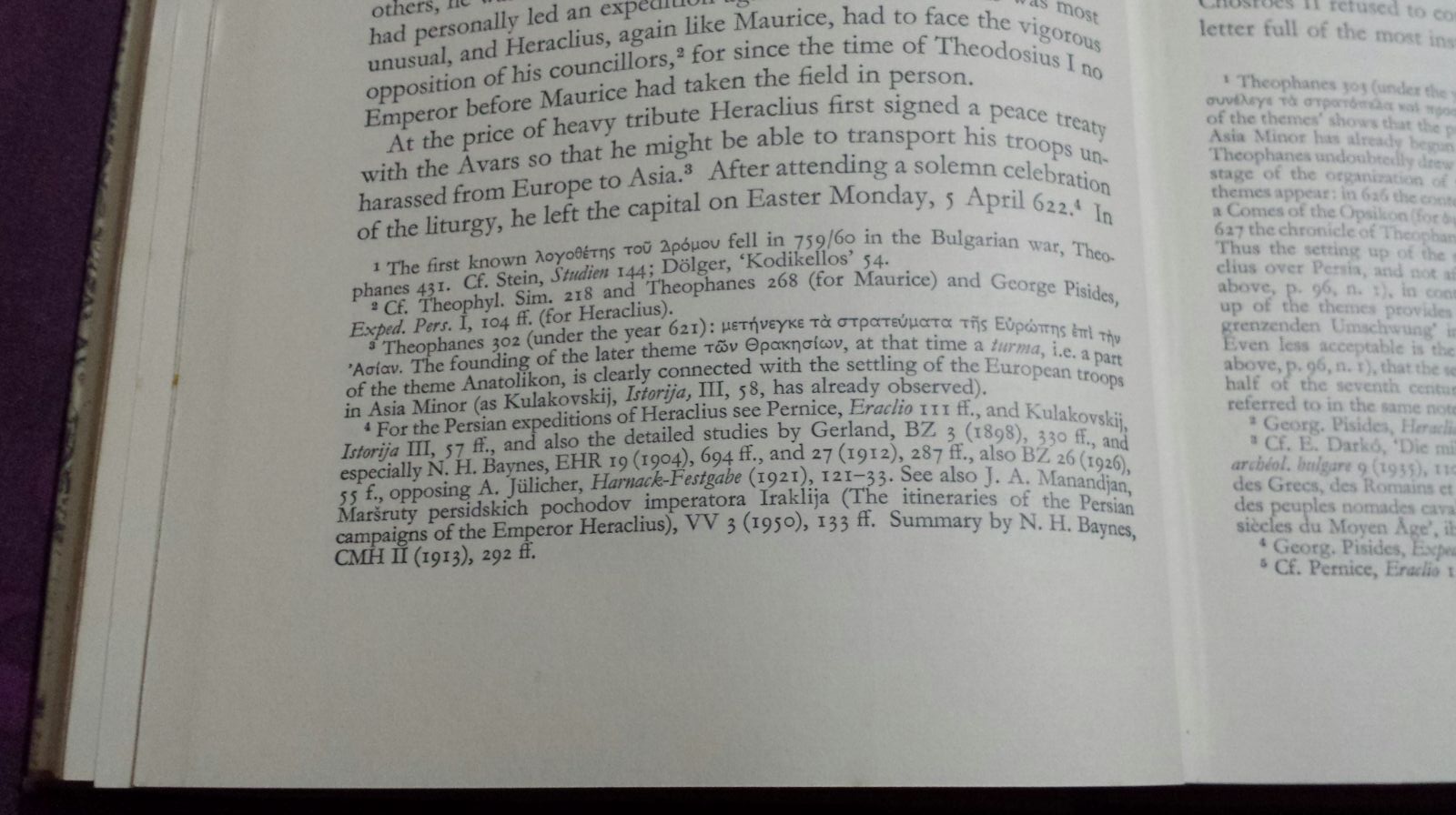
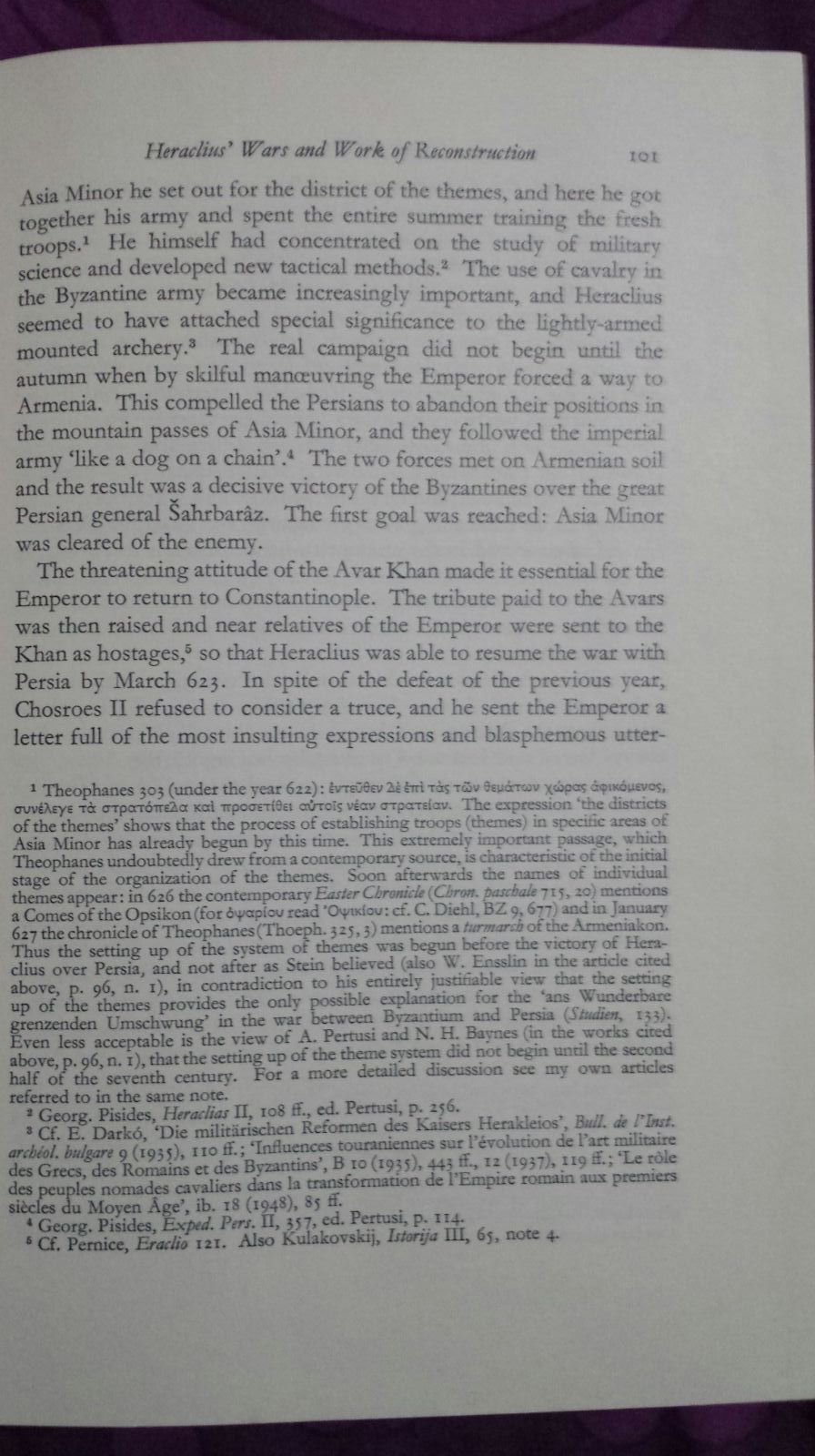
Thirdly, Hussein’s assertion concerning what Ostrogorsky says in his book is a boldfaced lie, since there is nothing about a decisive victory taking place in the year 622 on that page. More importantly, this author emphatically says that the Byzantines defeated and vanquished the Persians in 627-628 AD!

Please note that Sam claims to have read the page, and that the author says “nothing about a decisive victory taking place in the year 622 on that page”. He then proceeded to present the following quote from page 101:

Here is the quote:

“The threatening attitude of the Avar Khan made it essential for the Emperor to return to Constantinople. The tribute paid to the Avars was then raised and near relatives of the Emperor were sent to the Khan as hostages, so that Heraclius was able to resume the war with Persia by March 623. In spite of the defeat of the previous year, Chosroes II REFUSED TO CONSIDER A TRUCE, and he sent the Emperor a letter full of the most insulting expressions and blasphemous utterances against the Christian faith.”

Please take note of where Sam begins the quote. Read and re-read that line. Now here’s page 100:

cc-2015-ss-dec3

What year is the author speaking of? 622 CE. As the book clearly says, “he left the capital on Easter Monday, 5 April 622.” Now, here’s page 101:

cc-2015-ss-dec1

On this page, which is page 101, on lines 11-14, the Ostrogorsky says:

“The two forces met on Armenian soil and the result was a decisive victory of the Byzantines over the great Persian general Sahrbaraz. The first goal was reached: Asia Minor was cleared of the enemy.”

What does this mean? Not only is the quote he claimed on the same page, he has intentionally misquoted the book, by starting his own quotation one line below the relevant quote used by Br. Zakir Hussein! It clearly states that their was indeed a “decisive victory”!

Perhaps though, if Sam had read the very quote he pasted in his article, it speaks about and I quote, “In spite of the defeat of the previous year….”, it really can’t get more obvious than that, does it? The previous year of 623 CE, would be what? (If Sam is reading this, previous means before, so you minus 1 from 623). That would mean 622 CE. What was the defeat in 622 CE? The decisive victory by the Byzantines!

Not only is Sam deceptive for lying about what Dr. Shabir claimed during the debate, and then later shifting the argument to be about a “misrepresentation of Gundry about the Trinity”, when it comes to his own claims, and his own research, Sam is shown to be, in Shamounian terms, quite functionally illiterate.

Sam further alleged in an article, that Dr. Ally needed to be “exposed” and put to shame as a person notorious for “misquoting and mishandling scholars”. Given that Sam has been refuted en toto by Dr. Shabir Ally, and that Sam in this article, has been shown to be notorious of misquoting and mishandling scholars, shouldn’t he then expose and put himself to shame? Perhaps then, this is a case of irony. If Sam spent less time feeding his ego and his stomach, maybe he’d have the cognitive capacity to recognize that attacking people more intelligent than himself is a bad move.

and God knows best.

Sam Shamoun and Lying by Dr. Shabir Ally – Part 2

Shabir Ally

October 1, 2015

Now that I am back in Toronto, and have access to my books, I am able to write a more telling response to Sam and his accusation about lying. I also had a chance to review the recording of what I said during the debate, and Sam’s interaction with me during the Q&A.[1]

Two things (at least) will become evident below:

  • I correctly cited that book of Robert Gundry to which I was referring;[2]
  • In order to generate his proof that I misquoted Robert Gundry, Sam actually misquoted me!

This is a sad day for Muslim-Christian dialogue.

Having listened to the recording, I still have the question that I had put to Sam during that conversation. Sam had said that he had two books right in front of him: one book is Robert Gundry’s commentary on the New Testament; the other book is Gundry’s commentary on Matthew’s gospel in particular. Sam read a portion from the commentary on the New Testament which obviously includes a brief commentary on Matthew’s gospel.[3] That is not the book I had cited. I had studied and cited the other book: the commentary on Matthew’s gospel in particular.

So, I asked Sam for the page number of the relevant section of the commentary on Matthew’s gospel in particular. Instead of supplying this simple piece of information, Sam kept telling me pages 135-36 of the book which he had read from. I asked him why he could not simply tell me the page number of the relevant section of Robert Gundry’s commentary on Matthew’s gospel which he said he also had in his possession at the time. Sam admitted that the page numbers he was giving me were from Gundry’s commentary on the entire New Testament, But when I asked him again for the page number of the commentary dedicated to Matthew’s gospel, there was a definite silence. I thought he had hung up. But he was still on the call. Why the silence?

Moreover, in listening to the recording I realized all the more how bizarre was the conversation between me and Sam. I kept asking him for the page number of a book which he claimed to have with him. In response, he kept challenging me to read a book which I did not claim to have in my possession at the moment. Naturally, I could not read a book I did not have in my hands; I could only accurately quote the most relevant line from my head. But, for some reason, Sam was unable to give me the page number of the book he had in his hands even though the relevant page number is easy to find. The commentary progresses from the start to the end of Matthew’s gospel, and the page headers show the progression verse by verse. It would have been a snap for Sam to thumb through the commentary following the page headers to chapter 28 and then to its verse 19 and give me the page number.

Obviously, he later located the relevant page number of a commentary on Matthew’s Gospel, this being the first book Sam referred to in his article composed on that same date.[4] It would be interesting to trace the relationship between this commentary and the one I was citing. It seems that the one Sam is referring to is the second edition of the same book, now with a different subtitle.[5] The page numbers of the relevant sections are the same, and the wording is strikingly similar, though the subtitles are different.

Now, the book I was citing really said on p. 596 what I cited it to say. So too does the second edition, as is evident from Sam’s citation in his article. But both of these are dissimilar to the book which Sam was reading on air.

To understand what is going on here between me and Sam, one has to see the big picture, as follows. In debates between Muslims and Christians, Muslims argue that in the Old Testament Yahweh is the only God. Jews agree. Many Christians also agree. Consequently, for Jesus to be God, he would have to be Yahweh. But if he is Yahweh, then he is the only God, and therefore the Father and the Holy Spirit would not be God.

In response to this clear logic, some Christians cite Matthew 28:19 as proof that the Father, Son, and Holy Spirit are each Yahweh, and yet altogether Yahweh. In that verse, Jesus directs his followers to baptize in the name of the Father, the Son, and the Holy Spirit. Christians point out that the name here is singular, though the named persons are three. Hence they insist that Jesus is Yahweh, the Holy Spirit is Yahweh, the Father is Yahweh; yet altogether the three are Yahweh.

This is the big picture, the context within which I am using the citation from Robert Gundry. I am saying that according to Robert Gundry the verse does not imply that the three persons bear the same name. According to him, the verse is not actually referring to their name; rather, the verse is saying that the baptism should be done with fundamental reference to the Father, Son, and Holy Spirit. Here is an approximate transcript of what I said, as evidenced by the video recording:

In Matthew’s gospel towards the end where Jesus says, “Go and baptize in the name of the Father, Son, and Holy Spirit,” some will take that as an expression of Trinitarian doctrine. But in fact, as Robert Gundry says in his commentary on Matthew’s Gospel, it does not actually mean that—it does not mean that the three of them have just one name—it means, ‘Go and baptize with fundamental reference to the Father, Son and Holy Spirit.’ It does not mean that the three are one. In fact, there is no passage in the New Testament gospels or in any of the writings of the New Testament that says that the three—the Father Son, and Holy Spirit—are together as one God.[6]

This is what Sam needs to address. Instead, he changes the subject to me. But attacking me will not remove the problem. The problem, as the clear logic above indicates, is that there is only one God Yahweh, as Jews, Christians and Muslims agree.[7] According to Matthew 12:18, Jesus is the servant of Yahweh. This too Muslims and even Christians accept. But Christians insist that, in addition to being the servant of Yahweh, Jesus is also Yahweh himself. I have been refuting this latter claim with my clear logic. And now Sam wants to attack me. But my logic is not exclusively mine. Logic is universal. To get rid of this problem, Sam does not need to attack me, he needs to battle with the fundamental laws of nature, or the designing work of God who fashioned us to think logically. He needs to battle with his own thoughts which cannot escape the same logic.

When Sam called, he accused me of claiming that Robert Gundry in his commentary on Matthew’s gospel denies that Mt. 28:19 is a Trinitarian text.[8] But that is not what I claimed.

In the above transcript of the relevant portion of my speech, I started out with my own statement, cited Gundry, and then ended with my own statement. I can see where at first glance it may not be clear to others where I intended to end my citation of Gundry. But if that was not clear at first, during the call I explained to Sam:

In that commentary, Robert Gundry says very plainly that the idea that the mention of Father, Son and Holy Spirit should mean that they share the same name—that is not the idea. He is saying that the idea there is that the baptism should be done with fundamental reference to the Father, Son and Holy Spirit. I am not saying anything more than this.[9]

Notice that last sentence: ‘I am not saying anything more than this.’ Now it should be clear that I am only claiming as follows: in a particular book, Gundry denies that Mt 28:19 implies that the three persons bear the same one name.

Despite my taking pains to clarify the point on air, however, Sam charges in his writing composed after the debate:

Ally basically claimed that Gundry denies that this text supports the Triune nature of God.[10]

That is not what I claimed.

I am not saying that Gundry is not a Trinitarian, or that he denies that Mt. 28:19 can be put to Trinitarian use, etc. It should be clear to all students of logic that a statement of the form,

‘A does not imply B’

does not mean the same as,

‘A implies that B is not the case,’

and it does not mean the same as,

‘I deny B.’

In what follows, I will replace B with ‘the Father, Son and Spirit share the same name.’

Logically, therefore, when I cite Gundry to say,

‘Mt. 28:19 does not imply that the Father, Son and Spirit share the same name,’

that is not the same as citing him to say,

‘Mt. 28:19 implies that the Father, Son and Spirit do not share the same name.’

And it does not mean the same as citing him to say,

‘I deny that the Father, Son and Spirit share the same name.’

It is really sad to see Sam misquoting me to prove his charge that I misquoted someone else. Sam does not like my message. But does that justify shooting the messenger? Dialogue between Muslims and Christians need to move beyond such tactics. We need to listen to each other, learn, and pray to God asking him to guide us all.

Finally, the book I was citing was published in 1982 for an academic level of readership. It caused a stir in evangelical circles leading to Gundry’s resignation from the Evangelical Theological Society. The book Sam read on air was published 28 years later in the year 2010 for a more common readership.

This latter work, from which Sam’s read to me on air, and which he cited second in his article, clearly supports Sam’s contention that Gundry believes that the three divine persons are included in ‘the name.’ I am grateful for this information. I did not know it until Sam pointed it out. And I am glad that I did not overstate my case in citing Gundry. However, if I do cite him again, on this matter, it will be appropriate for me to add that Gundry apparently changed his mind about this as is evident from his later writing. Why he apparently changed his mind would be interesting to learn. Is it that the two books were meant for two different audiences, in which case he was willing to tease the academic community but not the masses? Did the negative response to his earlier book cause him to be more cautious? Or, did he find new evidence to convince him that his earlier statement was incorrect?

In short,

  • I correctly cited Gundry’s earlier statement,
  • I am willing to incorporate his later statement in future citations, and
  • I am grateful to Sam for alerting me to this, but
  • I find it at least ironic that Sam would misrepresent me to prove that I misrepresented Gundry.

[1] The recording can be viewed here: https://www.youtube.com/watch?v=idHxegbSunQ&feature=youtu.be. Sam’s call comes in at 2 hours and 14 minutes into the recording. My thanks to Brother Nazam for pinpointing this location.

[2] Robert H. Gundry, Matthew: A Commentary on His Literary and Theological Art (Grand Rapids: Eerdmans, 1982) p. 596.

[3] Sam was referring to Gundry, “Matthew,” Commentary on the New Testament: Verse-by-Verse Explanations with a Literal Translation (Grand Rapids: Baker Academic 2010) pp. 135-136.

[4] http://www.reformedapologeticsministries.com/2015/09/catching-shabir-ally-red-handed.html?m=1

[5] Robert Gundry, Matthew: A Commentary on His Handbook for a Mixed Church Under Persecution, 2nd edition (Grand Rapids: Eerdmans, 1995).

[6] This begins at approximately 19:55 and lasts for about 40 minutes.

[7] Though Muslims call him by another name Allah, which is also in the Bible in Arabic translations. See Genesis 1:1.

[8] At 2:14 in the recording.

[9] At 2:16:40.

[10] http://www.reformedapologeticsministries.com/2015/09/catching-shabir-ally-red-handed.html?m=1

Sam Shamoun and Lying by Dr. Shabir Ally – Part 1

Shabir Ally

September 30, 2015

During my debate with David Wood on ABNSAT, Sam Shamoun called in to challenge one of my statements. According to my statement, Robert Gundry said that the formula in Matthew 28 does not imply that the three persons, Father, Son, and Holy Spirit share the same name. Rather, the formula means that baptism should be done with fundamental reference to the Father, Son and Holy Spirit. Sam claimed that Gundry wrote no such thing, and he had Gundry’s books to prove it. I pointed out that I was referring to another book by Gundry. But Sam was not convinced by my plea. Rather, he was convinced that I was lying. Hence he wrote to that effect here:

http://www.reformedapologeticsministries.com/2015/09/catching-shabir-ally-red-handed.html?m=1

In that document, Sam cites two books of Gundry, and links to a third, all to prove that Gundry did not voice the view I attributed to him.

However, in each case he is referring to a book other than the one I was referring to. As I am away from my hometown at the moment, I cannot check the reference at the moment, but here is something I found on my laptop that I had written elsewhere complete with a reference to the book I was referring to.

As for the apparent Trinitarian formula of Matthew 28:19, Robert H. Gundry writes that “Matthew seems to be responsible for the present formula.”[1]

As will be immediately clear, this is not the same as any of the three books Sam cited or referred to in his above linked article. It should also be clear that Gundry is saying that Matthew is responsible for the saying whereas we would expect Christians to think that Jesus actually said this.

Sam apparently assumed that the books he came across are the only books that Gundry wrote on the subject. Instead of hastily composing an article claiming that I was lying, he should have asked me for the reference to the specific book I was citing, and then check the reference in that book. As it turns out, people these days are too quick to assume the worst about other people but the best about themselves.

Even if it turns out that the book I was referring to does not contain the material I cited, does this necessitate a charge of lying? Or, could it be a case of citing from memory and recalling incorrectly as humans sometimes do?

During the debate itself, I cited many other books, some of which I had on the desk before me. These too I cited from memory, as is my usual style in debates. I do not claim that my memory is impeccable. However, in how many cases did Sam find a significant discrepancy between my citations and my named sources? If it is just this one, does that require such a serious charge? Is Sam here exhibiting the usual charitableness of Christians? If we go about slinging such uncharitable accusations against each other will that lead to better dialogue and mutual understanding?

When I get back to Toronto, I will check again to see if my memory serves me correctly, and thus that Gundry said what I cited him to say. Otherwise, I will issue a public retraction. But if what I cited is correct, will Sam retract his article and issue an apology for his false accusation?

Meanwhile, it is interesting to know that after Gundry published this critical commentary in 1982, some evangelical scholars called for his resignation from the Evangelical Theological Society. He resigned in 1983.

Does that sound like Gundry was saying in this book what Sam wants to hear?

[1] Robert H. Gundry, Matthew: A Commentary on His Literary and Theological Art (Grand Rapids: Eerdmans, 1982) p. 596.

« Older Entries Recent Entries »