Is the Qur’an Easy to Understand?

Question:

Christians and those who disagree with the Qur’an often cite the verse which claims that the Qur’an is clear to understand. They ask, if the Qur’an is clear and easy to understand, why are there so many different interpretations of it?

Answer:

The questioner also submitted the following clip as an example:

Dr. James White says:

“I don’t know, it’s [sic], the, the Qur’an claims to be mubeenun ummm [sic] which means clear, perspicuous, but this text is not clear and perspicuous, which is a problem because it’s been misused.”

He is probably referencing a verse such as this (emphasis ours):

“Alif, Lam, Ra. These are the verses of the Book and a clear Qur’an.” – Qur’an 15:1.

The Qur’an however, qualifies and explains, what’s clear and to whom it is clear in understanding (emphasis ours):

It is He Who has revealed the Book to you. Some of its verses are absolutely clear and lucid, and these are the core of the Book. Others are ambiguous. Those in whose hearts there is perversity, always go about the part which is ambiguous, seeking mischief and seeking to arrive at its meaning arbitrarily, although none knows their true meaning except Allah. On the contrary, those firmly rooted in knowledge say: ‘We believe in it; it is all from our Lord alone.’ No one derives true admonition from anything except the men of understanding. – Qur’an 3:7.

The Qur’an clarifies that not everything in it is understandable to everyone. It further clarifies that its verses are clear to men of understanding who are, “firmly rooted in knowledge”. Hence, claiming that the Qur’an is clear to everyone is not true and wholly incorrect.

Let us then, now consider some examples. Someone may ask, why would God reveal a verse that cannot be clearly understood? God says that He sustains Himself, while this informs us of the nature of God, as humans it is difficult for us to grasp how anything can sustain itself and not depend on anything for its livelihood. Humans need food, animals need food, computers need electricity, cars need oil and gas, but God needs nothing. While we cannot wrap our heads fully around this concept, we still have learned about the nature of God.

We must also then consider the example of a car of which the manufacturer says it is the easiest to drive. Someone purchases the car and then crashes it. Does that make the manufacturer’s statement false? No, it does not. It means that the driver has made a mistake and despite the car’s handling being easy, the fault lays with the actions of the driver.  The same is with the Qur’an, while the Qur’an has been made clear and easy, it does not mean that everyone will have the ability or capacity to understand it.

and Allah knows best.

Missionary Mishap: Bible Thrown in Masjid in Act of Vandalism

Someone got the really intelligent idea to vandalise a Masjid (Mosque, Islamic Center). The criminal broke a few glass panes, a door, and damaged some woodwork. The incident occurred in the early hours of Sunday morning.

What stands out though is the Bible thrown into the Islamic Center’s prayer room. Not sure what logic the criminal was using. Maybe they thought the Bible would prevent Muslims from using the prayer room? Maybe they thought we viewed it as unclean as we do with pork? Maybe they thought the Bible would cast Muslims away?

This might sound absolutely ridiculous, but some people, especially extremist Christians do hold some crazy beliefs when it comes to Islam. There was an incident where Christians stood and threw crosses at a Muslim while he was praying… So it isn’t exactly a unique incident for an extremist Christian to do something as silly as this.

The center has a donation page set up at Go Fund Me, do donate and help them recover.

and Allah knows best.

Ravi Zacharias Caught Lying About Credentials Again

In 2015, Ravi Zacharias was outed for manufacturing claims about his scholarship regarding being a visiting scholar at Cambridge University. This led to him acknowledging and then removing the claim from his website. This year, the same person who did the first investigation has done a second video demonstrating that Ravi has lied again, this time about studying quantum physics at Cambridge University:

Why does Ravi have the need to continuously pad his credentials? We all agree that lying is a sin, therefore as a leader of an international ministry, why doesn’t he seem to understand that making fraudulent claims about oneself is wrong? It’s simply unjustifiable. To call Ravi to be truthful in his actions and descriptions about himself, we are asking those who are interested in the truth to send Ravi an email at the following address: PR@RZIM.ORG

The subject line is as follows: Did Ravi Zacharias really study quantum physics at Cambridge?

The email body is as follows:

Dear Mr. Zacharias and Ms. Malhotra:

I write you in a spirit of inquiry, not challenge. Serious allegations, purporting to be carefully-researched and based on publicly available information, have been made that Mr. Zacharias has systematically exaggerated his academic credentials.

And while I have formed no conclusion as to the merits of these charges, I can see no harm in Mr. Zacharias publicly responding to them. Indeed, given the growing concern about these allegations, it seems that no legitimate purpose will be served by Mr. Zacharias continuing to remain silent.

In furtherance of the truth, might you kindly address the following questions?

Did Ravi Zacharias ever enroll in, or audit, a physics class taught by John Polkinghorne at Cambridge University?

Was Mr. Zacharias ever “a visiting scholar at Cambridge University”? If so, is there a reason that this claim was removed from his website after he was criticized for making it? How does Mr. Zacharias respond to the email statement allegedly made by the Cambridge Office of External Affairs that his attending classes at the University whilst on sabbatical at Ridley Hall would not have made him a visiting scholar at their University?

At page 205 of his autobiography, Mr. Zacharias writes about spending time at Cambridge University where, he says, “I was invited to be a visiting scholar.” Given that Mr. Zacharias’ sabbatical supervisor, Jeremy Begbie, has stated, in writing, that Mr. Zacharias was only a “visiting scholar” at Ridley Hall (which is not a constituent part of the University), might you kindly state who it was who invited Mr. Zacharias to be a visiting scholar at Cambridge University itself?

Mr. Zacharias has claimed to have been “a senior research fellow” at Oxford University. Is this claim true? Was the position in fact an honorary one? If so, is there a reason that in February of 2103 Mr. Zacharias said in an Apologetics315 interview “If I’m in an academic forum, then the fact that I’m a senior research fellow at Wycliffe Hall Oxford University, that’s a credential with which I work in the academy”? Is there a reason the entire Senior Research Fellow claim has been removed from his website?

Mr. Zacharias’s bio and publicity materials refer to him as “Dr. Zacharias.” Does Mr. Zacharias have a PhD or other academic doctorate? If not, how might he reply to the concern that his routine use of the title “Dr.” is likely to create a false impression in significant numbers of people?

The jacket of Mr. Zacharias’s book New Birth or Rebirth? says “Zacharias holds three doctoral degrees.” His publisher bios at Random House and Penguin refer to him holding multiple doctoral degrees. These make no mention of such degrees being honorary. What responsibility does Mr. Zacharias have to ensure that those promoting the sales of his books make clear that his doctorates are exclusively honorary? (This question may, of course, be disregarded if Mr. Zacharias has in fact earned an academic doctorate.)

Thank you very much for your anticipated cooperation in shedding light on these important issues.

Sincerely,
[Your Name Here]

More details to follow.

Missionary Mishap: Jonathan McLatchie

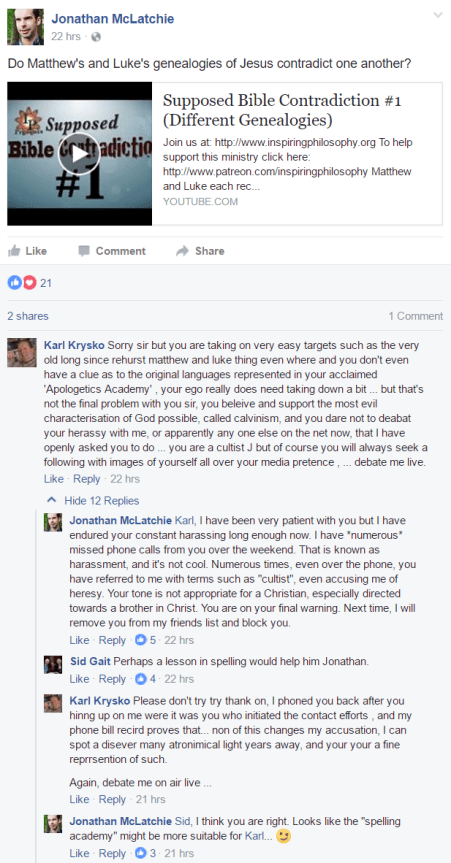
It seems odd that the Muslims at Hyde Park, the Muslims in Newcastle and Christian colleagues of Jonathan can all hold the same view of him. Either there is some crazy international conspiracy ongoing, or Jonathan has given the same negative impression of himself consistently to large groups of people. For starters we have a Christian colleague stating exactly the same thing that almost all other critics of him have said:

cc-2017-jm-karlandjonny

Let’s do a quick checklist:

  1. Does Jonathan respond only to simple criticisms of Christianity? Yes.
  2. Has he only ever presented rehearsed arguments? Yes.
  3. Does he know Hebrew or Greek? No.
  4. Does anyone take his “apologetics” “academy” seriously? No.cc-2017-jm-donation
  5. Is Jonathan egoistic? Yes.
  6. Does Jonathan like to plaster images of himself everywhere? Yes.

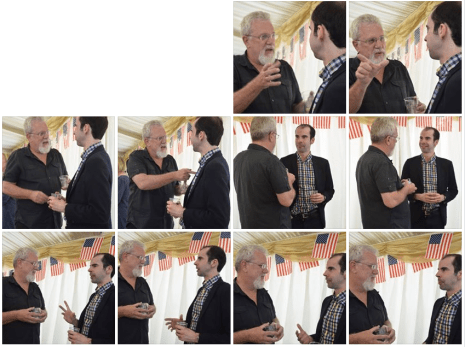
cc-2016-jm-jaypicswith jm

Okay, maybe we can forgive him for calling Muslims a cancer. Maybe we can forgive him for lying about the size of crowds attending his debates. Maybe we can forgive him for setting a bad example for his colleagues who insult and abuse those he disagrees with, claiming to humiliate people for the glory of Christ. Those things are to some extent character flaws that can be overlooked.

Yet, look at the first image presented. How does Jonathan proceed to disagree with a fellow Christian? By attacking his spelling. Of all things, Jonathan McLatchie who is pursuing a PhD, who is significantly older than I am in age, reduces himself to a spelling “apologist”. Not only does he like the comments being critical of the guy’s spelling, he proceeds to mock the guy about his spelling as well. Of all the things Jonathan is, he consistently demonstrates to Muslims and Christians alike that when disagreed with he immediately does three things:

  1. Threaten to block anyone who criticizes him.
  2. Mocks the person criticizing him.
  3. Likes comments of others engaging in the mocking.

This is a guy who wants people to take him seriously, but it is impossible that so many people from so many diverse backgrounds can walk away disagreeing with his behaviour without the problem being him. If it’s not myself, it’s Yahya Snow, if it’s not Yahya Snow it’s Paul Williams, if it’s not Paul Williams it’s Mansur, if it’s not Mansur it’s Darren Myatt, if it’s not Darren Myatt it’s Mustafa Ahmed, if it’s not Mustafa Ahmed it’s his University’s Chess team. I can literally write a paragraph or more of this immature and negative pattern of behaviour.

We sincerely pray that he can rectify his character.

Graphic: NT Reliability Comparison to Ancient Documents

Question:

This image has often been used to demonstrate the reliability of the New Testament. What is your response to this?

nt_reliability1

Answer:

This infographic relies on two of the three defective principles that beginners make when it comes to textual criticism, namely the number of witnesses (manuscripts) and the age of the witness (manuscripts). I’ve previously written on these three defective principles as outlined by the textual critical scholar Leon Vaganay. Before we get into the textual critical problems with this infographic, we first need to examine the theological problems with it.

Theology

One of the first claims we normally associate with the use of this infographic bases itself on the fallacy of false equivalency. We are told that scholars and historians have no problem trusting and relying on the ancient works ascribed to Homer, Aristotle or Plato, so given that we have so many more manuscripts of the New Testament we should have even more trust and reliance on the New Testament as it compares to the quantity of manuscripts for the previously aforementioned ancient documents. The problem with this argument is that I don’t need the works of Homer, Aristotle or Plato for salvation. Rejecting, not reading, ignoring and discarding the works of those men does not affect my salvation, which is why we can generally rely on and trust them. Since whether or not they actually are reliable or accurate does not affect my life in any meaningful way.

However, when it comes to the New Testament, it’s a different story. We are told it contains the inspired words of God, that we need to rely and trust it for our eternal salvation, that denying and rejecting it would lead to our eternal damnation. The stakes here are quite higher. Rejecting the works of Tacitus does not send me to hell. Waking up one morning to find out that alterations were made to the writings attributed to Plato, has no consequence on me whatsoever. My entire worldview does not change, my salvation does not rest on my accepting or rejecting the works of Tacitus and Plato. Therefore, when it comes to theology, it is an honestly poor argument to make that if we can trust something that has no bearing on our salvation, then we can also trust something that allegedly has significant bearing on our salvation. This is a dishonest comparison by all means.

The Number

There are some 24, 000 manuscripts! That number is practically meaningless and useless for a number of reasons. To begin with, of the 24, 000 that this infographic claims exists, how many of them are within the first 300 years of Christianity? According to the  Institute for New Testament Textual Research (INTF) there are only 67 manuscripts in total existing from this time period. That figure represents 0.27% of the total number of New Testament manuscripts. The vast majority of New Testament manuscripts were written after the 11th century CE, some 1100 years after the Messiah. So while the number is big, it is misleading.

The Date

The number is misleading because it is juxtaposed with the date range of 40-70 years “between the earliest surviving copies”. Seeing 24, 000 juxtaposed with an early date range is extremely misleading, leaving the impression that the number correlates with the date range. In reality, there are only 7 New Testament manuscripts that fall into the first 200 years of Christianity, all of which are extremely fragmentary. That represents a figure of 0.029% of all New Testament manuscripts that can possibly be ascribed to the date range given in the infographic.

Conclusion

While the infographic does provide somewhat accurate information, its use of that information to argue for the reliability of the New Testament is both misleading and dishonest. The arguments derived from the use of this infographic don’t endorse the claim of the reliability of the New Testament, but rather demonstrates that many Christians simply do consider their scripture to be equal in weight to the works of ancient peoples. The very fact that they choose to argue that if we can trust the ancient manuscripts ascribed to Plato and Homer, therefore we can trust the New Testament is to also say that Plato’s and Homer’s work stand on the same credibility level as that of scripture inspired by God. Rather than defend the holiness of scripture, such an argument truthfully undermines it, while falsely comparing what should be the work inspired by a holy and all knowing God, to that of mortal men.

and God knows best.


Missionary Mishap: Missing McLatchie

For what’s the 3rd time in as many months, Christians on Jonathan McLatchie’s “Apologetics” “Academy” have posted a lengthy discussion on popular and effective Christian apologists. It’s been over 12 hours and as expected, still no mention of Jonathan on his own academy group. You would think that maybe none of his friends were there or, colleagues who work with him on the “academy” were absent, but the case is, they were present and none of them decided to mention him in any capacity.

cc-2017-jm-apologistnotlisted1

The last time this occurred, he chided the group for participating in a “popularity” contest. Perhaps he thought third time would be the charm, but that did not turn out to be the case. Maybe the 4th time?

and God knows best.

Exclusive: Muslim Immigrant Voting Plan to Change Laws in America

EXCLUSIVE – Recent investigations by major media outlets have exposed a massive conspiracy by American-born Muslims and immigrant Muslims to change laws in the United States of America. Several news agencies have indicated that the number of Muslim voters continue to increase each election cycle, with the number reaching a staggering one million voters. The US Council of Muslim Organizations, a well-known globally aligned Muslim group in the US, has publicly admitted to this ongoing scheme:

The U.S. Council of Muslim Organizations, an umbrella group of two dozen Muslim advocacy organizations, said its yearlong “One Million Voters” campaign had surpassed its target, more than doubling the number of registered Muslim voters in America since the 2012 presidential election.

“We believe we’ve exceeded the one million mark,” said Oussama Jammal, secretary general of the group. “We’ve been mobilizing the community with voter registrations at mosques, schools and community events. That’s how we were able to make a difference this year.” – VOA News.

vote1

Muslims Voting

This umbrella Muslim organization operates two dozen Muslim lobbying groups that have drastically increased the rate of eligible Muslim voters in the USA. They freely admit to having doubled the number of Muslim voters, as well as to mobilizing their “communities” across the American heartland, involving mosques and schools. They aim to “make a difference” to the USA. CAIR, another major Muslim organization operating in dozens of states has also admitted to engaging in this major plan with the US Council of Muslim Organizations:

When the Council on American-Islamic Relations (CAIR), a Washington-based rights organization, launched its 2016 Muslims Vote campaign, the goal was to lead 1 million Muslim constituents to the voting booths.

Robert McCaw, director of government affairs at CAIR, said campaign organizers across the nation would work within communities to make sure Islamic community centers have the tools they need to register voters. – VOA News.

The same article also mentions that this plan involved organizing Muslims in key swing states to elect candidates who sympathise and have allegiances with the Muslim communities across the US:

According to the Pew Research Center, Muslims represent just 1 to 2 percent of the country’s population, but they tend to live in strategic places — swing states like Florida, Ohio and Virginia.

“When the vote is close, then in fact, the Muslim vote in those swing states can play a significant role. They … will be seen as a significant minority community,” Georgetown University Islamic studies professor John Esposito said. – VOA News.

These Muslims openly admit to wanting to play a “significant role” by voting. This is not some conspiracy theory, this is open and freely available proof that Muslims are trying to change the political order in the USA to favour their communities. They are organizing communities, using globalist umbrella organizations, having campaigns, using schools and mosques to promote their political agendas.

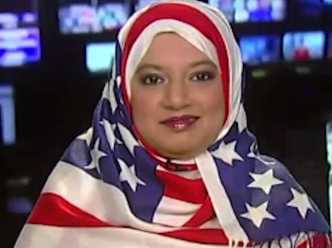
hijab

Is this what the future America looks like?

Who knows what else they are planning that the mainstream media is not reporting?


Why do Muslims use sources they don’t believe in?

Question:

When Muslims quote the Bible, or quote scholars like Bart Ehrman who disagree with what Muslims believe, isn’t that cherry picking, a double standard?

Answer:

This answer can apply to any topic, regardless of the source or reference that a Muslim uses. When Muslims use sources like the Bible, it is not cherry picking nor a double standard to use it in their argumentation. This is because we have a standard of consistent truth. Regardless of what a source says, we agree and affirm when that source is correct. Consider the example of a flat earther (a person who does not believe the earth is a globe). If a flat earther told me that humans lived on the earth or that gravity was real, I would affirm those truths. I would not reject everything the flat earther says, simply because he is wrong in some of what he says.

Consider the example of a Jew who affirms that God is absolutely one. As a Muslim, I would affirm that such a monotheistic belief is a truth. Regardless of his other beliefs about the Prophets or about God, I am not going to reject monotheism merely because the Jew holds some beliefs I disagree with. Our standard of truthful affirmation remains consistent, we affirm the truth wherever it is, and reject the falsehood wherever it is. The ability to both accept and reject from a source is called rational discernment, or the ability to distinguish between truth and falsehood. There is no rule or law which states that one must absolutely agree with everything a source says, this is a false impression to hold to. Being able to distinguish, discern is to remain consistent in one’s approach to works that someone may find things disagreeable with.

The same holds true to the Bible. A Muslim will gladly affirm that Jesus is the Christ as the New Testament mentions. It would be inconsistent to reject that Jesus is the Christ because the New Testament says so. Being able to discern between what we believe and don’t believe is to remain consistent in one’s theology. A long time Christian polemicist also received a similar question when he used and quoted Catholic works, when he himself is not a Catholic:

cc-2017-ss-quoteothersources

The irony here, is that when this same individual sees a Muslim quoting the Bible he becomes angry and belligerent, often using insults. Yet in this comment of his, he affirms that it is perfectly fine to quote sources when and where they agree with one’s theology in common. He has no issue with it. As one of his colleagues would say, inconsistency is the sign of a failed argument.

and Allah knows best.

Missionary Mishap: McLatchie Strikes Out

The $579.88 (USD) per year Zoom platform that Jonathan McLatchie uses has struck out again. After spending so much money and time advertising it to his over 4,996 friends on Facebook and 3,977 members on his “Academy” group, he struck out once more:

cc-2017-jm-zoomflop

An amazing 0 likes and 0 comments on his own Facebook group dedicated to his “online Academy”, and that’s after an hour. When it comes to the actual Zoom room, he hit a very high number of viewers:

cc-2017-jm-zoomflop2

5 viewers! He’s got quite the value there. That’s almost more than $100 dollars per person that he’s invested in. Well done Jonathan. Also 0 likes and 0 comments (at the time of posting we did like the post to give him some support).

Quite the success!

and God knows best.

« Older Entries Recent Entries »