This dialogue took place in the context of a discussion I have been having with Mr. Kerimli for the past two years. It mainly revolves around the Old Testament, the
Hosted by the TARIC Masjid and moderated by Br. Sadat Anwar, Br. Ijaz Ahmad and Mr. Luis Dizon (TBS) discussed Biblical history, textual criticism and much more! Click Here for the
Hosted by the TARIC Masjid and moderated by Br. Sadat Anwar, Br. Ijaz Ahmad and Mr. Luis Dizon (TBS) engaged in a lively debate on the Islamic views of the
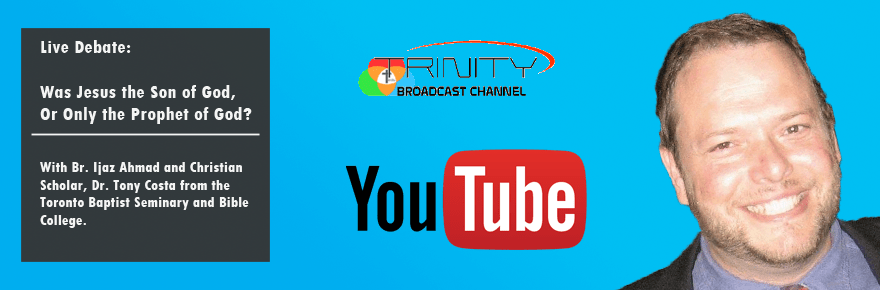
Br. Ijaz Ahmad is debating Dr. Tony Costa on Friday October the 9th. The debate will be held on the Trinity Channel/ ABN TV, as well as livestreamed…on the Trinity
Br. Ijaz Ahmad faced off in a lively and entertaining debate with Reverend Steven Martins on the topic of the true faith of Jesus’ disciples. This debate featured discussion on
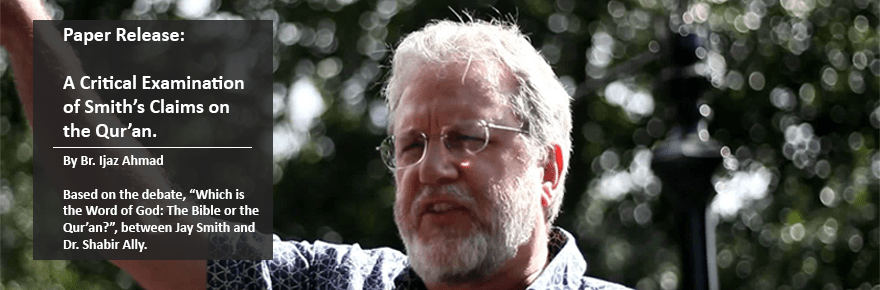
Following Jay Smith’s unfortunate and dishonest claims about the Qur’an’s textual history, a 53 page, point by point refutation has been prepared. Examining his allegations through scholastic sources, with full
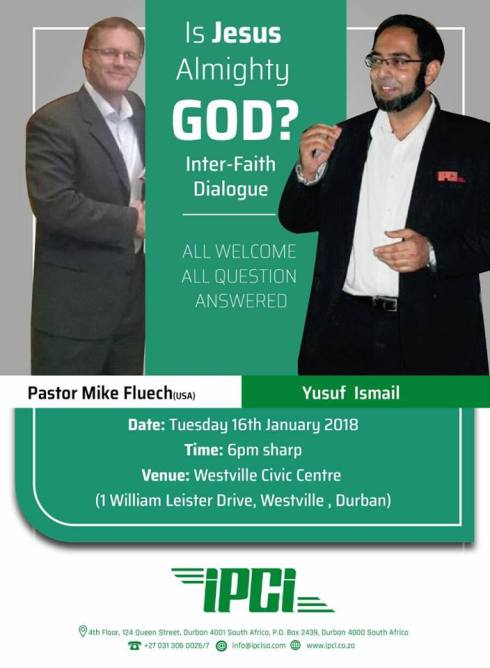
To contact IPCI for further details, please see their Facebook page. We have requested details about a possible livestream and we have received information that there most likely will be one. As soon as we get any further information we’ll share it, and we’ll also post the link to our social media pages.
The time for the debate for those of us outside of South Africa is as follows:
As of yet there is no confirmed livestream of the event, however if this changes we will be sure to update the general public.
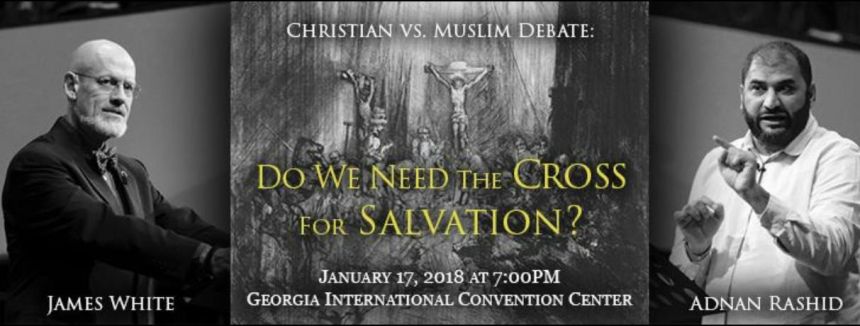
The general reception to the words of the published topic are mixed. The cross, literally, is not needed for salvation in Christianity and so it is understood that a more accurate interpretation of the topic itself would be along the lines of, “Do we need the crucifixion/ sacrifice of Jesus/ blood of Jesus for Salvation?” Nonetheless, this is a debate that boils down to soteriological differences between Islam and Christianity. Debates between Muslims and Christians on this topic or those similar to this topic have not seen much progress beyond the overused argument of, “there is no justice in Islam for sin if no one is punished”.
As was done for the debate between Br. Zakir Hussain and Dr. James White, I will publish a bingo card of key phrases/ arguments to be used by the Christian debater. It received a great reception last time around in London, and one can hope the same for this upcoming event. The intent behind a bingo card is not to mock or demean anyone but to encourage the introduction of new argumentation, to move beyond repeating old polemics, it also becomes a fun way to see if it’s possible to predict what argument a speaker would use.
In a narration recorded by al Musharrah ibn al Murajja al Maqdisi in his work, Fada’il Bayt al Maqdis, we read a prophecy about ‘Umar’s (may Allah be pleased with him) peaceful conquest of Jerusalem. What makes the prophecy special, is that the Prophet Muhammad (peace be upon him) also described al Quds al Sharif in great detail to the point that ‘Umar (may Allah be pleased with him) who had never been to Jerusalem before was able to locate al Quds al Sharif (the Temple Mount) solely based on the Prophet’s detailed and highly accurate description. This video brings to life that narration:
I’ve previously posted on the issue of how just one letter can create a theological conundrum in the New Testament. On Christmas Day Dr. James White of Alpha and Omega Ministries also posted a variant that affects the beliefs of his Calvinist colleagues:
It is with a heavy heart that I convey the sad news of the passing away of my teacher, Sheikh Muhammad Mustafa Al-A’zami (rahimahullah).
The Sheikh was one of the world’s premier scholars of Hadith, and received his education at Dar al-‘Ulum Deoband, India (1952), al-Azhar University, Cairo (M.A., 1955),
The Shaykh
and the University of Cambridge (Ph.D., 1966). He was Professor Emeritus at King Sa’ud University (Riyadh) where he also chaired the department of Islamic Studies.
He served as curator of the National Public Library, Qatar; Associate Professor at Umm al-Qura University (Makkah); Visiting Scholar at University of Michigan (Ann Arbor); Visiting Fellow at St. Cross College (University of Oxford); King Faisal Visiting Professor for Islamic Studies at Princeton; and Visiting Scholar at University of Colorado (Boulder). He was also an Honorary Professor at University of Wales (Lampeter).
His publications include Ageless Qur’an: A Timeless Text, The History of the Qur’anic Text, Studies in Early Hadith Literature, Hadith Methodology and Literature, On Schacht’s Origins of Muhammadan Jurisprudence, Dirasat fi al-Hadith an-Nabawi, Kuttab an-Nabi, Manhaj an-Naqd ‘ind al-Muhaddithin, and al-Muhaddithin min al-Yamamah. He had also edited numerous other works including Kitab at-Tamyiz of Imam Muslim, Muwatta of Imam Malik, Sahih Ibn Khuzaymah and Sunan Ibn Majah to name a few.
In 1980 he was the recipient of the prestigious King Faisal International Award for Islamic Studies.
In the western world, the Sheikh was best known for his critical investigation of the writings of the famous orientalists Ignác Goldziher, David Margoliouth, and Joseph Schacht.
I was fortunate to spend almost 15 years with the Sheikh learning from him and benefiting from his knowledge.
Last month I published a paper on how the very first words in the New Testament evolved over time. It was entitled, “The Inscriptio of the Gospel Attributed to Matthew.” Today we have produced a 2 minute video that simplifies and summarizes the research from that research paper:
For many Christians the authorial identity behind the first Gospel (as per the Augustinian order), commonly attributed to Matthew usually appears to be a matter of little or no concern. This is in part due to the inscriptio of the Gospel itself as is found in most modern translations of the New Testament. Without this inscriptio, the first mention of the name Matthew appears in Matthew 9:9. While at first this may not seem like an issue of note, a critical examination of the inscriptio with respect to its inception, and eventual adoption and evolution can give us deep insight into the perception of this document by those contemporaneous to its creation and development.
Who was authorship ascribed to, if anyone at all in the manuscript tradition? Was it considered to be scripture from inception? How has the use of the inscriptio in today’s modern translations affected the belief that an individual identified as Matthew did indeed write the first Gospel?
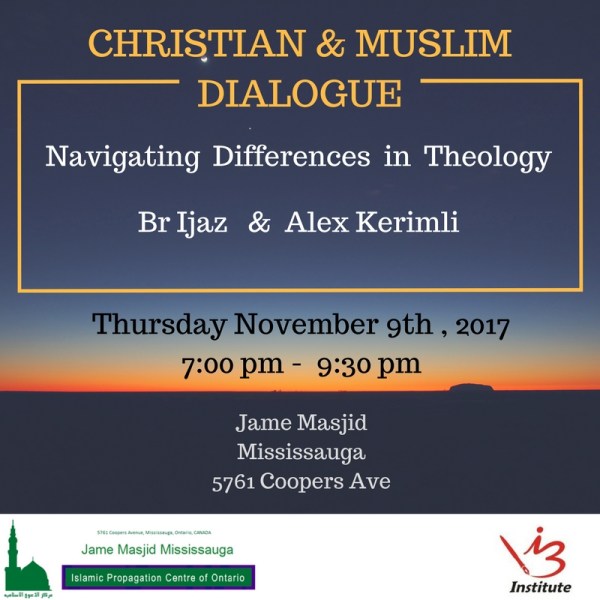
I recently had a dialogue with my friend and colleague, Mr. Alex Kerimli in Toronto. Today the video of that event is being released. The event was graciously hosted by the i3 Institute, which offers courses for young Muslims in the Greater Toronto Area.
The event went extremely well and in the end I have to say that I definitely enjoyed my time with Mr. Kerimli. We met a second time following the dialogue and had a second more informal dialogue that would be released in the near future. In the meantime, this dialogue took place in the context of a discussion I have been having with Mr. Kerimli for the past two years. It mainly revolves around the Old Testament, the New Testament and the Qur’an’s relationship with both of those books. We explore these relationships, the existence of a possible “Madinian Torah” and other fascinating questions about textual preservation in light of historical evidences.
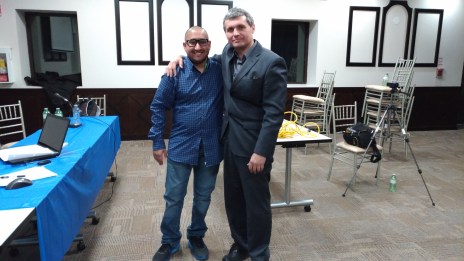
At the end of the dialogue, it was all smiles from both sides of the theological divide.
In addition to releasing the video of the dialogue I am also including my PowerPoint presentation slides in PDF form. There are two versions of these slides. There is the original presentation as I used it in the dialogue. Following the event I noted that there was a miscitation of a quote from Mark, instead of Mark 4:15 I accidentally put Mark 4:20. There was also another miscitation, instead of Pslam 40:6-8, I wrote Isaiah 40:6-8. Along with that error, I also clarified my use of terms in the table comparing the contents of the Shema in the Gospels and the Septuagint editions. To be fair, I am releasing both the original version with the errors and the corrected version for clarity. I will follow up with Mr. Kerimli to see if he would be willing to do the same.
Recently I demonstrated that Jonathan McLatchie plagiarized in his recent debate with our esteemed Br. Yusuf Ismail.
The two videos published on the issue have gathered more views than the debate itself ever will, I haven’t even factored in the views it got on Facebook when several other Muslims uploaded it either. The point being, that I just wanted to provide some context for what I’ll say in this article. A person could respond in a lot of ways to allegations of plagiarism, it’s part of fair criticism when one is in the interfaith-apologetics field. People analyse your statements, double check your references, these are expected things to happen when you debate because this isn’t a game. You’re calling people to change their entire worldview, base their salvation on what you are saying, so you expect debaters to put their best, most accurate and honest foot forward.
Jonathan responded in three ways to my pointing out his plagiarism. Firstly, he accused me of plagiarising from Rabbi Tovia Singer in a now deleted comment on Facebook. He later on removed that comment after I asked him for proof, evidently he misheard a comment from Dr. James White on Muslims in the UK (which by itself is also unproven). I’m neither from, nor have I been to the UK. To be clear, he didn’t apologize for the lie, he just deleted it as he did with his comments about Br. Mansur recently. Secondly, he then posted a status referring to me as deceptive and then allowed copious amounts of insults to be posted about me from some Paltalk friends he has who are aligned with Sam Shamoun. That’s neither unexpected or interesting, at this point it’s sort of expected behaviour from those people.
Thirdly, he lashed out and posted an unverified photo of a Facebook comment where I apparently insulted David Wood. I’m not really sure what he was expecting? I read the comment thread where his verification process basically entailed asking (and I’m paraphrasing here), “is that Ijaz’s Facebook profile from last year in the photo? By golly, that must mean he actually said it!” He’s apparently unaware that anyone could create false photos from Facebook using someone’s profile picture, it’s something fairly common. It also turns out, when questioned for evidence that I actually posted it…that the only person who claimed to have seen when I did post it…was a person who had blocked me roughly two years ago on Facebook (effectively predating the date on the alleged photo altogether), in fact…that same witness boasted in another post of Jonathan’s that he had blocked me and that his Facebook experience was peaceful for that very reason. Lying, is not their forte to say the least. That person is Robert Wells. He also happens to be the person who threatened my life when I used to interact with him on Paltalk:
So, do I fault Jonathan for not doing proper checks before “exposing” me? Yes, I do. Do I fault him for trusting the testimony of someone who blocked me on Facebook and threatened to kill me? Yes, I do. Will I respond in like? No. See, I happen to forgive Jonathan because I understand how much my two videos about his plagiarism may have affected him. I definitely understand how embarrassing it must’ve been, and so I can understand why he lashed out. On the other hand, this isn’t a tit for tat game. I criticize him fairly when it comes to his apologetics and Islamo-political claims, I criticize him fairly when he slanders my colleagues like Br. Mansur and Br. Hamza. His reaction however, was not something related to any of those areas of interest, his lashing out was personal and I do not respond to personal attacks.
So, while I am disappointed in his behaviour, I’m sorry Jonathan, but I’m not interested. Perhaps when you can learn to meaningfully interact with my publications and videos, I’ll gladly respond, but when you go low, I’ll go high. I forgive you.
“Show forgiveness, enjoin what is good, and turn away from the ignorant.” – Qur’an 7:199.





 Calling Christians
You must be logged in to post a comment.