Tag Archives: islam

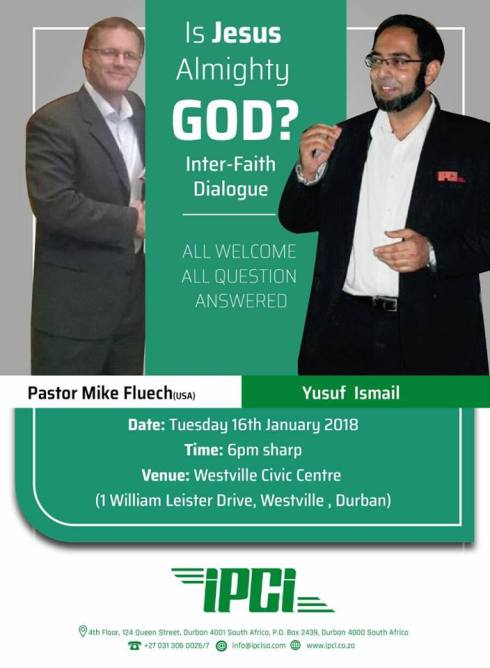
Upcoming Debate: Br. Yusuf Ismail and Pastor Fluech

cc-2018-sitenews-yusufmikefluechdebate

To contact IPCI for further details, please see their Facebook page. We have requested details about a possible livestream and we have received information that there most likely will be one. As soon as we get any further information we’ll share it, and we’ll also post the link to our social media pages.

The time for the debate for those of us outside of South Africa is as follows:

  • London, UK – 4 PM.
  • New York, USA – 11 AM.
  • Port of Spain, Trinidad – 12 Noon.
  • Lahore, Pakistan – 9 PM.

and God knows best.

Jerusalem and the Fulfillment of Prophecy

In a narration recorded by al Musharrah ibn al Murajja al Maqdisi in his work, Fada’il Bayt al Maqdis, we read a prophecy about ‘Umar’s (may Allah be pleased with him) peaceful conquest of Jerusalem. What makes the prophecy special, is that the Prophet Muhammad (peace be upon him) also described al Quds al Sharif in great detail to the point that ‘Umar (may Allah be pleased with him) who had never been to Jerusalem before was able to locate al Quds al Sharif (the Temple Mount) solely based on the Prophet’s detailed and highly accurate description. This video brings to life that narration:

YouTube Mirror: Jerusalem and Umar’s (ra) fulfillment of Prophecy

The Problem of the Thief and the Crucifixion

Introduction

In perhaps what is one of the most perplexing passages of the New Testament, we find a story during the alleged crucifixion of Jesus the Christ that challenges the very core of commonly held Christian beliefs about Christ and salvation. We read from Luke 23:39-43 (NIV) the following:

39 One of the criminals who hung there hurled insults at him: “Aren’t you the Messiah? Save yourself and us!”

40 But the other criminal rebuked him. “Don’t you fear God,” he said, “since you are under the same sentence? 41 We are punished justly, for we are getting what our deeds deserve. But this man has done nothing wrong.”

42 Then he said, “Jesus, remember me when you come into your kingdom.”

43 Jesus answered him, “Truly I tell you, today you will be with me in paradise.”

The Problem

If we were to ask a confessional Christian today (one that knows of and adheres to the doctrinal confessions of the faith) what one needed to believe in for salvation, we would perhaps have a very long list. It would likely include belief that Jesus died for the sins of all, that Jesus was God, that Jesus was both man and God (belief in the hypostatic union), belief that the New Testament is the word of God, belief in the Godhead, in the Personhood of each member of the Godhead who were all co-equal and co-substantial to each other.

Yet the 5 verses from the Gospel eventually attributed to Luke present a severe theological problem that strikes at the very core of Christian theology. The question before us is, what did the thief say, believe and do to be granted salvation? When we examine the verses we can identify only two things:

  1. That Jesus was an innocent man.
  2. That Jesus was a King (or would become one at some point).

All the thief had to do to be granted salvation was to accept that Jesus was innocent and thus did not deserve to be crucified, and that Jesus would survive in some form such that he would become a king or have a kingdom. By this standard, all Muslims will be granted entry into the kingdom of God. The thief did not have to believe in the New Testament, did not have to accept the Old Testament, did not have to express belief in the Trinity, did not have to believe in the Godhead, did not have to believe in the two natures of Christ, did not have to even accept Jesus as the Messiah! He did not have to believe Jesus was the incarnate word of God, he did not have to believe that Jesus was the 2nd person in the Godhead…in other words, the thief did not have to believe in anything that Christians today hold to be true.

There is perhaps an even greater issue here. The thief claims that Jesus was innocent and thus did not deserve to be punished. See, Christians necessarily believe that while Jesus was innocent, he deserved to suffer and be punished, because he came to suffer for our sins as an act of grace:

“For God so loved the world that he gave his one and only Son, that whoever believes in him shall not perish but have eternal life.” – John 3:16 (NIV).

“And he said, “The Son of Man must suffer many things and be rejected by the elders, the chief priests and the teachers of the law, and he must be killed and on the third day be raised to life.” – Luke 9:22 (NIV).

According to the above passages, Christ must suffer and must be killed. However, the thief on the cross, seemingly disagrees with these teachings. The thief explicitly says that not only is Jesus innocent, but that he did not deserve to die. In other words, the thief is expressing an Islamic position that Muslims would agree with. Jesus did not deserve to die, he did not deserve to suffer and he was an innocent man. In other words, Jesus rewards a thief and claims the thief would be in the Kingdom of God with him because he denied the core tenets of Christianity while affirming core beliefs of Islam.

The thief in no uncertain words explains that his crucifixion on the cross is justified, but Jesus’s isn’t, however, confessional Christians would argue that in order for sin to be paid, it had to be justified through the death of Jesus the Christ. This presents a problem for Christianity. Jesus rewards a man and accepts him into the Kingdom of God for expressively, clearly and absolutely, rejecting core Christian beliefs about salvation!

Comments by Scholars

These 5 verses deliver a devastating blow to the consistency of the doctrine of salvation in Christianity. These verses essentially approve of Islamic beliefs and indicate that Muslims according to Jesus…would be in the Kingdom of God, since we believe that he was innocent and that the alleged crucifixion was not justified in any way. These are things a Christian today cannot deny, these are things a Christian today has to believe in, yet a thief with Islamic beliefs only accepted two tenets, both of which agree with core Islamic beliefs, and was rewarded and praised by Jesus! The scholars have had difficulty in understanding these passages. It must first be noted that only one Gospel records this incident and this is the Gospel of Luke:

“Luke’s account is noticeably independent of the other three. The three sayings of Christ’s, round which his narrative is grouped, are preserved by him alone. We shall best grasp the dominant impression which the Evangelist unconsciously had himself received, and sought to convey, by gathering the whole round these three words from the Cross.” – MacLaren’s Expositions.

The other three Gospels are noticeably silent on the thieves, except for the case of demonizing them:

“In the same way the rebels who were crucified with him also heaped insults on him.” – Matthew 27:44 (NIV).

“Those crucified with him also heaped insults on him.” – Mark 15:32 (NIV).

The final Gospel, later attributed to John (which John, we don’t know), does not mention any of the words of the thieves, it does not even identify them as thieves or rebels. Instead, this is all the Gospel as to say:

“The soldiers therefore came and broke the legs of the first man who had been crucified with Jesus, and then those of the other.” – John 19:32 (NIV).

Resolving the Problem

Some Christian commentators (exegetes) have attempted to navigate around this narrative disaster by implying that the thief/ rebel had other beliefs, that he believed Jesus was a God or that Jesus was meant to die for his sins and thus was saved because of this. The problem with such an argument is that the only Gospel to mention this incident does not indicate any of these things. The Gospel does not indicate that the thief/ rebel believed in anything other than what was recorded. In other words, this is a poor attempt at reading between the lines and should therefore be rejected. If scripture is sufficient for understanding salvation, then the plain reading of these 5 passages should be accepted without having a need to insert anything into scripture, to force it to say something it does not.

Conclusion

These five passages are a disaster for any Christian who takes their faith seriously. Every core tenet that one needs to believe in to be considered a confessional Christian is necessarily discarded by the thief and approved of by Jesus himself. In fact, the very beliefs that Jesus was an innocent man and did not deserve to die, that his death is unjustifiable is an Islamic belief. Thus, there are two arguments to be claimed here:

  1. According to Jesus, all one has to do to be granted entry into the Kingdom of God is to accept that Jesus is innocent and that his death was unjustified (which affirms Islam’s beliefs about Jesus). Therefore the beliefs of most Christians have been deemed unnecessary and useless by Jesus himself.
  2.  That belief in Jesus dying for the sins of the world is unjustified and that Jesus affirms this, thereby establishing that him dying does not acquit us of our sins (essentially refuting core Christian beliefs about the purpose behind Jesus’s death in the first place).

May God guide our Christian brothers and sisters to the truth of Jesus the Christ, which is to the Oneness of God.

and Allah knows best.

The Intolerance of Tolerance – White/ Qadhi Fallout

Catch Up to Speed: What is the White/ Qadhi Issue?

Following a two-part dialogue between Dr. James White and Dr. Yasir Qadhi, an outspoken Christian missionary by the name of Sam Shamoun began a crusade against his coreligionist, Dr. White, for holding the view that not all Muslims are hateful, intolerant, bloodthirsty terrorists. The argument made by Sam was essentially that Islam in its entirety is an intolerant religion.

There’s a problem though. A big one.

If Islam is so intolerant, then why haven’t Muslims erupted in the same anger the Christian community has, for Dr. Qadhi allowing Dr. White, a Christian, to speak about the Trinity in a Masjid (mosque, Islamic center)? So far, some in the Christian community have referred to Dr. White as an apologist for Islam, an apostate, a useful idiot for Muslims. There has been a campaign to have his events cancelled, Churches have been called with the demand that he not be allowed to speak in them. There have been endless YouTube videos, social media posts, and articles damning Dr. White for his claim that not all Muslims are evil, intolerant terrorists. All this, being done by a portion of the Christian community who believe themselves to be tolerant.

Yet where is the same outcry from the Muslim community towards Dr. Qadhi? No major Muslim speaker or apologist has condemned Dr. Qadhi for his dialogue with Dr. White. He hasn’t been called an apologist for Christianity, an apostate or a useful idiot for Christians. There has been no campaign to have his events cancelled, Masjids have not been called with the demand that he be banned from speaking in them. There have been no YouTube videos, social media posts or articles by Muslims, condemning Dr. Qadhi. Remember, Muslims are supposed to be the intolerant ones, and the Christian community is supposed to be the tolerant one, if that is the case then why are the Muslims tolerating Dr. Qadhi’s events with Dr. White?

It would therefore seem that there is an intolerance on behalf of some sections of the Christian community, towards the tolerance of the Muslim community for that interfaith dialogue. The irony here is quite palpable. Surely then, if Dr. White is wrong and the Muslim community and the Islamic faith are intolerant, then where do we find the outcry from the Muslim community?

and God knows best.

The Translational History of the Qur’an and the New Testament

Does the translational history of a scripture matter? Most people don’t often consider this question, but it is very consequential with emphasis being on the transmission and understanding of scripture. While most people would consider translations to be a tool and aid for understanding scripture, the impact of a translation is often ignored. In this article, I wanted to point out some of the benefits and problems that the Qur’an and New Testament would face on this topic.

As Muslims, we believe that God revealed the Qur’an in Arabic:

Indeed, We have sent it down as an Arabic Qur’an that you might understand. – Qur’an 12:2.

We need to consider that when God reveals scripture, that He has chosen a language that would best suit His message, and that when He has chosen a message to send in a specific language, that language and its language devices need to be studied to understand all of scripture. Not all languages are equal, there are language devices that exist in one language that may not exist in another, and so to translate between these languages would raise issues. For example, let’s say you’re trying to translate a metaphor from one language to another. It’s raining cats and dogs. For an English speaker they would know that this refers to heavy rainfall, but if we translate it word for word, literally from English into Spanish, would a Spanish speaker grasp the meaning intended by the phrase? If we translate it contextually to say that it means rainfall (excluding the mention of cats and dogs), is this faithfully representing the text as it was written? Confusion can occur for example, if a Spanish reader in looking at the Spanish text sees rainfall, but when comparing with the English, they see cats and dogs. They may assume the translator made an error and omitted words thus leading to confusion. Translators often have to walk a very fine line, if they translate a phrase word for word it can lead to the loss of intended meaning (context) and if they translate contextually they can be accused of not faithfully representing the original words as they were written.

Therefore, the language of scripture matters.

Throughout Islam’s history, the Qur’an as revealed in the Arabic language has always been regarded as scripture. Translations have however been understood as interpretations of scripture and not necessarily scripture in and of itself. Translators by profession are interpreters, it’s their very job title. This distinction is very important because the Islamic tradition has always definitively defined what scripture is and what it isn’t. The Islamic tradition has always emphasized that Muslims should learn how to read the Arabic Qur’an, how to recite the Arabic Qur’an (tajweed), it is fard al ‘ayn (personally obligatory) to learn the Arabic language such that we can understand the Qur’an and the Prophetic Sunnah. I previously spoke about language devices existing in one language and not in another, an example of this is the dual noun in the Arabic language. In the English language we know of singular and plural nouns, the Arabic language has an intermediate category of nouns, dual nouns, this is not found in the English language. Muslims are taught to perform salaah (prayer) in the Arabic language and to perform the remembrance of God in the Arabic language (dhikr). Suffice it to say, one of the reasons the Qur’an has been preserved, not just merely the text itself but also the recitation and the meaning is because of the commands of God to use the Arabic language when it comes to scripture and worship, it preserves the sources of Islam as they were received by the Prophet (peace be upon him) and his companions (may God be pleased with them all).

This is not the case with the New Testament. While the earliest manuscripts of the New Testament are written in Koine Greek, for 1000 years the New Testament was only considered to be scripture in the Latin language. This would mean that for 1000 years (until the Erasmian text) Christians were not reading scripture in its original language with its original language devices but that they were reading an interpretation of the New Testament altogether. Even when the Greek reconstructions of the New Testament came into favour, Christians still relied primarily on translations. This presents many problems for the transmission and preservation of the New Testament itself. We need to ask ourselves, why would God reveal a scripture in Koine Greek, only for it to be abandoned and a translation used in its place? The fact remains that the go-to language for the New Testament, from its inception has statistically been a language other than the Koine Greek it originated in, whether that be Latin or today’s English. The problem is compounded by the fact that the Christian tradition itself has no internal mechanisms for which Christians need to rely on the language the scripture was allegedly revealed in. Consider that translations are not merely considered translations but equal with the original Koine Greek in and of itself, also consider that there is no onus on a Christian to have to learn to read Koine Greek, to have to study Koine Greek, or to have to use it in any religious practises. This is in stark contrast with Islam, God not only revealed an Arabic scripture but also placed internal mechanisms (religious practises) that encouraged and ensured that the scripture as it was revealed would be preserved and studied, as it was meant to be understood. The same cannot be said for the New Testament and so it brings into question the validity of the New Testament as scripture to begin with.

And so we return to our original question.

If God revealed scripture in a specific language, then surely there was a purpose for that. While we can account for this purpose in Islam, we cannot account for this purpose in Christianity.

Yes it is true that scripture is meant to be understood, so there is no inherent harm in translating scripture into a language so people may understand it, but there is harm in abandoning the original language of scripture altogether. At a very young age Muslims begin the practise of teaching the Arabic language but we do not find this in Christianity when it comes to Koine Greek, this has led to a significant divide in the way that Muslims and Christians understand scripture. Should you ask a Christian if it is important to learn Koine Greek, they’d tell you no. Yet when we look at their commentaries of the New Testament, we find endless translation notes and lexical explanations. If there is no need to learn the language of the New Testament, then why do these translation notes and lexical explanations exist? Seminary graduates have to learn Koine Greek to understand scripture, to be able to exegete scripture, so while the lay Christian is told that they don’t need to learn the language, their scholars and preachers who attend seminaries realise that they do have to learn Koine Greek. This cognitive dissonance when it comes to the attitudes that Christians have towards the New Testament harms the religion of Christianity. A person who relies solely on the understanding of scripture through a translation will either end up with a wrong understanding or a wrong impression of what scripture teaches. Often times we find preachers using word studies to prove doctrines based on English translations! Clearly there is a problem inherent to the Christian understanding and definition of scripture.

To demonstrate the validity of this point, let’s take for example Dr. Michael Licona’s new book, “Why Are There Differences in the Gospels?: What We Can Learn from Ancient Biography”. After specifically studying Graeco-Roman bios (biographical) literature for 7-9 years, Dr. Licona, a well-known Christian scholar and apologist, advertises his book with the claim that he has discovered a literary device used by ancient authors in biographies that explains the contradictions in the stories about the life of Jesus Christ in the New Testament. This literary device he calls, “literary spotlighting”, a device not ever named by anyone before in the some 2000 years that Graeco-Roman literature has been studied by scholars worldwide. Consider the troubling consequences of such a claim. That for 2000 years, scholars who have dedicated not merely 7-9 years of study on classical ancient works but their entire lives did not know of an important and core literary device used extensively by Graeco-Roman authors. Even worse off, is the claim that this literary device was used in scripture and not known by anyone else. How is such an absurd claim possible? It’s only possible when the language the scripture was allegedly revealed in, was ignored, discarded and abandoned. Literary devices directly affect the way we understand a language, Dr. Licona is effectively saying that for some 2000 years there has been a language device in use in scripture, that had not been identified previously. This fundamentally affects the way we understand the New Testament and at the very least demonstrates the importance of preserving a scripture in the language it was said to have been revealed in.

In the end, when Christians preach to Muslims and those of other faiths, they boldly claim that all you need to be saved is to accept Jesus Christ as Lord and Saviour. It’s only when a new Christian (or newly practising) becomes devoted to Bible study, do they find themselves being told that they should probably find a better translation, or compare translations for a better understanding, or that they need to return to the Koine Greek rendition of a passage to wholly grasp its meaning. For some, they quickly realise that the requirements of understanding scripture go beyond reading a translation and that it’s more than just accepting Jesus Christ as Lord and Saviour. It’s a lot like being signed up for a cable subscription only to discover that there are hidden fees. We do not find this problem with Islam, and so we must ask once more, if God revealed a scripture in a specific language then surely that language and learning it must matter, right?

and God knows best.


Missionary Mishap: McLatchie’s Mystery Math™

When promoting yourself as leading an “academy”, it might be in your best interest to know how to count. Unfortunately, McLatchie’s Mystery Math™ strikes again. In a previous incident, McLatchie argued that God was 1/3 of God, leading to much ire from the Christian community and much backpedaling to no avail. Today, McLatchie’s Mystery Math™ strikes again:

cc-2017-jm-refuteislam10mins2

If it’s any consolidation, the inability to count does indeed indicate the quality of argument that the video offers. That being, little to none. It does serve as a warning to the video about the leaps in logic, reasoning, bias that the ~14 minute video presents.

Looks like we weren’t the only ones to heed the warning about the quality of content from Jonathan.

and God knows best.

Christian in Indonesia Speaks Up for Muslims

Following a recent visit to Dearborn, Michigan, Mark Zuckerberg spoke about his meeting with young Muslims who attend the University of Michigan-Dearborn. He had a lot to say, so I’ll share his post here:

His post did have an important message, but as with all messages on immigrants and Muslims, some really angry people found their way into the comments section. They didn’t have much pleasant things to say about Muslims, or immigrants. There was a lone voice that stood out though, a voice that few noticed, but which still stood up in support of Muslims. A Christian from Indonesia had this comment to offer us:

cc-2017-news-christianinindonesiablurred

I’ve blurred the name because I don’t want those angry people who disagree with their message being directed to this kind and considerate Indonesian Christian. The Qur’an speaks about Christians like these, it says:

“…and you will find the nearest of them in affection to the believers those who say, “We are Christians.” That is because among them are priests and monks and because they are not arrogant.” – Qur’an 5:82.

and God knows best.

The Preservation of the Qur’an Explained in Detail

Br. Adnan Rashid and Br. Mansur have delivered an exceptional lecture on the preservation of the Qur’an. Dozens upon dozens of common claims made against the Qur’an’s preservation are completely and totally refuted in what can only be described as having been done in an academic yet accessible form:

I would highly recommend this lecture for those who are interested in the Qur’an’s preservation. I would also recommend subscribing to the channel that the video is posted on, they have excellent content and even better videos will be appearing soon.

and Allah knows best.

Joseph (Jay) Smith Hates Free Speech

Joseph Smith, otherwise known as Jay Smith, a notorious panderer who has been known to promote fear and hate about other immigrants to the UK, primarily Muslims, has found himself in another scandal.

Jay_Smith

Joseph (Jay) Smith – Anti-immigrant Immigrant to the UK

His religio-political anti-Muslim group, otherwise known as Pfander, has claimed in the past that they stand for free and open discussion about religion, usually those of Islam and Christianity. On the Pfander website, in their About section, it reads:

“Understanding other religions is often difficult, and can cause either intrigue or fear, and misunderstandings. Therefore, it is important to listen carefully and to learn about the beliefs of another religion, as well as research its very foundations. That is why Pfander is passionate about transparent and open debate between Christians and Muslims. Such discourse is rare, but it is a vital preparatory step to discovering truth. It is important for people to realise that Christianity and Islam each makes its own (often competing) truth-claims, this is the point where debate is necessary and right.”

It is ironic that the group claims to engage in open and transparent debate, but at the same time, the group is banning Muslims who engage with their social media pages. In the last few weeks, after spending a considerable amount of donation money on Facebook advertising (post boosts) to gain user views for a specific video about Muslims, they became quite upset when Muslims began to engage with their Facebook page, banning and removing comments en masse.

We’ve received numerous complaints from Muslims who took Pfander up on their offer for open and transparent debate being banned from commenting on the Pfander page, simply by asking questions or trying to engage in polite dialogue with the notorious group. Very recently, up and coming Muslim apologist, Br. Mustafa Ahmed was also banned for asking questions about claims made by Pfander’s Lizzie Schofield. As such, we feel that this should be the new header on their website:

cc-2017-js-panderinglogo

We hope that Joseph (Jay) Smith, Sarah Foster, Lizzie Schofield, Beth and Hatun can begin to engage with Muslims in an honest, open and transparent fashion, after all, this is what their group was allegedly created for.

and God knows best.

« Older Entries Recent Entries »