Tag Archives: Bible

Wheaton College Suspends Professor for Wearing Hijab

Professor Larycia Hawkins was suspended from teaching at Wheaton College for wearing a cloth head covering. In an attempt to justify this decision, the College stated:

“While Islam and Christianity are both monotheistic, we believe there are fundamental differences between the two faiths, including what they teach about God’s revelation to humanity, the nature of God, the path to salvation and the life of prayer,” Wheaton College said in a statement.

“Wheaton College faculty and staff make a commitment to accept and model our institution’s faith foundations with integrity, compassion and theological clarity,” the college said in a statement. “As they participate in various causes, it is essential that faculty and staff engage in and speak about public issues in ways that faithfully represent the college’s evangelical Statement of Faith.” – Chicago Tribune.

This is quite a peculiar statement. What part of Christian theology, prevents women from wearing a cloth covering on their heads? There is no part of Christian theology which specifically states that women cannot wear a head covering. To the contrary, there is an edict where women are supposed to wear a head covering or veil:

That is why a wife ought to have a symbol of authority on her head, because of the angels. – 1 Corinthians 11:10.

Explicating upon this passage, Matthew Henry’s commentary states:

It was the common usage of the churches, for women to appear in public assemblies, and join in public worship, veiled; and it was right that they should do so.

Gill’s Exposition of the Bible says about this verse:

The Greek word more properly signifies the power she had of putting on and off her covering as she pleased, according as times, places, and persons; made it necessary…

Women have the power, as given to them by God, to put on or take off a hawkinsveil according to the aforementioned commentary. Thus, it is quite damning that a Christian College would find it necessary to condemn, reproach and suspend a Christian woman because she wore a veil, a piece of cloth on her head. The question needs to be asked, if educated Christians from a Christian College  are so insecure about a woman’s wearing of a piece of cloth on her head, does this reaction from the College indicate the level of prejudice and xenophobia Christians hold towards Muslims?

and God knows best.

A Quick Comparison of Satan in Christianity and Islam

In comparing Christian literature and Islamic literature in regard to Satan, there appears to be a clear dichotomy as to how each faith treats Satan in relation to both God and man. As it would seem, Islam lessens the stature of Satan, demeans him whereas Christianity elevates him to quite a lofty status. To most, this wouldn’t be noticeable but when the Islamic view and the Christian view of Satan is considered, the outcome can be quite disturbing.

Satan in Islam

Who is Satan a rival to in Islam? As the Qur’an teaches, he is a rival to mankind, to humans not to God:

“O mankind! Eat of that which is lawful and good on the earth, and follow not the footsteps of Satan. Verily, he is to you an open enemy.” – 2:168.

Satan is subordinate to God. Who is the all powerful deity that is Lord over all Creation? Allah is. He has no rivals, He is Lord of everything in creation (الْعَالَمِينَ):

“All praise is to Allah, the Lord Of The Creation.” – 1:2.

Does sin restrict God’s mercy in Islam? No, God forgives all sins.

Say, “O My servants who have transgressed against themselves [by sinning], do not despair of the mercy of Allah. Indeed, Allah forgives all sins. Indeed, it is He who is the Forgiving, the Merciful.” – 39:53.

Satan in Christianity

Who is Satan a rival to in Christianity? As the Bible teaches, he is a rival to God:

“Then Jesus was led up by the Spirit into the wilderness to be tempted by the devil.” – Matthew 4:1.

In this episode in the wilderness and on the mount, Satan has the ability to directly tempt Jesus, directly challenge him and the power to take Jesus wherever he wills:

“Jesus answered him, “It is also written: ‘Do not put the Lord your God to the test.’” Again, the devil took him to a very high mountain and showed him all the kingdoms of the world and their splendor.” – Matthew 4:7-8.

Here we have Jesus who Christians claim to be God, telling Satan not to put him to test and what does Satan do? He puts Jesus or God, to test. Not only that, Satan then proceeds to take Jesus or God from one place to another thus demonstrating his power and will are on par with Jesus’/ God’s.

Is the God of Christianity, Lord of all Creation? It isn’t. The God of Christianity has a rival in the Lord of this world, who is Satan:

“(Satan) In their case the god of this world has blinded the minds of the unbelievers, to keep them from seeing the light of the gospel of the glory of Christ, who is the image of God.” – 2 Corinthians 4:4.

Does sin restrict God’s mercy in Christianity?

“but whoever blasphemes against the Holy Spirit will never be forgiven; they are guilty of an eternal sin.” – Mark 3:29.

Conclusion

As one can see in Christianity, Satan is the rival to God. He rivals God on His Lordship (power, stature, ability) and the sin which Satan spreads (blasphemy) cannot be forgiven by God, He (God) is restricted by Satan’s spreading of sin. Whereas in Islam, Satan cannot rival God, he is a rival to mankind. Only God is the true Lord of all creation, nothing is equal in power, stature or ability to Him (God) and He can forgive all sins, regardless of whom Satan misguides. Satan is subordinate to Allah (God), whereas in Christianity this is not the case. Therefore, it stands to reason that Christianity elevates Satan to a pedestal whereas Islam declares him lowly in God’s sight, subordinate to God.

and Allah knows best.

Debate Release: What is the True Faith of Jesus’ Disciples – Br. Ijaz vs Rev. Steven Martins

We’re happy to announce that the first debate between myself and Rev. Steven has been published online. The topic, “What is the True Faith of Jesus’ Disciples?,” featured a lot of discussion on the early Christology of the proto-orthodox Christian tradition. There was also discussion on the New Testament manuscript tradition however the Reverend chose not to pursue that course of argument (I had with me several papyrological studies on hand but the debate did not follow that path). The claim that the disciples were eyewitnesses or the authors of the NT textual tradition was deeply discussed and the Reverend makes quite the statement during the debate, “it’s all hypothetical!,” which then led to some even more interesting remarks.

I focused on the chains of transmission as claimed by Church tradition, and examined them in light of the deutero-canonical traditions, the results would surprise many. I also compared and contrasted several “claims” by the early Church fathers as to from whom they took their testimony from about Christ, which led to quite a major contradiction given Papias’ witness. All in all, this was an extremely enjoyable debate and the audio is 100% clear. Again, I’d like to thank Br. Haseeb from IBN for the recording, Br. Asad (of Motorway Hall) and the MYTT for hosting the event, Br. Nazam for stitching the video together and then uploading to his channel, Pastor Kris for moderating the event and especially Rev. Steven for being my gracious interlocutor. The event was extremely well attended and I must thank the community for their participation.

Enjoy the recording!

and Allah knows best.


Missionary Mishap: Missionary Talks to Jesus – Will Help Us Solve the Bible’s Textual Problems

wpid-2015-01-21-19.08.10.png.png

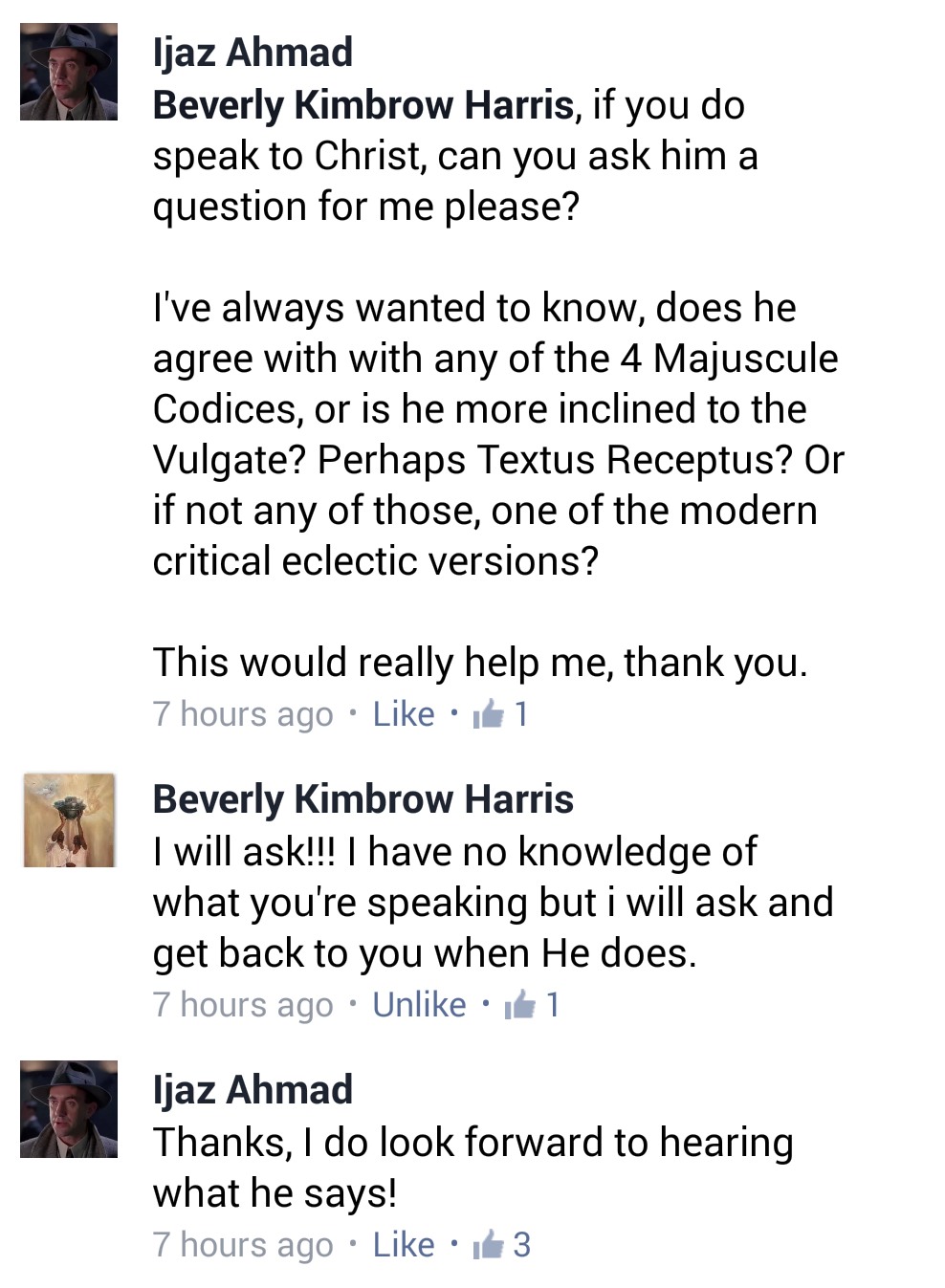
So, I meet this lady who says she talks to Jesus all the time! I decide to ask for her expertise since she has a direct line to the one guy that can help us solve our textual challenges with the New Testament. She says she’ll ask him about it. What are the chances I should expect a reply?

Note: For those pedantic types, I meant the Latin Vulgate and the later “Greek Textus Receptus”. The Latin is not the same as the Greek.

and Allah knows best!

John 3:16 Teaches Us Unconditional Love

I would like to encourage missionaries to stop making this claim in regard to John 3:16. The verse does not teach unconditional love. It does not. You simply have to read the verse and you’ll realise this. So, let’s take a look at the verse:

For God so loved the world that he gave his one and only Son, that whoever believes in him shall not perish but have eternal life. – John 3:16 (NIV)

The love of God in giving His Son to us, is pivoted on the condition of whoever believes in this happening. Only those who believe that God sent His Son, would earn the merits of God sending the Son and by extension, loving the world. The verse is saying that due to God’s love for the world, He gave His Son, and in giving His Son we will have eternal life and will not perish, if we believe. This love for the world in giving us His Son, is conditional on us believing. Therefore, a condition does exist, you have to believe. For those who God does not love, they will perish and you can only perish if God does not love you.

In conclusion, John 3:16 does not teach that God’s love is unconditional, as the condition of belief exists. Therefore, those who make such a claim most likely have not read the verse properly. Considering it’s one of the most famous, if not the most famous verse of the Bible, it’s pretty ridiculous that anyone can understand it this wrongly.

and Allah knows best.

Why Muslims Reject the Bible as Scripture

Islam acknowledges that scripture was given to the Christians and Jews, we call such people, “Ahlul Kitab” or the “People of the Book”. However, where we disagree,  begins with the very understanding of what the Bible is. To the Muslim, the Torah was given to Moses and the Gospel to Christ. This is, as the Qur’an says in Surah 5, Verse 44 and Verse 46. The Qur’an explicitly states that the Injeel was a scripture given to Jesus from God. No Christian today believes that the New Testament was given by Jesus to his disciples. These are therefore, distinct books. The New Testament is not the Injeel. As Muslims, we believe that both Christians and Jews today both do not have in their possession the original Torah or the original Gospel.

We don’t make this claim simply because we can, but we make this claim due to the evidences we possess. To begin with, the Qur’an states in Surah 2, Ayah 79 and in Surah 5, Ayah 13 that both the Jews and the Christians corrupted their “scripture” which they wrote of themselves and then claimed those writings to be from God. This might seem odd to some Christians that the Bible is a corrupted, and manufactured “scripture”. You may be asking if the Muslim is able to defend such a claim. We can and it’s simple. One example I am fond of using is the following argument, it goes a little something like this:-

Can you tell me which Old Testament you believe in?

  • Greek Septuagint.
  • Hebrew Vorlage based on the Septuagint.
  • Masoretic Text.
  • Samaritan Pentateuch.
  • DSS/ Qumran Scrolls.
  • Mystery Source of the Greek Septuagint.

Can you tell me which New Testament you believe in?

  • Marcion’s Canon.
  • Tatian’s Diatesseron.
  • Codex Sinaiticus.
  • Textus Receptus.
  • Codex Vaticanus.
  • Codex Alexandrius.
  • Codex Bezae.
  • Codex Syriac.
  • Codex Washingtonesis.
  • Nestle Aland Greek New Testament Codices through to the 28th Edition..
  • UBS 1 through 5 Greek New Testament Editions.
  • John Mill’s 1707 Greek New Testament Codex.
  • Codex Ephraemi-Rescriptus.
  • Westcott and Hort Greek New Testament (1881).

The problem is, there is no “one Biblical text” that all Christians agree on. What you call the Bible today is a translated text based on Greek, Arabic, Syriac and even Ethiopian writings. All collected and pieced together. What you call the Bible in 2014, is not what the first Christians called it some 2000 years ago. Namely because the New Testament didn’t exist until the writings of Paul began some 14 years after Christ ascended. At the earliest, the Bible was decided upon by what was called an Ecumenical Council or a “Unity Council”, today known as the Councils of Carthage in 393 and 397 AD. Yet, every Bible since that time, has varied, with no two remaining the same. Thus, what the Bible exists as today, is not considered to be the Bible which Christians in any previous century have believed in. The Bible is still evolving to this day, with both conservative and liberal Christian scholars attempting to define what the Bible “could” have looked like according to what each textual critic’s understanding of the text could have or should have looked like.

A new critical edition of the New Testament, means that textual critics examine the manuscript variants which occur in words and passages. They examine these variants and then through a select criteria, they attempt to ascertain which variant is the most authentic. In some cases, as in the Westcott and Hort Greek New Testament, when scholars do not find any of the variants to be accurate, authentic or valid they invent their own reading which has no manuscript basis. This is known as “conjectural emendation”. In the Westcott and Hort New Testament, this was done some 65 times. As such, this would mean that as variant words and passages continue to be argued over, the New Testament text continues to evolve every few years as the critical editions are released, as with the latest Nestle Aland and United Bible Societies’ Greek New Testaments. This is due to the textual critics employing what we know as the “eclectic method”. As a consequence of this method, there is not a single codex on the face of the earth that has existed with in the form of the New Testament we have today. The New Testament we have today is based on variants from hundreds of differing manuscripts and variant codices. The truth is, if the Christian scholars of today and those of the past still cannot decide on what the Bible is or what it was or what it will be, why should Muslims accept it as their scripture?

This case begets another problem, as the God of the Old Testament, proclaims that there is one eternal word of God, in Psalms 119:89, it reads:

“Your word, LORD, is eternal; it stands firm in the heavens.”

Which word is it referring to? There are so many canons and codices to choose from, none being the same from the first complete codices in the third century to those of today. How can you ask the Muslim to accept, what the Christian faith itself cannot decide upon?

wa Allaahu ‘Alam,

First Published: 6/ 8/ 12. Error noted by the missionary Paulus in which I wrote KJV Codex. I’m not sure on which basis I made that error, but it has since been corrected.

Paul’s Stolen Name


It is common knowledge or should be common knowledge that Paul’s former name was Saul. Being a Jew, Paul had a Jewish name before his conversion. The day Saul changed his name to Paul is quite peculiar, if not outright absurd to say the least. In the 13th Chapter of Acts, many strange incidents occurred:

They traveled through the whole island until they came to Paphos. There they met a Jewish sorcerer and false prophet named Bar-Jesus,  who was an attendant of the proconsul, Sergius Paulus. The proconsul, an intelligent man, sent for Barnabas and Saul because he wanted to hear the word of God. But Elymas the sorcerer (for that is what his name means) opposed them and tried to turn the proconsul from the faith. Then Saul, who was also called Paul, filled with the Holy Spirit, looked straight at Elymas and said,  “You are a child of the devil and an enemy of everything that is right! You are full of all kinds of deceit and trickery. Will you never stop perverting the right ways of the Lord?

As it turns out Saul met the son of Jesus (Bar-Jesus) and Sergius Paulus. What happens next is quite unbelievable. After Saul meets Sergius Paulus, Saul’s name is then introduced in Acts as being Paul. Let’s break this down for some understanding:

  • Saul is a Jew who converts to Christianity after having a magical/ demonic experience on the road to Damascus.
  • After sometime, Saul and Barnabus travel to Cyprus to preach Saul’s new religion.
  • Saul meets a Roman General, a “Proconsul”, named Sergius Paulus or for short, “Paul” – verse  7.
  • Saul’s name then is for the first time in Acts, introduced as Paulus or for short, “Paul” – verse 9.

Strong’s Greek Lexicon, comments on the name of “Paul” by saying:

Paul or Paulus = “small or little”

  1. Paul was the most famous of the apostles and wrote a good part of the NT, the 14 Pauline epistles
  2. Paulus was a deputy or pro-consul of Cyprus and is said to be a prudent man, in the management of affairs, as a governor

According to famed Christian scholar and exegete, Adam Clarke, he says:

This is the first time the name Paul occurs, and the last time in which this apostle is called Saul, as his common or general name.

Another famed exegete, James Coffman of the Coffman Commentaries on the Bible, in his exposition of Acts 13:9, quotes J.W. Conybear’s analysis of the verse and makes the following comment:

Conybeare said, “We cannot believe it accidental that the words `who is also called Paul’ occur at this particular point.” He made the deduction that the conversion of Sergius Paulus brought the name Paul to the surface and precipitated the use of it.

Therefore, our conclusion has to be that Paul copied the name of Sergius Paulus, as the coincidences are too great and obvious, to simply be a name that Saul assumed for himself. As such, even Christian scholars such as J.W. Conybeare and John Gill (as quoted above) admit that Saul’s usage of the name Paul is due to his meeting with Roman General, Sergius Paulus. What are we supposed to understand from Paul’s stealing of another person’s name, especially of a man who had a Jewish magician/ sorcerer as his aide and teacher:

The fact of Bar-Jesus’ having been a Jew suggests that Sergius Paulus had made inquiry into the beliefs of the Jews and may therefore be presumed to have had some knowledge of the sacred Scriptures. As MacGreggor admitted, “there would be nothing extraordinary in a Roman official having a Jewish teacher in his house.” – Ibid.

This concession by Christian scholarship casts a shady aura upon Paul, sorry, Saul of Tarsus. For what reason he copied the person’s name, or began using it exclusively after meeting his namesake, is unknown, but most interesting indeed.

wa Allaahu ‘Alam.


  • Note: Originally published on Oct. 19th, 2012. 14:45. 
  • Fixed error referencing John Gill instead of James Burton Coffman.
  • Error noted by users flightjam and defendchrist.

The Christian Teaching of ‘God is Love’

What does this mean? You hear it often, ‘Our God is a God of Love’, or ‘God is love’. Does this mean that God’s only attribute is ‘to love’ or that God is the ’emotion of love’? If God ‘is love’, then how do you reconcile this teaching with God’s wrath in the Old Testament and his returning wrath towards the end of days, or his wrath of torture and punishment according to the prophecies in the Book of Revelation?

What kind of loving God, who is known to have the ability to ‘just forgive sin’ as seen in the Lord’s prayer:

And forgive us our debts, as we also have forgiven our debtors. – Matthew 6:12.

Forgive us our sins, for we also forgive everyone who sins against us. – Luke 11:4.

Would then kill his son/ murder himself to forgive us of our sins? These acts, clearly do not seem loving. I’ve read John Gilchrist’s, “The Love of God in the Qur’an and the Bible“, and unfortunately, no act of God in the Old Testament is seen as loving, in his book, chapters 3, 4 and 5 contain not a single quote from the Old Testament to demonstrate the love of any of the Gods (Father, Son, Spirit) in the Old Testament. Would that then mean that the true God of the Christians was not always loving? The only ‘loving’ that God seems to do is to murder his son to forgive us of our sins, yet, we already know from the Lord’s prayer and the practise of the law – as confessed by Paul in Philippians 3:4-6, that one is able to be sinless and attain God’s love:

If someone else thinks they have reasons to put confidence in the flesh, I have more: 5 circumcised on the eighth day, of the people of Israel, of the tribe of Benjamin, a Hebrew of Hebrews; in regard to the law, a Pharisee; 6 as for zeal, persecuting the church; as for righteousness based on the law, faultless.

Yes, following the commandments leads to the love of God, as is written in 2 John 1:6:

And this is love, that we follow his commandments; this is the commandment, as you have heard from the beginning, that you follow love.

Therefore it is irrational according to the Bible, and Paul, that God is love, only due to Christ’s murder by his Father. Yet, John Gilchrist says in Chapter 4 of his previously mentioned book:

Herein lies the proof of the depth of God’s love towards us. He has done the greatest thing he could possibly do to reveal his love for us – he gave willingly his very own Son Jesus Christ to die on a cross for our sins to redeem us to himself. No greater proof of God’s love can be given to mankind than this. It is no wonder that John does not appeal to anything further to make his point. He has given the very best possible proof of God’s love towards men.

Murdering his own son is God’s greatest act of love! As humans, we must stop and ask ourselves, can murder ever be seen as righteous? See, the words ‘kill and murder’ are substituted with the word ‘sacrifice’, which makes it seem as something dutiful, loving and passionate, an act of goodness. Yet, the reality is, and if we are to be honest, we must look at this situation objectively, why would God kill an innocent soul for the forgiveness of others, a soul who begged and cried out at the Father’s abandonment of him:

About three in the afternoon Jesus cried out in a loud voice, “Eli, Eli,[clemasabachthani?” (which means “My God, my God, why have you forsaken me?”).

An innocent soul who asked the Father not to kill him:

“Father, if you are willing, take this cup from me; yet not my will, but yours be done.”

 We read according to the famous Coffman’s Commentary of the Bible, that Christ did not want to die, but God had no choice, although the Lord’s prayer clearly indicates otherwise!
The implications here are profound. There was no way God could remove the cup of suffering from Jesus without abandoning the purpose of human redemption. Some have interpreted the “cup” as agony itself, so great that Jesus was in imminent danger of dying before he ever came to the cross. Whether this was truly the “cup” or not is uncertain, but the appearance of an angel to strengthen the Lord in that agony surely suggests that it was at least an element in it.
Murder is not an act of love, it is both a crime and a sin. Any human who tries to rationalise the murder and torture of an innocent man as something good and beneficial is simply psychopathic. No mentally sane and stable person can ever testify and claim that the murder, torture, and death of an innocent man, especially by his Father, needlessly, should ever be considered an act of praise. We ask our Christian brothers and sisters, do you really believe that a God who is described as, ‘Love’, would murder his own son for your benefit, when all he had to do was simply forgive you as he had mentioned in his own prayer revealed through that same Son?
A God who kills his son, is not a God of love. We invite you to Islam, may God guide us all, Amen/ Ameen.
and Allaah knows best.
« Older Entries Recent Entries »