Missionary Mishap: The Greatest Argument Ever?
Sometimes there comes to you an argument that just leaves you…..speechless. This is one of those times.
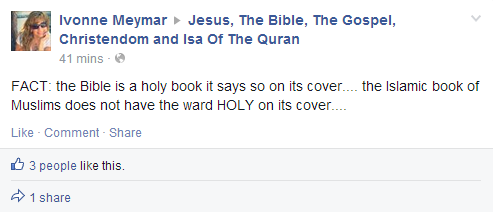
and God knows best.

Search



Sometimes there comes to you an argument that just leaves you…..speechless. This is one of those times.
and God knows best.
Muslims (of the Ummah of Muhammad salallaahu ‘alayhi wa salam), Catholics at the time of King Solomon. I had to re-read this missionary’s comment a few times before I could have established that I was seeing correctly. I did correct him on his statements, but I doubt he’s going to change his mind. A bit shocking, weird and silly – but I’ve seen worse….

and God knows best.
Question:
Why are so many Christians focused on preaching against Islam, some of them even devoting their entire lives to this cause. What is the reason for this behaviour?
Answer:
When Islam first came into contact with the Western Judaeo-Christian civilizations, their understanding of Islam is what primarily explains their animosity towards Muslims today. John of Damascus, possibly our earliest written source of a Christian’s understanding of Islam saw Muslims as heretics of the Judaeo-Christian worldview and not necessarily of a distinct religious worldview in itself. Islam therefore was a form of Judaeo-Christian heresy, and just as they referred to as other heretical Christian sects by the names of their founders (Basilideans from Basilides, Marcionites from Marcion, Arians from Arius etc ), Muslims were therefore known as Mohammedans and our religion was not Islam, but Mohammedanism. Christians then, from their first interaction with Islam saw it as a threat to the orthodoxy of their faith and not as a distinct religion from their own. This would be the beginning of the theological disputes between these two Abrahamic faiths.
Islam by itself in Qur’aan Surah 112 (al-Ikhlas), directly disputes with the view that God is triune, or that God is begotten. Some Christians have not simply viewed this as a disagreement with their belief system, but they treat it as a polemical statement against their most precious beliefs. Their focus on “defeating” or “responding” to Islam, can also be attributed to the understanding that God could bring a Prophet from the Arabs, the descendants of Ishmael, referred to as the wild man who Jews believe had no covenant with God. Why would God raise a Prophet from an illiterate, pagan, backward, people? The succession of Prophets according to Biblical literature has always focused on the children of Israel, and so, since the Arabs are not from them and they are not God’s chosen people, a true Prophet could not have come from them.
This is despite their beliefs that the Gentiles are now included in the Judaeo God’s worldview for salvation, it’s a bit of a contradiction but this is neither the time nor the place to explore this issue in great detail. Regardless of how certain sections of the Christian community continue to view Islam, as Muslims we are commanded to accept them as the Ahl al Kitab, the People of the Book, and as such – we should not and we must not imitate them in their animosity or hatred. Rather, we should continue to treat them with respect, for they are also the children of the Prophet Adam ‘alayhi as salaam, and our deen does not encourage us to mimic the behaviour of the disbelievers, regardless of our emotions or of their treatment towards us. I encourage the Muslim community to engage with the Christian community in a respectable and kind manner, especially towards those of the community who hate Muslims. The only way we can change how these certain Christians treat us, is not to imitate their behaviour but to follow the Prophetic example of Muhammad salallaahu ‘alayhi wa salam:
“The Prophet said, “Be patient, till you face them and invite them to Islam and inform them of what Allah has enjoined upon them. By Allah! If a single person embraces Islam at your hands (i.e. through you), that will be better for you than the red camels (most prized possession).” – Saheeh al Bukhari, Book #52, Hadith #192.
and Allaah knows best.
It is with a heavy heart that I’d like to inform the general public that Ergun Caner – of anti-Islamic gibberish fame, has faced a serious tragedy earlier today. His 15 year old son has committed suicide. While as Muslims we may fundamentally disagree with Ergun’s ingenuous, deceptive and generally dishonest means of preaching, our faith teaches us to be merciful to others as God has commanded us to be.
With these few words, I’d like to kindly ask that the Muslim community use this time to desist from any harsh words they may have for him, to put aside our differences with him and to enact the Prophetic example of Muhammad salallaahu ‘alayhi wa salam in praying for the comfort and peace of his family during this time. Most importantly, we ask that God guide him through this tragic occurrence and that it becomes a means of guidance for him and his family, an inspiration for him to re-think his ways.
If you can, do extend some kind words to him and pray for his guidance.
and Allaah knows best.
Note: I do not support nor identify with nor call to the cause of ISIS/ IS. This is not a defense of their terrorism or their violence or any of their actions. This is intended to be a fact checking investigation.
By now you’ve seen this photo with the claim that ISIS militants have burned down an 1800 year old Church in Mosul:

The problem with that would be that the Church in the photo is from Egypt, an entirely different country, and it was burned down in mid-August of 2013, that’s last year. So not only is it from the wrong year, the person who contrived this story couldn’t even be bothered to use a Church in Iraq itself, they used one from a completely different country. Fact checking does not seem to be the best ability of Christians crying persecution.
The issue in Mosul is that the IS de-facto Government, has determined that as the Caliphate, they now have the right to seek taxes from those living within their state. If persons choose not to pay their Government, then they would be asked to leave the state, as they would become a financial burden to the Government. The issue with the taxes therefore, is not one of persecution, but one of Governmental economic policies. The IS is a state with financial burdens and a state at war with the Iraqi Army, and as such, if it seeks to tax some of its citizens who are ineligible to fight on behalf of the state’s army then in place of that they pay a fee or tax known as the Jizya which in effect, is a promissory tax, of which upon acceptance by the state, they assume the role of having the responsibility of protecting those within the state’s boundaries.
Along with the invented story of burning Churches, there has been even more malicious stories of massacres and rapes. I decided a few blog websites by anti-Islamic, anti-Arab, angry Christians with an inferiority complex weren’t a very objective news source. So, I went to the source which the news agencies were quoting themselves, the head of Iraqi Christians on Mosul, Chaldean Patriarch Louis Sako! In his message to the Vatican, there was no mention of burning churches, murders, rapes, beheadings etc. We all agree that ISIS/ IS is evil and pretty violent, but by inventing stories about false atrocities for the chance to claim that your faith is being persecuted is quite low. It takes a person of very low morals to take the plight of a people and use it to manipulate the faithful of the world’s various religions.
The only effect inventing stories about ISIS/ IS can cause, is to legitimize them. If you heard 100 bad things about them, and it turned out a lot of it was false, doesn’t matter if 20 or so of those things actually occurred, you’re going to give the impression that they weren’t as bad as we thought. So in essence, by lying for pity, you’re legitimizing a violent, armed gang. Not the best thing you could’ve done, and yes I’m speaking to you 24/7 Christian persecution websites.
and God knows best.
Earlier this year, a popular Muslim YouTube channel featuring hundreds of debates and inter-faith discussions was taken down by YouTube due to copyright strikes. However, Br. Marwan’s channel has been resurrected and the situation has been sorted. We’d like to welcome back Br. Marwan and we are once more very happy to have such a large collection of videos back online. May Allaah reward the brother for his hard work. Click here to go to his channel!
and Allaah knows best.
A friend and financial supporter of Sam Shamoun, David Wood and Anthony Rogers, sends hate mail:

“And the servants of the Most Merciful are those who walk upon the earth easily, and when the ignorant address them [harshly], they say [words of] peace” – Qur’an 25:63.
and Allah Knows Best.
Question:
Christians (non-Muslims) and some Muslims find the Qur’aan (in English) to be disjunct. It does not follow through with one persistent topic throughout a Surah (Chapter) or throughout several Surahs in succession. It seems to jump from one topic to another without fluidity, why is this?
Answer:
Note: (This post is not about translation issues but rather about the typography we should expect from a book from God.)
I have previously remarked somewhat on a this topic in the article, “Why Didn’t Allah Send the Qur’aan in a Universal Language?” We can begin to understand the nature of the typography (form/ art/ style of writing) of the Qur’aan by using the example of a commonly known book, the Bible. Anyone who picks up the Bible and reads it, immediately understands what he’s reading. The narrative reads like any other story would, the knowledge it is presenting to you is easily digestible. You can read it to an elderly man, and to a young child and they’ll be able to follow the narrative without difficulty. Let’s say we’re reading the Gospel attributed to Matthew. It’s about a man who has this lineage and he does these things with these people at these places. Thus, there is no difficulty in reading it and therefore understanding what the Gospel of Matthew is trying to convey is a simple matter.
The ease of understanding of the narrative is a direct reflection of the knowledge, skill and ability that the author possesses. What this means therefore, is that the author and the reader are on the same level of knowledge, skill and ability. If you can pick up a piece of literature and find no difficulty in understanding what it attempts to convey or express, then the literature has nothing to offer you, it is of the same level of knowledge that the reader possesses. However, let’s say a child opens a University textbook on neuroscience and begins to read, he’s going to have many problems. Most likely, he’s going to encounter terms, statements, descriptions, language devices, formulas that the child has never met before. The child would struggle to read such a textbook and that is because the knowledge, skill and ability of the author is far greater and more advanced than that of the child. Therefore the child has to climb the stairs of knowledge to attain understanding and to thereby make sense of what the textbook is presenting.
The same can be said of a book from God. What do we expect such a book to convey? If it’s a book from God, and we assume in this scenario that the deity of said book is all knowing, then we must expect the book to be at a higher level than us. In other words, we have to stretch our intellectual capabilities and skills to develop the requisite (required) knowledge to understand the book from God. This is a simple, yet significant difference between the Bible and the Qur’aan. If we continue with our example of the Gospel attributed to Matthew, what this means for us, is that the author was as simple minded and knowledgeable as you and I are. We don’t have to stretch our intellect, develop our cognitive abilities to reach the level of knowledge needed to understand what the author is trying to convey. This therefore, clearly indicates to us that the Gospel is a human work, a human production and not from a being of higher knowledge. Whereas with the Qur’aan, it can be difficult to translate something accurately that uses terms, phrases, knowledge of a higher intellectual spectrum. It becomes difficult to express its intricacies and complexities because it possesses and conveys ideas and narratives of a higher intellect than that of ours. This is a hallmark of a message from God, its complexity demonstrates that it is not from a simple minded human. Consider the case of the following child’s bedtime story:

Did you struggle to read it? Of course not, well not unless you are between the ages of 1 year and 2 years old. That was simple to read. Nothing complex, unfamiliar, difficult, educational, informative, critically intensive or tedious. It’s a story for a simple mind, by a simple mind, the author cannot express complex emotions and ideas or theories in such a limited vocabulary and typography, it’s quite limiting. To the contrary, the Qur’aan is like a University textbook, it requires ability, knowledge and skill to read it, because it presents knowledge, beyond that of a human, it contains knowledge we would expect a deity to possess; knowledge expressed in a form distinct from human forms of expression. In this way, the “author” of the Qur’aan, can express significantly greater information because its typography is of a higher intellectual nature. It therefore reflects, the knowledge, skills and ability of a higher being as opposed to a simple minded one.
To the person who therefore says that the Qur’aan in difficult to follow in its fluidity, then this is not due to the Qur’aan’s fault. This is a fault of the reader, who does not possess the requisite knowledge, skills and ability to approach the message of the Qur’aan. We should be reminded that the English translations are meant to merely represent what the text is trying to say on an apparent level and not necessarily generated to express the complete ideas and teachings of the “author”. In the same way one has to have a certain level of knowledge, skill and ability to study a University textbook on neuroscience, we should then understand that one needs to possess a certain level of intellectual competency to comprehend the Qur’aan. The Qur’aan is not a simple book, it is from a higher being, an all knowing deity that is conveying some message to us, and if we can afford the time needed to study human works of higher intellect, then we can more than dedicate the same time and effort needed to study the Qur’aan. Anything less should be considered as laziness and complacency, not that of sincerity.
If one wishes to read more on this topic, an excellent book which examines epistemological typography is, “How to Read a Book”, by Mortimer J. Adler.
and Allaah knows best.
I had a bit of a strange incident in the twilight of yesterday’s morning. See, I had ventured into a Christian dialogue/ debate room and proceeded to ask a nonchalant question on the importance or lack thereof, of an early Christian letter: Oxyrhynchus 3057. This is what the manuscript looks like[1]:
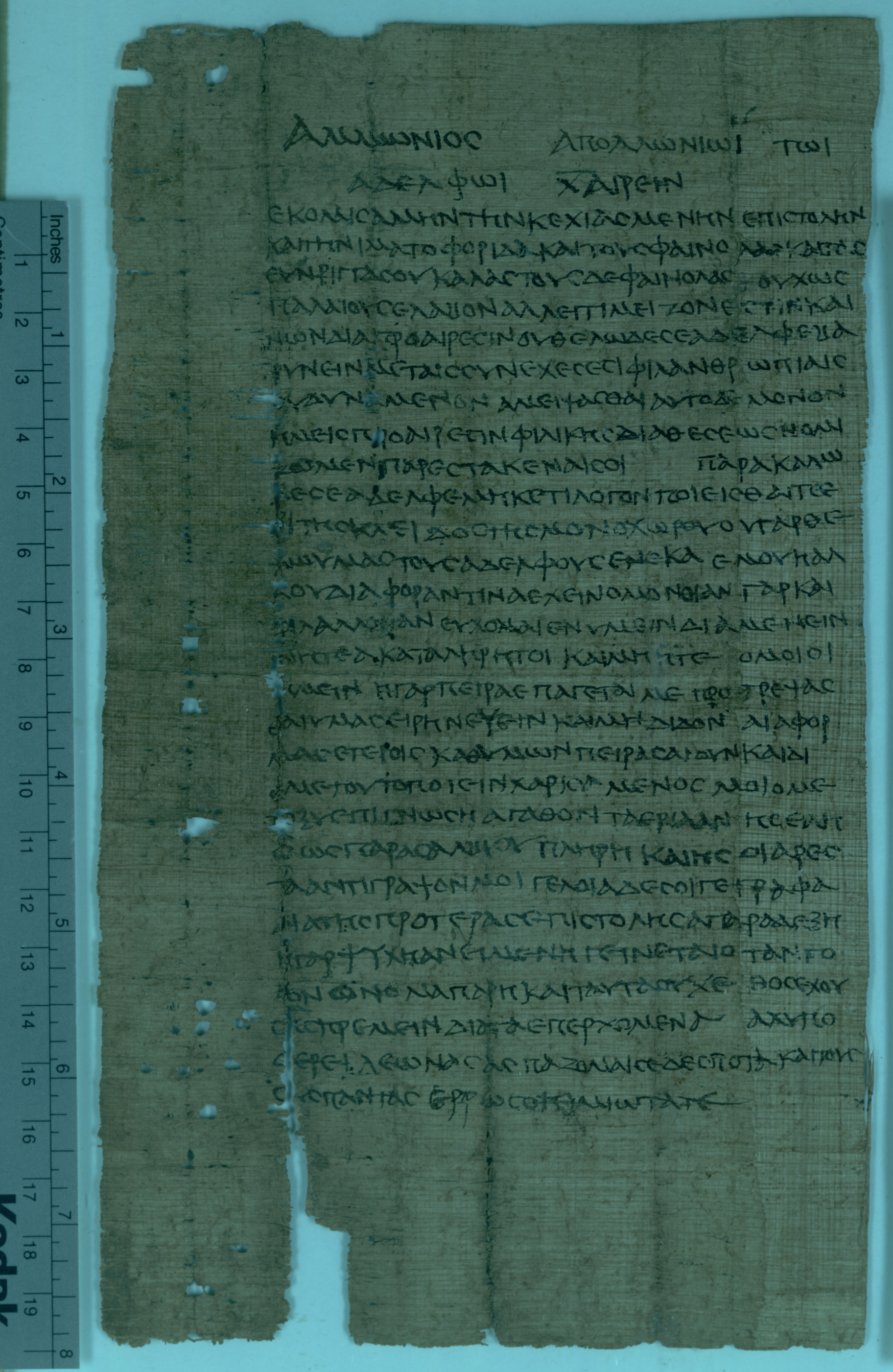
Its transcription and translation reads as follows[2]:
Ammonios to Apollonios his brother greeting. I received the crossed letter and the portmanteau and the cloak and (l. 5) your good reeds. I received the cloaks not as old but as better than new because of your intention. I do not want you, brother, to weigh me down with continuous philanthropy, not being able to repay, but we suppose we only (l. 10) offer to you the intention of friendly disposition. I exhort you, brother, no longer to concern yourself with the key of the single room. For I do not want you, the brethren, on account of me or (l. 15) another to have any difference. For I pray that oneness of mind and mutual concord remain among you so that you are free from gossip and you are not like us. For the trial leads me to impel you to peace and not to give (l. 20) a starting point to others against you. And so attempt to do this for me, favoring me, which in the meantime you will recognize as good. Write to me if the wool you received from Silvanus in full measure is pleasing to you. I wrote ridiculous things to you in a (l. 25) former epistle, which you should disregard. For my soul becomes careless whenever your name is present, and this though it has no habit to rest on account of the things that are happening, but it [soul] endures. I, Leonas, greet you, master, and (l. 30) all your people. Farewell, most honored friend. (back) To Apollonius, son of Apollo(?) surveyer, brother.
The manuscript is dated to be from the late first century, to early second century CE. What happened next took me a bit by surprise. A missionary of some sort responded to my question and stated that the manuscript in question contained several important passages from the Gospel accounts. If you read the above transcription and translation, not a single sentence is related to, or from any Gospel account in the New Testament, or otherwise. I found his claim to be quite, odd. I took the initiative and asked him if he knew that for certain or if he just Googled it, and merely read one of the results as a response to my question. He did reply honestly and confirmed that he did Google for an answer and read one of the resulting articles, thereby making him uncertain that his response was accurate.
This however, was not the strangest statement he was to make. Our conversation progressed for sometime until he asked me a question in relation to the Muslim understanding of Surah 4, Verse 157. My response involved the dating of Papyri 52, which I mentioned was the earliest extant manuscript of any of the four Gospels. To this, he was surprised and he subsequently proceeded to validate my statement by again, searching via Google. When I realised that he doubted what I had said about Papyri 52, I then realised the discussion was useless, as he was most certainly uninformed about the most basic information about New Testament manuscripts. I have to admit though, that since I’ve begun to ask questions about textual criticism and New Testament development, many polemical and missionary Christians have all attempted to respond to me in a plethora of ways. A significant majority of those had no idea what they were talking about, and it’s been quite a thrill listening to many of these individuals tell me of the extant manuscripts of the disciples which were written in the first century, in the 40’s, 50’s and 60’s. I’ve found though, that once I introduce them to textual criticism and inform them of their wrong understanding, they’d become quite hostile and begin to make crass remarks about my person.
Perhaps, what I’m trying to say after having had all of these strange experiences with many polemical and missionary Christians, is that while I do value the time I spend with them, I’m quickly realising that a majority of lay Christians are uninformed about their scripture, its history, development and preservation. Nothing though, can beat the expression on their faces when they learn that Textus Receptus (which the KJV Bible is based upon) was codified and published by a humanist, Desiderius Erasmus, a disbeliever in the Christian God. Oh, what a sight that is to behold.
Sources:
[1] – “Oxyrhynchus 3057“, Recto.
[2] – “Is P.OXY. XLII 3057 The Earliest Christian Letter”, by Licoln H. Blumell, Early Christian Manuscripts: Examples of Applied Method and Approach, Edited by Thomas J. Kraus & Tobias Nicklas (Boston: 2010).
and Allaah knows best.
Pharisaical, from the term Pharisee, refers to someone who engages in practicing or advocating strict observance of external forms and ceremonies of religion or conduct, without regard to the spirit of the religion[1]. There are unfortunately many Muslims who follow Islamic teachings and jurisprudence without understanding the scope and purpose of such teachings. This generally means that they adhere to Islamic jurisprudence, henceforth known as fiqh, but that they don’t understand the principles of fiqh, henceforth known as Usool al Fiqh. For a general understanding of what fiqh is and how it functions within the Islamic belief system, Mufti Ebrahim Desai states[2]:
Among the torch bearers of true knowledge and guidance after the illustrious Sahaaba (Radhiallahu Anhum) were the four famous Imaams of Fiqh who possessed deep understanding of the Shari’ah. They extracted the fundamental rules and principles of Shari’ah in the light of the Qur’aan and Hadith and thereby extracted many Shar’ee rulings. The fundamental rules and principles are known as Usool-al-Fiqh and the laws extracted therefrom are known as Fiqh.
In responding to a question on certain fiqhi practises, Mufti Yaseen gives us another angle of understanding what Usool al Fiqh is, he states[3]:
Not every single detail of Shari’ah must be explicitly expressed or declared in the Qur’an and Sunnah. Sometimes, rulings are derived from indications, and implications of verses or ahaadith. For this reason, a whole science, known as Usool al-Fiqh is established in order for a Scholar to recognise and identify the correct sources of Islamic Law and methods to deduce rulings from those sources. Some rulings are deduced from Dalaalat al-Nass, Ibaarat al-Nass, Ishaarat al-Nass, and Iqtidhaa al-Nass.
Therefore, it is inappropriate for the lay Muslim to develop an understanding of the laws in Islam, by merely extracting information from the hadeeth corpus and the Qur’aan. In Islam, the only persons who are qualified to do so are those studied in the science of fiqh, previously mentioned as Usool al Fiqh. Shaykh Zahir Mahmood, a prominent scholar based in the UK, corrects a misconception of one of the laws in Islam as it pertains to women, and demonstrates the great danger that can occur if lay Muslims follow their own eisegtical conclusions and not the valid teachings from the scholars, he states[4]:
Without belittling anyone or anyone’s question, I need to respond to a question which was posted under my previous post. The post was about the Saudi sister who was stabbed and people just walked passed her without helping. I have deleted the persons post so you will not be able to ascertain who it is.
The question was “should a person touch a Non Mahram to save her.” The issue of concern is the lack of basic Islamic knowledge, every Muslim should know the answer to this. Next time you see a non Mahram dying on the street are you going to ring the local Mufti for a fatwa before you help her/he.
The answer it not only permissible it is an obligation.
May Allah guide us all to the straight path.
For those who are critical of Islam and who base their criticism on the perceived laws of Islam, it is my intention to have proven that the practises of some Muslims as it pertains to women, betrays the principles of Islamic Jurisprudence, and that the scholars have recognized this problem and are working to guide the misguided lay men. Therefore such criticism is invalid against Islam, but valid against those who misapply Islamic teachings due to their own ignorance.
Sources:
[1] – “Pharisaical“, Dictionary.Com
[2] – “What is Your Definition of a Qualified Scholar and its Justification?“, AskImam.Org, Mufti Ebrahim Desai.
[3] – “Questions About Ahlus Sunnah wal Jamaah“, MuftiSays.Com, Mufti Yaseen Shaikh.
[4] – “Shaykh Zahir Mahmood’s Facebook Post“, Facebook.Com, Shaykh Zahir Mahmood.
and Allaah knows best.
 Calling Christians

You must be logged in to post a comment.