Refutation: Comparing the Bible and the Qur’an

This article is in response to another writing of the same title by Pastor Samuel Green, “Comparing the Bible and the Qur’an“.

Reason 1. The Context of the Bible and Qur’an

Scripture is supposed to be God’s message to mankind, it does not have to be a history book or a biography. It needs to mention what is needed to be known so that the message could be understood. The Qur’aan does not revolve around the life of Muhammad ﷺ, but it does relate many relevant verses about occurrences throughout the Prophet’s ﷺ life. The Qur’aan is not of human production and thus unlike the Bible it is not ordered through human concepts of organization: chronologically, topically, by (chapter) length, by name (title) or alphabetically. It would be crass to expect the Qur’aan to be ordered like the Bible or to provide the same information as the Bible. Whereas the Bible consists of biographies, letters, revelation, doxologies, epistles, pastorials, poems; the Qur’aan specifically consists only of revelation and nothing else. Pastor Samuel goes on to state:

“Thus, to understand the Bible you only need the Bible. In fact, many of the stories which are only briefly retold in the Qur’an are told in full in the Bible. The Bible is self-sufficient, as the word of God should be.”

This would be patently false and one of the ways we can demonstrate this is by the dependence of Christians to rely upon commentaries, exegeses and lectionaries. In fact, to not rely upon any of the three previous categories of writings and to rely upon one’s own understanding of the Bible is considered to be eisegesis. Oxford Biblical Studies defines this to mean, “A comparatively modern term to describe, disapprovingly, a piece of scholarship which appears to find in a given text a significance alien to its context. This might be to provide biblical support for a doctrinal position already held. The term was coined (from the Greek eis, in, and egeisthai, to guide) as the opposite of exegesis (Greek ek), which means an elucidation of.

In regard to the claim that the Qur’aan cannot be understood without the Seerah (Biography of the Prophet ﷺ) or without the narrations of the Prophet ﷺ, we believe that the Qur’aan can be understood without them to some extent, but for a more accurate understanding and a more comprehensive understanding we must often refer to these other forms of literature. It should be noted that it is the Qur’aan which commands the believers to obey the Prophet ﷺ:

“Say, “Obey Allah and the Messenger.” But if they turn away – then indeed, Allah does not like the disbelievers.” – Qur’aan 3:32.

The only way to do this is to follow his Prophetic Sunnah, and so it can be understood that by utilizing the Prophetic Sunnah to understand the Qur’aan, we do this because it is a command in the Qur’aan to do so.This is more of a safeguard as to avoid the sin of eisegesis, as opposed to the Qur’aan being incomplete in any way, shape and or form. I would agree with the Pastor’s statement, “Therefore to compare the Bible to the Qur’an alone is misleading and inaccurate.” I agree with this because the Qur’aan is unlike the Bible in purpose and historical development. Whereas the some parts of the Bible began as authoritative writings and then became scripture (Councils of Carthage, 393 &397 CE), the Qur’aan from its very inception has been and was always scripture in its entirety.

Reason 2. Practices and Beliefs

The Qur’aan contains all of the beliefs that Muslims must know, the Pastor has not provided an instance where we believe something that is not manifested in the Qur’aan. Whereas the Qur’aan commands us to do certain actions such as to fast and pray, to understand how the Prophet ﷺ enacted these commands we refer to the Prophetic Sunnah. While in Islam we separate scripture or the Word of God (risalah) from the biography and actions of the Prophet ﷺ or the Messenger of the Word of God (rasool), the New Testament mixes both and thus the Word of God is lost among the words of men, history and biographies. The Pastor continues by stating:

“The Bible has everything a Christian needs. The Bible fully declares what God has done to save us and bring glory to himself and how we are to live. It is the basis for our wisdom and defines our liberty. “

This is largely untrue, for example the beliefs about the Trinity cannot be found in the New Testament. Nor can the beliefs about the hypostatic union, the second coming of Christ, the immaculate nature of Mary, their doctrine of salvation solely by grace (their soteriological perspective), the foregoing of the laws of God and the original sin.

Why is the Bible so complete?

The Bible is not complete for the reasons outlined above. The Pastor makes the claim that the Bible contains the teachings of the Prophets. However, as is well known, Christians forego the alleged teachings of the Prophets and follow the teachings of Paul. Therefore including the alleged writings of the Prophets in the Bible is largely useless to the Christian faith. Perhaps what is most troubling is that while Moses lived between 1600 and 1300 BCE, the oldest record of the Old Testament is from 250 BCE, the Dead Sea Scrolls. With a space of over 1300 years between the Prophets and the Old Testament, it would be very difficult to ascertain whether or not these writings were actually written by the Prophets themselves or written homonymously (by authors writing in the name of the Prophets).

A More Accurate Comparison

Whereas none of the major doctrines of the Christian faith can be found in the New Testament or the Old Testament, the major beliefs of Islam can be found with complete certainty in the Qur’aan. Our doctrine of Tawheed? Surah al Ikhlas 112 covers the entirety of that doctrine in 4 verses. The same cannot be said of the Trinity, Salvation by Grace, the Immaculate  Conception, a Divine Messiah, a Second Coming of Christ or of the hypostatic union. As stated previously, whereas the Qur’aan solely contains the words of God, the Bible contains the words of men in the form of letters, epistles, pastorials, biographies, poems mixed with the words of God to the point that it is very difficult for any Christian to ascertain which is from God and which is from man. This therefore, cannot be seen as a deficiency of the Qur’aan, but should be seen as a corruption and blatant travesty against the sanctity of scripture in the form of the Bible. Whereas Islam keeps the distinction between the commands of God and the Prophetic enactment of those commands, the same cannot be said of the New Testament.

Some Application

1. The Bible and the Qur’aan are not the same in their typology (style of presenation) and in terms of their contents. Whereas the Bible is absent of the major beliefs of Christianity (as highlighted previously), the Qur’aan contains all major beliefs of the Muslims. While the Bible contains biographical works, letters, epistles, poems and other works of men, the Qur’aan solely contains the word of God. Thus, the Muslim is able to distinguish between the Word of God and the Prophetic enactment of the Word of God. While the Bible does claim to contain the works of the Prophets, the time span between that of the Prophets and that of the oldest Old Testament is too wide for anyone to claim with certainty that they were written by the Prophets themselves and until such evidence is presented, anyone who holds to that claim has fallen prey to the fallacy of wishful thinking.

2. If Muslims and Christians were to take the Qur’aan and the Bible in order to demonstrate their most sacred beliefs, the Christian would not be able to discuss the Trinity, the Hypostatic union and other major beliefs without relying on the debates of the Patristics (Church Fathers) who articulated most of their beliefs over a 400 year period. An example would be the doctrine of Tawheed versus that of the doctrine of the Trinity. Whereas the Muslim can refer the Christian to Qur’aan Surah 112 (al-Ikhlas), the Christian cannot refer us to any passage that entirely expresses their belief in the Trinity.

3. It is true that the Prophetic Sunnah compliments the Qur’aan and that beliefs can be derived from both. However, while the Prophetic Sunnah can undergo scrutiny, literary criticism and inspection, the Qur’aan does not undergo these things. Therefore beliefs extracted from the Prophetic Sunnah can be studied to verify their authenticity as the Prophet ﷺ may have been commanded to practise an act in one particular way earlier during his life and another way at a later period during his life. In the case of female circumcision, this is a common practise that should not be confused with female genital mutilation. A cliterodectomy is legal in most Western nations and is considered a cosmetic medical practise.

4. All religions with scripture do not condone the practise of extracting one’s own understanding of the scripture by self interpretation. This practise, known as eisegesis (defined above), is actively discouraged in both the Christian and Muslim faiths respectively. To tackle the Pastor’s claim, we invite him to defend the view that the Unitarians who read the Bible and reject the Trinity based on the Bible, that they are reading it correctly. It is quite obvious that when it comes to contentious verses with which the various Christian sects dispute about, the Pastor would turn to his commentaries to explain the proper understanding of those verses. While the Qur’aan can be understood by reading it, a Muslim knows he would be understanding its passages clearly by seeing the enactment of the Qur’aan and its explanation through the Prophetic Sunnah of Muhammad ﷺ. Thus, I find the Pastor’s claim to be wholly inaccurate and a poor representation of both the beliefs of Muslims and Christians in regard to their handling of scripture.

and Allaah knows best.
The Science of Hadeeth in Light of Orientalism

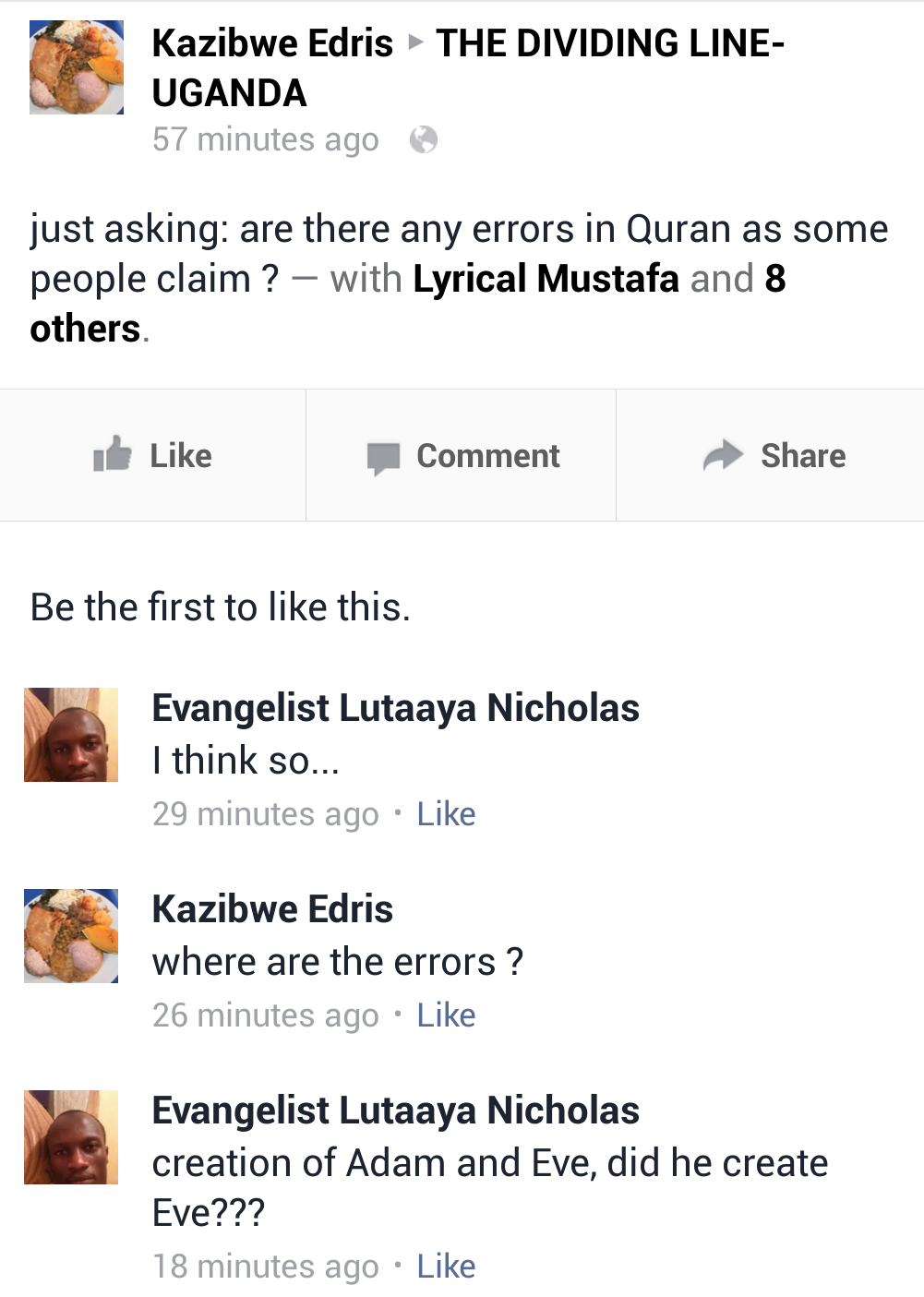
I was pleasantly surprised to view this video, as I think it answers many of the questions Muslims would have in regard to the authenticity of ahadeeth in both the arguments of the hadeeth deniers and of the Orientalists. It tackles the questions along the lines of, “if there were 750, 000 narrations why did the Imams only narrate several thousand?“, “how can someone memorize 600, 000 or 750, 000 narrations?“, “did people make up narrations and then invent a chain of narrators?“, “what is the difference between an isnad and a matn?” and, “how do we respond to Orientalist criticism of ahadeeth?” For a fifteen minute video it answers these questions and more in a very simplified manner.

and Allaah knows best.

China’s Violent Christian Cult [BBC]

You won’t find this as an example of religious extremism on David Wood’s site or on Atlas Shrugs. I’d like to emphatically state that this cult is not representative of all Christians or of the Christian faith. What this video is an example of, is the end result of radical, violent, hateful figures who prey on those who don’t agree with their extremist rhetoric. Humans partake in religion, humans are violent, religious humans can be and will be violent – it’s human nature and they’ll justify their violence through whatever philosophy or ideology or religion that allows them to do so. What people like Sam Shamoun and David Wood are afraid to come forward and say is that Christians have been and can be violent too. It’s just under reported. They will celebrate and gladly announce how the Christian Church is growing in China, but they will never say that it as a result of violent, hateful Churches like these, producing cults!

Maybe someone can shoot David Wood or Pamela Geller an email and ask them why they don’t also highlight the growing trend of violent Chinese Christian cults?

and God knows best.

Missionary Mishap: Preach to Muslims About Jesus the Tasteless

I follow an Apologetic Christian Kindle Deals Page on Facebook, and I usually purchase the books they have on discount. Imagine my surprise when they finally posted a book about preaching to Muslims. “Facing Islam, Engaging Muslims“, by Allen Pritzlaff.

cc-2014-missionarymishap-jesusthetasteless1


While browsing the book information, I came across quite a surprise!

cc-2014-missionarymishap-jesusthetasteless2


I imagine that this person who examined Islamic doctrine, the Seerah an Nabawiyyah, the Hadeeth Corpus and the Qur’aan would know that we refer to Jesus as the Messiah, al Maseeh (مسيح). Instead, he writes that we need to know God through Isa al Masikh – مسيخ. Masikh (otherwise transliterated as Maseekh) translates to, “tasteless”. In other words, his book quite literally insults, denigrates Jesus, referring to him as Jesus the Tasteless. Took me quite by a surprise. I’d really like to see the author’s face when he realises he gets one of the most basic things about Islam and Jesus wrong, in a book titled about Islam and Jesus. A bit funny, a bit embarrassing and a bit ironic, what more could we ask for?

and God knows best.

Abraham Righteous Solely by Faith?

Question

Many Christians refer to Genesis 15:6 to demonstrate that Abraham was righteous only by faith and not by following the commands and laws of God. How can we respond to this?

Answer

This topic is covered extensively in EP Sanders’, “Paul, the Law and the Jewish People”, which I would strongly recommend for those trying to understand the use of this passage to justify Christian beliefs in regard to salvation, or in trying to understand their soteriological perspective.

Genesis 15:6 says as follows, “Abram believed the Lord, and he credited it to him as righteousness,” the argument from this which is normally given, is that this verse never mentions works, commandments or laws. It specifically mentions faith only, therefore it is perfectly acceptable to believe that Abraham was righteous solely by his faith and nothing else. This is the same form of argument used by Paul in Romans 3:27-29, 4:9-25. Unfortunately for those who use this verse to argue their case of righteousness only by faith, they are appealing to the argument from silence – a fallacy. Simply because it is not mentioned in this verse, does not mean that Abraham is solely righteous by faith.

In fact, God in other places directly ascribes Abraham’s blessing/ righteousness due to his obeying of God’s command/ the law. We read, “and through your offspring all nations on earth will be blessed, because you have obeyed me.” – Genesis 22:18, and we also read from Genesis 26:4-5, “I will make your descendants as numerous as the stars in the sky and will give them all these lands, and through your offspring all nations on earth will be blessed, because Abraham obeyed me and did everything I required of him, keeping my commands, my decrees and my instructions.

Therefore, while Genesis 15:6 does mention that Abraham was righteous due to his faith while mentioning the promise of his descendants being as numerous as the stars, Genesis 22:18 and Genesis 26:4-5, while speaking of the same promise, mention Abraham’s righteousness and blessing by God due to his obeying of commands and laws. It is quite probable that the Christian had not read all of the related passages or were solely taught this one proof text that related to the teachings of Paul in Romans. Either way, the related texts clearly contextualise what Genesis 15:6 was saying.

and God knows best.

Read: Empower Yourself

Whether you’re a Muslim, Christian, Jew or Atheist, we all listen to scholars to educate ourselves. We spend hours upon hours watching lectures, sharing them and commenting on them. There is no doubt that they can be beneficial, but they can only be beneficial insofar as they allow us to engage with the primary sources of information from which they draw from. What this means, is that while we can gain a lot from watching a 20 minute lecture about the biography of some famous religious personality, we can gain a lot more by actually reading the biography or works of that personality. Let’s take for example, the Passion of the Christ movie by Mel Gibson. The primary goal of a movie is to entertain, not educate. Entertainment is guided towards gaining the attention and interest of the most amount of viewers as is possible. By promoting focus on entertaining, rather than educating, the movie will be successful and significantly less boring. We can see this by comparing the narrative of the Passion of the Christ as opposed to that of the four Gospels. The movie presents one narrative whereas the New Testament Gospels present a number of differing narratives that often conflict with one another. Unless the movie presented four different versions of the Passion event, the narrative it gives us must then be considered limited in scope and depth, it would exclude information otherwise unknown to us unless we had read the Gospels ourselves.

For a Muslim, let us consider the Seerah or the Biography of the Prophet Muhammad salallaahu ‘alayhi wa salam. In many of the books on the subject (I prefer Martin Lings’ edition of the Seerah), most of us who’ve read it would be familiar with the personality of Umm Ayman, otherwise known as Umm Barakah. An African wet nurse, or rather adoptive mother of the Prophet salallaahu ‘alayhi wa salam. Her role, purpose and place in his life is truly one of the most beautiful historical events that we should be aware of. Yet, most of us who have only come to know the Prophet salallaahu ‘alayhi wa salam through short lectures, or the few movies on his life are completely unaware of her existence. Most are actually surprised to know that the wet nurse or adoptive mother of the Prophet salallaahu ‘alayhi wa salam was an African woman, moreso that she spent a significant amount of his blessed life with him, by his side, through his struggles. By omitting such an important piece of history from his life, many Muslims are unfortunately disregarding one of the most beautiful personalities in regard to the Prophet salallaahu ‘alayhi wa salam

The Qur’aan says, ” رَّبِّ زِدْنِي عِلْمًا” – which translates to: “My Lord Increase me in Knowledge (Qur’aan 20:114)”. It is one thing to experience the Prophet  salallaahu ‘alayhi wa salam through short videos of his Seerah or movies, but it is an entirely different experience to come to know him through the reading of his Seerah. Perhaps this image can put things into perspective:

cc-2014-caleb

Consider a book of 100 pages. It would take someone an average of 1 minute to read a page of 300 words. If there are 100 pages, and the person reads 1 page a minute, it would take them 100 minutes to read the entire book. That’s roughly 1 hour and 40 minutes. Yet, if a person watched a movie on the Seerah of the Prophet salallaahu ‘alayhi wa salam, as opposed to reading the Seerah, they would come to know significantly less about his life, minute for minute versus to two mediums. Sure, you can see beautiful images of grand desert vistas with Arab cultural music in the background, but in that same time you could’ve read a page or two and actually learned something. The question that needs to be posed to ourselves is quite clear. From where do the people speaking in videos, or the screen writers behind movies, get their information from? They get it from the same books we neglect to read! So if it is, that we truly admired the people we spend hours watching videos of, wouldn’t we stand to learn a lot more by actually interacting with the primary sources, as opposed to having watered down third person narratives fed to us? Quite frankly there are two kinds of people, those willing to learn and those willing to have someone spoon feed them information. I’m often reminded of the young Muslims who spend hours watching videos of Shaykh Ahmad Deedat or of Dr. Shabir Ally debating. Most are amazed at their level of knowledge and understanding of complicated inter-faith topics. Yet, most young Muslims would prefer to watch those videos to gain quick knowledge, than read any of the books that either of the two great personalities above have read to get their information and recommended for Muslims to learn from.

At the end of the day, we all have a choice to make. If we truly want to learn we can go directly to the books that house the information or we can choose to have tid bits of it given to us by persons who have read the works themselves. The only true limit of gaining knowledge, is the limit we place on ourselves. With this, I say, empower yourself, read, or as the Lord of the Worlds has said: “قْرَأْ بِاسْمِ رَبِّكَ الَّذِي خَلَقَ” – Read in the name of your Lord who created (Qur’aan 96:1).

and God knows best.


Jesus as the Messiah in the Old Testament

Question

Christians often use Old Testament passages to demonstrate that Jesus is the Messiah prophesied in the Jewish writings. How would you respond to this and should a Muslim disagree with these passages?

Answer

‘Aissa al Maseeh, Jesus the Messiah. As Muslims we adhere to the belief that Jesus was the Messiah and thus we agree with our Christian brethren that he was the Messiah. Concerning the passages used by Christians which foretell the crucifixion of the Messiah for the sins of the world, it is important that we first understand what the term Messiah means. The term for Messiah in Hebrew is, “Mashiach“, Christians naturally claim that every Messianic passage is about Jesus and thus he is, “Ha Mashiach” or, “the Messiah”. To begin with, there is not a single passage in the Old Testament that refers to a person known as, “Ha Mashiach“, the Messiah. There are many Messiahs in the Old Testament, with the term Messiah merely meaning, “anointed one”. The Christian would therefore have to demonstrate for us a single occurrence of the term, “the Messiah”, referring to one specific Messiah alone. Rather there are many Messianic passages in the Old Testament because in Judaism, there were many Messianic figures.

To be anointed was a common practise in their faith:

After you put these clothes on your brother Aaron and his sons, anoint and ordain them. Consecrate them so they may serve me as priests. – Exodus 28:41.

Therefore being the Messiah does not deify Jesus, nor does it mean that every Messianic passage could be about him. This would mean that not every suffering Messiah would also be Jesus. A popular passage used to prove that Jesus was foretold of being crucified for the sins of the world is the chapter of Isaiah 53. To respond to this chapter as an evidence, we can ask the Christian concerning verse three which reads as follows:

Like one from whom people hide their faces, he was despised, and we held him in low esteem.” – Isaiah 53:3.

Why did people hide their faces from him? Isaiah 52, says of the suffering servant:

“Just as there were many who were appalled at him – his appearance was so disfigured beyond that of any human being and his form marred beyond human likeness – ” – Isaiah 52:14.

When did Jesus have a disfigured face and when did he hide this disfigured face? There is not a single passage in the New Testament which mentions that Jesus had a disfigured face. Since this is the case, we must then ask, how can this possibly refer to Jesus?

and Allaah knows best.

What is the Evidence that the Injeel Existed, is it the same as the Gospel?

Question:

Christians often ask where is the evidence of the Injeel. There is no physical evidence of it, so how do we respond to them. They also claim that the Injeel is the same as the Gospel and we have the Gospel therefore the New Testament is from God.

Answer:

Lack of physical evidence does not necessitate that the Injeel did not exist. This is actually fallacious reasoning and is known as the argument from silence, further information on this fallacy can be seen here. We can understand this fallacy by realising that a lack of evidence of something existing does not mean that it did not exist. An example would be your great grandfather, no one living today has seen him smile, therefore he never smiled. This would be the argument from silence. Similarly, because no one today has seen evidence of the Injeel, this does not mean that it did not exist. There are many reasons why there are no physical evidences of its existence, the Qur’aan states:

We do not abrogate a verse or cause it to be forgotten except that We bring forth [one] better than it or similar to it. Do you not know that Allah is over all things competent? – Qur’aan 2:106.

Since it has been abrogated, Allaah can surely cause it be forgotten to us. We can also flip this argument onto the Christian. Jesus nor any of his disciples knew the New Testament to be scripture – it was canonized as scripture in 393 and 397 CE at the Councils of Carthage in what is modern day Tunisia. Would the Christian then agree that since there is no evidence that Jesus or his disciples knew of the New Testament, that it did not exist or that it is not scripture?

In regard to the claim that the Injeel is the same as the Christian Gospels, the Qur’aan describes the Injeel as follows:

And We sent, following in their footsteps, Jesus, the son of Mary, confirming that which came before him in the Torah; and We gave him the Gospel, in which was guidance and light and confirming that which preceded it of the Torah as guidance and instruction for the righteous. – Qur’aan 5:46.

The Qur’aan describes the Injeel as a message given to Jesus. No Christian believes that the Father gave Jesus any scripture, nor did He give Jesus the New Testament. Therefore these are two distinct writings, one is not the other.

and Allaah knows best.

ISIS’ Most Persecuted: Muslims

ISIS, or IS as it now calls itself has earned a notorious reputation for the blood letting it’s members thrive upon. Reports of threats and abuses towards Christian minorities and the Yazidi minority have captured the hearts of co-religionists worldwide. There will be many victims of IS’ wanton disregard and care for human life, but the greatest victim of all would be Islam and its adherents. This understanding has not yet manifested itself in the hearts and minds of those willing to condemn the violence. The problem therefore, is that the greatest victims of IS have been overlooked, forgotten and disregarded. If we are to truly care about the victims afflicted by the violent plague of IS, then surely we must also be concerned about the Muslims who have to live among them, live under their rule and give allegiance to a leader they were forced to accept.

We must remember, that IS’ new state is based on primarily Muslim dominated lands, towns and cities. This would lead us to cc-2014-syriawarunderstand that a vast majority of the bloodshed is occurring in Muslim lands, towns and cities. There homes are no longer safe for them, as entire towns and cities become battlefields for the foreign fighters against the governing forces. Everyone seems to understand the plight of the minorities in the conflict, but not the main victim themselves. This is troubling. If we are to care only about minorities, then can we say that we truly detest persecution? President Obama authorized bombing raids when the Yazidis were being massacred by IS, yet did nothing while IS violently rampaged through Iraqi and Syrian cities.

The problem persists in part because those in the West see the Iraqi infighting as sectarian violence and so those Muslims living in Iraq are the cause of the problem. This however, is trivializing the issue. Muslims are not the problem, Muslims are the victims of the problem – an insurgency fostered by a failed Iraqi war led by NATO forces. This though, is not merely my opinion but the opinion of US State Department Officials, US Military Strategists and the journalists who have been following the war since its inception – as documented in this PBS Frontline Report: LOSING IRAQ. Former Secretary of State, Hilary Clinton directly blames the Obama administration’s foreign policy for the devastation now raging throughout Iraq.

Saleel wa Sawarim – the IS movie depicting andvideo logging their militant endeavors to spread their state, demonstrates the violence towards fellow Muslims, regardless of religious beliefs that they are willing to undertake in order to achieve their goals. Video clip after video clip gives us just reason to state that Muslims are IS’ greatest victims. Whether their deaths come through drive by shootings, martyrdom-suicide operations, mass executions or sniper fire – the fact remains that the most amount of blood being spread is by that of Muslims. It’s not Christian armies, NATO armies or Yazidi armies that are committing soldiers in the fight against IS, rather it is the Muslim Sunni Tribes who are placing their lives at risk to protect themselves and the religious minorities being persecuted by IS. Therefore, it should not be said that Muslims are the cause of IS or that Islam is to blame, when the truth on the ground is that the only peoples to commit troops to the cause are Muslim Sunnis. We should not condemn Muslims as terrorists, rather we should praise the efforts of the Muslims who are not complicit in IS treachery but are fighting them, one battle at a time.

and God knows best.

« Older Entries Recent Entries »