Can Muslims be friends with non-Muslims?

cc-2014-friends

Ustadh Tabraze Azam of Seekers Guidance answers this popular question:

Question: Assalamu alaykum,

I have been recently highly agitated by what I have read in Islamic sources about friendship between Muslims and non-Muslims. Essentially what I have understood is that friendship with non-Muslims is wrong. That so much as eating or chatting with non-Muslims is haram. There is also fatwas insisting that close friendship with non-Muslims is haram.

This seems horrible to me, as well as bigoted. Why is this haram?

Answer: Wa alaikum assalam wa rahmatullahi wa barakatuh,

I pray that you are in the best of health and faith, insha’Allah.

No, it is not unlawful nor disliked to befriend non-Muslims. Thinking otherwise is a misunderstanding of divine revelation and prophetic guidance.

The Qur’anic Verses

Allah Most High says, “The believers should not make the disbelievers their [supporting] allies rather than other believers– anyone who does such a thing will isolate himself completely from God– except when you need to protect yourselves from them.” [3.28]

And, “You who believe, do not take the Jews and Christians as [supporting] allies: they are [supporting] allies only to each other. Anyone who takes them as an ally becomes one of them– God does not guide such wrongdoers.” [5.51]

To read the full answer and its explanation, click here to go to the Seekers Guidance website.

Spot an Error?

cc-2014-spotanerror

Sometimes we make mistakes when writing or citing sources. Most of the time we realise when an error has been made and we correct it, other times we only see an error when someone brings our attention to it. So, if you spot an error, send us an email or comment on the post and we’ll fix the error as soon as is possible. Errors don’t have to be spelling mistakes or wrong references, we could make factual mistakes as well – like when I referred to Erasmus as an atheist because I had read he was a humanist, or that time I referenced a wrong commentary but posted the right link to it. Most importantly though, sometimes I may post an article when provoked by someone’s dirty attack on Islam, like that image I posted earlier this week of Dr. Michael Brown – sure, he was wrong for attacking Islam but it was also wrong of me to make my response personal and so I’ve since edited that article.

As the site continues to grow, the greater the responsibility we have to ensuring that what we post is both accurate and respectable. This is a learning experience for all of us. We learn a lot from our readers who send us emails on articles we’ve posted or when they’ve shared one of our photos 500 times on Facebook. Every email sent, most comments posted are usually read but we can’t always reply to them all. So your voices are being heard, we do listen to our readers but we don’t always have the time to respond. With that having been said, fixing errors is our top priority as we want to provide you with accurate, factual and responsible information to help you understand Islam and defend Islam in a manner pleasing to Allaah.

So, if you spot an error, let us know!

and God knows best.

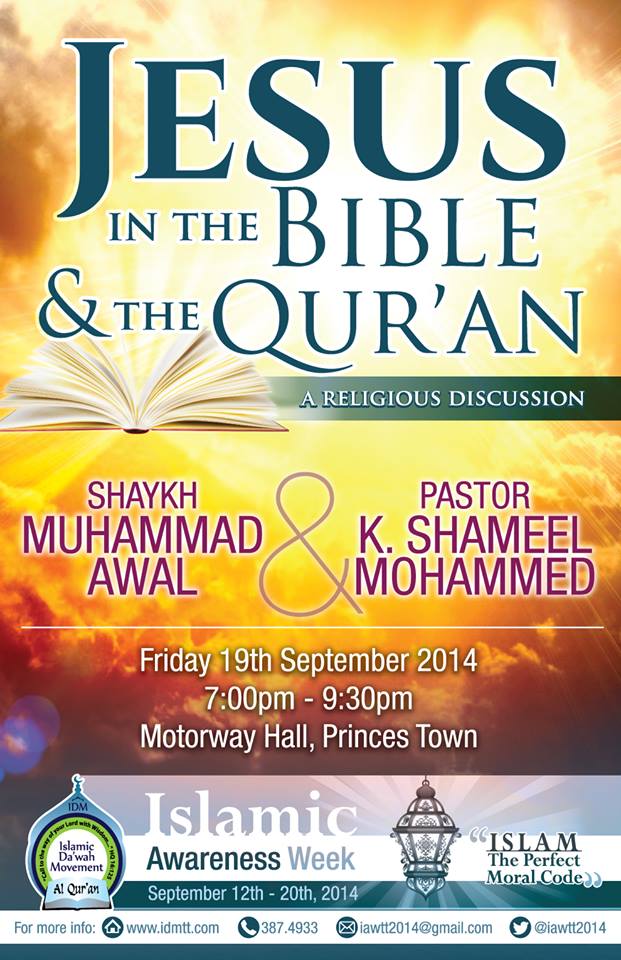
Review: Jesus in the Bible and Qur’an, a Discussion by Shaykh Awal and Pastor Mohammed

Introduction:

Pastor Mohammed has an MA in Theology and represents the Seventh Day Adventist Church. He’s the child of a marriage comprised of a Muslim father and a Christian mother. This explains his religion and it’s odd juxtaposition with his Islamic surname.

Sheikh Mohammed Awal, founder and director of Zaitun Dawah Institute (ZDI), a think tank research center with head quarters in Seattle Washington State USA, and branches in NY, Atlanta, Nigeria, and Ghana.

Sh. Awal is a scholar in Islamic Sciences, Comparative Religion and logic. He is an Islamic apologist, a debater, a motivational speaker and a prolific writer. He holds a diploma in Agric. Science and Irrigation Engineering from College of Irrigation and Surveying, and a degree from the prestigious Kaduna Polytechnic College of Environmental Studies both In Nigeria. He also bags a diploma in logic and philosophy from Seattle Institute of Advance Studies. Read more about him here.

Opening Discussion:

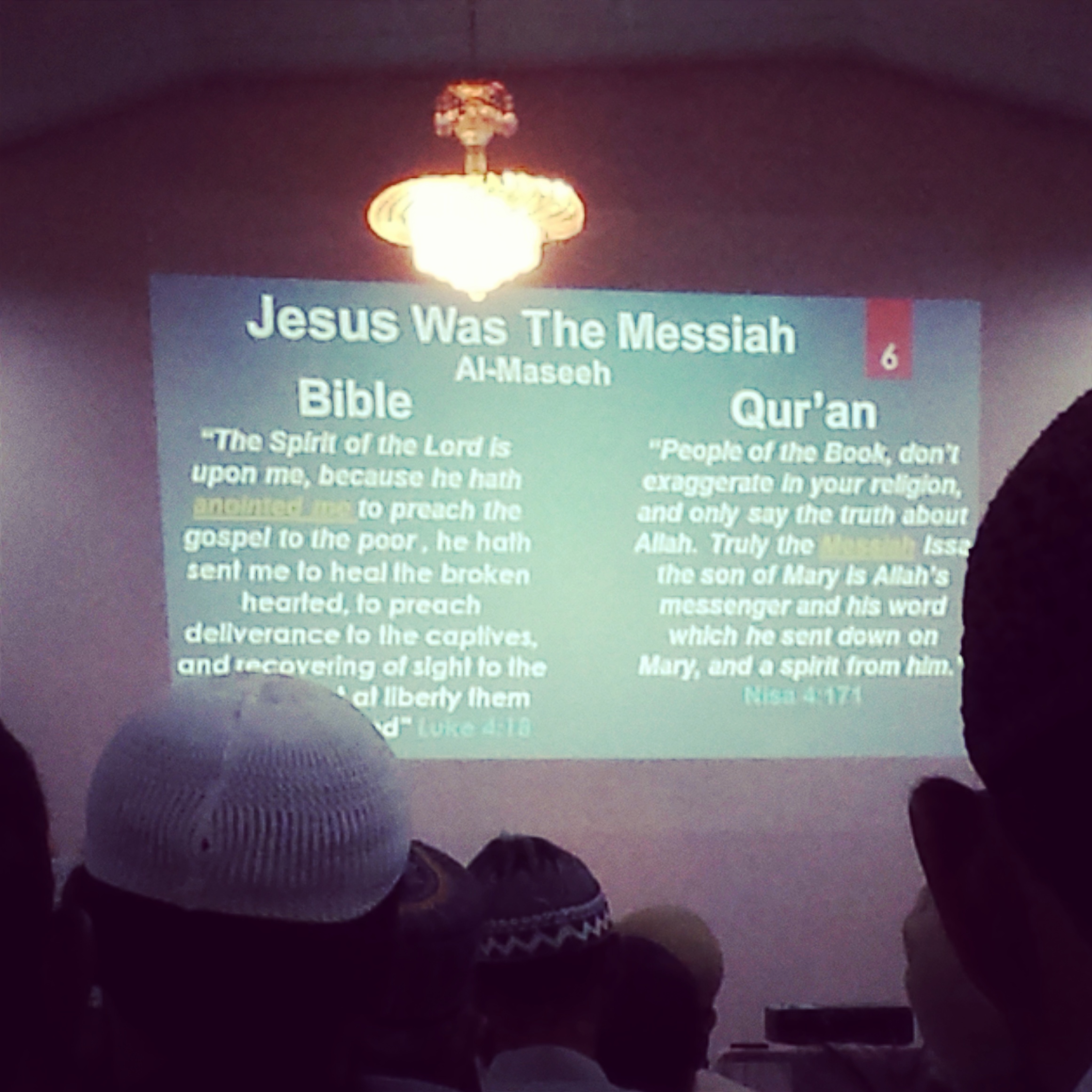
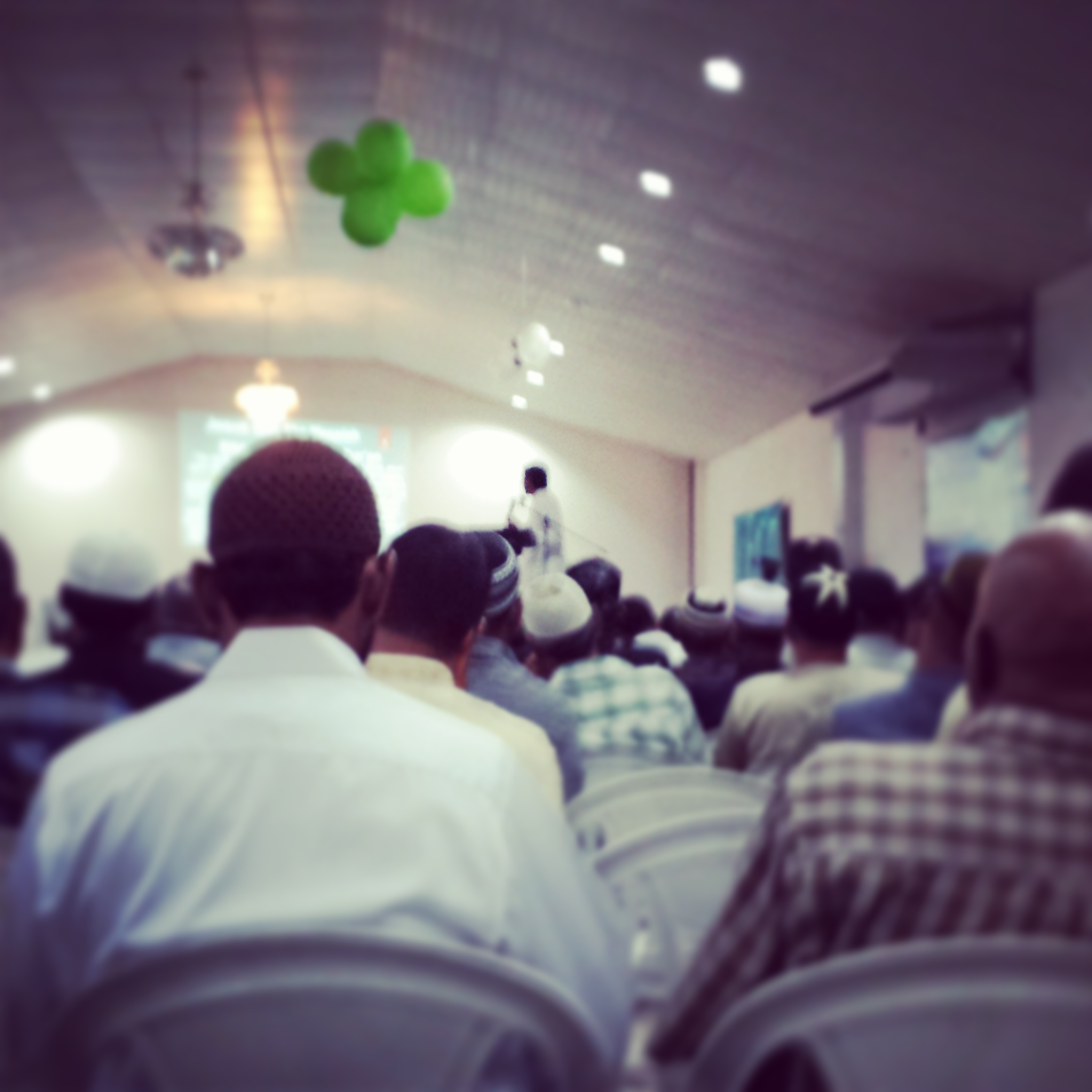
Pastor Mohammed began the discussion and was very well spoken. He did not try to prove that Jesus was a deity nor was he preaching to Muslims. The Pastor did not stray from the topic and stayed very well within its delimits. His presentation involved a number of slides displaying both the Bible and the Qur’aan in respect to our shared beliefs about Jesus the Christ. Below are photos of the Pastor while speaking and one of his slides (click to expand photos).
wpid-img_20140919_214316.jpg

wpid-img_20140919_214246.jpg

He mentioned that both the Bible and Qur’aan taught that Jesus was a Prophet, the Messiah, did miracles by God’s will, raised the dead, cured the sick etc.

Shaykh Awal agreed with the presentation of the Pastor and so decided not to repeat what the Pastor had already spoken. He chose to elaborate and expand on the points previously presented. Shaykh Awal mentioned that Jesus was sent for the lost sheep of Israel, that Jesus came to confirm the Torah and practised God’s laws. His opening also focused on Jesus’ prophesying the coming of the Prophet Muhammad ﷺ and referenced the comforter in John 14, 15 and 16, as well as quoting Isaiah 29:12.

Cross Fire Questions and Answers (3 each):

Shaykh Awal opened this round and asked the following three questions:

  1. Does Jesus’ ability to perform miracles make him God?
  2. Why was Jesus baptised?
  3. How did the Prophets (Abraham, Moses, Jesus) pray?

The Pastor’s answers are as follows:

  1. Performing miracles does not make Jesus unique. It is one of the predicted signs of the Messiah that he would perform miracles according to Isaiah. His performing of signs and miracles does not make him unique or divine.
  2. Jesus was baptised to fulfill the prophesy of the Messiah being righteous. Matthew 3 expands on this view. The rite of baptism is symbolic and Muslims can read Qur’aan 2:138 or thereabout for more information. Jesus was baptised so that others would follow this practise and be forgiven.
  3. Muslims pray more like the Prophets of the Torah than the Christians do. He referred to how both Muslims and the Prophets like Moses pray by bowing and prostrating and he believes this is how Jesus prayed. He finished by encouraging Christians to also pray this way.

The Pastor then poised his three questions to Shaykh Awal and they are as follows:

  1. You spoke about not using the English word for God and recommended that we should use the Arabic term as it is more accurate. Before the Prophet Muhammad ﷺ came, what term did the Arab pagans, Jews and Christians use for God?
  2. You said that Jesus only came to the Jews, but I’ve read otherwise. Have you considered John 3:16-17?
  3. You mentioned the Torah, Zabur, etc. If the Torah is for the Jews and the Injeel for the Christians, are these books for all the followers of God or only these specific people?

Shaykh Awal answered these questions by stating:

  1. El, Elah, Alah, these are the Semitic words for God before the Prophet Muhammad ﷺ came. The Qur’aan mentions that some of the Arabs were Hanifah (righteous), following the example of Abraham who was Hanif. They followed his practice of referring to the Semitic word for God, Allaah. The Prophet’s ﷺ father’s name was Abdullah and so we know from this that the Arabs knew of God’s name as Allaah and so they used it before the Prophet Muhammad ﷺ was born.
  2. I’m yet to see a single place in the New Testament where Jesus went outside of Israel and preached to the gentiles. Look at Matthew 15:21, a Caananite woman came to Jesus and he showed her no mercy because she was not Jewish. Why won’t he heal her? When Jesus was alive, where did he say he came for the entire world?
  3. The Torah of the Qur’aan was given to the Jewish peoples. Nowhere does the Torah state that it is for all of mankind. The Injeel is a confirmation of the Torah. Jesus obeyed the laws of Moses as well as what God revealed to him.

Question and Answer Period from the Audience:

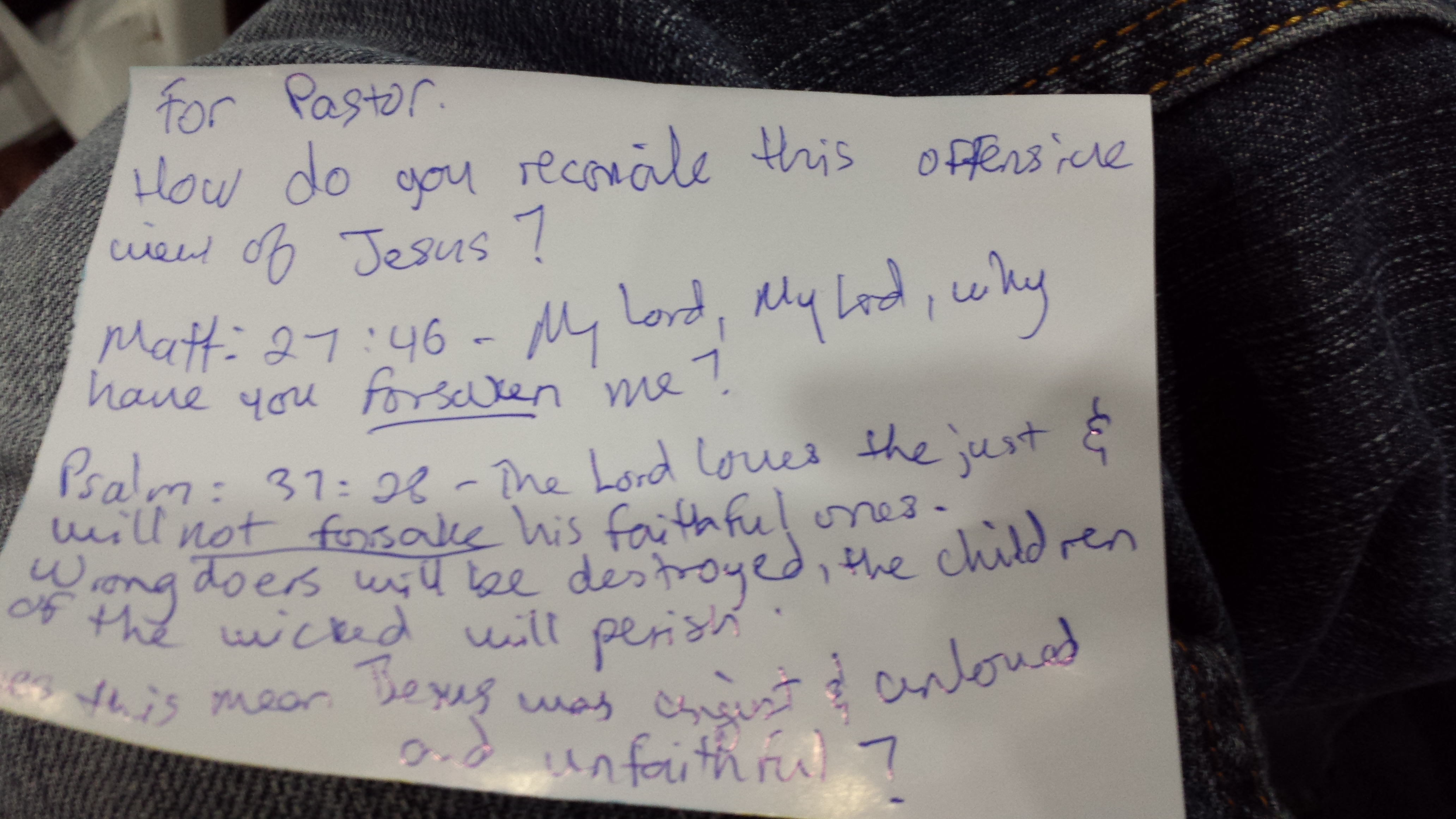
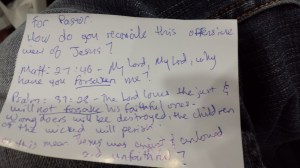
Note: I was unable to record the questions and their answers but I did listen to them. Most of the questions were about Jesus being God, they were not in relation to the topic. This was my question posed to the Pastor but he did not choose to read it or respond to it (click to expand):
wpid-20140919_200313.jpg


My handwriting is not this bad, but I was in a hurry and had to borrow someone’s pen while writing on a chair. It’s absolutely not a fair example of my handwriting. The question and answer period lasted roughly 40 or so minutes and concluded with a question for both speakers, “Shaykh Awal, what is your view of Jesus and Pastor Mohammed, what is your view of Muhammad ﷺ “. One of the questions posed to the Pastor by Br. Reyaz was, “If Jesus died for the sins of the world, does that mean my sins are forgiven and taken care of?.

Location & Organizers:

The Islamic Da’wah Movement and the Muslim Youth of Trinidad and Tobago did an excellent job in setting up and advertising for the event. Br. Zaheer Ali was there and took many photos. Br. Asad Yacobali did an excellent job in facilitating parking and distributing paper for the questions from the audience. Br. Shezad Mohammed moderated the event/ was the chairman and did an excellent job in managing the events on the stage.

The location at Motorway Hall had a lot of space for parking and accommodated quite a large crowd of around 150 – 200 persons. The crowd consisted of a large number of Muslims and the Christian side was adequately represented. Two Pastors from Pastor Mohammed’s Seventh Day Adventist Church accompanied him and sat among the Muslim males. Seating was segregated for the Muslim community.

Conclusion:

The event was well organized and both speakers were on point and stayed well within the scope of the discussion’s title. The dialogue was lively and entertaining, while being informative but very casual. There were no heated exchanges, no personal attacks by the speakers. They kept it very professional and focused on delivering accurate and factual information to the audience. Shaykh Awal did a splendid job in representing the Muslim side and we definitely look forward to more of his dialogues and discussions. Pastor Mohammed was respectful and cordial, I expect him to continue dialoguing with the Muslim community.

and Allaah knows best.

Dr. Michael Brown’s Inflammatory Posts About Muslims

Religion is supposed to cross ethnic, cultural and socio-economic divides. Unfortunately, it has become quite too easy and quite too profitable for some religious individuals to misuse religious ideals to demonize those they disagree with. Below is a post by Dr. Michael Brown, a Christian scholar and missionary who many in the Christian community respect due to his knowledge about Judaism and his works in converting the Jewish peoples. To my displeasure, I saw an inflammatory post by Dr. Brown regarding Muslim beliefs and it is because of this I have decided to share my thoughts on his disrespectful and immature statements. While I understand that he supports the illegal State of Israel, and he is free to do so, and while I understand his ire with ISIS, I cannot allow him to demonize the entire Islamic community by defacing the message of the Qur’aan. Out of all people, he himself should know that it is irresponsible and intellectually dishonest to misrepresent what scripture teaches. Below, we can read the image he has been circulating quite proudly, one may note his watermark in the lower right corner of the image:

askdrbrownI produced the following image, which I encourage Muslims to share with their Christian and Right-Wing friends, including Dr. Michael Brown on his Facebook page.

cc-2014-askdrmichaelbrown

and God knows best.

Why does God care about what I eat or drink or who I sleep with? Is God a control freak?

Question:

Why does God care about what I eat or drink or who I sleep with? Is God a control freak?

Answer:

Many people view God adversely because of the many rules, both small and large that religions teaches that God wants us to follow. Some ask, why would an all powerful deity/ God who manages the entire Universe and all that exists in it be concerned about what one human being of 7 billion people eats or drinks? For some, this is considered strange or overbearing, they view God as micro-managing their lives and thus God does not allow them to live freely. I understand how someone can reach such a conclusion, with so many rules to obey and follow it would seemingly be overbearing or too restrictive a lifestyle to live, if one can call that living at all.

This may be a lengthy topic, but I will try to explain the theological perspective on this issue in as simple terms as I can manage. From a theological perspective, we do not exist by random, we believe that God chose to create each and everyone of us. Therefore from our inception, God has a vested interest in each and everyone of us. We also believe that God created every individual for a purpose, whether big or small, we all have a purpose. Different religions offer varying answers as to our purpose in this life, but Islam teaches that God created us to worship Him out of freewill, see Qur’aan 51:56. Other faiths have a similar belief and consider our purpose of existence to be that we should serve God and or, to come to know/ be aware of God, see 1 John 4:16 or 1 John 5:13.

From this understanding, since our purpose of existence is to serve God, then our lives should be spent fulfilling this purpose. The theological perspective is that, if we do serve God, we will be at peace/ happiness in both this life and for the faiths which accept the afterlife, we will also be at peace/ happiness after death. If we do not fulfill our purpose, we can achieve some peace and success in this life, for this is the Islamic and Christian belief that God is merciful to all. However, while one may attain some peace and success in this life, God will hold them accountable for failing to fulfill their purpose in the afterlife. Due to such a belief, when we eat and drink according to what God has permitted, it shows self restraint and willing obedience to our Creator, thus we are fulfilling our purpose for existence. This belief also relates to our sexual acts. Theists believe that every act we do can either be permissible according to the laws of our Creator or impermissible. These acts range from eating, to sleeping, copulation, dress, decorum and more.

We do not consider God to be overbearing or that following God restricts us from living, because theists genuinely believe they are fulfilling the will of their Creator, we derive purpose, pleasure and comfort from obeying these rules and laws. We live and are happy to serve God, we do not feel restricted, but we do feel a sense of serenity and self-fulfillment in committing ourselves to God. I do believe that those who disbelieve in God’s existence do not necessarily understand how anyone can derive pleasure and comfort from restricting themselves from certain foods or acts. From a theist’s perspective a food or act can only be enjoyable if it is pleasing/ permissible according to God. Therefore not eating pork is isn’t seen as missing out on the fun, it’s seen as missing out on sin and temporary pleasure as the case may be. From sin, we will feel remorse and guilt, therefore we do not derive pleasure but negative feelings and emotions from doing acts or consuming foods prohibited by God.

Humans naturally derive pleasure from different things. I for one may enjoy eating mangoes, you may not and thus in a sense you “restrict” yourself from them, you don’t believe that you are missing out on the fun; I may think that you are, but to you that won’t be the case and I’d be very wrong. It is my hope that this has answered your question, or that it has enlightened you somewhat in regard to a theist’s perspective.

and God knows best.


If a Muslim is one who believes in Prophet Muhammad (pbuh) and Allaah – How can Moses or Jesus be Muslims?

Question:

If a Muslim is one who believe in Prophet Muhammad  ﷺ and Allaah, how can Moses or Jesus be Muslims if Muhammad ﷺ was not born or did not live at their times?

Answer:

To answer this, a person must first understand the concept of an Ummah or nation in Islam. An Ummah is defined as a group of people, a tribe or a nation. Until the advent of Muhammad ﷺ, Messengers were sent by God to specific groups of people, the Qur’aan teaches us:

For every people (Ummah – أُمَّةٍ) there is a messenger; and when their messenger is come the matter is decided between them equitably, and no one is wronged. – Qur’aan 10:47.

A messenger or Rasūl ( رَّسُولٌ) is sent with a message or Risālah (رسالة). A Muslim is one who believes in the message, the messenger and the one who sent the message – God. In the Qur’aan, God relates that He sent messengers to many people and those who rejected the message, the messengers and therefore God, are considered disbelievers:

Remember We gave Moses the Book and sent after him many an apostle; and to Jesus, son of Mary, We gave clear evidence of the truth, reinforcing him with divine grace. Even so, when a messenger brought to you what did not suit your mood you turned haughty, and called some imposters and some others you slew. And they say: “Our hearts are enfolded in covers.” In fact God has cursed them for their unbelief; and only a little do they believe. – Qur’aan 2:87-88.

Both Moses and Jesus believed in God and the message God gave them, therefore they would be considered Muslims. The people to whom they preached to and who believed in Moses and Jesus, along with the messages from God given to them, would also be considered Muslims. Today, the current Ummah or nation, is not one tribe or nation, Muhammad ﷺ was sent as a messenger with a message for the entire world:

And We have not sent you, [O Muhammad], except as a mercy to the worlds. – Qur’aan 21:107.

Therefore Muslims today are those who accept the messenger (Muhammad ﷺ) and his message, the Qur’aan.

and God knows best.

Islam: The Path of Appreciation and Thanks in Brotherhood

Human relations is perhaps one of the most difficult and treacherous roads in navigating this life of ours. Man is easy to offend, difficult to please, stubborn to forget. There is a truth which Satan the accursed has spoken, whether one chooses to believe in him or not, it is a truth that can be seen and understood by every man, he says:

ثُمَّ لَآتِيَنَّهُم مِّن بَيْنِ أَيْدِيهِمْ وَمِنْ خَلْفِهِمْ وَعَنْ أَيْمَانِهِمْ وَعَن شَمَائِلِهِمْ ۖ وَلَا تَجِدُ أَكْثَرَهُمْ شَاكِرِينَ

“Then I will come to them from before them and from behind them and on their right and on their left, and You will not find most of them grateful [to You].” – Qur’aan 7:17.

It is true that most men are not grateful to God, or that higher power they ascribe to, what some men today call the Universe. Some call it karma, what goes around comes around, an ironic if not cynical cycle of self debasement without realization. Whatever it is that men ascribe to, by and large they are difficult to please and are generally ungrateful to themselves, others and that which they worship or hold to be the power which holds the worlds together. One of the most successful books of the 20th century focused on this very topic, human relations and navigating them. Written in 1937, Dale Carnegie’s “How to Win Friends and Influence People” focused a great deal on advising men in this regard. It is regarded as a must read, and quotes from some of history’s most famous personalities on acquiring the skills needed to establish meaningful friendships and practising empathy towards our fellow man. In reading the book, it mentions:

Lincoln once began a letter saying: ‘Everybody likes a compliment.’ William James said: ‘The deepest principle in human nature is the craving to be appreciated.’ He didn’t speak, mind you, of the ‘wish’ or the ‘desire’ or the ‘longing’ to be appreciated. He said the ‘craving’ to be appreciated.

The book goes on to mention:

I have among my clippings a story that I know never happened, but it illustrates a truth, so I’ll repeat it:

According to this silly story, a farm woman, at the end of a heavy day’s work, set before her menfolks a heaping pile of hay. And when they indignantly demanded whether she had gone crazy, she replied: ‘Why, how did I know that you’d notice? I’ve been cooking for you men for the last twenty years and in all that time I ain’t heard no word to let me know you wasn’t just eating hay.’

When a study was made a few years ago on runaway wives, what do you think was discovered to be the main reason wives ran away? It was ‘lack of appreciation.’ And I’d bet that a similar study made of runaway husbands would come out the same way. We often take our spouses so much for granted that we never let them know how we appreciate them.

A member of one of our classes told of a request made by his wife. She and a group of other women in her church were involved in a self-improvement programme. She asked her husband to help her by listing six things he believed she could do to help her become a better wife. He reported to the class: ‘I was surprised by such a request. Frankly, it would have been easy for me to list six things I would like to change about her – my heavens, she could have listed a thousand things she would like to change about me – but I didn’t. I said to her, “Let me think about it and give you an answer in the morning.”

“The next morning I got up very early and called the florist and had them send six red roses to my wife with a note saying: ‘I can’t think of six things I would like to change about you. I love you the way you are.’

“When I arrived at home that evening, who do you think greeted me at the door: That’s right, my wife! She was almost in tears. Needless to say, I was extremely glad I had not criticised her as she had requested.

“The following Sunday at church, after she had reported the results of her assignment, several women with whom she had been studying came up to me and said, “That was the most considerate thing I have ever heard.” It was then I realised the power of appreciation.’

Yet, in the 7th century CE, some 1200 years before Dale’s book enlightened the educated, free, modern man; Prophet Muhammad ﷺ spoke this very advise. What Dale wrote an entire book on, quoting some of the most famous men in history, the Prophet Muhammad ﷺ spoke in one powerful sentence:

“Whoever is not grateful to the people, he is not grateful to Allah.”

قَالَ رَسُولُ اللَّهِ صلى الله عليه وسلم ‏ “‏ مَنْ لَمْ يَشْكُرِ النَّاسَ لَمْ يَشْكُرِ اللَّهَ ‏” – at-Tirmidhi: Volume 4, Book 1, Hadith 1995. “Chapter on Righteousness and Maintaining Good Relations with Relatives”. 

cc-2014-islamthanks

This sublime Prophet narration is graded as authentic by the scholars of hadith. It is the mark of a great mind, a great man to elucidate the masses by enunciating the wisest of teachings in the simplest of ways. What this Prophetic narration proposes, is that gratefulness, appreciation, thanks to our fellow man is needed to establish a relationship with the Creator, the Lord of the Worlds. That is the most important relationship anyone can have, and to achieve this, one must appreciate his brothers, sisters, spouse, friends, parents – everyone. This is all that anyone has to say on the matter. An entire book is not needed. We can extract more of such beautiful teachings from among the Prophetic narrations:

“O Abu Hurairah, be cautious, and you will be the most devoted of people to Allah. Be content, and you will be the most grateful of people to Allah. Love for people what you love for yourself, and you will be a (true) believer. Be a good neighbor to your neighbors, and you will be a (true) Muslim. And laugh little, for laughing a lot deadens the heart.”

قَالَ رَسُولُ اللَّهِ ـ صلى الله عليه وسلم ـ ‏ “‏ يَا أَبَا هُرَيْرَةَ كُنْ وَرِعًا تَكُنْ أَعْبَدَ النَّاسِ وَكُنْ قَنِعًا تَكُنْ أَشْكَرَ النَّاسِ وَأَحِبَّ لِلنَّاسِ مَا تُحِبُّ لِنَفْسِكَ تَكُنْ مُؤْمِنًا وَأَحَسِنْ جِوَارَ مَنْ جَاوَرَكَ تَكُنْ مُسْلِمًا وَأَقِلَّ الضَّحِكَ فَإِنَّ كَثْرَةَ الضَّحِكِ تُمِيتُ الْقَلْبَ ‏”‏ ‏.‏ – Sunan ibn Majah, Volume 1, Book 37, Hadith 4217. “The Book of Zuhd”.

Appreciation comes in many forms, not just in mere words. The Prophetic narrations mention:

The Prophet (ﷺ) said, “A man felt very thirsty while he was on the way, there he came across a well. He went down the well, quenched his thirst and came out. Meanwhile he saw a dog panting and licking mud because of excessive thirst. He said to himself, “This dog is suffering from thirst as I did.” So, he went down the well again and filled his shoe with water and watered it. Allah thanked him for that deed and forgave him. The people said, “O Allah’s Messenger (ﷺ)! Is there a reward for us in serving the animals?” He replied: “Yes, there is a reward for serving any animate (living being).”

‏”‏ بَيْنَا رَجُلٌ بِطَرِيقٍ، اشْتَدَّ عَلَيْهِ الْعَطَشُ فَوَجَدَ بِئْرًا فَنَزَلَ فِيهَا فَشَرِبَ، ثُمَّ خَرَجَ، فَإِذَا كَلْبٌ يَلْهَثُ يَأْكُلُ الثَّرَى مِنَ الْعَطَشِ، فَقَالَ الرَّجُلُ لَقَدْ بَلَغَ هَذَا الْكَلْبَ مِنَ الْعَطَشِ مِثْلُ الَّذِي كَانَ بَلَغَ مِنِّي، فَنَزَلَ الْبِئْرَ، فَمَلأَ خُفَّهُ مَاءً، فَسَقَى الْكَلْبَ، فَشَكَرَ اللَّهُ لَهُ، فَغَفَرَ لَهُ ‏”‏‏.‏ قَالُوا يَا رَسُولَ اللَّهِ وَإِنَّ لَنَا فِي الْبَهَائِمِ لأَجْرًا فَقَالَ ‏”‏ فِي كُلِّ ذَاتِ كَبِدٍ رَطْبَةٍ أَجْرٌ ‏”‏‏.‏ – Sahih al Bukhari, Book 46, Hadith 27. Alternatively, Sahih al-Bukhari 2466.

The Prophetic example has emphasized the importance of appreciating others in words, thought and action. If we wish to adhere to the command of God, we must adhere to the Prophetic example of Muhammad ﷺ. Whether you are a Muslim, or not, this is indispensable advice as articulated by him, or as later given by men throughout history. Either way, one can only benefit from the path of appreciation and giving thanks to others.

and Allaah knows best.

« Older Entries Recent Entries »