Upcoming Debates – April & May 2016

There are two major debates happening soon, details are provided below.

Topic: “What Is the Qur’an’s View of the Christian “Scriptures”?”
Featuring: Dr. Shabir Ally and Mr. David Wood
Location: Bethel Church (USA).
Date: April 26th, 2016.
Time: 6 PM.

shabir debate

Considerations for a livestream are ongoing, however the debate will be recorded. Links to the video or possible livestream will be posted when they become available. Sam Shamoun has asked that we do not mention the terms “hammer” or “father” in our interactions with Mr. Wood given his ongoing mental issues. Women are also asked not to wear clothing that may attract Mr. Wood’s attention due to his gender proclivities.


Topic: “The Doctrine of the Trinity: Man Made or Divinely Stipulated?””

Featuring: Br. Adnan Rashid and Dr. James White
Location: Kensington, London (UK).
Date: May 13th, 2016.

The debate will be livestreamed, we will be sharing the link when it becomes available. Details about the event’s location and time will be provided when they also become available.

and God knows best.

Missionary Mishap: Sam Shamoun’s Cursing Rage

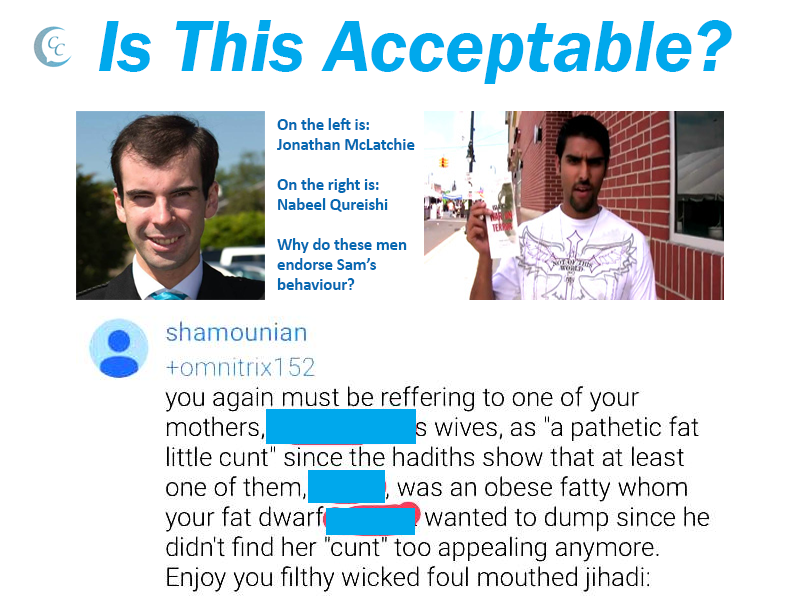
Tonight I find myself disappointed in the Christian inter-faith community. In my possession is an image of a comment on YouTube by Sam Shamoun. When we speak of good, moral people, we expect them to behave in a certain manner. It is strange to me, that people like Nabeel Qureishi and Jonathan McLatchie endorse and continue to promote Sam as not only a Christian teacher, but as a friend and someone to support. It says a lot about their characters that they consider a man who behaves in such a manner to be someone they endorse and support. That they hold this man on a pedestal, when he behaves and speaks like a thug. Curses more than a drunken sailor. I really need to ask if this is Christian behaviour, if this is the work of the Holy Spirit guiding Sam. It is absolutely a shame that people like Nabeel and Jonathan endorse Sam as someone to learn from and that they endorse his behaviour. We need to ask, where have Jonathan and Nabeel ever condemned Sam’s behaviour, rebuked him for unChristian-like speech, corrected him for his thuggish behaviour? The answer is nowhere, because to them, this is the example of a good Christian, that Sam is a good representation of what Christianity can do to a person. This, is sad.

Note: The image has been censored because of the extreme obscenities and vulgar language used. Curses to the Prophet (salallaahu ‘alayhi wa salam) have been censored, but the language has been left to bear witness of Sam’s character.

cc-2016-ss-samcntimage-clicktoreveal

If clicking the image does not open it, click this link to see the Facebook post about it.

Yes, he was arguing with someone and they traded insults. However, as an adult, as a faith leader, he should know to behave in a manner befitting his Christian faith. Is Christ not the one who said to turn the other cheek? Or was he the one who said to behave in an uncouth and obscene manner? I do not hold Sam to be a representative of the Christian faith and I am concerned that people, especially the two mentioned above continue to hold him as such.

and God knows best.

The Problems of John 3:16

For God so loved the world that he gave his one and only Son, that whoever believes in him shall not perish but have eternal life. – John 3:16 (NIV)

This is perhaps one of Christianity’s most referenced verses from the Bible. It’s so popular that even many non-Christians can recite this passage from memory without error. However, as oft-repeated as this passage is, it’s quite difficult to ignore the glaring issues it raises in regards to the theological beliefs of mainstream Christianity.

Subordinationism

This is an ancient Christological heresy which entails the Son and the Spirit being subordinate in nature and being to the Father. Many Christians today would argue that this passage does not reflect subordinationism, because it refers to functional subordinationism and purpose, not to nature and being. However, it should be noted that if God is all-powerful, and if the three persons of the Godhead are equally God, then the excuse of purpose is thrown out the window. At this point, it would mean that one of the three persons has inherently, more authority than the others and thus this directly refers to the nature and being of God. As such, the strawman argument of purpose is a purposeful distraction from this core Christological problem.

Love

It is quite strange to see the act of murder as an act born out of love. In this scenario, God who has in the past forgiven sins without need for sacrifice and due to prayer, somehow necessitates the death of an innocent man to forgive the sins of His own creation. The salvation doctrine here is not consistent:

May my prayer be set before you like incense; may the lifting up of my hands be like the evening sacrifice. – Psalm 141:2.

Return, Israel, to the Lord your God. Your sins have been your downfall! Take words with you and return to the Lord. Say to him: “Forgive all our sins and receive us graciously, that we may offer the fruit of our lips.” – Hosea 14:1-2.

if my people, who are called by my name, will humble themselves and pray and seek my face and turn from their wicked ways, then I will hear from heaven, and I will forgive their sin and will heal their land. – 2 Chronicles 7:14.

The Lord detests the sacrifice of the wicked, but the prayer of the upright pleases him. – Proverbs 15:8.

A Christian may argue that sin requires justice, which necessitates punishment. However this argument is invalid on several fronts. To begin with, it has already been established that in lieu of sacrifices, God forgives sins through prayer as documented above. Secondly, God is the one who has ultimately been sinned against and it is His prerogative to determine what justifies the forgiveness of sin, in this and many other cases this is manifested in the form of repentance and prayer. As humans, we do not get to decide what justifies our forgiveness, in the same way that we do not get to decide what is moral and immoral. In all of these decisions, God has the ultimate say. In light of this, it seems as though in attempting to claim that Christ must die for sins, as most Christians argue, then they are not arguing from a position of love but one of circumstance. Many would argue that Christ was the only sinless man and as such, he was the perfect sacrifice (this is foregoing the false belief that the Passover Lamb sacrifice was meant to forgive all sins – it wasn’t). However, it should be noted that if he was the only sinless man, then the only reason he was sacrificed (I prefer the term murder), was out of necessity, he was the only one at that time that fulfilled that role. We must also ask, if Christ is God and he truly did love the world, why did he have to be sent? Why not come of his own volition? As such, love is truly not in the equation.

God Apart From Christ

One of the more interesting occurrences in this passage is the positioning of Christ in relation to God.

For God so loved the world that he gave his one and only Son.

Christ is spoken of as being apart from God. It’s God who does the sending. However, if Christ is God, why doesn’t the passage read as:

For God so loved the world that he gave himself.

Why is the personhood of Christ and that of God, spoken as if they were two distinct beings? It is God that loves the world, not Christ. It is God that sends Christ, not Christ who sends himself. This structure clearly indicates that Christ is not only distinct from God, but that they are two beings wherein one is subordinate to the other. In other words, this passage fundamentally demonstrates the incoherent beliefs of Christianity. Many Christians gladly repeat this slogan as a representation of their core beliefs, but very few of them have ever put a pittance of time into considering the theological challenges that this passage presents. It also needs to be asked, why doesn’t the passage read as follows:

For Christ so loved the world that he gave himself.

The proper reading represents Christ as the object of the sentence and not the subject. As such, it demonstrates a case where God is apart from Christ and Christ is apart from God. Such phraseology is prominent throughout the Johannine Gospel, we find another case here:

Now this is eternal life: that they know you, the only true God, and Jesus Christ, whom you have sent. – John 17:3 (NIV)

Again, Christ is represented and spoken of as being apart from God. There is only One True God, and on the other hand there is Christ. In fact, the passage is better read as:

Now this is eternal life: that they know you, the only true God, and Jesus the Messiah.

In this more accurate reading, there are two subjects, God, and then Jesus who is the Messiah. The Messiah qualifies who Jesus is, in this case – not God. Therefore, the language used both in John 3:16 and John 17:3 are not reflective of modern Christian beliefs, but rather illustrate the very distinction between the Jesus the Messiah and His Master, God.

Conclusion

Given the popularity of John 3:16, and its lack of study by Christians, I encourage Muslims to use this verse as a point from which we can encourage Christians to examine their beliefs critically. If you’re a Christian and you are now being made aware of the problems of this passage, then I encourage you to discuss them with a Church Elder or a learned Christian, followed by conversation with a Muslim. Understanding this verse and its consequences will drastically reshape a Christian’s theology and for Muslims, it will at the least, help us understand the crisis of faith that most Christians experience when they actively begin to read the Bible.

and Allah knows best.

Jonathan McLatchie Flops in South Africa

cc-2016-jm-meme

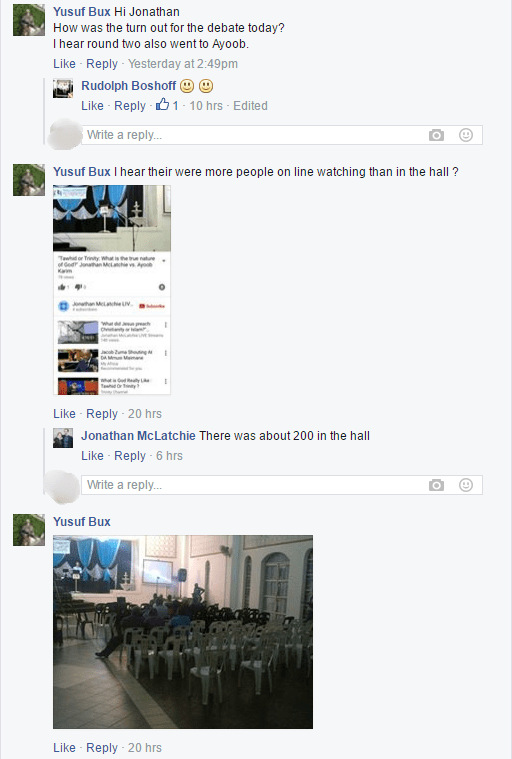
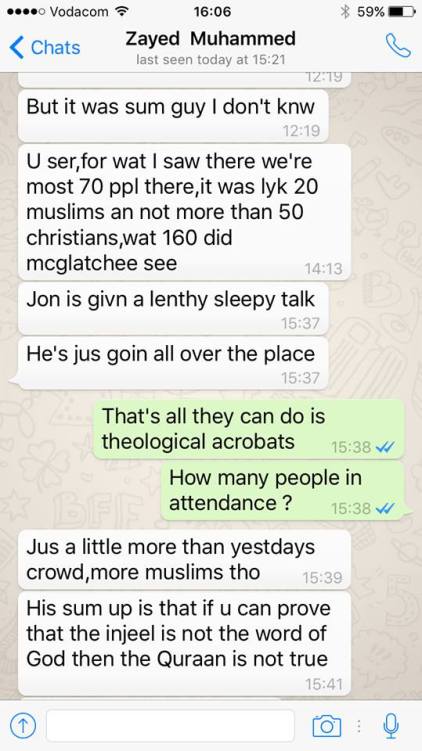
Embarrassing. This is the term being used by Christians in response to erratic, untruthful and dishonest claims made by Jonathan McLatchie about his South African events. Despite having the support of his close friend and teacher Sam Shamoun, Jonathan’s events in South Africa have had appallingly small crowds (?) attending those events. One South African speaker, Br. Yusuf Bux, decided to question Jonathan about the size of attendance at his events:

cc-2016-jm-sadebate1

Jonathan replied with a large figure, 200 people! However, Br. Yusuf Bux responded with a picture that clearly showed roughly 20 people in attendance or less. In questioning Jonathan’s integrity, Br. Yusuf Bux replied as follows:

cc-2016-jm-sadebate2

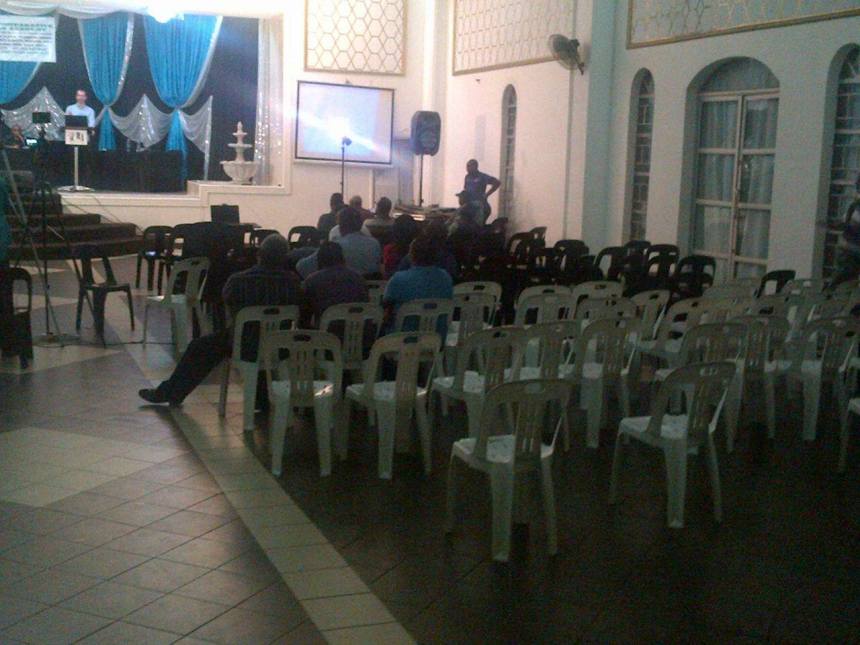
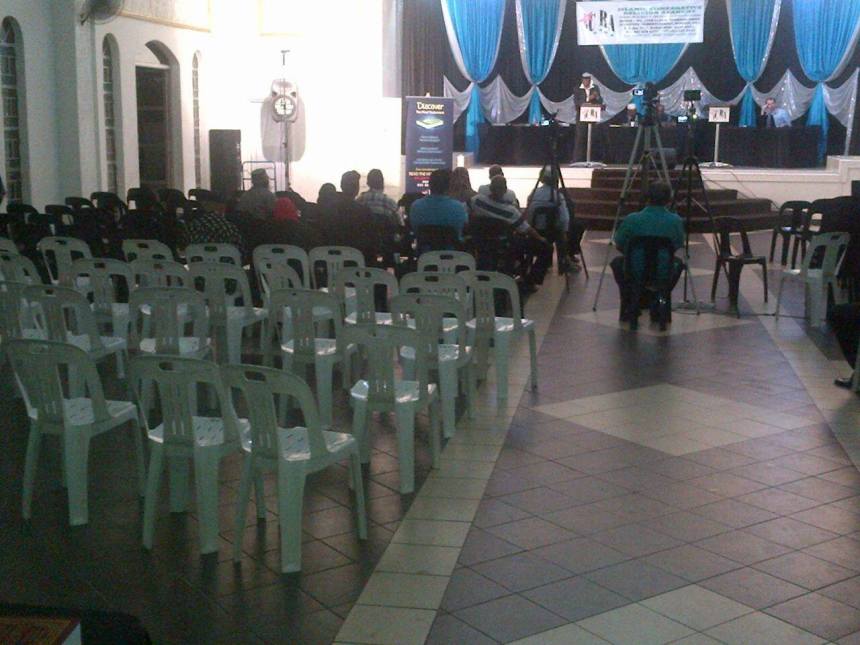
Jonathan insisted that the photos were taken at a bad time, however these are photos from two different debates, both showing less than 100 people at either event. Instead of responding with photographic evidence to the contrary, Jonathan insisted that “someone did a headcount”. Unfortunately for Jonathan, the pictures were taken by attendees who confirmed that such numbers from Jonathan are not only imagined, Jonathan was simply lying. Another person who attended the event also replied and confirmed that Jonathan’s numbers were simply made up:

cc-2016-jm-sadebate5

According to the above eyewitness, the testimonies of both Christians and Muslims, and the photographs of the events, Jonathan is simply making up attendance numbers at will. In fact, Br. Yusuf Ismail has mentioned that there were 40 people at the first event and 70 at the second. No where near the large figures that Jonathan claimed:

cc-2016-jm-sadebate6

Not only have the events themselves failed to draw in any crowds, attendees from both Islamic and Christian backgrounds have complained that Jonathan’s arguments were not only poor, but he was significantly repetitive, leading to crowds leaving while he was speaking. As seen in this photo below, the room is practically empty while Jonathan is speaking:

cc-2016-jm-sadebate3

cc-2016-jm-sadebate7

In another event, there are 4-5 more people, but the seats are simply empty while Jonathan is speaking:

cc-2016-jm-sadebate4

There’s no need to make up numbers Jonathan, the pictures speak for themselves. If anyone would like to submit further pictures of the crowds, send us an email or post them to our Facebook Page.

and Allah knows best.
 

Missionary Mishap: Easter Violence

There are many nominal and cultural Christians that have adopted ancient Pagan practises into their faith. Many Christian groups in recent years have begun to expunge these Pagan practises from their faith, one website for Christians states:

The name “Easter” has its roots in ancient polytheistic religions (paganism). On this, all scholars agree. This name is never used in the original Scriptures, nor is it ever associated biblically with the death and resurrection of Jesus Christ. For these reasons, we prefer to use the term “Resurrection Sunday” rather than “Easter” when referring to the annual Christian remembrance of Christ’s resurrection. – Christian Answers.

Some Christians however, see these adopted Pagan practises as sacrosanct, involiable, an essential part of the Christian tradition. This had unfortunately led to some violence in Tennessee where one outspoken group of Christian protesters were violently attacked.

cc-2016-mm-attackedforeaster1

Their sign was also torn apart in the incident:

cc-2016-mm-attackedforeaster2

This was the sign before it was torn, there was also an Easter Bunny on a crucifix:

cc-2016-mm-attackedforeaster3

We applaud the efforts and risks that some Christians take when attempting to reform their faith and to remove its Pagan practises. We continue to pray that God guides these Christians to the truth, one step at a time, and that He protects them from harm and violence.

and God knows best.

Book Review: Jesus, the Fake Jihadis & Evangelical Christians

Last month I had intended to publish my review of this book, and sadly got delayed. Fortunately, I’ve had the opportunity to mull over Jesus, the Fake Jihadis and Evangelical Christians for sometime and now I’m able to give my thoughts about it. The title is certainly a mouthful, and quite an unusual combination of terms. The question that immediately stands out is what does Jesus have to do with Fake Jihadis and Evangelical Christians? I surmised from the title alone that this work was going to pique my interest and it surely has. At best, I can describe this work as a treatise on Christians and their demonizing of Islam. At its worst, I can describe it as a title that touches on a variety of topics ranging from Jihad, Christian scholarship, Christian claims about Islam to Christian polemical arguments.

jesus jihadis

The book’s focus is responding to two evangelical Christians’ comments about Islam on a recent radio programme highlighting the publication of their book about terrorism and Islam, namely Craig Evans’ and Jeremiah Johnston’s Jesus and the Jihadis: Confronting the Rage of ISIS: The Theology Driving the Ideology. Comprising of nine (9) main chapters, the title tackles a variety of topics in a very accessible manner. There are no prerequisites needed to understand the topics that the book engages with and that certainly is welcomed. This allows for a reader of any level to simply pick up the book and understand the messages it conveys. There is a notable lack of academic pretentiousness, there is no use of overcomplicated technical terms that usually bore or confuse the reader. While the author certainly engages with technical topics, his tone and style is presented matter-of-factly.

There is an overwhelming sense of regret on behalf of the author, as he repeatedly mourns his loss of respect for noted Christian academic, Dr. Craig Evans. Frequently mentioned throughout the book, the author espouses a once great respect for the Historical Jesus Specialist while declaring his disappointment with Dr. Evans’ inconsistent treatment of Islam in light of his notable academic achievements:

It is disappointing to see a noted scholar behaving in an unscholarly manner, trading scholarship for fairly low-level polemics.

This is a recurring theme throughout the book. Time and again, the author, Muhammad Asad, asks a very simple question. Why does Evans seem to disregard his scholarly training when he writes or speaks about Islam? It’s almost as if he threw caution to the wind and decidedly chose to engage with Islam as a polemicist, not as a scholar. Any modicum of scholastic methodology, analysis and research is simply absent from the asinine statements as spewed by Evans. Perhaps what is worse, is that Evans seems to have accepted the claims made by the co-author, without having fact checked or researched his statements. The author, Muhammad Asad deals with these statements in an in-depth manner that is certainly well appreciated.

By quoting and including timestamps of the radio progamme, the author responds claim by claim in an orderly and respectful fashion. What surprised me the most is the number of scholastic citations referenced in the book. There is not a single page that lacks at least one citation or quotation. I only noticed this after spending some time re-reading select chapters, most notably the last two. Having been surrounded by academic material for sometime, I was certainly pleased to view the title as a reference work. The reader is provided with dozens upon dozens of citations, from a wide array of scholastic works that would keep a keen reader busy for at least a decade of study. This is the point when I recognized the immense value of this title, and it dawned upon me then, that the author and Evans seemed to have switched roles. A relatively unknown author uses post-graduate level scholastic methodology, research and analysis, while Dr. Evans seems to have utilized no academic guidelines at all. The student, had become the master.

In trying to answer the question of what does Jesus have to do with Fake Jihadis and Evangelical Christians, the answer is quite straightforward. The author attempts to demonstrate the inanity of Evans’ and Johnston’s claims that true Islam is embodied by ISIS. In further qualification of his points, he compares Christian teachings, and Christianity’s handling of Jews and Christian eschatology. He notes that ISIS’ brand of theological extremism is not only mirrored in Christian eschatology, but has been and continues to form core beliefs of Christianity. Many readers would find Martin Luther’s comments about Jews to not only be wholly anti-Semitic, but clearly criminal. There is no doubt that had Martin Luther been writing and uttering such statements today, he’d be labelled a racist and charged for hate speech. Yet, despite Luther’s teachings and their influence on modern Christianity, Evans and Johnston turn a blind eye and through what can only be described as cognitive dissonance, demonize Islam for significantly more civil and accommodating rhetoric in that regard.

The final chapter of the book rebuts the Orientalist claim of Islam’s borrowing from ancient traditional Judaeo-Christian and Gnostic-Christian sources for use in the Qur’an. I spent some time reading and re-reading this chapter as the author does not deal with each claim in the same manner. It can clearly be seen that the author examined each claim pensively with almost each claim being rebuffed under differing reasons, while using a consistent and cohesive methodology. He simply does not blanket all claims of borrowing as false. Rather, the author examines the claims in light of literary dependency, anachronisms, exegesis and hermeneutics. This is perhaps where his skill shines, he takes a serious and sometimes difficult topic and with what can be described as a fluent display of intellectual achievement, completely rebuts these insular claims en toto.

In roughly 120 pages, the author manages to combine key elements from Shaykh Muhammad al Yaqoubi’s Refuting ISIS, and Imam Zia Sheikh’s Islam: Silencing the Critics, with that of EP Sanders’ The Historical Figure of Jesus. The question then needs to be asked, should one borrow, purchase or discard this book? For me, although it’s only available on Amazon Kindle (US, UK), if I had the opportunity to own a hardcover edition of the work, I’d certainly purchase it. I consider it necessary reading, as more and more evangelical Christians attempt to use the Middle East’s political troubles to malign the immensely rich and diverse traditions of Islam; this work is perhaps one that would enable Muslims to stem the tide against the misuse and abuse of Islamic teachings by two opposing groups, that of radical Christians and extremist Muslims, who in the end, seem to share more in common regarding their teachings than one would have assumed.

and God knows best.


« Older Entries Recent Entries »