Category Archives: Other Speakers

Sam Shamoun and Lying by Dr. Shabir Ally – Part 2

Shabir Ally

October 1, 2015

Now that I am back in Toronto, and have access to my books, I am able to write a more telling response to Sam and his accusation about lying. I also had a chance to review the recording of what I said during the debate, and Sam’s interaction with me during the Q&A.[1]

Two things (at least) will become evident below:

  • I correctly cited that book of Robert Gundry to which I was referring;[2]
  • In order to generate his proof that I misquoted Robert Gundry, Sam actually misquoted me!

This is a sad day for Muslim-Christian dialogue.

Having listened to the recording, I still have the question that I had put to Sam during that conversation. Sam had said that he had two books right in front of him: one book is Robert Gundry’s commentary on the New Testament; the other book is Gundry’s commentary on Matthew’s gospel in particular. Sam read a portion from the commentary on the New Testament which obviously includes a brief commentary on Matthew’s gospel.[3] That is not the book I had cited. I had studied and cited the other book: the commentary on Matthew’s gospel in particular.

So, I asked Sam for the page number of the relevant section of the commentary on Matthew’s gospel in particular. Instead of supplying this simple piece of information, Sam kept telling me pages 135-36 of the book which he had read from. I asked him why he could not simply tell me the page number of the relevant section of Robert Gundry’s commentary on Matthew’s gospel which he said he also had in his possession at the time. Sam admitted that the page numbers he was giving me were from Gundry’s commentary on the entire New Testament, But when I asked him again for the page number of the commentary dedicated to Matthew’s gospel, there was a definite silence. I thought he had hung up. But he was still on the call. Why the silence?

Moreover, in listening to the recording I realized all the more how bizarre was the conversation between me and Sam. I kept asking him for the page number of a book which he claimed to have with him. In response, he kept challenging me to read a book which I did not claim to have in my possession at the moment. Naturally, I could not read a book I did not have in my hands; I could only accurately quote the most relevant line from my head. But, for some reason, Sam was unable to give me the page number of the book he had in his hands even though the relevant page number is easy to find. The commentary progresses from the start to the end of Matthew’s gospel, and the page headers show the progression verse by verse. It would have been a snap for Sam to thumb through the commentary following the page headers to chapter 28 and then to its verse 19 and give me the page number.

Obviously, he later located the relevant page number of a commentary on Matthew’s Gospel, this being the first book Sam referred to in his article composed on that same date.[4] It would be interesting to trace the relationship between this commentary and the one I was citing. It seems that the one Sam is referring to is the second edition of the same book, now with a different subtitle.[5] The page numbers of the relevant sections are the same, and the wording is strikingly similar, though the subtitles are different.

Now, the book I was citing really said on p. 596 what I cited it to say. So too does the second edition, as is evident from Sam’s citation in his article. But both of these are dissimilar to the book which Sam was reading on air.

To understand what is going on here between me and Sam, one has to see the big picture, as follows. In debates between Muslims and Christians, Muslims argue that in the Old Testament Yahweh is the only God. Jews agree. Many Christians also agree. Consequently, for Jesus to be God, he would have to be Yahweh. But if he is Yahweh, then he is the only God, and therefore the Father and the Holy Spirit would not be God.

In response to this clear logic, some Christians cite Matthew 28:19 as proof that the Father, Son, and Holy Spirit are each Yahweh, and yet altogether Yahweh. In that verse, Jesus directs his followers to baptize in the name of the Father, the Son, and the Holy Spirit. Christians point out that the name here is singular, though the named persons are three. Hence they insist that Jesus is Yahweh, the Holy Spirit is Yahweh, the Father is Yahweh; yet altogether the three are Yahweh.

This is the big picture, the context within which I am using the citation from Robert Gundry. I am saying that according to Robert Gundry the verse does not imply that the three persons bear the same name. According to him, the verse is not actually referring to their name; rather, the verse is saying that the baptism should be done with fundamental reference to the Father, Son, and Holy Spirit. Here is an approximate transcript of what I said, as evidenced by the video recording:

In Matthew’s gospel towards the end where Jesus says, “Go and baptize in the name of the Father, Son, and Holy Spirit,” some will take that as an expression of Trinitarian doctrine. But in fact, as Robert Gundry says in his commentary on Matthew’s Gospel, it does not actually mean that—it does not mean that the three of them have just one name—it means, ‘Go and baptize with fundamental reference to the Father, Son and Holy Spirit.’ It does not mean that the three are one. In fact, there is no passage in the New Testament gospels or in any of the writings of the New Testament that says that the three—the Father Son, and Holy Spirit—are together as one God.[6]

This is what Sam needs to address. Instead, he changes the subject to me. But attacking me will not remove the problem. The problem, as the clear logic above indicates, is that there is only one God Yahweh, as Jews, Christians and Muslims agree.[7] According to Matthew 12:18, Jesus is the servant of Yahweh. This too Muslims and even Christians accept. But Christians insist that, in addition to being the servant of Yahweh, Jesus is also Yahweh himself. I have been refuting this latter claim with my clear logic. And now Sam wants to attack me. But my logic is not exclusively mine. Logic is universal. To get rid of this problem, Sam does not need to attack me, he needs to battle with the fundamental laws of nature, or the designing work of God who fashioned us to think logically. He needs to battle with his own thoughts which cannot escape the same logic.

When Sam called, he accused me of claiming that Robert Gundry in his commentary on Matthew’s gospel denies that Mt. 28:19 is a Trinitarian text.[8] But that is not what I claimed.

In the above transcript of the relevant portion of my speech, I started out with my own statement, cited Gundry, and then ended with my own statement. I can see where at first glance it may not be clear to others where I intended to end my citation of Gundry. But if that was not clear at first, during the call I explained to Sam:

In that commentary, Robert Gundry says very plainly that the idea that the mention of Father, Son and Holy Spirit should mean that they share the same name—that is not the idea. He is saying that the idea there is that the baptism should be done with fundamental reference to the Father, Son and Holy Spirit. I am not saying anything more than this.[9]

Notice that last sentence: ‘I am not saying anything more than this.’ Now it should be clear that I am only claiming as follows: in a particular book, Gundry denies that Mt 28:19 implies that the three persons bear the same one name.

Despite my taking pains to clarify the point on air, however, Sam charges in his writing composed after the debate:

Ally basically claimed that Gundry denies that this text supports the Triune nature of God.[10]

That is not what I claimed.

I am not saying that Gundry is not a Trinitarian, or that he denies that Mt. 28:19 can be put to Trinitarian use, etc. It should be clear to all students of logic that a statement of the form,

‘A does not imply B’

does not mean the same as,

‘A implies that B is not the case,’

and it does not mean the same as,

‘I deny B.’

In what follows, I will replace B with ‘the Father, Son and Spirit share the same name.’

Logically, therefore, when I cite Gundry to say,

‘Mt. 28:19 does not imply that the Father, Son and Spirit share the same name,’

that is not the same as citing him to say,

‘Mt. 28:19 implies that the Father, Son and Spirit do not share the same name.’

And it does not mean the same as citing him to say,

‘I deny that the Father, Son and Spirit share the same name.’

It is really sad to see Sam misquoting me to prove his charge that I misquoted someone else. Sam does not like my message. But does that justify shooting the messenger? Dialogue between Muslims and Christians need to move beyond such tactics. We need to listen to each other, learn, and pray to God asking him to guide us all.

Finally, the book I was citing was published in 1982 for an academic level of readership. It caused a stir in evangelical circles leading to Gundry’s resignation from the Evangelical Theological Society. The book Sam read on air was published 28 years later in the year 2010 for a more common readership.

This latter work, from which Sam’s read to me on air, and which he cited second in his article, clearly supports Sam’s contention that Gundry believes that the three divine persons are included in ‘the name.’ I am grateful for this information. I did not know it until Sam pointed it out. And I am glad that I did not overstate my case in citing Gundry. However, if I do cite him again, on this matter, it will be appropriate for me to add that Gundry apparently changed his mind about this as is evident from his later writing. Why he apparently changed his mind would be interesting to learn. Is it that the two books were meant for two different audiences, in which case he was willing to tease the academic community but not the masses? Did the negative response to his earlier book cause him to be more cautious? Or, did he find new evidence to convince him that his earlier statement was incorrect?

In short,

  • I correctly cited Gundry’s earlier statement,
  • I am willing to incorporate his later statement in future citations, and
  • I am grateful to Sam for alerting me to this, but
  • I find it at least ironic that Sam would misrepresent me to prove that I misrepresented Gundry.

[1] The recording can be viewed here: https://www.youtube.com/watch?v=idHxegbSunQ&feature=youtu.be. Sam’s call comes in at 2 hours and 14 minutes into the recording. My thanks to Brother Nazam for pinpointing this location.

[2] Robert H. Gundry, Matthew: A Commentary on His Literary and Theological Art (Grand Rapids: Eerdmans, 1982) p. 596.

[3] Sam was referring to Gundry, “Matthew,” Commentary on the New Testament: Verse-by-Verse Explanations with a Literal Translation (Grand Rapids: Baker Academic 2010) pp. 135-136.

[4] http://www.reformedapologeticsministries.com/2015/09/catching-shabir-ally-red-handed.html?m=1

[5] Robert Gundry, Matthew: A Commentary on His Handbook for a Mixed Church Under Persecution, 2nd edition (Grand Rapids: Eerdmans, 1995).

[6] This begins at approximately 19:55 and lasts for about 40 minutes.

[7] Though Muslims call him by another name Allah, which is also in the Bible in Arabic translations. See Genesis 1:1.

[8] At 2:14 in the recording.

[9] At 2:16:40.

[10] http://www.reformedapologeticsministries.com/2015/09/catching-shabir-ally-red-handed.html?m=1

Sam Shamoun and Lying by Dr. Shabir Ally – Part 1

Shabir Ally

September 30, 2015

During my debate with David Wood on ABNSAT, Sam Shamoun called in to challenge one of my statements. According to my statement, Robert Gundry said that the formula in Matthew 28 does not imply that the three persons, Father, Son, and Holy Spirit share the same name. Rather, the formula means that baptism should be done with fundamental reference to the Father, Son and Holy Spirit. Sam claimed that Gundry wrote no such thing, and he had Gundry’s books to prove it. I pointed out that I was referring to another book by Gundry. But Sam was not convinced by my plea. Rather, he was convinced that I was lying. Hence he wrote to that effect here:

http://www.reformedapologeticsministries.com/2015/09/catching-shabir-ally-red-handed.html?m=1

In that document, Sam cites two books of Gundry, and links to a third, all to prove that Gundry did not voice the view I attributed to him.

However, in each case he is referring to a book other than the one I was referring to. As I am away from my hometown at the moment, I cannot check the reference at the moment, but here is something I found on my laptop that I had written elsewhere complete with a reference to the book I was referring to.

As for the apparent Trinitarian formula of Matthew 28:19, Robert H. Gundry writes that “Matthew seems to be responsible for the present formula.”[1]

As will be immediately clear, this is not the same as any of the three books Sam cited or referred to in his above linked article. It should also be clear that Gundry is saying that Matthew is responsible for the saying whereas we would expect Christians to think that Jesus actually said this.

Sam apparently assumed that the books he came across are the only books that Gundry wrote on the subject. Instead of hastily composing an article claiming that I was lying, he should have asked me for the reference to the specific book I was citing, and then check the reference in that book. As it turns out, people these days are too quick to assume the worst about other people but the best about themselves.

Even if it turns out that the book I was referring to does not contain the material I cited, does this necessitate a charge of lying? Or, could it be a case of citing from memory and recalling incorrectly as humans sometimes do?

During the debate itself, I cited many other books, some of which I had on the desk before me. These too I cited from memory, as is my usual style in debates. I do not claim that my memory is impeccable. However, in how many cases did Sam find a significant discrepancy between my citations and my named sources? If it is just this one, does that require such a serious charge? Is Sam here exhibiting the usual charitableness of Christians? If we go about slinging such uncharitable accusations against each other will that lead to better dialogue and mutual understanding?

When I get back to Toronto, I will check again to see if my memory serves me correctly, and thus that Gundry said what I cited him to say. Otherwise, I will issue a public retraction. But if what I cited is correct, will Sam retract his article and issue an apology for his false accusation?

Meanwhile, it is interesting to know that after Gundry published this critical commentary in 1982, some evangelical scholars called for his resignation from the Evangelical Theological Society. He resigned in 1983.

Does that sound like Gundry was saying in this book what Sam wants to hear?

[1] Robert H. Gundry, Matthew: A Commentary on His Literary and Theological Art (Grand Rapids: Eerdmans, 1982) p. 596.

Jonathan McLatchie: ‘Self-Professed Expert’ on Islam Gets the Basics Wrong

Following in the footsteps of now disgraced pseudo-academic (false credentials regarding the teachings of Islam – Alpha and Omega Ministry), Ergun Caner, Jonathan McLatchie is now advertising himself as an “expert on Islam”. According to an August 2nd post advertising his lecture in which he claimed that “France has a problem with Islam”, and that Islam and Muslims were “tantamount to inviting a virus into your civilization“, Jonathan is described as an “expert on Islam“:

cc-2015-jm-expert

“Expert on Islam”

In a private interview conducted with myself, meant for publication, I decided to ask Jonathan questions about Shari’ah law, given his previous xenophobic comments regarding Muslims and Islam. A portion (in chronological order) is given as follows:

cc-2015-jm-expert1

So how did the ‘expert on Islam’ do? Not so well….

According to Ahlus Sunnah wa’l Jama’ah, there are four sources of Islamic law:

  1. Qur’an
  2. Hadith
  3. ‘Ijma
  4. Qiyaas

Shari’ah law, also includes what the English would refer to as “common law” and “civil law” with deep considerations taken of ‘Urf (العرف) – cultural norms and values. Shari’ah law, also includes the corpus of laws a Muslim would adhere to in his daily life: how do I pray, what is the Shari’ah ruling on food cooked in the same pot as pork or ham, what does the Shari’ah say regarding fasting if I’m traveling, etc. So not only does this ‘expert on Islam’, not know the basics, he relegated it only to crime, politics and economics.

It was at this point I realised he did not know what he was talking about and I decided to ask him a very basic question regarding Shari’ah law. Immediately, he renounced his ‘expertise’, despite having advertised himself as such on Christian apologetics websites and on ABN/ Trinity TV’s shows last week. Jonathan was clearly caught off guard and quickly realised he needed to mitigate the situation, thereby relinquishing his claim to be an ‘expert’. This was a live interview, so he had no time to Google the answer, and he was live on Skype with me, I would have noticed if he was trying to Google search the answer to my question. So caught between a rock and a hard place, the ‘expert’ then, ‘not an expert’, who returned to being an ‘expert’ last week did indeed get the question wrong.

The Hadd laws, refer to very specific punishments within the Shari’ah. This would include stoning and cutting of the hands, which do require in and of themselves, very specific evidences for the punishment to be meted out (which is difficult to attain in most cases). These are not Ta’zir laws, which are discretionary judgments by an Islamic judge (qadhi). So the well advertised and self-proclaimed ‘expert’ on Islam needs to publicly correct himself. His rabid tirades against the Islamic Shari’ah, when he clearly does not understand it are very worrisome. He’s arguing and hating against something of which he has no idea about. Clearly then, when confronted with a difficult situation, he quickly discarded his ‘expert’ title and rightfully accepted his position as being theological unqualified about Islam.

I advise Jonathan, to fully discard the title, you sir are not an ‘expert on Islam’.

and God knows best.

Jonathan McLatchie Makes a Fundamental Error About the Bible

The Bible consists of many forms of revelation, including ‘literal inscriptions’ from ‘finger of God’ according to Exodus 31:18. Jonathan didn’t know this and as agreed by his friends, he did make an error. We do expect him to say that the video takes him “out of context”, so we do invite everyone to watch the video of his appearance on the Trinity Channel (YouTube) between minutes 44 to 52, for full context of his mistake.

cc-2015-jm-bibleerror

We’d like to thank Jonathan for sending his friends over to spam the page, at the very least we got a candid admission from one of his friends and admirers and he indeed was not taken “out of context”, this time, and that he did indeed make an error fundamental to the theology of his faith.

and God knows best.

A Response to a Review of a Review

After finding no one from the Christian community willing to perform a review of his debate with Dr. Shabir Ally, Jonathan McLatchie has finally taken the onus upon himself to “review” my review of their debate. It is unfortunate that Jonathan believes that I “misheard” or “misread” him, as this is a common excuse he uses when confronted with any criticism. Last month it was brought to the inter-faith community’s attention that Jonathan had described Muslim communities in France as a virus and a cancer to European society. If one were to compare his “review” of his debate, with the excuses used when confronted with his xenophobic statements, we’d quickly realise that Jonathan is being perpetually misunderstood by everyone. At first he claimed he never made such a statement, everyone had simply lied about him! Then, it was a statement he made, but everyone simply misunderstood him! Then, it was a statement he made, but it was not referring to Muslims but a cultural structure of extremism, everyone simply hadn’t given him enough time to explain himself! Then, he posts a video in which Muslims who practise Islam are compared to ISIS terrorists and we’re not supposed to be offended by that. The 19,000 people who viewed that article and the 3500 people that watched that video, all seem to have “misheard” and “misunderstood” him.

As one Christian apologist put it, “Jonathan is simply oblivious to any form of self criticism”. When I announced news that a Christian had accepted Islam following the debate between Dr. Shabir and Jonathan, Jonathan found it impossible that anyone would disagree with his remarks in that debate, such to the extent their faith would be questioned. I remarked to him at that point, that it doesn’t matter what you think of your own arguments, it is up to the audience to decide that. He disagreed, that just could not be a possibility, his remarks were without fault. Jonathan lives in a world, where everyone who disagrees with him, either perpetually misunderstands him, or they misread him, or they mishear him. It’s almost never the case that he has said something wrong, or that he has made a mistake, and this is exactly what we find in his “review” of my review. What sort of debater, reviews someone’s review? I mean, there’s the occasional post-debate rejoinder, but I’ve never seen anyone who considers themselves to be a professional, review their own debate. That’s what the community does, that’s not what the debaters themselves do. Jonathan though, does not like to be criticized, and so when my review criticized him, he could not contain himself.

Let’s take a brief look at some of his claims. He began with saying:

Ijaz briefly summarises Shabir’s opening statement, curiously omitting any mention of the numerous problems with Shabir’s Biblical argumentation (such as his misuse of Greek grammar in regards to John 1:1).

Yet, this is simply deceitful. I didn’t omit mention of Dr. Shabir’s use of Colwell’s rule, as stated in my review:

At this point, Dr. Shabir began to speak on the language used in regard to Jesus in the Gospel ascribed to John. John 1:1c is problematic as the attribution of total deity to the Word (later identified as Jesus), is uncertain due to Colwell’s rule. Grammarians do dispute about the definiteness of attributing deity to the Word in this verse due to the absence of a defining article which the original author purposely left out, this opened the wording and subsequent understanding of the verse to dispute. If the author wanted to ascribe total deity to the Word, then they would not have intentionally left out the defining article and thus, total deity cannot be ascribed to Jesus the Christ given the author’s grammatical intentions.

Let’s take a look at another one of his criticisms, he says:

The first point to note here is that I never stated that “the Bible is a wholly Trinitarian text”. It is my view that one can demonstrate a multiplicity of divine persons from both the Old and New Testaments, while the doctrine of the Trinity reaches its fullest expression in the New Testament where we read of the incarnation of the Son of God.

Yet, this is exactly what he said, I even quoted him and put the timestamp to the exact moment in the video in which he makes this very statement:

(timestamp in video, he says, “The Gospel of our Lord Jesus Christ is thoroughly Trinitarian.”)

If Jonathan believes that the words “thoroughly” and “wholly”, are different, then he must consult a dictionary. They mean the same thing. He should also note, that in my very review, I quoted him as saying, “thoroughly”, so on that basis, where exactly does he believe this was something he did not say? Strangely enough, he proceeded to argue that Dr. Shabir did not pre-empt his appeal to the Bible (read as “scripture”), but he did. One of Dr. Shabir’s most important points was “the texts of scripture”. So while Jonathan may disagree, it doesn’t make him right, to the contrary it makes him seem desperate to create points of imaginative disagreement. Perhaps, what is most puzzling of all, is Jonathan’s inability to see that he is deluding himself. Take for example this statement:

That’s not quite what I said. My first premise was that, from a Muslim perspective, “If Tawhid is true, it must be consistent with the Qur’an.” My second premise was that Tawhid is not consistent with the Qur’an.

What’s not quite what he said? At this point, he mentions that I presented his premises for this particular argument incorrectly, yet when we read what I wrote, I literally wrote, word for word, the exact same words that he used:

P1 – If Tawhid is true, it must be consistent.
P2 – Tawhid is not consistent.
C  – Therefore Tawhid must not be true.

The exact same words he uses to dispute what I wrote, are the exact same words I wrote. How then, is this “not quite what I said”? If this is not being deceitful, then what is? I find this to be desperation of the grossest order. Jonathan then made, what I consider to be one of the most absurd comments I have ever heard:

Yes, this is a Modus Tollens argument. I don’t know why Ijaz seems to think that the need to demonstrate the truth of the premises in order to support the conclusion is a problem with this manner of argumentation.

I don’t know if he understands how logic works, but one needs to qualify their premises before assuming the conclusion as being true. This is referred to as sequential logic. Your individual premises must be consistent, before your conclusion could be seen as true (or valid). My criticism, was that he did not qualify his premises, thus his conclusion was contrived. I do not understand how he can disagree that he needs to first prove his claims before arriving at a conclusion. This is common sense. He then went on to state:

The only problem is that I did not make this argument in my opening statement at all. I noted that Nabeel had made this argument in his debate with Shabir, and that I was going to be making a different argument instead.

What argument is he referring to? He’s referring to the argument that the Qur’an is the incarnate word of God. Yet, his disagreement here is unfounded and is again, something derived from the depths of his imagination. In my review, I did not claim that he made this argument, I specifically said that he referred to it:

All he did was refer (timestamp in video, he says “Those who saw Shabir’s debate with Nabeel Qureishi would’ve been exposed to the problems with reconciling the eternality of the Qur’an with the doctrine of Tawhid.”) to the argument that Nabeel used regarding the Qur’an being the eternal word of Allah, yet physical and created.

Perhaps he needs to check the definition of the word, “refer”, for this disagreement makes absolutely no sense to a reader with a command of simple vocabulary. Reading comprehension is not difficult and it should not be this difficult for Jonathan. He then spent an inordinate amount of time attempting to validate his bad argument that the Spirit (of God) is the same as Allah. Yet, he does not validate his bad argument, he merely repeats it without meaningfully responding to the criticism leveled against it. As the Qur’anic verse itself mentions, God the one true Creator, sent the Spirit as a messenger to Mary. The Spirit itself cannot create of its own volition, it is an agent of creation, in the same way the Angel of Death is an agent of the opposite of creation, death. According to Jonathan’s logic, if an agent of God does something by God’s will, this means that the agent is itself also divine. If we follow through with this logic, since the Angel of Death takes away life, does this also mean the Angel of Death in Christianity (the archangel in 1 Thess. 4:16) shares in the divinity of God? According to Jonathan it does, and hence his Trinity now includes a 4th person that shares in the divinity of the other three persons.

Interestingly, Jonathan provides a quote from a commentary that doesn’t address this response at all. The commentary does not mention anything about agency of power or authority, and so while I am thankful he has atleast tried to quote something, what he quoted was irrelevant and useless. His argument remains, really bad. As with the other recommendations in this article, I highly encourage him to learn about God’s ontology in Islam and in Christianity. An agent of God has no inherent power or ability, except by the will of God, in which those powers or abilities are temporal, and by such a definition they could never be in and of themselves, “divine” or of a “Godly” nature. Rather agents of God are temporal in their very attributes and as such, cannot and do not share in the divinity of God. Jonathan attempted to say he addressed this argument by presenting a verse which mentions the phrase, “My Spirit”. It was at this point I gave up any hope that Jonathan was being serious and I began to realise that his article was satirical in nature. I mean, it can’t be that he didn’t realise that the Qur’an uses, “Spirit” in different contexts right, and that not every reference to the Spirit refers to the Holy Spirit (Angel Gabriel), right? It can’t be that he merely saw the word “Spirit” and assumed it meant the same thing throughout the entire Qur’an, while being used in different contexts and forms. Yet, this is exactly what he did. I fully believe he searched an English translation for the word “Spirit” and assumed every instance of it referred to the Holy Spirit in Islam. Ergo, not only was his initial argument bad, so was his response and so was his depth of research and understanding of the Qur’an.

Jonathan proceeded to mention that he didn’t think one of his arguments was circular, he says:

There is no way in which the above argument can possibly be construed as circular. The Qur’an makes a prediction about what we should expect to find (namely, that the disciples believed Islamic doctrines such as Tawhid). I then set out to falsify this prediction, in my judgement successfully. Nothing circular about it.

Edit:

I incorrectly referred to this form of argumentation as circular because I viewed the first premise as entailing itself, “If Tawheed is inconsistent”, which is self-reliant and thus circular. In other words it entailed itself, despite being in the form of modus ponens. After discussing with our resident scholar, I (Br. Ijaz) am indeed wrong. Although the first premise is indeed invalid (it does not logically follow if Tawheed could be inconsistent, that the Trinity is true), and needs to be qualified, the form is valid, but the first premise needs to be proven. So the argument itself is invalid, but the form correct. Apologies to Jonathan for this error.

End of Edit.

He went on to say, concerning the dominance of the companions of Christ:

But the Qur’an does specify that Allah would “place those who follow [Jesus] above those who disbelieve up to the Day of Resurrection.” This strongly suggests a continuity of dominance, right from day one.

Where does it specify what form the dominance would take? It doesn’t. Which is what I mentioned in my review of the debate. Where does it specify in the Qur’an what form the dominance takes? He chose not to answer this question, even though claiming this is what he was doing, rather he chose to mention that some Tafseer commentators agreed with him. Perhaps he should mention that those commentators presuppose that belief, with first believing that Paul’s true teachings, like Christ’s, became corrupted by later Christians. I fully believe he did not do his research on this topic and at this point, he’s repeating himself without addressing my criticisms. Lastly, he said:

Ijaz offered no comment on the third argument I presented in the debate, namely that the Injeel (i.e. the gospel) is Trinitarian and that the Injeel is affirmed by the Qur’an.

I actually did offer a comment on it, from my review, I said:

If we were to identify his main arguments, they would be easily recognizable by anyone who is familiar with Islamic and Christian inter-faith discourse, namely that the Qur’an validates the New Testament, that the disciples believed Jesus was God and that the Bible is historically accurate. He did not present any new arguments, nor any new research, nor did he seek to upgrade any of the arguments he copied from other Christian debaters.

In conclusion, Jonathan’s review of my review, is a bad attempt at trying to defend his poor arguments used in his debate with Dr. Shabir. At the most, he merely repeated himself, and at the worst he claimed he was misheard. Unfortunately for him, I was able to quote him word for word, and cite numerous places from my review in which I did address the concerns outlined in this review of his. All in all, this comes down to a lack of professionalism. If the Christian community is unwilling to do a review of his debate, and he is left to respond personally to everyone who criticizes him, this says a lot about the community’s perception of his role as a Christian apologist.

and God knows best.

Jonathan McLatchie’s Xenophobic Views

A shocking video by Br. Yahya Snow has brought to light xenophobic comments by Christian apologist, Jonathan McLatchie.

While addressing a congregation at a Church, Jonathan can be heard describing Islam as a “problem” and Islamic communities as “cancers” in French society. This is quite disturbing and has certainly impacted the way Muslims viewed Jonathan during and after his debate with Dr. Shabir Ally. See Br. Paul’s post on it here, as well as a response from Jonathan here.

and God knows best.

Debate Event: What is God Like – Tawhid or Trinity? – Dr. Shabir and Jonathan McLatchie

Tonight features a follow up debate to Qadiani Nabeel Qureishi’s debate with the erudite, Dr. Shabir Ally, on the topic of Tawhid and the Trinity.

cc-2015-shabirdebatejonathan

See the Facebook Event’s page here. The event will be livestreamed on YouTube, via this link. At present, I intend to do a live review of the debate as it happens, as I did with the previous debate between Dr. Shabir and Nabeel.

and Allah knows best.

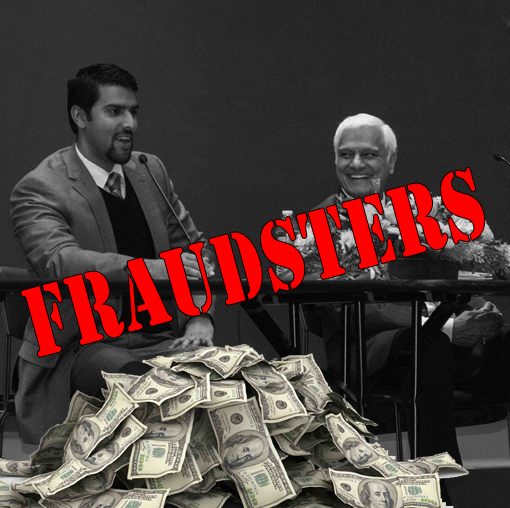
Fraud at Ravi Zachiarias International Ministries: Fake Qualifications Exposed

Ravi Zacharias of Ravi Zacharias International Ministries is being called upon by the public to respond to allegations of manufacturing his theological and academic qualifications. Touted as a “Dr” who is alleged to be a visiting scholar at Cambridge University, UK, Ravi Zacharias is facing claims of being a fraudster. Popular YouTuber FriendlyBanjo attempted to verify the academic qualifications of Mr. Zacharias and found them to be absolutely false. In a damning video, showing clear manipulation of academic credentials and falsifying biographical details, the inter-faith community is calling on Mr. Zacharias to tender his resignation, and return monies stolen under false pretenses. Mr. Zacharias is the founder of an international evangelical ministry which attempts to spread the “Gospel” worldwide, specifically targeting Atheists and Muslims. An acclaimed author and international speaker, Mr. Zacharias is now being labeled as an Ergun Caner 2.0, a complete and total fraudster who attempted to pass of honorary degrees as having been academically qualified.

cc-2015-rzimnabeel

Questions are now also being asked about monies collected under these false pretenses, which are said to have been used in the publication and promotion of the Qadiani Nabeel Qureishi’s latest publication, “Seeking Allah, Finding Jesus”. Written in a similar style to Ravi Zacharias’s biography, as well as funded and promoted by Ravi’s Ministry, many are now asking if Nabeel’s biography also contains similar embellishments as have now been indicated in his mentor’s manufactured biography. As pictured above, Nabeel closely works with Ravi and is featured heavily in RZIM’s Toronto tour on September 12th of this year. Many faithful believers assumed that Mr. Ravi’s theological and academic qualifications were accurate given his popularity in evangelical circles, today that assumption is causing many to regret donating thousands of dollars to a fraudster on par with internationally condemned Ergun Caner who also falsified academic and theological qualifications, as well as having been accused of manufacturing his biography in exchange for monies, academic positions and paid speaking engagements.

It remains to be seen whether or not these allegations will be clarified by Mr. Ravi Zacharias, or by those profiting from monies donated under false pretenses, such as Nabeel Qureishi. See the shocking video below:

and God knows best.

« Older Entries Recent Entries »