Author Archives: Ijaz Ahmad

Tom Holland’s Conversation Regarding the Birmingham Manuscripts

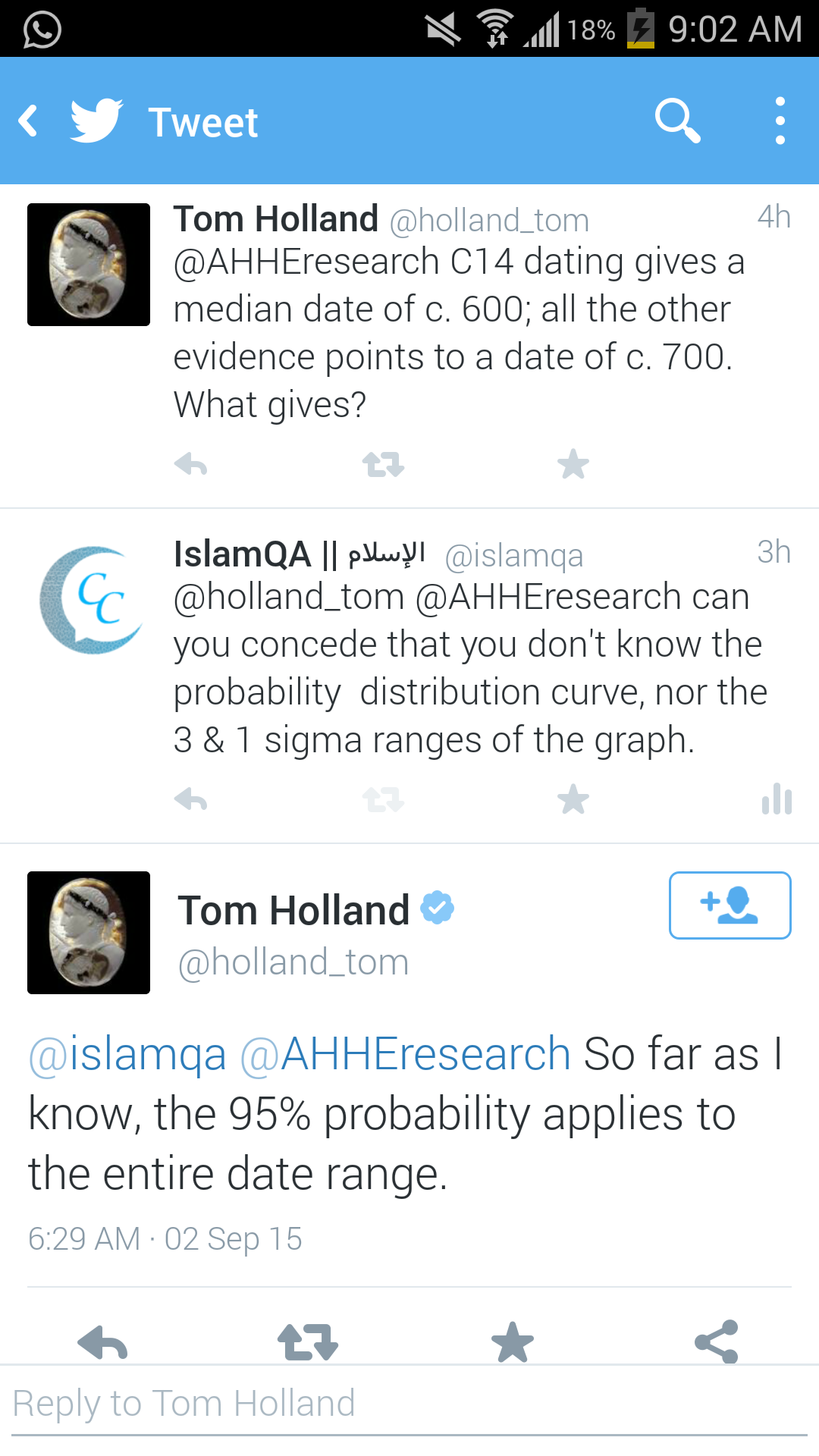
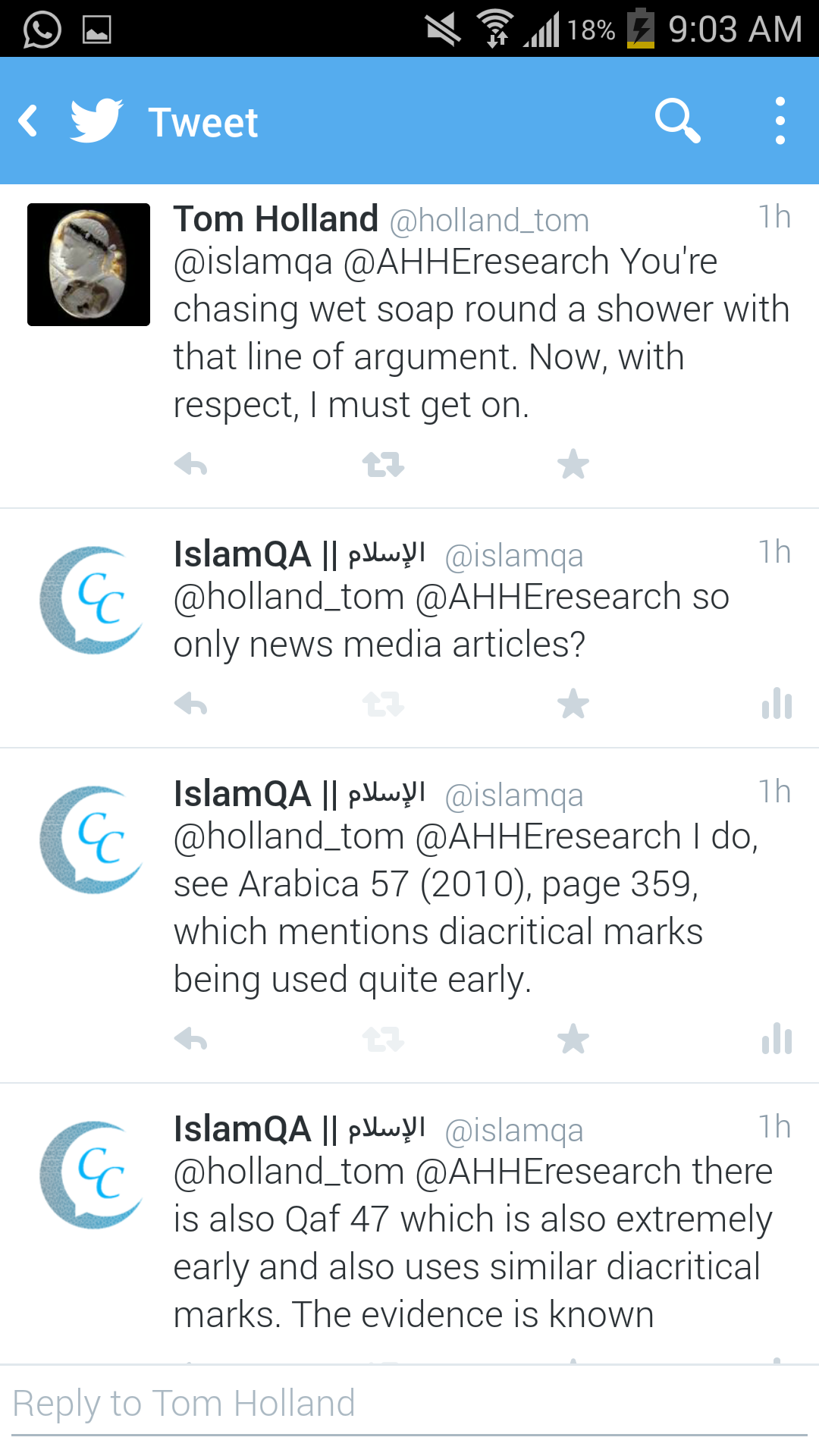
Most people are aware that Tom Holland is a historian, most people are also aware that he is not a palaeographer, nor a papyrologist, nor has he studied Arabic codicology. Therefore, finding him being referenced as an academic source regarding the Birmingham manuscripts was extremely strange. I decided to tweet Tom and get some answers. 

wpid-screenshot_2015-09-02-09-02-25.png

wpid-screenshot_2015-09-02-09-02-33.png

wpid-screenshot_2015-09-02-09-02-40.png

wpid-screenshot_2015-09-02-09-02-49.png

wpid-screenshot_2015-09-02-09-03-00.png

wpid-screenshot_2015-09-02-09-03-08.png

wpid-screenshot_2015-09-02-09-03-17.png

wpid-screenshot_2015-09-02-09-03-24.png

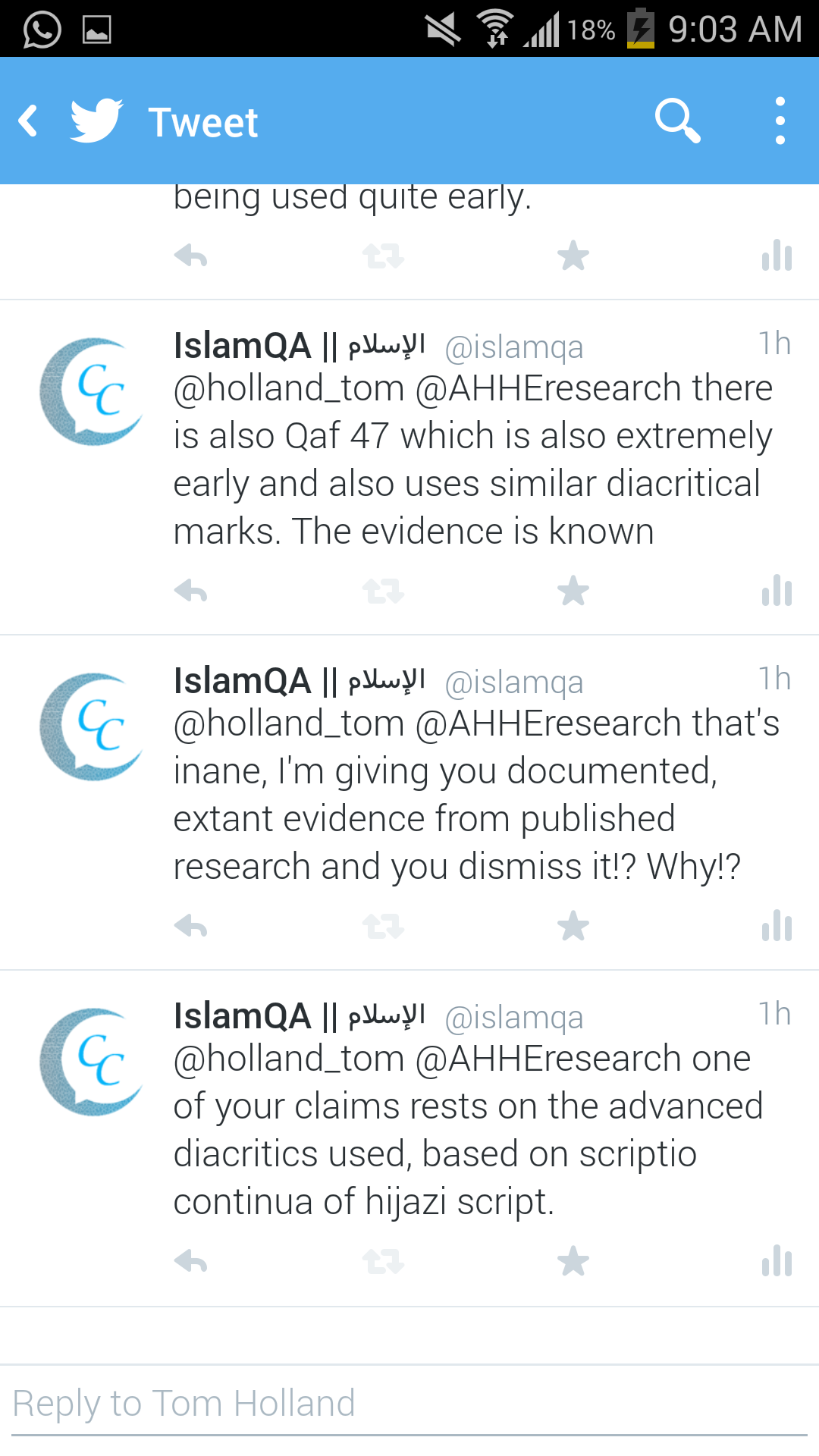
I recognize that some people may not be able to follow the conversation. So here is a simple run down of the conversation:

  • Have you seen the probability distribution curve with any of the sigma ranges? His answer was no, he was not aware of any graph. This is strange because you can only know how the date ranges work if you’ve seen the graph, if you haven’t, then where did he get his “analysis” from?
  • I asked, if he didn’t see the curve, how was he able to give an analysis. His answer was, “(based) on the information Birmingham University have publicly made available”. The problem here is that the only information regarding the dating that they have made publicly available is merely mentioning the date range, no scientific data regarding the analysis of the C14 was made public. In other words, he had no sources and did not consult any scientific data to arrive at his conclusion. I immediately pointed this out to him.
  • I then asked, if not based on actual C14 data, what did he base his analysis on? He proceeded to state, “even on the latest date, the script reflects a sophisticated scribal culture that does not accord with it”. To which I replied that we do have early manuscripts with diacritical markings.
  • He asked me for evidence of this, and so I gave him one citation and before I could proceed, he chose to end the conversation at that point in time.

So what have we learned? Tom Holland is not a specialist in this field. He did not consult any actual data to arrive at his publicly claimed conclusions. He is not aware of how manuscripts are carbon dated, nor is he aware of modern studies on Arabic palaeography and codicology. In other words, his opinion is akin to asking any random person off of the street to give their analysis of highly specialized scientific data.

Interestingly in July of this year, Tom actually held the opposite view, that the manuscripts validated the traditional teaching about its codification:

Tom Holland, the author of “In the Shadow of the Sword,” which charts the origins of Islam, said the discovery in Birmingham bolstered scholarly conclusions that the Quran attained something close to its final form during Muhammad’s lifetime. He said the fragments did not resolve the controversial questions of where, why and how the manuscript was compiled, or how its various suras, or chapters, came to be combined in a single volume. – NYT.

You can read the full conversation on Twitter, here. As we say in cricket, Tom, learn to bat in your own crease.

and God knows best.

Does the Qur’an Pre-date the Prophet?

Question:

Several news articles today have stated that the manuscripts of the Qur’an in Birmingham prove that the Qur’an is earlier than the Prophet. Is this true?

Answer:

The articles by both the Daily Mail and Raw Story were both sensationalized and neither presented any new information, nor were the people who were interviewed (Tom and Keith) privy to any new research by Dr. Alba Fedeli (the one whose research led to the discovery). There was a lot of behind the scenes controversy (due to his colleagues severely criticizing him, leading him to send a clarification email) about Keith’s statements, which were based off of a question raised by a popular Christian scholar of Qur’anic studies whose article in which this question was originally raised, was brought into severe disrepute by several colleagues of the Christian and Secular persuasions, which led to either the article’s removal by the scholar himself or by the publishing agency, which I will also not name. So the question itself is not new, and nor was it an original thought, nor was either the Daily Mail the primary source for the information. The information from the Daily Mail, citing Keith’s proposition was from a separate interview done for The Times, a UK paper.

Accordingly, the original interview is inaccessible as The Times seems to have put it behind a paywall, fortunately it was sent to a few people and we were able to read the article, as well as given details of the entire interview, specifically, what prompted Keith to make the statements he did. To quickly recap, these articles were not prompted by new research or by the original scholar who re-dated the manuscripts, nor was this question new, it was something raised a month or so ago by another Christian academic, the news is sensationalizing something which what was over a month ago, just a question raised by someone in an article which was later taken down after serious questions by the academic’s own colleagues. As for the claim in and of itself, it is quite absurd to say the very least. The question that prompted the original question to be asked was due to the authenticity of the date range of the carbon dating. The date of 568 CE, dates to some two years before the Prophet’s (peace be upon him) birth. The question raised, asks, “is it possible the manuscript was unused until 610 CE when the revelation is said to have begun?”

If it was unused, why? That’s the basis for the questioning! That’s it. Why was the manuscript unused for some decades? Well, the answer is quite simple, whoever owned it, or whichever series of owners possessed it, they had no need to use such an expensive, rare and ornate material until the advent of the Qur’an. At that time, the Arabs had no published literature, their most popular form of entertainment – poetry, was primarily oral and most of the population were illiterate. Quite simply, it’s like asking why a person would keep an old silver coin for several decades without using it – it could be due to value, sentiment, could have been in storage and unused, there are quite simply, too many reasons why the manuscript was not used until the owner found a suitable reason to use it. That’s it. Nothing more, nothing less. The news sensationalized something, based off of a non-issue, that no academic in this field of Arabic codicology, paleography or papyrology sees as holding any weight.

It should be noted that there have been previously bad and unreliable carbon datings that were later corrected by other labs, Dr. Deroche notes one such recent incident:

“This become especially clear when such measurements provide results which simply cannot be accepted. Two samples from the famous Sanaa palimpsest (Sanaa, DaM|Inv. 01-27.1) were recently dated with this method. According to the laboratory, one folio was produced between 543 and 643 AD whereas the other one was made between 433 and 599 AD. Later dates would be easier to explain by a contamination. Here the problem may lie with the conditions (arid or semi-arid climate) under which the cattle, the hides of which were later turned into parchment, was raised.” – Qur’an of the Umayyads, p. 13.

Those dates were found to later be wrong after several other labs did their own carbon datings, cementing the date range to be within the 7th century CE or 1st century hijri.

and God knows best.

Debate Review: What is God Like – Tawhid or Trinity? – Dr. Shabir & Jonathan McLatchie (Part 1)

At the outset, it’s best to say that if you saw Dr. Shabir’s debate with Nabeel on this topic and if you saw Jonathan’s debate with AbdurRaheem Green, also on this topic, then there was no real need for this debate. Most of what each speaker presented was contained within those two previous debates. There were no new arguments from either debater. Although touted as a dialogue, Jonathan’s approach was more debate minded, whereas Dr. Shabir was laid back and more or less relaxed in his use of technical arguments (compared to his demeanor and approach in his debate with Nabeel).

Dr. Shabir’s Introduction

He began by repeating the same three points he articulated in the debate with Nabeel.

  • T – for the text of scripture.
  • H – for history.
  • R – for reason.

Dr. Ally argued that according to the Bible, God declared that He was not a man and that only He should be worshiped. This God whose name we do not know with certainty, but whom we refer to as Yahweh due to combining the consonants of the tetragrammaton with the name of Adonai (Lord), cannot be Jesus as Jesus is a man. To further his point of allowing scripture to interpret scripture, he mentioned that there can only be one Yahweh and according to Isaiah 42, Yahweh sends his servant, this servant is identified as Jesus in Matthew 12. Thus, Jesus cannot be Yahweh as the Bible identifies him as the servant which Yahweh sends. He further argues that according to the Christology of the New Testament, Jesus is an intermediary of God who the Jews came to identify as an agent of creation. The language of the New Testament is also vague regarding Jesus’s station. He is constantly referred to as Lord, which is a term used to describe humans of varying stations. The term Lord in and of itself cannot deify someone.

At this point, Dr. Shabir began to speak on the language used in regard to Jesus in the Gospel ascribed to John. John 1:1c is problematic as the attribution of total deity to the Word (later identified as Jesus), is uncertain due to Colwell’s rule. Grammarians do dispute about the definiteness of attributing deity to the Word in this verse due to the absence of a defining article which the original author purposely left out, this opened the wording and subsequent understanding of the verse to dispute. If the author wanted to ascribe total deity to the Word, then they would not have intentionally left out the defining article and thus, total deity cannot be ascribed to Jesus the Christ given the author’s grammatical intentions. In John 20:17, Jesus allegedly states to Mary Magdelene that he was ascending to “my God” and “your God”, thus denying that he was God himself. We also see where during the time of Paul, he himself was also deified, as within his historical milieu he was considered Zeus and sacrifices were offered to him as attested in Acts 14.

Dr. Shabir focused more on the text of scripture, than the other two points of history and reason. I do believe that he should have reduced the amount of time he spoke on the Bible, as logically, once he established that the scripture was both historically unreliable and not reasonable, he would have negated the authority of the scripture itself. While his three pronged argument of THR is intelligent and concise, I do disagree with the acronym he chose and the order in which he articulated those points. He would have known that Jonathan would have heavily depended upon quoting the Bible as a proof for his beliefs, and I expected that he would have pre-empted this appeal to authority by demonstrating the use of the Bible as an authoritative source as useless. Thus, leaving Jonathan without any credible options of arguing in favour of the Trinity, as he would not have any other arguments in store but for appealing to the Bible. I used this approach myself in my debate with Chessie Edwards, who admitted after the debate that the rug was pulled from under him, and he could not articulate his belief in Jesus as a God, beyond appealing to the Bible.

The reason for doing this, is that once one allows a Christian to appeal to the Bible, the debate becomes focused on interpreting the Bible. Which would mean that the debate would be about whose interpretation was more correct and not many people will be convinced of a Muslim interpreting their scripture for them. I adopted this reasoning from Professor Burton Mack who argued that we should not allow an appeal to the New Testament to count as an authoritative argument. I highly suspect that Dr. Shabir chose to ease the burden of Jonathan, by sticking to basic, common, popular arguments which would be simple. The reason for this is twofold, primarily because he may have felt the debate of the same topic with Nabeel would have been too technical and thus alienated his core audience, and secondly, he may have wanted to take it easy on Jonathan given this was his first stage debate. Dr. Shabir is quite a kind person and he does not argue to win, but more to build relationships and to open the floor to dialogue and understanding. This isn’t a fault, but some may misconstrue his kindness as being lax with missionaries. My only other complaint would be that he did not spend much time speaking on Tawhid, while he did qualify the Trinity as a problematic belief, he did not dedicate enough time to offering the belief of Tawhid as a superior doctrine.

Jonathan’s Introduction

He began by defining what the doctrine of the Trinity was. This is something I strongly agree with, opening a debate by delimiting the scope of the discussion. As a proponent of socratic thinking, this was a pleasant and welcomed feature of his presentation. As previously mentioned, it was expected that Jonathan would base his arguments about the nature of God by mainly appealing to the Bible. He opened by declaring that the Bible was a wholly Trinitarian text (timestamp in video, he says, “The Gospel of our Lord Jesus Christ is thoroughly Trinitarian.”), which unfortunately for him, was pre-empted by Dr. Shabir who demonstrated it was not, thus Jonathan’s first argument was already weakened by Dr. Shabir. Jonathan then presented three other arguments which he felt negated the validity of the doctrine of Tawhid.

  • Tawhid has its own internal problems.
  • The disciples were Trinitarian.
  • The Injeel is Trinitarian.

Of his first argument, he stated:

P1 – If Tawhid is true, it must be consistent.
P2 – Tawhid is not consistent.
C  – Therefore Tawhid must not be true.

Technically, this (form of argument) is referred to as Modus Tollens. The problem here, is that you have to prove the premises before you can qualify and validate your conclusion which is expected to be a tautology. In attempting to do this, Jonathan disappointed me greatly. All he did was refer (timestamp in video, he says “Those who saw Shabir’s debate with Nabeel Qureishi would’ve been exposed to the problems with reconciling the eternality of the Qur’an with the doctrine of Tawhid.”) to the argument that Nabeel used regarding the Qur’an being the eternal word of Allah, yet physical and created. I was disappointed because this is an argument copied from Jay Smith, which Samuel Green tried to use on me in my debate with him, which Nabeel later picked up and tried to use against Dr. Shabir. The problem here is that Dr. Shabir already addressed this argument, and so have I. Jonathan merely repeated Nabeel’s poor argument. He did not try to revamp the argument, he did not add anything to the argument, he did not articulate it differently, he did not try to incorporate Dr. Shabir’s response to Nabeel into the argument. He quite literally just repeated the argument, which was already responded to. Naturally, I would expect, that if he did his homework and decided to use an argument which was already refuted, that he’d adjust the argument in some way. He didn’t do that. He presented nothing new. It was at that point I wondered why he even offered to debate the same topic if he was merely going to repeat the same points from the previous debate of the same topic by offering nothing new.

At this point, he presented another argument, namely that there are other creators other than Allah. He did not seem to understand that what he presented was the fallacy of false equivalency, wherein the Qur’an mentioned numerous times that there were agents of God who had abilities attained by the “leave/ permission of Allah”, which are temporal and not absolute. Logically, this would mean their abilities are not inherent and eternal, but appropriated by God, thus his argument was non-sequitur from the get go. I firmly believe that he did not critically consider this argument beyond a cursory copy and paste from Answering Islam’s website. Ironically, he attempted to present this argument in syllogistic form, but the argument was inherently non-sequitur due to its format including the fallacy of false equivalency. How he did not realise this, was impossible to understand, if he is using logic, he should know what fallacies are and how they inhibit his premises. What’s troubling is that in the same sentence he declares that Allah has no partners, then states in the same breath that the Holy Spirit shares in the divinity of God. That’s a contradiction, so either it is his argument and conclusions were wrong, or he forced a false conclusion which he himself did not notice.

His second argument was that the disciples of Jesus were Trinitarian. Interestingly, I had a debate on this topic earlier in the year and demonstrated that according to the proto-orthodox Christian tradition, the disciples were definitely not Trinitarian. At this point he introduced a very strange argument.

P1 – If the Disciples of Jesus were Trinitarian then the Islamic concept of God is false.
P2 – The Disciples of Christ were Trinitarian.
C   – Therefore the Islamic concept of God is false.

Jonathan cannot make such an argument and believe that he is arguing logically. This is known as the fallacy of circular reasoning. What is worse was his attempt at drawing out the logical routes. He presumed that Dr. Shabir could refute his argument in one of two ways, firstly that the disciples were later misled or secondly, that the disciples were overcome (by other groups). Jonathan posited that the second option was impossible as the Qur’an says they were victors. The problem therein with his reasoning is that the Qur’an does not say in what way they were victors. He assumes that it has to be in the promulgation of their beliefs, which the Qur’an does not state itself. It is alleged that the early Christians were persecuted and the religion did not become “accepted” until Constantine’s conversion. According to Jonathan’s appeal to the Qur’an, he alleged that the Qur’an mentioned the disciples of Christ were victorious. Yet the Church was not accepted or mainstream until 300 years after them, so in what way were the disciples victorious according to his reading of the Qur’an? It would then mean that his interpretation was wrong, given that victory was not achieved as he understood it to be during the time of the disciples and so the victory being referred to here is not what he is asserting. The victory may have very well been that they themselves held on to their true faith despite persecution and in this way they were victorious in the sight of God. I do not believe that Jonathan spent more than a minute thinking of this argument, for if he did so, he’d realise instantly that the disparity between his idea of the normative proto-orthodox Church’s “victory” and that of the disciples exceeded the bounds of the Qur’an’s teaching.

At this point, he began to appeal to the New Testament as a historical witness, but for those of you familiar with Dr. Shabir’s works and my own, we already know that the New Testament en toto is not historically viable nor accurate. I have explicitly explained this in great detail in my debate with Steven on the very topic of the beliefs of the disciples using palaeography, papyrology, form criticism, textual criticism and historical criticism. The following links should be sufficient to refute his appeal to the New Testament as a historical witness, especially in his appeal to the Patristics:

He began to close his argument by referring to hadith criticism’s use of the isnad or chain of transmission. Unfortunately, he merely referred to the use of the chain of transmission by Islamic scholarship, what he utterly failed to do was qualify the authority of these alleged chains of transmission by applying the methods of hadith criticism to the chains themselves. I myself did this in my debate with Steven, in fact this was one of the arguments I researched in great detail and whose historicity the early Church itself disputed. Thus, by both Christian historical traditions and the methodology of hadith criticism, the chains of transmission in regard to John used by Jonathan are known to have been falsified and are historically inaccurate. I do not believe that Jonathan spent more than a few minutes constructing this argument, nor do I believe he consulted any major works of Patristic criticism, especially due to the reason his sole academic source seemed to be Richard Bauckham, whom I also referenced in my debate. I do believe he rushed through this portion of his opening statement, and I do not believe he himself knew in any great detail the methodologies of hadith criticism, and so his appeal to this Christian isnad was mere buzz word dropping.

What can we take away from Jonathan’s presentation? We need to take into consideration that this was his first stage debate and this was a debate with Dr. Shabir of all people. With that in mind, his preparation was not up to standard and he seemed to rely on previously used arguments from Nabeel’s debate and his debate of the same topic with AbdurRaheem Green. If we were to identify his main arguments, they would be easily recognizable by anyone who is familiar with Islamic and Christian inter-faith discourse, namely that the Qur’an validates the New Testament, that the disciples believed Jesus was God and that the Bible is historically accurate. He did not present any new arguments, nor any new research, nor did he seek to upgrade any of the arguments he copied from other Christian debaters. Most of his presentation seemed to comprise of quickly assembled syllogistic arguments that were not critically assessed or put together with much thought and research behind them. He did not seem to put a lot of effort into his opening presentation, it almost seems rushed and half done, with most of his content directly sourced from his debate of the same topic with AbdurRaheem Green. I really wonder if he thought AbdurRaheem Green and Dr. Shabir were on the same level of study about the Christian religion. That is the impression he gave me. I strongly believe that he did not prepare his debate statement with Dr. Shabir’s education in mind.

One major difference between this debate and the one with AbdurRaheem Green was Jonathan’s comfort level. He certainly seemed uneasy and nervous, and at times he just appeared to be uncomfortable with addressing the crowd. His nerves may have gotten the better of him. Most notably, he rushed through his presentation, he spoke quite quickly and I fear that coupled with his accent, most of the audience would not have followed what he said. In contrast, Dr. Shabir almost seemed to be too relaxed and at times engaged with persons in the audience. As a Muslim though, I do not believe that Jonathan stuck to the topic. Although he began with defining the Trinity, he never really explained or spoke about the teachings of the Trinity, how they made sense, what the value of the Trinity was, why God would or could be a Trinity, how the Trinity was superior to Tawhid. Rather, what I got from Jonathan’s presentation is everything but the Trinity itself. His entire focus seemed to be on establishing that the Trinity was historically viable through the teachings of the Qur’an, and in doing so, he never dealt with the Trinity itself. I did not gain any new knowledge about the Trinity, I didn’t hear him speak on the reasoning of why God had to be a Trinity of persons or how it was possible for an immutable and impassible God to become a man and suffer. Jonathan just seemed to miss the mark spectacularly. As a Muslim, Jonathan’s opening simply did not present the Trinity to me and that is perhaps his greatest failure in this debate.

In Part 2, I’ll cover the Rebuttals.

and God knows best.

Jonathan McLatchie’s Xenophobic Views

A shocking video by Br. Yahya Snow has brought to light xenophobic comments by Christian apologist, Jonathan McLatchie.

While addressing a congregation at a Church, Jonathan can be heard describing Islam as a “problem” and Islamic communities as “cancers” in French society. This is quite disturbing and has certainly impacted the way Muslims viewed Jonathan during and after his debate with Dr. Shabir Ally. See Br. Paul’s post on it here, as well as a response from Jonathan here.

and God knows best.

Should We Address Missionaries Harshly?

Question:

Sometimes in your writings and your discussions you are very stern with missionaries. Is this an approach you advise Muslims to take when debating and discussing inter-faith topics with missionaries?

Answer:

This is not a good trait of my character. I do not advise that a Muslim should address anyone with harsh or stern speech and words. The Qur’an says:

Invite to the way of your Lord with wisdom and good instruction, and argue with them in a way that is best. Indeed, your Lord is most knowing of who has strayed from His way, and He is most knowing of who is [rightly] guided. – Qur’an 16:125.

Thus, Allah exhorts us to be mindful of the way in which we interact with those we disagree with. I have my shortcomings, and one of my many shortcomings is to use a harsh tone when annoyed. I invite the brothers and sisters who read this answer to make du’a that Allah cures me of this negative trait. God willing, all future articles on the website will not contain harsh tones, and I will tread very carefully with my words. I sincerely ask Allah’s forgiveness for any of the Muslims who may have imitated this behaviour of mines and I ask the forgiveness of those whom I have addressed in an unfair manner.

All visitors are welcomed to post a comment under our articles or to send us a message if you believe the tone of a post is out of bounds. As they say, be your brother’s keeper!

and Allah knows best.

Financier of Sam Shamoun Threatens a Terrorist Attack

A well known financier of Sam Shamoun, Anthony Rogers and David Wood, has made quite a startling threat to innocent civilians.

cc-2015-robertwellsterroristMany schizophrenics who are Christians and proclaim to hear voices in their heads, otherwise known to them as “God”, pose a very real and terrifying threat to human life. It is quite disturbing to see the extent to which this Christian has been radicalized. Speaking on Christians who claim to hear God speaking to them, psychologist Tanya Marie says:

“Most people reading the ancient scriptures understand these accounts of hearing God’s voice as miracles that really did happen but no longer take place today, or maybe as folkloric flourishes to ancient stories. Even Christians who believe that miracles can be an everyday affair can hesitate when someone tells them they heard God speak audibly. There’s an old joke: When you talk to God, we call it prayer, but when God talks to you, we call it schizophrenia.”

This is a very real threat, one recent example of a Christian hearing voices in her head, believing the voice to be God, almost murdered a man:

Police later found the driver of the car, Prionda Hill, at the Rally’s several blocks down the road from where she hit [motorcyclist Anthony] Oliveri. She told police “she was driving and out of no where God told her that he would take it from here and she let go of the wheel and let him take it.” She’s now facing several charges.

We call upon Sam Shamoun, Anthony Rogers and David Wood, to contact the authorities and help prevent a massacre in the name of Christianity, by a psychopath who claims he would absolutely kill everything that breathes if the voices in his head told him to do so.

and God knows best.

Debate Event: What is God Like – Tawhid or Trinity? – Dr. Shabir and Jonathan McLatchie

Tonight features a follow up debate to Qadiani Nabeel Qureishi’s debate with the erudite, Dr. Shabir Ally, on the topic of Tawhid and the Trinity.

cc-2015-shabirdebatejonathan

See the Facebook Event’s page here. The event will be livestreamed on YouTube, via this link. At present, I intend to do a live review of the debate as it happens, as I did with the previous debate between Dr. Shabir and Nabeel.

and Allah knows best.

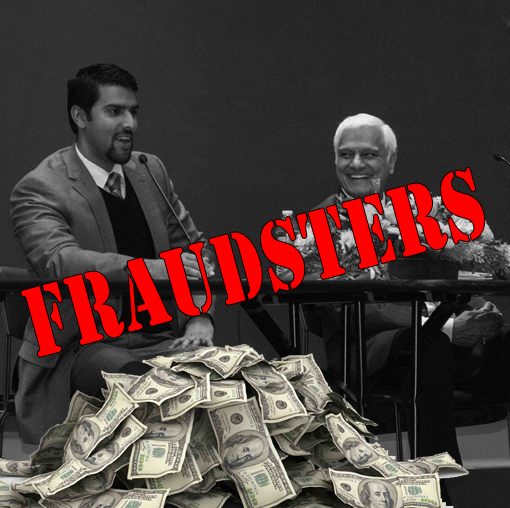
Fraud at Ravi Zachiarias International Ministries: Fake Qualifications Exposed

Ravi Zacharias of Ravi Zacharias International Ministries is being called upon by the public to respond to allegations of manufacturing his theological and academic qualifications. Touted as a “Dr” who is alleged to be a visiting scholar at Cambridge University, UK, Ravi Zacharias is facing claims of being a fraudster. Popular YouTuber FriendlyBanjo attempted to verify the academic qualifications of Mr. Zacharias and found them to be absolutely false. In a damning video, showing clear manipulation of academic credentials and falsifying biographical details, the inter-faith community is calling on Mr. Zacharias to tender his resignation, and return monies stolen under false pretenses. Mr. Zacharias is the founder of an international evangelical ministry which attempts to spread the “Gospel” worldwide, specifically targeting Atheists and Muslims. An acclaimed author and international speaker, Mr. Zacharias is now being labeled as an Ergun Caner 2.0, a complete and total fraudster who attempted to pass of honorary degrees as having been academically qualified.

cc-2015-rzimnabeel

Questions are now also being asked about monies collected under these false pretenses, which are said to have been used in the publication and promotion of the Qadiani Nabeel Qureishi’s latest publication, “Seeking Allah, Finding Jesus”. Written in a similar style to Ravi Zacharias’s biography, as well as funded and promoted by Ravi’s Ministry, many are now asking if Nabeel’s biography also contains similar embellishments as have now been indicated in his mentor’s manufactured biography. As pictured above, Nabeel closely works with Ravi and is featured heavily in RZIM’s Toronto tour on September 12th of this year. Many faithful believers assumed that Mr. Ravi’s theological and academic qualifications were accurate given his popularity in evangelical circles, today that assumption is causing many to regret donating thousands of dollars to a fraudster on par with internationally condemned Ergun Caner who also falsified academic and theological qualifications, as well as having been accused of manufacturing his biography in exchange for monies, academic positions and paid speaking engagements.

It remains to be seen whether or not these allegations will be clarified by Mr. Ravi Zacharias, or by those profiting from monies donated under false pretenses, such as Nabeel Qureishi. See the shocking video below:

and God knows best.

Should Christians Appeal to Jesus’s Human Nature to Explain God’s Ignorance or Fallibility?

Question:

When discussing whether Christ was God or a man with Christians, they often explain his “defects” as being due to his human nature. For example, they say if he was hungry, it was due to his human nature, or cursing the fig tree and praying to God, was due to his human nature. What would be your response to this?

Answer:

Assuming that this question refers to interactions with Trinitarian Christians, it is actually a heresy to explain Jesus’s actions exclusively in light of his human nature. In Trinitarianism, Jesus is considered to be both God and man, with his divine nature and his human nature being eternally united, otherwise known as the hypostatic union. In the centuries when the Trinitarian creed was being developed, a popular heresy which existed at that time was to separate these two natures. This was known as Nestorianism. Thus, the Nestorians believed that there were two natures, a divine and human but that they were not joined together in a union.

Trinitarians describe this union as Jesus being one person with two unified natures, sometimes referred to as “fully God and fully man”. Meaning, at all times, he – Christ, was both fully God and fully man. Let’s take the example of Jesus’s crucifixion. If we ask, did the all powerful God suffer, a Christian would say no, as a divine being cannot suffer. Only the human nature suffered. This is the heresy of Nestorianism. They are disuniting the natures, and isolating the human nature from the divine nature. We must remind these Trinitarians of their beliefs, if the human nature suffered, then the divine nature must also have suffered as these natures are eternally united. Modern Trinitarians often use the heresy of Nestorianism when defending the Trinity, without realising it.

Another popular example is Jesus praying. Many Trinitarians would claim that the human nature was praying. This is incorrect, both the divine and the human natures were praying to God, the human nature is eternally united with the divine, at no point can one nature be disunited from the other. When Jesus was hungry, the human nature hungered. This is what Trinitarians claim when we inquire of Jesus’s cursing of the fig tree. Yet, they are once again isolating one of the two natures. We must remind them, both the divine and the human nature hungered, these natures cannot be separated under any circumstances unless one is willing to declare themselves apostates from Trinitarianism and believers in the heresy of Nestorianism. As Dr. James White says in his book, The Forgotten Trinity:

“Instead, the doctrine is misunderstood as well as ignored. It is so misunderstood that a majority of Christians, when asked, give incorrect and at times downright heretical definitions of the Trinity.” – White, James R. (1998-11-01). Forgotten Trinity, The (p. 16). Baker Publishing Group. Kindle Edition.

Interestingly, despite this book claiming to be a defense of the Trinitarian doctrine, Dr. White himself also appeals to the heresy of Nestorianism. In seeking to explain the dual nature of Christ, he says:

“Crucifixion is only meaningful with reference to his human nature (you cannot crucify the divine nature). When Paul speaks of the crucifixion of the Lord of glory, he is speaking of Christ as one person with two natures.” – White, James R. (1998-11-01). Forgotten Trinity, The (p. 160). Baker Publishing Group. Kindle Edition.

In the space of two sentences, a person writing on the very topic of understanding the Trinity, appeals to and accepts Nestorianism. He begins by saying that the crucifixion can only be meaningful in regard to the human nature, yet in the next sentence he states that Paul teaches that the crucifixion is of the person of Christ, the person with two natures. Such a level of confusion and contradiction is rampant throughout Trinitarian teachings. I have previously written about another Trinitarian book that sought to explain the Trinity, which you can read here.

It is interesting that John 14:26 claims that the Spirit would come to explain all things necessary for salvation and to make these things easy to understand, yet all Trinitarians would gladly proclaim that the Trinity is a divine mystery which cannot be understood and that the communication between the two natures (communicatio idiomatum) is a divine mystery. Surely then, the Trinity is not a doctrine of God, and it is something that both Christian scholars and laymen alike, find extreme difficulty in accepting and believing, and it is unfortunate that while they condemn Nestorianism as a heresy, they openly appeal to it in trying to explain Trinitarianism.

and Allah knows best.

« Older Entries Recent Entries »