Author Archives: Ijaz Ahmad

Reproaching One’s Brother – Jonathan McLatchie

After spending sometime among Christian activists and preachers, a prominent theme I found amongst them was having the ability to discern between right and wrong, and the act of reproaching fellow Christians if they fell out of line. Many verses were given to me, some of them are as follows: Proverbs 27:17, Galatians 6:1-2, James 5:16, Ephesians 4:25, Hebrews 10:25, etc. This act of reproaching fellow Christians is seen as a mandatory spiritual duty, failing to do so indicates that one isn’t devoted to Christ as much as he should be. A Christian, as I was told, that lacks the ability of spiritual discernment, lacked Christ.

In light of these beliefs, it was brought to my attention sometime ago that most Christian polemicists actively don’t care about Christianity, see my article: Do Christian Apologists Care About Theology? One of the polemicists I didn’t comment on in that article was Johnny (Jonathan McLatchie). I gave him the benefit of the doubt and waited to see what he’d do with his entrance into polemics. Sadly, I waited in vain as he repeated articles from Rogers, Wood and Shamoun. Nothing new was coming from him, nor was he attempting to reach out to heretical Christians. Take for example, his relationship with David Wood.

cc-2015-jonathanmclatchie

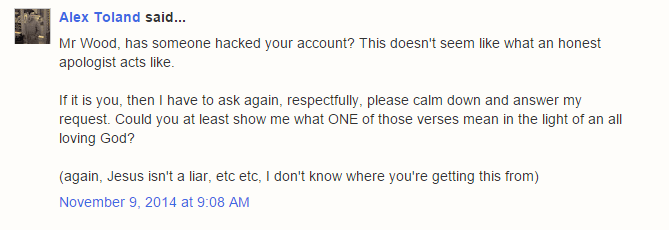
David expressly declares his agnosticism on core Christian beliefs and has made those views public. Jonathan as a fellow Christian, who now posts on David’s blog has had the opportunity to reproach David and preach the Gospel to him. However, Jonathan has failed to do so, and according to the aforementioned verses, this would mean he lacks devotion to Christ. Consider the case of David’s agnosticism over God’s ontology. The very nature of God is something that David is agnostic about. How can one be so hypocritical as to preach a religion about a God that they are doubtful about? If Jonathan was a devoted Christian, shouldn’t preaching to, and reproaching a popular Christian speaker be his most important goal? It needs to be asked, does Jonathan simply not care about Christ and is he merely speaking about Islam (an area he is demonstrably uneducated in), for private and personal gain?

Regarding God’s ontology, David is undecided about the power and knowledge of God. He does not know, and he does not care to accept one of the two mainstream beliefs in Christianity: Calvinism and Arminianism. In Calvinism, the Person of Christ – whom Christians consider to be God – did not die in the same way for everyone. This is known as limited atonement. It teaches that Christ/ God did not die in the same way for all men, otherwise everyone would be born-again. On the opposite end, Arminianism teaches universal atonement, that Christ/ God died for everyone in the same way. These are two fundamentally differing views of God. Christians trying to preach to David had to endure verbal threats and abuse from him, one Christian stated:

cc-2015-dw-calvinism2

David himself said:

cc-2015-dw-calvinism4

David in this post admits to flip-flopping between his beliefs. This is problematic because it involves his own salvation. According to Calvinist beliefs, the elect cannot become apostates or lose their faith. By this definition, since David is undecided and flip-flopping, then he is not of the elect, which would mean he is not saved according to Calvinist theology. On the other hand, Arminians believe a Christian can fall from grace and lose their salvation. Which view does Jonathan take regarding David? If he takes the Calvinist view, then David is an apostate. Since David flip-flops between the two mainstream views, he’s an agnostic and is not certain about his own salvation. In that case, it must then be asked, why isn’t Jonathan worried about David’s salvation when readers on the blog he posts too are?

cc-2015-dw-calvinism

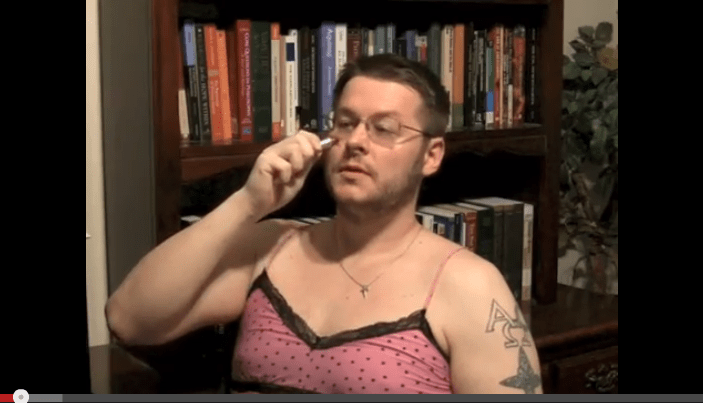
Being undecided about God’s nature regarding God’s attribute of love is a serious issue. It would then mean that Jonathan and David fundamentally believe in two different Gods, with two different attributes of love. It would mean that they believe in two different plans of salvation, two different plans of soteriology. This isn’t something minor and to be ignored, it deals with a person’s salvation. This is the most important discussion that should be happening. Yet, it isn’t. There are many other things we can ask about. Has Jonathan ever condemned and reproached David for cross-dressing?

cc-davidwood

David Wood the Voyeur Wearing Women’s Lingerie – Self Admitted Cross Dresser

The question needs to be asked: is Jonathan interested in Christian theology, or does he just want to gain popularity? Let’s take for instance, Jonathan’s appearing on ABN TV. David in an e-mail dated September 15, 2015 says of ABN’s audience:

“The more complicated the set-up, the more problems are going to slip in to derail the debates. Second, the vast majority of viewers would rather listen to us address a topic than a questioner asking us questions. It would be nice if all callers asked relevant, probing questions, but they won’t. Good questions will be only a fraction of the actual questions we get. People will call in with insults, they will start yelling and we’ll have to cut them, and most of the questions will be completely irrelevant to the topics. That’s just what happens when phone lines are opened for anyone to call in.”

David recognizes that ABN’s audience are Christians who insult, yell, and who ask irrelevant questions. David went so far as to cut ABN off, in an e-mail of the same date he says:

“As for ABN, I’ve been working with them for years, but I’m at the end of my rope. I simply want to get these debates out of the way so that I don’t have to deal with this network ever again.”

While David condemns and reproaches ABN, Jonathan runs to them and attempts to get on as many programs as he can. Does this mean that David is lying about ABN and its poor quality of viewership, or does it mean that he is telling the truth and Jonathan just wants to serve his ego? If David is wrong, then Jonathan should condemn him and reproach him for lying about a Christian network. On the other hand, if David is correct, then Jonathan needs to reproach ABN and condemn them. If he does neither, which is most likely, then he is failing to uphold his spiritual Christian duty of reproaching fellow Christians when they fall into evil, whether that be having heretical beliefs, cross-dressing, and lying about fellow Christians.

It remains to be seen whether Jonathan cares about David’s salvation, or of his own.

and God knows best.

The Passing of Br. Akbar Ali Sidi

cc-2016-akbarsidi

As Salaamu ‘Alaykum,

Br. Akbar Sidi was a founding member of Calling Christians. I came to know him while giving da’wah to Christians online. For many years we worked together and he supported my da’wah efforts greatly. He introduced me to the brothers and sisters that eventually went on to found Calling Christians. Due to him, I was inspired to converse, dialogue and debate with missionaries. At the moment I am lost for words. However, what I will say is that he is perhaps one of the greatest Muslim men I have ever known, his faith was steadfast and despite his old age he strove in the path of Allah by giving da’wah everyday, and true to character he also did so in the hours before his passing.

May Allah forgive him of any misgivings and grant him Jannat al Firdous, Ameen.

إِنَّا لِلَّـهِ وَإِنَّا إِلَيْهِ رَاجِعُونَ –

“Indeed we belong to Allah, and indeed to Him we will return.” – Qur’an 2:156.

Biography & Testimony:

I am Akbar Ali Sidi by name. Born in 1951 on the 1st of June. Born in a Muslim family, married with four children. Three of those children are already married. I worked for the Bank of Baroda briefly after completion of my high school but took up my favorite career in auto engineering. I then joined the Kenyan police force and did part time service to my country for 12 years. Presently, I’m in auto repairs in my small workshop.

421866_3190650761369_1831148859_n

Br. Akbar Ali Sidi

Educated at Consolata Catholic School where I did Bible studies as one of the compulsory subjects. The school was run by Italian priests. My mentor in Bible studies was the late Father Tosillini who was also the Principal of the school. In those days I was convinced that the only true religion was Christianity. I was so involved in Bible studies that I had opted to enroll in a Christian Bible Seminary College for further studies in the Bible. But due to financial strains I was not able to. All my religious discourses involved the Bible.

I therefore opted to be employed and joined Bank of Baroda where I worked for three years. I then opened my own workshop and it was during this time that the turning point in my religious views began. The person responsible for this was none other than the late Sheikh Ahmed Deedat who at that time was on a brief visit to Kenya. I enrolled in his classes on Comparative Religions that is: Islam and Christianity. My main interest was to hear his views on the Bible. Our first lecture was on the Crucifixion of Jesus. Contrary to what I had believed he convinced me beyond no doubt that it was a false concept in Christianity. This was followed by lectures on Trinity which he again proved to be a false doctrine.

akbar sidi smile

Br. Akbar Ali Sidi

It was at this juncture that I started looking keenly at my birth religion with renewed interest. I started talking with various Christian friends on the Bible and Quran showing the superiority of the Quran on the Bible. From then on I have been involved in debates with the Christians. Alhamdulillah to have been born a Muslim and that is why I debate strongly on the internet (Facebook, with them).

– May 6th, 2012.

Further Information:

On the passing of our elder brother AKBAR ALI SIDI, familiarly known as BABU:

Br. Akbar collapsed this morning soon after waking up from his bed. Unfortunately, he passed away while being rushed to the hospital.

Janaza prayers will be at Masjid Nur Mosque in South C at the time of Asr prayers (4 p.m.), burial thereafter at the Langata Cemetery.

and Allah knows best.

Who Wrote the Gospels?

Note: The following is an article by Br. Andrew Livingston, the authorship of the Gospels. Br. Andrew’s writings can be found at taqwamagazine.com. In this article, Br. Andrew takes an honest and critical look at the traditional assertions about the identities of the Gospel authors.

REGARDING THE AUTHORSHIP OF THE GOSPELS 
by Andrew Livingston

Upon seeing brother Ijaz’s debate with Tony Costa you may have gotten a sense of déjà vu. Are you beginning to get the feeling that on every single debate topic Christian apologists have precisely one opening statement that gets perpetually repeated by any number of people? As though there’s only one set of arguments to go around and therefore they must be very carefully guarded and preserved? I certainly have.

More than anything, there is one line of argumentation and one only for Christians trying to demonstrate that The Bible is more accurate than The Qur’an. Namely, they will keep on repeating—to the point where I wouldn’t be surprised to someday see one of their faces actually, literally turn blue—that The Qur’an was written six hundred years after The New Testament. If you’re not immediately struck by the sheer surreality of their reasoning, let me show you how William Lane Craig put this argument, and that should make it clear.

“Which would you trust: a collection of documents written during the first generation after the events, while the eyewitnesses were still alive, or a book written six hundred years later by a man who had no independent source of historical information? Why, to even ask the question is to answer it.” [1]

What independent source of historical information?? What on earth is he talking about??? Evidently Craig pictures Muhammad (P) sitting down at a desk in some fancy study and poring over ancient equivalents of Strong’s Concordance and the Encyclopedia Britannica, as he painstakingly pieces together historical chronicles via extensive research. That was never the idea, and Craig and Costa and their ilk very well know it. The claim The Qur’an makes for itself is that it’s a prophetic revelation. Either this claim is true or it is false. If it’s true, it won’t matter if the book came six trillion years after any of the events it describes. God (praise Him) does not forget. And if the claim is false, that’s because the belief that it’s a prophetic revelation is itself false, not because Muhammad failed at a task he wasn’t attempting in the first place. Either way this “six hundred years” talk is total, utter nonsense.

The more fitting analogy would be to compare The Qur’an not to the Gospels but to a book like Joel or Hosea. Let me put it this way. Hosea 12:4 tells us that it was an angel who wrestled with Jacob (P) in his tent. Nowhere in the original account of Genesis 32:24-30 is that specified. If anything the Genesis text seems to contradict Hosea, depicting Jacob as encountering God Himself. One way or another it contains no reference to an angel. So how could the author of Hosea, who was writing so many generations later, presume to say that he knew what happened? What independent source of historical information was he using when he wrote this belated document? Do you see now how ridiculous that sounds?

No, they’ll never see. Not Christian apologists. And I think I know why. To get into this fully would require an entirely separate essay but it suffices to explain that the assertion you’re hearing isn’t actually the assertion they have in mind: no, you have to read between the lines to find that. You see, buried beneath all of this endless harping on “early sources” is a hidden premise which, for no reason at all, we’re expected to take for granted is true. I’m referring to the belief in the traditional authorship of the gospels. If memory serves, in the aforementioned debate Costa spent his entire opening statement repeating himself ad nauseum about the relative dates of our scriptures—and then offhandedly snuck in the phrase “from the eyewitnesses” during his rebuttals. He had not devoted a single syllable of his opening statement to arguing for the Gospels’ traditional authorship; he would not offer a syllable later on. Rather, we’re automatically expected to understand, without even being told let alone convinced, that Matthew was truly written by Matthew, John by John, et cetera.

It’s not like the Gospels’ titles come from the original authors any more than the chapter and verse divisions do. Those titles are a matter of guesswork or tradition. The idea of apostolic authorship and apostolic witness seems to be rooted largely in the words of Saint Papias:

“Mark, having become the interpreter of Peter, wrote down accurately, though not in order, whatsoever he remembered of the things said or done by Christ. For he neither heard the Lord nor followed him, but afterward, as I said, he followed Peter, who adapted his teaching to the needs of his hearers, but with no intention of giving a connected account of the Lord’s discourses, so that Mark committed no error while he thus wrote some things as he remembered them. For he was careful of one thing, not to omit any of the things which he had heard, and not to state any of them falsely…Then Matthew wrote the oracles in the Hebrew language, and every one interpreted them as he was able.” [2]

At the very least Papias wasn’t talking about the same book we now call “The Gospel According to Matthew”. Rather, he was referring to a sayings Gospel (think the book of Proverbs, only this one is the proverbs of Jesus) written in Hebrew, whereas our book of Matthew is the opposite of that. It’s a narrative in Greek. Would you be surprised to find that that such misattribution applies to the other three Gospels as well? The fact of the matter is, nobody knows who wrote any of the four Gospels, just like nobody knows who wrote the book of Hebrews. What we do know is that the book of Mark came first, Matthew and Luke use Mark for source material, and John came last. And that whoever wrote Luke also wrote Acts. That’s about it.

Let us begin with John. The whole basis for its alleged Johannine authorship rests on a single verse:

“This is the disciple who is testifying to these things and has written them, and we know that his testimony is true.” (Chapter 21, verse 24) [3]

Because the traditional identity of this “disciple whom Jesus loved” is John the apostle, John therefore is supposed to be the author of the Gospel. Yet you’ll notice that the above verse doesn’t read, “This is the disciple who is sitting here writing this.” Rather, it tells us, “WE know that HIS testimony is true.” What we’re actually told here is that the author of this Gospel is using the beloved disciple as a source of information. He has this other account sitting in front of him, which he takes to have been written by the beloved disciple, and he’s basing his own text on what it contains. How do we know that he was correct about the identity of his source? That he was getting material from an authentic apostolic writing?

It’s quite a mystery who this beloved disciple is even supposed to be. Harold Attridge proposed that he may be not so much an actual historical figure as a literary device. You see, when we read through John we become faced with this maddening mystery. The most important or noticeable person in the whole book (apart from Jesus) is frustratingly anonymous. And so to figure it out we’ll go back and read the Gospel again…and again…and again. Until the actual theology or message of the book starts to catch our attention through repetition. [4]

But the important thing is that John 21:24 and its claim to apostolic witness probably weren’t present in the original version of the text. They are the result of an interpolation. “Holman Illustrated Bible Dictionary” tells us:

“John originally may have ended with 20:30-31. In the ‘epilogue’ (21) we are told of the restoration of Peter and the prediction of his death. The rumor that John was not to die before the second coming is also refuted.” [5]

Let me unpack this for you. Let’s look at the last two sentences of chapter 20:

“Now Jesus did many other signs in the presence of his disciples, which are not written in this book. But these are written so that you may come to believe that Jesus is the Messiah, the Son of God, and that through believing you may have life in his name.”

Be honest with yourself: how hard is it to imagine that being the last two sentences of the book itself? Come on, you can practically hear a “THE END” (or as they would have put it back then, “Amen”). And yet the book continues right on like nothing happened. For a whole chapter, no less. And it’s in this obviously tacked-on chapter that we find the claim of apostolic witness. Just before which the text reads as follows.

“Jesus said to [Peter], ‘Feed my sheep. Very truly, I tell you, when you were younger, you used to fasten your own belt and to go wherever you wished. But when you grow old, you will stretch out your hands, and someone else will fasten a belt around you and take you where you do not wish to go.’ (He said this to indicate the kind of death by which he would glorify God.) After this he said to him, ‘Follow me.’ Peter turned and saw the disciple whom Jesus loved following them…When Peter saw him, he said to Jesus, ‘Lord, what about him?’ Jesus said to him, ‘If it is my will that he remain until I come, what is that to you? Follow me!’ So the rumor spread in the community that this disciple would not die. Yet Jesus did not say to him that he would not die, but, ‘If it is my will that he remain until I come, what is that to you?’”

Now consider that passage along with these two:

“[Jesus] said to [the apostles], ‘Truly I tell you, there are some standing here who will not taste death until they see that the kingdom of God has come with power.’” (Mark 9:1)

“[Jesus said to the apostles:] When they persecute you in one town, flee to the next; for truly I tell you, you will not have gone through all the towns of Israel before the Son of Man comes.” (Matthew 10:23)

And so we can see that John 21 is partly intended to debunk previous Gospel tradition. We’re told that Jesus never actually claimed that one of his apostles would still be alive come Judgment Day: rather, what he did say was misunderstood, and the whole thing snowballed from there. Take note, reader! The Bible itself is acknowledging that parts of it—regarding Jesus, no less—are based on a distortion of the facts. [6]

But the important thing is that John 21 seems to come from somebody who lived and wrote after the apostles’ time—if only by a little bit, and as far as he himself knew. So unless that radioactive satellite from “Night of the Living Dead” was somehow involved it would seem that the book of John was not actually written by John—or any apostle.

What of the Synoptics? As it turns out, the authors of Matthew and Luke were unmistakably using Mark as their main source. Indeed, the influence of Mark can be seen even in the smallest details. If three authors all independently tell the same stories, each of their accounts being based on a different person’s eyewitness testimony, you’d expect there to be a lot of similarity in the narratives—but you would not expect to find just as much similarity in the actual writing itself. The way that everything gets described—the way that it’s worded. And yet that is often what we’ll find. Even parenthetical asides sometimes have verbatim agreement from Gospel to Gospel. That is to say, on several occasions the author of Mark will jot down a little incidental note, and should you turn to Matthew or Luke you’ll find the remark reproduced along with the rest of the story. For example compare these two passages from the Olivet Discourse:

“…When you see the desolating sacrilege standing in the holy place, as was spoken of by the prophet Daniel (let the reader understand), then those in Judea must flee to the mountains…” (Matthew 24:15-16)

“…When you see the desolating sacrilege set up where it ought not to be (let the reader understand), then those in Judea must flee to the mountains.” (Mark 13:14)

Ask yourself where the author of Matthew got the words “let the reader understand”. What, did he just so happen to write precisely the same note to his readers, in precisely the same place, using precisely the same wording? No, obviously he was copying from the text of Mark. The same applies to this passage from Luke:

“Some Sadducees, those who say there is no resurrection, came to [Jesus] and asked him a question…” (Chapter 20, verses 27-28)

Compare it to the following verse from Mark:

“Some Sadducees, who say there is no resurrection, came to him and asked him a question…” (Chapter 12, verse 18)

Did both authors just so happen to mention the Sadducees’ beliefs, in the same place, and using the same wording?

Let me clarify that I’m not accusing anyone of academic dishonesty. As modern day westerners our concept of plagiarism is fairly different from that of a first-century Palestinian. With that said, the copying itself is undeniable. The authors of Matthew and Luke were using the text of Mark. [7]

But wait a minute! How do we know that it isn’t the other way around? How do we know that it wasn’t the author of Mark who drew on Matthew and Luke? Well, Bart Ehrman has explained that very well:

“Suppose you number the stories that are found jointly in Matthew, Mark, and Luke. They occur, say, in the sequence of: 1, 2, 3, 4, 5, 6. And then you give letters to the passages found in Matthew and Luke but not in Mark: A, B, C, D, E. What is striking is that the numbered stories are usually in the same sequence of Matthew and Luke. But the lettered stories are usually NOT in the same sequence in Matthew and Luke. So (this is an illustration: it’s not a statement of what you actually find), Matthew’s Gospel is organized from the following combination of materials: 1, A, B, 2, 3, 4, C, 5, D, 6, E. But Luke’s is organized 1, 2, C, A, 3, E, 4, B, 5, 6, D. The only materials in the same sequence between Matthew and Luke are the ones found in Mark. How could this be?

The best explanation is that Matthew and Luke each used Mark as one of their sources, and also had a different source…that they ‘plugged into’ the narrative framework of Mark at different places. That is to say, not having any indication from Mark’s Gospel where traditions like the Lord’s prayer or the Beatitudes would have fit into the life of Jesus, each author put them in wherever he saw fit. Almost never, though, did these passages go in at the same places. This curiosity of sequence can scarcely be explained if Mark were not one of the sources for Matthew and Luke.” [8]

And what of the book of Mark? Now that is a quandary. Since this time we’re looking at the world’s earliest surviving narrative Gospel, it’s much harder to puzzle out who its author could have been. Because what are you going to compare Mark to? We’ve hit rock bottom. Well, as it so happens there’s already an article here on the site which you may find helpful:

https://callingchristians.com/2015/05/23/the-markan-gospels-systematic-development-in-light-of-miracle-sets/

Apparently people who believe in apostolic authorship also find the situation problematic, because they seem to have gotten desperate. You see, no matter what Bible commentary you consult, the main argument for Markan authorship (indeed, pretty much the only argument) will be the same every time. They’ll tell you that the passage about the naked man fleeing Jesus’s arrestors (chapter 14, verses 43-52) is Mark’s humble way of identifying himself. Yeah, I don’t buy it either.

Father Nicolas King has explained that no western writer seems to have used that argument before the year 1927. [9] I certainly do find a pattern when I search through countless Bible commentaries. Most every commentary written after the early twentieth century will claim that the naked Gethsemane man was Mark himself and that this fact somehow indicates Markan authorship. (They’ll point you to Acts 12:12.) And most every commentary written before the early twentieth century will offer little speculation, or else the speculation will be unexciting. Take, for instance, the mid-1700s exegete John Gill:

“Some think this was John, the beloved disciple, and the youngest of the disciples; others, that it was James, the brother of our Lord; but he does not seem to be any of the disciples of Christ, since he is manifestly distinguished from them, who all forsook him and fled: some have thought, that he was a young man of the house, where Christ and his disciples ate their passover; who had followed him to the garden, and still followed him, to see what would be the issue of things: but it seems most likely, that he was one that lived in an house in Gethsemane, or in or near the garden; who being awaked out of sleep with the noise of a band of soldiers, and others with them, leaped out of bed, and ran out in his shirt, and followed after them, to know what was the matter.” [10]

So in other words, he was just some guy. Why is that hard to believe?

Let me put it this way. Now I want you to stop and ponder the following question for thirty seconds at least.

Is there any good reason why a Gospel written by Matthew wouldn’t be a first-person narrative? You know, “Jesus came to me and asked me my name. I said, ‘Matthew.’” Well, why wouldn’t it be written that way? Seriously, give it a good thirty seconds.

Throughout the Gospels-and-Acts collection there are only a few passages in which stories get told in the first person—told, that is, by someone who talks like he was actually there. And not a single one of these passages is a story about Jesus. They’re all in Acts. Read chapter 20 of Acts and observe how abruptly and haphazardly the text switches back and forth between the first and third person.

The author of Luke and Acts had said:

“Since many have undertaken to set down an orderly account of the events that have been fulfilled among us, just as they were handed on to us by those who from the beginning were eyewitnesses and servants of the word, I too decided, after investigating everything carefully from the very first, to write an orderly account…” (Luke 1:1-3)

So this author was getting his info partly from eyewitnesses (or people he believed were eyewitnesses) and partly from preachers or what not. Seeing as there are only a few first-person passages it would appear that the great majority of the Luke-Acts text does not fall into the “eyewitness” category.

Nor does so much as a single passage anywhere in the Gospels.

But God knows best.

NOTES:

[1] From his opening statement in the Bill Craig-Shabir Ally debate, “Who Is the Real Jesus?”

[2] Church History 3:39:15-16.

Obtained via newadvent.org. Accessed Tuesday, November 24th, 2015.

[3] All biblical quotations come from the New Revised Standard version (and through the use of biblegateway.com).

[4] From “The Gospel of John: Lazarus”, one of Harold Attridge’s dialogues with David Bartlett in the course videos at Yale’s Youtube page.

https://www.youtube.com/watch?v=yzOvM6E-8-0

Accessed Tuesday, November 24th, 2015.

[5] “Holman Illustrated Bible Dictionary”, page 935. General editors: Chad Brand, Charles Draper, Archie England. 2003 Holman Bible Publishers.

[6] See also Mark 8:27-28. And compare Mark 14:55-59 to John 2:18-22.

[7] For more info watch this James McGrath lecture on the Synoptic Problem:

https://www.youtube.com/watch?v=BbMBjrRijJs

[8] “Did Matthew Copy Luke or Luke Matthew?” at Bart Ehrman’s blog.

http://ehrmanblog.org/did-matthew-copy-luke-or-luke-matthew/

Accessed Tuesday, November 24th, 2015.

I hope it’s not wrong of me to publicly quote text from behind the paywall.

[9] From “Mark: The Strangest Gospel”, a speech by Father Nicholas King to the Ecumenical Chaplaincy at the University of York on January 25th, 2012.  https://www.youtube.com/watch?v=3pOL422Ttww

Accessed Tuesday, November 24th, 2015.

[10] “Gill’s Exposition of the Entire Bible”, commentary on Mark 14:51. As obtained via biblehub.com.

Three Reasons Why Christians Should Not Celebrate Christmas

Tis the season to be jolly, but should Christians hold this holiday in such high esteem? In this article, we look at three reasons why Christians should reject celebrating Christmas –

merry

1. The Earliest Christians  Didn’t Celebrate Christmas

As shocking as it might seem, the earliest Christians – including the apostles and disciples of Christ, had no such celebration. The early Church Fathers Iraenaeus and Tertullian omit any mention of it from their list of Christian feasts. The Church Father Origen argues that only sinners celebrate their birthdays. Furthermore, the early Christian apologist Arnobius ridiculed the pagan Graeco-Romans for celebrating the ‘birth’ of their gods.

Notoriously absent from any of the four gospel accounts is the mention of a yearly celebration of Jesus’s birth. During Jesus’s ministry, no such celebration is ever recorded. During the formative years of the Church, as recorded in the Acts of the Apostles, no such celebration is ever mentioned. One needs to ask, if such a celebration was essential to the Christian faith, wouldn’t Christ, his mother, his apostles and disciples have mentioned it? Whether Catholic or Protestant, Christian tradition does not record any yearly celebration or feast of Jesus’s birth in the Bible, nor is there any record of any yearly celebration or feast of Jesus’s birth in the early Church tradition until the 3rd century CE.

When mention of this celebration did occur, the dates listed were the 20th of May, the 19th or 20th of April and the 28th of March. Even if one wanted to celebrate the birth of Christ due to some late Church tradition, it would not be held in December. So, if you’re a Catholic or adhere to the doctrine of Sola Scriptura, it’s going to be quite difficult to claim that Christmas is an essential Christian feast that merits the Christian faith. According to all historical records, Christmas is a later development, far removed from the time of Christ and early Christian apologists ridiculed the pagans for celebrating the ‘birth’ of their pagan gods.[1]

2. Christians Once Banned Christmas and Condemned it as a Heretical Festival

Citing a lack of ‘Biblical Justification’ and its ‘derivation from the Catholic tradition’, Protestant Christians in England banned Christmas in 1644. In further condemnation of the festival, the English’s Long Parliament in June 1647 passed an ordinance confirming the abolition of the feast of Christmas. Protestant Christians in England considered Christmas Trees, decorations and Christmas foods to be unholy pagan rituals.[2] Across the Atlantic, Christians in America soon followed suit. Christmas was banned in Boston from 1659 to 1681, and it did not become a legal holiday in the New England until 1856.[3]

sadsanta

3. Christmas in a Christian Perspective

The festival now known as ‘Christmas’ is derived from the Old English phrase Cristes Maesse, first noted in 1038 CE.[4] While the first use of Christmas Trees – the Evergreen Fir Trees, was adopted from the pagan usage of them for decorating their homes during the winter solstice. Similarly, it is documented that pagans also used them for decorating their temples during the festival of Saturnalia. The first documented use of the Christmas Tree was in the cities of Tallinn in Estonia (1441 CE) and Riga in Latvia (15010 CE).[5]

Taking into consideration the previous evidences – there was no yearly celebration of Christ’s birth recorded to be done by Christ, his family, the apostles or the disciples. No mention of a yearly celebration of Christ’s birth by the early Church, and early renunciations of this practise as a pagan festival by at least one noted Christian apologist. The dates for Christ’s birth are not only historically uncertain, none of the recorded date coincide with the month of December. The festival itself was banned by Christian nations, with those prohibitions being based on a lack of scriptural evidence and an acute similarity to pagan festivals.

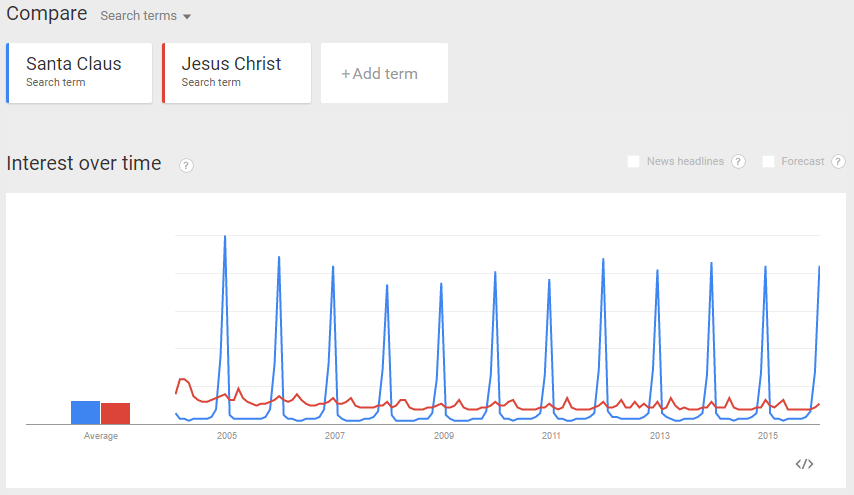
Christmas itself is not, and has not been for a long time about the nativity or Jesus. The most famous character during the Christmas season is Santa Claus. Worldwide search trends since 2004 record Santa Claus being the dominant search term, exponentially outpacing Jesus Christ on a year to year basis during the Christmas Season by a factor of 7:

cc-2015-santavsjesus

Commercialization. Holiday sales account for at least 1/5th or ~20% of retail industry’s sales in the US. The holiday season accounts for more sales than Mother’s Day, Father’s Day, Valentine’s Day, Halloween, Easter, and St. Patrick’s Day combined.

cc-2015-christmassales

Notably, the only time Jesus is said to have reacted violently, is recorded in the Gospels when money changers were using the Temple as a marketplace. In essence, people were using something holy for commercial means, not unlike what we find with the commercialization of the Christ-mass season today. A cursory reading of Matthew 21:12-13 or of John 2:14-17 makes it absolutely clear that the commercialization of Jesus’s name is something of great disrepute.

All in all, Christmas is not about Jesus. It’s not essential to the Christian faith and it’s not a practise found in the early Christian tradition. Christians who practise Christmas today are practising a festival that took hundreds of years to develop, a festival which adopted pagan practises, a festival which has no Biblical basis, a festival that is more about retail sales and Santa Claus than it is about the person of Jesus the Christ.

Christians have an important decision to make. Either you go against the grain and reject this pagan-commercialized syncretic holiday or adopt a non-Biblical modern commercial holiday:

Aggravation is better than merriment
because a sad face may lead to a glad heart.
4 The wise heart is in the house that mourns,
but the foolish heart is in the house that rejoices.
5 It is better to obey the reprimand of the wise
than to listen to the song of fools,
6 because the fool’s merriment
is like nettles crackling under a kettle.
That too is pointless.

– Ecclesiastes 7:3-6.

and God knows best.

Sources:

1 – Martindale, Cyril Charles. “Christmas.” The Catholic Encyclopedia. Vol. 3. New York: Robert Appleton Company, 1908. 24 Dec. 2015 <http://www.newadvent.org/cathen/03724b.htm&gt;.

2 – Burton-Hill, Clemency. “When Christmas Carols Were Banned.” BBC. BBC, 19 Dec. 2014. Web. 24 Dec. 2015. <http://www.bbc.com/culture/story/20141219-when-christmas-carols-were-banned&gt;.

3 – Melina, Remy. “The Surprising Truth: Christians Once Banned Christmas.” LiveScience. TechMedia Network, 14 Dec. 2010. Web. 24 Dec. 2015. <http://www.livescience.com/32891-why-was-christmas-banned-in-america-.html&gt;.

4Ibid – 1.

5 – “The History of Christmas Trees on Whychristmas?com.” The History of Christmas Trees. Web. 24 Dec. 2015.<http://www.whychristmas.com/customs/trees.shtml&gt;.

Nabeel Qureishi Deemed Heretic by Christian Scholar

The former Qadiani, Nabeel Qureishi attempted to unceremoniously drag noted Christian scholar and theologian, Miroslav Volf into his response to the Wheaton College suspension of a Professor for promoting solidarity between Islam and Christianity.

cc-2015-nq-slav

Unfortunately for Nabeel, he earned the ire of Miroslav Volf, who deemed him a heretic for arguing that Jews worship a different God than that of Jesus’s. His argument is that according to the Bible, Jesus acknowledged that Jews worshiped ‘His Father’, despite denying his (Jesus’s) alleged divinity. As such, not only does this demonstrate Nabeel’s lack of education when it comes to his own theology, it indicates to the wider public that Nabeel is not serious about his faith and is clearly more interested in pandering to the lay-Christian audience that follows RZIM.

This is quite disappointing, but in some respect it is a sign that not only does Nabeel not understand Islam, despite trying to study Christianity, he still is unable to grasp its theological nuances to the extent according to one well noted Christian scholar, he holds heretical notions and beliefs.

and God knows best.

Encountering Christian Apostates

Trinidad & Tobago’s majority religious demographic is that of Christianity.20151215_151024-1.jpg Earlier this year I received a number of books from Dr. Shabir Ally, and had decided to read some of these books while on campus at one of our Universities. The book I chose to start with was John Loftus’ The End of Christianity. I hadn’t considered the reaction I would receive from walking around with a book of that title, I did receive reactions and those reactions are not what I expected them to be.

It started in class, I had taken out the book to read because I was either bored or had finished an in-class assignment early. A classmate who I knew to be Christian asked me to see the book. In that moment, I wondered if the book’s title had upset the person. They took the book, read the cover, checked the table of contents and even flipped through the book, skimming as they went along. The classmate asked me what I thought of the book, I answered quite honestly (I’m paraphrasing here): it’s new atheist dribble, but it has some nice points I hadn’t thought of as yet.

They weren’t offended, they were interested in the book. That was just the first encounter, over the course of the next 3 months, I met students throughout the campus that not only wanted to skim through the book, but many of them wanted to borrow it. This had taken me by surprise. The positive reactions from so many of my Christian colleagues had me wondering what was going on. Why would they react so positively to a book that critiqued their faith? I knew that my generation was less conservative than the previous generations. I knew that more young adults were less religious than those found in previous generations, but had this decrease in religiousity been more than I thought it to have been? As it turns out, while most of the young adults my age came from Christian families, most of them no longer considered themselves Christian. Not only were young adults apostating from Christianity, they were interested in exploring other religions, while taking an active role in leading their peers out of Christianity.

This book sparked more conversations than I am able to recall, this book gave my peers the opportunity to speak out and renounce Christianity. I never could have imagined that merely carrying a book around by this title would have this much of an effect on the people around me. What this experience taught me, was that many young adults are desperate to leave Christianity, they want to reject Christianity, they are tired of the message of the Cross and of its ineffectual teachings. These last few months gave me the opportunity of a lifetime, it opened my eyes and allowed me to reach out and apostate many Christians. At most, it took 4 conversations for me to bring someone out of Christianity. Most of the people that engaged me in discussion abandoned Christianity during the first conversation! They were just waiting for someone to reach out and agree with them, to give them the motivation to abandon the message of the Cross. This year, a simple book cover allowed me to bring many young adults out of Christianity and get them interested in Islam. While the book itself has a few interesting arguments, its overly wordy and most of its essays are okay at best.

and Allah knows best.

Wheaton College Suspends Professor for Wearing Hijab

Professor Larycia Hawkins was suspended from teaching at Wheaton College for wearing a cloth head covering. In an attempt to justify this decision, the College stated:

“While Islam and Christianity are both monotheistic, we believe there are fundamental differences between the two faiths, including what they teach about God’s revelation to humanity, the nature of God, the path to salvation and the life of prayer,” Wheaton College said in a statement.

“Wheaton College faculty and staff make a commitment to accept and model our institution’s faith foundations with integrity, compassion and theological clarity,” the college said in a statement. “As they participate in various causes, it is essential that faculty and staff engage in and speak about public issues in ways that faithfully represent the college’s evangelical Statement of Faith.” – Chicago Tribune.

This is quite a peculiar statement. What part of Christian theology, prevents women from wearing a cloth covering on their heads? There is no part of Christian theology which specifically states that women cannot wear a head covering. To the contrary, there is an edict where women are supposed to wear a head covering or veil:

That is why a wife ought to have a symbol of authority on her head, because of the angels. – 1 Corinthians 11:10.

Explicating upon this passage, Matthew Henry’s commentary states:

It was the common usage of the churches, for women to appear in public assemblies, and join in public worship, veiled; and it was right that they should do so.

Gill’s Exposition of the Bible says about this verse:

The Greek word more properly signifies the power she had of putting on and off her covering as she pleased, according as times, places, and persons; made it necessary…

Women have the power, as given to them by God, to put on or take off a hawkinsveil according to the aforementioned commentary. Thus, it is quite damning that a Christian College would find it necessary to condemn, reproach and suspend a Christian woman because she wore a veil, a piece of cloth on her head. The question needs to be asked, if educated Christians from a Christian College  are so insecure about a woman’s wearing of a piece of cloth on her head, does this reaction from the College indicate the level of prejudice and xenophobia Christians hold towards Muslims?

and God knows best.

Missionary Mishap: Jonathan McLatchie’s Honesty

People make mistakes, I’ve made mistakes, however if you accept your mistakes and take responsibility for them, you can make amends. There are some people though, where the issue of honesty is not so black and white. In this case, it quite literally is black, there’s no denying it. So, here we are again with another infamous Missionary Mishap! In August of 2015, Jonathan McLatchie unleashed a xenophobic tirade, describing Muslims in Europe as a cancer. At that point in time, he was unable to clear his name, since video evidence was widely available. He never apologized or recanted his xenophobic views. Recently, Jonathan once again unleashed another xenophobic tirade, denigrating Caucasian converts to Islam.

The Muslim community continues to forgive Jonathan for his xenophobic views, and we do not ascribe his extremism to his faith. We do not hold Christianity responsible for Jonathan’s views. However, Jonathan seems to have found himself in another controversy. In his video denigrating Caucasian converts to Islam, he erroneously claimed that Khalid Yasin, the African American convert to Islam, was a white (caucasian) man. After repeated attempts at correcting him, Jonathan insists that Khalid Yasin is a white man. He even went so far as to claim he met Khalid Yasin to prove that he was a white man. This incident is indicative of Jonathan’s inability to correct himself when wrong. Jonathan refuses to acknowledge that he made a mistake.

cc-2015-jm-khalidyasin.png

I’ve got news for Jonathan. Khalid Yasin is an African American man. He is not white, as is noted by the photo above. To assess Jonathan’s ability to correct himself, he was contacted via Twitter and he continued to affirm that he had not made a mistake, Khalid Yasin was a white man, and the proof was that Jonathan met him.

cc-2015-jm-khalidyasintwitter

In response to that, I too also met Khalid Yasin several years ago when he visited Trinidad at the IBN TV8 studios. I can assure Jonathan that Mr. Yasin, is indeed, not a white man. As proof, I also offer any image or video of the man himself. No one in the Muslim community can make sense of Jonathan’s inability to correct himself in the face of obvious and glaring mistakes. Even when the issue is as simple as the difference between black and white, Jonathan is unable to be honest or correct himself. If he cannot be honest for such simple matters, should he be trusted when it comes to theology? The answer is clearly no.

Should Jonathan correct himself, I will edit this post to reflect this. However, that is as likely as it is for a camel to go through the eye of a needle.

and God knows best.

Jonathan McLatchie Confuses Christians About the Trinity

In what can be described as completely embarrassing, Christians are once again cringing at Jonathan McLatchie’s views on the Trinity. On the anti-immigrant blog hosted by the previously institutionalized David Wood, Jonathan recently posted a video of himself ‘explaining the Trinity’. In the comment section, one Christian absolutely condemns McLatchie as making the Trinity, ‘as clear as mud’.

cc-2015-jm-muddytrinity

What makes it worse is that while Jonathan has been copy-pasting articles about Islam from Wood and Shamoun, and attempting to present them as his own research, the moment he touches on the subject of Christianity he finds himself being mocked and ridiculed by his fellow Christians (about his understanding of his own faith). It is thus, quite ironic that McLatchie in attempting to promote himself as a ‘Christian apologist’, but cannot even express or defend the Trinity, to the point that other Christians are ridiculing him for it. Peculiarly, Jonathan chose to ignore this criticism and to post other plagiarized articles from Wood and Shamoun, and failed to address this Christian’s criticism of his ignorance about Christianity.

This explains why he is focusing on Islam. Jonathan does not understand his own religion, and when it comes to Islam he is reduced to copying decades old arguments from Shamoun and Wood. He is unable to present his own ideas and research, he is left to plagiarise the works of others, and claim them as his own. This is a new low for Christian apologetics. It almost seems as if they are scraping the bottom of the barrel in some attempt to appease donors to Wood’s website. No new arguments, no new research, and the best they can do is to get an unqualified Christian xenophobe and polemicist to repost old articles while failing to get the Trinity right.

Scraping the bottom of the barrel indeed.

and God knows best.

« Older Entries Recent Entries »