Tag Archives: samuel green

Fantastic Debate with Pastor Samuel Green

Last night’s debate with Samuel was absolutely splendid. The events could not have gone better than I’d hoped and the experience was certainly uplifting and motivating. Here are two quick incidents from last night:

Pastor Samuel: Ijaz you keep asking me for a verse which demonstrates the incarnate Christological (man-God) creed, well I’ve been providing it all along, here it is:

“In my vision at night I looked, and there before me was one like a son of man,[a] coming with the clouds of heaven. He approached the Ancient of Days and was led into his presence. 14 He was given authority, glory and sovereign power; all nations and peoples of every language worshiped him.” – Daniel 7:13-14.

Me: Pastor, did you even LOOK at the verse? It literally says that GOD was GIVEN authority, glory and power. That’s funny, because the very definition of God is an all powerful deity, how can an all powerful deity be GIVEN power?

If you that that was bad, this was even worse!

Pastor Samuel: Ijaz you’re confusing Greek mythology with Greek Philosophy, the belief in the Son of God in the Greek culture was mythology not philosophy, you need to study ancient Greek culture.

Me: Reminds the kindly Pastor that Plato and Pythagoras were seen as ‘the Sons of God’ and in Greek Philosophy (as quoted by the Apostle Paul himself!), all men were ‘like’ God because we all possess the faculties of ‘reason’.

I should have the debate uploaded to our channel in a day or two, God willing. There were a few technical glitches and timing issues last night, but we were able overcome these trials and have an eventful debate. At one point I lost internet connection and was unable to hear Samuel’s second rebuttal. The room itself was packed with 120+ persons, and to be quite honest I’m certain it went beyond this number, but because I was busy having a debate – I didn’t think to keep checking the room count, in any case there certainly was a significant turn out from both the Muslim and Christian communities.

Lastly, I’d like to thank Sister Waduha, our moderator who was fair and unbiased. This makes it 3/3 debates in which I’ve worked with her and she pulled out all the stops last night by gifting both Samuel and I a week’s worth of Paltalk Extreme, i.e. we get a full week’s service of the paid Paltalk experience.

In relation to the debate and my performance, I’ve been told by Muslims and Christians alike that perhaps my quotations and my use of them in my arguments seemed to have gone over the heads of most people. I presented an unbiased Christian historical perspective on the development of the incarnate Christology, something in which Pastor Samuel was not prepared for and it clearly shows in his rebuttals that he really didn’t know how to respond and so he went into a hundred and one directions and gifted me three smashing cross fire questions that seemed to put him into the hot seat!

Many have been asking for the sources of the quotes I used during my Opening Statement, rest assured that in the coming days, perhaps after my debate with Bob Siegel, I’ll put something together for the public’s use inshaaAllaah.

wa Allaahu ‘alam.

Samuel Green Responds to my Question

بِسۡمِ ٱللهِ ٱلرَّحۡمَـٰنِ ٱلرَّحِيمِ ,

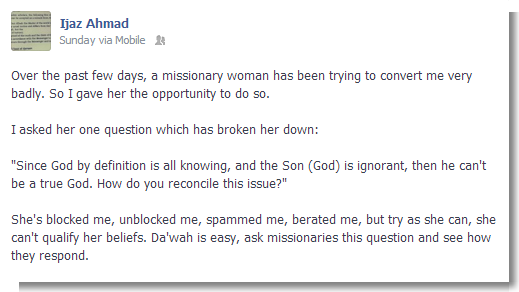
Samuel Green, an Australian preacher who is described by Shamoun as his favourite apologist/ Christianity’s best apologist has responded to a Facebook post of mines. Unfortunately, I don’t think it went well for him, perhaps there are other Christians out there willing to help him? I did want to post this as a Missionary Mishap, but I think this post is a serious question and I don’t wish to denigrate the character of Mr. Green, of whom I enjoy discussing Christianity with.

1  Ijaz Ahmad


1  Ijaz Ahmad (1)


1  Ijaz Ahmad (2)


My question has yet to be answered and I fully believe that Samuel’s exacerbated the issue to a far greater extent that I imagined he would have. Any Christians willing to take the dive and jump into this debacle?

wa Allaahu ‘Alam.

Debate: Was Muhammad (peace be upon him) Foretold in the Bible? Zakir Hussein vs Samuel Green

بِسۡمِ ٱللهِ ٱلرَّحۡمَـٰنِ ٱلرَّحِيمِ ,

Another excellent debate from the up and coming debater, Br. Zakir Hussein. Eloquent in his speech, spot on in his arguments, well articulated rebuttals and most importantly he stayed on topic. Samuel Green attempted to refute him a few times, but got carried away, you’ll notice that Br. Zakir played a bit of logic on Samuel and used the same method of finding prophecies of Christ in the Old Testament and applied it to his own agenda. Thereby allowing Samuel to argue against his own methodology, pure brilliance from Br. Zakir.

wa Allaahu ‘Alam.

A Rejoinder to Sam Shamoun: Christian Fans on Editing of Debate Videos

بِسۡمِ ٱللهِ ٱلرَّحۡمَـٰنِ ٱلرَّحِيمِ ,

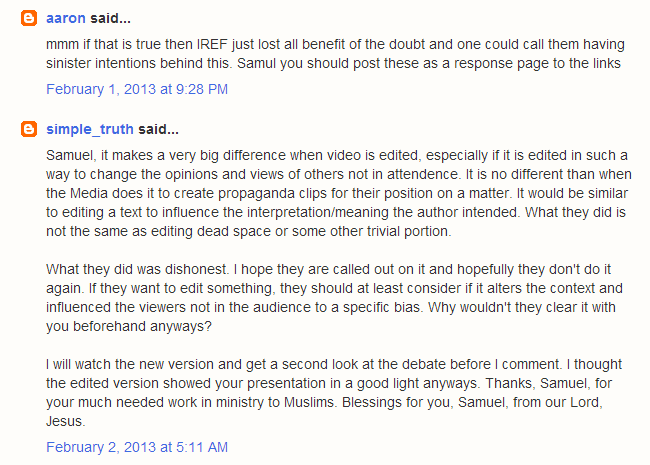
Recently the foul mouthed missionary zealot, Sam Shamoun attempted to bully me through verbal abuse during an audio discussion. Unfortunately for Sam Shamoun, his tactics backfired and brought sincere Christians to begin communications with Calling Christians. In light of the discussion, Sam Shamoun then ordered his congregational minion/ audio recorder to post an edited version of our discussion. In Sam’s edited version, his comments are moved about, some of his insults are deleted and a portion of my rebuttal to his inane ranting was removed. Many Christians defended this and praised Sam for doing this on the Youtube video page of our discussion. Yet in typical Christian hypocrisy, on David Wood’s blog, that is Sam Shamoun’s debating partner, a strange thing occurred. As it turns out the Christian Samuel Green and Br. Imran of IREF had a debate. According to Samuel Green, IREF edited portions of the debate in light of the audience’s reaction to certain points but no speaking material was changed, just audience shots. These same Christians who were applauding and accepting Sam’s edit of our discussion, are now crying foul and claiming any edit is dishonest, abhorrent and distasteful.

cc-samedit


Isn’t that hilarious? The nature of these Christians in Sam/ David’s congregation are completely hypocritical. Apparently, it’s okay for a Christian speaker to edit and manipulate a debate’s content, but to skip audience pan shots is tantamount to ‘promoting bias‘, ‘dishonest‘, ‘it makes a big difference‘, ‘influencing the meaning the author intended‘, ‘costs them the benefit of doubt‘, etc. It’s important for us Muslims to note the kind of missionaries we are dealing with. They are dirty, underhanded, deceitful and shameless. Most importantly, ‘people‘ like these will cry foul and claim victimization whenever they can to achieve emotional tendencies. Thankfully, us Muslims are not of the ilk that Sam Shamoun, et al are like. We are commanded to practise integrity and to remain on the path of righteousness and we most certainly do not need to be perverted in our speech or actions as they need to be.

wa Allaahu ‘Alam.

Samuel Green, Islam and Paedophilia

Bismillahir Rahmanir Raheem
بِسۡمِ ٱللهِ ٱلرَّحۡمَـٰنِ ٱلرَّحِيمِ ,

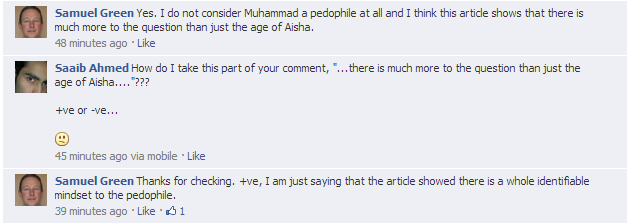
Answering Muslims and Acts17 are Christian Apologetics Ministries that are infamous for creating propaganda against Islam. David Wood, Anthony Rogers and Samuel Green are what I would consider to be the main proponents of these organization’s workings. Yet, I was thrown off balance by a shocking admission by Samuel Green via a Facebook article written by Calling Christian’s team member, Br. Azhan Ahmed on the topic of Muhammad [saws] and Paedophilia:

That’s a revelation by itself. Samuel Green openly disagrees with the views of David Wood, Sam Shamoun, and the rest of the Answering Muslism team, Acts17 team and the Answering Islam team. Samuel Green is known for his debates against numerous Muslim Da’ees in Australia and he is also known for associating with missionary groups organized for the sole purpose of Ministering to Muslims. Therefore, when he reneges on a view not only held by his closest Missionary friends, but by 3 other organizations he’s involved with, that speaks volumes. We look forward to Samuel Green’s further discussion on this revealing news, we also look forward to David Wood’s take on one of his writers disagreeing with what is considered to be a standard belief among his peers.

Does this represent dissension among the ranks of Answering Muslims and Answering Islam? Would Samuel Green be publicly refuted by his peers, or would he be forced to recant such statements? I can’t say what will happen, but this is overall good news for Islamic da’wah.

wa Allaahu Alam,
and Allaah knows best.

Refutation: Where Did Jesus Say, “I Am God, Worship Me”? #2

Bismillahir Rahmanir Raheem
بِسۡمِ ٱللهِ ٱلرَّحۡمَـٰنِ ٱلرَّحِيمِ ,

After responding to David Wood’s article, located here, I came across Samuel Green’s addendum. In his presentation, he appealed to the Gospel narrative of Christ before the Sanhedrin located in Matthew 26:62-66, which reads:

“Then the high priest stood up and said to Jesus, “Are you not going to answer? What is this testimony that these men are bringing against you?” But Jesus remained silent. The high priest said to him, “I charge you under oath by the living God: Tell us if you are the Christ, the Son of God.” “Yes, it is as you say,” Jesus replied. “But I say to all of you: In the future you will see the Son of Man sitting at the right hand of the Mighty One and coming on the clouds of heaven.” Then the high priest tore his clothes and said, “He has spoken blasphemy! Why do we need any more witnesses? Look, now you have heard the blasphemy. What do you think?” “He is worthy of death,” they answered.”

Samuel’s point being that Jesus calls himself the son of God and therefore by admission, claims to be God:

“In a recent debate I was told that Jesus never said, “I am God worship me”. At that time I did not answer with the above verses but now I think I should have. The reason is that in these verses Jesus proclaims his divinity and that all people will worship him. First Jesus says he is the Christ/Messiah, the Son of God.”

The problem with this assertion, is that the title, “Son of God” is not a claim of divinity. It’s simple to prove, if we return to the Old Testament, specifically to Bereishit (Genesis), we have the exact phrase being used for the children of Adam:

” When human beings began to increase in number on the earth and daughters were born to them, the sons of God saw that the daughters of humans were beautiful, and they married any of them they chose. ” – Genesis 6:1-2 [NIV, same as Samuel’s version].

If therefore, the claim that anyone who is a son of God, is a God, then Moses, under inspiration from YHWH, when authoring the Book of Genesis claimed all the sons of Adam to be Gods. However, we know that this cannot be the case. Either it is that Samuel Green accepts the phrase, “Son of God” is not a title of divinity, or if he does assert that it is a title of divinity, then he must also bear witness that he worships Adam’s children. The case can even be furthered, if it is that the title, “son of God” is equivalent to being a God, then Samuel’s YHWH, has proclaimed to have many sons and therefore Samuel would have to accept he has many Gods:

“Then say to Pharaoh, ‘This is what the Lord says: Israel is my firstborn son” – Exodus (Shemot) 4:22.

“They will come with weeping;  they will pray as I bring them back. I will lead them beside streams of water  on a level path where they will not stumble, because I am Israel’s father, and Ephraim is my firstborn son.” – Jeremiah (Yirmiyahu) 31:9.

Mr. Green however, has seen it fit to distinguish Jesus’ claim to the son of Godship as something unique and prophesied to mean a divine Son of God. He does this by appealing to a version of Psalms 2:12, which reads:

Kiss the Son, lest he be angry and you be destroyed in your way, for his wrath can flare up in a moment. Blessed are all who take refuge in him.”

The problem with this however is that the phrase, “kiss the son”, is an interpolation, found in the Syriac MSS, however absent from the Septuagint, Masoretic Text, Vulgate, Ethiopic MSS and the Chaldee codices:

It is remarkable that the word son ( bar, a Chaldee word) is not found in any of the versions except the Syriac, nor indeed any thing equivalent to it.

The Chaldee, Vulgate, Septuagint, Arabic, and Ethiopic, have a term which signifies doctrine or discipline: “Embrace discipline, lest the Lord be angry with you,” and especially that in so pure a piece of Hebrew as this poem is, a Chaldeeword should have been found; bar, instead of ben, which adds nothing to the strength of the expression or the elegance of the poetry. I know it is supposed that bar is also pure Hebrew, as well as Chaldee; but as it is taken in the former language in the sense of purifying, the versions probably understood it so here. Embrace that which is pure; namely, the doctrine of God.” – Adam Clarke Biblical Exegesis, Psalms 2:12.

Seeing as that line of evidence for asserting Jesus’ divinity through sonship is faulty, if not wholly fraudulent, and with possibly knowing this, Samuel Green then attempts to qualify his eisegesis by appealing to Daniel 7:13-14, which reads:

“In my vision at night I looked, and there before me was one like a son of man, coming with the clouds of heaven. He approached the Ancient of Days and was led into his presence. He was given authority, glory and sovereign power; all peoples, nations and men of every language worshiped him. His dominion is an everlasting dominion that will not pass away, and his kingdom is one that will never be destroyed.” – Daniel 7:13-14.

Samuel interprets this passage as meaning the son of man (son of God) would be worshipped:

“Then Jesus says he is “the Son of Man sitting at the right hand of the Mighty One and coming on the clouds of heaven.” This language is again from the earlier prophets, the prophet Daniel, and is referring to the divine man who will receive the worship of God.”

The problem is, the word used in Daniel 7:14, doesn’t refer to worship, when we return to the Hebrew we find that the word used is פּלח, which means to revere, serve or minister. That is not to say that it can’t mean worship, but there is a contextual basis for this particular definition. It refers to authority, as persons have to revere, serve or minister to this person. Therefore to present it in a historical context, it is equivalent to the modern use of, “His worship the mayor”. A common term, referring to the respect and authority of a dignitary:

“often Worship Chiefly British Used as a form of address for magistrates, mayors, and certain other dignitaries: Your Worship.” – Dictionary Definition.

There is a distinction between the term used in Daniel, referring to power, authority, reverence and service/ ministering, and with this word שׁחה, which is used when referring to worship of a deity, as demonstrated below:

“Then the man bowed down and worshiped (שׁחה) the Lord” – Genesis 24:26.

 and I bowed down and worshiped (שׁחה) the Lord. I praised the Lord, the God of my master Abraham, who had led me on the right road to get the granddaughter of my master’s brother for his son.” – Genesis 24:48.

With these evidences having been presented, the texts and Hebrew examined, there is no doubt that Samuel Green has grossly misrepresented the Old Testament’s texts, as well as misinterpreting verses to project the view that Jesus is a God. Simple examination of his evidences, have rendered his argument void of any intellectual foundation, solely based on conjecture and most likely can be labelled as an act of gross desperation.

wa Allaahu Alam.
[and God knows best].

Refutation: Reading Deuteronomy 24:16 and Ezekiel 18:20 in context.

Bismillahir Rahmanir Raheem
بِسۡمِ ٱللهِ ٱلرَّحۡمَـٰنِ ٱلرَّحِيمِ ,

Samuel Green has sought to defend the Christian position of salvation by substitutional sacrifice. That being  that sin can be dispensed of through the death of another human being (Christ as the sacrificial lamb). At first, he references the two verses which negate such a teaching:

Fathers shall not be put to death for their children, nor children put to death for their fathers; each is to die for his own sin. (Deuteronomy 24:16, NIV)

The soul who sins is the one who will die. The son will not share the guilt of the father, nor will the father share the guilt of the son. The righteousness of the righteous man will be credited to him, and the wickedness of the wicked will be charged against him. (Ezekiel 18:20, NIV)

At this point, before I dissect the eisegesis of Samuel, we need to properly lay a foundation of the views which some of the more notable and erudite Christian exegetes themselves have taken, we read from Adam Clarke’s Exegesis the follow excerpt:

“None shall die for another’s crimes, none shall be saved by another’srighteousness. Here is the general judgment relative to the righteousness andunrighteousness of men, and the influence of one man’s state on that of another; particularly in respect to their moral conduct.”

We also read from Matthew Henry’s Complete Commentary on the Entire Bible that the persons who are punished are due to their own sinning brought about by themselves:

But this people that bore the iniquity of their fathers had not done that which is lawful and right, and therefore justly suffered for their own sin and had no reason to complain of God’s proceedings against them as at all unjust, though they had reason to complain of the bad example their fathers had left them as very unkind. “

Seeing as the Torah (Old Testament) is primarily the book of the Jews, it would be inappropriate to leave off their understanding of the verses referenced, we read from Rabbi Rashi’s commentary, the following excerpts from his exegesis of Devarim (Deuteronomy):

“Fathers shall not be put to death because of sons: [I.e.,] by the testimony of [their] sons. But, if you say [that it means that fathers shall not be put to death] because of the sins of their sons, it has already been stated, “each man shall be put to death for his own transgression.”

With these statements in mind, we now have a proper understanding from traditional Christian sources and Judaic sources as to the proper meaning of these verses. Samuel however, sought to circumvent the orthodox interpretations of these verses by claiming that he himself had a proper understanding based on Judaic principles:

“This, however, is not the case because both of these verses are referring to a person living under the covenant of the Torah (the Law of Moses). Deuteronomy 24:16 is part of the Torah itself and Ezekiel 18:20 is addressing the Israelites who were living under the Torah.”

Take note, that he’s claiming that he is representing the orthodox Judaic understanding/ context of the verses, yet nowhere, does he cite, reference or quote a single Rabbinic Judaic source to qualify his statements. It should be understood, that if he is attempting to represent the views of the people who lived under and held to the practise of the Torah, that he should atleast present one authoritative source from among these people to make extant their views. Instead, what he does is continue to quote verses, without referencing the Judaic interpretations. This therefore is a case of intentional decontextualization of a scripture by referencing a group of persons with specific beliefs, yet alienating their positions by transposing his own mendacious ideas about their belief on said scripture. He references the following verses as being representative of his position:

“(H)e must bring as his offering for the sin he committed a female goat without defect. He is to lay his hand on the head of the sin offering and slaughter it at the place of the burnt offering. Then the priest is to take some of the blood with his finger and put it on the horns of the altar of burnt offering and pour out the rest of the blood at the base of the altar. He shall remove all the fat, just as the fat is removed from the fellowship offering, and the priest shall burn it on the altar as an aroma pleasing to the LORD. In this way the priest will make atonement for him, and he will be forgiven. (Leviticus 4:28-31, NIV)

For the life of a creature is in the blood , and I have given it to you to make atonement for yourselves on the altar; it is the blood that makes atonement for one’s life. (Leviticus 17:11, NIV)”

He then interprets this in the following manner:

“This is why a lot of the Torah teaches about priests, sacrifices and the tabernacle/temple where the sacrifices were offered. The Torah teaches individual responsibility and forgiveness through a substitute sacrifice that bears our sin…..hese verses are not saying there is no sacrifice that can bear our sin. Instead they are saying that we are individually responsible for our sins and need to seek forgiveness through God’s provision of a substitute sacrifice that can bear our sin.”

Let’s examine his statements. To begin with, Samuel has mistakenly supposed that the animals bare the sin of the one who is doing the  sacrifice or of the one for whom the sacrifice is done. Recall, that nowhere is this stated in the verses he referenced. Note that the quotes he references makes it quite explicitly known that these sacrifices are an atonement. This is where his first problem begins, his understanding of what an atonement is, has been severely perverted. For example, if we follow through on his logic, then an act of atonement is one in which something bares the sin on behalf of the sinner:

“Make an atonement cover of pure gold—two and a half cubits long and a cubit and a half wide.” – Exodus 25:17.

In this scenario, we have a cloth, a cover becoming a source of atonement for the Jewish peoples. Nothing is being sacrificed, nor is anything perishing, suffering, or being tortured to bear the sin of a sinner. Rather a piece of cloth has become a means through which sins can be forgiven. Don’t take my word on it, Adam Clarke, the Christian exegete confirms this, he says:

“This propitiatory covering, as it might well be translated, was a type of Christ, the great propitiation, whose satisfaction fully answers the demands of the law, covers our transgressions, and comes between us and the curse we deserve. “

Note the conditions that are laid forth. The cloth has to accede to the demands of God’s law (that is, it has to be tailored, or exacted by those who are executing the criteria [law] as commanded by God), when that is done, those acts which fulfill the criteria as sent by God, then covers or atones for the sins of those who carry out the commands of God. From this we then see that the act of properly abiding by God’s command as an act of atonement, delivers us from His divine punishment. If we continue onwards, we read from Exodus (Shemot) 30:11-15, the following:

“Then the LORD said to Moses, “When you take a census of the Israelites to count them, each one must pay the LORD a ransom for his life at the time he is counted. Then no plague will come on them when you number them. Each one who crosses over to those already counted is to give a half shekel, according to the sanctuary shekel, which weighs twenty gerahs. This half shekel is an offering to the LORD. All who cross over, those twenty years old or more, are to give an offering to the LORD. The rich are not to give more than a half shekel and the poor are not to give less when you make the offering to the LORD to atone for your lives.”

In this case, Samuel’s God, is taking money as a form of expiation for sin. Note, no one is suffering, no one is being tortured, no one is being killed for sin. Money is being used as a form of expiation and as it is, in this case, just like the piece of cloth aforementioned, money is like a Christ here as well, being waged for the gift of life.

Where does this therefore leave us? What it does is indicate that Samuel’s understanding of what atonement is defined as, is incorrect. Atonement is not substitutional sacrifices, rather as I have demonstrated, atonement entails enacting certain criteria as set out by God in a way which sanctifies His divine commands. In the first scenario I presented, we see the stringent conditions for the cover, with God specifying what dimensions the cloth and gold have to be. In the second scenario we see that the certain condition to be undertaken is the amount of money to be  collected and from whom, that is, if they wished for their lives to be preserved.

Note, that nothing has to suffer or die, ergo, no blood is spilled, therefore nothing has died for the sins of anyone. Rather atonement as we can see, is not that something has bared the sin of another, but that atonement is a means through which one gains God’s forgiveness and mercy. Just like prayer, or fasting, these are also means of atonement, where we hold true to God’s divine commands, with whichever criteria He denotes as being the measuring stick to qualify our acts of repentance.

In conclusion, Samuel has not provided a strong argument to demonstrate that one object or person, or for the sake of argument, an animal can bear the sin of another. Rather what he has allowed us to demonstrate is that the sacrifices we make, whether with blood or gold, money or otherwise, are means of atonement because God has dictated them and they fulfil His criteria for forgiving us of our acts of inequity (sins).  In order for his point to be valid, he has to demonstrate that the proprietary cloth or the shekels collected by Moses had to suffer and die, blood had to magically spew from them, so that a price of sin was paid, as he clearly alludes to this in his referencing of the commands in Leviticus and with his mentioning of the alleged death of Christ.

wa Allaahu Alam.
[and God knows best.]

Recent Entries »