Tag Archives: debate

Nestorianism in Light of Modern Christian Apologetics (Part 2)

In a previous post, I commented on an inter-Christian theological controversy regarding modern Christians and the heresy of Nestorianism. Many Christians were unaware that such a debate existed within their faith today, primarily between the Protestant sects of Lutheranism and Reformed/ Calvinist theology. I had first raised my argument using the study of the philosophy of religion regarding the ontology (nature of being) of the incarnate Christian God during my recent debate with Dr. Tony Costa. Quite a few lay-Christians thought I’d misidentified orthodox Christian beliefs (Dr. Costa and his supporter Anthony Rogers are guilty in this regard), that I as a Muslim did not understand Christian beliefs and as such my claim was based out of ignorance. Rather, through my subsequent posts a number of Christians have come to realise that I had actually raised an argument that Christian theologians themselves had raised, it was in fact the lay-Christians who were ignorant of their own modern day Christological controversies. In his erudite work on Systematic Theology, Louis Berkhof wrote:

1. UP TO THE NINETEENTH CENTURY. The Reformation did not bring any great changes in the doctrine of the person of Christ. Both the Church of Rome and the Churches’ of the Reformation subscribed to the doctrine of Christ as it was formulated by the Council of Chalcedon. Their important and deep-seated differences lay elsewhere. There is one peculiarity of Lutheran Christology that deserves special mention. Luther’s doctrine of the physical presence of Christ in the Lord’s supper led to the characteristically Lutheran view of the communicatio idiomatum, to the effect “that each of Christ’s natures permeates the other (perichoresis), and that His humanity participates in the attributes of His divinity.” It is held that the attributes of omnipotence, omniscience, and omnipresence were communicated to the human nature of Christ at the time of the incarnation.

Even prominent Calvinist theologian RC Sproul wrote in, “What Is the Trinity?”:

I have Lutheran friends, and I always refer to them as “my monophysite friends.” They refer to me as their “Nestorian friend,” but I always say, No, I don’t separate the two natures, I just distinguish them.”

It’s not an argument or claim invented by myself, it’s quite a well known common argument that many Protestant and Eastern Orthodox Christian sects regard Calvinists as Nestorians. It is not difficult to see why. I tried to convey an argument that lay-Christians would be able to understand during my debate with Dr. Costa, but I will have to use a little bit of mathematics to better illustrate my point. The heresy of Nestorianism, entails that despite Christ having two natures, they are distinguished from each other to the point that Jesus becomes two Persons. Jesus with a divine nature and Jesus with a human nature. Surely in Islam, this enters the realm of polytheism. For the time being, let’s express how Reformed/ Calvinistic Theology about Jesus’s Hypostatic Union is Nestorian.

  • Jesus is a Person.
  • Jesus has a Divine Nature.
  • Jesus has a Human Nature.
  • Jesus = {Divine Nature, Human Nature}

If we were to say that Jesus suffered, does that mean the Person of Jesus with two natures suffered? Calvinists would readily say yes, but they would then additionally say, as James White has claimed, that only the human nature suffered. Thus, logically speaking it is a contradiction in thinking.

  • Jesus the Person with a Divine and Human Nature suffered.
  • Jesus the Person’s Divine Nature did not suffer.
  • Jesus the Person’s Human Nature did suffer.

Thus, this in effect breaks Jesus up into two Persons. They speak of Jesus in terms of only his human nature and of Jesus in terms of only his divine nature. Hence, regardless of their cries of orthodoxy, their ideas concerning the nature of Christ are inherently self-defeating and self-contradicting, thus eliciting charges of advocating the Nestorian heresy. In conclusion, as we have seen, Christians themselves did not know of these inter-Christian debates. That’s why I raised the argument in the first place. To bring attention to a problem that only their scholars seem to argue about, I merely wanted to demonstrate that Christians after 2000 years fundamentally disagree about the nature of God and cannot reconcile the God-man doctrine about Christ.

Why wrestle with confusion, when the solution is simply, there is no God but Allah….

and Allah knows best.

Nestorianism in Light of Modern Christian Apologetics (Part 1)

In an earlier article entitled, “Should Christians Appeal to Jesus’s Human Nature to Explain God’s Ignorance or Fallibility?“, I concluded that doing so is to use the heresy of Nestorianism. To demonstrate this, I quoted an example from James White’s The Forgotten Trinity:

“Crucifixion is only meaningful with reference to his human nature (you cannot crucify the divine nature). When Paul speaks of the crucifixion of the Lord of glory, he is speaking of Christ as one person with two natures.” – White, James R. (1998-11-01). Forgotten Trinity, The (p. 160). Baker Publishing Group. Kindle Edition.

Most recently, in my debate with Tony Costa, “Was Jesus the Son of God or Only the Prophet of God?“, I also raised this argument. In response, Tony argued that I didn’t understand what Nestorianism was. In light of this, I began to realise that the more popular Christian apologists did not seem to be aware of what the Church Fathers had written about Nestorianism in light of the doctrine of the ‘communication between the two natures’. Thus, in this short article I’d like to refer both of the aforementioned apologists, to The Anathemas of Cyril of Alexandria which was accepted in the Council of Ephesus (431 CE). He writes:

4. If any one distributes between two characters [προ′σωπα] or persons [υ‘ ποστα′ σεις] the expressions used about Christ in the gospels, etc. … applying some to the man, conceived of separately, apart from the Word, … others exclusively to the Word …, let him be anathema.1

The full text reads:

4. If anyone distributes between the two persons or hypostases the expressions used either in the gospels or in the apostolic writings, whether they are used by the holy writers of Christ or by him about himself, and ascribes some to him as to a man, thought of separately from the Word from God, and others, as befitting God, to him as to the Word from God the Father, let him be anathema.2

Thus, the position that both of these apologists hold to, that they can apply some expressions of Christ (suffering, dying, hunger) to singly his human nature and others singly befitting God, is considered to be Nestorianism. The consequences of which, both of these apologists could be labelled as heretics and anathematized from the Christian faith according to the Church Father Cyril of Alexandria.

Note: Here is a Christian who apostated from Reformed Theology, and has debated James White’s colleague Turretin: click here for the apostate’s exposition on Reformed Theology’s similarities of Noestorian beliefs, and here for the debate. Thus, it seems as if I have inadvertently stumbled upon an inter-Christian debate, leading to the same conclusions I have been arguing all along. 

and God knows best.

Sources:

  1. Bettenson, Henry. Documents of the Christian Church. 3rd ed. London: Oxford UP, 1999. 51. Print.
  2. “Twelve Anathemas Proposed by Cyril and Accepted by the Council of Ephesus.” Twelve Anathemas. Web. 31 Oct. 2015.

Debate: Was Jesus the Son of God or Only the Prophet of God – Audience’s Review #1

This is the first of several audience reviews from the debate between Dr. Tony Costa and myself. The following review is from Abu Ilias (USA):


As a student of comparative theology, I am addicted to watching Christian/Muslim interfaith dialogues and debates. Different speakers have different oratory attributes, skills, knowledge, and of course deficiencies as well, and present their information in various ways. There are some who, to the discerning minds, seem to merely want to spout hate and animosity at the interlocutor’s person and faith conviction, not seriously interested in genuine dialogue or hoping to reach a fair and objective conclusion. And there are those that , bless them, seem to be very sincere and earnest but do not posses adequate knowledge in the scope of their debate endeavors and consequently end up creating straw men arguments, misrepresentations and false conclusions, albeit not intentionally.

This debate between Tony Costa and Ijaz Ahmed encapsulated the best of both worlds in my humble opinion. Ijaz was lucid, intelligent, respectful and up to date on the current landscape of Christian theological doctrine and textual criticism. He did not allow his Quranic or Islamic preconceptions to muddy the merit of his arguments nor did he allow the fever of religious debate to infiltrate and ruin the civility of the event (contrary to what others such as David Wood and Sam Shamoun frequently do on ABN). Tony Costa, is also one of the more respectable Christian personalities and apologists. He displayed a very professional level of dialogue and did not resort to some of the oft repeated bigoted slogans that ubiquitously occupy the lips of others who use the ABN platform. And while I believe some of Costa’s arguments to be weak or unfounded, I never found myself grinding my teeth or face palming at any time during his debate, which is a first for me as a listener of ABN’s material.

Ijaz (as well as some very intelligent Muslim questioners during the Q and A) did a terrific job using only christian and general biblical scholarship to support his claims on various topics and I learned much from his presentations as well as his style of delivery, in fact, I am shocked at his level of knowledge and wisdom at such a young age. I will definitely watch this debate numerous times in order to study the material he so eloquently presented and utilize it in the future! By my humble estimation, Ijaz clearly provided the more objective and faith-neutral arguments while Costa, although being respectful and polite, countered with little more than cliches that have long been discarded by modern studies in textual criticism and Christology. Examples include his continued claim that the Gospels were 1st century documents despite Ijaz’s elucidation of the fact that the oldest known manuscripts like P52 are dated by biblical scholars no earlier than the early second century and as late as the third century (even though Prof Dan Wallace claims to have been a part of the dating and discovery of a small late first century fragment of Mark back in 2012, it is now almost 2016 with still no verification.)

There are many more points, paramount ones, that can be expounded upon to show how Ijaz demonstrated the problematic nature of reconciling unitiarian passages in the NT with the trinity and the dual nature of Jesus peace be upon him, as well as how he academically clarified the dubious nature of the NT text as a whole, which in essence trumped anything Costa could have had to refute!


To have your review or comments about the debate published on the website and on our Facebook page, submit them via our Contact Us page.

and Allah knows best.

Debate Video: Was Jesus the Son of God or Only the Prophet of God – Br. Ijaz Ahmad & Dr. Tony Costa

Alhamdulillah!

The debate video has been added to our ‘Debates page‘, and is available on YouTube:

I’ve received a ton of positive feedback about the debate. There are a number of reviews expected to be published soon. The following review is from a Muslim YouTube user who watched all of the debates from the Trinity Channel’s Debate Marathon, featuring Dr. Shabir Ally, David Wood, Dr Costa and myself, he says:

I just found this channel, and during the past week or so watched all these debates against Muslims.

As a Muslim convert from Christianity, I must say that the Christians on here are good at debating but they do it in a slick way. That is that they always take the Qur’an and twist it back onto the Muslim by saying things like “According to your book, blah blah blah.”

This debate was the best one so far because Ijaz went into it know this was going to happen and in his initial statement didn’t even mention the Qur’an and used just Christian ideology to make his point. I was thinking that we would finally get a good discussion going.

Unfortunately, right in the first rebuttal, the Christian side went right into the same tactics as in all the previous debates. This is what made this one feel like a big rehash of the previous week.

Another popular Muslim author, and convert from Christianity, Br. Abu Zakariya of Many Prophets One Message posted on Facebook:

A big congratulations to our brother Ijaz Ahmad on last night’s debate with Dr. Tony Costa. It was a resounding victory for Ijaz, despite lacking the academic credentials and decades of experience that his opponent possesses.

May Allah increase Ijaz in goodness. Ameen.

One other mini-review which took place directly after the debate, is as follows by our esteemed and scholastic, Br. Mansur:

Dr. Costa misunderstood your arguments. He misunderstood the topic of the debate. Perhaps he had not given enough thought on the subject. It is strange indeed to see his logic at play here. Suppose the debate title was: ‘ Is the Qur’an the word of God’ or ‘is Muhammad a Prophet of God?’ Merely quoting the Qur’an or the early followers of Islam, or even contemporary non-Muslims who stated this belief of Muslims does not prove any of these propositions. Dr. Costa presumed wrongly that the debate was ‘ Does the Bible claim that Jesus is the son of God or …’. I can accept that the laity can be a victim of poor comprehension on this but I don’t expect that from learned individuals.

The approach I took in this debate has piqued the interest of the inter-faith dialogue community. I chose not to use the historical/ Biblical interpretation route (Son of God has many meanings). Rather, I accepted that my opponent believes that Jesus was God/ the Son of God. From that, I argued based on the philosophy of religion and on the ontology (nature of his God), that Jesus did not meet or fulfill the criteria of God (defined in the debate as a maximally perfect being).

In other words, I asked very important questions. If Jesus is God, does he demonstrate the qualities of a deity? Do the beliefs of Christians regarding the Son of God’s place in the Trinity, make any sense? Are those beliefs consistent, are they rational? Do they contain heretical teachings? Do Christians appeal to heresies to defend the Trinity?

P1: If the beliefs about the Son of God by Christians are inconsistent and irrational, then Jesus is not the Son of God.

P2: The beliefs about the Son of God by Christians are inconsistent and irrational.

C: Therefore Jesus is not the Son of God.

The debate was absolutely wonderful. I thoroughly enjoyed engaging with Dr. Costa, and I was very much pleased with the outcome. Quite a lot of Muslims thanked me for introducing these arguments, and for not repeating the same arguments that have traditionally been used for debates about this topic since time immemorial. I always try to introduce new information, new arguments, new research when I debate. The goals are to raise and advance the level of intellectual discourse, to discuss the fundamental and essential beliefs about our respective faiths, and finally to educate the public.

May Allah reward all those who take their time to watch the debate, Ameen.

And Allah knows best.

Sam Shamoun’s Tirade Against Dr. Shabir Ally – Hypocrisy Incarnate

The GED “educated” Sam Shamoun, has recently accused Dr. Shabir Ally of being, among other things, a “deceptive”, “dishonest”, “slanderer”, who is a purveyor of, “smoke and mirrors”. He’s dedicated several days to attacking Dr. Shabir Ally for apparently “misquoting” Robert Gundry on Matthew 28:19. The irony of all this, is that Sam is quite desperate to one-up a man that he has been obsessing about for the past decade, after a debate in which Dr. Shabir, to put it lightly, “embarrassed Sam”:

As indicated in Dr. Shabir’s responses to Sam, see Part 1 here, see Part 2 here, Sam had to manufacture quotes and lie about what Dr. Shabir said during the debate, to maintain the illusion that Dr. Shabir “misquoted” anyone. Thus, Sam, has shifted the goalposts from first claiming Dr. Shabir misquoted Gundry, to now claiming he “misrepresented Gundry about the Trinity”. These are two different positions, they are not the same. This is typical of the character of Sam, he’s unable to competently understand his opponents, and spends an inordinate amount of time trying to deflect from his stunted intellectual abilities. One might say that I’m exaggerating, but this is not the case. Sam has done the same to Br. Zakir Hussein. Let’s look at Sam’s inability to read. In an article slandering Br. Zakir, Sam accuses him of lying about a quote from a work by Ostrogorsky, by first stating:

Thirdly, Hussein’s assertion concerning what Ostrogorsky says in his book is a boldfaced lie, since there is nothing about a decisive victory taking place in the year 622 on that page. More importantly, this author emphatically says that the Byzantines defeated and vanquished the Persians in 627-628 AD!

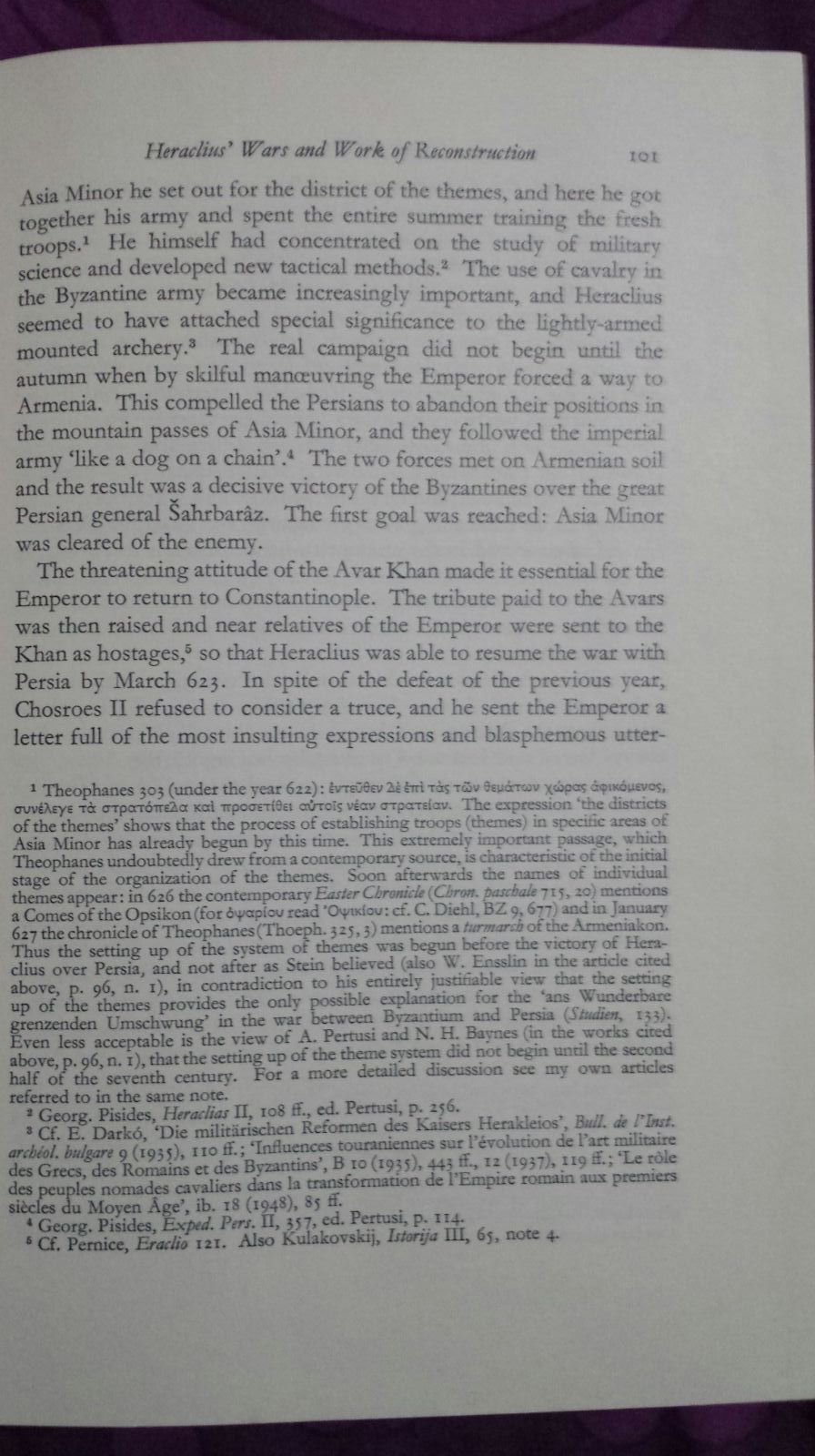
Please note that Sam claims to have read the page, and that the author says “nothing about a decisive victory taking place in the year 622 on that page”. He then proceeded to present the following quote from page 101:

Here is the quote:

“The threatening attitude of the Avar Khan made it essential for the Emperor to return to Constantinople. The tribute paid to the Avars was then raised and near relatives of the Emperor were sent to the Khan as hostages, so that Heraclius was able to resume the war with Persia by March 623. In spite of the defeat of the previous year, Chosroes II REFUSED TO CONSIDER A TRUCE, and he sent the Emperor a letter full of the most insulting expressions and blasphemous utterances against the Christian faith.”

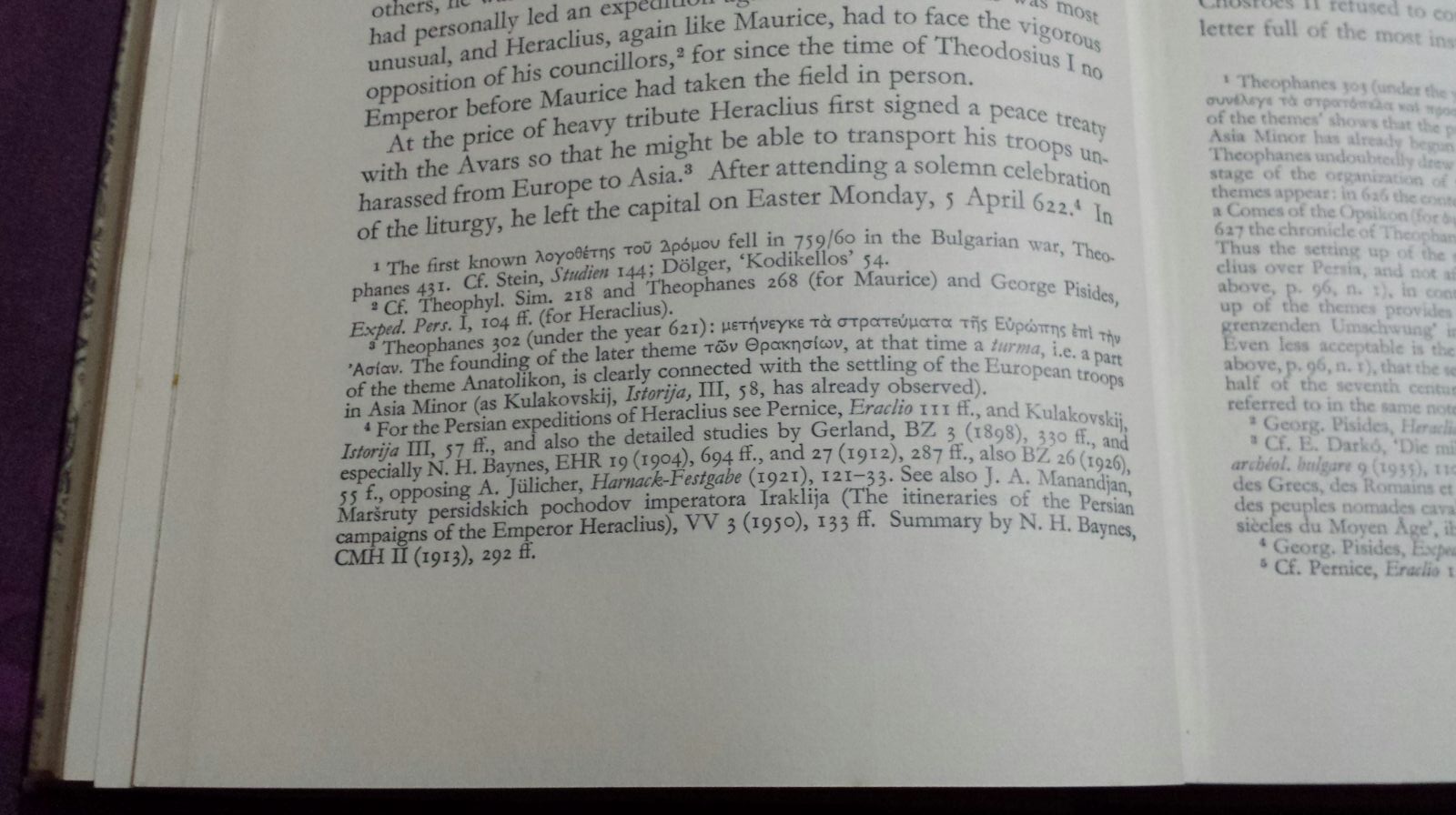
Please take note of where Sam begins the quote. Read and re-read that line. Now here’s page 100:

cc-2015-ss-dec3

What year is the author speaking of? 622 CE. As the book clearly says, “he left the capital on Easter Monday, 5 April 622.” Now, here’s page 101:

cc-2015-ss-dec1

On this page, which is page 101, on lines 11-14, the Ostrogorsky says:

“The two forces met on Armenian soil and the result was a decisive victory of the Byzantines over the great Persian general Sahrbaraz. The first goal was reached: Asia Minor was cleared of the enemy.”

What does this mean? Not only is the quote he claimed on the same page, he has intentionally misquoted the book, by starting his own quotation one line below the relevant quote used by Br. Zakir Hussein! It clearly states that their was indeed a “decisive victory”!

Perhaps though, if Sam had read the very quote he pasted in his article, it speaks about and I quote, “In spite of the defeat of the previous year….”, it really can’t get more obvious than that, does it? The previous year of 623 CE, would be what? (If Sam is reading this, previous means before, so you minus 1 from 623). That would mean 622 CE. What was the defeat in 622 CE? The decisive victory by the Byzantines!

Not only is Sam deceptive for lying about what Dr. Shabir claimed during the debate, and then later shifting the argument to be about a “misrepresentation of Gundry about the Trinity”, when it comes to his own claims, and his own research, Sam is shown to be, in Shamounian terms, quite functionally illiterate.

Sam further alleged in an article, that Dr. Ally needed to be “exposed” and put to shame as a person notorious for “misquoting and mishandling scholars”. Given that Sam has been refuted en toto by Dr. Shabir Ally, and that Sam in this article, has been shown to be notorious of misquoting and mishandling scholars, shouldn’t he then expose and put himself to shame? Perhaps then, this is a case of irony. If Sam spent less time feeding his ego and his stomach, maybe he’d have the cognitive capacity to recognize that attacking people more intelligent than himself is a bad move.

and God knows best.

Sam Shamoun and Lying by Dr. Shabir Ally – Part 1

Shabir Ally

September 30, 2015

During my debate with David Wood on ABNSAT, Sam Shamoun called in to challenge one of my statements. According to my statement, Robert Gundry said that the formula in Matthew 28 does not imply that the three persons, Father, Son, and Holy Spirit share the same name. Rather, the formula means that baptism should be done with fundamental reference to the Father, Son and Holy Spirit. Sam claimed that Gundry wrote no such thing, and he had Gundry’s books to prove it. I pointed out that I was referring to another book by Gundry. But Sam was not convinced by my plea. Rather, he was convinced that I was lying. Hence he wrote to that effect here:

http://www.reformedapologeticsministries.com/2015/09/catching-shabir-ally-red-handed.html?m=1

In that document, Sam cites two books of Gundry, and links to a third, all to prove that Gundry did not voice the view I attributed to him.

However, in each case he is referring to a book other than the one I was referring to. As I am away from my hometown at the moment, I cannot check the reference at the moment, but here is something I found on my laptop that I had written elsewhere complete with a reference to the book I was referring to.

As for the apparent Trinitarian formula of Matthew 28:19, Robert H. Gundry writes that “Matthew seems to be responsible for the present formula.”[1]

As will be immediately clear, this is not the same as any of the three books Sam cited or referred to in his above linked article. It should also be clear that Gundry is saying that Matthew is responsible for the saying whereas we would expect Christians to think that Jesus actually said this.

Sam apparently assumed that the books he came across are the only books that Gundry wrote on the subject. Instead of hastily composing an article claiming that I was lying, he should have asked me for the reference to the specific book I was citing, and then check the reference in that book. As it turns out, people these days are too quick to assume the worst about other people but the best about themselves.

Even if it turns out that the book I was referring to does not contain the material I cited, does this necessitate a charge of lying? Or, could it be a case of citing from memory and recalling incorrectly as humans sometimes do?

During the debate itself, I cited many other books, some of which I had on the desk before me. These too I cited from memory, as is my usual style in debates. I do not claim that my memory is impeccable. However, in how many cases did Sam find a significant discrepancy between my citations and my named sources? If it is just this one, does that require such a serious charge? Is Sam here exhibiting the usual charitableness of Christians? If we go about slinging such uncharitable accusations against each other will that lead to better dialogue and mutual understanding?

When I get back to Toronto, I will check again to see if my memory serves me correctly, and thus that Gundry said what I cited him to say. Otherwise, I will issue a public retraction. But if what I cited is correct, will Sam retract his article and issue an apology for his false accusation?

Meanwhile, it is interesting to know that after Gundry published this critical commentary in 1982, some evangelical scholars called for his resignation from the Evangelical Theological Society. He resigned in 1983.

Does that sound like Gundry was saying in this book what Sam wants to hear?

[1] Robert H. Gundry, Matthew: A Commentary on His Literary and Theological Art (Grand Rapids: Eerdmans, 1982) p. 596.

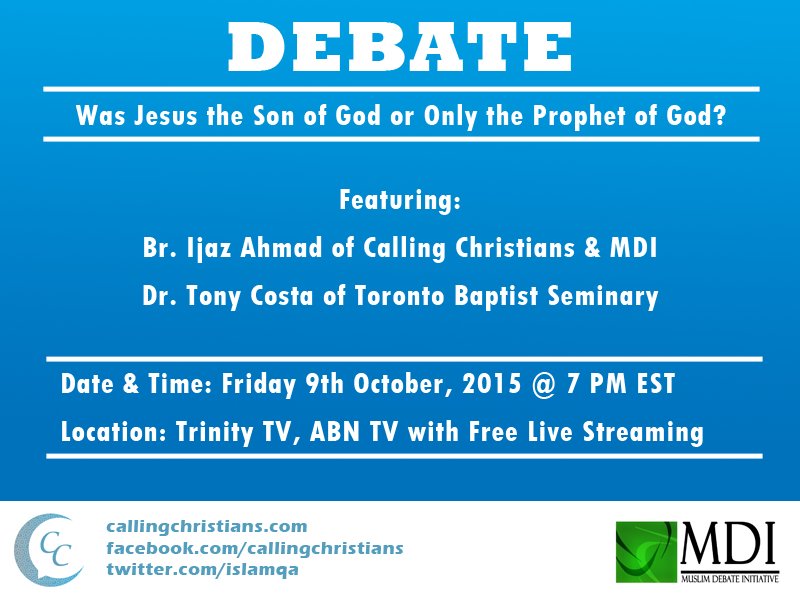
Upcoming Debate: Was Jesus the Son of God or Only the Prophet of God? – Dr. Tony Costa and Br. Ijaz

Quick Information:
Topic: Was Jesus the Son of God or Only the Prophet of God?
Debaters: Br. Ijaz Ahmad of Calling Christians/ MDI and Dr. Tony Costa of the Toronto Baptist Seminary.
Date: Friday 9th of October, 2015.
Time: 7 PM EST.
Location: ABN TV, Trinity TV and YouTube.
Moderator: TBA.
cc-2015-debatewithcosta
Note: Br. Ijaz is not an Imam, the error has been made aware to the channel.
and God knows best.

Upcoming Debate: Is the Muslim Denial of Jesus’s Death by Crucifixion Valid? – Br. Ijaz and Keith of Answering Islam

Quick Information:
Topic: Is the Muslim Denial of Jesus’s Death by Crucifixion Valid?
Debaters: Br. Ijaz Ahmad of Calling Christians and Keith Thompson of Answering Islam.
Date: Saturday 26th of September, 2015.
Time: 10 PM EST.
Location: Paltalk, Answering Christianity Room.
Moderator: Sister Waduha.
A little background on the Christian debater:
keith thompson

Keith Thompson of Answering Islam

Keith Thompson is a Christian apologist who runs Reformed Apologetics Ministries and has been writing for Answering-Islam.org since 2008. He is a debater having debated opponents such as Inamullah Mumtaz, Sami Zaatari, Nadir Ahmed, Peter Dimond and others. He resides in Canada and will be completing his seminary studies shortly.
This will be my (Br. Ijaz’s) third debate for the year, with one final (fourth) debate to be announced shortly. The final debate will be with a well known Christian scholar and will be televised (and is expected to be streamed live). The debate is to be held on Friday October the 9th, 2015 (tentative dating).


If you don’t use Paltalk and would still like to view the debate between Keith and myself, alternative arrangements may be made for a YouTube streaming of the event (tentative), or a recording should be available within a week’s time (on YouTube via Nazam44’s and MuslimByChoice’s channels).
cc-2015-debatewithkiethflyer
If you or someone you know is interested in debating me, do send a request via our contact us form.

and Allah knows best.

A Response to a Review of a Review

After finding no one from the Christian community willing to perform a review of his debate with Dr. Shabir Ally, Jonathan McLatchie has finally taken the onus upon himself to “review” my review of their debate. It is unfortunate that Jonathan believes that I “misheard” or “misread” him, as this is a common excuse he uses when confronted with any criticism. Last month it was brought to the inter-faith community’s attention that Jonathan had described Muslim communities in France as a virus and a cancer to European society. If one were to compare his “review” of his debate, with the excuses used when confronted with his xenophobic statements, we’d quickly realise that Jonathan is being perpetually misunderstood by everyone. At first he claimed he never made such a statement, everyone had simply lied about him! Then, it was a statement he made, but everyone simply misunderstood him! Then, it was a statement he made, but it was not referring to Muslims but a cultural structure of extremism, everyone simply hadn’t given him enough time to explain himself! Then, he posts a video in which Muslims who practise Islam are compared to ISIS terrorists and we’re not supposed to be offended by that. The 19,000 people who viewed that article and the 3500 people that watched that video, all seem to have “misheard” and “misunderstood” him.

As one Christian apologist put it, “Jonathan is simply oblivious to any form of self criticism”. When I announced news that a Christian had accepted Islam following the debate between Dr. Shabir and Jonathan, Jonathan found it impossible that anyone would disagree with his remarks in that debate, such to the extent their faith would be questioned. I remarked to him at that point, that it doesn’t matter what you think of your own arguments, it is up to the audience to decide that. He disagreed, that just could not be a possibility, his remarks were without fault. Jonathan lives in a world, where everyone who disagrees with him, either perpetually misunderstands him, or they misread him, or they mishear him. It’s almost never the case that he has said something wrong, or that he has made a mistake, and this is exactly what we find in his “review” of my review. What sort of debater, reviews someone’s review? I mean, there’s the occasional post-debate rejoinder, but I’ve never seen anyone who considers themselves to be a professional, review their own debate. That’s what the community does, that’s not what the debaters themselves do. Jonathan though, does not like to be criticized, and so when my review criticized him, he could not contain himself.

Let’s take a brief look at some of his claims. He began with saying:

Ijaz briefly summarises Shabir’s opening statement, curiously omitting any mention of the numerous problems with Shabir’s Biblical argumentation (such as his misuse of Greek grammar in regards to John 1:1).

Yet, this is simply deceitful. I didn’t omit mention of Dr. Shabir’s use of Colwell’s rule, as stated in my review:

At this point, Dr. Shabir began to speak on the language used in regard to Jesus in the Gospel ascribed to John. John 1:1c is problematic as the attribution of total deity to the Word (later identified as Jesus), is uncertain due to Colwell’s rule. Grammarians do dispute about the definiteness of attributing deity to the Word in this verse due to the absence of a defining article which the original author purposely left out, this opened the wording and subsequent understanding of the verse to dispute. If the author wanted to ascribe total deity to the Word, then they would not have intentionally left out the defining article and thus, total deity cannot be ascribed to Jesus the Christ given the author’s grammatical intentions.

Let’s take a look at another one of his criticisms, he says:

The first point to note here is that I never stated that “the Bible is a wholly Trinitarian text”. It is my view that one can demonstrate a multiplicity of divine persons from both the Old and New Testaments, while the doctrine of the Trinity reaches its fullest expression in the New Testament where we read of the incarnation of the Son of God.

Yet, this is exactly what he said, I even quoted him and put the timestamp to the exact moment in the video in which he makes this very statement:

(timestamp in video, he says, “The Gospel of our Lord Jesus Christ is thoroughly Trinitarian.”)

If Jonathan believes that the words “thoroughly” and “wholly”, are different, then he must consult a dictionary. They mean the same thing. He should also note, that in my very review, I quoted him as saying, “thoroughly”, so on that basis, where exactly does he believe this was something he did not say? Strangely enough, he proceeded to argue that Dr. Shabir did not pre-empt his appeal to the Bible (read as “scripture”), but he did. One of Dr. Shabir’s most important points was “the texts of scripture”. So while Jonathan may disagree, it doesn’t make him right, to the contrary it makes him seem desperate to create points of imaginative disagreement. Perhaps, what is most puzzling of all, is Jonathan’s inability to see that he is deluding himself. Take for example this statement:

That’s not quite what I said. My first premise was that, from a Muslim perspective, “If Tawhid is true, it must be consistent with the Qur’an.” My second premise was that Tawhid is not consistent with the Qur’an.

What’s not quite what he said? At this point, he mentions that I presented his premises for this particular argument incorrectly, yet when we read what I wrote, I literally wrote, word for word, the exact same words that he used:

P1 – If Tawhid is true, it must be consistent.
P2 – Tawhid is not consistent.
C  – Therefore Tawhid must not be true.

The exact same words he uses to dispute what I wrote, are the exact same words I wrote. How then, is this “not quite what I said”? If this is not being deceitful, then what is? I find this to be desperation of the grossest order. Jonathan then made, what I consider to be one of the most absurd comments I have ever heard:

Yes, this is a Modus Tollens argument. I don’t know why Ijaz seems to think that the need to demonstrate the truth of the premises in order to support the conclusion is a problem with this manner of argumentation.

I don’t know if he understands how logic works, but one needs to qualify their premises before assuming the conclusion as being true. This is referred to as sequential logic. Your individual premises must be consistent, before your conclusion could be seen as true (or valid). My criticism, was that he did not qualify his premises, thus his conclusion was contrived. I do not understand how he can disagree that he needs to first prove his claims before arriving at a conclusion. This is common sense. He then went on to state:

The only problem is that I did not make this argument in my opening statement at all. I noted that Nabeel had made this argument in his debate with Shabir, and that I was going to be making a different argument instead.

What argument is he referring to? He’s referring to the argument that the Qur’an is the incarnate word of God. Yet, his disagreement here is unfounded and is again, something derived from the depths of his imagination. In my review, I did not claim that he made this argument, I specifically said that he referred to it:

All he did was refer (timestamp in video, he says “Those who saw Shabir’s debate with Nabeel Qureishi would’ve been exposed to the problems with reconciling the eternality of the Qur’an with the doctrine of Tawhid.”) to the argument that Nabeel used regarding the Qur’an being the eternal word of Allah, yet physical and created.

Perhaps he needs to check the definition of the word, “refer”, for this disagreement makes absolutely no sense to a reader with a command of simple vocabulary. Reading comprehension is not difficult and it should not be this difficult for Jonathan. He then spent an inordinate amount of time attempting to validate his bad argument that the Spirit (of God) is the same as Allah. Yet, he does not validate his bad argument, he merely repeats it without meaningfully responding to the criticism leveled against it. As the Qur’anic verse itself mentions, God the one true Creator, sent the Spirit as a messenger to Mary. The Spirit itself cannot create of its own volition, it is an agent of creation, in the same way the Angel of Death is an agent of the opposite of creation, death. According to Jonathan’s logic, if an agent of God does something by God’s will, this means that the agent is itself also divine. If we follow through with this logic, since the Angel of Death takes away life, does this also mean the Angel of Death in Christianity (the archangel in 1 Thess. 4:16) shares in the divinity of God? According to Jonathan it does, and hence his Trinity now includes a 4th person that shares in the divinity of the other three persons.

Interestingly, Jonathan provides a quote from a commentary that doesn’t address this response at all. The commentary does not mention anything about agency of power or authority, and so while I am thankful he has atleast tried to quote something, what he quoted was irrelevant and useless. His argument remains, really bad. As with the other recommendations in this article, I highly encourage him to learn about God’s ontology in Islam and in Christianity. An agent of God has no inherent power or ability, except by the will of God, in which those powers or abilities are temporal, and by such a definition they could never be in and of themselves, “divine” or of a “Godly” nature. Rather agents of God are temporal in their very attributes and as such, cannot and do not share in the divinity of God. Jonathan attempted to say he addressed this argument by presenting a verse which mentions the phrase, “My Spirit”. It was at this point I gave up any hope that Jonathan was being serious and I began to realise that his article was satirical in nature. I mean, it can’t be that he didn’t realise that the Qur’an uses, “Spirit” in different contexts right, and that not every reference to the Spirit refers to the Holy Spirit (Angel Gabriel), right? It can’t be that he merely saw the word “Spirit” and assumed it meant the same thing throughout the entire Qur’an, while being used in different contexts and forms. Yet, this is exactly what he did. I fully believe he searched an English translation for the word “Spirit” and assumed every instance of it referred to the Holy Spirit in Islam. Ergo, not only was his initial argument bad, so was his response and so was his depth of research and understanding of the Qur’an.

Jonathan proceeded to mention that he didn’t think one of his arguments was circular, he says:

There is no way in which the above argument can possibly be construed as circular. The Qur’an makes a prediction about what we should expect to find (namely, that the disciples believed Islamic doctrines such as Tawhid). I then set out to falsify this prediction, in my judgement successfully. Nothing circular about it.

Edit:

I incorrectly referred to this form of argumentation as circular because I viewed the first premise as entailing itself, “If Tawheed is inconsistent”, which is self-reliant and thus circular. In other words it entailed itself, despite being in the form of modus ponens. After discussing with our resident scholar, I (Br. Ijaz) am indeed wrong. Although the first premise is indeed invalid (it does not logically follow if Tawheed could be inconsistent, that the Trinity is true), and needs to be qualified, the form is valid, but the first premise needs to be proven. So the argument itself is invalid, but the form correct. Apologies to Jonathan for this error.

End of Edit.

He went on to say, concerning the dominance of the companions of Christ:

But the Qur’an does specify that Allah would “place those who follow [Jesus] above those who disbelieve up to the Day of Resurrection.” This strongly suggests a continuity of dominance, right from day one.

Where does it specify what form the dominance would take? It doesn’t. Which is what I mentioned in my review of the debate. Where does it specify in the Qur’an what form the dominance takes? He chose not to answer this question, even though claiming this is what he was doing, rather he chose to mention that some Tafseer commentators agreed with him. Perhaps he should mention that those commentators presuppose that belief, with first believing that Paul’s true teachings, like Christ’s, became corrupted by later Christians. I fully believe he did not do his research on this topic and at this point, he’s repeating himself without addressing my criticisms. Lastly, he said:

Ijaz offered no comment on the third argument I presented in the debate, namely that the Injeel (i.e. the gospel) is Trinitarian and that the Injeel is affirmed by the Qur’an.

I actually did offer a comment on it, from my review, I said:

If we were to identify his main arguments, they would be easily recognizable by anyone who is familiar with Islamic and Christian inter-faith discourse, namely that the Qur’an validates the New Testament, that the disciples believed Jesus was God and that the Bible is historically accurate. He did not present any new arguments, nor any new research, nor did he seek to upgrade any of the arguments he copied from other Christian debaters.

In conclusion, Jonathan’s review of my review, is a bad attempt at trying to defend his poor arguments used in his debate with Dr. Shabir. At the most, he merely repeated himself, and at the worst he claimed he was misheard. Unfortunately for him, I was able to quote him word for word, and cite numerous places from my review in which I did address the concerns outlined in this review of his. All in all, this comes down to a lack of professionalism. If the Christian community is unwilling to do a review of his debate, and he is left to respond personally to everyone who criticizes him, this says a lot about the community’s perception of his role as a Christian apologist.

and God knows best.

Debate Review: What is God Like – Tawhid or Trinity? – Dr. Shabir & Jonathan McLatchie (Part 1)

At the outset, it’s best to say that if you saw Dr. Shabir’s debate with Nabeel on this topic and if you saw Jonathan’s debate with AbdurRaheem Green, also on this topic, then there was no real need for this debate. Most of what each speaker presented was contained within those two previous debates. There were no new arguments from either debater. Although touted as a dialogue, Jonathan’s approach was more debate minded, whereas Dr. Shabir was laid back and more or less relaxed in his use of technical arguments (compared to his demeanor and approach in his debate with Nabeel).

Dr. Shabir’s Introduction

He began by repeating the same three points he articulated in the debate with Nabeel.

  • T – for the text of scripture.
  • H – for history.
  • R – for reason.

Dr. Ally argued that according to the Bible, God declared that He was not a man and that only He should be worshiped. This God whose name we do not know with certainty, but whom we refer to as Yahweh due to combining the consonants of the tetragrammaton with the name of Adonai (Lord), cannot be Jesus as Jesus is a man. To further his point of allowing scripture to interpret scripture, he mentioned that there can only be one Yahweh and according to Isaiah 42, Yahweh sends his servant, this servant is identified as Jesus in Matthew 12. Thus, Jesus cannot be Yahweh as the Bible identifies him as the servant which Yahweh sends. He further argues that according to the Christology of the New Testament, Jesus is an intermediary of God who the Jews came to identify as an agent of creation. The language of the New Testament is also vague regarding Jesus’s station. He is constantly referred to as Lord, which is a term used to describe humans of varying stations. The term Lord in and of itself cannot deify someone.

At this point, Dr. Shabir began to speak on the language used in regard to Jesus in the Gospel ascribed to John. John 1:1c is problematic as the attribution of total deity to the Word (later identified as Jesus), is uncertain due to Colwell’s rule. Grammarians do dispute about the definiteness of attributing deity to the Word in this verse due to the absence of a defining article which the original author purposely left out, this opened the wording and subsequent understanding of the verse to dispute. If the author wanted to ascribe total deity to the Word, then they would not have intentionally left out the defining article and thus, total deity cannot be ascribed to Jesus the Christ given the author’s grammatical intentions. In John 20:17, Jesus allegedly states to Mary Magdelene that he was ascending to “my God” and “your God”, thus denying that he was God himself. We also see where during the time of Paul, he himself was also deified, as within his historical milieu he was considered Zeus and sacrifices were offered to him as attested in Acts 14.

Dr. Shabir focused more on the text of scripture, than the other two points of history and reason. I do believe that he should have reduced the amount of time he spoke on the Bible, as logically, once he established that the scripture was both historically unreliable and not reasonable, he would have negated the authority of the scripture itself. While his three pronged argument of THR is intelligent and concise, I do disagree with the acronym he chose and the order in which he articulated those points. He would have known that Jonathan would have heavily depended upon quoting the Bible as a proof for his beliefs, and I expected that he would have pre-empted this appeal to authority by demonstrating the use of the Bible as an authoritative source as useless. Thus, leaving Jonathan without any credible options of arguing in favour of the Trinity, as he would not have any other arguments in store but for appealing to the Bible. I used this approach myself in my debate with Chessie Edwards, who admitted after the debate that the rug was pulled from under him, and he could not articulate his belief in Jesus as a God, beyond appealing to the Bible.

The reason for doing this, is that once one allows a Christian to appeal to the Bible, the debate becomes focused on interpreting the Bible. Which would mean that the debate would be about whose interpretation was more correct and not many people will be convinced of a Muslim interpreting their scripture for them. I adopted this reasoning from Professor Burton Mack who argued that we should not allow an appeal to the New Testament to count as an authoritative argument. I highly suspect that Dr. Shabir chose to ease the burden of Jonathan, by sticking to basic, common, popular arguments which would be simple. The reason for this is twofold, primarily because he may have felt the debate of the same topic with Nabeel would have been too technical and thus alienated his core audience, and secondly, he may have wanted to take it easy on Jonathan given this was his first stage debate. Dr. Shabir is quite a kind person and he does not argue to win, but more to build relationships and to open the floor to dialogue and understanding. This isn’t a fault, but some may misconstrue his kindness as being lax with missionaries. My only other complaint would be that he did not spend much time speaking on Tawhid, while he did qualify the Trinity as a problematic belief, he did not dedicate enough time to offering the belief of Tawhid as a superior doctrine.

Jonathan’s Introduction

He began by defining what the doctrine of the Trinity was. This is something I strongly agree with, opening a debate by delimiting the scope of the discussion. As a proponent of socratic thinking, this was a pleasant and welcomed feature of his presentation. As previously mentioned, it was expected that Jonathan would base his arguments about the nature of God by mainly appealing to the Bible. He opened by declaring that the Bible was a wholly Trinitarian text (timestamp in video, he says, “The Gospel of our Lord Jesus Christ is thoroughly Trinitarian.”), which unfortunately for him, was pre-empted by Dr. Shabir who demonstrated it was not, thus Jonathan’s first argument was already weakened by Dr. Shabir. Jonathan then presented three other arguments which he felt negated the validity of the doctrine of Tawhid.

  • Tawhid has its own internal problems.
  • The disciples were Trinitarian.
  • The Injeel is Trinitarian.

Of his first argument, he stated:

P1 – If Tawhid is true, it must be consistent.
P2 – Tawhid is not consistent.
C  – Therefore Tawhid must not be true.

Technically, this (form of argument) is referred to as Modus Tollens. The problem here, is that you have to prove the premises before you can qualify and validate your conclusion which is expected to be a tautology. In attempting to do this, Jonathan disappointed me greatly. All he did was refer (timestamp in video, he says “Those who saw Shabir’s debate with Nabeel Qureishi would’ve been exposed to the problems with reconciling the eternality of the Qur’an with the doctrine of Tawhid.”) to the argument that Nabeel used regarding the Qur’an being the eternal word of Allah, yet physical and created. I was disappointed because this is an argument copied from Jay Smith, which Samuel Green tried to use on me in my debate with him, which Nabeel later picked up and tried to use against Dr. Shabir. The problem here is that Dr. Shabir already addressed this argument, and so have I. Jonathan merely repeated Nabeel’s poor argument. He did not try to revamp the argument, he did not add anything to the argument, he did not articulate it differently, he did not try to incorporate Dr. Shabir’s response to Nabeel into the argument. He quite literally just repeated the argument, which was already responded to. Naturally, I would expect, that if he did his homework and decided to use an argument which was already refuted, that he’d adjust the argument in some way. He didn’t do that. He presented nothing new. It was at that point I wondered why he even offered to debate the same topic if he was merely going to repeat the same points from the previous debate of the same topic by offering nothing new.

At this point, he presented another argument, namely that there are other creators other than Allah. He did not seem to understand that what he presented was the fallacy of false equivalency, wherein the Qur’an mentioned numerous times that there were agents of God who had abilities attained by the “leave/ permission of Allah”, which are temporal and not absolute. Logically, this would mean their abilities are not inherent and eternal, but appropriated by God, thus his argument was non-sequitur from the get go. I firmly believe that he did not critically consider this argument beyond a cursory copy and paste from Answering Islam’s website. Ironically, he attempted to present this argument in syllogistic form, but the argument was inherently non-sequitur due to its format including the fallacy of false equivalency. How he did not realise this, was impossible to understand, if he is using logic, he should know what fallacies are and how they inhibit his premises. What’s troubling is that in the same sentence he declares that Allah has no partners, then states in the same breath that the Holy Spirit shares in the divinity of God. That’s a contradiction, so either it is his argument and conclusions were wrong, or he forced a false conclusion which he himself did not notice.

His second argument was that the disciples of Jesus were Trinitarian. Interestingly, I had a debate on this topic earlier in the year and demonstrated that according to the proto-orthodox Christian tradition, the disciples were definitely not Trinitarian. At this point he introduced a very strange argument.

P1 – If the Disciples of Jesus were Trinitarian then the Islamic concept of God is false.
P2 – The Disciples of Christ were Trinitarian.
C   – Therefore the Islamic concept of God is false.

Jonathan cannot make such an argument and believe that he is arguing logically. This is known as the fallacy of circular reasoning. What is worse was his attempt at drawing out the logical routes. He presumed that Dr. Shabir could refute his argument in one of two ways, firstly that the disciples were later misled or secondly, that the disciples were overcome (by other groups). Jonathan posited that the second option was impossible as the Qur’an says they were victors. The problem therein with his reasoning is that the Qur’an does not say in what way they were victors. He assumes that it has to be in the promulgation of their beliefs, which the Qur’an does not state itself. It is alleged that the early Christians were persecuted and the religion did not become “accepted” until Constantine’s conversion. According to Jonathan’s appeal to the Qur’an, he alleged that the Qur’an mentioned the disciples of Christ were victorious. Yet the Church was not accepted or mainstream until 300 years after them, so in what way were the disciples victorious according to his reading of the Qur’an? It would then mean that his interpretation was wrong, given that victory was not achieved as he understood it to be during the time of the disciples and so the victory being referred to here is not what he is asserting. The victory may have very well been that they themselves held on to their true faith despite persecution and in this way they were victorious in the sight of God. I do not believe that Jonathan spent more than a minute thinking of this argument, for if he did so, he’d realise instantly that the disparity between his idea of the normative proto-orthodox Church’s “victory” and that of the disciples exceeded the bounds of the Qur’an’s teaching.

At this point, he began to appeal to the New Testament as a historical witness, but for those of you familiar with Dr. Shabir’s works and my own, we already know that the New Testament en toto is not historically viable nor accurate. I have explicitly explained this in great detail in my debate with Steven on the very topic of the beliefs of the disciples using palaeography, papyrology, form criticism, textual criticism and historical criticism. The following links should be sufficient to refute his appeal to the New Testament as a historical witness, especially in his appeal to the Patristics:

He began to close his argument by referring to hadith criticism’s use of the isnad or chain of transmission. Unfortunately, he merely referred to the use of the chain of transmission by Islamic scholarship, what he utterly failed to do was qualify the authority of these alleged chains of transmission by applying the methods of hadith criticism to the chains themselves. I myself did this in my debate with Steven, in fact this was one of the arguments I researched in great detail and whose historicity the early Church itself disputed. Thus, by both Christian historical traditions and the methodology of hadith criticism, the chains of transmission in regard to John used by Jonathan are known to have been falsified and are historically inaccurate. I do not believe that Jonathan spent more than a few minutes constructing this argument, nor do I believe he consulted any major works of Patristic criticism, especially due to the reason his sole academic source seemed to be Richard Bauckham, whom I also referenced in my debate. I do believe he rushed through this portion of his opening statement, and I do not believe he himself knew in any great detail the methodologies of hadith criticism, and so his appeal to this Christian isnad was mere buzz word dropping.

What can we take away from Jonathan’s presentation? We need to take into consideration that this was his first stage debate and this was a debate with Dr. Shabir of all people. With that in mind, his preparation was not up to standard and he seemed to rely on previously used arguments from Nabeel’s debate and his debate of the same topic with AbdurRaheem Green. If we were to identify his main arguments, they would be easily recognizable by anyone who is familiar with Islamic and Christian inter-faith discourse, namely that the Qur’an validates the New Testament, that the disciples believed Jesus was God and that the Bible is historically accurate. He did not present any new arguments, nor any new research, nor did he seek to upgrade any of the arguments he copied from other Christian debaters. Most of his presentation seemed to comprise of quickly assembled syllogistic arguments that were not critically assessed or put together with much thought and research behind them. He did not seem to put a lot of effort into his opening presentation, it almost seems rushed and half done, with most of his content directly sourced from his debate of the same topic with AbdurRaheem Green. I really wonder if he thought AbdurRaheem Green and Dr. Shabir were on the same level of study about the Christian religion. That is the impression he gave me. I strongly believe that he did not prepare his debate statement with Dr. Shabir’s education in mind.

One major difference between this debate and the one with AbdurRaheem Green was Jonathan’s comfort level. He certainly seemed uneasy and nervous, and at times he just appeared to be uncomfortable with addressing the crowd. His nerves may have gotten the better of him. Most notably, he rushed through his presentation, he spoke quite quickly and I fear that coupled with his accent, most of the audience would not have followed what he said. In contrast, Dr. Shabir almost seemed to be too relaxed and at times engaged with persons in the audience. As a Muslim though, I do not believe that Jonathan stuck to the topic. Although he began with defining the Trinity, he never really explained or spoke about the teachings of the Trinity, how they made sense, what the value of the Trinity was, why God would or could be a Trinity, how the Trinity was superior to Tawhid. Rather, what I got from Jonathan’s presentation is everything but the Trinity itself. His entire focus seemed to be on establishing that the Trinity was historically viable through the teachings of the Qur’an, and in doing so, he never dealt with the Trinity itself. I did not gain any new knowledge about the Trinity, I didn’t hear him speak on the reasoning of why God had to be a Trinity of persons or how it was possible for an immutable and impassible God to become a man and suffer. Jonathan just seemed to miss the mark spectacularly. As a Muslim, Jonathan’s opening simply did not present the Trinity to me and that is perhaps his greatest failure in this debate.

In Part 2, I’ll cover the Rebuttals.

and God knows best.

« Older Entries Recent Entries »