Tag Archives: Bible

The nude young man of the Gospel(s)!

بِسۡمِ ٱللهِ ٱلرَّحۡمَـٰنِ ٱلرَّحِيمِ ,

The nude young man of the Gospel(s)!

Investigating the weird presence of a mysterious man with biblical Jesus (peace be upon him)

Question Mark

Introduction

It was one of the most critical juncture in biblical Jesus’ (peace be upon him) life time. Only a few hours before he was to be confiscated by the colluded forces of Jewish elders and Roman authorities; Jesus (peace be upon him) was in the garden of Gethsemane with a “distressful”, “anguished” heart “crushed under sorrow” (Mark 14: 33-34).

Given the ponderous situation, Jesus (peace be upon him) wanted, as naturally expected, his most loyal and some of the best disciples to accompany him in the garden. He bestowed Peter, James and John with the privilege (Mark 14:33).

However, mysteriously Jesus (peace be upon him) was also followed by an hitherto unknown person:

And they all left him, and fled. And a certain young man followed with him, having a linen cloth cast about him, over his naked body: and they lay hold on him; but he left the linen cloth, and fled naked. (Mark 14:50-52, Revised Version)

Then all the disciples left him and ran away. A certain young man, dressed only in a linen cloth, was following Jesus. They tried to arrest him, but he ran away naked, leaving the cloth behind. (Mark 14: 50-52, Good News Edition)

The above “verses” perfunctorily looks simple. However, it entails with it rather intriguing and important queries:

  1. Who was this “young man”?
  2. Why did he dress up so unusually with only a thin linen sheet covering his nakedness going to otherwise public place – the gardenof Gethsemane, under sensitive setting of seizure of Messiah (peace be upon him) who was to be put to death?
  3. What motivated this young man to endanger his life by following Jesus (peace be upon him) in that risky situation?
  4. Did he “follow” Jesus (peace be upon him) as his disciple?
  5. If he was a disciple, why was he not introduced before?
  6. Furthermore, except Mark, why are every other New Testament author, including the gospel authors, absolutely silent about him?

Moreover,

  1. Why did the “Holy Ghost” felt it now important enough to mention him who was hitherto un-introduced?
  2. What did the author achieve by mentioning the young man in not more than two “verses” in the “God’s word”? After all every portion of scripture has to attain some objective (2 Timothy 3: 16-17)
  3. Why did the “Holy Ghost” inspire the author to stress on young man’s dress that he was wrapped in only a linen sheet – implying and later expressly informing that he was naked underneath?

Yet further,

  1. The abrupt appearance of an unusual man out of nowhere in the gospel;
  • Does it allude that these “verses” are a result of interpolation?
  • Or, does it prove that there was much more in the gospel of Mark than which survived in the “New Testament”; and the presence of the young man is just an allusion of that larger, more elaborative gospel of Mark now lost for good!?

The queries are numerous around otherwise innocent looking only two verses long “God’s word”! However, there simply isn’t enough information in the New Testament(1.) about the young-man to answer the above queries. As Bible expositor Albert Barnes noted, “A certain young man – Who this was we have NO means of determining” (Albert Barnes’ notes on the Bible, Mark 14:51)

Nevertheless, (not) surprisingly we do have ancient Christian writings which directly allude to the intriguing only linen laden otherwise nude young-man. Even more interestingly, these writings were also authored by the same author Mark (!) – remember no other author in the entire New Testament has referred to this young-man except Mark – entitled as the “Secret Gospel of Mark”.


Secret gospel of Mark 


New Testament giant Morton Smith made a remarkable discovery of a letter from Clement of Alexandria – an early (merely second century), influencing and “orthodox” church father. The Clementine letter was discovered in one of the not-so-easily-accessible monasteries in the so-called “Holy Land”! This was an orthodox monastery in Mar Saba.

In the letter, Clement alludes to the circulation of several other versions of gospel of Mark in Alexandria during his time:

“Clement indicates that Mark wrote an account of Jesus’ public ministry based on his acquaintance with the apostle Peter in Rome; in his Gospel, however, Mark did not divulge the secret teachings of Jesus to his disciples. But after Peter was martyred, Mark moved to Alexandria and there composed a second“more spiritual Gospel” for those who were more spiritually advanced. Even though he still did not divulge the greatest secrets of Jesus’ teachings, he did add stories to his Gospel to assist the Christian elite in progressing in their knowledge of the truth.

According to this letter, in other words, there were three versions of Mark’s Gospelavailable in Alexandria: the original Mark (presumably the Mark we are familiar with in the canon); a Secret Mark, which he issued for the spiritually elite; and a Carpocratian Mark, filled with the false teachings of the licentious heretic. (Bart Ehrman, Lost Christianities, p. 73)

It was a quotation from “Secret Mark” which Clement cited in his letter and which eventually has relevance to our mysterious, only linen laden young-man. Consider the following intriguing account from the “Secret Mark” which took place just after the “canonical”New Testament Mark 10:34:

They came to Bethany, and a woman was there whose brother had died. She came and prostrated herself before Jesus, saying to him, “Son of David, have mercy on me.” But his disciples rebuked her. Jesus became angry and went off with her to the garden where the tomb was. Immediately a loud voice was heard from the tomb. Jesus approached and rolled the stone away from the entrance to the tomb. Immediately he went in where the young man was, stretched out his hand, and raised him by seizing his hand. The young man looked at him intently and loved him; and he began pleading with him that he might be with him. When they came out of the tomb they went to the young man’s house, for he was wealthy. And after six days Jesus gave him a command. And when it was evening the young man came to him, wearing a linen cloth over his naked body. He stayed with him that night, for Jesus was teaching him the mystery of the Kingdom of God. When he got up from there, he returned to the other side of the Jordan. (Bart Ehrman, Lost Christianities, p.74)

We pointed out earlier the abrupt presence of the “young man” in the “canonical” gospel of Mark. However, if we accommodate the notion that Mark actually wrote a much larger version comprising of the canonical gospel of Mark and the Secret gospel of Mark; then we then find a confluent flow of the text.

Now we have a context in which the mysterious “young man” is no more mysterious! We now know that he was a dead man in Bethany and Jesus (peace be upon him) raised him up miraculously upon the request of his sister. Consequently, he became a disciple of Jesus (peace be upon him).

Although we may now know who this young-man was, yet we do not know why he chose to wear just a linen cloth? We still need to investigate this. It is a fact that every human wearing any cloth, let alone a linen wrapping, would be nude underneath it. Thus, it is intriguing to note that the author Mark chose to emphasize that the man was nude under his linen wrapping in both his “canonical” and “Secret” works!

On the foregoing, Christian scholars, not Muslim “propagandists”, have asserted that (i) young-man’s unusual dressing sense (ii) his overnight stay with Jesus (peace be upon him) and (iii) Jesus (peace be upon him) “teaching” him “mysteries” of Kingdom of God the whole night; have homoerotic overtones:

It is this newly recovered story which has caused the greatest stir in connection with Smith’s discovery. For even though it is similar to stories in the canonical Gospels, such as the raising of Lazarus in John 11 and the story of the rich young man in Mark 10, there are significant differences. And some of the differences, especially near the end, have appeared to some interpreters, notably Smith himself, to have clear homoerotic overtones. Jesus becomes acquainted with a young man who loves him and who comes to him wearing nothing but a linen cloth over his naked body. Jesus then spends the night with him, teaching him about the mystery of the Kingdom. What is that all about? (Bart Ehrman, Lost Christianities, p. 74)


These Christian scholars could see erotic insinuations since they somehow see its roots in the New Testament itself; it was indeed a Christian (cult) practice in early churches to get “baptized” nude and unite with Christ (peace be upon him):

[Morton] Smith is struck, quite understandably, by the fact that the young man comes to Jesus wearing nothing but a linen cloth over his nakedness. That sounds like someone coming forward for baptism, since in the early church, people were baptized, as adults, in the nude (after taking off a simple robe worn to the ceremony). Now the Synoptic Gospels of Matthew, Mark, and Luke do not indicate that Jesus baptized people. But the Gospel of John indicates that he may have done so (John 3:22; 4:1–2).Moreover, the apostle Paul talks about baptism and indicates that at baptism a person is somehow “united” with Christ (Rom. 6:1–6). Did Paul, after Jesus’ death, make up such a view himself? No, argues Smith, it was a view known to Jesus’ followers before his death, because it was Jesus’ own view. Jesus himself baptized people, and in that baptism they came to be united with him. (Bart Ehrman, Lost Christianities, p.80)


Authenticity


The easiest way out for Christians is to simply discard the letter of Clement as fictitious (2.). However, there is sizeable Christian scholars who do consider the Clementine epistle to be authentic!

Morton Smith being the scholar that he was had the following consensus of scholars:

But how could one establish that the letter was from Clement rather than, say, from a forger pretending to be Clement hundreds of years later (who fooled, then, the eighteenth-century scribe who copied the letter)? The first step Smith took in answering the question was to show the letter to scholars who were experts in Clement, who had spent their lives studying Clement, who would recognize a new work by Clement simply on the basis of its subject matter and writing style. When he did so, the majority of the experts agreed, this looked very much like something Clement would write. If someone had forged it, she or he had done highly credible work. But how could one know for sure? The only way to decide is by making a careful point-by-point comparison of the vocabulary, writing style, modes of expression, and ideas found in the letter with the vocabulary, writing style, modes of expression, and ideas found in the writings known to have been produced by Clement. This, needless to say, is not a simple task, not the sort of thing most people would care to undertake. But Smith did it. One word at a time. It was slow, arduous, painstaking work of many years. The results are published in his scholarly volume, and they are impressive.

This was not an easy kind of work to produce in the days before computers. But Smith was able to use this and similar resources to determine whether his discovery followed Clement’s writing style and used his distinctive vocabulary and whether it ever used a style or words uncharacteristic of Clement. The end result was that this letter looks very much like something Clement would have written. In fact, it is so much like Clement that it would be well nigh impossible to imagine someone other than Clement being able to write it, before tools like those produced by modern Clement scholars such as Stählin were available. Smith’s verdict was that the letter actually was written by Clement of Alexandria. (Bart Ehrman, Lost Christianities, p. 77-78)

Smith went on to establish that not merely was the Clementine letter authentic (3.)but that the Markan quotation was also in line with author Mark:

But were the quotations of Secret Mark in this letter of Clement actually written by the author of the Gospel of Mark? Here again, it is a question of vocabulary, writing style, modes of expression, and theology. A careful analysis of the quotations of Clement indicates that these passages, while not in the style of Clement himself, are very much in the style of Mark as found in the New Testament. (Bart Ehrman, Lost Christianities, p. 79)

At the outset, however, I should emphasize that the majority of scholars Smith consulted while doing his research were convinced that the letter was authentic, and probably a somewhat smaller majority agreed that the quotations of Secret Mark actually derived from a version of Mark. Even today, these are the majority opinions. (Bart Ehrman, Lost Christianities, p. 81)

To add more value to the genuineness of the letter, it is fact that the letter is now out-of-sight from the library of Mar Saba which ironically had always been a highly restricted area!

Some years later, someone told Stroumsa of a rumor that the letter of Clement had been cut out of the book for “safe-keeping.” Stroumsa called the librarian at the Greek Patriarchate and was told that it was true. He himself had done just that. And he now did not know where the pages were. And that’s the end of the story. Did the librarian hide the pages, to keep scholars from rifling through the monks’ treasured possessions looking for lost Gospels? Did he burn the pages simply to get them off his hands? Where are they now? Do they still exist? I’m afraid that as of this moment, no one appears to know. Maybe that will change. What is certain is that no one has carefully examined the book itself, and it may be that no one ever will. (Bart Ehrman, Lost Christianities, p.84)

The “loss” of such a critically acclaimed antique letter, in this age of science, technology and preservation points forcefully to the fact that there was something(to say the least) which was rather embarrassing to the “orthodox” Christianity. Otherwise how and why would a letter of antiquity be “lost” – just like that, from a highly restricted and reserved site!

As if these were not enough, we even have scholars who assert on “good reasons” that the nude companion of Jesus (peace be upon him) was the author Mark himself (!):

“His disciples failed Him, but as He submitted to the Father’s will His spirit rose triumphant. Sleep on now-the past is irrevocable. The disciples fled as fast as their feet would carry them. If only they had prayed, they would have been steadfast and unmovable. There are good reasons for supposing that the young man mentioned here was Mark himself.” (Mark 14:32-52, Alone in the hour of Trial, Through the Bible Day by Day by F.B. Meyer)

F.B. Meyer is not the only scholar, even Robertson concurs with him:

A certain young man (neaniskos tis). This incident alone in Mark. It is usually supposed that Mark himself, son of Mary (Act_12:12) in whose house they probably had observed the passover meal, had followed Jesus and the apostles to the Garden. It is a lifelike touch quite in keeping with such a situation. Here after the arrest he was following with Jesus (sunēkolouthei autōi, imperfect tense). Note the vivid dramatic present kratousin (they seize him). (Mark 14:51, Robertson’s Word Pictures)

It cannot, therefore, be mere coincidence that (i) we have “Holy Ghost” only inspiring Mark about the young man, (ii) the secret gospel is also attributed to Mark with a good level of authenticity and (iii) multiple orthodox conservative scholars asserting that the nude man was Mark himself!It is all Mark, Mark and Mark!

Christians might reject it on “obvious” grounds however, the preceding chain of observations strongly imply that the nude man’s presence in the garden had some pretext not worthy of mention in the “canonical” gospel!

Furthermore, let’s apply the Principle of Embarrassment to the incident of nude man. We are applying the Principle since Christian apologists love applying it against Islam especially when they deal with the issue of “Satanic Verses”. So we thought of applying the same on Christianity as well.

The following Christian polemical source defines the Principle for us:

Principle of Embarrassment: is a principle that is employed to validate the trustworthiness, authenticity, and truthfulness of any historical document. Christian apologetics also applies this principle to determine the historicity of the events described in the Bible. When a source (s) that can potentially damage/s its case admits something embarrassing, these assertions are unlikely to be invented or fabricated. (CAFN)

Based on the observed facts that we have, namely, (i) a “Christian” text, (ii) found in highly restricted “Christian” monastery, (iii) discovered by “Christian” scholar, (iv) approved by “Christian” academia, (v) attributed to “inspired” “evangelist” Mark himself!, it can be concluded on the lines of Principle of Embarrassment that the text could not possibly be an invention or fabrication.

Conclusion


In the last few pages of the canonical gospel of Mark we found bizarre presence of a mysterious young-man. Hitherto, unknown in the gospel (or in any of the gospels for that reason)! Neither did we have any clue as to who he was nor were we given any context alluding to this weird person.

Moreover, out of nowhere, we find him in the one of the most critical place with one of the most important man in Christianity – Jesus (peace be upon him). What he was doing in such a risky place – the garden of Gethsemane – where authorities came to handcuff Jesus (peace be upon him) to put him to death!

The young-man’s presence made the flow of the gospel rather jerky and as such it pointed to either of the two possibilities: (i) either, for some unknown reason, the verses concerning the young-man was interpolated in the text of the gospel or (ii) the gospel itself was a crafty redacting/editing work of a larger text. Both the conclusions raises question on the preservation of the so-called “Injeel”.

On the foregoing [point (ii)], the unaccounted and abrupt presence of the young-man was easily explained when we allowed that at one point of time the gospel of Mark was much larger than the present one.

However, besides explaining the identity and purpose of the young-man, this larger version of gospel of Mark also added the embarrassment of “homoerotic overtones” upon Jesus (peace be upon him) – the second god of the Trinitarian godhead. To add more chagrin, Christian scholars consider the narration to be genuine.

Of course, as a Muslim, based on the information of Qur’an and Hadith, we do not believe that Jesus (peace be upon him) would have ever tolerated any man in merelinen wrapping, let alone teaching him about any “Kingdom of God” the whole night, he would have chided him towards modest dressing! Nevertheless, we are not dealing with the information from Qur’an or Hadith. We have the so called God breathed, canonized gospel of Mark.

 We do not believe that Jesus (peace be upon him) could be attributed with any “homoerotic” attribution, this is not because certain Christian scholar has doubted the authenticity of Clementine letter, but because we believed in what Mohammad (peace be upon him) taught us about Jesus (peace be upon him) six hundred yearsafter his ascension. Nevertheless, marginalizing “homoerotic” twists from the text does not explain who this (nude) man was, what was he doing in the garden especially in that eccentric attire so on and so forth?

In the light of the above, either the mysterious young-man would always be mysterious since neither Mark nor any other evangelist took pain to inform sufficiently about him. Or, since Mark has referred to him, we would have to painfully refer to the larger version of Mark at the cost of imputing “homoerotic overtones” on the person otherwise labeled as “lord” Jesus (peace be upon him) of the Christians.


Notes:


  • Unless otherwise mentioned all biblical texts taken from Good News Edition.
  • Emphasis wherever not matching with original is ours.
  • A few Christian apologists like using the argument that Qur’an does not elaborate who Zaid was? And thus they deem it incomplete. However, such apologists need to be careful the next time they use any such argument. Because we would certainly enquire who was this (ironically) nameless young man, let alone his purposes with Jesus (peace be upon him).


Footnote:


(1.)  That is the “New Testament” which was handed to us after church’s century long deliberations after suppressing and destroying many other New Testaments.


(2.) It is an open secret now why Christian apologists would deem the incident of nude man learning “Kingdom of God” from Jesus (peace be upon him) as dubious. They would not accept the appeal to “apocryphal” notwithstanding the internal and external proof of authenticity Christian scholars give.

However, this helps us expose these apologists for their double standards: they have no qualms when imposing all sorts of Islamic “apocrypha” on Muslims. One can easily see a pattern where either disowned “Hish  hhJJHistory” of At-Tabari; or unknown sources of Ibn Ishaq; or mere “Chronicles” of Waqidi etc are used. None of the preceding texts are “canonical” in Islam yet they are widely used to demonize Islam. Next time Christian apologists are required to be more prudent with their choice of Islamic texts.

(3.) Contrarily there had been few scholars who doubted the authenticity of the letter. However, because of the majority positive opinion towards the letter, they could never come to a concrete and common consensus.

Some scholars have thought the letter was forged, either in antiquity or in the Middle Ages or in the modern period. Some have suspected from the beginning that Smith forged it. Those who think so appear to be increasing in number—or at least they are speaking out more, now that Smith is not around to respond. Among the earliest doubters was one of the greatest scholars of Christian antiquity of the twentieth century, Smith’s own teacher at Harvard, Arthur Darby Nock,… But Nock evidently did not think that it would have been a modern forger, let alone Smith. Others have thought otherwise. (Bart Ehrman, Lost Christianities, p. 82)


Does God call Jesus God? [Hebrews 1:8-12]

بِسۡمِ ٱللهِ ٱلرَّحۡمَـٰنِ ٱلرَّحِيمِ ,

When asking a Christian where Christ said he was a God, it is impossible to find a first person statement on this issue. Therefore, it becomes problematic, as no such Biblical quote exists. What they turn to however, is third person accounts, from which there are many in the Bible. This presents a problem, for Jesus allegedly stated:

“I have spoken openly to the world,” Jesus replied. “I always taught in synagogues or at the temple, where all the Jews come together. I said nothing in secret.” (John 18:20)

If Jesus had said that he was God, then there would be no need to seek out second and third party accounts, to that effect of being a self claimant to divinity. Thus it is clear from the verse above (John 18:20), that his claiming to be God would be explicit and quite extant as demonstrated by the persona of the Old Testament God. To understand the difference between the personas of the Old Testament God and the New Testament God, I suggest reading my article on the topic: Non Compos Mentis. Therefore, by seeking a 3rd person account to validate their claim of Christ’s divinity, that person has already failed to meet the mark. Looking beyond this, one must study a very important group of verses pertaining to Christ’s divinity as used by missionaries:

“8But about the Son he says, “Your throne, O God, will last for ever and ever,
and righteousness will be the scepter of your kingdom.

9 You have loved righteousness and hated wickedness; therefore God, your God, has set you above your companions by anointing you with the oil of joy.”[a]

10He also says, “In the beginning, O Lord, you laid the foundations of the earth,
and the heavens are the work of your hands.

11 They will perish, but you remain; they will all wear out like a garment.

12 You will roll them up like a robe; like a garment they will be changed.
But you remain the same, 
and your years will never end.[b]”

(Hebrews 1:8-12)

Christians get very excited about these verses, God has called Jesus God, thus proving that in the Bible, Jesus is God. So that’s it, the Christians win, Jesus is God, because God said so……

Alas! Wait! Do you see  the two citations of [a] and [b], what do they say?

  • Hebrews 1:9 Psalm 45:6,7
  • Hebrews 1:12 Psalm 102:25-27
Let’s take a look at these verses from the Hebrew Old Testament, JPS Translation:
Your arrows are sharpened, nations shall fall under you, in the heart of the king’s enemies. Your throne, O judge, [will exist] forever and ever; the scepter of equity is the scepter of your kingdom.” (Psalms 45:6-7)
The throne, being the throne of the Messiah who is to rule from the throne of David for all time (according to Judaic doctrine). The Messiah is undoubtedly a judge, one who comes to judge people in righteous and guide them, as he himself stated:
By myself I can do nothing; I judge only as I hear, and my judgment is just, for I seek not to please myself but him who sent me.” (John 5:30)
Judge to please who? Himself? No. To please God. The one who sent him. Therefore, Jesus judging according to the laws of God is something we Muslims accept and agree with. Continuing with the other footnote which cited Psalms again:
I say: to the Lord, “You are my God, do not take me away in the middle of my days, You Whose years endure throughout all generations. In the beginning You founded the earth, and the heavens are the work of Your hands. They will perish but You will endure, and all of them will rot away like a garment; like raiment You will turn them over and they will pass away.” (Psalms 102:25-27)
In the New Testament, again, it reads vastly differently, the Jewish texts places it into context, that the judge, who is the Messiah Jesus, is saying this about God. God is not saying this about Jesus. This is one of many examples where Christians have abused and manipulated to the Judaic Scriptural tradition in order to derive easily refutable arguments about Christ’s deity.
wa Allahu ‘Alam.
Note: Originally published on July 5th, 2010 @ 3:34.

New Covenant, Old Traditions

Bismillahir Rahmanir Raheem
بِسۡمِ ٱللهِ ٱلرَّحۡمَـٰنِ ٱلرَّحِيمِ ,

The crucifixion of Christ is alleged to have herald into commission, the New Covenant [1].  However, if we are to do a basic reading of the New Testament narrative of Christ’s alleged death, we run into some theological conundrums. The unknown authors of the synoptic Gospels were familiar with the Tanach, citing it at every chance they got, yet in doing so they’ve unearthed a vast amount of room for misapplied dogmas and theological errata. Often times, leading to the mess we’re about to uncover. On the cross, Jesus is alleged to have said:

“About three in the afternoon Jesus cried out in a loud voice, “Eli, Eli, lemasabachthani?” (which means “My God, my God, why have you forsaken me?”).[d]” – Matthew 27:46.

Most people see that little citation, that “d” and don’t seem to investigate it. So where does that “d”, lead to?

Matthew 27:46 – Psalm 22:1

Therefore, it is apparent that while Jesus was on the cross, he was referencing this chapter from Psalms. If we go to the chapter in Psalms, most people upon reading would be shocked at the contents within:

My God, my God, why have you forsaken me?
Why are you so far from saving me,
so far from my cries of anguish?
My God, I cry out by day, but you do not answer,
by night, but I find no rest.

According to the reading, God has abandoned Christ on the Cross. This is a far worse depiction of Christ, than any Pharisee could muster. Christ is depicted as abandoned by God, he is suffering and is not being saved by God, hardly a ‘willing sacrifice’ if you were to ask me. Strikingly, even Jesus concedes to the fact that if he was being crucified, that his own “Father”, did not answer his cries for help, this wasn’t for a moment, but lasted day and night. A most strange circumstance, considering that Christ is alleged to have said, “Ask and it will be given to you; seek and you will find; knock and the door will be opened to you.[2]” Unfortunately for Jesus, this was not the case, as God never answered him. If it didn’t work for Christ on the Cross, why do Christians expect anything to be granted to them, save for them believing they are greater than Christ, for if Christ’s sonship could not merit mercy from the “Father”, on what grounds should a lay Christian expect to be given more mercy than the son himself?

Yet you are enthroned as the Holy One;
you are the one Israel praises.
In you our ancestors put their trust;
they trusted and you delivered them.
To you they cried out and were saved;
in you they trusted and were not put to shame.

The diatribe continues by questioning God’s actions, see, God saved the Israelites when they called out to Him, yet when His own alleged Son calls out, there was no answer. Christ is also indicating here, that he was put to shame, yet the Israelites were not, can any Christian answer as to why Jesus was put to suffer and was void of God’s mercy and help?

But I am a worm and not a man,
scorned by everyone, despised by the people.
All who see me mock me;
they hurl insults, shaking their heads.
“He trusts in the Lord,” they say,
“let the Lord rescue him.
Let him deliver him,
since he delights in him.”

Yet you brought me out of the womb;
you made me trust in you, even at my mother’s breast.
10 From birth I was cast on you;
from my mother’s womb you have been my God.

11 Do not be far from me,
for trouble is near
and there is no one to help.

At this point, Christ, in referencing these verses, he no longer considers himself a ‘man’, he considers himself to be less than a man. We’ve all heard of the hypostatic union, half man, half God, well as it turns out, Christ negates being a man and assumes the role of a worm. I guess this is the Hypostatic Union Version 2.0. It’s also telling that Christ says there is no one to help him, this would either mean that Christ who is God, could not help himself or God, the all powerful, failed to help his son.

12 Many bulls surround me;
strong bulls of Bashan encircle me.
13 Roaring lions that tear their prey
open their mouths wide against me.

This is most intriguing, why does Christ reference Psalms 22, when it is in these passages that insults to Gentiles are still considered to be normal? If Christ was dying for their sins, shouldn’t he be dying with the intention of, “Father, forgive them, for they do not know what they are doing.[3]” Yet this is not Jesus’ attitude, it’s quite the opposite, he lowers himself to mocking and insulting, with curses meant for gentiles. In fact, this verse contains some level of anti-Semitism (not too dissimilar to John 8:44-48), Adam Clarke, a famed Christian exegete comments:

The bull is the emblem of brutal strength, that gores and tramples down all before it. Such was Absalom, Ahithophel, and others, who rose up in rebellion against David; and such were the Jewish rulers who conspired against ChristBashan was a district beyond Jordan, very fertile, where they were accustomed to fatten cattle, which became, in consequence of the excellent pasture, the largest, as well as the fattest, in the country. See Calmet. All in whose hands were the chief power and influence became David’s enemies; for Absalom had stolen away the hearts of all Israel. Against Christ, the chiefs both of Jews and Gentiles were united. [4]

Christ therefore, according to Christian theology, in his weakest moment, not only questioned God’s mercy but he fell privy to the sin of insulting and cursing both Gentiles and Jews. This as previously stated, in direct contrast to the earlier statement of, “Father, forgive them, for they do not know what they are doing.”

16 Dogs surround me,
a pack of villains encircles me;
they pierce my hands and my feet.

Lastly, we jump to the last of the insults, using a term that he also used to describe gentiles in Matthew 7, which reads:

Do not give dogs what is sacred; do not throw your pearls to pigs. If you do, they may trample them under their feet, and turn and tear you to pieces.”

Who are these dogs? According to several commentaries, it refers to ‘disbelievers‘, therefore Jews, Muslims, Hindus, Atheists are all considered to be dogs by the Christian God while bringing into commission, the New Covenant. The People’s New Testament Commentary says:

The dog was regarded an unclean animal by the Jewish law. They probably represent snarling, scoffing opposers. The characteristic of dogs is brutality. To try to instill holy things into such low, unclean, and sordid brutal minds is useless. [5]

Therefore infidels (those who are unfaithful) to Christ, are like dogs, because we oppose the religion of Christianity. How strange are these words indeed, especially when Christ was supposed to be dying for our sins. In his supposed ultimate act of mercy and sacrifice, Christ berates, curses and abuses the very people he is allegedly killing himself for.

Conclusion

While Christ was dying for our sins, he references Psalms 22. Upon reading Psalms 22, we discover that it entails a man who is abandoned by God, void of God’s mercy, leading the one in pain to question God’s authority and means of grace. The person suffering then decides to insult, mock and curse those who do not accept his beliefs. If these verses were referenced by Christ as a means of expressing his emotion while on the cross, then the notion that Christ introduced a New Covenant is hogwash, as Christ insults, mocks and curses both Gentiles and Jews. If this is not what Christ intended to communicate with his referencing of the aforementioned passages, why would he allegedly reference them to begin with?

Sources:

  1. Luke 22:20, “In the same way, after the supper he took the cup, saying, “This cup is the new covenant in my blood, which is poured out for you.”.
  2. Matthew 7:7.
  3. Luke 23:34.
  4. Adam Clarke’s Commentary, Psalms 22:12-13.
  5. People’s New Testament Commentary, Matthew 7:6.

Refutation: More proof that Allah worships like his creatures do

Bismillahir Rahmanir Raheem
بِسۡمِ ٱللهِ ٱلرَّحۡمَـٰنِ ٱلرَّحِيمِ ,

This article is a response to Sam Shamoun’s, “More proof that Allah worships like his creatures do“. I’m not familiar with Sam Shamoun’s personal behaviour outside of what he says about Muslims via his website, blog posts and TV shows, but something stood out in this article of his which really caught my attention. I’ve been insulted and mocked by Sam, fatwa’d by Sam, even threatened by his friends, and that’s okay. I understand that Ministering to Muslims is difficult and he’s human, so I expect him to lose patience once in a while. I’ll excuse him for those mistakes, but Sam reached a new level of superiority complex by referring to Muslims as ‘creatures’. This is not okay, this is a product of his years of anti-Islamic behaviour, that he now considers non-Christians to be ‘creatures’. As a Muslim, I am genuinely worried that Sam’s behaviour is mimicking those terrorists who in the the recent past (think: Anders Behring Breivik), who through years of anti-Muslim behaviour finally ‘snapped’ and committed mass murder. I leave Sam with some Bible passages, in the hope that he corrects his behaviour before he follows the path of his Lord (see: Luke 19:27, John 8:44-48):

 As for a fool, on that very day he makes his anger known, but he who ignores an insult is prudent. – Proverbs 12:16.

“Listen to Me, you who know righteousness, You people in whose heart is My law: Do not fear the reproach of men, Nor be afraid of their insults. – Isaiah 51:7.

Now, on to the article at hand, Sam’s declares his goal to be to:

In this article we are going to provide further proof that Allah not only worships similarly to the way his so-called righteous followers do so, but that he actually worships himself.

If we follow Sam’s rationale, then Sam must do the following:

  • Where Allah does Sujood.
  • Where Allah does Taubah (repentance).
  • Where Allah fasts.
  • Where Allah does Hajj or pay Zakaat.

This is because this is how we, as Muslims, worship Allaah ta ‘ala (God – the Exalted). However, not for one moment does Sam do this in his article, therefore although Sam declares the above as his intent, he fails to follow through on his promise. Instead, he commits some eisegesis of Qur’anic ayat, back peddles a bit, throws some insults, quotes a few of his previous articles and combines it into this article. Can’t say I expected any better, but this article seems more of an afterthought, than anything else. If you’ve read it, you’d realise how disjointed his points are, how disconnected the evidences are and most importantly, how absurd his reasoning is. Sam begins his rabid diatribe by explaining to us Muslims, something we already know, that Allaah’s word…..is Allaah’s word. The Qur’an is Allaah’s word, not the word of Muhammad [saws], or of any poet or inspired author, but the direct word of God. Sam continues by saying:

As such, Islamic orthodoxy teaches that it is the Muslim deity who is speaking the Quran, and therefore means that the one who is communicating all throughout the Islamic scripture is Allah himself.

It is important to understand that the Qur’an, literally means, “The Recitation”, therefore the Qur’an is meant to be recited, or in other words, the Qur’an is Allaah’s word which we are commanded to recite, as is seen in this ayah (the very first revealed ayah):

Recite thou in the name of thy Lord Who has created everything – Qur’an 96:1.

Or of these other ayat:

  • Read, and your Lord is the most gracious – Qur’an 96:3.
  • When thou dost read the Qur’an, seek Allah’s protection from Satan the Rejected one. – Qur’an 16:98.
  • When the Qur’an is read, listen to it with attention, and hold your peace: that ye may receive Mercy. – Qur’an 7:204.
  • Establish prayer at the decline of the sun [from its meridian] until the darkness of the night and [also] the Qur’an of dawn. Indeed, the recitation of dawn is ever witnessed. – Qur’an 17:78.
  • And is it not sufficient for them that We revealed to you the Book which is recited to them? Indeed in that is a mercy and reminder for a people who believe. – Qur’an 29:51.

Allaah also mentions the punishment of those who failed to take heed of recitation of the Qur’an:

My revelations were recited unto you, but ye used to turn back on your heels – Qur’an 23:66.

Therefore, Allaah revealed the Qur’an to us, for us to recite it (or read it) for guidance and direction. In this way, Allaah has given us something to praise and glorify Him with. Similarly, the Jews also have an ‘aliyah’ (recitation) of the Torah to praise and glorify God:

In all Jewish communities, it is considered a great merit and honor to be called to recite the blessings at the Torah. It is referred to as an aliyah,which means “ascent,” referring not just to the climb to the platform upon which the Torah is read, but also to the spiritual elevation which comes along with this opportunity. [1]

The reading of the Torah out loud, is a recitation for the congregation to hear the words of the Lord:

Traditionally, two people are not called up for the same aliyah. Jewish law requires that congregants hear every word of the Torah reading distinctly, which is difficult if two persons chant the portion simultaneously. This ruling was extended to prohibit two people from being called up to the Torah together, even if only to recite the blessings, since worshipers unable to hear the words clearly would not be permitted to respond “amen.” [2]

Therefore, both Muslims and Jews recite their ‘scripture’ or the “Word of their Lord”, as an act of reverence to God. With this having been understood, we now reach Sam’s main argument:

It needs to be stressed that these are not commands issued to others, ordering them to say these words. Rather, these statements are supposed to come directly from the mouth of Allah, so to speak.

What!? I am compelled to use this GIF to express my current emotions:

We clearly saw above in the following Qur’anic references where Muslims are commanded to recite the Qur’an or portions of the Qur’an:

  1. Qur’an 96:1.
  2. Qur’an 96:3.
  3. Qur’an 16:98.
  4. Qur’an 7:204.
  5. Qur’an 17:78.
  6. Qur’an 29:51.
  7. Qur’an 35:29.
  8. Qur’an 46:29.
  9. Qur’an 2:44.
  10. Qur’an 17:107
  11. Qur’an 15:1.
  12. Qur’an 26:69.
  13. Qur’an 84:21.
  14. Qur’an 87:6.
  15. Qur’an 23:105.
  16. Qur’an 68:15.
  17. Qur’an 73:4 which reads: “and recite the Qur’an in slow, measured rhythmic tones.”

Therefore, Sam’s argument has fallen flat on his own face, his rationale depends on the understanding that Allaah did not command us to recite the Qur’an, however through proof by contradiction, Sam’s argument has been nullified. Sam continues his fallacious reasoning by quoting Surah Fatihah and saying:

Not only is Allah praising and worshiping himself here, he even invokes himself to guide himself on the straight path in order to avoid becoming the object of his own wrath and judgment!

Sam seems to be ignoring the fact that the Qur’an is Allaah’s word, which He wants us to recite, therefore by reciting Surah Fatihah, we are praising and glorifying our Lord. Let me give another example of Sam’s inconsistency, if we were to apply his methodology to the Bible, we reach the case that it is wrong for God to praise Himself, yet, in his own scripture we read:

 After this, the word of theLORD came to Abram in a vision: “Do not be afraid, Abram. I am your shield, your very great reward. ” – Genesis 15:1.

When Abram was ninety-nine years old, theLORD appeared to him and said, “I am God Almighty ; walk before me faithfully and be blameless. – Genesis 17:1.

I am the LORD your God; consecrate yourselves and be holy, because I am holy. Do not make yourselves unclean by any creature that moves along the ground. – Leviticus 11:44.

I am the LORD, who brought you up out of Egypt to be your God; therefore be holy, because I am holy. – Leviticus 11:45.

Then all mankind will know that I, the LORD, am your Savior, your Redeemer, the Mighty One of Jacob.” – Isaiah 49:26.

You shall not bow down to them or worship them; for I, the LORD your God, am a jealous God, punishing the children for the sin of the parents to the third and fourth generation of those who hate me, – Exodus 20:5.

According to Sam’s reasoning, if God praises himself (as is demonstrated above) then this is not a true God, therefore Sam has either implicitly declared his hate for YHWH, or has explicitly declared his disdain with YHWH, either way, Sam’s argument demonizes YHWH and that’s quite remarkable. If it is that God praising Himself is wrong, then why does Sam’s God do it as well? In fact, Sam argues the following:

These statements pretty much show that Allah is a very needful deity, one that desperately needs to be loved, praised and adored, which is precisely why he created mankind and genies in the first place:

And I have not created the jinn and men except to worship me. 51:56

Which is ironic, since YHWH commands that He too, be praised and worshipped:

Then say to Pharaoh, ‘This is what the Lord says: Israel is my firstborn son, and I told you, “Let my son go, so he may worship me.” But you refused to let him go; so I will kill your firstborn son.’” – Exodus 4:22-23.

Then say to him, ‘The Lord, the God of the Hebrews, has sent me to say to you: Let my people go, so that they may worship me in the wilderness. But until now you have not listened. – Exodus 7:16.

Then the Lord said to Moses, “Go to Pharaoh and say to him, ‘This is what the Lord says: Let my people go, so that they may worship me. – Exodus 8:1.

Not only is Sam’s argument insulting to his own God, Sam is condemning his Bible and Jesus himself. I say this because if we believed as Sam believed (Jesus is a God), then Jesus who is a God, came to earth to worship Himself:

Going a little farther, he fell with his face to the ground and prayed, “My Father, if it is possible, may this cup be taken from me. Yet not as I will, but as you will.” – Matthew 26:39.

In fact, if we follow with Sam’s reasoning, God came to earth to command people to worship Him, isn’t that vain and desperate, Sam?

Jesus said to him, “Away from me, Satan! For it is written: ‘Worship the Lord your God, and serve him only.’” – Matthew 4:10.

Therefore let’s analyse all of  Sam’s arguments thus far:

  • The Qur’an does not say that it is to be recited. Debunked!
  • God commands himself to be praised and worshipped only in the Qur’an. Debunked!
  • God cannot praise Himself. Debunked!

Conclusion:

Sam’s arguments contradict Biblical teachings, demonizes YHWH, is self contradictory and he has shown abject dishonesty. This is what I personally refer to as, “Shamounian Logic“, I should probably trademark it, but then again, I don’t think it is possible to trademark human incompetence and inanity.

wa Allaahu ‘Alam,
and God knows best.

For further articles debunking, exposing Sam Shamoun, see here.

Similar Topics:

Debate: James White vs Sami Zataari, “Was Christ Crucified?” – Video

Bismillahir Rahmanir Raheem
بِسۡمِ ٱللهِ ٱلرَّحۡمَـٰنِ ٱلرَّحِيمِ ,

MDI has finally released their video of Sami’s debate with James. For a quick review, if you’ve ever heard James speak, then expect nothing new from him. Sami responded well, kept up with James, easily nullified James’ arguments and ran rings around the Alpha and Omega Ministry man:

wa Allaahu Alam,
and Allaah knows best.

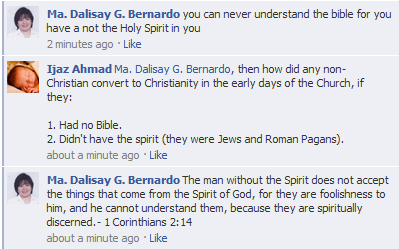
Non-Christians Can Never Understand the Bible?

Bismillahir Rahmanir Raheem
بِسۡمِ ٱللهِ ٱلرَّحۡمَـٰنِ ٱلرَّحِيمِ ,

As a Muslim who frequently discusses the Bible and its thousands of passages with Christians, I often come across some really unique arguments. By unique, I mean quite illogical, irrational and morbidly absurd argumentation, in otherwords, I mean constantly breaking the threshold of human stupidity. Let’s take a look at one such example:


Br. Shabbir Ally had argued against this passage from 1 Corinthians 2:14 during a debate as well, I fondly remember scoffing at the absolute inanity of his opponent for raising such an illogical notion.  The passage in question, reads:

“The person without the Spirit does not accept the things that come from the Spirit of God but considers them foolishness, and cannot understand them because they are discerned only through the Spirit.” –  1 Corinthians 2:14.

Their illogical argument can be summarized as such:

  1. The Bible is inspired through the Holy Spirit.
  2. Muslims, Atheists, Jews, all non-Christians cannot understand the Bible.
  3. They cannot understand the Bible because they do not have the Holy Spirit to guide them (to understanding).

This presents many arguments against Christianity:

  1. If non-Christians cannot understand the Bible, why do you share free Bibles?
  2. If non-Christians cannot understand the Bible (which is the Gospel), how can you ‘spread the Gospel’ ?
  3. If non-Christians cannot understand the Bible, how did any of the early Christians convert to Christianity by use of the Bible?
  4. If non-Christians cannot understand the Bible, were the people who wrote it, always Christian, if not, then the people who wrote it, did not understand it!

Do these people sit and think about the arguments they present? I really do not think so. I’m not saying all Christians are guilty of this really silly argument, but as of late, it’s been popping up a lot more frequently and it’s really sad to see. If an adult does not have the foresight, the mental fortitude, the critical thinking abilities to see how irrational such an argument is, then what kind of brain dead cult is this religion truly mass producing? I really must be frank about it, you must suffer from severe learning disabilities to present such a case against your own religion. The funny thing about this, is the sheer arrogance that some of these Christians possess who say this to us. The lady in the picture was proud! She got many congratulations for posting that verse, I think they were happy to see me fall silent after she posted that comment, but I did not fall silent due to that comment being ‘solid argumentation’. Rather, the abject and rash stupidity it required to use it, made me feel really depressed for the human race, which is why I’m currently writing this article.

If you are a Christian and you or someone you know, uses such an argument, just think for a moment. Just a moment, it isn’t too hard, trust me, as a Muslim I do it all the time. How can you guide any non-Christian with the Bible, if they can never understand the Bible?

To the woman who posted that verse for me, I say to you, how did you ever expect me to understand 1 Corinthians 2:14, if I did not have the Spirit in me? Your own argument has back fired on you, it’s self defeating to be honest. In closing, if anyone uses this argument against you and uses this verse as evidence or even posts the verse itself, share with them the 4 points I noted above and educate them before they continue to embarrass themselves.

wa Allaahu Alam,
and God knows best.

The Greatest Evidence for the Veracity of Christianity: Its Absurdity, By Tertullian

Bismillahir Rahmanir Raheem
بِسۡمِ ٱللهِ ٱلرَّحۡمَـٰنِ ٱلرَّحِيمِ ,

Note: The following quote is not from my own writing, nor my own translation, the source and link is clearly cited below for all to enjoy reading.

One of early Christendom’s most significant and prominent leaders, (what we term a Patristic) was Tertullian (Quintus Septimius Florens Tertullianus) who was one of the very first Christian apologists, writing against many people, most notably, “Against Marcion” (Adversus Marcionem) who awkwardly enough was the first man to canonize the Christian Bible and “Against the Jews” (Adversus Judaeos ) who even more strangely enough followed the religion of their God (as they say Jesus was a Jew). What is apparent is that these statements are supposed to be in support of Christianity, being such a major apologetic in his day, it is quite shocking to read some of his statements about the veracity of the Christian faith. As such, please do research more on this issue and enjoy reading:

There are, to be sure, other things also quite as foolish (as the birth of Christ), which have reference to the humiliations and sufferings of God. Or else, let them call a crucified God “wisdom.” But Marcion will apply the knife’ to this doctrine also,, and even with greater reason. For which Is more unworthy of God, which is more likely to raise a blush of shame, that God should be born, or that He should die? that He should bear the flesh, or the cross? be circumcised, or be crucified? be cradled, or be coffined? be laid in a manger, or in a tomb? Talk of “wisdom!” You will show more of fiat if you refuse to believe this also. But, after all, you will not be “wise” unless you become a “fool” to the world, by believing” the foolish things of God.”Have you, then, cut away all sufferings from Christ, on the ground that, as a mere phantom, He was incapable of experiencing them? We have said above that He might possibly have undergone the unreal mockeries of an imaginary birth and infancy.But answer me at once, you that murder truth: Was not God really crucified? And, having been really crucified, did He not really die? And, having indeed really died, did He not really rise again? Falsely did Paul “determine to know nothing amongst us but Jesus and Him crucified;” falsely has he impressed upon us that He was buried; falsely inculcated that He rose again. False, therefore, is our faith also. And all that we hope for from Christ will be a phantom.O thou most infamous of men, who acquittest of all guilt the murderers of God! For nothing did Christ suffer from them, if He really suffered nothing at all. Spare the whole world’s one only hope, thou who art destroying the indispensable dishonour of our faith? Whatsoever is unworthy of God, is of gain to me. I am safe, if I am not ashamed–my Lord.“Whosoever,” says He, “shall be ashamed of me, of him will I also be ashamed.” Other matters for shame find I r none which can prove me to be shameless t in a good sense, and foolish in a happy one, by my own contempt of shame. The Son of God was crucified; I am not ashamed because men must needs be ashamed of it. And the Son of God died; it is by all means to be believed, because it is absurd. And He was buried, and rose again; the fact is certain, because it is impossible.But how will all this be true in Him, if He was not Himself true–if He really had not in Himself that which might be crucified, might die, might be buried, and might rise again?I mean this flesh suffused with blood, built up with bones, interwoven with nerves, entwined with veins, a flesh which knew how to be born, and how to die, human without doubt, as born of a human being. It will therefore be mortal in Christ, because Christ is man and the Son of man. Else why is Christ man and the Son of man, if he has nothing of man, and nothing from man? Unless it be either that man is anything else than flesh, or man’s flesh comes from any other source than man, or Mary is anything else than a human being, or Marcion’s man is as Marcion’s god. Otherwise Christ could not be described as being man without flesh, nor the Son of man without any human parent; just as He is not God without the Spirit of God, nor the Son of God without having God for His father. Thus the nature of the two substances displayed Him as man and God,–in one respect born, in the other unborn; l in one respect fleshly in the other spiritual; in one sense weak in the other exceeding strong; in on sense dying, in the other living.

This excerpt has been taking from, “De carne Christi (On the flesh of Christ), Chapter 5, – Christ Truly Lived and Died in human flesh. Incidents of human life on earth, and refutation of Marcion’s docetic parody of the same.”

Link to online resource of said book: http://www.earlychristianwritings.co…tullian15.html

From this we can deduce that Paul was a liar and a man which altered the true doctrine of Christ, as Tertullian clearly indicates. Following from this, we can also conclude that the greatest proof of Christianity’s theological foundations, is that the religion is so morbidly absurd tha it just has to be true. Recall the famous saying, “that idea is so stupid it just might work“, same reasoning applies here. That’s truly some great logic!

Qur’aan Surah 4, Ayah 156-159:

“That they rejected Faith; That they uttered against Mary A grave false charge; That they said (in boast): ‘We killed Christ Jesus The son of Mary, The Messenger of Allah.’ But they killed him not, Nor crucified him, but so it was made to appear to them, and those who differ therein are full of doubts, with no (certain) knowledge, but only conjecture to follow, for of a surety they killed him not. Nay, Allah raised him up Unto Himself; and Allah Is Exalted in Power, Wise. And there is none of the people of the book (Jews and Christians) But must believe in him (Jesus) Before his death; And on the Day of Judgment He (Jesus) will be a witness Against them.”

wa Allaahu Alam,
and God knows best.

Originally Published: December 2nd, 2011, 14:11 PM.
Edited and Republished: August 19th, 2012, 10:10 AM.

Simple Reasons to Disbelieve in the Bible

Bismillahir Rahmanir Raheem
بِسۡمِ ٱللهِ ٱلرَّحۡمَـٰنِ ٱلرَّحِيمِ ,

Christians are fond of saying that although the Bible has unstable and sketchy textual contradictions, they can analyse the manuscripts and develop (yes, develop), a Bible as close to God’s words as possible. The problem however is that if you don’t know what God’s word was, how can you develop something, into it? That’s like saying you don’t know what an aeroplane looks like, but you’re going to design one.

The problem isn’t that errors can be corrected within the manuscripts, by all means this is not the point. To clarify, I will state what the points of such a dialogue on the Bible’s authenticity should be about:

  1. Authorship.
  2. Validation of Authorship.
  3. Validity of Chain of Transmission.
  4. Comparison with other scriptures.

Authorship:
The authorship of any document, especially those of high esteem must accompany the scribe’s identity.

E.g. I write a document, claim it’s from the President and it doesn’t have his signature. No one would accept it.

Likewise, if I were to claim that I have a scripture from God, written by “unknown”, how much trust would you actually place on me? In stating this, it should be noted the names of the Gospels were based on assumptions and traditions. Although it is common for scribes to leave a manuscript autograph signature, we have no such signature from any of the four (4) synoptic Gospels.

Validation of Authorship:
The validity of the author must be sought.

E.g. I write a document, sign my name and say I am the President. There is no evidence I am the President, who would then believe me?

Likewise if I authored a scripture and claimed to be a scribe of God, then some evidence must be shown, after all would you trust someone based on word of mouth or credentials? Similarly, the Bible has no such form of verification. There is no one from the Patristics (early Church Fathers), the Presbyters (early Church elders) or from the Disciples (Peter, Barnabus) to testify to the identity and works of Mark, Luke, John or Matthew.

Validation of Chain of Transmission:
Again, questionable character comes in here, if the chain of narration contains those persons who are known to lie, shall we trust their words? Surely this is not so. Similarly, what about a man who willingly declares himself to be a fool (2 Corinthians 11) and possessed by a demon (2 Corinthians 12)?

Comparison with Similar/ Linked Scriptures:
If we compare the OT with the NT, it is radically different. You have to apply your own exegesis (therefore eisegesis) to create some form of bond/ relationship between these two “revelations”. Yet, Jews, the majority of which, do not accept the New Testament as scripture, because it does not comply with their mainstream beliefs.

Generally, the problem with 150,000 manuscripts, is not that they have errors which can be corrected, but it is that there is not a single original of which to compare any of these manuscripts with. Of the 24,000 pre-Codex Sinaiticus manuscripts, most are not used.

The Bible is generally a book where errors have to be continuously eliminated as errors keep popping up, such as with Mark 16:9-20. How are we to know, that for almost 2000 years men believed those words to be true, many today, yet the earliest manuscripts never had them.

According to Bruce Metzger[1]:

Variant Readings among the Manuscripts

The first problem facing Bible translators is the differences in wording among manuscripts of the Scriptures. These differences have arisen because, even with the strongest determination to copy a text without error, a scribe copying a text of considerable length will almost inevitably introduce changes in the wording. It is understandable that mistakes can arise from inattentiveness brought on by weariness. For example instead of the correct reading, “Is a lamp brought in to be put under a bushel, or under a

bed, and not on a stand?” (Mark 4:21, RSV), several important manuscripts read “under the stand.” This is obviously a scribal error in repeating the preposition “under” in the third phrase.

Sometimes a scribe’s error of judgment works havoc with the text. One of the most atrocious blunders of this kind is in the minuscule Greek manuscript no. 109, dated to the 14th century. This manuscript of the four Gospels was transcribed from a copy that must have had Luke’s genealogy of Jesus (3:23–38 ) in two columns of 28 lines in each. Instead of transcribing the text by following the columns in succession, the scribe of MS 109 copied the genealogy by following the lines across the two columns.

In addition to such transcriptional blunders, which can usually be detected and corrected, occasionally a scribe deliberately introduced into the copy a change that seems to clarify the sense or eliminate a difficulty. For example the older manuscripts of Mark 1:2–3 attribute to the Prophet Isaiah the evangelist’s composite quotation from both Malachi and Isaiah, whereas later manuscripts (followed by the King James translators of 1611) read, “As it is written in the prophets,” an obvious amelioration of the earlier text.

wa Allaahu Alam,
and God knows best.

1 – Bruce Metzger, Persistent Problems Confronting Bible Translators, Bibliotheca Sacra 150: 599 (1993): 273-284.

[Originally published: April 20th, 2010, 21:24 pm]
[Altered and republished: August 12th, 2012, 4:00 pm]

Punishing the Female Rape Victim in Islam

Bismillahir Rahmanir Raheem
بِسۡمِ ٱللهِ ٱلرَّحۡمَـٰنِ ٱلرَّحِيمِ ,

It is unfortunate that for people who profess objectivity and sincerity in their study, research and pursuit of knowledge that there continues to be a great perversion of the understanding of Islamic Shari’ah laws and its applications. Proponents of the modern secular system, or of varying theological political systems, seemingly cannot produce a consistent stance on judging the use or misuse of the Islamic Shari’ah, while wholly regarding it to be unfair, unjust and backwards. Demonstrably, it can be noted that their own justice systems produce often, curious if not peculiar judgements. In one case, a mother can be sentenced to jail for a period of 5 years, for stealing clothing from a store for her children at a value of  $102 dollars. While at the same time a Wall Street tycoon who has defrauded enough persons to make himself a billionaire, was sentence to a period of only, 11 years. What then, can we say is logical about this? Based on this one example of a judgement that is neither proportional to the crimes when compared and contrasted nor morally justifiable, can I then generalize the American justice system as being inhumane, profiteering and socially inept?

To further this discussion with more evidences relevant to the topic at hand, let’s examine sexual assault cases, in particular rape. This child rapist was sentenced to only 5 to 7 years in prison, the same amount of time as the woman who stole $102 dollars worth of goods. This rapist was sentenced to only 9 years in prison, while defrauding persons of hundreds of millions of dollars and sending families into distress, bankruptcy and insolvency will earn you the same amount of jail time. Continuing with this trend, we can deduce that according to the modern secular system, stealing and rape are upon the same field of justice. Considering these tragic acts, let’s examine the Islamic position on rape in the modern world. To rape in Islamic law is to have committed “ightisaab”, which means to forcefully transgress and take a woman’s honour from her (rape). The crime is punishable by death but doesn’t have to be punished by death, the punishment however has to be severe as to deter anyone else from attempting this crime. Therefore, there can be no equivalence between stealing and rape, a woman’s honour is not the same as stealing an apple, or clothing as it is seen in the secular justice system.

Islamic Shari’ah rule, is intended to govern a state by Islamic law, where the ulema (religious leaders) who are fuqaha (jurists), establish courts where a qadhi (judge) can make binding rulings (fatawa) on behalf of the state against a criminal and establish justice in the society. This understanding is based upon the Qur’anic statements:

“And so judge (you O Muhammad صلى الله عليه وسلم) among them by what Allaah has revealed” – [al-Maa’idah 5:49].

“And whosoever does not judge by what Allaah has revealed, such are the Kaafiroon (i.e. disbelievers — of a lesser degree as they do not act on Allaah’s Laws)” – [al-Maa’idah 5:44].

“And whosoever does not judge by that which Allaah has revealed, such are the Zaalimoon (polytheists and wrongdoers — of a lesser degree)” – [al-Maa’idah 5:45].

“And whosoever does not judge by what Allaah has revealed (then) such (people) are the Fâsiqûn [the rebellious i.e. disobedient (of a lesser degree)] to Allaah” – [al-Maa’idah 5:47].

“But no, by your Lord, they can have no Faith, until they make you (O Muhammad صلى الله عليه وسلم) judge in all disputes between them, and find in themselves no resistance against your decisions, and accept (them) with full submission” – [al-Nisa’ 4:65].

“Do they then seek the judgement of (the days of) Ignorance? And who is better in judgement than Allaah for a people who have firm Faith” – [al-Maa’idah 5:50].

To make this succinct and easy to grasp, the discussion will be broken up into several questions:

  • What do the Islamic scholars (Ulema) say on the punishment of rape?
  • Are four witnesses needed to prove rape?
  • Are women who do not wear hijab responsible for their rape?
  • Is the woman to be punished for rape?
  • Forced marriage to rapist?
  • Further reading.

What do the Islamic scholars (Ulema) say on the punishment of rape?

Yûsuf ibn `Abd Allâh ibn Muhammad Ibn `Abd al-Barr  Abû `Umar al-Namarî al-Andalusî al-Qurtubî al-Mâlikî (may Allaah be pleased with him), a prominent Islamic jurist, of whom Imam al Qurtubi cites/ references about 500 times in his tafsir has stated in Al-Istidhkâr li Madhhab `Ulamâ’ al-Amsâr fîmâ Tadammanahu al-Muwatta’ min Ma`ânî al-Ra’î wal-Athâr (“The Memorization of the Doctrine of the Scholars of the World Concerning the Juridical Opinions and the Narrations Found in Mâlik’s Muwatta'”),  7/146:

The scholars are unanimously agreed that the rapist is to be subjected to the hadd punishment if there is clear evidence against him that he deserves the hadd punishment, or if he admits to that. Otherwise, he is to be punished (i.e., if there is no proof that the hadd punishment for zina may be carried out against him because he does not confess, and there are not four witnesses, then the judge may punish him and stipulate a punishment that will deter him and others like him). There is no punishment for the woman if it is true that he forced her and overpowered her, which may be proven by her screaming and shouting for help.

Are four witnesses needed to prove rape?

Mufti Taqi Uthmani [db] in his discussion during an interview on Pakistan’s implementation of the Protection of Women Bill 2006, expounded upon his rulings and the rulings of other Islamic judges:

‎”I myself had been directly hearing cases registered under Hudood Ordinance, first as a Judge of Federal Shariah Court and then for seventeen years as a member of Shariah Appellate Bench of the Supreme Court. In this long tenure, not once did I come across a case in which a rape victim was awarded punishment simply because she was unable to present four witnesses.

In fact it was not possible to do so. First, according to the Hudood Ordinance, the condition of four witnesses only applied to enforcing the hadd for rape. Clause 10(3), which awarded the ta’zeer punishment, did not have this requirement; the crime could be proven through one witness, medical reports, and chemical analysis report. Consequently most rape criminals were awarded punishment as per this clause.

Further, a woman claiming rape could not be punished under Qazf (false accusation of zina) since Exemption 2 in Qazf Ordinance Clause 3 clearly stated that if someone approaches the legal authorities with a rape complaint, she could not be punished in case she was unable to present four witnesses.”

To compound this statement, Shaykh Faraz Rabbani (may Allaah be pleased with him) has stated:

“This is a common myth about Islamic criminal law. Rather, the four witness requirement applies only to the prescribed hadd punishment (which in the case of a married person could be death and for the non-married, 100 lashes). [Marghinani, Hidaya] This punishment is only applied in very rare cases, as is clear, and is meant to be a social deterrent, above all.

As the classical and contemporary jurists (such as Mufti Taqi Usmani) have made clear, a rapist can be convicted on lesser evidence (including scientific evidence, such as DNA tests and medical reports) for discretionary punishments. These discretionary punishments are left up to the legal system to determine.

However, it is a myth to say that Islam would in any way condone rape, or allow a rapist to go free for this terrible crime against an innocent human being and against society.”

This therefore rests the case, of the issue with 4 witnesses being needed to prove rape, indeed rape can be proven using modern scientific methods and other evidences, as seen above, as being agreed upon by Islamic fuqaha (jurists).

Are women who do not wear hijab responsible for their rape?

Mufti Muhammad Kadwa and Mufti Ebrahim Desai (may Allaah be pleased with them both) have stated:

These are two separate issues; rape and the lack of Hijaab. The rapist will be punished for his heinous crime whilst the woman will be sinful not for rape, but for failure to observe the rules of Hijaab. Failure to wear Hijaab in no way justifies the heinous crime of rape.

Is the woman to be punished for rape?

Imam Maalik (may Allaah have mercy on him) has said in Al-Muwatta’, 2/734:

In our view the man who rapes a woman, whether she is a virgin or not, if she is a free woman he must pay a “dowry” like that of her peers, …. The punishment is to be carried out on the rapist and there is no punishment for the woman who has been raped, whatever the case.

Prophet Muhammad (may Allaah’s peace and blessings be upon him) has also decreed punishments for persons who have committed rape, while freeing the woman of any punishment:

“Narrated Wa’il ibn Hujr (may Allaah be pleased with him):
When a woman went out in the time of the Prophet (peace be upon him) for prayer, a man attacked her and overpowered (raped) her. She shouted and he went off, and when a man came by, she said: That (man) did such and such to me.

And when a company of the Emigrants came by, she said: That man did such and such to me. They went and seized the man whom they thought had had intercourse with her and brought him to her. She said: Yes, this is he. Then they brought him to the Apostle of Allah (peace be upon him).

When he (the Prophet) was about to pass sentence, the man who (actually) had assaulted her stood up and said: Apostle of Allah, I am the man who did it to her.

He (the Prophet) said to her: Go away, for Allah has forgiven you. But he told the man some good words (AbuDawud said: meaning the man who was seized), and of the man who had had intercourse with her, he said: Stone him to death.”  – (Sunan Abu Dawud, Hadith #4366, Kitab al Hudud [38]).

Forced Marriage to Rapist?

While Islam punishes the rapist, we do hear of some really peculiar instances where the woman is married to the man. This has no basis in Islamic law, nor does it comply with Islamic reasoning, according to this fatwa by Mufti Ebrahim Desai [db]:

“Knowing the importance and sacredness of a marriage commitment, the boy and girl having consulted with their seniors and making Istikhaara, should make their own independent choice.

They should not be compelled to marry against their wishes as the consequences (non-compatibility, divorce, disputes, custody of children, etc.) are too ghastly to bear. Parents should not compel their children to marry against their wishes due to economic status reasons.”

As well as this fatwa by the same Mufti (Islamic Jurist):

“As an adult, you have an independent right to choose your marriage partner. You should not be forced into marrying someone against your choice. Those forcing you are guilty of depriving you of your Shar’ee right and committing a major sin,

You should simply say no if you are not confident of marrying against your choice. The consequences of forced marriages are too ghastly. There are great possibilities of a marital breakdown. That will lead to disunity among many families. The matter will be clouded even more if there is a child born through the marriage. Considering the many negative consequences of a forced marriage, you should never give in to being forced to marry against your wish. It will be you and no one else who will have to bear the burdens in future. You may forward this email to those forcing you to marry against your wishes.”

However, to contrast the Islamic position, let’s look at this excerpt from the Jewish and Christian religious text, Old Testament (Torah), Deuteronomy (Devarim), Chapter 22, Verses 28 – 29:

“If a man happens to meet a virgin who is not pledged to be married and rapes her and they are discovered, he shall pay her father fifty shekels of silver. He must marry the young woman, for he has violated her. He can never divorce her as long as he lives.”

Further Reading:
http://www.loonwatch.com/2009/12/testimony-of-rape-victim/
http://www.bismikaallahuma.org/archives/2006/does-islam-require-four-witnesses-for-rape/
http://thedebateinitiative.com/2012/03/12/is-the-shariah-inhumane-you-decide/ 

wa Allaahu Alam.
[and God knows best.]

James White’s Futility and Inconsistency

Bismillahir Rahmanir Raheem
بِسۡمِ ٱللهِ ٱلرَّحۡمَـٰنِ ٱلرَّحِيمِ ,
This video analyses James White’s evidences, his pivots during his opening statement with Br. Shabir Ally during their debate, “Did Jesus Claim Deity?”. An indepth write up to be published on Monday/ Tuesday 26th/ 27th of March fully explaining, and refuting his arguments. I was planning to write up a full response, but I’m terribly busy, please see our video response to James White instead, thanks.
wa Allaahu ‘Alam.
[and God knows best.]
« Older Entries Recent Entries »