Do We Have the Actual Words of Christ in the NT?

Question:

Missionaries often claim that Jesus said x or said y in the New Testament. I have seen you say that the NT does not contain the actual words of Jesus, is this a Muslim claim?

Answer:

It is disingenuous for Christians to claim that Jesus said anything based on New Testament quotes. Traditionally in Graeco-Roman literature, under which the New Testament falls there are two main forms of quotations, ipsissima verba (the very words) and ipsissima vox (the very voice). The majority of New Testament quotes claimed to be said by Jesus fall under the category of ipsissima vox, meaning that someone has interpreted Christ’s alleged words and developed this quote according to their understanding of what was said. Similarly, this form of quotation also refers to invented quotes, where authors spoke (wrote) on behalf of others, based on the reasoning that they believe the quotes would have been accepted by the original speaker. Thus, it was and is common in Graeco-Roman literature to find works being written in other people’s names or quotes being manufactured and attributed to other people. Daniel Wallace, a conservative Christian scholar has said something similar regarding this topic:

Myth 2: Words in red indicate the exact words spoken by Jesus of Nazareth.

Scholars have for a long time recognized that the Gospel writers shape their narratives, including the sayings of Jesus. A comparison of the Synoptics reveals this on almost every page. Matthew quotes Jesus differently than Mark does who quotes Jesus differently than Luke does. And John’s Jesus speaks significantly differentyly than the Synoptic Jesus does. Just consider the key theme of Jesus’ ministry in the Synoptics: ‘the kingdom of God’ (or, in Matthew’s rendering, often ‘the kingdom of heaven’). Yet this phrase occurs only twice in John, being replaced usually by ‘eternal life.’ (“Kingdom of God” occurs 53 times in the Gospels, only two of which are in John; “kingdom of heaven” occurs 32 times, all in Matthew. “Eternal life” occurs 8 times in the Synoptics, and more than twice as often in John.) The ancient historians were far more concerned to get the gist of what a speaker said than they were to record his exact words. And if Jesus taught mostly, or even occasionally, in Aramaic, since the Gospels are in Greek the words by definition are not exact.

A useful distinction is made between the very words of Jesus and very voice of Jesus, known as ipsissima verba and ipsissima vox, respectively. Only rarely can we say that we have the very words of Jesus, but we can be far more confident that what is recorded in red letters in translations is at least the very voice of Jesus. Again, if ancient historians were not as concerned to get the words exactly right, we should not put them into a modernist straitjacket in which we expect them to be something they were never intended to be. – Source.

It is very difficult to claim that a quote belongs to the second category of ipsissima verba, that is, verbatim speech. Scholars differ on the very few instances where they believe Christ’s true speech may have been recorded. There is very little general agreement regarding these instances and each case needs to be inspected and qualified critically. Additionally, since we do not have the original words of Christ in their original language, there exists a difficulty in translating where language devices have been used. As such, this matter of a different language, after already being re-interpreted by someone other than Jesus makes the matter of knowing what Jesus actually said quite complicated. This is especially true in places where we have single quotes attributed to Jesus, without any other witnesses. How would we know that the one listening and recording, understood what was said? There is no way to know.

Therefore, the next time a missionary claims to have the very words of Christ, you may want to point out that this is historically untrue and that the quote itself requires extensive examination before qualification.

and God knows best.

Missionary Mishap – Copying Bad Arguments

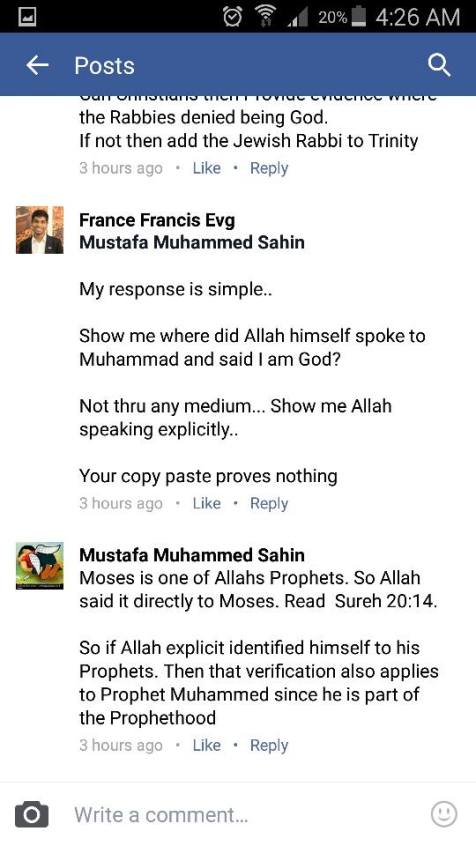
Everyone wants to be a debater. Today, all it takes is a keyboard and adding a title to one’s name. In this case we have a callow missionary by the name of Evangelist France Francis. He has previously boasted that he is a friend of Jonathan McLatchie (a quick perusal of Jonathan’s timeline indicates that ‘France’ comments often on his page). With that said, while Jonathan has accepted that he made an error with regard to his claim that nowhere does Allah say: ‘I am God, Worship Me’ in the Qur’an, his young missionary friend has yet to get this memo:

12400927_10153386907683004_4671740293140677233_n

As can be seen, Br. Mustafa Sahin an up and coming Muslim apologist and debater, knocks France the Evangelist out of the park. His Qur’anic reference directly refutes the missionary:

Indeed, I am Allah. There is no deity except Me, so worship Me and establish prayer for My remembrance. –20:14.

It truly is amazing just how fast bad arguments can spread. Even when the missionary you allegedly learn from recants his position, missionaries still insist on using those bad arguments. It’s quite embarrassing to say the least.

and God knows best.

The rivals of Paul who were followers of Jesus

2 Corinthians 11:4 provides a clue to the existence of a powerful rival group that opposed Pauline Christianity

by Ibn Anwar BHsc (Hons), MCollT

The text of 2 Corinthians 11:4 reads as follows:

“For if someone comes and proclaims another Jesus than the one we proclaimed, or if you receive a different spirit from the one you received, or if you accept a different gospel from the one you accepted, you put up with it readily enough.”

From this verse, we may glean that there was at least one group that was prominent enough to receive Paul’s attention and compel him to spend ink on it that was teaching a different Jesus and a different gospel than what Paul was teaching as James Dunn writes, “Similarly in 2 Cor. 11.4 the “other Jesus” preached could refer to a differently interpreted Jesus tradition.” [1]Though little detail is given concerning this group, we may reasonably speculate about their fundamental beliefs that disconcerted Paul by looking at the content of the context of 2 Corinthians 11:4, with particular focus on what points that Paul emphasise therein.

In Paul’s letter to the Corinthians, one of his primary concerns is with the crucifixion of Jesus, the belief that Jesus suffered and died as a sin offering. As James Dunn writes, “The most distinctive emphasis of Paul’s preaching on Jesus, however, was on Jesus’ crucifixion… in 1 Cor. 2.2 Paul recalls how ‘I decided to know nothing among you except Jesus Christ, and him crucified. For in Cor. 15:2 he recalls the message he had preached to the Corinthians, including the message that ‘Christ died for our sins…” [2] From the emphasis Paul puts on this theme, we may discern that those mentioned in 2 Corinthians 11:4 may well have opposed this belief that Paul was propagating. To this effect, commenting on the phrase “another Jesus” in 2 Corinthians 11:4 the scholar Colin Kruse writes:

“It may well be that in their preaching Paul’s opponents stressed the power and glory of Christ to the virtual exclusion of the fact that he had also known weakness, humiliation, persecution, suffering and death. Paul preached Christ crucified as Lord, so a proclamation like that outlined above would seem to him to be the preaching of another Jesus.” [3]

This means that anyone who did not preach that Christ was crucified as Lord, that he suffered humiliation, persecution, suffering and ultimately death on the cross were antithetical to Paul’s ministry and were therefore preaching another Jesus.

David Garland who is Dean of George W. Truett Theological Seminary at Baylor University, likewise, writes:

“Another Jesus” refers to a different interpretation of Jesus that is not congruent with with the facts of Jesus’ life and death. Paul’s emphasis in 13:4, that Christ was “crucified in weakness,” suggests the possibility that the rivals presented a Jesus who was not “weak, suffering and humiliated.” They may talk about Christ, but Christ crucified is not the heart of their gospel nor does it influence the way they live.” [4]

From the above, we learn that this group gave no importance to the crucifixion of Jesus and it was certainly not part of their fundamental beliefs.

Michael Gorman however, tells us that this group’s teachings may well have amounted to the repudiation of the crucifixion rather than a mere disinterested detachment. They in fact abandoned the belief in the crucified Christ.

“What is very likely, however, is that Paul saw a massive incongruence between their gospel and their lifestyle (since for Paul an apostle was his or her message, and vice versa), between a message of Christ’s death for sin (s) and a preoccupation with powerful manifestations of the Spirit. Is this grounds for a charge of heresey? Yes, it is, at least for Paul, if it amounts to the repudiation of the cross as both the foundation and the form of life in Christ… to abandon the crucified Christ and the God-given Spirit of cruciformity is to offer another gospel.” [5]

The scholarly understanding that this group that Paul regarded as preaching another Jesus and another gospel disassociated themselves from the “suffering servant” image of Jesus that is so prominent in the Pauline portrayal of Jesus’ purpose and ministry seems to be across the board. Their detachment from any theological significance given to the cross seems to be one of their hallmarks. The massive New Jerusalem Biblical commentary comments:

“4. This is perhaps the most important clue in the quest for the identity of Paul’s opponents: if someone comes : his adversaries were from outside Corinth (3:1, 10:14-16), preaches a Jesus other than the one we preached. The sudden switch from “Christ” ( 10:1,5,7,14; 11:2,3) gives Jesus a special significance; the emphasis is on his earthly existence. Since the intruders claimed to “belong to Christ,” they must have shared the tendency of the “spirit-people” to downgrade the importance of Christ’s humanity, which was displayed in service, suffering, and death…

The Judaizers (3:3) preached a different gospel (Gal. 1:6-9). Since Paul’s ministry was a “ministry of the Spirit” (3:8) and of freedom (3:17), his opponents must have given their allegiance to a different spirit, viz., that of the new covenant, which they understood in a way that Paul could not accept (see comment on 3:6). The Judaizers would have shared common ground with the “spirit-people” (-> 1 Corinthians , 49:18) insofar as the wisdom tradition of the latter was rooted in the law.” [6]

From the above, we may discern, as we did from preceding scholarly references that this group of preachers had no interest in the suffering and alleged death and Jesus. Additionally, O’Connor tells us that they had a firm belief in the importance of the law in direct opposition to Paul who primarily concerned himself with “freeing” people from the “bondage” of the law through his version of Christ’s ministry.

Jan Lambrecht gives us an even greater insight as to the identity of this opponents of Paul who uniquely opposed him in his fundamental beliefs: the crucifixion and the law.

“Let us listen to what Paul himself says. The most pertinent text is 2 Corinthians 11:22-23a: “Are they Hebrews? So am I. Are they Israelites? So am I. Are they descendants of Abraham? So am I. Are they servants of Christ? – I am talking as out of my mind – I am more.” For Paul these people are decidedly Jewish Christians, even ministers of Christ.” [7]

From the above we see that Paul himself in the immediate context of 2 Corinthians 11:4 identifies these individuals as Jewish Christians. And though he labels them “Satan”, “deceivers”, and “false apostles”, he is unable to forthrightly deny them as real ministers or servants of Christ. He sees himself as a better servant (“I am more”) but this necessarily implies that he sees them as equally servants of Christ but of lower status and inferior. Lambrecht continues:

“The opponents were probably not very numerous. It is, we think, is not completely impossible that there were connections between them  and the Jerusalem authorities (see our discussion of 10:12-18), nor, as most scholars hold, is it absolutely certain that they were wholly from Paul’s opponents in Galatia, those who compelled the Gentile Christians to live like Jews (Gal 2:14; see our discussion of 2 Cor 10:4-6; cf. Gal 1:7-9).” [8]

The above tells us that there is possibility that this group had links to the Jerusalem Church which was headed and lead by the direct apostles of Jesus and it also tells us that their movement was quite widespread as it is possible that the opposition Paul faced from opponents in Galatia were the same people as they had similar traits to those who went to Corinth to challenge Paul. This group was in fact quite successful in their ministry, at least in the early days, prior to the victory of Pauline Christianity over all others, pulling many, even the Gentiles, to their fold:

“Many Christians of Corinth must taken sides with the intruders and detached themselves from Paul, at least during a certain period of time. Second Corinthians shows us a Paul who, above all, wants to win them back.” [9]

The People’s New Testament Commentary by New Testament scholars Eugene Boring and Fred Craddock provides an even better overview of this group, what they believed and why Paul opposed them so.

11:4 Another Jesusspiritgospel: These may be only general descriptions of the false message and ministry of the rival apostles, or in Paul’s mind they may have had specific content. “Another Jesus” has been understood in several ways:

1. The opponents may have emphasized the life and teachings of the earthly Jesus, whom Paul had not known. The details of Jesus’ earthly life did not play a role in Paul’s own gospel, which focused on the act of God in the whole Christ event, not on stories about and sayings of the earthly Jesus.

2. The opponents may have contrasted the exalted heavenly Christ and the purely human Jesus, one who could be disdained and even cursed (see on 1 Cor. 12:3). If so, it means that before their arrival in Corinth some Corinthians already leaned toward this view which the new missionaries elaborated and exploited.

3. Since Paul places their Christology in contrast to his own, which emphasizes the vulnarability and weakness of the crucified Christ (see 1 Cor. 1:18-2:5; 2 Cor. 13:4; Phil. 2:5-11), they may have emphasized the power of the miracle-working “divine man” Jesus, a view that had no place in Paul’s own understanding. It may be that they saw the power at work in Jesus’ life as continued in their own powerful ministry, just as Paul saw the self-giving of a victimized and crucified Jesus as continued in his ministry. Neither group saw a way of combining the pictures of Jesus the divinelike miracle worker and the Jesus who died a human death on the cross. Paul chose the weakness of the crucified Jesus as the power of God; they chose the power of the miracle-working of Jesus as representing the power of God. [10]

This group then had access to stories concerning Jesus and his words during his ministry while Paul did not. They also had difficulty allowing Jesus to be the victim of some curse and exalted Jesus over above Paul’s victimized Jesus model. They adopted Jesus’ deeds of miracle as important to the person of Jesus and completely abandoned any attachments to the crucifixion while Paul fixates himself on the crucifixion to the subtraction of all else. Even though Paul identifies them as “false apostles” as we have seen above and even called them ministers of Satan (contradicting himself as we illustrated that he couldn’t help but recognise that they were ministers of Christ), Boring and Craddock write, “Though Paul considers them false, they were probably sincere Christian leaders whose differences with the Pauline mission were so great they considered him a false apostle, a danger to the churches, whose converts had to be “corrected.” ” [11]

In the foregoing discussion we have seen the many shades of colour of this mysterious and nameless group found in 2 Corinthians 11:4. Although we may never know exactly what they believed and who they were in precise terms (unless some new early manuscripts that document their existence and beliefs are unearthed), we have gleaned from Paul’s own writing, as we have done above, what they may very well have believed. In all likelihood, this was a group that completely detached themselves from the alleged crucifixion of Jesus and emphasised the earthly ministry of Jesus. This was probably the utter most sticking point that irked Paul so much to the extent that he labels them not only false apostles but the servants of Satan himself. The rift between Paul and this group must have been quite significant and their beliefs must have greatly agitated Paul for he would not have been so harsh in the epithets that he affords them which he affords to none of his other numerous opponents elsewhere. Despite Paul’s meanderings about their supposed distasteful behaviour that were incongruent to the gospel they were preaching, which is something that we cannot confirm as there are absolutely no independent corroborating eyewitnesses to justify Paul’s appraisal regarding this, what is evidently clear is that his theology of the cross was completely disregarded by this group and this was probably the unpardonable sin that led Paul to identify them as servants of Satan. This removes the Christian apologetics critique on Islam that it brought something new when it put doubt on the crucifixion of Jesus by seemingly denying that it actually took place. It would appear that denial of the crucifixion and/or any importance attached to it was in vogue even at the time of Paul. This then corroborates the Qur’anic crucifixion narrative as historical rather than merely mythical.

Notes:

[1] Dunn, J. D. G. (1998). The Theology of Paul the Apostle. Grand Rapids, Michigan: William B. Eerdmans Publishing Company. p. 196

[2] Dunn, J. D. G. (2009). Christianity in the Making, Volume 2: Beginning from Jerusalem. Grand Rapids, Michigan: William B. Eerdmans Publishing Company. p. 576

[3] Kruse, C. (1987). The Second Epistle of Paul to the Corinthians: An Introduction and Commentary. Grand Rapids, Michigan: William B. Eerdmans Publishing Company. p. 184

[4] Garland, D. E. (1999). The New American Commentary: An Exegetical and Theological Exposition of the Holy Scripture, 2 Corinthians. Nashville, Tennessee: B & H Publishing Group. p. 464

[5] Gorman, M. J. (2004). Apostle of the Crucified Lord: A Theological Introduction to Paul and his Letters. Grand Rapids, Michigan: William B Eerdmans Publishing Company. p. 322

[6] O’Connor, J. M. (1990). 2 Corinthians. In Raymond E. Brown (Ed.), The New Jerome Biblical Commentary. New Jersey: Prentice Hall. pp. 826-827

[7] Lambrecht, J. (1998). Second Corinthians. In Daniel J. Harrington (Ed.), Sacra Pagina Series. Collegeville, Minnesota: The Liturgical Press. p. 7

[8] Ibid.

[9] Ibid.

[10] Boring, M. E. & Craddock, F. B. (2010). The People’s New Testament Commentary. Louisville, Kentucky: Westminster John Knox Press. p. 570

[11] Ibid. p. 571

Does Angel Gabriel Choking the Prophet Mean He Is Not an Angel?

Question:

Missionaries argue that an angel would not choke someone or be violent, and so the “angel” that Muslims believe to be Gabriel was actually a demon. Some claim this was a demon parading as an angel because of this act of choking. What can we say to them?

Answer:

You can advise them to study their Bible(s) more often. If acting violent means that an Angel is actually a demon, or that the one being hurt by the Angel is evil, what happens to the story of the Angel (of the Lord) wrestling with Jacob (Israel)? The main story is found in Genesis 32:22-31, however the story itself is referenced in Hosea 12:4 and clarifies with whom Jacob (Israel) wrestled with:

Yes, he wrestled with the angel and prevailed; He wept and sought His favor. He found Him at Bethel And there He spoke with us,

Following the missionaries’ logic, it would either mean that the Angel (of the Lord) was evil and demonic, that Jacob (Israel) – the Father of the Twelve Tribes was evil and demonic or that both of them were evil and demonic. Irrespective of which choice they choose, the argument negates a major aspect of their faith. That in itself discredits the argument. Even if we were to forego this one major incident, there are many instances where angels were violent in the Bible, one significant example of that is as follows:

Then the angel of the Lord went out and put to death a hundred and eighty-five thousand in the Assyrian camp. When the people got up the next morning—there were all the dead bodies! – Isaiah 37:36.

Thus, this is not a very good argument and it would benefit the Muslim to encounter a missionary using it, as it can allow us to invite them to Islam. Thank you for your question.

and Allah knows best.


Is the Canonization of the NT a Divine Proof?

Question:

Missionaries often claim that the canon of the New Testament was not decided by a Council, and that its authors were guided by God. They also claim that since a Council was not needed and that all of Christendom accepted the books, it is a divine proof from God that Christianity is the truth. How do we respond to this?

Answer:

This is factually incorrect. The proto-orthodox Church whose canon of scripture later came to be known as the New Testament, did in fact have two Ecumenical (Unity) Councils regarding the canon of their scripture. The Councils of Carthage in 393 and 397 CE respectively, are historically considered to be when the Church ‘confirmed’ the canon. Most Christians seem to be unaware of these Councils and so make this claim that the canon was not decided by any Council, and so the emergence of their scripture is a divine truth. Even if we were to forego these two Councils, this is in itself a poor argument. This argument, is in essence stating that a divine truth does not need a Council to determine beliefs.

However, Christianity’s history is replete with Ecumenical Councils regarding the very basic tenets of their faith, most notably those of Nicaea, Constantinople and Chalcedon. Thus, if the lack of Councils demonstrate divine truth then the very existence of the aforementioned Councils discount Christianity’s most foundational beliefs as divine truths. As absurd as this argument may seem, I myself have experienced it firsthand. I recall an incident some years ago with a group of Jehovas Witnesses came to preach to us and we had a discussion regarding errors in the New Testament. One Elder quipped that the canon was determined by God, and that no human chose their canon. To say the least, that discussion did not last very long once they learned of Carthage.

Interestingly, Islam did not need any Councils to determine our beliefs. Thus, if a missionary was consistent, the lack of Councils in Islamic history to determine our beliefs is an evidence of the divine truth of Islam. This argument actually discounts Christianity as a divine truth and establishes Islam as the truth. Yet, given that so many missionaries use this argument one does have to wonder if they truly ponder what they’re saying before they say it. It’s truly quite a peculiar argument that seems to be extremely common. Unfortunately it’s also quite a bad one.

and God knows best.


Missionary Mishap: Jonathan McLatchie’s Argument Fails Spectacularly

Jonathan is known for making mistakes, whether that’s being ignorant of the Bible (he didn’t know God literally inscribed the ten commandments according to Exodus), or ignorant of the Qur’an:

In this amazing video from Br. Yahya Snow, Jonathan claims that nowhere in the Qur’an does Allah say: I am God, worship me. That’s unfortunate, for the Qur’an says:

Indeed, I am Allah. There is no deity except Me, so worship Me and establish prayer for My remembrance. – 20:14.

Br. Yahya has a ton more clips of Jonathan to be released in the coming days. Subscribe to his YouTube channel here: Yahya Snow.

and God knows best.

Missionary Mishap: Jonathan McLatchie Doesn’t Understand How Debates Work

Earlier today I watched a dialogue between Jonathan and someone named Inamullah on the topic of, “Is Jesus God?”. I found a statement of Jonathan’s to be quite peculiar and made a post about it. If you’re unfamiliar with Jonathan, he’s the guy that referred to immigrants in Europe as “cancers” and “viruses”. Also the guy that believes Br. Khalid Yasin, is a Caucasian man, despite being…..African American. So what was the problem?

Moderated debates follow formats. Typically, something along the lines of:

  1. Speaker 1’s Opening Statements.
  2. Speaker 2’s Opening Statements.
  3. Speaker 1’s 1st Rebuttal.
  4. Speaker 2’s 1st Rebuttal.
  5. Speaker 1’s 2nd Rebuttal.
  6. Speaker 2’s 2nd Rebuttal.
  7. Speaker 1’s Concluding Statements.
  8. Speaker 2’s Concluding Statements.

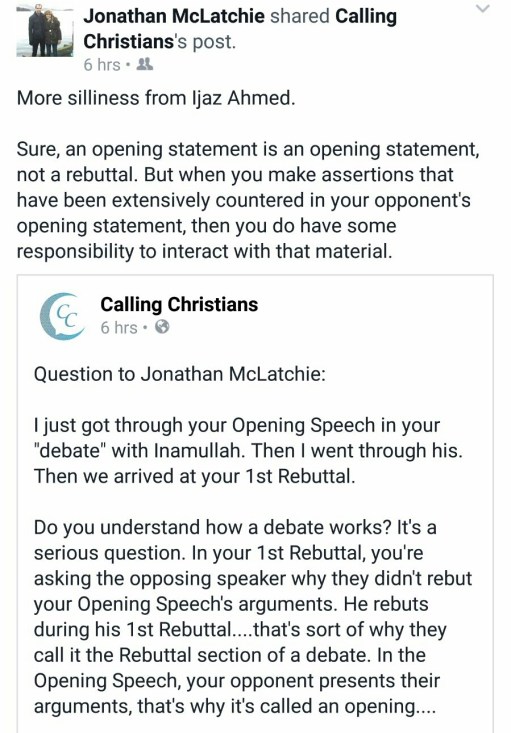
There’s an alternation between the speakers, as can be seen above. What should also be noticed is that there are Opening Statements and then Rebuttals. This is common sense, but Jonathan does not seem to understand this. In the Opening Statements, each speaker open’s….with….their…..statements! Shocking, I know! This is where each speaker presents their arguments, their research, their ideas. Following this, the speakers then rebut, that is, respond to the arguments and claims made in each others’ Opening Statements. That’s not difficult to understand, it’s pretty much common sense. Jonathan however, does not seem to understand this basic concept. In his dialogue with Inamullah, following Inamullah’s Opening Statements, Jonathan during his 1st Rebuttal asks Inamullah why he (Inamullah) did not rebut Jonathan during his (Inamullah’s) Opening Statement.

In other words, Jonathan gave his Opening Statement. Then Inamullah gave his Opening Statement. Then Jonathan gave his 1st Rebuttal. However, it is during this 1st Rebuttal that Jonathan asks why Inamullah did not respond to Jonathan’s Opening Statement. I made a post on Facebook asking Jonathan why he expected Inamullah to rebut him, when his (Inamullah’s) 1st Rebuttal had not yet occurred. He replied:

2016-01-13-17.27.48.jpg.jpeg

You’d notice that Jonathan immediately falls into his Christian character and must find a need to insult me. I don’t mind this behaviour, after all, Jonathan did mention that Muslims were like cancer, so his hate is understandable. Follow what he says carefully though. While he acknowledges that his opponent’s rebuttal should have come during his rebuttal period, he still and amazingly so….argues that his opponent must also rebut him during their Opening Statement. I agree with Jonathan, your opponent does have a responsibility to engage with your material, that’s why there’s a Rebuttal period! There’s a solution for that Jonathan, it’s built into the format of the debate, it’s called Rebuttal periods.

The problem here is quite a good example of Jonathan’s inability to deal with criticism. There was no need for him to be condescending and rude during the debate, by speaking down to his opponent directly after his Opening Statement. You don’t demand things of people during a debate, you most certainly don’t order them around if you don’t like what they’re saying. If only there wasn’t a moderator, how much more uncouth would he have been?

and God knows best.

Since the Qur’an Is 600 Years After Jesus – Is It An Unreliable Witness?

Question:

Christians often argue that since the Qur’an is 600 years after Jesus, it is a less reliable witness than the New Testament. How do we respond to this?

Answer:

Consistency is key here, and the response is quite simple. The Christian accepts the first five books of the Old Testament which are usually attributed to Moses (عليه السلام). Yet, these books contain histories ranging from hundreds of years to thousands of years before Moses (عليه السلام) is alleged to have written them. Some Christians consider the accounts in Genesis 1 regarding the creation of the universe to be a historical account. Others consider it to be a phenomenological rendition of the creation of the universe. Either way, Christians accept these accounts as accurate despite the distance (disparity) between the time of Moses (عليه السلام) and that of the creation of the universe.

Consistency is key. Moses (عليه السلام) lived several generations removed from that of Noah (عليه السلام). Yet Christians accept and view the account of Noah (عليه السلام) in the Old Testament as a historical witness. The account of Noah (عليه السلام) is far more than 600 years between himself and Moses (عليه السلام) , yet Christians do not doubt an iota of what the Old Testament says. If we apply the scales of consistency regarding this topic, it would be seen that Christians do not adhere to a sensible methodology for judging what is and what is not historical. Theologically speaking,  when it comes to matters of revelation, time is irrelevant. Since God is all knowing,  it can be inferred that when He inspired Moses or Muhammad (عليه السلام) to write about the past, then it is assumed that what they wrote was historically accurate.

If missionaries applied the same criteria to their scriptures, they’d have to deny them as well as declare them as being historically inaccurate due to the gaps of time between the events themselves and the later authorship which recounted them. It should also stand to reason that not all accounts closest to an incident would be accurate, and that there exists the possibility of a later writing based on a stronger oral tradition. In such a case, the closest account may be inaccurate but the later writing could be more accurate. In conclusion, this is a very poor argument and it is an excellent example of poor thought processes.

Edit:

This answer is only in response to the argument of time being used, that is, the number of years between Muhammad (peace be upon him) and Jesus (‘alayhi as salam). It isn’t about whether Muslims consider the New Testament historical, or if Christians consider the Qur’an historical, or whether the histories of either writing corresponds with each other. This answer is only in response to the argument by Christians that 600 years is a factor in accepting or rejecting history.

and God knows best.

Reproaching One’s Brother – Jonathan McLatchie

After spending sometime among Christian activists and preachers, a prominent theme I found amongst them was having the ability to discern between right and wrong, and the act of reproaching fellow Christians if they fell out of line. Many verses were given to me, some of them are as follows: Proverbs 27:17, Galatians 6:1-2, James 5:16, Ephesians 4:25, Hebrews 10:25, etc. This act of reproaching fellow Christians is seen as a mandatory spiritual duty, failing to do so indicates that one isn’t devoted to Christ as much as he should be. A Christian, as I was told, that lacks the ability of spiritual discernment, lacked Christ.

In light of these beliefs, it was brought to my attention sometime ago that most Christian polemicists actively don’t care about Christianity, see my article: Do Christian Apologists Care About Theology? One of the polemicists I didn’t comment on in that article was Johnny (Jonathan McLatchie). I gave him the benefit of the doubt and waited to see what he’d do with his entrance into polemics. Sadly, I waited in vain as he repeated articles from Rogers, Wood and Shamoun. Nothing new was coming from him, nor was he attempting to reach out to heretical Christians. Take for example, his relationship with David Wood.

cc-2015-jonathanmclatchie

David expressly declares his agnosticism on core Christian beliefs and has made those views public. Jonathan as a fellow Christian, who now posts on David’s blog has had the opportunity to reproach David and preach the Gospel to him. However, Jonathan has failed to do so, and according to the aforementioned verses, this would mean he lacks devotion to Christ. Consider the case of David’s agnosticism over God’s ontology. The very nature of God is something that David is agnostic about. How can one be so hypocritical as to preach a religion about a God that they are doubtful about? If Jonathan was a devoted Christian, shouldn’t preaching to, and reproaching a popular Christian speaker be his most important goal? It needs to be asked, does Jonathan simply not care about Christ and is he merely speaking about Islam (an area he is demonstrably uneducated in), for private and personal gain?

Regarding God’s ontology, David is undecided about the power and knowledge of God. He does not know, and he does not care to accept one of the two mainstream beliefs in Christianity: Calvinism and Arminianism. In Calvinism, the Person of Christ – whom Christians consider to be God – did not die in the same way for everyone. This is known as limited atonement. It teaches that Christ/ God did not die in the same way for all men, otherwise everyone would be born-again. On the opposite end, Arminianism teaches universal atonement, that Christ/ God died for everyone in the same way. These are two fundamentally differing views of God. Christians trying to preach to David had to endure verbal threats and abuse from him, one Christian stated:

cc-2015-dw-calvinism2

David himself said:

cc-2015-dw-calvinism4

David in this post admits to flip-flopping between his beliefs. This is problematic because it involves his own salvation. According to Calvinist beliefs, the elect cannot become apostates or lose their faith. By this definition, since David is undecided and flip-flopping, then he is not of the elect, which would mean he is not saved according to Calvinist theology. On the other hand, Arminians believe a Christian can fall from grace and lose their salvation. Which view does Jonathan take regarding David? If he takes the Calvinist view, then David is an apostate. Since David flip-flops between the two mainstream views, he’s an agnostic and is not certain about his own salvation. In that case, it must then be asked, why isn’t Jonathan worried about David’s salvation when readers on the blog he posts too are?

cc-2015-dw-calvinism

Being undecided about God’s nature regarding God’s attribute of love is a serious issue. It would then mean that Jonathan and David fundamentally believe in two different Gods, with two different attributes of love. It would mean that they believe in two different plans of salvation, two different plans of soteriology. This isn’t something minor and to be ignored, it deals with a person’s salvation. This is the most important discussion that should be happening. Yet, it isn’t. There are many other things we can ask about. Has Jonathan ever condemned and reproached David for cross-dressing?

cc-davidwood

David Wood the Voyeur Wearing Women’s Lingerie – Self Admitted Cross Dresser

The question needs to be asked: is Jonathan interested in Christian theology, or does he just want to gain popularity? Let’s take for instance, Jonathan’s appearing on ABN TV. David in an e-mail dated September 15, 2015 says of ABN’s audience:

“The more complicated the set-up, the more problems are going to slip in to derail the debates. Second, the vast majority of viewers would rather listen to us address a topic than a questioner asking us questions. It would be nice if all callers asked relevant, probing questions, but they won’t. Good questions will be only a fraction of the actual questions we get. People will call in with insults, they will start yelling and we’ll have to cut them, and most of the questions will be completely irrelevant to the topics. That’s just what happens when phone lines are opened for anyone to call in.”

David recognizes that ABN’s audience are Christians who insult, yell, and who ask irrelevant questions. David went so far as to cut ABN off, in an e-mail of the same date he says:

“As for ABN, I’ve been working with them for years, but I’m at the end of my rope. I simply want to get these debates out of the way so that I don’t have to deal with this network ever again.”

While David condemns and reproaches ABN, Jonathan runs to them and attempts to get on as many programs as he can. Does this mean that David is lying about ABN and its poor quality of viewership, or does it mean that he is telling the truth and Jonathan just wants to serve his ego? If David is wrong, then Jonathan should condemn him and reproach him for lying about a Christian network. On the other hand, if David is correct, then Jonathan needs to reproach ABN and condemn them. If he does neither, which is most likely, then he is failing to uphold his spiritual Christian duty of reproaching fellow Christians when they fall into evil, whether that be having heretical beliefs, cross-dressing, and lying about fellow Christians.

It remains to be seen whether Jonathan cares about David’s salvation, or of his own.

and God knows best.

The Passing of Br. Akbar Ali Sidi

cc-2016-akbarsidi

As Salaamu ‘Alaykum,

Br. Akbar Sidi was a founding member of Calling Christians. I came to know him while giving da’wah to Christians online. For many years we worked together and he supported my da’wah efforts greatly. He introduced me to the brothers and sisters that eventually went on to found Calling Christians. Due to him, I was inspired to converse, dialogue and debate with missionaries. At the moment I am lost for words. However, what I will say is that he is perhaps one of the greatest Muslim men I have ever known, his faith was steadfast and despite his old age he strove in the path of Allah by giving da’wah everyday, and true to character he also did so in the hours before his passing.

May Allah forgive him of any misgivings and grant him Jannat al Firdous, Ameen.

إِنَّا لِلَّـهِ وَإِنَّا إِلَيْهِ رَاجِعُونَ –

“Indeed we belong to Allah, and indeed to Him we will return.” – Qur’an 2:156.

Biography & Testimony:

I am Akbar Ali Sidi by name. Born in 1951 on the 1st of June. Born in a Muslim family, married with four children. Three of those children are already married. I worked for the Bank of Baroda briefly after completion of my high school but took up my favorite career in auto engineering. I then joined the Kenyan police force and did part time service to my country for 12 years. Presently, I’m in auto repairs in my small workshop.

421866_3190650761369_1831148859_n

Br. Akbar Ali Sidi

Educated at Consolata Catholic School where I did Bible studies as one of the compulsory subjects. The school was run by Italian priests. My mentor in Bible studies was the late Father Tosillini who was also the Principal of the school. In those days I was convinced that the only true religion was Christianity. I was so involved in Bible studies that I had opted to enroll in a Christian Bible Seminary College for further studies in the Bible. But due to financial strains I was not able to. All my religious discourses involved the Bible.

I therefore opted to be employed and joined Bank of Baroda where I worked for three years. I then opened my own workshop and it was during this time that the turning point in my religious views began. The person responsible for this was none other than the late Sheikh Ahmed Deedat who at that time was on a brief visit to Kenya. I enrolled in his classes on Comparative Religions that is: Islam and Christianity. My main interest was to hear his views on the Bible. Our first lecture was on the Crucifixion of Jesus. Contrary to what I had believed he convinced me beyond no doubt that it was a false concept in Christianity. This was followed by lectures on Trinity which he again proved to be a false doctrine.

akbar sidi smile

Br. Akbar Ali Sidi

It was at this juncture that I started looking keenly at my birth religion with renewed interest. I started talking with various Christian friends on the Bible and Quran showing the superiority of the Quran on the Bible. From then on I have been involved in debates with the Christians. Alhamdulillah to have been born a Muslim and that is why I debate strongly on the internet (Facebook, with them).

– May 6th, 2012.

Further Information:

On the passing of our elder brother AKBAR ALI SIDI, familiarly known as BABU:

Br. Akbar collapsed this morning soon after waking up from his bed. Unfortunately, he passed away while being rushed to the hospital.

Janaza prayers will be at Masjid Nur Mosque in South C at the time of Asr prayers (4 p.m.), burial thereafter at the Langata Cemetery.

and Allah knows best.

« Older Entries Recent Entries »