Refutation: Islam a Anti-Grace religion:Reply to Ijaz of callingchristians

Bismillahir Rahmanir Raheem
بِسۡمِ ٱللهِ ٱلرَّحۡمَـٰنِ ٱلرَّحِيمِ ,

I must say that I am quite impressed by Mr. Edwards’ post. It’s truly quite remarkable that any critically thinking hominid could possibly call that disaster of a post, a “response” to my articles here and here. I’m not sure if he’s wanting attention or perhaps he couldn’t afford to not reply, so he’s having to save face here, but it’s absolutely hilarious on his part to assume he has any form of any argument. One of the basic flaws of a failed academic and pseudo intellectual is that they would try to appeal to a few fallacies/ argument inconsistencies:

(1) Fallacy of Reading Between the lines.
(2) Being Overtly Pedantic.
(3) Arguing over Semantics.

He begins his barbaric tirade by implying I did not answer his question(s):

The short of it is He refuses to directly answer the question but we can gather from the above reply he doesn’t, nor does any Muslim for that matter…

However, I suggest you read this article, where not only is my answer a clear and resounding, “Yes”, it’s even in bold and big bright, red lettering for his convenience. If I didn’t reply, then why did he comment on my post? Self contradicting statements are always funny. The deceit of an ignoramus knows no end indeed. He sums up his post by saying his response to me is the above quoted statement:

And that was the point of my post.

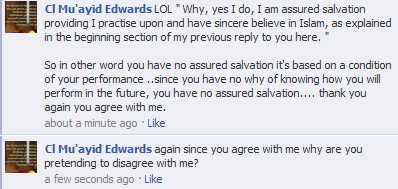
So after saying I didn’t provide a response, he then decides to magically see my response, which was:

” Why, yes I do, I am assured salvation providing I practise upon and have sincere believe in Islam, as explained in the beginning section of my previous reply to you here. “

To which his reply was:

“Proving you practise is a condition, something with a condition is not assured, because He vary well my not live up to the condition.  If it was truly assurd it would be with out condition.”

So what exactly is his argument? Let me break it down:

(1) He says he will go to heaven.
(2) I say we can only go to heaven depending on God’s will, we cannot tell God we’re going to heaven.
(3) He says he agrees with me:

(4) After saying he agrees with me, he decides that he doesn’t agree, as his blog post now says:

“As for me I have no shame in declaring to the world that I am saved by Grace through Faith in Jesus Christ, He has given me eternal Life, and I rest in Christ with perfect peace because of this salvation He has achieved for me.”

So sir, can you please make up your mind? On one end you’re saying I’m right (you agree with me), the other you’re saying you don’t, as you can self claim going to heaven.

wa Allahu Alam,
[and God knows best.]

[Updated x3!] CL. Edwards Caught Lying: Can’t Make Up His Mind!

Bismillahir Rahmanir Raheem
بِسۡمِ ٱللهِ ٱلرَّحۡمَـٰنِ ٱلرَّحِيمِ ,

After posting this article, Mr. Edwards decided to publicly shame himself, I’m not sure why he decided to do so, but I must say it was a pleasure to see his act. To begin with, his response to said article was:

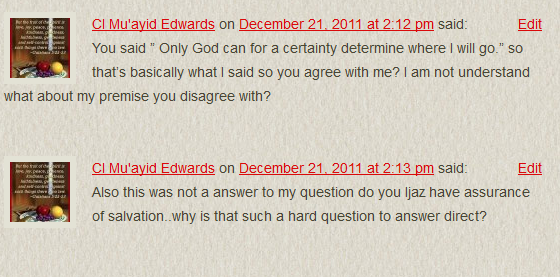
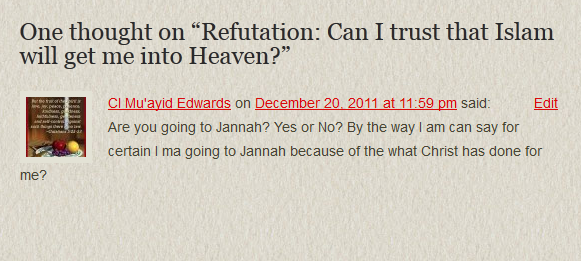
Mr. Edwards, sir, you did not say, “Only God can for a certainty determine where I will go”. Sir you actually said the following, let me refresh your mind for you:

You actually said the opposite,”By the way I can say for certain I ma going to Jannah because of what the Christ has done for me…“.

Mr. Edwards, at this point, I must ask you, which is it?
(1) You can say for sure you’re going to heaven.
(2) You let God decide where you go.

You’re singing two songs here sir, does your own deceit know no end? What I must admit, is that this guy cannot stop fumbling, if we take a look at the second comment from the first photo, he proposes a question to me:

“…do you Ijaz have assurance of Salvation..”

Why, yes I do, I am assured salvation providing I practise upon and have sincere believe in Islam, as explained in the beginning section of my previous reply to you here.

Please learn to read Mr. Edwards, I don’t have the time to have to constantly fix your inequities.

[Updated:]

After showing Mr. Edwards this post, he still couldn’t find the answer to his question, which I have now put in red and bold for his viewing pleasure. Here you can see that I clearly linked to him the post, with his answer being in the second to last line of this very response [article, see in red above]:

[Updated x2:]

I’m not sure if he’s colorblind or illiterate, but this was his response, he still could not find my answer which was in bold and red letters:

[Updated x3]:

Again, Mr. Edwards is simply grasping for straws, after answering his question above, which was not only in this post and my previous post, he decided to create a strawman and attack it. What was my answer to his question?

Why, yes I do, I am assured salvation providing I practise upon and have sincere believe in Islam, as explained in the beginning section of my previous reply to you here.

Do you all see the word, “YES“, in that quote, because I do, unfortunately Mr. Edwards sees the word no, so I’m not sure if he’s being petulant or simply can’t accept the YES which I gave:

wa Allaahu Alam.
[ and God knows best.]

CL. Edwards Responds: Certainty in Jannah

Bismillahir Rahmanir Raheem
بِسۡمِ ٱللهِ ٱلرَّحۡمَـٰنِ ٱلرَّحِيمِ ,

Mr. Edwards decided that he wouldn’t respond to the entire post, so he’d just post a comment because as in his own words, my exposition was “too long”. Not a problem, let’s see what estranged concept he brings to the table this time:

Edwards' Comment

His question is rather absurd, but to humour him, the answer is quite simple. Only God can for a certainty determine where I will go. I do not know the future and I don’t speak on behalf of God. However, the Qur’aan tells us what we need to believe in and what we need to practise upon to gain Jannah and as Muslims we strive towards that, knowing that God’s mercy is greater than His anger. It’s absurd to say, “yes”, because I am not God, I do not know the future and I do know what God’s judgement upon me will be, as I, like all other humans, are a sinner.

The Qur’aan does not make it difficult though, so what does a Muslim need to act upon and believe to gain heaven?

This is the Book; in it is guidance sure, without doubt, to those who fear Allah;

Believe in the Qur’aan, use it as a form of guidance, so that we develop taqwa (God consciousness).

Who believe in the Unseen, are steadfast in prayer, and spend out of what We have provided for them;

Believe in what Allaah has ordained for us and what He has told us, but which we have yet to know or experience. Perform praise and worship of God and live life within the means He has provided for us in a righteous way.

And who believe in the Revelation sent to thee, and sent before thy time, and (in their hearts) have the assurance of the Hereafter.

Belief in the Qur’aan, Injil, Tawrah Zabur, Suhuf al Ibrahim. As for assurance of the hereafter:

(And in the Hereafter they are certain) that is the resurrection, the standing (on the Day of Resurrection), Paradise, the Fire, the reckoning and the the Scale that weighs the deeds (the Mizan). The Hereafter is so named because it comes after this earthly life. – Tafsir ibn Kathir : Suratul Baqarah (2) : 4.

Lastly:

They are on (true) guidance, from their Lord, and it is these who will prosper.

Meaning:

(They are) refers to those who believe in the Unseen, establish the prayer, spend from what Allah has granted them, believe in what Allah has revealed to the Messenger and the Messengers before him, believe in the Hereafter with certainty, and prepare the necessary requirements for the Hereafter by performing good deeds and avoiding the prohibitions.

(And they are the successful) meaning, in this world and the Hereafter. They shall have what they seek and be saved from the evil that they tried to avoid. Therefore, they will have rewards, eternal life in Paradise, and safety from the torment that Allah has prepared for His enemies. Tafsir ibn Kathir : Suratul Baqarah (2) : 4.

Therefore the Qur’aan is extremely clear, it essentially spells it out for all Muslims, that sincere belief and God sanctioned actions would secure one a place in heaven. Of course Mr. Edwards doesn’t believe in this doctrine. He believes that no matter what he does, he gets to go to heaven, which brings up the question, does God reward sin? Funny enough, his friend and long time partner in crime (of deceit), Antonio Santana did admit to us that God rewards sinning in Christianity:

Antonio - Skype Convo

It’s absolutely nonsensical for one to say he knows where he is going in the afterlife merely based on some inconsistent and incoherent belief of “salvation in Christianity”, which has been thoroughly refuted here. They’re self claimants to their own misigivings, even the Jesus of the Bible lets it be known that merely believing in him will not benefit you in the least:

Not everyone who says to me, ‘Lord, Lord,’ will enter the kingdom of heaven, but only the one who does the will of my Father who is in heaven. – Bible : Matthew (7) :21.

So who are these people who won’t go to heaven then?

The sense of this verse seems to be this: No person, by merely acknowledging my authority, believing in the Divinity of my nature, professing faith in the perfection of my righteousness, and infinite merit of my atonement, shall enter into the kingdom of heaven, shall have any part with God in glory. – Adam Clarke’s Exegesis : Matthew (7) : 21.

In fact, the Bible wages sin and deceit for the one who speaks on God’s behalf, specifically when it comes to God’s will (judgment, doings etc):

Will you speak wickedly on God’s behalf?  Will you speak deceitfully for him?- Bible : Job (13) : 7.

The meaning of this verse is made much clearer by a scholarly Christian’s commentary:

“In order to support your own cause, in contradiction to the evidence which the whole of my life bears to the uprighteousness of my heart, will ye continue to assert that God could not thus afflict me, unless fragrant iniquity were found in my ways; for it is on this ground alone that ye pretend to vindicate the providence of God. Thus ye tell lies for God’s sake, and this ye wickedly contend for your maker.” – Adam Clarke’s Exegesis : Job (13) : 7.

See, Job in this verse or rather, this chapter, is condemning the people to whom he was sent to preach. It is because they began to play God and judge who is righteous and sinful among themselves. Decided who God afflicted and whom God did not afflict with punishment. They claimed because Job was afflicted, that he was a sinful man (yet it was not the case, he was purer than them all), whereas they perverted the truth (much like Mr. Edwards) and cast righteous judgement on themselves:

“Will you speak wickedly for God?
As he suggests they did, they spoke for God, and pleaded for the honour of his justice, by asserting he did not afflict good men, which they thought was contrary to his justice; but: then, at the same time they spoke wickedly of Job, that he being afflicted of God was a bad man, and an hypocrite; and this was speaking wickedly for God, to vindicate his justice at the expense of his character, which there was no need to do, and showed that they were poor advocates for God…”- The New John Gill Exposition of the Entire Bible : Job (13) : 7.

Well, atleast through Biblical means, his own scripture and by extension his own God, has deemed him a wicked and hypocritical man. Casting judgement on himself (for righteousness) whereas condemning others, when he does now know what God knows is in their hearts. I suppose he needs to be rewarded with Grace for his sin. God rewarding sin, what a joke.

wa Allaahu Alam.
[and God knows best.]

Refutation: A clear Quranic contradiction in Ta-Ha surah 20 verses 83-97

Bismillahir Rahmanir Raheem
بِسۡمِ ٱللهِ ٱلرَّحۡمَـٰنِ ٱلرَّحِيمِ ,

Response to: A clear Quranic contradiction in Ta-Ha surah 20 verses 83-97
By: C.L. Edwards from Calling Muslims website.

The ill reputed author, Mr. Edwards is at it again. This time he is claiming a contradiction in the Qur’aan and quite funnily, borrows the argument of Abraham Geiger which most Orientalists have used against Islam, since some 200 odd years ago. His argument isn’t new or is it of any academic value. However in the name of exposing his indecent affinity towards absurdity, we shall engage his argument step by step and refute him. He begins by asserting that these verses supposedly have a contradiction:

“(When Moses was up on the Mount, Allah said:) “What made thee hasten in advance of thy people, O Moses?”He replied: “Behold, they are close on my footsteps: I hastened to thee, O my Lord, to please thee.”  (Allah) said: “We have tested thy people in thy absence: the Samiri has led them astray.” So Moses returned to his people in a state of indignation and sorrow. He said: “O my people! did not your Lord make a handsome promise to you? Did then the promise seem to you long (in coming)? Or did ye desire that Wrath should descend from your Lord on you, and so ye broke your promise to me?” They said: “We broke not the promise to thee, as far as lay in our power: but we were made to carry the weight of the ornaments of the (whole) people, and we threw them (into the fire), and that was what the Samiri suggested. “Then he brought out (of the fire) before the (people) the image of a calf: It seemed to low: so they said: This is your god, and the god of Moses, but (Moses) has forgotten!” Could they not see that it could not return them a word (for answer), and that it had no power either to harm them or to do them good? Aaron had already, before this said to them: “O my people! ye are being tested in this: for verily your Lord is (Allah) Most Gracious; so follow me and obey my command.” They had said: “We will not abandon this cult, but we will devote ourselves to it until Moses returns to us.” (Moses) said: “O Aaron! what kept thee back, when thou sawest them going wrong, “From following me? Didst thou then disobey my order?” (Aaron) replied: “O son of my mother! Seize (me) not by my beard nor by (the hair of) my head! Truly I feared lest thou shouldst say, ‘Thou has caused a division among the children of Israel, and thou didst not respect my word!'” (Moses) said: “What then is thy case, O Samiri?” He replied: “I saw what they saw not: so I took a handful (of dust) from the footprint of the Messenger, and threw it (into the calf): thus did my soul suggest to me.” (Moses) said: “Get thee gone! but thy (punishment) in this life will be that thou wilt say, ‘touch me not’; and moreover (for a future penalty) thou hast a promise that will not fail: Now look at thy god, of whom thou hast become a devoted worshipper: We will certainly (melt) it in a blazing fire and scatter it broadcast in the sea!” – Suratul Ta-Ha (20) : 83 – 97.

So what is his argument? In summation:

“There are many details in the Quran that differ or are missing from the original account in the Bible, one of which is a person named al Samari. Now the name as-Samari literally means “The Samaritan a person who comes from Samaria”……..The problem in all this is this event in the history of the nation Israel happened over 600 years before the area of Samaria came into existence. To add to this colossal blunder early Muslims(the Salaf) are recorded as explaining that this as-Samari came from a Israelite tribe called Samaria…no such tribe has ever existed.

To begin with, he implies that the original account is from the Bible, one must point out that he is referring to the Old Testament, therefore that begs the question, which Canon or Codex of the Old Testament is he appealing to this time? Here’s a short list for him to choose from:

(1) Samaritan Scrolls.
(2) Qumran/ Essene’s Scrolls.
(3) Greek Septuagint (LXX).
(4) Masoretic Text.
(5) Massorah Oral Tradition.
(6) Eastern Orthodoxy’s varying Canon’s (Coptic Canon versus Ethiopian Canon….etc).

After he’s played a game of lottery with “God’s word”, the next step is to determine if the Bible’s historical accounts are valid to establish the veracity of a particular historical event. This of course is easily laid to rest with a resounding no, by consensus of most Biblical scholars, to validate this claim, here’s a few quotes:

The original copies of the NT books have, of course, long since disappeared. This fact should not cause surprise. In the first     place, they were written on papyrus, a very fragile and persihable material. In the second place, and probably of even more importance, the original copies of the NT books were not looked upon as scripture by those of the early Christian communities. – (George Arthur Buttrick (Ed.), The Interpreter’s Dictionary Of The Bible, Volume 1, p 599 “Text, NT”.)

To begin with, how can it be logically sound, that if the people at the time of the Bible’s authoring, rejected it as a scripture (inspired by God, contains absolute truth), much less as a historical document (if it isn’t an absolute truth, then it’s fickle truth), how can you expect us, some 2000 years or so later to accept such historical claims?

He says: Complaints about the adulteration of texts are fairly frequent in early Christian literature. Christian texts, scriptural and nonscriptural, were no more immune than others from vicissitudes of unregulated transmission in handwritten copies. In some respects they were more vulnerable than ordinary texts, and not merely because Christian communities could not always command the most competent scribes. Although Christian writings generally aimed to express not individual viewpoints but the shared convictions and values of a group, members of the group who acted as editors and copyists must often have revised texts in accordance with their own perceptions. This temptation was stronger in connection with religious or philosophical texts than with others simply because more was at stake. A great deal of early Christian literature was composed for the purpose of advancing a particular viewpoint amid the conflicts of ideas and practices that repeatedly arose within and between Christian communities, and even documents that were not polemically conceived might nevertheless be polemically used. Any text was liable to emendation in the interest of making it more pointedly serviceable in a situation of theological controversy. – (H. Y. Gamble, Books And Readers In The Early Church: A History Of Early Christian Texts, 1995, Yale University Press: New Haven & London, pp. 123-124.)

The Bible, clearly as a historical document is said to have been emendated (improved with bias) according to each sect’s understanding of it. What’s worse is that the first person to ever canonize and codify the Bible (canonize – to say what is scripture, codify – collected to be arrange in some order) emendated his own version, enough for him and his followers to be persecuted (see: Marcion’s Canon). With the above quotes and subsequent historical lesson, there is no basis for us to accept the account of the Bible, none whatsoever. It is merely wishful thinking and an appeal to emotion that CL Edwards seeks.

His second error, is that he incorrectly, which was his purpose, defines the term: “As-Samiri” (السَّامِرِ‌يُّ).

We do ask Mr. Edwards, on what authority do you have to give the absolute definition of the term above? Are you an expert in the field of Arabic or Hebraic Etymology? From where is your certification in these fields derived? To answer on his behalf and rightly so, nowhere! Therefore we assume he’s probably appealed to the fallacy of appeal to authority (to Orientalist Christian Scholarship). In his desperation for trying to find an error in Al Qur’aan ul Kareem, he has inadvertently exposed his lack of honesty, integrity and self respect. Thus, we do request that he come to terms with these self deficiencies.

Let’s continue by trying to grasp the history of this Samiri, so we can know who he was or from where he came:

“Samiri’s name as generally believed, was Musa Ibn Zafar. Ibn Jarar has narrated from Sayiddina Ibn ‘Abbas {ra} that Samiri was born in the year when under the orders of Pharaoh all male Israili children were to be killed. His mother, fearing the worst, put him in the hallow of a cave and covered its mouth.” – Tafsir Maa’riful Qur’aan, page 144.

Now that we’ve established some form of historical context to this person, his lineage does go back to the time of Moses (Musa alayhi as salaam), so this person did exist at the time of Moses. In that context, why is he called “As Samiri”, well, there are two probablities here:

(1) It could be a place from which he came.
(2) It could be a title due to his beliefs.

Earlier Islamic sources tend to cite both (1) and (2) as their understanding of the person named As-Samiri, that being, he came from a people who were worshipers of the cows:

Sayiddina Ibn ‘Abbas {ra} says that he belonged to a nation of cow-worshippers who somehow reached Egypt and pretended to join the religion of Bani ‘Israil whereas in actual fact he was a hypocrite. (Qurtubi) – Tafsir Maa’riful Qur’aan, page 143.

Where did they come from, if they were not from around Egypt?

“According to Sayddina Sa’id ibn Jubair {ra} he was a Persian from the Kirman province.” – Tafsir Maa’riful Qur’aan, page 143.

Now this logically makes sense.

(1) The Samiri was born during the time of Moses.
(2) The Samiri was from Persian (Mesopotamia) and was brought to or near Egypt when a group of Persians migrated.
(3) Persia is near the Indus Valley River Civilization (known cow worshipers), in fact, they share similar cultural traits (languages, religions, dress).

Therefore it is logical to assume that the Samiri is a person who was from among a people who worshiped cows, and who had migrated to near Egypt. The entire narration from the Qur’aan makes sense when compared to basic history. Of course one had to be objective and look outside the inconsistent and incoherent Biblical tradition and really accept the historical narrative as it exists through modern historical interpretations.

The historical context is easy to grasp, the Samiri was a cow worshiper with Mesopotamian origins (from which his religion came) through the Indian peoples (Indus Valley Civilization – known cow worshipers):

In the case of Egyptian and Harappan civilizations, there exists considerable evidence that the two societies, which flanked Mesopotamia on the west and east, respectively, had continuous trade contact with the cities of Sumer and, in the case of Egypt, political and military contacts as well. So the channels for the diffusion of technology and ideas certainly were there. It should probably be stressed at this point that a certain amount of diffusion and cross-fertilization is critical to the development of any civilization and no society has developed in total isolation. Whatever the degree of borrowing, however, every civilization adapts and applies ideas, technologies and institutions to its own physical environment and cultural heritage. – (The World’s History (Volumes 1 and 2 – 2nd Edition), Chapter 3 (River Valley Civilizations), Page 11 – by Howard Spodek.)

Therefore in conclusion, the Biblical claim is that a city known as Samaria did not exist until some 700 years after Moses, therefore the Samiri people could not have existed. Whereas historical knowledge (go figure, the Bible contradicts history) indicates that the Mesopotamian, Harappan (Indus Valley Civilization) and the Egyptians all shared a common and integrated history some 1500 years before Moses (Civlizations from 3000 BCE, Moses from 1500 BCE) and the incident of Pharaoh.

We therefore propose that Mr. Edwards rescinds his absurd, infantile, petulant, irrational and ignorant arguments and perhaps, for the good will of his humanity, cease to embarrass himself and his archaic faith.

wa Allaahu Alam.
[and God knows best.]

Refutation: Can I trust that Islam will get me into Heaven?

Bismillahir Rahmanir Raheem
بِسۡمِ ٱللهِ ٱلرَّحۡمَـٰنِ ٱلرَّحِيمِ ,

Response to: Can I trust that Islam will get me into Heaven?
By: C.L. Edwards from Calling Muslims website.

It is always interesting to read how Extremist Christians, anti-Muslims think. One such person is the propagandist Mr. Edwards. One of his more recent attacks against Islam, sponsored by his inanity rests on the topic of Salvation. Let’s take a look at what he says:

Most Muslims believe they will enter Jannah(Islamic heaven) based on their confession of the Shahadah(Statement of Faith) and doing good deeds, like Praying, giving Zakat(Charity) etc. Most Muslims fill some assurance they will make it into Jannah despite knowing they sin just like every other human being, because of their status of being Muslims. But consider these facts taken from authentic Islamic sources.

What is quite funny is that Mr. Edwards begins his intellectually fraudulent discourse by appealing to the fallacy of hasty generalization, and then he quite expectedly, rests his assertion upon not a single citation, to show atleast some majority of Muslims believe what he asserts. It is a common problem for persons who are wholly uneducated in Islam to understand the vast topic of Salvation within the faith. To begin with, Muslims do not believe that “despite sinning”, that we gain heaven. We believe that through repenting for our sins and through God’s mercy that He will grant us Jannah (Paradise):

Our Lord, and make us Muslims [in submission] to You and from our descendants a Muslim nation [in submission] to You. And show us our rites and accept our repentance. Indeed, You are the Accepting of repentance, the Merciful. – Suratul Baqarah (2) : 128.

Except for those who repent and correct themselves and make evident [what they concealed]. Those – I will accept their repentance, and I am the Accepting of repentance, the Merciful. – Suratul Baqarah (2) : 160.

What’s even more embarrassing for him, is that the Qur’aan also clearly states that Allaah does not accept those sinners who do not repent from their evils, for they would be punished:

And that repentance is not of those who constantly commit sins, and when death approaches one of them, he says, “I repent now”, nor of those who die as disbelievers; for them, We have kept prepared a painful punishment. – Suratul Baqarah (4) : 18.

So Mr. Edward’s assertion is contradicted by the Qur’aan which clearly states that only those who sincerely repent gain His mercy of Jannah and those who sin and do not repent are to be painfully/ severely punished. He then goes on to say:

Yet he doesn’t tell them forcertain that if they do good works they will be forgiven.

After quoting Suratul Hujurat (49) : 14 about an ayat of hypocrites, Mr. Edwards continued to display his ignorance of Islamic theology. The problem here is that he is saying, Muhammad {saw} doesn’t guarantees these people heaven (as from the context of the ayah), because he (Muhammad {saw}) wasn’t sure of his own salvation. While that is an entire topic by itself, his interpretation is wrong. The proper theological exegesis (interpretation) of this ayat is that Muhammad {saw} is addressing munafiqeen (hypocrites), thus their doing of good works is hypocritical, therefore it will not avail them in the least:

The ignorant said, “We have accepted faith”; say, (O dear Prophet Mohammed – peace and blessings be upon him), “You have surely not accepted faith, but you should say ‘We have submitted’, for faith has not yet entered your hearts; and if you obey* Allah and His Noble Messenger, He will not reduce the reward of any of your deeds; indeed Allah is Oft Forgiving, Most Merciful.” (* By accepting faith and then obeying the commands). – Suratul Hujurat (49) : 14.
“According to Imam Bahgawi, this verse was revealed in connection with the Tribe of Banu Asad. A few members of that tribe came up to Prophet Muhammad {saw} in Madinah during a severe drought. These people were not sincere believers. They had expressed their Islam merely to demand help from the Muslim Sadaqat funds. As they were not believers in the real sense of the word, they were unaware of Islamic injunctions and manners. They spread filth and excrement on the streets of Madinah.” – Tafsir Maar’iful Qur’aan, page 148.   

He then forwards his ill fated premise based on his clearly laughable eisegesis (intellectually fraudulent interpretation), by ignoring the context of the ayah (hypocrites and their actions), he mistakenly (due to ignorance) attributes it to a hadith where it is said:

…..He (Muhammad {saw}) said, “As to him, by Allah, death has overtaken him, and I hope the best for him. By Allah, though I am the Apostle of Allah, yet I do not know what Allah will do to me,”….. – Sahih al Bukhari : Volume 5 : Book 58 : Hadith 266.

He then on the same note goes on to make some statements of the same understanding:

……So we see that one may consider themselves Muslim, even a believer(Mumin) but you have no objective way of really knowing if you truly are in Allah’s eyes, at least until you die and are resurrected. Not even Muhammad himself could be sure what his fate would be……

To begin with, the hadith in Sahih Al Bukhari is not referring to whether or not Muhammad {saw} will be granted Jannah as he himself says he would cross the Pulsiraat (the bridge between being judged and the gates of Jannah) first:

Allah will call them, and As-Sirat (a bridge) will be laid across Hell and I (Muhammad) shall be the first amongst the Apostles to cross it with my followers. – Sahih al Bukhari : Book 12 : Hadith 770.

As for the statement that He does not know what the Lord of the Worlds (Allaah) will do to him, then I do not see the problem with the statement, it is referring to the ‘Ilm ul Ghayb (Knowledge of the Unseen):

“Say: “None in the heavens and the earth knows the Ghaib (Unseen) except Allaah, nor can they perceive when they shall be resurrected” – Suratul Naml (27) : 65.

“And with Him are the keys of the Ghayb (all that is hidden), none knows them but He. And He knows whatever there is in the land and in the sea; not a leaf falls, but He knows it. There is not a grain in the darkness of the earth nor anything fresh or dry, but is written in a Clear Record” – Suratul An’aam (6) : 59.

Even this is confirmed in the Bible, that God knows, or God’s knowledge is not equal to man’s knowledge:

“No one knows about that day or hour, not even the angels in heaven, nor the Son, but only the Father.” – Bible: Matthew 24 : 36.

Mr. Edward’s arguments are so completely devoid of any logical reasoning, I consider it child’s play to have to write this rebuttal. I am deeply discontented with his challenge, a simple reading of the Qur’aan dispels all of his arguments and knowledge of some of the most common ahadith are enough to lay his inanity to rest, however let’s see more of what this propagandist has to offer:

“Here is more conclusive proof that no matter how hard you believe or how many good deeds you strive to do for Allah, He may decided to over ride what you have done and damn you to Hell anyway! Please read this authentic hadeeth that says, its your destiny not your faith or works that determine your end in Islam. “

What was his conclusive proof? A hadith that says that a good man can do evil, and in the end go to hell, whereas an evil man can do good and then go to heaven:

“Abdullah (b. Mas’ud) reported that Allah’s Messenger (may peace be upon him) who is the most truthful (of the human beings) and his being truthful (is a fact) said: Verily your creation is on this wise. The constituents of one of you are collected for forty days in his mother’s womb in the form of blood, after which it becomes a clot of blood in another period of forty days. Then it becomes a lump of flesh and forty days later Allah sends His angel to it with instructions concerning four things, so the angel writes down his livelihood, his death, his deeds, his fortune and misfortune. By Him, besides Whom there is no god, that one amongst you acts like the people deserving Paradise until between him and Paradise there remains but the distance of a cubit, when suddenly the writing of destiny overcomes him and he begins to act like the denizens of Hell and thus enters Hell, and another one acts in the way of the denizens of Hell, until there remains between him and Hell a distance of a cubit that the writing of destiny overcomes him and then he begins to act like the people of Paradise and enters Paradise.” – Sahih Muslim : Book 33 : Hadith 6390.

God is all knowing, therefore God knows what a person’s life is destined to be, part of being all knowing, is to know the past (to us), present (to us) and future (t0 us). However God knows the past, present and future. Therefore God will know what will happen to persons. A man may be a believer and then up becoming a disbeliever (acting like the people of the fire). It makes perfect sense, this has nothing to do with God removing ‘aql (free will) from man and damning them to hell. It has to do with God knowing what will happen to these two sets of people, one may start as a believer and end up as a disbeliever and vice versa.

Mr. Edwards then returns with his deceits once more:

“……but Islam teaches that everyone will enter Hell Fire, not just non-Muslims.”

You can pretty much predict the ayat he would use:

” Not one of you there is, but he shall go down to IT; that for thy Lord is a thing decreed, determined.” – Mr. Edward’s interpretation of Suratul Maryam (19) : 71.

What does “go down to it” even mean? They ayah is referring to the Siraat or the Bridge which one would have to cross over to go to Jannah, as referenced above:

Allah will call them, and As-Sirat (a bridge) will be laid across Hell and I (Muhammad) shall be the first amongst the Apostles to cross it with my followers. – Sahih al Bukhari : Book 12 : Hadith 770.

Which is why the ayah really says:

“Not one of you but will pass over it: this is, with thy Lord, a Decree which must be accomplished.” – Suratul Maryam (19) : 71.
وَإِنْ مِنْكُمْ إِلَّا وَارِ‌دُهَا ۚ كَانَ عَلَىٰ رَ‌بِّكَ حَتْمًا مَقْضِيًّا

Look at the difference between his statement, and what the Qur’aan actually says, for him to fight against Islam, as the Christian he is, he had to reinterpret the ayah and reject the real meaning! Perhaps he can show us where in the Arabic which I provided above it says everyone will enter hell. The challenge stands Mr. Edwards. What’s funny is how over enthusiastic he became after he incorrectly quoted the ayah:

“Did you catch that? Everyone will go down into “it”  and the context tells you the “it” that is being discussed is Hell.”

Somehow I have a very strong notion that he will not be able to defend his errors when confronted with them. It is clear as day that he has emendated (changed for the purpose of bettering his argument) the interpretation and English text of the Qur’aan. It is indeed a shameful plunge into the realms of intellectual dishonesty that this Extremist Christian Polemic has ended up within.

He then goes on to state:

“Islam offers no sure way of ever saving yourself, no assurance of salvation, because even if you think you really believe and have done goods, you can not know for sure until you die and are resurrected and find out if you get rescued out of Hell.”

Actually, the very second page (Chapter 2) of the Qur’aan would like to differ, how funny is it that the refutation for his statement comes from the second Surah of the Qur’aan? The very first 5 lines (ayat) are the answer to his question:

“This is the Book; in it is guidance sure, without doubt, to those who fear Allah; Who believe in the Unseen, are steadfast in prayer, and spend out of what We have provided for them; And who believe in the Revelation sent to thee, and sent before thy time, and (in their hearts) have the assurance of the Hereafter. They are on (true) guidance, from their Lord, and it is these who will prosper. – Suratul Baqarah (2) : 2 – 5.

He then goes on to further contradict Islamic sources:

“And your Shaykh, your Imam, not even Muhammad himself can save you.”

Whereas the hadith says:

“The Messenger or Allah (may peace be upon him) observed: So they would come to me and I would ask the permission of my Lord and it would be granted to me, and when I would see Him, I would fall down in prostration, and He (Allah) would leave me thus as long as He would wish, and then it would be said: O Muhammad, raise your head, say and you would be heard; ask and it would be granted; intercede and intercession would be accepted.” – Sahih Muslim : Book 1 : Hadith 373.

He has been fully refuted, as usual, he ends his posts with erratic, misconstrued and illogical posts from the Bible, specifically about Jesus being the source of salvation for their sins, this has been previously responded to in this article.

Can Mr. Edwards respond in an academic manner to this post or shall he Call Muslims yet not be able to answer them?
wa Allaahu Alam.
[and God knows best].

Calling Christians Now Live!

Bismillahir Rahmanir Raheem
بِسۡمِ ٱللهِ ٱلرَّحۡمَـٰنِ ٱلرَّحِيمِ ,

I would love to announce the launch of CALLINGCHRISTIANS.COM . For sometime now this former blog on theology has grown from a few hits per day to nearing 10,000 10,000+ unique views. With the success of the numerous articles, debates and dialogues that have occurred through our da’wah, it was decided that we should dutifully expand our operations (that means more articles, debates, contradictions, rebuttals!). We will continue with our modus operandi of debating, dialoguing and discussing theology in light of Islam. We ask that you support us and share our articles, videos and debates insha Allaah (God Willing).

To see a list of recent changes made from blog to full blown website, click here.

What’s to Come:

  • Testimonials page (both Muslim and Non-Muslim interviews!)
    [Update: Testimonials being written by respective authors, soon to be posted!]
  • Rebuttals page.
    [Update: Already rebutted a few ignorant anti-Islamists, will place into a single page soon.]
  • Articles Section.
    [Update: Quite a number of articles written, will place into a single page soon.]

Please feel free to contact us on our progress, articles, debates by clicking here.
and Allaah [God] knows best.

Changes…

Bismillahir Rahmanir Raheem
بِسۡمِ ٱللهِ ٱلرَّحۡمَـٰنِ ٱلرَّحِيمِ ,

As Salaamu ‘Alaykum, as some of you would have noticed, the blog’s theme recently changed and there have been a few notable alterations as well. Over the next week significant and more bold changes will be taken to enhance this blog’s readability, visibility, quality and content. The major changes will be rolled out over the months of December (2011) to January (2012), as for now, here are a list of the minor changes:

  • New theme (lighter, less clutter).
  • Disabled and Removed the “About” page.
  • Disabled and Removed the “A Muslim’s View of War” page.
    [Update: Reinstated Page, Added New Content]
  • Altered the “Contact Us” page, you can now reach me directly from the browser via our [simple] contact form.
    [Update: Added New Fields, Challenges for debates can now be issued to us from there]
  • Altered the Sidebar, Search Field at the top, reorganized other areas for post visibility and discovery.
  • Changed blog’s/ website’s name.
  • Added “Rebuttals” page, however private (hidden from users) until page is populated.
  • Developing/ Rendering blog logo, to be uploaded soon.
  • Domain name bought.
  • New name to be launched!
    [Update: If you’re seeing this, then the website has launched with its new name! Subhanallah!]

Over the next few days the major changes will be rolled out bit by bit, and a post will accompany every major change that is made.  Keep us in your du’as insha Allaah.

wa Allaahu Alam.

Atheism: Belief in the Inconsistent.

Bismillahir Rahmanir Raheem
بِسۡمِ ٱللهِ ٱلرَّحۡمَـٰنِ ٱلرَّحِيمِ ,

In light of modern militant atheism, let’s take a logical, analytical and methodological approach towards understanding their position for the purpose of coming to a common understanding to develop our da’wah. To begin with, we must first comprehend what atheism is and is not, that is to define it.

Theism – the belief (ism) in a God (theos).
Atheism – the disbelief in (a) God(s) or the negation (denial) of belief in (a) God(s).

The “a” is a negation of the statement, just as would find in:

Gnostic – a knower.
Agnostic – one who does not know.

It is as this point I’d like to introduce the basis for atheism, the cardinal belief of the atheist:

“God(s) do(es) not exist, because their exists no evidence for this (these) God(s).”

The typical response to such a statement, is usually to create arguments, premises, statements that in someway try to present God or the existence of God as a logical position. This is problematic because the statement of the atheist is by innate nature, inherently flawed. That is to say, their position is flawed, the question is flawed, so the answer will definitely have flaws. Therefore, the response to such a statement should not be an attempt to refute it, as the atheist has already concluded their position:

(If) there is no proof for God => (then, this implies that) God does not exist.

This is called a logical implication, taking the form (if) A (then) => B.

The proper response to such a statement, should be to question their “if”. What does this atheist mean, by “evidence”?

Do they mean philosophical? Super natural? Empirical? All of the above?

Usually, atheists have to create philosophical arguments to defend their empirical reasoning. Meaning, the evidence they seek is empirical. Empirical evidences is defined as that which can be seen, touched, heard, smelled and tasted. More or less, it has to be something which one can directly interact with, in a physical sense.

At this point, as a Muslim, I have to categorically dismiss such a notion of God. This atheist, believes in the disbelief of a God that Islam neither condones nor promotes. Muslims believe in Allaah, who is more or less described as being a non-physical, incomparable being, of which we cannot comprehend, because this Allaah is unlike anything we know and our minds can only generate concepts which are relative to what we see, hear, touch, smell and taste because we as humans function by these mechanical attributes in this world. So the atheist, is disbelieving in a concept of God that we as Muslims also hold to be irrational.

I am not condoning the belief of the atheist, but it is as this occasion, we can begin to understand what form our da’wah has to take towards them. Let them know, that their concept of God, is greatly flawed and thus their arguments towards such a God we wholly reject.

They may then pose the question, if God is all seeing, should God not have 1000 eyes?

Taking my advice from above, why should God need eyes to see? Eyes are built to function in this world, for which we are limited in numerous ways. The eyes of the Christian God only saw the Israelite kingdoms while being tempted by Satan. In this regard, we accept that human vision is greatly limited, which ever being has a human eye, cannot be all seeing, or in this regard, all knowing, as the eye is not meant to function as such.

So then the question presents itself, if you don’t know the nature of this God, how can you know that this God exists. If God is not a physical being, then what is God? How would one be assured that what you don’t see, feel, hear, taste or smell, exists?

I’d like to say that that’s also an inherently flawed question, which we will answer by using the age old method of proof by contradiction through analytical deduction by way of conversing their statements through an analogy:

“How do we know that Alexander the Great (insert any historical figure here) existed?”

None of us, have ever touched, seen, heard, smelled or tasted Alexander. So the erroneous concept of the onus on being on theists to present such a case to suit empiricist concepts is out of the window. If you believe that a historical figure existed without fulfilling the above criteria, then you cannot demand that the only evidence to prove God’s existence should be that which you also cannot use to substantiate your belief.

So what do we rely on to confirm that Alexander the Great existed? Why, the historical record of historians, reliant upon numerous narrations of his conquests, victories and losses. The vast amount of testification to this person’s existence or any other historical person’s existence, really depends upon the mass flow of historical information from the people at his time and after his time, attesting to his existence. Therefore, with that logic, we must also confirm that God exists, just as the reasoning for Alexander’s existence is used to confirm his. The testification of thousands at their specific time in existence to God’s works throughout our history, is testament to His existence. We simply use the same method that we used to substantiate the existence of Kingdom’s, historical figures, or events.

If the atheist presupposes that we cannot use the same method, then we must question their objective integrity. Are they questioning to understand, or questioning to display their character flaw of hypocrisy? What is good for you, is it not also good for me?

wa Allaahu Alam.

Prophetic Cure: The Fly’s Cure

Bismillahir Rahmanir Raheem
بِسۡمِ ٱللهِ ٱلرَّحۡمَـٰنِ ٱلرَّحِيمِ ,

Prophet Mohammad (peace be upon him) said: “If a fly falls down to your vessel, drown it then remove it, for one of its wings has the ailment and the other has the cure,”

The surface of flies is the last place you would expect to find antibiotics, yet that is exactly where a team of Australian researchers is concentrating their efforts.

Working on the theory that flies must have remarkable antimicrobial defences to survive rotting dung, meat and fruit, the team at the Department of Biological Sciences , Macquarie University, set out to identify those antibacterial properties manifesting at different stages of a fly’s development.

“Our research is a small part of a global research effort for new antibiotics, but we are looking where we believe no-one has looked before,” said Ms Joanne Clarke, who presented the group’s findings at the Australian Society for Microbiology Conference  in Melbourne this week. The project is part of her PhD thesis.

The scientists tested four different species of fly: a house fly, a sheep blowfly, a vinegar fruit fly and the control, a Queensland fruit fly which lays its eggs in fresh fruit. These larvae do not need as much antibacterial compound because they do not come into contact with as much bacteria.

Flies go through the life stages of larvae and pupae before becoming adults. In the pupae stage, the fly is encased in a protective casing and does not feed. “We predicted they would not produce many antibiotics,” said Ms Clarke.

They did not. However the larvae all showed antibacterial properties (except that of the Queensland fruit fly control).

As did all the adult fly species, including the Queensland fruit fly (which at this point requires antibacterial protection because it has contact with other flies and is mobile).

Such properties were present on the fly surface in all four species, although antibacterial properties occur in the gut as well. “You find activity in both places,” said Ms Clarke.

“The reason we concentrated on the surface is because it is a simpler extraction.”

The antibiotic material is extracted by drowning the flies in ethanol, then running the mixture through a filter to obtain the crude extract.

When this was placed in a solution with various bacteria including E.coli, Golden Staph, Candida (a yeast) and a common hospital pathogen, antibiotic action was observed every time.

“We are now trying to identify the specific antibacterial compounds,” said Ms Clarke. Ultimately these will be chemically synthesised.

Because the compounds are not from bacteria, any genes conferring resistance to them may not be as easily transferred into pathogens. It is hoped this new form of antibiotics will have a longer effective therapeutic life.

http://www.abc.net.au/science/articles/2002/10/01/689400.htm

wa Allaahu Alam.

« Older Entries Recent Entries »