Category Archives: Muslim and Non-Muslim Dialogue

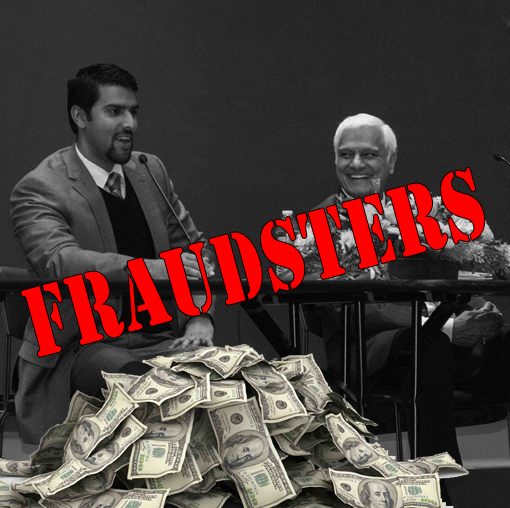
Has Evangelist Ravi Zacharias Lied About His Credentials?

The following is a guest post by three individuals who have taken it upon themselves to investigate the academic credentials of Ravi Zacharias. They have included their names, and their own academic qualifications and can be contacted by commenting on the post. Any comments or questions posted, will be sent to them.

cc-2015-rzimnabeel

HAS EVANGELIST RAVI ZACHARIAS LIED ABOUT HIS CREDENTIALS?

WHO WE ARE

We are two atheists and a Christian who are concerned that a prominent evangelist, Mr. Ravi Zacharias, has engaged in misconduct that undermines academic integrity and that tends seriously to mislead the public at large.   We issue this Press Release with two primary goals in mind. First, we wish to draw attention to what we believe are the dishonest practices of Ravi Zacharias.  Second, we hope the facts presented here will prompt professional journalists and investigators to continue the work we have started.

  • Steve Baughman is an attorney and part time philosophy student at the Graduate Theological Union in Berkeley, CA.  He holds a Masters Degree in Asian Studies from University of California at Berkeley. He is the creator of the YouTube channel Friendly Banjo Atheist, which first presented the matter of Mr. Zacharias’ credentials to the public.

  • Tom Lunal has a B.S. in Mathematics from U.C. Santa Barbara and an M.S. in Computer Science from USC. He worked for Microsoft before moving to a position at New York Life.

  • Andy Norman is a professor of philosophy at Carnegie Mellon University (CMU). He has a PhD from Northwestern University and has published widely on the norms of responsible discourse.

ABOUT RAVI ZACHARIAS

Ravi Zacharias is a world renowned Christian evangelist who has written over a dozen books. Former White House counsel, Chuck Colson, called him “the great apologist of our time.”  Mr. Zacharias maintains a busy travel schedule lecturing all over the world. He resides in Atlanta, Georgia, where his ministry, Ravi Zacharias International Ministries (RZIM), is headquartered. RZIM has numerous overseas offices and maintains a staff of over 100 people.  According to Mr. Zacharias’ website, his weekly radio program, “Let My People Think”, airs on over 2,000 outlets worldwide.

A. SUMMARY OF CONCERNS

THE CAMBRIDGE CLAIM

Ravi Zacharias has claimed for many years that he was a “visiting scholar at Cambridge University.”  He presents this claim prominently in his press bios and in his memoirs.  He makes frequent mention of it in his public appearances (in about 90% of his youtube videos). It is by far the most impressive item in his academic portfolio.

The claim is absolutely false.  The University of Cambridge press office has confirmed the same to us.

We recently contacted Mr. Zacharias and informed him of our belief that he has misrepresented having been a “visiting scholar at Cambridge University.” We informed him of our intent to go public with this information and we asked him for a response. None came.

Shortly thereafter Mr. Zacharias deleted the claim from his official website bio.

B. THE DETAILS OF MR. ZACHARIAS’ MISREPRESENTATIONS

THE CAMBRIDGE CLAIM

In his memoirs Mr. Zacharias states the following:  “By 1990, the load of ministry had gotten so heavy that I decided to take a sabbatical for the first time since I had started in the ministry. I spent part of that year at Cambridge University in England with my family, and it was a very special time for us.”

He also writes “I was invited to be a visiting scholar, and I decided to focus my studies on the Romantic writers and moralist philosophers.” (Walking from East to West, at p. 205.)

Until several weeks ago, Mr. Zacharias’ website bio at RZIM.org stated, “Dr. Zacharias has been a visiting scholar at Cambridge University.” Mr. Zacharias is frequently introduced at his university appearances as having been “a visiting scholar at Cambridge University.” The President of Liberty University said “Ravi was a visiting scholar at Cambridge university” when awarding him an honorary doctorate recently. The claim also appears on the jacket of his book, The Real Face of Atheism and a few of his books claim in the back cover that he was educated at Cambridge University.

A Google search of [“Ravi Zacharias” “visiting scholar at Cambridge University”] reveals thousands of pages in which the claim is repeated.

The claim is false as mentioned earlier, and Mr. Zacharias withdrew it shortly after we asked him for a response to our concern that he has misrepresented his Cambridge visiting scholar status.

How do we know it is false? We contacted the University of Cambridge Office of External Affairs and Communications and asked whether Mr. Ravi Zacharias was ever a visiting scholar at their university.  We were told in writing the following:

 1. “We can confirm that Mr. Zacharias spent a sabbatical term at Ridley Hall in the city of Cambridge.” He was there for a mere 12 weeks (1 term).

2. “Ridley Hall is independent from Cambridge University and trains people for effective work in the Church of England”.

3. “Attending lectures and classes at the University of Cambridge whilst on sabbatical at Ridley Hall would not confer University of Cambridge Visiting Scholar status on a student. Ridley Hall is not and has never been a constituent part of the University of Cambridge and has different criteria for granting Visiting Scholar status.”

4. “All student and visitors to Ridley Hall know the difference between Ridley hall and Cambridge University and to equate this is plainly false.”
Insofar as it is exclusively the province of the University of Cambridge to decide who constitutes a “visiting scholar” at their institution, we believe it to be established beyond dispute that Mr. Zacharias’ visiting scholar claim is false.  
We sincerely ask that you contact Cambridge University and Ridley Hall independently and verify this information.
 

FIRST ANTICIPATED DEFENSE FROM RAVI ZACHARIAS

1. The close connection between the University of Cambridge and Ridley Hall justifies the claim. 

No it does not.  We note that his website was recently changed to state that “Dr. Zacharias has been a visiting scholar at Ridley Hall, Cambridge (then affiliated with Cambridge University, now more recently allied with Cambridge and affiliated with Durham University) where he studied moralist philosophers and literature of the Romantic era.) This is totally false. It makes it seem as if Ridley Hall was a constituent Hall of Cambridge University back when he was there. The officials at Cambridge University and Ridley Hall confirmed that it has never has that affiliation. Ridley Hall has always been an independent clergy training school and never part of Cambridge University.

However, we acknowledge the close affiliation between the University of Cambridge and Ridley Hall.  Both are in the town of Cambridge, and both are part of the Cambridge Theological Federation (CTF). There are various institutions that are a part of the Cambridge Theological Federation and the students and others are allowed to utilized the facilities, libraries at these various schools. They are also able to take a few Cambridge, Durham etc. accredited courses. That’s it, no more, no less. No one can ever claim that being at one equals to being at the other as Ravi Zacharias might claim.

We believe it to be a misleading practice to claim to have been a “visiting scholar” at one institution by virtue of one’s doing a sabbatical at a different “affiliated” institution.  We note that Mr. Zacharias’ supervisor at Ridley, Dr. Jeremy Begbie, who taught at both Ridley and Cambridge University, draws a very clear distinction in his own Curriculum Vitae between Ridley Hall and Cambridge University. (See https://divinity.duke.edu/academics/faculty/jeremy-begbie ).
SECOND ANTICIPATED RESPONSE FROM RAVI ZACHARIAS
2.  The “visiting scholar at Cambridge University” claim is accurate because Mr. Zacharias attended classes and lectures at Cambridge University while on Sabbatical at Ridley
Again, the University of Cambridge has told us in writing that ““Attending lectures and classes at the University of Cambridge whilst on sabbatical at Ridley Hall would not confer University of Cambridge Visiting Scholar status on a student.” The Director of Programs at Ridley Hall actually said “that such a claim might be made for personal benefit but would be absolutely false. If you want to study at Ridley, you would apply to Ridley and if you want to study at Cambridge University, you would apply to Cambridge University.” There is absolutely no justification for making any of the claims that Ravi Zacharias has made even if he took a few classes at Cambridge. Seeing that he was there foronly 12 weeks, just how many classes would he have taken anyway?
Additionally, just think about it. Even if we, for the sake of argument grant that he was indeed a visiting scholar at Cambridge University (which he clearly was not!), does it justify the marketing and publicizing he has done for years trying to pass as a Cambridge scholar. His book, DVDs, CDs, public talks, sermons, speech bios etc. are full of references to being a visiting scholar at Cambridge University, making it look like he spent years doing research at that fine institution. The actual fact of the matter is that he was never a visiting scholar at Cambridge University but was on a sabbatical at Ridley Hall.
THIRD ANTICIPATED RESPONSE FROM RAVI ZACHARIAS
3. The vagueness of the term “visiting scholar” justifies Mr. Zacharias’ use of it:

Now we move to the designation of visiting scholar status. The official record at Ridley Hall says that he was on Sabbatical for one term (12 weeks). You can check it out independently. Just call them! We acknowledge that the term “visiting scholar” is used both formally and informally.  In its formal sense it carries great prestige, especially at respected institutions like Cambridge University. In its informal sense, it can mean nothing more than attending lectures and classes for a short period  while on sabbatical at a given institution.However, the informal designation cannot be utilized for official purposes. For instance, if I go to Cambridge and do some research for a few months and interact with faculty/students, I could unofficially call myself a visiting scholar but unless the university has officially invited me I cannot claim so in official documents. This, however, is precisely what Ravi Zacharias has done. His official records show that he was on sabbatical at Ridley Hall but he claims that he was visiting scholar at Cambridge University. He writes in his autobiography that he was “invited by Cambridge University.” This is not a case of stretching the truth, its a case of telling an absolute lie.

Mr. Zacharias clearly intends us to understand his “visiting scholar at Cambridge University” claim in the formal, prestigious sense.  It is, quite simply, the crown jewel of his otherwise very unremarkable academic history.  It is a claim he has trumpeted loudly and widely.

To be sure, Mr. Zacharias may now urge as his defense that he intended the claim to be understood informally (perhaps as nothing more than him attending lectures and classes at Cambridge while he was at Ridley.)  But the more Mr. Zacharias drifts from the formal/prestigious conception of the term “visiting scholar,” the more the public will be justified in feeling deceived. Why make such a big issue of it in the press materials (books, videos, CDs, speech bios etc.) if it was an informal arrangement involving nothing more than “attending lectures and classes”?

REMAINING CONCERNS:

We believe that Mr. Zacharias’ deception is clearly established. Nevertheless, we believe that we might gain greater clarity as to the depth of that deception if several outstanding questions be answered.

CONCERN 1:
Who invited Mr. Zacharias to be a “visiting scholar at Cambridge”? Which office at Cambridge University invited him? They have absolutely no record of him being there.  Did Mr. Zacharias formally take classes at Cambridge? Or did he merely audit? Were these graduate classes? (See p. 205-206 of Walking From East to West where Mr. Zacharias specifically claims to have been invited to be a visiting scholar at Cambridge University.)  

We hope others will be more successful than we have been in obtaining information from Mr. Zacharias about these significant matters of concern.   
CONCERN 2:
The website at RZIM claims that “He has been honored with the conferring of six doctoral degrees, including a Doctor of Laws and a Doctor of Sacred Theology.” Please notice the wording. This makes it look like he earned these doctorates, especially to the person in the pew. What it should say clearly is that “He has been conferred six honorary doctoral degrees, including a Doctor of Laws and a Doctor of Sacred Theology.” Again, there is always this need for Mr. Zacharias to boost his credentials by either telling a lie or by making things unclear.

CONCERN 3:

Mr. Zacharias claims to have “lectured at the world’s most prestigious universities.” (See for example the jacket of his book The Real Face of Atheism.  In his autobiography he states, “I have spoken on almost every major campus – Berkeley, Princeton, Cornell, you name it.  If we haven’t been to a major school it is more often than not because we haven’t had the time to accommodate the request.” Walking from East to West, p. 209.

We are concerned about the extent to which Mr. Zacharias’ claim implies that his appearances at such universities have been pursuant to invitations from the faculty or the institutions.  It is our understanding that Mr. Zacharias’ appearance at prestigious universities has been primarily, if not exclusively, pursuant to invitations from student clubs and Christian evangelical organizations or local churches. For instance, many of Mr. Zacharias’ appearances at prestigious universities have been sponsored by the Veritas Forum, a Christian campus ministry that promotes discussion “about life’s hardest questions and the relevance of Jesus Christ to all of life.”  Mr. Zacharias is closely connected to the organization, appearing in their promo video and writing the preface to the Veritas founder’s book. http://veritas.org/about/#link1. He has never been invited by Harvard, Yale or Princeton universities i.e., officially by the universities for any lectures. However, he often refers to his lectureships at various leading universities in the world. Misleading at best and false at worst. None of the schools he mentions, like Harvard, Yale or Princeton have officially invited him to give a lecture. He was just on their campus at the sponsorship of the Christian organization, the Veritas Forum.

CONCERN 4:
It is an open question whether Ravi Zacharias qualifies as any kind of scholar at all.  Not only has he no doctoral degree, to our knowledge he has published nothing in scholarly journals, done no peer-reviewed research, and his academic qualifications are limited to his having a Masters of Divinity and having held the chair of evangelism and contemporary thought at a missionary training school, Alliance Theological Seminary in Nyack, NY.  He is a great speaker and communicator but no scholar. If he really is a foremost thinker and philosopher, has he ever delivered a paper at the American Philosophical Association, The Society of Christian Philosophers, The American Academy of Religion, The Evangelical Philosophical Society, The Evangelical Theological Society or any other academic forums? the answer is NO.
CONCLUSION:
1. His claim about being a visiting scholar at Cambridge University is absolutely false.
2. Cambridge University as well as Ridley Hall have given us written statements that this claim is false.
3. He was officially on a sabbatical at Ridley Hall in the city of Cambridge for a term (12 weeks)
4. He continues to project the false impression that his doctorates are earned.
5. He continues to project the false impression that he is a scholar lecturing at leading universities like Harvard and Yale. A claim that is absolutely false. None of these universities recognize him as an academic or intellectual.
6. He is a great speaker and communicator but not a scholar in any way. His false projection is not fair to those who are actual scholars.
7. All that Ravi and RZIM need to do is to present an official letter from Cambridge University that he was a “visiting scholar” at their institution and the inquiries and investigations will end. Neither he nor RZIM are undertaking any efforts to get this done because you cannot substantiate a lie.
Thanks,
Tom, Steve and Andy

Jonathan McLatchie Continues to Misrepresent Himself

Two days ago, Jonathan wrote an article responding to my review of the debate with Dr. Shabir. I wrote my response, to his response sometime after 6 PM in the night, in the spare hour I had between classes (on Friday) and published it when I finished the last two paragraphs the next day (on Saturday). Then I went to bed, saw that I referred to one of his arguments as circular, discussed it with him and his friends for some two hours, then consulted one of our many resident scholars, realised I made an error and corrected myself. On this, Jonathan says in his new article:

…but only after he had attempted to settle the matter by blocking myself and his other critics from commenting on his page and deleting our comments. He has since deleted the entire thread from his Facebook page. After having consulted his “resident scholar” and being told that I was right and he was wrong, he went into damage control mode.

I’m trying to give Jonathan the benefit out of the doubt, but I am sincerely running out of reasons for doing so. “Damage control”, really Jonathan? When someone makes an error, it is expected that they cease perpetuating that error and they correct themselves and make every effort for that correction to be known. Jonathan though, curtains this “correction” with malice and refers to it as “damage control”. Would he have rather I let the error stay? Would he have rather I didn’t try to remove the error? In my world, it is called being responsible. Once you find the error, you find all sources of the error, correct it, make the correction known and that’s how it’s done. Thus, I am quite surprised that Jonathan, with all of his good intentions would look down upon someone trying to correct an error, that does say a lot about his character. In his words, that would be very uncharitable.

As one would expect, Jonathan was quite upset at my article responding to his, and he did bring some friends along with him to argue with me. I don’t mind that he did that. After two hours of him repeating himself, and his friends posting in various places on the page, ranging from discussing his xenophobic tirades to arguments, whether he qualified them or not. I decided to put an end to it. Once I was able to establish contact with one of our resident scholars, who could either affirm I was correct, or disagree and point out my error, I decided to focus on one thing and unfortunately for Jonathan, that one thing was not to argue with him on Facebook. So, I blocked him and his 2 friends from the page, while I discussed the matter. Once I was corrected by our resident scholar, I unblocked them and allowed them to comment as they willed. This, again, although wanting to be seen as malicious by Jonathan, was merely “crowd” control. Following that, Jonathan was indeed blocked again, but this is because he had blocked the main account for the page, my account. One can read about this here. Therefore, unlike Jonathan, I am willing to publicly correct myself and apologize, when I’ve done something wrong. On that same note, should Jonathan be willing to apologize for his hate speech against Muslims, I would not chastise him for doing so, and I certainly wouldn’t call that back peddling or damage control, in other words, I don’t have a hateful mind that seeks to demonize everything a person does merely because they disagree with me. Moving on to Jonathan’s next point, he said:

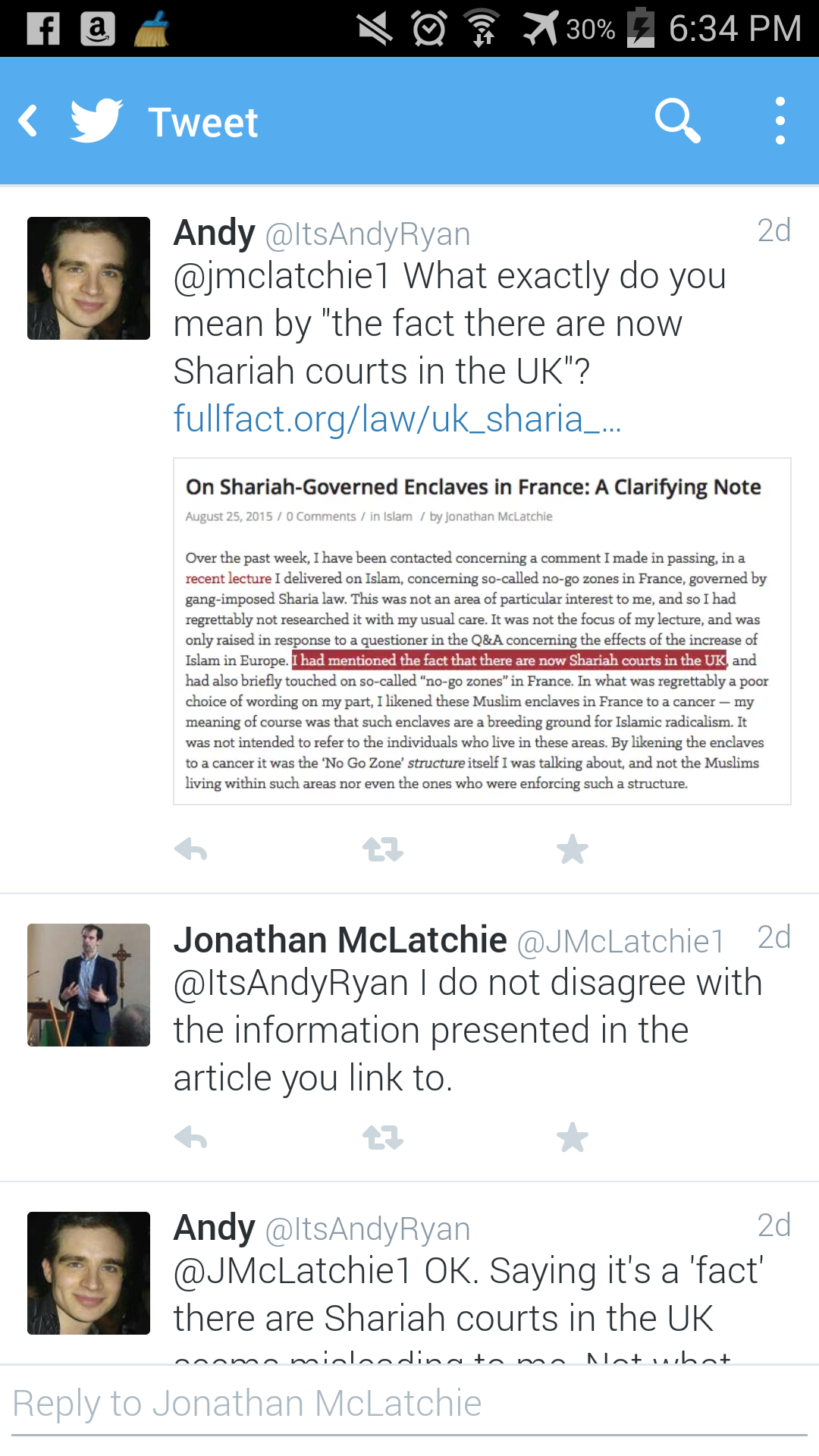
Wrong again. As I explained here, I did not make the statement attributed to me at all. Although my word-choice was unquestionably unfortunate, I neither described Muslim communities nor any individuals as “cancer” or a “virus”. Ijaz, as he always does, simply represented what I said in the most uncharitable way conceivable. As far as I recall, I never claimed that anyone had “lied” about me.

It is unfortunate that he continues to deny making the statement. All one has to do is look at my example. Once I quickly realised my error, I apologized and corrected myself. Jonathan on the other hand, simply denies he made any error at all. I’ll leave this lovely recording of Jonathan for interested readers to make up their minds. He then proceeded to say:

Wrong again. I defy anyone to show me where “Muslims who practice Islam are compared to ISIS terrorists” in any video I have shared.

Well let me show you (also, see article here)….

He then said:

Ijaz Ahmad accuses me of deception because I stated that he failed to mention any of Shabir’s weaknesses in his opening statement, such as his misuse of Greek grammar in relation to John 1:1 (documented here). Ijaz says that I am dishonest because he did mention John 1:1 in his review of the debate.

But this is precisely the point.
Ijaz simply repeated this poor argument, despite the fact that it has been refuted ad nauseum.

This is Jonathan’s problem. He does not correct himself and say that I didn’t omit any mention of Dr. Shabir’s use of Greek grammar. Instead of apologizing for this mistake, or false claim, he decided to shift the goalposts. Now the issue was not that I had failed to mention the use of Greek grammar, the issue was that I did not remark more about it. All Jonathan had to do was correct himself, he did not need to shift the goalposts. He then said:

I never claimed that Shabir did not argue that the Trinity was contrary to the Old Testament. He did claim that. I happen to think he is wrong in claiming that, but Ijaz contends that Shabir in claiming this pre-empted this statement from my opening remarks, which is simply not the case.

This is quite disingenuous from him. Did Dr. Shabir address the Bible (read as “Christian scripture”), which included both the Old and New Testaments, in his opening statement? Yes, he did. So then, on that basis, how can Jonathan claim that this did not happen. Dr. Shabir, pre-empted Jonathan’s appeal to scripture, by arguing based on that very scripture in his own opening remarks. There is nothing to be mistaken of here. Jonathan just does not want to accept this fact. He then said:

Ijaz then back peddles with his claim from his review that I had made the argument about the eternality of the Qur’an in my opening statement. He said “In my review, I did not claim that he made this argument, I specifically said that he referred to it.”

What exactly has been back peddled? I said in my review you referred to it, and I said in my response to your review that you referred to it. Nothing’s changed. Your problem seems to be that I criticized you for referring to it. In which case, your criticism would be wrong. He then proceeded to argue:

Ijaz also contends that, if I am consistent, I would have to say that the angel of death is a fourth member of the Trinity. But this is simply mistaken — there is no verse in the Bible to my knowledge where we are told that God alone actively brings about death…

This is correct, in Christianity, death is a rival to God and not an action that God can do of his own volition. According to Christian scripture, death in fact had mastery and power over God. Although it should be mentioned that I did refer him to 1 Thessalonians 4:16, which does mention that his God needs the voice of an archangel for the resurrection. Therefore, again, an agent of God according to Jonathan is sharing in the divinity of God. Or, perhaps I can make it even simpler for him. God creates, yet women also create life, women are agents of God’s creation. According to Jonathan’s logic, does he now need to add 3 billion women to the Godhead? He has not interacted with the argument of agency, or how it responds to his argument. Rather, he has opened a can of worms for Christianity, and I applaud him for that. He then argued:

I am giving the historical interpretation of this text. Is Ijaz really prepared to say that ibn Kathir, al-Tabari, al-Qurturbi and ibn Ishaq all got it wrong, and that we had to all wait for Ijaz to show up in order to give us the correct meaning of the text?

Except it’s the case that Ibn Kathir disagrees with Jonathan. It’s a rather lengthy read, so I’ll link to it here. That’s called proof by contradiction. We should take note of the language that Jonathan uses, he says:

The meaning of the text that I gave seems to me to be clearly the most plausible and the most clear-reading of the texts. Ijaz’s explanation seems rather ad hoc.

He outs himself. The meaning of the text he gave. You’d notice in the debate he also didn’t cite or quote anyone’s interpretation of those passages, and today he admits it was the meaning which he gave. I think that says a lot. Jonathan then proceeded to shift the goalposts again, he says concerning the Gospel being the Injeel….

He may have mentioned it, but he certainly offered no comment by way of response to the argument.

Yet, his problem with me, was that I did not mention it. Now his problem is that I didn’t respond to the argument. So it’s not that I misheard him or misrepresented him. Rather, in almost every instance he has proven to be wrong, he shifts the goalposts, at first I didn’t mention it or comment on it, then it’s, I did mention and I did comment on it, but not mentioning or commenting enough. It’s either one or the other, and at this point he truly is wasting my time.

Lastly, Jonathan said in his xenophobic tirade…

Islam is certainly on the rise, and I think it will have greater and greater influence….there are Shari’ah courts in the UK. France has a bigger problem with Islam at the moment.

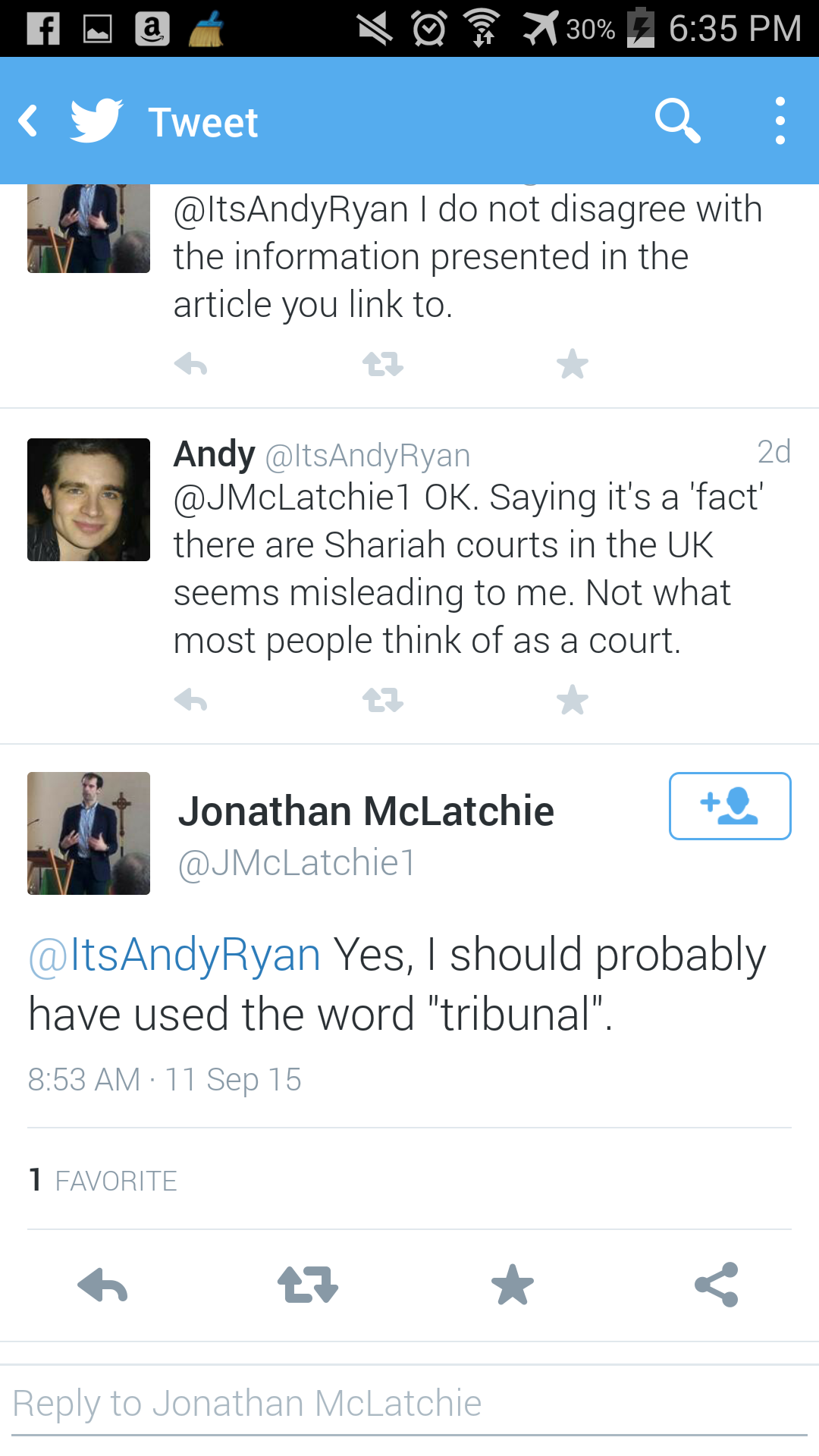
What does France have a problem with? Islam. It should be noted that others did call Jonathan out on this mistake of referring to Shari’ah Courts as a “fact”:

wpid-screenshot_2015-09-13-18-34-57.png

wpid-screenshot_2015-09-13-18-35-07.png

As Jonathan has repeatedly said, he has, “no problems with Shari’ah Law per se“. Which leads us to the end of his quote, which says:

Which is essentially tantamount to inviting a virus into your civilization, which is not…
It’s basically like inviting a cancer into your civilization, it’s going to expand..

So now, everyone, a process of elimination. The problem with France is….Islam! Who practises Islam? Muslims. Do you know who else thought a minority in Europe with different customs and a religious law was like a virus?

“. . . the discovery of the Jewish virus is one of the greatest revolutions that has taken place in the world. The battle in which we are engaged today is of the same sort as the battle waged, during the last century, by Pasteur and Koch. How many diseases have their origin in the Jewish virus!” – Adolf Hitler (quoted in Burleigh and Wippermann, Racial State, p. 107)

and God knows best.

Jonathan McLatchie Endorses View that “True Islam” Belongs to ISIS

In continuing his diatribe against Muslims, Jonathan McLatchie has shared a very spiteful video about Muslims. Before sharing this video, I asked Jonathan about his position on the statements in the video he shared:

You endorse the view that if Muslims follow Islam, they naturally act like ISIS?

Jonathan’s xenophobic response was as follows:

if you follow the example of Muhammad, then yes.

He then proceeded to no longer respond to questioning about his behaviour and hateful view of Muslims.

Previously, using publicly verified information by the US Government and international news agencies, we crunched the numbers and found that ISIS represented exactly 0.001% of all Muslims worldwide. How then, can Jonathan hold to his racist, xenophobic and hateful view of Muslims, when 99.999% of Muslims disagree with and are not part of the ISIS terrorist group? In Jonathan’s hateful eyes, 0.001% “Muslims” are the same as 100% of Muslims.

ISISandIslam

and God knows best.

Tom Holland’s Conversation Regarding the Birmingham Manuscripts

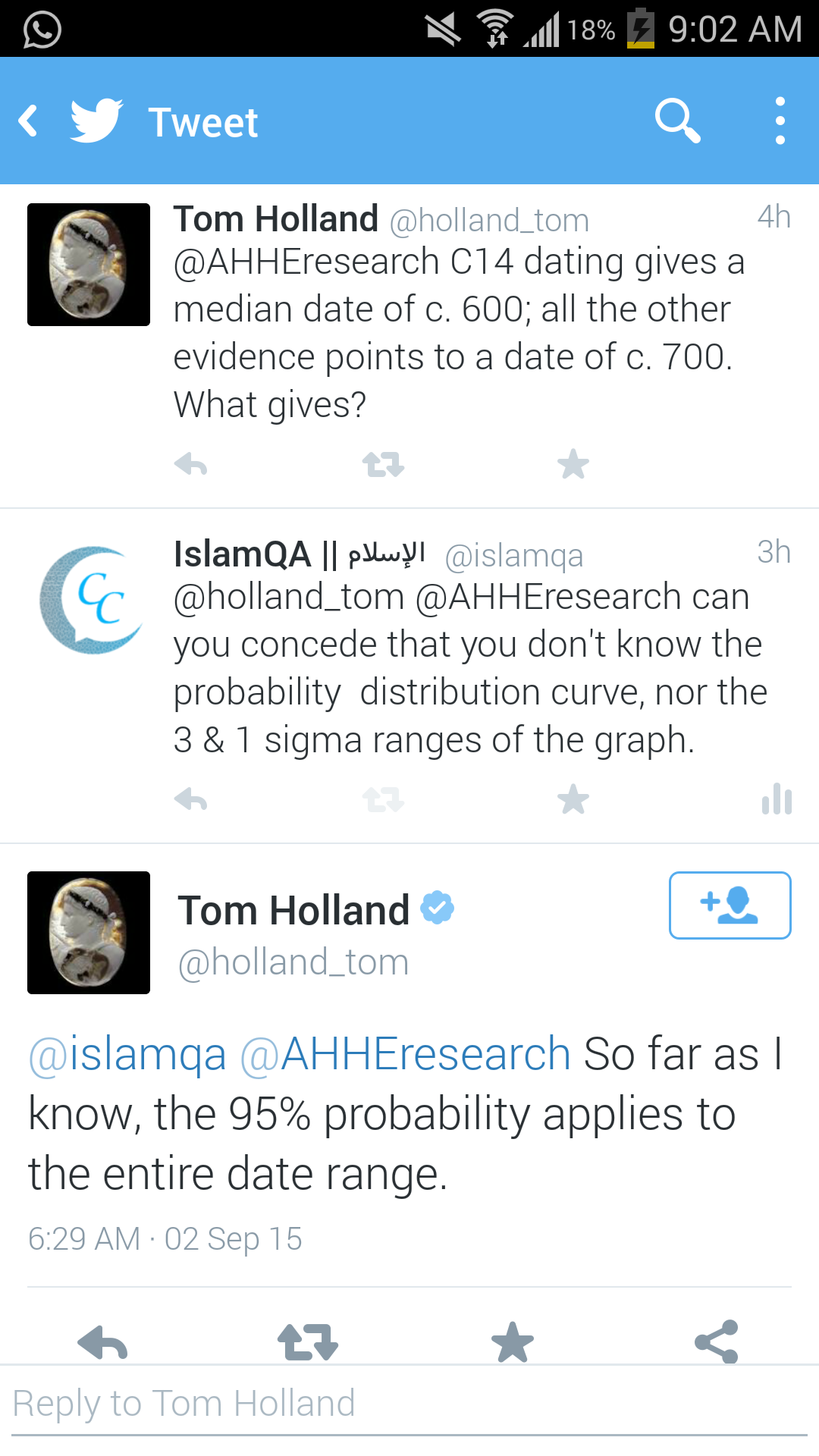
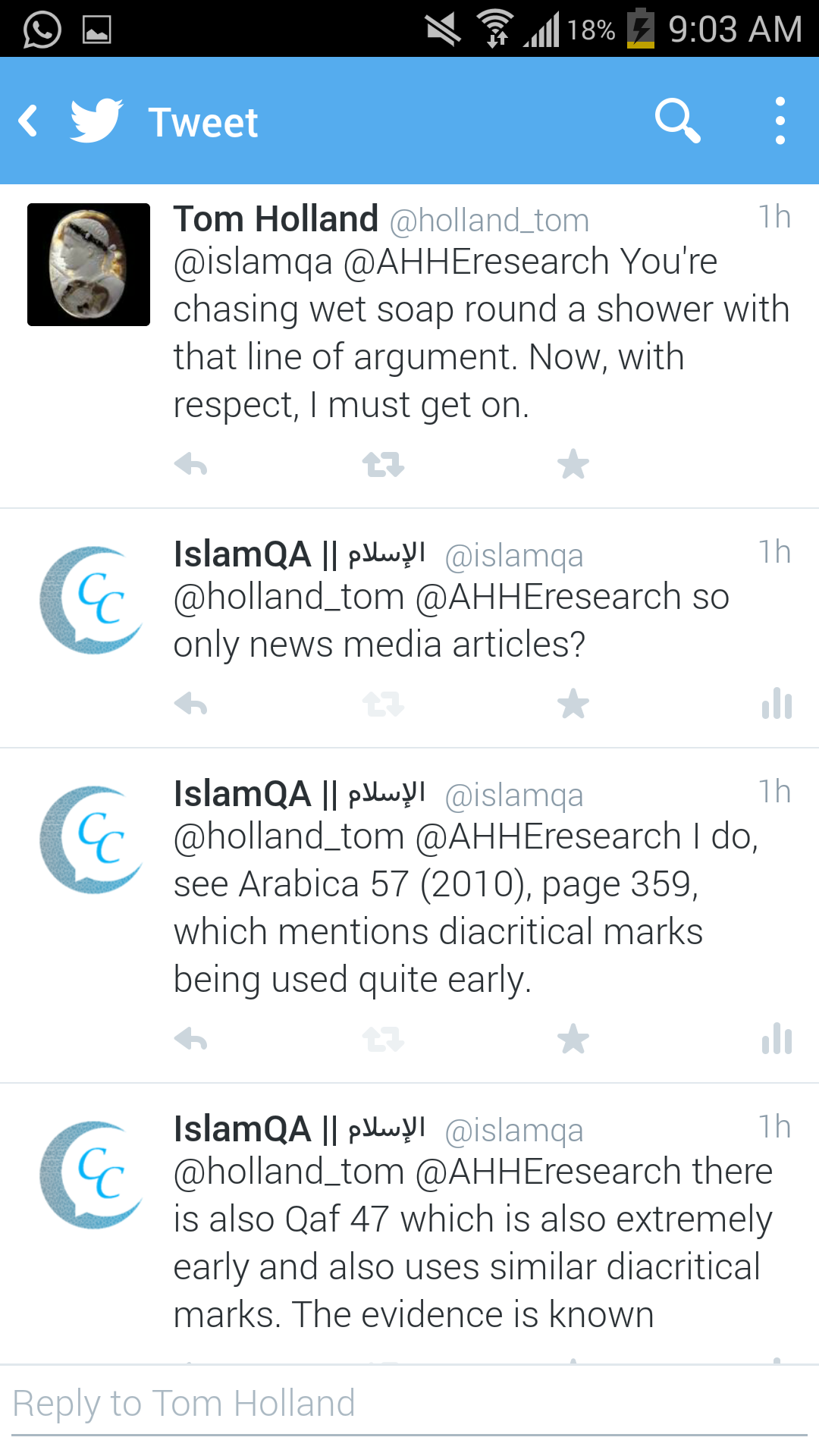
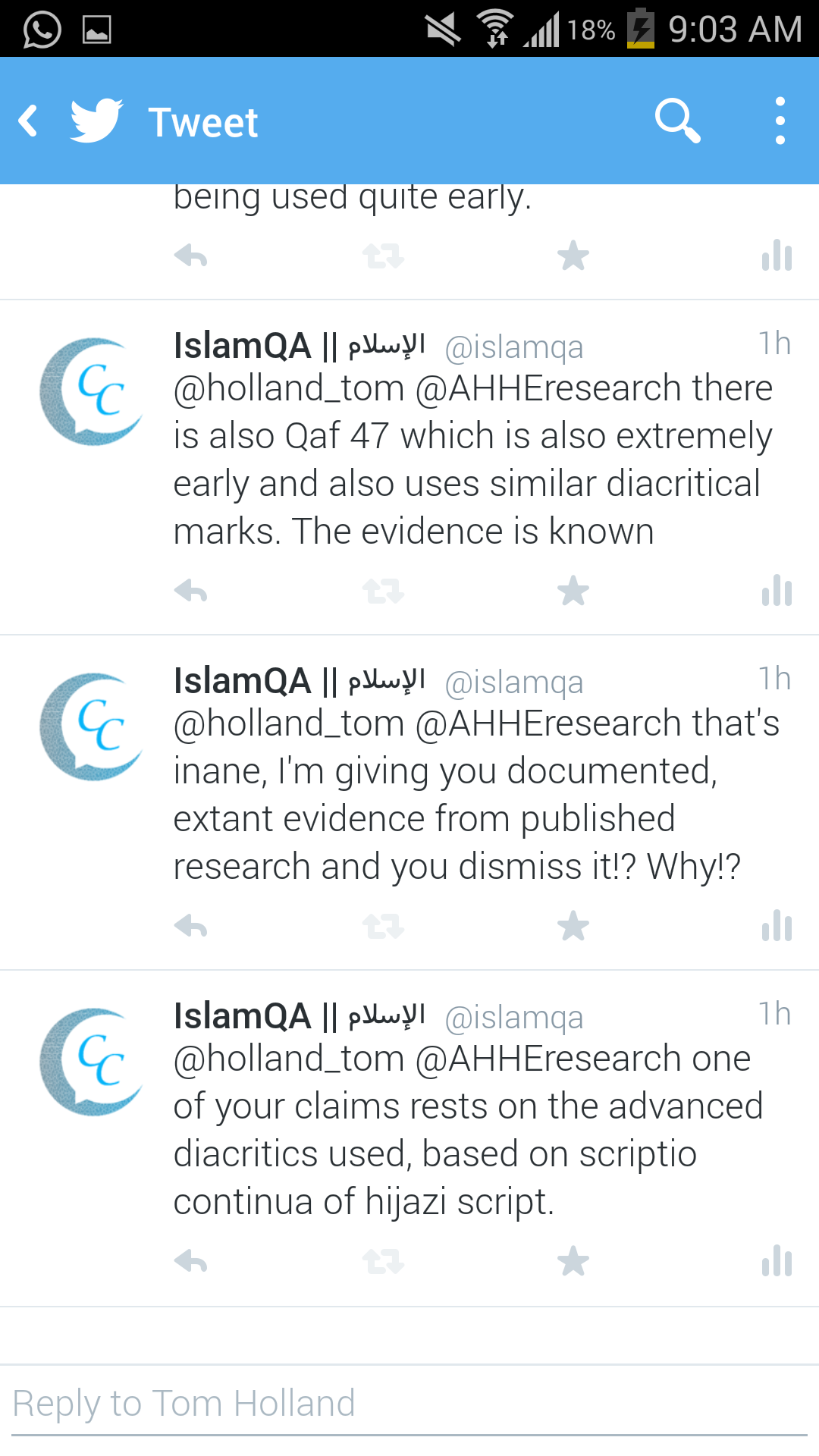
Most people are aware that Tom Holland is a historian, most people are also aware that he is not a palaeographer, nor a papyrologist, nor has he studied Arabic codicology. Therefore, finding him being referenced as an academic source regarding the Birmingham manuscripts was extremely strange. I decided to tweet Tom and get some answers. 

wpid-screenshot_2015-09-02-09-02-25.png

wpid-screenshot_2015-09-02-09-02-33.png

wpid-screenshot_2015-09-02-09-02-40.png

wpid-screenshot_2015-09-02-09-02-49.png

wpid-screenshot_2015-09-02-09-03-00.png

wpid-screenshot_2015-09-02-09-03-08.png

wpid-screenshot_2015-09-02-09-03-17.png

wpid-screenshot_2015-09-02-09-03-24.png

I recognize that some people may not be able to follow the conversation. So here is a simple run down of the conversation:

  • Have you seen the probability distribution curve with any of the sigma ranges? His answer was no, he was not aware of any graph. This is strange because you can only know how the date ranges work if you’ve seen the graph, if you haven’t, then where did he get his “analysis” from?
  • I asked, if he didn’t see the curve, how was he able to give an analysis. His answer was, “(based) on the information Birmingham University have publicly made available”. The problem here is that the only information regarding the dating that they have made publicly available is merely mentioning the date range, no scientific data regarding the analysis of the C14 was made public. In other words, he had no sources and did not consult any scientific data to arrive at his conclusion. I immediately pointed this out to him.
  • I then asked, if not based on actual C14 data, what did he base his analysis on? He proceeded to state, “even on the latest date, the script reflects a sophisticated scribal culture that does not accord with it”. To which I replied that we do have early manuscripts with diacritical markings.
  • He asked me for evidence of this, and so I gave him one citation and before I could proceed, he chose to end the conversation at that point in time.

So what have we learned? Tom Holland is not a specialist in this field. He did not consult any actual data to arrive at his publicly claimed conclusions. He is not aware of how manuscripts are carbon dated, nor is he aware of modern studies on Arabic palaeography and codicology. In other words, his opinion is akin to asking any random person off of the street to give their analysis of highly specialized scientific data.

Interestingly in July of this year, Tom actually held the opposite view, that the manuscripts validated the traditional teaching about its codification:

Tom Holland, the author of “In the Shadow of the Sword,” which charts the origins of Islam, said the discovery in Birmingham bolstered scholarly conclusions that the Quran attained something close to its final form during Muhammad’s lifetime. He said the fragments did not resolve the controversial questions of where, why and how the manuscript was compiled, or how its various suras, or chapters, came to be combined in a single volume. – NYT.

You can read the full conversation on Twitter, here. As we say in cricket, Tom, learn to bat in your own crease.

and God knows best.

Does the Qur’an Pre-date the Prophet?

Question:

Several news articles today have stated that the manuscripts of the Qur’an in Birmingham prove that the Qur’an is earlier than the Prophet. Is this true?

Answer:

The articles by both the Daily Mail and Raw Story were both sensationalized and neither presented any new information, nor were the people who were interviewed (Tom and Keith) privy to any new research by Dr. Alba Fedeli (the one whose research led to the discovery). There was a lot of behind the scenes controversy (due to his colleagues severely criticizing him, leading him to send a clarification email) about Keith’s statements, which were based off of a question raised by a popular Christian scholar of Qur’anic studies whose article in which this question was originally raised, was brought into severe disrepute by several colleagues of the Christian and Secular persuasions, which led to either the article’s removal by the scholar himself or by the publishing agency, which I will also not name. So the question itself is not new, and nor was it an original thought, nor was either the Daily Mail the primary source for the information. The information from the Daily Mail, citing Keith’s proposition was from a separate interview done for The Times, a UK paper.

Accordingly, the original interview is inaccessible as The Times seems to have put it behind a paywall, fortunately it was sent to a few people and we were able to read the article, as well as given details of the entire interview, specifically, what prompted Keith to make the statements he did. To quickly recap, these articles were not prompted by new research or by the original scholar who re-dated the manuscripts, nor was this question new, it was something raised a month or so ago by another Christian academic, the news is sensationalizing something which what was over a month ago, just a question raised by someone in an article which was later taken down after serious questions by the academic’s own colleagues. As for the claim in and of itself, it is quite absurd to say the very least. The question that prompted the original question to be asked was due to the authenticity of the date range of the carbon dating. The date of 568 CE, dates to some two years before the Prophet’s (peace be upon him) birth. The question raised, asks, “is it possible the manuscript was unused until 610 CE when the revelation is said to have begun?”

If it was unused, why? That’s the basis for the questioning! That’s it. Why was the manuscript unused for some decades? Well, the answer is quite simple, whoever owned it, or whichever series of owners possessed it, they had no need to use such an expensive, rare and ornate material until the advent of the Qur’an. At that time, the Arabs had no published literature, their most popular form of entertainment – poetry, was primarily oral and most of the population were illiterate. Quite simply, it’s like asking why a person would keep an old silver coin for several decades without using it – it could be due to value, sentiment, could have been in storage and unused, there are quite simply, too many reasons why the manuscript was not used until the owner found a suitable reason to use it. That’s it. Nothing more, nothing less. The news sensationalized something, based off of a non-issue, that no academic in this field of Arabic codicology, paleography or papyrology sees as holding any weight.

It should be noted that there have been previously bad and unreliable carbon datings that were later corrected by other labs, Dr. Deroche notes one such recent incident:

“This become especially clear when such measurements provide results which simply cannot be accepted. Two samples from the famous Sanaa palimpsest (Sanaa, DaM|Inv. 01-27.1) were recently dated with this method. According to the laboratory, one folio was produced between 543 and 643 AD whereas the other one was made between 433 and 599 AD. Later dates would be easier to explain by a contamination. Here the problem may lie with the conditions (arid or semi-arid climate) under which the cattle, the hides of which were later turned into parchment, was raised.” – Qur’an of the Umayyads, p. 13.

Those dates were found to later be wrong after several other labs did their own carbon datings, cementing the date range to be within the 7th century CE or 1st century hijri.

and God knows best.

Missionary Mishap: When Reading Comprehension is a Problem

From time to time I get tagged on Facebook with every Tom, Dick and Harry wanting to challenge me to a debate. Some react badly when I decline, or if I don’t respond. This is an example of one of those people and it’s also an example of why I choose not to “debate” or “dialogue” with them:

wpid-2015-07-28-23.32.03.png.png

There are what? 250 000 manuscripts of the Qur’an worldwide. What does the missionary read? That there are 250 000 mistakes in the Qur’ans worldwide. To me, this is pretty funny as I don’t have to do anything to “respond” to him. He’s given the quote and posted his comment, both are in conflict and so he’s done my part for me, by refuting himself.

That’s what I enjoy about the Missionary Mishap series. Almost every post in this series demonstrates the lengths to which missionaries will go, even to the point of quoting something and not being able to read it properly. It makes for good entertainment.

and God knows best.

« Older Entries Recent Entries »