Category Archives: Muslim and Non-Muslim Dialogue

Examining the Engineering behind Jesus’ title as the “Lamb of God”


Question Mark

Introduction

We have been arguing on good grounds that gospels elicit internal evidences – in fact, hard evidences – which alludes that its verses have been penned to meet biased theological agendas; as such on one hand where the gospels compromise with historical facts, on the other hand, it defies the very concepts of divine “inspiration”.

Thus, in this paper we would bring to light another intriguing incident which shows that gospel of John’s portrayal of “doctrine of vicarious atonement” through the alleged death of Jesus (peace be upon him) was the result of that conscious engineering which was meant to bolster one of the fundamental “orthodox” doctrine, albeit, at the cost of conflict with Mark’s gospel!

Mark’s “Passover” did pass!


Mark narrates that before being trialed by the Sanhedrin and subsequent crucifixion, Jewish Jesus (peace be upon him) ate the famous “Passover” feast with his disciples:

“On the first day of the Festival of Unleavened Bread, the day the lambs for the Passover meal were killed, Jesus’ disciples asked him, “Where do you want us to go and get the Passover meal ready for you?” Then Jesus sent two of them with these instructions: “Go into the city, and a man carrying a jar of water will meet you. Follow him to the house he enters, Teacher says,Where is the room where my disciples and I will eat the Passover meal?’ Then he will show you a large upstairs room, prepared and furnished , where you will get everything ready for us.” The disciples left, went to the city and found everything just as Jesus had told them; and they prepared the Passover meal. When it was evening, Jesus came with the twelve disciples.While they were at the table eating, Jesus said, “I tell you that one of you will betray me – one who is eating with me.” The disciples were upset and began to ask him, one after the other, “Surely you don’t mean me, do you?” Jesus answered, “It will be one of you twelve, one who dips his bread in the dish with me. The Son of Man will die as the Scriptures say he will; but how terrible for that man who betrays the Son of Man! It would have been better for that man if he had never been born!” While they were eating, Jesus took a piece of bread, gave a prayer of thanks, broke it, and gave it to his disciples. “Take it,” he said, “this is my body.” Then he took a cup, gave thanks to God, and handed it to them; and they all drank from it. Jesus said, “This is my blood which is poured out for many, my blood which seals God’s covenant.” (Mark 14:12-24)

It is vitally important to observe a few incidents as it turned out in the above passage:

Firstly, note the day. It starts with the day before the Passover is to be eaten. In other words, it is the day when the sacrificial animal would be slaughtered for the Passover meal: “the lambs for the Passover meal were killed

Secondly, Jesus (peace be upon him) specifically directed his disciples where they should prepare the Passover meal for him: at the house where the man with the pitcher of water enters.

Thirdly, the disciples prepared the Passover meal for Jesus (peace be upon him)and they ate it.

Fifthly, on the foregoing, Jesus (peace be upon him) symbolized that the food and drink is like his body and blood!

From all of the above, we want to stress that Jesus (peace be upon him) ate the Passover meal with his disciples at his chosen place before any case and conviction by Pontius Pilate. In fact immediately after the meal, Jesus (peace be upon him) goes to the well-known garden of Gethsemane where he is subsequently arrested by Roman authorities with Jewish elders (c.f. Mark 14:27-49). Thereafter he was convicted to be finally, biblically, crucified to death.

This is good enough a narration on the face of it; however, when this is juxtaposed with John’s narration of the same incident it starts to create problems!

John’s “Passover” never passed!


Quite contrastingly, John claims that Jesus (peace be upon him) was captured, litigated, convicted and crucified before the Passover meal was ever eaten by him:

“When Pilate heard these words, he took Jesus outside and sat down on the judge’s seat in the place called “The Stone Pavement” (In Hebrew the name is “Gabbatha.”) It was then almost noon of the day before Passover. Pilate said to the people, “Here is your king!” They shouted back, “Kill him! Kill him! Crucify him!” Pilate asked them, “Do you want me to crucify your king?” The chief priests answered, “The only king we have is the Emperor!” Then Pilate handed Jesus over to them to be crucified. So they took charge of Jesus. He went out, carrying his cross, and came to “The Place of Skull,” as it s called. (In Hebrew it is called “Golgotha.”) There they crucified him; and they also crucified two other men, one on each side, with Jesus between them. (John 19: 13-18)

Notice that Jesus (peace be upon him) is being prosecuted when it was “almost noon of the day before Passover”, in other words, more or less the exact time when the slaughter animal would be made ready for sacrifice and simultaneously preparations for other associated rituals would be made. This in turn implies that John’s Jesus (peace be upon him), unlike Mark’s Jesus (peace be upon him), did not ever had chance to eat the Passover meal.

In fact, John’s narration gets internal support for his timing of Jesus’ (peace be upon him) prosecution; this is so because John alludes that the Jewish elders who conspired against Jesus (peace be upon him) did not enter into Pontius’ hall. They tarried outside while Jesus (peace be upon him) alone was standing in front of the Roman governor:

Early in the morning Jesus was taken from Caiaphas’ house  to the governor’s palace The Jewish authorities did not go inside the palace, for they wanted to keep themselves ritually clean, in order to be able to eat the Passover meal.(John 18:28)

Note the reason why the Jewish priests did not enter into Pontius’ hall; so that they might not be defiled for being into the chambers of a pagan gentile – Pontius Pilate. And, they wanted to remain “ritually clean” so that they “be able to eat the Passover meal”! So, Passover feast is yet to materialize and Jesus (peace be upon him) ingospel of John is being prosecuted.

To further bolster John’s position, we can observe that Jesus (peace be upon him) is not portrayed as symbolizing his body and blood to the food and drink of the Passover meal respectively as he did in Mark’s gospel; simply because he was never present in the Passover meal! Probably, by the feast time, he was in his alleged tomb!


What did author of John achieve?

It is extremely difficult to resolve the conflict between the two so-assumed god breathed “injeels”. However, what exactly were these “orthodox” authors achieving by these well-thought manipulations of data. In fact in the passages to follow we would realize that the author of John did achieve an “orthodox” theological agenda which happens to be the cornerstone of the “orthodox” Christianity which, otherwise, would have been impossible to achieve:

Remember that we were talking about the Passover meal. And in Jewish culture it was marked by slaughter of an animal – a lamb for that reason.

Quite interestingly, John’s gospel happens to be the only gospel which symbolizes Jesus (peace be upon him) as a (sacrificial) animal – a lamb:

The next day John saw Jesus coming to him, and said, “There is the Lamb of God, who takes away the sin of the world! (John 1:29)

So when author of gospel of John manipulated the timing of Jesus’ (peace be upon him) crucifixion from after Passover meal to before Passover meal when the “lamb” is traditionally “prepared” for slaughter, he was able to draw a strong theological link between the crucifixion of Jesus (peace be upon him) as the “lamb” slaughtered for the traditional Jewish “Passover”!

In other words, when Jews in Jerusalem were slaughtering their “lambs” for Passover meal, Jesus (peace be upon him) – the Lamb of Lambs, so to say – was also slaughtered for the “Passover” of the sins of the world unto himself. Not surprisingly, of this happening just at the exact time when traditional Jewish slaughter takes place, namely, just after noon so that when sunsets, i.e., when the Passover day really sets in, the Passover meal would be ready! Obviously this strong figurative correlation would have been impossible given the way Holy Ghost “inspired” Mark; thus, a manipulation of “God’s word” was inevitable and necessary.

In all of these, do keep in mind that when John’s gospel was being written, Pauline epistles with its outstanding emphasize on the alleged death and resurrection of Jesus (peace be upon him) than his life, was already available for at least half – a – century!

Therefore, if author of John’s gospel was one influenced by Pauline philosophy or used his epistles as source, then it certainly makes sense why Jesus’ (peace be upon him) crucifixion was meticulously shifted before the Passover meal in John’s gospel!

Conclusion


It is not the blatant contradiction between so called god-breathed “scriptures” which intrigues; rather, it is the hefty price of allowing flagrant contradiction(s) between gospels to meet skewed theological agendas – that has to be observed!

On this regard, it would be best to end this brief investigation with New Testament scholar Bart Ehrman’s note:

“The main point is that the stories that Christians told and retold about Jesus were not meant to be objective history lessons for students interested in key events of Roman imperial times. They were meant to convince people that Jesus was the miracle-working Son of God whose death brought salvation to the world, and to edify and instruct those who already believed. Sometimes the stories were modified to express a theological truth. For the early Christians who passed along the stories we now have in the Gospels, it was sometimes legitimate and necessary to change a historical fact in order to make a theological point. These are the stories that the Gospel writers inherited.” (The New Testament: A Historical Introduction, The Traditions of Jesus in their Greco-Roman context, Chapter 3, Pp 48-49)

We need to think about a certain aspects! If gospel author(s) can manipulate the timing of alleged crucifixion for mere correlation with a Jewish custom, then is it possible that they can modify other aspects of Jesus’ (peace be upon him) life and alleged death as well! How about manipulating his words too which ended up in thecurrent New Testament? How about exaggeration of his status and miracles? In fact the possibilities just open up like opening of floodgates. We leave that for readers to cogitate further when they pick up New Testament.

Finally an exemplification at par for the treatment of “Scriptures”:

Then We made you heirs in the land after them, to see how ye would behave! But when Our Clear Signs are rehearsed unto them, those who rest not their hope on their meeting with Us, Say: “Bring us a reading other than this, or change this,” Say: “It is not for me, of my own accord, to change it: I follow naught but what is revealed unto me: if I were to disobey my Lord, I should myself fear the penalty of a Great Day (to come).” (Qur’an 10:14-15, Yusuf Ali)

In the hostile situation where Prophet (peace be upon him) preached it was easier for him to compromise the revelations he was inspired with at least at nominal level, yet it was not in his authority to change God’s word.

Notes:

  • Unless otherwise mentioned all biblical text taken from Good News Edition.
  • Textual emphasize wherever not matching with original is ours.
Harvard University Posts Qur’an Verse at Entrance of Law Faculty

بِسۡمِ ٱللهِ ٱلرَّحۡمَـٰنِ ٱلرَّحِيمِ , 

The US Harvard University has posted a verse of the Holy Quran at the entrance of its faculty of law, describing the verse as one of the greatest expressions for justice in history, a Saudi newspaper reported on Sunday. Verse 135 of Sura Al Nisa (women chapter) has been posted at a wall facing the faculty’s main entrance, dedicated to the best phrases said about justice.

A Saudi student who studies at Harvad published a picture of the poster in his Twitter page, according to the Saudi Arabic language daily Ajel. “I noticed that the verse was posted by the faculty of law, which described it as one of the greatest expressions for justice in history,” Abdullah Jumma said. Harvard University was established in Cambridge, Massachusetts, in 1636 as the oldest institution of higher learning in the United States.

O you who have believed, be persistently standing firm in justice, witnesses for Allah, even if it be against yourselves or parents and relatives. Whether one is rich or poor, Allah is more worthy of both. So follow not [personal] inclination, lest you not be just. And if you distort [your testimony] or refuse [to give it], then indeed Allah is ever, with what you do, Acquainted. – Qur’aan 4:135.

Article Source: Emirates 24/7.

wa Allaahu ‘Alam.

Video: Jesus the Christ, Man, God or Both? – Ijaz Ahmad vs CL Edwards

بِسۡمِ ٱللهِ ٱلرَّحۡمَـٰنِ ٱلرَّحِيمِ ,

Post Debate thoughts:
https://callingchristians.com/2013/01/13/post-debate-remarks/

Debate Information:
https://callingchristians.com/2013/01/12/debate-announcement/

Video:

Feel free to leave your thoughts, suggestions and comments! I’d also like to thank CL Edwards for having the video provided so quickly. The video was taken from his website’s posting.

wa Allaahu ‘Alam!

Post Debate Remarks

بِسۡمِ ٱللهِ ٱلرَّحۡمَـٰنِ ٱلرَّحِيمِ ,

I began my preparation for this debate by watching Br. Paul Bilal William’s debates on the same topic, as well as Dr. Shabir Ally’s debate. I didn’t finish watching either debate because I became tired of the Christian arguments that were being used. They were identical. They simply went to the New Testament and the rest of the debate devolved into whose interpretation of the New Testament verses was more accurate. I realised that this was the argument that Muslims and Christians have been having for 1434 years. Whose interpretation of the same verses was more valid. After seeing this I decided that if I am to debate this topic, I would refuse to carry on this archaic tradition. It was time for something new. There are only two sources for which my opponent could have appealed to; the New Testament and the Old Testament. From this, my aim therefore was to negate the use of the New Testament, relegate my opponent to using the Old Testament and when he tried to use it, refute his claims and leave him without a foundation upon which to stand. In other words, my aim was to render my opponent as a headless chicken.

My method was as such:

  1. To be objective in our discussion we need to go to the primary source which mentions a Messiah.
  2. Hence any text after the Messiah could not be utilized if we are to be honest; thus negating both the Qur’aan and the New Testament.
  3. Ask my opponent where the Messiah is said to be YHWH or where YHWH is said to be the Messiah in the Old Testament; since neither can be found in the Old Testament, my opponent could no longer use it.

It was my intention therefore to create such a simple methodology, that by negating any foundation for my opponent to argue upon, he would be dumbfounded, confused and make horrendous mistakes. As Allaah ta ‘aala willed, it was as exactly as I planned. My opponent began his arguments with appealing to the New Testament, then by affirming the Ecumenical Creeds and lastly by placing the New Testament Christological interpretations into Old Testament verses. From the get go he fell into my hands and I enjoyed it. At one point I got bored and began shopping on Amazon and talking with Br. Nazam from London. I even commented on a few Facebook statuses. It was absolutely hilarious to hear my opponent’s first rebuttal.

Real talk, straight up, CL was dumbfounded. He cautiously took the mic and failed to use all of his time. All he did was claim that in my opening statement I did not give my rebuttal to any of his arguments. That was his entire rebuttal to my opening statement. In his rebuttal he failed to:

  • Provide any justification for using the New Testament to prove Christ’s deity.
  • Provide any justification for interpreting the Old Testament texts through a Christological proto-orthodox lens.
  • Address my critique of his methodology.

So what was the result? CL was forced into preaching about his life as an ex-Muslim. At that point we had Muslims and Christians congratulating me on a momentous victory. What was funny to me was that CL was a Muslim for exactly half of my entire lifetime and he was unable to refute me, despite doing apologetics courses. I caught him off guard, brought new arguments and completely disarmed him. He didn’t know what to do. Seriously. He spent almost two minutes praising me in his conclusion as well, he had nothing to say, he couldn’t respond to the simple logic I used. I am not being boastful or prideful, but I am happy that haqq prevailed over baatil. CL got spanked horribly. We had no question and answer session as I was still medicated due to my post-op medication. Yet I was the one who stayed for about 15 minutes after the debate to take questions. CL fled immediately. Both Christians and Muslims were shocked that he ran away immediately after the debate.

The debate will be uploaded shortly. All I have to say is, I am happy it occurred, I got a chance to demonstrate how devastating simple arguments are and I am proud to have introduced new arguments into the fray of centuries old religious discourse. It’s also the first time in world history – to my knowledge, that a debate on Christ’s deity occurred and the opposing side did not quote the New Testament once. I hope to take up another debate soon and I pray that CL sees the reality of Islam soon, Ameen.

wa Allaahu ‘Alam.

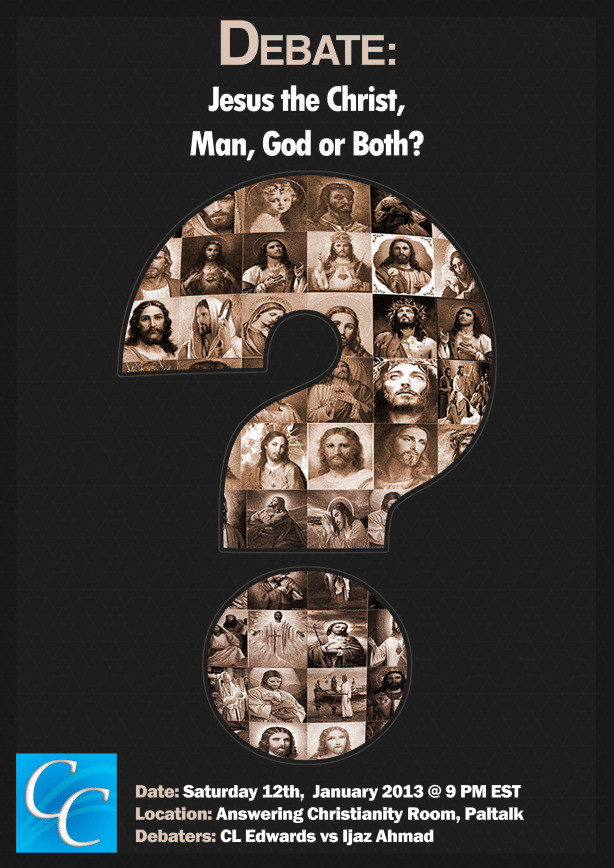
Debate Announcement

بِسۡمِ ٱللهِ ٱلرَّحۡمَـٰنِ ٱلرَّحِيمِ ,

2013 is going to begin with a blast. Long time rival, CL Edwards of ‘Calling Muslims’, has opted to debate me on the personhood of Christ. The topic is, “Jesus the Christ, Man, God or Both?“. We’ll be having the debate via Paltalk Room, “Answering Christianity“, for information on the download and usage of Paltalk, click here. We’ll be having it on Saturday, 12th January (2013). It’s an oft-repeated topic, but it is the most important as well. Christ is centric to both the Islamic and Christian faiths, his position in either, as Christ is certain, but whether he is more or not is up for much discussion. I do hope to raise several interesting arguments, and some new ones as well. Allaah willing, I hope to present some fresh, new and exciting perspectives on the personhood of Jesus the Christ, ‘alayhi as salaatu wa salaam. My opponent, CL Edwards and I have had a long, but thrilling history which you can read of here. CL is an apologetics student, he’s appeared on ‘Jesus or Muhammad’ with Sam Shamoun and runs a blog on Christian apologetics. I look forward to seeing the arguments he is able to present.

As some would recall, my previous public debate incited a flurry of controversy due to my referencing of the Holy Prepuce. My opponent at that time couldn’t handle my use of historical data and decided to ‘attack‘ me with a counter claim of Allaah ta ‘aala having ‘genitals’ (far removed is He from such claims). Unfortunately for him, the information he used in his video was stolen from a Muslim website and the proprietor of website, refuted the Christian himself. Will this debate incur such controversy? I don’t know, but I do wish that it will provoke much inter-religious dialogue as the last one did, but perhaps with a little less genital talk. To find out the exact time use this easy to use website, just remember it’s 9 PM EST.

Debate-flier

wa Allaahu ‘Alam.

Muhammad [saws] in the Bible According to a Priest Turned Muslim

بِسۡمِ ٱللهِ ٱلرَّحۡمَـٰنِ ٱلرَّحِيمِ ,

Dr. David Benjamin Keldani or Dawud Benyamin (1867-c.1940) was a Catholic priest who converted to Islam and adopted the name Abd ul-Aḥad Dāwūd.  He started an attempted to disprove claims by Muslims that Muhammad is mentioned in their Bible, but to his surprise he ended up asserting the claim and accepting Islam. He wrote Muhammad in the Bible – originally published in 1928. To read the book “Muhammad in the Bible”, click here.

wa Allaahu ‘Alam.

The Best Christian Orator – Ever

بِسۡمِ ٱللهِ ٱلرَّحۡمَـٰنِ ٱلرَّحِيمِ ,

Speaker’s Corner in Hyde Park, London, has been home to very interesting public debate and discussion since its inception. Jay Smith, the popular but widely known to be academically challenged is arguably the worst Christian polemic known to Hyde Park’s frequent visitors. However, I actually think that I’ve found one Christian polemic who is significantly worse!

  • Racist
  • Abusive
  • Argumentative
  • Ignorant
  • Arrogant
  • Christian

Enjoy!

wa Allaahu ‘Alam.


Why the gospel of Matthew is not the-oldest?

The age of gospels is not as straight forward as they look! 

Question Mark

Introduction

Virtually all the scholars of Christian antiquity and New Testament now accept that gospel of Mark was the oldest gospel written originally in Greek by Peter’s assistant in Rome – St. Mark. And approximately after a decade and a half, Matthew and Luke penned their gospels. It is also accepted that both Matthew and Luke copied much of their text from Mark’s already available gospel. The information look pretty simple on the face of it but there are a few interesting, if not intriguing, queries to be pondered over:

  • Does not it come a little ironic, if not a tad fishy, that it was the disciple of the disciple writing the first gospel (or “receiving” the first gospel from Holy Ghost)! Is not it highly expected that it should be one of Jesus’ (peace be upon him) self chosen apostle to “receive” the first gospel?
  • Jesus’ (peace be upon him) very first target audience were the Jews of Palestine. So, should it not be expected that the first gospel be in the local tongue – may be Hebrew, Aramaic – catering to the general mass rather than in Greek – an otherwise alien language for an everyday Jew in Palestine.

In this paper, therefore, we would be concentrating over these concerns and would try to correlate its implication over the age as fixed by Christiandom for the gospels. We would be keenly interested into noting the purpose it served by adjudging gospel of Mark as the oldest gospel.

Why the gospel of Matthew is not the oldest.

Out of the four gospels vetoed as “canonical” by the church, only two are attributed to the “apostles” Jesus (peace be upon him) chose, namely, Matthew – the tax collector in first century Palestine and John, of course, the son of Zebedee. Mark and Luke were disciple and companion of Peter and Paul respectively. They were certainly not the immediate disciples of Jesus (peace be upon him).

Therefore, it makes a lot of sense based on seniority (an immediate apostle of Jesus (p)), knowledge (received preaching from Jesus (p) directly) and social setup (first century Hebrew/Aramaic speaking Palestinian) that if Matthew (or John) was anyhow to write a gospel then it should have been at least before Mark’s and Luke’s.

In fact if we have to pay any respect to the earliest and “orthodox” church fathers then they almost unanimously agree that it was Matthew who wrote his gospel first (!):

“Eusebius in his history (6.25.4) quotes Origen as saying that he had learned that “The first Gospel was written by Matthew, who was once a tax collector, but who afterwards was an Apostle of Jesus Christ, and it was prepared for converts from Judaism, and published n the Hebrew language.” (The Qur’an and the Gospels – A comparative Study by Dr. Muhammad M. Abu Laylah, pp.85)

A couple of information should be immediately captured. Firstly, Matthew wrote the first gospel. And, secondly, more importantly, that Matthew’s gospel was prepared for Jewish converts from Judaism in Hebrew language.

Origen is not the only early Christian figure, Augustine also concur the same:

Augustine in his work on the agreement of the evangelists (1.2.4.) writes: “Of these four it is certain that only Matthew is regarded as having written in the Hebrew language, while the others wrote in Greek” and he says that Mark “followed closely in his footsteps, as his imitator and epitomizer.” (The Qur’an and the Gospels – A comparative Study by Dr. Muhammad M. Abu Laylah, pp.85)

Furthermore, another early “orthodox” church figure Irenaeus writes the following in his famous book “Against Heresies” (3.1.1):

“Matthew also published a book of the Gospel among the Hebrews, in their own dialectWHILE Peter and Paul were preaching the Gospel in Rome and founding the Church.”

(W.Barclay, op. cit., vol. 1, p. 149; Bar-Hebraeus, p. 4; see also Meyer, The Gospel of Matthew, part 1, vol. 1, p. 6 and Brown, The Gospel According to St. Matthew, (J.B.C.), vol. 2, p. 65.)  (1.)

Observe that not merely does Irenaeus re-confirm that Matthew originally wrote his gospel in Hebrew, but he also substantially alludes to the time period in which it was written. He expressly states that Matthew wrote his gospel “while” Peter and Paul were preaching in Rome! This indicates Matthew’s gospel was contemporary to Paul and traditionally we know that Paul’s books predate every book of the New Testament including the gospels! (That’s another weird phenomenon).

Finally, Bible authority Barclay seals the matter for us:

As we have said, and was we have now seen, the tradition of the early Church is clear, consistent and unanimousIt was believed that Matthew wrote the first Gospel, and he wrote it first of all the gospels and that it was originally written in Hebrew.” (A. Plummer, An Exegetical Commentary on the Gospel According to St. Matthew, p. VIII.) (2.)

Therefore, if Matthew’s gospel was the-oldest then why is Mark’s gospel touted as the most primitive gospel amongst all?!; in the same way if the “early Church” was “unanimous” that Matthew’s gospel was oldest then why was it later “discovered” that Mark’s was the oldest?! And, if Matthew was originally written in Hebrew as the circumstances and earliest testimonies indicate, then why do we have current gospel of Matthew in Greek?

The answer to all such queries lays beneath the fact that original gospel of Matthew, the one which was written in Hebrew for Hebrews, has long been lost. And, in the absence of this document, the very next gospel – the gospel of Mark was “prioritized” as the-oldest.

Subsequently, when a concerted effort was made to reconstruct gospel of Matthew, the Greek gospel of Mark was used. No wonder, no less than an egregiously exorbitant 600 verses from Mark were copied into Matthew in the name of reception of “inspirations” from the so-called “Holy Ghost”!

However, such an unscrupulous copying entailed with it that Matthew – the Hebrew/Aramaic speaking Palestinian Jew – was now had to be assumed as an expert level Greek author; notwithstanding the basic premise that he was to write for the first century Palestinian Jews and not Greek speaking Europeans!

On this note, Muslim scholar Dr. Muhammad M. Abu Laylah’s makes very insightful remark:

“Origen, for example, tells us that Matthew’s Gospel was written for believers who had come from Judaism and the same view is held by Irenaeus, Clement of Alexandria and Eusebius. The above information suggest an Aramaic origin for Matthew’s Gospel which has been generally abandoned on account of theuse of Mark and the LXX version of the O.T.”

According to the principle of the priority of Mark established 200 years ago in biblical criticism, the present Matthew is a Greek, not an Aramaic or Hebrew Gospel, and was composed in Greek, and could not have been composed except in Greek, that is because it has evidently copied 600 verses from the more primitive Gospel of Mark, which is purely Greek.

There is no indication that the Apostle Matthew wrote the existing Gospel; indeed, it is almost impossible, because the present Gospel was authored in Greek and copied 600 verses from Mark. (The Qur’an and the Gospels – A comparative Study by Dr. Muhammad M. Abu Laylah, pp.86-88)

The way to refute this critique!


In the following passage we have five queries. If these queries are satisfactorily answered then we think this critique would be falsified:

  1. Why would “Holy Ghost” go out of its way to bypass Jesus’ (peace be upon him) self chosen “apostle(s)” – Matthew – to first “inspire” Mark?
  2. On the same logic as above, why would “Holy Ghost” first consider a non Jewish audience for the gospel message. It is because Mark wrote his gospel in Greek which was not the vernacular of Jesus’ (peace be upon him) immediate Hebrew speaking audience in Palestine!
  3. Why would Matthew go out of his way to write his gospel in Greek for non-Jews when as noted by virtually all early church fathers that Matthew was to write “for believers who had come from Judaism” as a result of Jesus’ (peace be upon him) preaching in Palestine.
  4. If Matthew was divinely “inspired”, then why did the gospel of Matthew have copied texts from Mark’s gospel (and even ‘Q’ source for that reason)?
  5. What about the numerous testimonies of multiple early, “orthodox” church fathers? If scholarship deems Mark’s gospel to be the-oldest then were these “orthodox” church fathers shoddy historians to claim Matthew’s gospel as the oldest and in Hebrew language?

Conclusion

It was not gospel of Mark the-oldest “canonical” gospel written; however, there was a definite need under which it needed to be deemed as the oldest of all gospels. We sought out to investigate this need and it turned out as follows:

  1. The criterion of Matthew’s seniority as an “apostle” and his Palestinian culture strongly indicated that he should have been the person, before Mark, to write his gospel.
  2. On the foregoing, we found that many important “orthodox” early church “fathers” accepted that Matthew’s gospel was the first gospel written, even before Mark, in Hebrew language!
  3. Nevertheless, quite strangely, Matthew’s gospel in possession today is neither older than Mark’s nor in Hebrew. It is in Greek!
  4. Add to the above observation that the original, Hebrew gospel of Matthew is now lost.
  5. Therefore, when the lost gospel of Matthew was to be reconstructed using Mark’s gospel (and the ‘Q’ source), quite obviously, chronologically Matthew’s gospel had to fall after Mark’s – that’s fundamental calendar arithmetic. This reconstruction also entails that now Matthew’s gospel would not be in Hebrew but in Greek since its source, namely, Mark’s gospel, was in Greek!

Therefore, on one hand where we now have a well devised reason for gospel of Matthew being younger than Mark’s gospel; on the other hand, we also have the bitter truth that original gospel of Matthew is lost. And this embarrassment has ever since been sold as “principle of the priority of Mark” in the markets of biblical criticism amongst the Christians; and then pathetically stamped as “inspired”, “unchanged word of God”!

Footnote:

(1.) As cited in The Qur’an and the Gospels – A comparative Study by Dr. Muhammad M. Abu Laylah, p.85) 

(2.) As cited in The Qur’an and the Gospels – A comparative Study by Dr. Muhammad M. Abu Laylah, p.86)                                                                                                              

Notes:

  • Emphasize wherever not matching with original, is ours.


Refutation: Where Does Moses Prophesy of Jesus’ Coming?

بِسۡمِ ٱللهِ ٱلرَّحۡمَـٰنِ ٱلرَّحِيمِ ,

AO Ministry’s Francis Turretin, wasn’t too fond my recent exchange with a Christian missionary. In my exchange, my question essentially was, what was YHWH’s purpose for revealing the Law, according to the Torah itself. Subsequent to this, the missionary claimed that the purpose of the Law was to foretell the coming of Jesus the Christ, I asked for some evidence of this and sadly that particular missionary could not provide any. To his rescue!? If I may call it that is Francis who says:

“There are doubtless many ways in which Moses pointed to Jesus’ coming. The most obvious and explicit one is this:

Deuteronomy 18:15-19
The LORD thy God will raise up unto thee a Prophet from the midst of thee, of thy brethren, like unto me; unto him ye shall hearken; according to all that thou desiredst of the LORD thy God in Horeb in the day of the assembly, saying, Let me not hear again the voice of the LORD my God, neither let me see this great fire any more, that I die not.

And the LORD said unto me, They have well spoken that which they have spoken. I will raise them up a Prophet from among their brethren, like unto thee, and will put my words in his mouth; and he shall speak unto them all that I shall command him. And it shall come to pass, that whosoever will not hearken unto my words which he shall speak in my name, I will require it of him.”

Except that:

  1. The brothers (‘ach in Hebrew) of the Israelites are any of the descendants of Abraham, inclusive of the Arabs.
  2. This verse is not a Messianic Prophecy.
  3. His application of it as a Messianic Prophecy is based on the fallacy of post-hoc eisegesis.
  4. Did Christ send himself, or was he sent by God? As it says ‘God will raise…’, not, ‘the Son’, ‘the Word’, ‘the Mashiach’ or,  ‘Immanuel’, would raise himself.
  5. Did Christ ever speak as a God? If so, then did he speak on behalf of his own identity as a son-God or as the verse says solely on behalf of the Father-God? As it is says, ‘I will put my words in his mouth…’.
  6. Did Christ give divine commands as a son-God or did he solely obey the will of the Father-God? As it says, ‘and he shall speak unto them all that I shall command him‘.
  7. Finally, the last line explicitly states that the words the person in the verse being referred to will speak God’s words, as it says, ‘in my name‘ and that God will, ‘require it of him’. Was Christ required as a deity to do the will of another deity?

Sorry Francis, unfortunately your archaic Christian response based on post-hoc eisegesis of the Messiah’s mission will not aid your cause here. You’ve raised more problems than solutions and atleast for the better part of things, given us Muslims believable reasons to reject the dual nature of Christ according to these passages.

Still the question remains unanswered: ‘What does YHWH Say the Purpose of the Law Is?‘ and as a consequential question for our missionary friends, ‘Where does Moses say the Law is to Prophesy About Jesus?‘.

wa Allaahu ‘Alam.

« Older Entries Recent Entries »