Category Archives: Muslim and Non-Muslim Dialogue

Why the gospel of Matthew is not the-oldest?

The age of gospels is not as straight forward as they look! 

Question Mark

Introduction

Virtually all the scholars of Christian antiquity and New Testament now accept that gospel of Mark was the oldest gospel written originally in Greek by Peter’s assistant in Rome – St. Mark. And approximately after a decade and a half, Matthew and Luke penned their gospels. It is also accepted that both Matthew and Luke copied much of their text from Mark’s already available gospel. The information look pretty simple on the face of it but there are a few interesting, if not intriguing, queries to be pondered over:

  • Does not it come a little ironic, if not a tad fishy, that it was the disciple of the disciple writing the first gospel (or “receiving” the first gospel from Holy Ghost)! Is not it highly expected that it should be one of Jesus’ (peace be upon him) self chosen apostle to “receive” the first gospel?
  • Jesus’ (peace be upon him) very first target audience were the Jews of Palestine. So, should it not be expected that the first gospel be in the local tongue – may be Hebrew, Aramaic – catering to the general mass rather than in Greek – an otherwise alien language for an everyday Jew in Palestine.

In this paper, therefore, we would be concentrating over these concerns and would try to correlate its implication over the age as fixed by Christiandom for the gospels. We would be keenly interested into noting the purpose it served by adjudging gospel of Mark as the oldest gospel.

Why the gospel of Matthew is not the oldest.

Out of the four gospels vetoed as “canonical” by the church, only two are attributed to the “apostles” Jesus (peace be upon him) chose, namely, Matthew – the tax collector in first century Palestine and John, of course, the son of Zebedee. Mark and Luke were disciple and companion of Peter and Paul respectively. They were certainly not the immediate disciples of Jesus (peace be upon him).

Therefore, it makes a lot of sense based on seniority (an immediate apostle of Jesus (p)), knowledge (received preaching from Jesus (p) directly) and social setup (first century Hebrew/Aramaic speaking Palestinian) that if Matthew (or John) was anyhow to write a gospel then it should have been at least before Mark’s and Luke’s.

In fact if we have to pay any respect to the earliest and “orthodox” church fathers then they almost unanimously agree that it was Matthew who wrote his gospel first (!):

“Eusebius in his history (6.25.4) quotes Origen as saying that he had learned that “The first Gospel was written by Matthew, who was once a tax collector, but who afterwards was an Apostle of Jesus Christ, and it was prepared for converts from Judaism, and published n the Hebrew language.” (The Qur’an and the Gospels – A comparative Study by Dr. Muhammad M. Abu Laylah, pp.85)

A couple of information should be immediately captured. Firstly, Matthew wrote the first gospel. And, secondly, more importantly, that Matthew’s gospel was prepared for Jewish converts from Judaism in Hebrew language.

Origen is not the only early Christian figure, Augustine also concur the same:

Augustine in his work on the agreement of the evangelists (1.2.4.) writes: “Of these four it is certain that only Matthew is regarded as having written in the Hebrew language, while the others wrote in Greek” and he says that Mark “followed closely in his footsteps, as his imitator and epitomizer.” (The Qur’an and the Gospels – A comparative Study by Dr. Muhammad M. Abu Laylah, pp.85)

Furthermore, another early “orthodox” church figure Irenaeus writes the following in his famous book “Against Heresies” (3.1.1):

“Matthew also published a book of the Gospel among the Hebrews, in their own dialectWHILE Peter and Paul were preaching the Gospel in Rome and founding the Church.”

(W.Barclay, op. cit., vol. 1, p. 149; Bar-Hebraeus, p. 4; see also Meyer, The Gospel of Matthew, part 1, vol. 1, p. 6 and Brown, The Gospel According to St. Matthew, (J.B.C.), vol. 2, p. 65.)  (1.)

Observe that not merely does Irenaeus re-confirm that Matthew originally wrote his gospel in Hebrew, but he also substantially alludes to the time period in which it was written. He expressly states that Matthew wrote his gospel “while” Peter and Paul were preaching in Rome! This indicates Matthew’s gospel was contemporary to Paul and traditionally we know that Paul’s books predate every book of the New Testament including the gospels! (That’s another weird phenomenon).

Finally, Bible authority Barclay seals the matter for us:

As we have said, and was we have now seen, the tradition of the early Church is clear, consistent and unanimousIt was believed that Matthew wrote the first Gospel, and he wrote it first of all the gospels and that it was originally written in Hebrew.” (A. Plummer, An Exegetical Commentary on the Gospel According to St. Matthew, p. VIII.) (2.)

Therefore, if Matthew’s gospel was the-oldest then why is Mark’s gospel touted as the most primitive gospel amongst all?!; in the same way if the “early Church” was “unanimous” that Matthew’s gospel was oldest then why was it later “discovered” that Mark’s was the oldest?! And, if Matthew was originally written in Hebrew as the circumstances and earliest testimonies indicate, then why do we have current gospel of Matthew in Greek?

The answer to all such queries lays beneath the fact that original gospel of Matthew, the one which was written in Hebrew for Hebrews, has long been lost. And, in the absence of this document, the very next gospel – the gospel of Mark was “prioritized” as the-oldest.

Subsequently, when a concerted effort was made to reconstruct gospel of Matthew, the Greek gospel of Mark was used. No wonder, no less than an egregiously exorbitant 600 verses from Mark were copied into Matthew in the name of reception of “inspirations” from the so-called “Holy Ghost”!

However, such an unscrupulous copying entailed with it that Matthew – the Hebrew/Aramaic speaking Palestinian Jew – was now had to be assumed as an expert level Greek author; notwithstanding the basic premise that he was to write for the first century Palestinian Jews and not Greek speaking Europeans!

On this note, Muslim scholar Dr. Muhammad M. Abu Laylah’s makes very insightful remark:

“Origen, for example, tells us that Matthew’s Gospel was written for believers who had come from Judaism and the same view is held by Irenaeus, Clement of Alexandria and Eusebius. The above information suggest an Aramaic origin for Matthew’s Gospel which has been generally abandoned on account of theuse of Mark and the LXX version of the O.T.”

According to the principle of the priority of Mark established 200 years ago in biblical criticism, the present Matthew is a Greek, not an Aramaic or Hebrew Gospel, and was composed in Greek, and could not have been composed except in Greek, that is because it has evidently copied 600 verses from the more primitive Gospel of Mark, which is purely Greek.

There is no indication that the Apostle Matthew wrote the existing Gospel; indeed, it is almost impossible, because the present Gospel was authored in Greek and copied 600 verses from Mark. (The Qur’an and the Gospels – A comparative Study by Dr. Muhammad M. Abu Laylah, pp.86-88)

The way to refute this critique!


In the following passage we have five queries. If these queries are satisfactorily answered then we think this critique would be falsified:

  1. Why would “Holy Ghost” go out of its way to bypass Jesus’ (peace be upon him) self chosen “apostle(s)” – Matthew – to first “inspire” Mark?
  2. On the same logic as above, why would “Holy Ghost” first consider a non Jewish audience for the gospel message. It is because Mark wrote his gospel in Greek which was not the vernacular of Jesus’ (peace be upon him) immediate Hebrew speaking audience in Palestine!
  3. Why would Matthew go out of his way to write his gospel in Greek for non-Jews when as noted by virtually all early church fathers that Matthew was to write “for believers who had come from Judaism” as a result of Jesus’ (peace be upon him) preaching in Palestine.
  4. If Matthew was divinely “inspired”, then why did the gospel of Matthew have copied texts from Mark’s gospel (and even ‘Q’ source for that reason)?
  5. What about the numerous testimonies of multiple early, “orthodox” church fathers? If scholarship deems Mark’s gospel to be the-oldest then were these “orthodox” church fathers shoddy historians to claim Matthew’s gospel as the oldest and in Hebrew language?

Conclusion

It was not gospel of Mark the-oldest “canonical” gospel written; however, there was a definite need under which it needed to be deemed as the oldest of all gospels. We sought out to investigate this need and it turned out as follows:

  1. The criterion of Matthew’s seniority as an “apostle” and his Palestinian culture strongly indicated that he should have been the person, before Mark, to write his gospel.
  2. On the foregoing, we found that many important “orthodox” early church “fathers” accepted that Matthew’s gospel was the first gospel written, even before Mark, in Hebrew language!
  3. Nevertheless, quite strangely, Matthew’s gospel in possession today is neither older than Mark’s nor in Hebrew. It is in Greek!
  4. Add to the above observation that the original, Hebrew gospel of Matthew is now lost.
  5. Therefore, when the lost gospel of Matthew was to be reconstructed using Mark’s gospel (and the ‘Q’ source), quite obviously, chronologically Matthew’s gospel had to fall after Mark’s – that’s fundamental calendar arithmetic. This reconstruction also entails that now Matthew’s gospel would not be in Hebrew but in Greek since its source, namely, Mark’s gospel, was in Greek!

Therefore, on one hand where we now have a well devised reason for gospel of Matthew being younger than Mark’s gospel; on the other hand, we also have the bitter truth that original gospel of Matthew is lost. And this embarrassment has ever since been sold as “principle of the priority of Mark” in the markets of biblical criticism amongst the Christians; and then pathetically stamped as “inspired”, “unchanged word of God”!

Footnote:

(1.) As cited in The Qur’an and the Gospels – A comparative Study by Dr. Muhammad M. Abu Laylah, p.85) 

(2.) As cited in The Qur’an and the Gospels – A comparative Study by Dr. Muhammad M. Abu Laylah, p.86)                                                                                                              

Notes:

  • Emphasize wherever not matching with original, is ours.


Refutation: Where Does Moses Prophesy of Jesus’ Coming?

بِسۡمِ ٱللهِ ٱلرَّحۡمَـٰنِ ٱلرَّحِيمِ ,

AO Ministry’s Francis Turretin, wasn’t too fond my recent exchange with a Christian missionary. In my exchange, my question essentially was, what was YHWH’s purpose for revealing the Law, according to the Torah itself. Subsequent to this, the missionary claimed that the purpose of the Law was to foretell the coming of Jesus the Christ, I asked for some evidence of this and sadly that particular missionary could not provide any. To his rescue!? If I may call it that is Francis who says:

“There are doubtless many ways in which Moses pointed to Jesus’ coming. The most obvious and explicit one is this:

Deuteronomy 18:15-19
The LORD thy God will raise up unto thee a Prophet from the midst of thee, of thy brethren, like unto me; unto him ye shall hearken; according to all that thou desiredst of the LORD thy God in Horeb in the day of the assembly, saying, Let me not hear again the voice of the LORD my God, neither let me see this great fire any more, that I die not.

And the LORD said unto me, They have well spoken that which they have spoken. I will raise them up a Prophet from among their brethren, like unto thee, and will put my words in his mouth; and he shall speak unto them all that I shall command him. And it shall come to pass, that whosoever will not hearken unto my words which he shall speak in my name, I will require it of him.”

Except that:

  1. The brothers (‘ach in Hebrew) of the Israelites are any of the descendants of Abraham, inclusive of the Arabs.
  2. This verse is not a Messianic Prophecy.
  3. His application of it as a Messianic Prophecy is based on the fallacy of post-hoc eisegesis.
  4. Did Christ send himself, or was he sent by God? As it says ‘God will raise…’, not, ‘the Son’, ‘the Word’, ‘the Mashiach’ or,  ‘Immanuel’, would raise himself.
  5. Did Christ ever speak as a God? If so, then did he speak on behalf of his own identity as a son-God or as the verse says solely on behalf of the Father-God? As it is says, ‘I will put my words in his mouth…’.
  6. Did Christ give divine commands as a son-God or did he solely obey the will of the Father-God? As it says, ‘and he shall speak unto them all that I shall command him‘.
  7. Finally, the last line explicitly states that the words the person in the verse being referred to will speak God’s words, as it says, ‘in my name‘ and that God will, ‘require it of him’. Was Christ required as a deity to do the will of another deity?

Sorry Francis, unfortunately your archaic Christian response based on post-hoc eisegesis of the Messiah’s mission will not aid your cause here. You’ve raised more problems than solutions and atleast for the better part of things, given us Muslims believable reasons to reject the dual nature of Christ according to these passages.

Still the question remains unanswered: ‘What does YHWH Say the Purpose of the Law Is?‘ and as a consequential question for our missionary friends, ‘Where does Moses say the Law is to Prophesy About Jesus?‘.

wa Allaahu ‘Alam.

Baptism is Needed for Salvation but Jesus Baptised No One

بِسۡمِ ٱللهِ ٱلرَّحۡمَـٰنِ ٱلرَّحِيمِ ,

One of the most important themes of the New Testament is the baptism of Jewish believers into the Christian faith, thus heralding the Spirit into their lives. In one of the more contentious passages of the Bible, Jesus allegedly made the following statement [1]:

Whoever believes and is baptized will be saved, but whoever does not believe will be condemned.

This verse ties salvation to being two fold, of belief and of baptism. It is known that baptism began with John the Baptist, hence his title and that Jesus himself was baptised by John in the river Jordan. This idea of being dunked in water for a ‘rebirth’ gained providence among the followers of Christ and thus the tradition of being ‘overwhelmed/ dunked in water’, literally: to be baptised, became a pillar of the Christian faith. However, when we read the New Testament, although Christ himself tied baptism to salvation, he did not baptise anyone [2]:

although in fact it was not Jesus who baptized, but his disciples.

It is of utmost importance to understand why Christ did not himself baptise anyone. You see, it’s a bit of a problem, as being baptised with water is a tradition that was not supposed to continue. When John the Baptist was questioned by the Pharisees concerning his baptism he stated [3]:

questioned him, “Why then do you baptize if you are not the Messiah, nor Elijah, nor the Prophet?”

According to the Jewish leaders, only the Messiah was to baptise (literally: overwhelm) the people. Upon finding John doing this strange practise of baptising with water, a practise not found in the Old Testament, they challenged him. In another Gospel, John the Baptist says:

baptize you with water, but he will baptize you with the Holy Spirit.”

Therefore, it is interesting to note that when the Messiah came, he would not baptise with water, but with the Spirit. Hence, when Jesus came, as the Bible rightfully says, he baptised no one with water, but some Christians did continue this tradition. We must ask ourselves two important questions:

  1. If John expected the Messiah to baptise with the Spirit and not with water, why do Christians still baptise with water?
  2. If Christ himself baptised no one with water, why do Christians still baptise with water?

It would then seem that baptism by water is not only an archaic process, but one which was and should have been absolved with the appearance of the Christ. One exegete says of this practise [4]:

And therefore as Nonnus observes, it was a false report that was made to the Pharisees; at least in part, so far as concerns the act of baptizing: though it may be this is observed, not so much to show the falsehood of that report, as to correct what is said of Christ’s baptizing; lest it should be understood, as if he baptized in his own person; whereas he did not, that not so, well comporting with his greatness and majesty: wherefore “the king did not baptize in water“, as Nonnus expresses it.

The Persic version indeed suggests, as if both Christ and his disciples baptized, rendering the words thus, “Jesus was not alone who baptized, but the disciples also baptized”: whereas the truth of the matter is, that Christ did not baptize in water at all.

Funnily enough, I came across one lexicon which explicitly declares that baptism by water is akin to an ancient Greek practise of dunking a pickle in a water solution:

to dip repeatedly, to immerse, to submerge (of vessels sunk) to cleanse by dipping or submerging, to wash, to make clean with water, to wash one’s self, bathe, to overwhelm.

Not to be confused with 911, bapto. The clearest example that showsthe meaning of baptizo is a text from the Greek poet and physician Nicander, who lived about 200 B.C.

It is a recipe for making picklesand is helpful because it uses both words. Nicander says that inorder to make a pickle, the vegetable should first be ‘dipped'(bapto) into boiling water and then ‘baptised’ (baptizo) in the vinegar solution. Both verbs concern the immersing of vegetables in asolution. But the first is temporary. The second, the act of baptising the vegetable, produces a permanent change. When used in the New Testament, this word more often refers to our union and identification with Christ than to our water baptism. e.g.Mark 16:16. ‘He that believes and is baptised shall be saved’. Christ is saying that mere intellectual assent is not enough. There must be a union with him, a real change, like the vegetable to the pickle!

Remember kids, when you’re baptised, it’s like being a pickle! We should also recall, that when you are baptised, according to the above quoted lexicon you are like a pickle, a vegetable. As it is commonly known and ironically so, to be a ‘vegetable’ in medical terms is to be, “One who is severely impaired mentally and physically, as by brain injury or disease.” [6]

Still however the answers as to why Christians still dunk themselves in water when (1) John the Baptist declared it would be archaic, and (2) Jesus himself never did it, are left to be desired.

wa Allaahu ‘Alam.

Sources:

[1] – Mark 16:16, Bible.
[2] – John 4:2, Bible.
[3] – John 1:25, Bible.
[4] – “John 4:2” – The New John Gill Exposition of the Entire Bible.
[5] – “Baptize” – NT Greek Lexicon, KJV.
[6] – “Vegetable” – The Free Dictionary.

Free Islamic Courses for New Muslims

بِسۡمِ ٱللهِ ٱلرَّحۡمَـٰنِ ٱلرَّحِيمِ ,

SeekersGuidance is offering classes for new Muslims that cover the basics of the Islamic faith. They are indepth, but simple enough for the newest of reverts to learn from. Free of charge, dedicated teachers and a simple registration/ courses system makes this an unmissable course. Check these links for more information New Muslim Series Part 1 and New Muslim Series Part 2. Share among your friends, especially among New Muslims as this knowledge will benefit them greatly!

The nude young man of the Gospel(s)!

بِسۡمِ ٱللهِ ٱلرَّحۡمَـٰنِ ٱلرَّحِيمِ ,

The nude young man of the Gospel(s)!

Investigating the weird presence of a mysterious man with biblical Jesus (peace be upon him)

Question Mark

Introduction

It was one of the most critical juncture in biblical Jesus’ (peace be upon him) life time. Only a few hours before he was to be confiscated by the colluded forces of Jewish elders and Roman authorities; Jesus (peace be upon him) was in the garden of Gethsemane with a “distressful”, “anguished” heart “crushed under sorrow” (Mark 14: 33-34).

Given the ponderous situation, Jesus (peace be upon him) wanted, as naturally expected, his most loyal and some of the best disciples to accompany him in the garden. He bestowed Peter, James and John with the privilege (Mark 14:33).

However, mysteriously Jesus (peace be upon him) was also followed by an hitherto unknown person:

And they all left him, and fled. And a certain young man followed with him, having a linen cloth cast about him, over his naked body: and they lay hold on him; but he left the linen cloth, and fled naked. (Mark 14:50-52, Revised Version)

Then all the disciples left him and ran away. A certain young man, dressed only in a linen cloth, was following Jesus. They tried to arrest him, but he ran away naked, leaving the cloth behind. (Mark 14: 50-52, Good News Edition)

The above “verses” perfunctorily looks simple. However, it entails with it rather intriguing and important queries:

  1. Who was this “young man”?
  2. Why did he dress up so unusually with only a thin linen sheet covering his nakedness going to otherwise public place – the gardenof Gethsemane, under sensitive setting of seizure of Messiah (peace be upon him) who was to be put to death?
  3. What motivated this young man to endanger his life by following Jesus (peace be upon him) in that risky situation?
  4. Did he “follow” Jesus (peace be upon him) as his disciple?
  5. If he was a disciple, why was he not introduced before?
  6. Furthermore, except Mark, why are every other New Testament author, including the gospel authors, absolutely silent about him?

Moreover,

  1. Why did the “Holy Ghost” felt it now important enough to mention him who was hitherto un-introduced?
  2. What did the author achieve by mentioning the young man in not more than two “verses” in the “God’s word”? After all every portion of scripture has to attain some objective (2 Timothy 3: 16-17)
  3. Why did the “Holy Ghost” inspire the author to stress on young man’s dress that he was wrapped in only a linen sheet – implying and later expressly informing that he was naked underneath?

Yet further,

  1. The abrupt appearance of an unusual man out of nowhere in the gospel;
  • Does it allude that these “verses” are a result of interpolation?
  • Or, does it prove that there was much more in the gospel of Mark than which survived in the “New Testament”; and the presence of the young man is just an allusion of that larger, more elaborative gospel of Mark now lost for good!?

The queries are numerous around otherwise innocent looking only two verses long “God’s word”! However, there simply isn’t enough information in the New Testament(1.) about the young-man to answer the above queries. As Bible expositor Albert Barnes noted, “A certain young man – Who this was we have NO means of determining” (Albert Barnes’ notes on the Bible, Mark 14:51)

Nevertheless, (not) surprisingly we do have ancient Christian writings which directly allude to the intriguing only linen laden otherwise nude young-man. Even more interestingly, these writings were also authored by the same author Mark (!) – remember no other author in the entire New Testament has referred to this young-man except Mark – entitled as the “Secret Gospel of Mark”.


Secret gospel of Mark 


New Testament giant Morton Smith made a remarkable discovery of a letter from Clement of Alexandria – an early (merely second century), influencing and “orthodox” church father. The Clementine letter was discovered in one of the not-so-easily-accessible monasteries in the so-called “Holy Land”! This was an orthodox monastery in Mar Saba.

In the letter, Clement alludes to the circulation of several other versions of gospel of Mark in Alexandria during his time:

“Clement indicates that Mark wrote an account of Jesus’ public ministry based on his acquaintance with the apostle Peter in Rome; in his Gospel, however, Mark did not divulge the secret teachings of Jesus to his disciples. But after Peter was martyred, Mark moved to Alexandria and there composed a second“more spiritual Gospel” for those who were more spiritually advanced. Even though he still did not divulge the greatest secrets of Jesus’ teachings, he did add stories to his Gospel to assist the Christian elite in progressing in their knowledge of the truth.

According to this letter, in other words, there were three versions of Mark’s Gospelavailable in Alexandria: the original Mark (presumably the Mark we are familiar with in the canon); a Secret Mark, which he issued for the spiritually elite; and a Carpocratian Mark, filled with the false teachings of the licentious heretic. (Bart Ehrman, Lost Christianities, p. 73)

It was a quotation from “Secret Mark” which Clement cited in his letter and which eventually has relevance to our mysterious, only linen laden young-man. Consider the following intriguing account from the “Secret Mark” which took place just after the “canonical”New Testament Mark 10:34:

They came to Bethany, and a woman was there whose brother had died. She came and prostrated herself before Jesus, saying to him, “Son of David, have mercy on me.” But his disciples rebuked her. Jesus became angry and went off with her to the garden where the tomb was. Immediately a loud voice was heard from the tomb. Jesus approached and rolled the stone away from the entrance to the tomb. Immediately he went in where the young man was, stretched out his hand, and raised him by seizing his hand. The young man looked at him intently and loved him; and he began pleading with him that he might be with him. When they came out of the tomb they went to the young man’s house, for he was wealthy. And after six days Jesus gave him a command. And when it was evening the young man came to him, wearing a linen cloth over his naked body. He stayed with him that night, for Jesus was teaching him the mystery of the Kingdom of God. When he got up from there, he returned to the other side of the Jordan. (Bart Ehrman, Lost Christianities, p.74)

We pointed out earlier the abrupt presence of the “young man” in the “canonical” gospel of Mark. However, if we accommodate the notion that Mark actually wrote a much larger version comprising of the canonical gospel of Mark and the Secret gospel of Mark; then we then find a confluent flow of the text.

Now we have a context in which the mysterious “young man” is no more mysterious! We now know that he was a dead man in Bethany and Jesus (peace be upon him) raised him up miraculously upon the request of his sister. Consequently, he became a disciple of Jesus (peace be upon him).

Although we may now know who this young-man was, yet we do not know why he chose to wear just a linen cloth? We still need to investigate this. It is a fact that every human wearing any cloth, let alone a linen wrapping, would be nude underneath it. Thus, it is intriguing to note that the author Mark chose to emphasize that the man was nude under his linen wrapping in both his “canonical” and “Secret” works!

On the foregoing, Christian scholars, not Muslim “propagandists”, have asserted that (i) young-man’s unusual dressing sense (ii) his overnight stay with Jesus (peace be upon him) and (iii) Jesus (peace be upon him) “teaching” him “mysteries” of Kingdom of God the whole night; have homoerotic overtones:

It is this newly recovered story which has caused the greatest stir in connection with Smith’s discovery. For even though it is similar to stories in the canonical Gospels, such as the raising of Lazarus in John 11 and the story of the rich young man in Mark 10, there are significant differences. And some of the differences, especially near the end, have appeared to some interpreters, notably Smith himself, to have clear homoerotic overtones. Jesus becomes acquainted with a young man who loves him and who comes to him wearing nothing but a linen cloth over his naked body. Jesus then spends the night with him, teaching him about the mystery of the Kingdom. What is that all about? (Bart Ehrman, Lost Christianities, p. 74)


These Christian scholars could see erotic insinuations since they somehow see its roots in the New Testament itself; it was indeed a Christian (cult) practice in early churches to get “baptized” nude and unite with Christ (peace be upon him):

[Morton] Smith is struck, quite understandably, by the fact that the young man comes to Jesus wearing nothing but a linen cloth over his nakedness. That sounds like someone coming forward for baptism, since in the early church, people were baptized, as adults, in the nude (after taking off a simple robe worn to the ceremony). Now the Synoptic Gospels of Matthew, Mark, and Luke do not indicate that Jesus baptized people. But the Gospel of John indicates that he may have done so (John 3:22; 4:1–2).Moreover, the apostle Paul talks about baptism and indicates that at baptism a person is somehow “united” with Christ (Rom. 6:1–6). Did Paul, after Jesus’ death, make up such a view himself? No, argues Smith, it was a view known to Jesus’ followers before his death, because it was Jesus’ own view. Jesus himself baptized people, and in that baptism they came to be united with him. (Bart Ehrman, Lost Christianities, p.80)


Authenticity


The easiest way out for Christians is to simply discard the letter of Clement as fictitious (2.). However, there is sizeable Christian scholars who do consider the Clementine epistle to be authentic!

Morton Smith being the scholar that he was had the following consensus of scholars:

But how could one establish that the letter was from Clement rather than, say, from a forger pretending to be Clement hundreds of years later (who fooled, then, the eighteenth-century scribe who copied the letter)? The first step Smith took in answering the question was to show the letter to scholars who were experts in Clement, who had spent their lives studying Clement, who would recognize a new work by Clement simply on the basis of its subject matter and writing style. When he did so, the majority of the experts agreed, this looked very much like something Clement would write. If someone had forged it, she or he had done highly credible work. But how could one know for sure? The only way to decide is by making a careful point-by-point comparison of the vocabulary, writing style, modes of expression, and ideas found in the letter with the vocabulary, writing style, modes of expression, and ideas found in the writings known to have been produced by Clement. This, needless to say, is not a simple task, not the sort of thing most people would care to undertake. But Smith did it. One word at a time. It was slow, arduous, painstaking work of many years. The results are published in his scholarly volume, and they are impressive.

This was not an easy kind of work to produce in the days before computers. But Smith was able to use this and similar resources to determine whether his discovery followed Clement’s writing style and used his distinctive vocabulary and whether it ever used a style or words uncharacteristic of Clement. The end result was that this letter looks very much like something Clement would have written. In fact, it is so much like Clement that it would be well nigh impossible to imagine someone other than Clement being able to write it, before tools like those produced by modern Clement scholars such as Stählin were available. Smith’s verdict was that the letter actually was written by Clement of Alexandria. (Bart Ehrman, Lost Christianities, p. 77-78)

Smith went on to establish that not merely was the Clementine letter authentic (3.)but that the Markan quotation was also in line with author Mark:

But were the quotations of Secret Mark in this letter of Clement actually written by the author of the Gospel of Mark? Here again, it is a question of vocabulary, writing style, modes of expression, and theology. A careful analysis of the quotations of Clement indicates that these passages, while not in the style of Clement himself, are very much in the style of Mark as found in the New Testament. (Bart Ehrman, Lost Christianities, p. 79)

At the outset, however, I should emphasize that the majority of scholars Smith consulted while doing his research were convinced that the letter was authentic, and probably a somewhat smaller majority agreed that the quotations of Secret Mark actually derived from a version of Mark. Even today, these are the majority opinions. (Bart Ehrman, Lost Christianities, p. 81)

To add more value to the genuineness of the letter, it is fact that the letter is now out-of-sight from the library of Mar Saba which ironically had always been a highly restricted area!

Some years later, someone told Stroumsa of a rumor that the letter of Clement had been cut out of the book for “safe-keeping.” Stroumsa called the librarian at the Greek Patriarchate and was told that it was true. He himself had done just that. And he now did not know where the pages were. And that’s the end of the story. Did the librarian hide the pages, to keep scholars from rifling through the monks’ treasured possessions looking for lost Gospels? Did he burn the pages simply to get them off his hands? Where are they now? Do they still exist? I’m afraid that as of this moment, no one appears to know. Maybe that will change. What is certain is that no one has carefully examined the book itself, and it may be that no one ever will. (Bart Ehrman, Lost Christianities, p.84)

The “loss” of such a critically acclaimed antique letter, in this age of science, technology and preservation points forcefully to the fact that there was something(to say the least) which was rather embarrassing to the “orthodox” Christianity. Otherwise how and why would a letter of antiquity be “lost” – just like that, from a highly restricted and reserved site!

As if these were not enough, we even have scholars who assert on “good reasons” that the nude companion of Jesus (peace be upon him) was the author Mark himself (!):

“His disciples failed Him, but as He submitted to the Father’s will His spirit rose triumphant. Sleep on now-the past is irrevocable. The disciples fled as fast as their feet would carry them. If only they had prayed, they would have been steadfast and unmovable. There are good reasons for supposing that the young man mentioned here was Mark himself.” (Mark 14:32-52, Alone in the hour of Trial, Through the Bible Day by Day by F.B. Meyer)

F.B. Meyer is not the only scholar, even Robertson concurs with him:

A certain young man (neaniskos tis). This incident alone in Mark. It is usually supposed that Mark himself, son of Mary (Act_12:12) in whose house they probably had observed the passover meal, had followed Jesus and the apostles to the Garden. It is a lifelike touch quite in keeping with such a situation. Here after the arrest he was following with Jesus (sunēkolouthei autōi, imperfect tense). Note the vivid dramatic present kratousin (they seize him). (Mark 14:51, Robertson’s Word Pictures)

It cannot, therefore, be mere coincidence that (i) we have “Holy Ghost” only inspiring Mark about the young man, (ii) the secret gospel is also attributed to Mark with a good level of authenticity and (iii) multiple orthodox conservative scholars asserting that the nude man was Mark himself!It is all Mark, Mark and Mark!

Christians might reject it on “obvious” grounds however, the preceding chain of observations strongly imply that the nude man’s presence in the garden had some pretext not worthy of mention in the “canonical” gospel!

Furthermore, let’s apply the Principle of Embarrassment to the incident of nude man. We are applying the Principle since Christian apologists love applying it against Islam especially when they deal with the issue of “Satanic Verses”. So we thought of applying the same on Christianity as well.

The following Christian polemical source defines the Principle for us:

Principle of Embarrassment: is a principle that is employed to validate the trustworthiness, authenticity, and truthfulness of any historical document. Christian apologetics also applies this principle to determine the historicity of the events described in the Bible. When a source (s) that can potentially damage/s its case admits something embarrassing, these assertions are unlikely to be invented or fabricated. (CAFN)

Based on the observed facts that we have, namely, (i) a “Christian” text, (ii) found in highly restricted “Christian” monastery, (iii) discovered by “Christian” scholar, (iv) approved by “Christian” academia, (v) attributed to “inspired” “evangelist” Mark himself!, it can be concluded on the lines of Principle of Embarrassment that the text could not possibly be an invention or fabrication.

Conclusion


In the last few pages of the canonical gospel of Mark we found bizarre presence of a mysterious young-man. Hitherto, unknown in the gospel (or in any of the gospels for that reason)! Neither did we have any clue as to who he was nor were we given any context alluding to this weird person.

Moreover, out of nowhere, we find him in the one of the most critical place with one of the most important man in Christianity – Jesus (peace be upon him). What he was doing in such a risky place – the garden of Gethsemane – where authorities came to handcuff Jesus (peace be upon him) to put him to death!

The young-man’s presence made the flow of the gospel rather jerky and as such it pointed to either of the two possibilities: (i) either, for some unknown reason, the verses concerning the young-man was interpolated in the text of the gospel or (ii) the gospel itself was a crafty redacting/editing work of a larger text. Both the conclusions raises question on the preservation of the so-called “Injeel”.

On the foregoing [point (ii)], the unaccounted and abrupt presence of the young-man was easily explained when we allowed that at one point of time the gospel of Mark was much larger than the present one.

However, besides explaining the identity and purpose of the young-man, this larger version of gospel of Mark also added the embarrassment of “homoerotic overtones” upon Jesus (peace be upon him) – the second god of the Trinitarian godhead. To add more chagrin, Christian scholars consider the narration to be genuine.

Of course, as a Muslim, based on the information of Qur’an and Hadith, we do not believe that Jesus (peace be upon him) would have ever tolerated any man in merelinen wrapping, let alone teaching him about any “Kingdom of God” the whole night, he would have chided him towards modest dressing! Nevertheless, we are not dealing with the information from Qur’an or Hadith. We have the so called God breathed, canonized gospel of Mark.

 We do not believe that Jesus (peace be upon him) could be attributed with any “homoerotic” attribution, this is not because certain Christian scholar has doubted the authenticity of Clementine letter, but because we believed in what Mohammad (peace be upon him) taught us about Jesus (peace be upon him) six hundred yearsafter his ascension. Nevertheless, marginalizing “homoerotic” twists from the text does not explain who this (nude) man was, what was he doing in the garden especially in that eccentric attire so on and so forth?

In the light of the above, either the mysterious young-man would always be mysterious since neither Mark nor any other evangelist took pain to inform sufficiently about him. Or, since Mark has referred to him, we would have to painfully refer to the larger version of Mark at the cost of imputing “homoerotic overtones” on the person otherwise labeled as “lord” Jesus (peace be upon him) of the Christians.


Notes:


  • Unless otherwise mentioned all biblical texts taken from Good News Edition.
  • Emphasis wherever not matching with original is ours.
  • A few Christian apologists like using the argument that Qur’an does not elaborate who Zaid was? And thus they deem it incomplete. However, such apologists need to be careful the next time they use any such argument. Because we would certainly enquire who was this (ironically) nameless young man, let alone his purposes with Jesus (peace be upon him).


Footnote:


(1.)  That is the “New Testament” which was handed to us after church’s century long deliberations after suppressing and destroying many other New Testaments.


(2.) It is an open secret now why Christian apologists would deem the incident of nude man learning “Kingdom of God” from Jesus (peace be upon him) as dubious. They would not accept the appeal to “apocryphal” notwithstanding the internal and external proof of authenticity Christian scholars give.

However, this helps us expose these apologists for their double standards: they have no qualms when imposing all sorts of Islamic “apocrypha” on Muslims. One can easily see a pattern where either disowned “Hish  hhJJHistory” of At-Tabari; or unknown sources of Ibn Ishaq; or mere “Chronicles” of Waqidi etc are used. None of the preceding texts are “canonical” in Islam yet they are widely used to demonize Islam. Next time Christian apologists are required to be more prudent with their choice of Islamic texts.

(3.) Contrarily there had been few scholars who doubted the authenticity of the letter. However, because of the majority positive opinion towards the letter, they could never come to a concrete and common consensus.

Some scholars have thought the letter was forged, either in antiquity or in the Middle Ages or in the modern period. Some have suspected from the beginning that Smith forged it. Those who think so appear to be increasing in number—or at least they are speaking out more, now that Smith is not around to respond. Among the earliest doubters was one of the greatest scholars of Christian antiquity of the twentieth century, Smith’s own teacher at Harvard, Arthur Darby Nock,… But Nock evidently did not think that it would have been a modern forger, let alone Smith. Others have thought otherwise. (Bart Ehrman, Lost Christianities, p. 82)

Christian Missionaries Prove the Qur’an to be True

بِسۡمِ ٱللهِ ٱلرَّحۡمَـٰنِ ٱلرَّحِيمِ ,

The Jews will never be pleased with you, nor will the Christians, unless you follow their faith. Say: “Guidance of Allah is, indeed, the guidance.” Were you to follow their desires despite the knowledge that has come to you, there shall be no friend for you against Allah, nor a helper. – Qur’an 2:120.

greg williams


Shall I remind them that there are also prominent Christians who have come to Islam:

  • Yusuf Estes.
  • Bilal Phillips.
  • Dr. Jerald Dirks.
  • Dr. Jeffrey Lang.

They can dream as much as they want, each day they spend fantasizing about me becoming a Christian because they know my worth. However, while I recognize that I am of some value in this world, I am worth nothing without Allaah ta ‘aala who has made all things possible. So to these Christians who hope I convert, keep dreaming!

wa Allaahu ‘Alam.

Why Did Paul Preach to the Gentiles?

بِسۡمِ ٱللهِ ٱلرَّحۡمَـٰنِ ٱلرَّحِيمِ ,

At Paul’s time there were two primary groups of which he could have targeted to preach his new self developed brand of soteriology to; the Jews and the Gentiles. However, as history dictates, Paul chose the gentiles and quickly won favour among their peoples. So much so, that he eventually entitled himself with the position of the ‘Apostle of the Gentiles‘:

For I speak to you Gentiles, inasmuch as I am the apostle of the Gentiles, I magnify mine office – Romans 11:13.

The question therefore begs itself, why did Paul choose to preach to the gentiles over the Jews? After all, he was a Pharisee and would have been familiar with the knowledge, teachings, methodologies and mistakes of his Pharasaic brothers. Thus, he would have been the best person to preach to them his interpretation of soteriology. Yet he did not do so.  He left the task to James, Peter and the rest, dubbing them as the ‘super apostles’.

The real reason Paul preached to the gentiles is because they were ignorant. They did not know the Torah. They did not possess intimate knowledge of Judaism, its scripture or its doctrine. Therefore Paul was not presenting his new religion to his own brethren because they would be able to debunk him. Due to this, logically speaking, he preached to those who would find his new faith appealing. The gentiles would not argue about Christ’s deity, or about the new doctrine of salvation, but the Jews would and vehemently so. Thus the path of least resistance is among the gentiles who would eventually see him as an authoritative figure, as opposed to the Jews who would see him as a heretic and shame him. Yet with the gentiles, he is able to avoid these problems and ascend to power and authority very quickly.

wa Allaahu ‘Alam.

What about Bible’s Mayan-like Hoax?

What about Bible’s Mayan-like Hoax?

Exactly how accurate was Bible’s calendar


Question Mark

Introduction


On 21 December, 2012, people at answering-islam were mocking about the fiasco of Mayan calendar and its incorrectness in predicting the end of the world. In the process they obviously took their shot at Islam:

“21 December 2012

Millions of people believe that the world is going to end today, because the Mayan calendar comes to an end – the calendar of a civilization that has ended a long time ago. However, Jesus says: Nobody knows the time or the hour (Mark 13). Jesus will come back as Lord and Judge, but certainly not when a multitude of people who do not even believe in him expect the world to end. (When faith in the true God is thrown out of the window, superstition creeps in by the backdoor.) Even though Islam has many cracks in its foundations, and many more people will eventually recognize this and abandon Islam, neither Islam nor the world as a whole has come to its end just yet. It is still necessary and worth the time and effort to provide our readers with a clear presentation of the Gospel and good arguments that are relevant to the discussions between Christians and Muslims. Therefore, here are our latest articles…:”

However, hardly did they realize that a similar, if not a greater, debacle had already materialized in the pages of Bible. Nevertheless, it understandably goes tacitly in the pages of Christian history year after year – now for at least 2000 years.

Thus, in this paper, while accepting that the Mayans were indeed flawed with their reckoning of the end of world; we would like to do justice that the authors of Bible,attributing words upon Jesus (peace be upon him), were also flawed in their calculation of the end of world.


The “Son of man” who never came, let alone with army of “Angels”!

Consider the following instance where Jesus (peace be upon him) predicted about his second coming:

From that time forth began Jesus to shew unto his disciples, how that he must go unto Jerusalem, and suffer many things of the elders and chief priests and scribes, and be killed, and be raised again the third day. Then Peter took him, and began to rebuke him, saying, Be it far from thee, Lord: this shall not be unto thee. But he turned, and said unto Peter, Get thee behind me, Satan: thou art an offence unto me: for thou savourest not the things that be of God, but those that be of men. Then said Jesus unto his disciples, If any man will come after me, let him deny himself, and take up his cross, and follow me. For whosoever will save his life shall lose it: and whosoever will lose his life for my sake shall find it. For what is a man profited, if he shall gain the whole world, and lose his own soul? or what shall a man give in exchange for his soul? For the Son of man shall come in the glory of his Father with his angels; and thenhe shall reward every man according to his works. Verily I say unto you, There be some standing here, which shall not taste of death, till they see the Son of man coming in his kingdom. (Matthew 16:21-28) (1.)

The point that we want to argue is obvious. However, before we get to it, observe the flow of the passage. Jesus (peace be upon him) intimated about his suffering in Jerusalem so much so that he would “be killed and be raised again the third day”.  Therefore, he insisted that his disciples should expect similar fates for themselves as well. They would have to undergo hardship as well; they will have to “deny themselves, take up their cross…” etc.

Nevertheless, Jesus (peace be upon him) immediately consoled his disciples by informing them that because of their rather ephemeral suffering, they would be sufficiently rewarded since he is soon returning (i) “in the glory of his Father and (ii) “with his angels” when (iii) “he shall reward every man according to his works”. And all of this would happen in life time of “some” standing then; (iv) and thus they would see his “kingdom”.

However, we know for a fact that none of it ever happened!  And, in contrast to “some” of them present there, categorically all of them have tasted death for good now! Thus, it is one of those Mayan-like hoaxes in the fabulous history of “orthodox” Christianity (2.) which never came to happen.

Later in the same gospel, Jesus (peace be upon him) gave even more vivid account of his second return [although the verse quoted below is long, but it worth it’s read]:

And as he sat upon the mount of Olives, the disciples came unto him privately, saying, Tell us, when shall these things be? and what shall be the sign of thy coming, and of the end of the world? And Jesus answered and said unto them, Take heed that no man deceive you. For many shall come in my name, saying, I am Christ; and shall deceive many. And ye shall hear of wars and rumours of wars: see that ye be not troubled: for all these things must come to pass, but the end is not yet. For nation shall rise against nation, and kingdom against kingdom: and there shall be famines, and pestilences, and earthquakes, in divers places. All these are the beginning of sorrows. Then shall they deliver you up to be afflicted, and shall kill you: and ye shall be hated of all nations for my name’s sake. And then shall many be offended, and shall betray one another, and shall hate one another. And many false prophets shall rise, and shall deceive many. And because iniquity shall abound, the love of many shall wax cold. But he that shall endure unto the end, the same shall be saved. And this gospel of the kingdom shall be preached in all the world for a witness unto all nations; and then shall the end come. When ye therefore shall see the abomination of desolation, spoken of by Daniel the prophet, stand in the holy place, (whoso readeth, let him understand:) Then let them which be in Judaea flee into the mountains: Let him which is on the housetop not come down to take any thing out of his house: Neither let him which is in the field return back to take his clothes. And woe unto them that are with child, and to them that give suck in those days! But pray ye that your flight be not in the winter, neither on the sabbath day: For then shall be great tribulation, such as was not since the beginning of the world to this time, no, nor ever shall be. And except those days should be shortened, there should no flesh be saved: but for the elect’s sake those days shall be shortened. Then if any man shall say unto you, Lo, here is Christ, or there; believe it not. For there shall arise false Christs, and false prophets, and shall shew great signs and wonders; insomuch that, if it were possible, they shall deceive the very elect. Behold, I have told you before. Wherefore if they shall say unto you, Behold, he is in the desert; go not forth: behold, he is in the secret chambers; believe it not. For as the lightning cometh out of the east, and shineth even unto the west; so shall also the coming of the Son of man be. For wheresoever the carcase is, there will the eagles be gathered together. Immediately after the tribulation of those days shall the sun be darkened, and the moon shall not give her light, and the stars shall fall from heaven, and the powers of the heavens shall be shaken: And THEN shall appear the sign of the Son of man in heaven: and then shall all the tribes of the earth mourn, and they shall see the Son of man coming in the clouds of heaven with power and great glory. And he shall send his angels with a great sound of a trumpet, and they shall gather together his elect from the four winds, from one end of heaven to the other. Now learn a parable of the fig tree; When his branch is yet tender, and putteth forth leaves, ye know that summer is nigh: So likewise ye, when ye shall see all these things, know that it is near, even at the doors.Verily I say unto you, This generation shall not pass, till ALL these things be fulfilled. Heaven and earth shall pass away, but my words shall not pass away.  (Matthew 24:3-35)

It is very important to observe that the query of disciples was very specific, “what shall be the sign of thy coming, and of the end of the world?” To which Jesus (peace be upon him) gave various signatures like “darkening of sun”, “falling of stars” etc and amidst such supernatural events would he appear!

Nevertheless, Jesus (peace be upon him) again qualified that the generation then would not die before they have witnessed all of it. He was so confident about his prophecy that he emphatically asserted that heaven and earth would be destroyed but his words would/should come to pass!

Disappointingly, none of the events occurred, Jesus (peace be upon him) is yet to return and all the New Testament figures are dealing with their fate in their graves; and to add to it, heaven and earth, luckily, have not passed as yet!

Mark also relates a similar assertion from Jesus (peace be upon him) in his brand of gospel:

Whosoever therefore shall be ashamed of me and of my words in this adulterous and sinful generation; of him also shall the Son of man be ashamed,when he cometh in the glory of his Father with the holy angels. And he said unto them, Verily I say unto you, That there be some of them that stand here, which shall not taste of death, till they have seen the kingdom of God come with power. (Mark 8:38, 9:1)

Scholars accept that Mark 8:38 where Chapter 8 ends, and the very next verse, namely, Mark 9:1 are part of one and the same passage and should not be separated:

Mark 8:38

When he cometh (hotan elthēi). Aorist active subjunctive with reference to thefuture second coming of Christ with the glory of the Father with his holy angels(cf. Mat_16:27). This is a clear prediction of the final eschatological coming of Christ. This verse could not be separated from Mar_9:1 as the chapter division does. These two verses in Mar_8:38; Mar_9:1 form one paragraph and should go together. (Robertson’s Word Picture)

Observe Robertson accepts that Jesus (peace be upon him) asserted that some from his generation would remain alive to witness his “future second coming”!

Albert Barnes also concords that some from Jesus’ (peace be upon him) would remain alive to witness the “day of judgment”:

Mark 8:27-38

In the glory of his Father – In the day of judgment. See the notes at Mat 26:64. The meaning of this verse is, Whosoever shall refuse, through pride or wickedness, to acknowledge and serve Christ here, shall be excluded from his kingdom hereafter. He was lowly, meek, and despised; yet there was an inimitable beauty in his character even then. But he will come again in awful grandeur; not as the babe of Bethlehem, not as the man of Nazareth, but as the Son of God, in majesty and glory. They that would not acknowledge him here must be rejected by him there; they that would not serve him on earth will not enjoy his favor in heaven; they that would cast Him out and despise him must be cast out by him, and consigned to eternal, hopeless sorrow. (Albert Barnes’ Notes on the Bible)

As Jesus (peace be upon him) oft asserted that some from his generation would remain alive to witness his “second coming” and other supernatural events entailing the end of the world, we see it as a case of inaccurate prophecy because all the people of Jesus’ (peace be upon him) generation are dead and yet he is to return and the world is yet to end! Just like the Mayans miscalculated the end of the world, so did biblical authors attributing the statements to Jesus (peace be upon him)!

Luke also reports a verbatim instance in his version of gospel! And quite expectedly Jesus (peace be upon him) asserts the same condition there as well:

For whosoever shall be ashamed of me and of my words, of him shall the Son of man be ashamed, when he shall come in his own glory, and in his Father’s, and of the holy angels. But I tell you of a truth, there be some standing here, which shall not taste of death, till they see the kingdom of God.  (Luke 9:26-27)

Jesus (peace be upon him) repeated his “prophecy” for the second time in Luke’s gospel!

And there shall be signs in the sun, and in the moon, and in the stars; and upon the earth distress of nations, with perplexity; the sea and the waves roaring; Men’s hearts failing them for fear, and for looking after those things which are coming on the earth: for the powers of heaven shall be shaken. Andthen shall they see the Son of man coming in a cloud with power and great glory. And when these things begin to come to pass, then look up, and lift up your heads; for your redemption draweth nigh. And he spake to them a parable; Behold the fig tree, and all the trees; When they now shoot forth, ye see and know of your own selves that summer is now nigh at hand. So likewise ye, when ye see these things come to pass, know ye that the kingdom of God is nigh at hand. Verily I say unto you, This generation shall not pass away, till all be fulfilled. Heaven and earth shall pass away: but my words shall not pass away. (Luke 21:25-33)

Based on the simple observation that multiple Bible authors repeated over and over again about Jesus’ (peace be upon him) second coming, end of the world, the trailing symptoms with it, and the condition that the generation then would be witness of all such preternatural events – we can conclude that they were very sure about it. Nevertheless, this “prophecy” failed just as the Mayan calendar and their reckoning of end of the world failed!

Conclusion


It is not that the historical Jesus (peace be upon him), the son of Maryam (may Allah (SWT) be pleased with her), was erroneous in his prophecies, nevertheless, the above (failed) prophecies shows that Bible has gone through human adulteration and the subject instances are just a few examples of it.

In all other cases, we would have to painfully accept that gospel authors wrote of failed prophecies – just like the Mayans and their calendar – and in such situation “Christianity has many cracks in its foundations, and many more people will eventually recognize this and abandon Christianity, neither Christianity nor the world as a whole has come to its end just yet.

In fact rather than searching for “cracks” in Islam, it would be better if these stalwarts at answering-islam put some concrete in the gaping fractures throught the pages of Bible.

Footnotes:

(1.) One of the most reliable biblical commentator, John Gill, has expectedly tried to “reconcile” the verse as follows:


Matthew 16:28

Verily I say unto you….. This is a strong asseveration, Christ puts his “Amen” to it; declaring it to be a certain truth, which may firmly be believed: there be some standing here; meaning either his disciples, or some of the audience; for it is clear from Mar_8:34 that the people were called unto him with his disciples, when he said these words: which shall not taste of death: that is, shall not die; a phrase frequently used by the Jewish doctors: they say (y), “All the children of the world, טעמין טעמא דמותא, “taste the taste of death”.”

That is, die: till they see the Son of man coming in his kingdom; which is not to be understood of his personal coming in his kingdom in the last day, when he will judge quick and dead; for it cannot be thought, that any then present should live to that time, but all tasted of death long before, as they have done; for the story of John’s being alive, and to live till then, is fabulous, and grounded on a mistake which John himself has rectified at the close of his Gospel: nor of the glorious transfiguration of Christ, the account of which immediately follows; when he was seen by Peter, James, and John, persons now present; for that, at most, was but an emblem and a pledge of his future glory: rather, of the appearance of his kingdom, in greater glory and power, upon his resurrection from the dead, and his ascension to heaven; when the Spirit was poured down in an extraordinary manner, and the Gospel was preached all over the world; was confirmed by signs and wonders, and made effectual to the conversion and salvation of many souls; which many then present lived to see, and were concerned in: though it seems chiefly to have regard to his coming, to show his regal power and authority in the destruction of the Jews; when those his enemies that would not he should reign over them, were ordered to be brought and slain before him; and this the Apostle John, for one, lived to be a witness of.  (John Gill’s Exposition on the Entire Bible)

At best we can say that it was a very desperate reconciliation we have read of Gill: Firstly, he compares Jesus’ (peace be upon him) resurrection from the dead, and his ascension to heaven as equal to Jesus (peace be upon him) descending from heaven in the glory of his Father with angels! Obviously the two are quite different.

Secondly, Gill equates the mere “preaching” of Gospel and conversion of people with Jesus’ (peace be upon him) assertion of “judging” people for their deeds, let alone the falling of stars and other astral events. Gill conveniently assumes the two to be the same, obviously, for the sake of “reconciliation”.

Nevertheless, the last part of Gill’s exegesis is most exposing. Note that Gill concedes that the verse’s main objective was to show “his coming, to show his regal power and authority in the destruction of the Jews; when those his enemies that would not he should reign over them, were ordered to be brought and slain before him; and this the Apostle John, for one, lived to be a witness of.” Gill is obviously referring to an instance in Luke’s gospel:

“But those mine enemies, which would not that I should reign over them, bring hither, and slay them before me.” Luke 19:27

Notwithstanding that Jesus (peace be upon him) gave other details like coming with Angels and in the honor of his Father etc, Gill has tried to somehow relate Jesus’ (peace be upon him) allusion of authority and regality with the above Lukan verse. However, quite contrary to his comments here, Gill wrote the following inconsistent “exegesis” for Luke 19:27:

bring hither, and slay them before me; which had its accomplishment in the destruction of Jerusalem, when multitudes of them were slain with the sword, both with their own, and with their enemies; and to this the parable has a special respect, and of which Christ more largely discourses in this chapter; see Luk_19:41 though it is true of all natural men, that they are enemies to Christ; and so of all negligent and slothful professors, and ministers of the word, who, when Christ shall come a second time, of which his coming to destroy the Jewish nation was an emblem and pledge, will be punished with everlasting destruction by him; and then all other enemies will be slain and destroyed, sin, Satan, the world, and death…(John Gill’s Exposition on the Entire Bible)


Initially when commenting on Matthew 16:28 Gill reported that Christ’s (peace be upon him) regale authority was evinced when he ordered Jews to be slain “before him”. Nevertheless, while commenting on Luke 19:27 Gill had to change his words to write that Jews being slain by the order of Jesus (peace be upon him) found “its accomplishment in the destruction of Jerusalem”!

But, we would ask, was the destruction of Jerusalem done “before him”; was Jesus (peace be upon him) present in the glory of his Father; in the company of Angels; “judging” people for their life-time deeds when the destruction of Jerusalem was being affected? Did destruction of Jerusalem set judgment day? The obvious answer is no.


(2.) It must be noted that the “orthodox” Christianity we know of was not the only form of Christianity competing for orthodoxy. Separate factions with separate set of books laid their claims on orthodoxy. So it is probable that such verses as Matthew 16:28 were never present in their gospels and in such situation they were more close to truth than their “orthodox” counterparts!


Notes:

  • Unless otherwise mentioned all biblical text taken from King James Version.

Debate with CL Edwards Update

بِسۡمِ ٱللهِ ٱلرَّحۡمَـٰنِ ٱلرَّحِيمِ ,

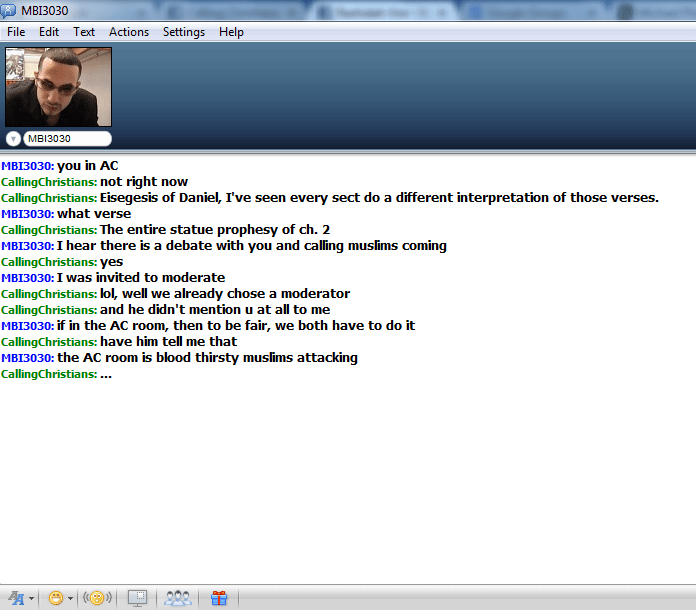
No debate is without a little controversy. A day before I had released the information about the debate, CL Edwards posted the information on his website. Later that evening I was approached by one of his friends, Antonio Santana, a Christian Missionary Polemic.


cl-debate-mbi

[Click Image to Zoom for Bigger Size]

Antonio deceptively came to ask me about a discussion in which the statue in Daniel was being discussed. I gave my opinion on this discussion and was about to exit the conversation when he brought up the debate. What was disturbing to me was the fact that he stated that CL Edwards invited him to moderate. I want to make it explicitly clear that I have all my email correspondences saved with CL and at no point in time did we discuss the possibility of Antonio (MBI3030) to be considered as a moderator. Now either it is that Antonio is lying or he is simply stirring trouble for CL.

When Antonio realised he would not get his way with me, he then insulted a significant portion of my friends by labelling them as blood thirsty Muslims. I must remind him that we Muslims do not ‘drink‘ the blood of any saviour, but he does, therefore when it comes to being blood thirsty, the label applies directly to him. I publicly call for CL Edwards to deal with his friend and proclaim that he does not endorse the violent and deceptive rhetoric of Antonio. I have agreed to debate CL, but I have not agreed to babysit his friends while they attempt to disturb our most exciting event.

wa Allaahu ‘Alam.

I Broke Another Missionary

بِسۡمِ ٱللهِ ٱلرَّحۡمَـٰنِ ٱلرَّحِيمِ ,

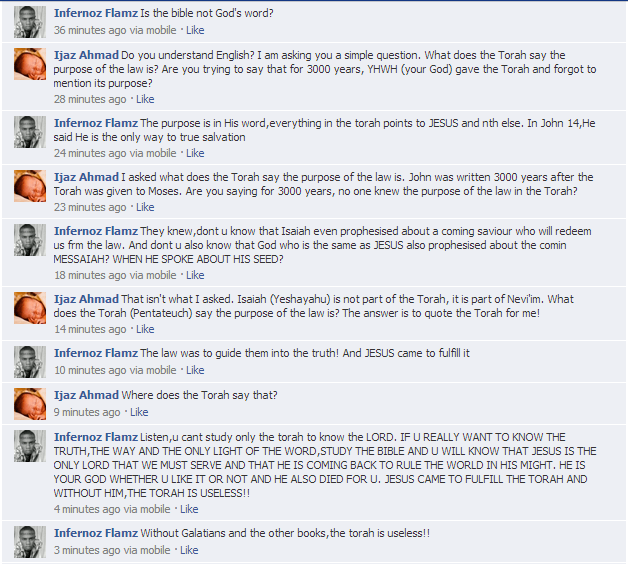
This morning I turned into a missionary’s worse nightmare. I’m sort of like the chap that comes to the car dealership, tests drives the car and it fails on me, I return to test drive another and it fails as well. Thus, it would appear that I’m not good for the dealership business. Similarly, I’m not good for missionaries either. After my initial run this morning, I decided to approach a Christian who has been on my list for sometime. As you will see:

  1. I asked a question that he could not answer.
  2. He knows he had no answer.
  3. So he repeated his wrong answer in hopes I’d stop asking.

Enjoy:

flamztotal


As you would eventually see, his patience finally ran out and he began typing in all caps. Clearly I’ve gotten on his nerves, I guess that whole ‘love your enemy’ mantra doesn’t seem to be working right about now…


flamz3

I’ve been told that the antidote to my questions is a dose of Islam, available everywhere and best of all, free of charge!

wa Allaahu ‘Alam.

« Older Entries Recent Entries »