Category Archives: Muslim and Non-Muslim Dialogue

Missionary Mishap: $50,000 Bet Lost

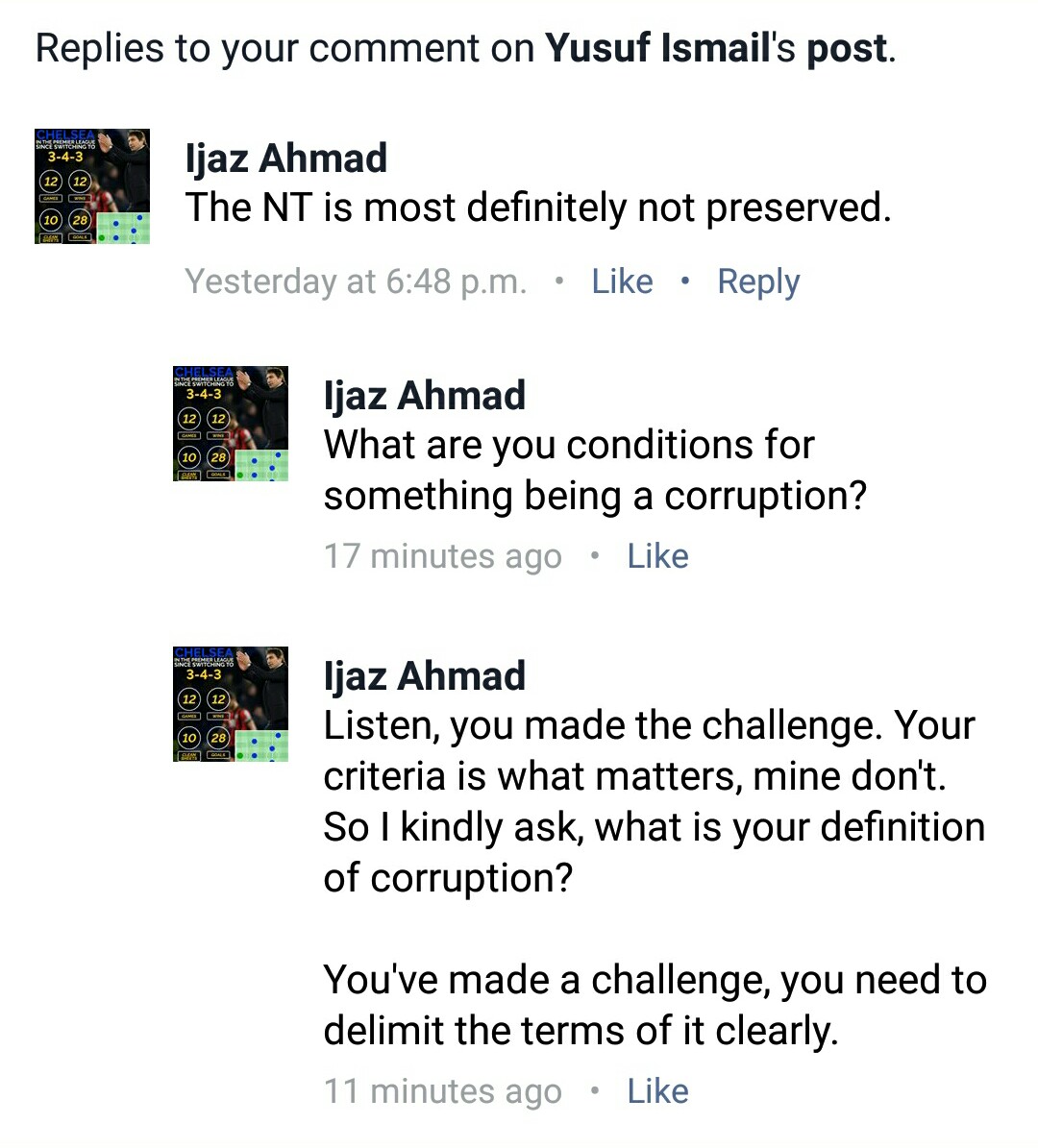
Many missionaries offer money as a means of demonstrating that their beliefs or arguments are true. One such person made a challenge and I duly responded. You can see the notifications of his responses to me here:

wp-1483160456938.jpg

Unfortunately, asking for the rules and conditions of his challenge, caused him to suddenly block me.

In the above photo you can see that only my comments are available, despite him having commented and replied to me as indicated by my notifications. I suppose blocking real challengers to your challenge is one way of keeping the money…

And God knows best.

Missionary Mishap: Doubting the Bible Makes Me an Atheist

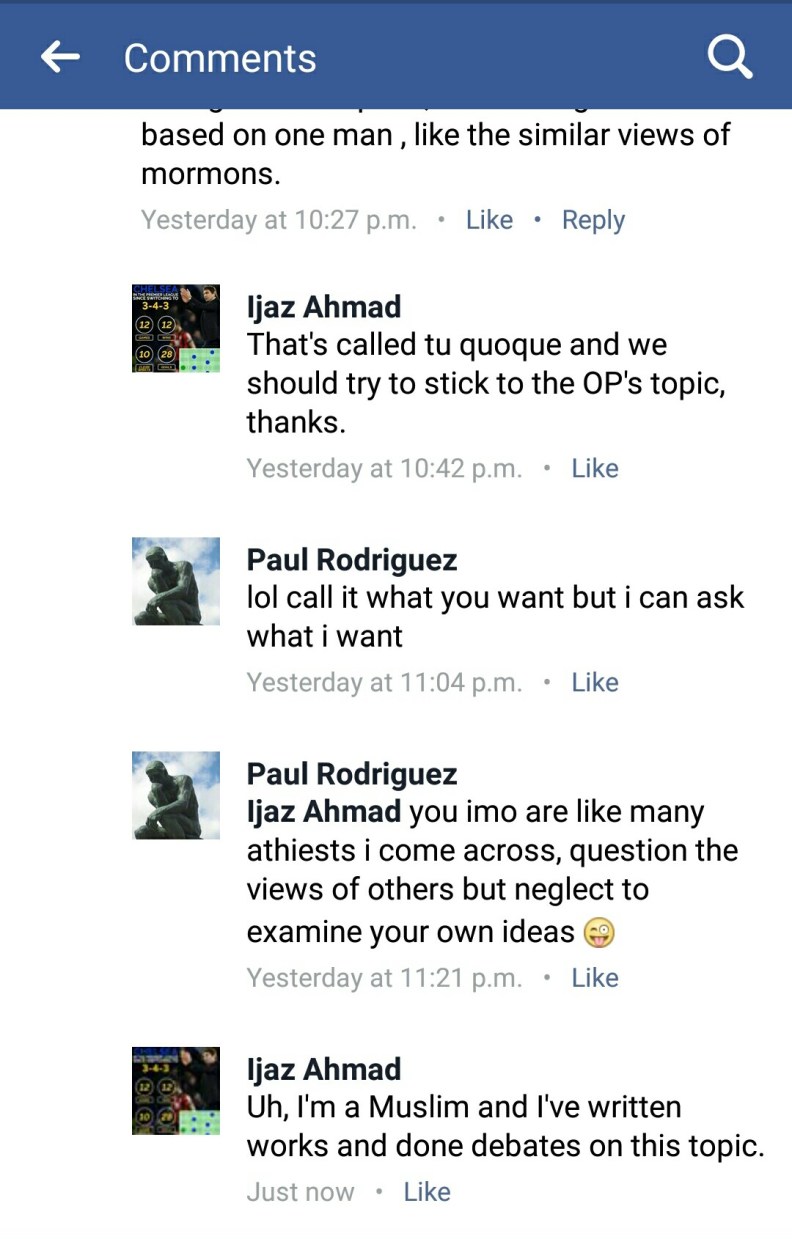
During a conversation on Facebook on a post by our esteemed Br. Yusuf Ismail on the presevation of the New Testament, a missionary decided to mention the Quran. I indicated to him quite kindly that this was the tu quoque argument, to which his response was negative:


Apparently, he does not understand how dialogue works and that not everyone who rejects his scripture is an atheist:

  1. And God Knows Best!


Christmas: A Unique Birth?

During the Christmas season, many celebrate the birth of Christ, the incarnation of God as something unique and unprecedented. It’s an incarnation of God that brought about the new covenant, allowing Christ to die for our sins and grant us eternal life. Or so that is what is said. There is however, nothing unique about God becoming incarnate from a Christian perspective, theophanies or the appearance of God in various forms throughout the Old Testament is a common and well-known theme, therefore it begs the question as to why any Christian should consider the incarnation to be a unique, once in a lifetime event.

cc-2016-fb-sonsofjupiter

As already established in an earlier article, the date of Christmas itself is not Biblically based1. Those who hold to the December 25th date are merely doing so out of tradition and culture, as opposed to Christian beliefs or rites. While some may believe that there is some religious, Biblical basis for the celebration of the birth of whom they consider to be God, at no point in the New Testament (or early Christian documents) do any of the authors ever indicate that the disciples, apostles, presbyters, or patristics ever commemorated the birth of Christ himself.

Perhaps though what is more confusing is that according to Christian beliefs the incarnation was not unique. It was not unique in the sense that Christ had come to earth in an incarnate form previously, and it was also not unique for in the same incarnate form he also bore no sin. One Christian author argues:

Divine manifestations and revelatory experiences of the latter sort are commonly called theophanies (i.e., appearances of God). One of the most important forms that theophanies take in the OT is that of the Malak Yahweh, commonly translated as “the Angel of the LORD” or “the Angel of Yahweh”. According to the Old Testament Scriptures, this figure is an appearance of Yahweh in human form.2

The author identifies this Angel of Yahweh as being Jesus in no uncertain terms:

The earliest Christians, as well as many other Christian worthies throughout the centuries, have also viewed the Malak Yahweh as a distinct divine person within the Godhead, further explicating it as a Christophany, that is, an appearance of the pre-incarnate Logos or Word of God – the Lord Jesus Christ.3

In the Book of Genesis, it records the myth of Abraham’s meeting with three men who were the God (the Lord) in human form:

The Lord appeared to Abraham by the oaks of Mamre while he was sitting at the entrance to his tent during the hottest time of the day. Abraham looked up and saw three men standing across from him. When he saw them he ran from the entrance of the tent to meet them and bowed low to the ground. He said, “My lord, if I have found favor in your sight, do not pass by and leave your servant. – Genesis 18:1-3.4

In conclusion, as it pertains to Christmas, the celebration of a unique incarnation of God is unremarkable. According to Christian beliefs, Christ was already incarnate in an earlier time and so the advent of the birth of Christ is not and should not be considered unique or something worthy of celebration unless one were Muslim. In the Islamic case, we do have reason to believe that Jesus’s birth was unique, that his birth manifested itself through the will of God, a birth without a father. While we do not celebrate Christmas under false pretenses, we do however have more of a reason to consider his birth unique and miraculous than our Christian brothers and sisters.

cc-2016-fb-prayersuponjesus

and Allah knows best.

Sources:

  1. Three Reasons Why Christians Should Not Celebrate Christmas.
  2. The Malak Yahweh: Jesus, the Divine Messenger of the Old Testament.
  3. Ibid.
  4. NET Genesis 18:1-3.

The Rise of Modern Christian Extremism

cc-2016-gunandcross1

The following are quotes from Christian author and journalist, Chris Hedges’ book “Wages of Rebellion”:

The breakdown of American society will trigger a popular backlash, which we glimpsed in the Occupy movement, but it will also energize the traditional armed vigilante groups that embrace a version of American fascism that fuses Christian and national symbols.

cc-2016-gunandcross4

Gabrielle Giffords, a member of the US House of Representatives, was shot in the head in January 2011 as she held a meeting in a supermarket parking lot in Arizona. Eighteen other people were wounded. Six of them died. Sarah Palin’s political action committee had previously targeted Giffords and other Democrats with crosshairs on an electoral map. When someone like Palin posts a map with crosshairs, saying, “Don’t Retreat, Instead – RELOAD!” there are desperate, enraged people with weapons who act. When Christian fascists stand in the pulpits of megachurches and denounce Barack Obama as the Antichrist, there are messianic believers who believe it. When a Republican lawmaker shouts “Baby killer!” at Michigan Democrat Bart Stupak, there are violent extremists who see the mission of saving the unborn as a sacred duty. They have little left to lose.

The kind of extremism that Hedges refers to, can be seen in the vitriol of Christian extremists such as Robert Spencer and Jonathan McLatchie. The next quote more accurately refers to these two missionaries:

Left unchecked, the hatred for radical Islam will transform itself into a hatred for Muslims. The hatred for undocumented workers will become a hatred for Mexicans and Central Americans.

More specifically, their self-delusion in referring to groups they dislike, as in the case of Jonathan McLatchie referring to Muslims as a cancer in European civilization speaks to their extremism. Hedges further says:

The ethnic groups, worshiping their own mythic virtues and courage and wallowing in historical examples of their own victimhood, vomited up demagogues and murderers such as Radovan Karadzic and Slobodan Milosevic. To restore this mythological past they sought to remove, through exclusion and finally violence, competing ethnicities. The embrace of non-reality-based belief systems made communication among ethnic groups impossible. They no longer spoke the same cultural or historical language. They believed in their private fantasy. And because they believed in fantasy, they had no common historical narrative built around verifiable truth and no way finally to communicate with anyone who did not share their self-delusion.

In conclusion about these extremists, he says:

Those who retreat into fantasy cannot be engaged in rational discussion, for fantasy is all that is left of their tattered self-esteem. Attacks on their myths as untrue trigger not a discussion of facts and evidence but a ferocious emotional backlash.

That last quote reminds me solely of Sam Shamoun. Rather than engage in intellectual dialogue, he copy pastes articles, and insults those he disagrees with. Thus, the rise of Christian fascism, and its role in spreading hatred and violence towards Muslims is a growing pattern among polemicists such as Robert Spencer, David Wood, Sam Shamoun and now recently Jonathan McLatchie. The result of this hate can only be expressed as follows:

cc-2016-gunandcross3

and God knows best.

A Clear Conscience?

Recently my friend and colleague, Br. Aqil Onque debated Jonathan McLatchie on the Trinity Channel – yes, the same channel that his mentor Sam Shamoun accused of stealing money and misappropriating funds:

cc-2016-ss-trinityfraud

Sam indicated that the Trinity channel was using donations to “fatten their pocket,” that is taking donations meant for evangelizing and managing the station, and instead using the money for their personal gain, i.e. theft. Yet, we find Jonathan openly promoting and working with the station. The question needs to be asked, did Sam Shamoun openly lie about his own Christian brothers and sisters at the Trinity channel, or is Jonathan colluding with Christians involved in fraud and theft? For those interested in inter-faith dialogue, the question of misusing religion for monetary gain or popularity seriously brings into doubt the actions of many Christian speakers, preachers and polemicists. As a Muslim, how can I trust what Sam Shamoun has to say if he is willing to fabricate claims about his own brothers and sisters in faith, or how can I trust someone who openly promotes a platform that engages in fraud and theft? Why Jonathan would knowingly promote a platform that engages in financial impropriety is a question he would have to answer himself.

Pursuant to this, I have to say that I am quite disappointed in the immaturity spouting from the Jonathan camp following his debate with Br. Aqil. I was shocked to see that both during and immediately following the debate, memes mocking and comments insulting Br. Aqil were shared to and posted on Jonathan’s Facebook profile. There is a stark difference between critiquing your opponent and openly insulting, mocking and ridiculing your opponent. While Jonathan himself did not post the offending comments or memes (photos), he did “like” them and did not remove them, nor did he caution his camp from such immature behaviour. This is surprising to me, because in the not so distant past, offensive memes ridiculing Jonathan were being shared on social media and I endeavoured quite greatly to not only stop the memes from being spread, but I also directly contacted Jonathan and expressed my disappointment and contempt with such behaviour from my Muslim brothers and sisters. To see that Jonathan would not only condone but engage in behaviour he himself found quite upsetting a month or two ago, is hypocritical to say the least.

In the end, we have to ask, do integrity, decency and maturity count for anything anymore?

and God knows best.

Terrorism in the Bible – Is the Godhead of the Bible Morally Upright?

Most Christians either completely gloss over or ignore the violence of the Old Testament. Such an apologetic is usually framed in the form of contextualising this violence as being for a specific period and people. We’re speaking about genocide, mass rape, mass torture, and horrendous acts of this nature. When compared with the New Testament, it is difficult to reconcile the two versions of God being presented to us. Our most read article also inspects some of these stories of the Old Testament.

The Old Testament contains the single most violent passage among any scripture in world history:

However, in the cities of the nations the Lord your God is giving you as an inheritance, do not leave alive anything that breathes. – Deuteronomy 20:16.

Rivaled by none, the scale of sheer violence and bloodshed in the Bible is not only disturbing, it is also extremely difficult to accept that this is the God that Christians want us to build a relationship with. Concerning the apologetic that such violence is meant for a specific place and time, this betrays the Bible’s teachings itself. To begin with, the Bible teaches that all of God’s laws are eternal:

All your words are true; all your righteous laws are eternal. – Psalm 119:160.

Pursuant to this belief, of the 613 commandments given in the Old Testament, several of them are to act upon the rules of Deuteronomy Chapter 20. This includes Deuteronomy 20:16. Some Christians in reading this chapter may state that it mentions Israel a number of times so it must only refer to the Children of Israel, however this is incorrect as the Church today is considered to be partakers in Israel, as is explained by one popular Christian ministry (emphasis mines):

Finally, Galatians 3:29 says, “If you belong to Christ, then you are Abraham’s seed, and heirs according to the promise.” In other words, in Christ, believers are counted righteous by faith in the same way that Abraham was (Galatians 3:6-8). If we are in Christ, then we are partakers of the blessing of Israel and all nations in the redemptive work of Christ. Believers become the spiritual descendants of Abraham. Believers do not become physical Jews, but they may enjoy the same type of blessings and privileges as the Jews.

and God knows best.

Qur’an says “Sun Setting in Muddy Water,” claim Refuted – By Br. Ijaz and Br. Abu Ayoub

In this in-depth video, myself and Br. Abu Ayoub examine the claim that Qur’an in Surah  18:83-86 literally says the sun is “setting in a spring of muddy water.” We walk through the phenomenological statements the Bible also uses in respect to the sun rising and setting, usually known as semitisms which is a form of language behaviour or syntax in the Semitic languages. In the end, we see that the Arabic and Hebrew languages use many language devices that are not meant to be interpreted hyper-literally and which use hyperbole to express some geographical boundary.

and God knows best.

« Older Entries Recent Entries »