Author Archives: Ijaz Ahmad

Sam Shamoun Refutes Jay Smith: Can the Christian God Do Anything?

Recently, Jay Smith was approached in Hyde Park by Br. Paul and was questioned regarding a popular polemical claim regarding God’s power. His claim is that the Christian God is so powerful, that this God can become a man. I have explained in detail why this is an ontologically weak argument. He was then asked by Br. Paul, can the Christian God become Satan? Unfortunately, Jay refused to reply.

Surprisingly, Smith’s friend and admirer, Sam Shamoun found Jay’s claim to be quite heretical. Sam publicly denied the claim that the Christian God can and will do anything. In his publicly damning refutation of Jay Smith, Sam used the Bible to prove his point, he said:

For example, the true God in the Holy Bible plainly and emphatically claims that there are certain things that are impossible for him to do due to his holy and immutable nature:

“for the gifts and the calling of God are IRREVOCABLE.” Romans 11:29 New Revised Standard Version (NRSV)

” in the hope of eternal life that God, who NEVER lies, promised before the ages began—” Titus 1:2 NRSV

“if we are faithless, he remains faithful—for he CANNOT deny himself.” 2 Timothy 2:13 NRSV

“In the same way, when God desired to show even more clearly to the heirs of the promise the UNCHANGEABLE character of his purpose, he guaranteed it by an oath, so that through two UNCHANGEABLE things, in which it is IMPOSSIBLE that God would prove false, we who have taken refuge might be strongly encouraged to seize the hope set before us. ” Hebrews 6:17-18 NRSV

“No one, when tempted, should say, ‘I am being tempted by God’; for God CANNOT be tempted by evil and he himself tempts no one.” James 1:13 NRSV

Sam Shamoun’s refutation of Jay Smith’s heretical teachings about Christ raises an interesting question. If Jay Smith and Sam Shamoun, who have studied for decades about Christianity, and who have worked in polemics for several decades together, can claim that the other is teaching heretical beliefs about God – then who’s the real Christian between them?

Is Sam Shamoun wrong and Jay Smith correct?

Is Jay Smith wrong and Sam Shamoun correct?

Which Christ is the real Christ?

Will the true Christian please stand up?

and God knows best.

Is There Any Early Evidence of the Corruption of the New Testament?

Question:

Muslims often claim that the New Testament was corrupted very early on, is there any proof of this?

Answer:

The Qur’an in Surah 2, Ayah 79 mentions that a people from among the People of the Book forged writings and claimed these writings to be from God:

So woe to those who write the “scripture” with their own hands, then say, “This is from Allah,” in order to exchange it for a small price. Woe to them for what their hands have written and woe to them for what they earn.

In this case, people were forging writings and claiming them to be scripture from God. As per the question being asked, we do have extremely early evidence from Paul (or someone writing in his name), claiming that letters and teachings bearing his name were being falsified by heretics during his lifetime. We read this in 2 Thessalonians 2:1-4:

Concerning the coming of our Lord Jesus Christ and our being gathered to him, we ask you, brothers and sisters, not to become easily unsettled or alarmed by the teaching allegedly from us—whether by a prophecy or by word of mouth or by letter—asserting that the day of the Lord has already come. Don’t let anyone deceive you in any way, for that day will not come until the rebellion occurs and the man of lawlessness is revealed, the man doomed to destruction.

Therefore, Muslims are not making this claim without evidence. This is a Biblically based belief, from one of Christianity’s earliest sources. I hope that this answers your question.

and Allah knows best.

If the Command was Given to Burn the Manuscripts, Why Do So Many Survive?

Question:

If the command was given to burn unauthorized copies of the Qur’an, why do so many early manuscripts exist?

Answer:

This narration must firstly be taken into its historical context. There were generally two types of writing material being used at that time. Papyrus and Vellum (Parchment). Papyrus is a plant based material, which is very delicate. In other words, it can be difficult to preserve and it is damaged somewhat easily. However, it was cheap to produce and attain. This type of material could not be washed or rubbed so that the writing on it could be changed. To the contrary, parchment (vellum) which is animal skin is very robust and it can be washed over or rubbed to have the writing changed. It is also very expensive and at that time, some may say difficult to procure (acquire). In this context, the command to burn, would have meant to burn what could not be changed, which is why we find a number of manuscripts (made with animal skin) with changes, and why papyrus based manuscripts are extremely rare. Therefore, in terms of the historical context of the writing material of that time period, it would make sense that you burn the cheap, mass produced material which could not be changed and you do not burn the expensive, difficult to acquire writing material which could be changed.

Similarly, we have to take into consideration the fact that this narration presupposes that the command be carried out by those who knew how to read. If the command was absolute, then any person who possessed any type of writing in their household, handed down through family tradition or given in trade, would have to destroy all the writing they possessed. However, this would not make sense. Only a person who knew how to read, and in this case, could read the writing of the Qur’an, would know what to burn. Most people at that time would not be able to read, and so we cannot expect that the command meant that every person, whether literate or illiterate, burn their entire libraries when they did not understand what they were burning in the first place. In this way, many manuscripts would have survived. It is not simply a case of burning everything and anything. These narrations do exist within a historical period and we must understand these narrations in light of their historicity.

If we take for an example, the command of a general on a battlefield who says, “kill everyone!” Does he mean to say that his own soldiers should kill each other and himself? Or, if you’re at a restaurant and order something from the menu, that it means you have ordered for everyone? Statements have to be taken into context and we must be careful about taking them absolutely literally, especially when we do not understand the customs and practises of the time period in which they are said to have taken place within.

and Allah knows best.

What Gives a Manuscript Inherent Authority?

Question:

What makes a manuscript authoritative for Christians and Muslims?

Answer:

The question we need to ask ourselves is, what makes a manuscript inherently, or innately authoritative? What is it, what is the criteria we use to determine the authority of a manuscript? Most of the manuscripts that both Christians and Muslims possess, are from unknown scribes. We do not know why they wrote what they wrote, what their level of skills were, for whom they wrote, what their intentions were, what their levels of education were. The only attribute which makes a manuscript authoritative by any criteria of measurement, is that it exists. We cannot assess manuscripts which do not exist, so we are left to examine what remains to this day (extant, still surviving). Does this make the manuscript authoritative though? Naturally, for something to be authoritative, we need to know where it was produced and from whom it was produced. Consider then, the case of a man who goes to a pawn shop to trade a letter he claimed was written to his grandmother by a famous celebrity during her lifetime.

Both the grandmother and the celebrity are dead, and we have very few, if any surviving artifacts from this celebrity. So, how can we validate this letter? We may never be able to do so. The same issues arise with manuscripts. Something’s existence, does not necessitate its authenticity. Many great libraries were sacked and destroyed during the medieval period, with many great codices and manuscripts lost during these tragedies. The fact that something exists, does not mean it is important or authoritative. There are, quite literally, 1001 reasons for any given manuscript to survive to our day. The fact that a particular manuscript happens to survive, does not give it authority. I’ve yet to see anyone, whether a textual critic or otherwise, argue for the authority of unknown documents, based on anything other than the reasoning that they “just happen to exist”. I’m reminded at this point of Lion Vaganay’s, “An Introduction to New Testament textual Criticism,” where he speaks on three false principles that beginners make when giving authority to manuscripts:

Three Defective Principles

In order to choose the correct reading from amongst the different variants, it used to be customary, and indeed it too often still is customary, to appeal to the number, the age and the general character of the witnesses; these are three criteria which, whether taken singly or together, are insufficient to justify a choice of reading.

The Number of Witnesses

A hundred manuscripts which are copies one of another continue but one authority, whereas two independent manuscripts should be reckoned as two. Moreover, even when faced with a real majority, care must be taken not to assume automatically that the majority is right without further examination. All copies do not have the same value. It is the question of the nature of the text which is important, not the quantity of its representatives. Non numerantur sed ponderantur, ‘A fault may be copied as many times as you like, you will never make a correct reading out of it’ (Collomp 1931, p.35). The beginner is naturally inclined to find safety in numbers and needs to be on his guard against this trap. Universal suffrage has no place on textual criticism.

It is, of course, true that the presence of a large number of documents can sometimes be a useful signpost but it can never be adequate on its own for drawing firm conclusions. As will be seen, copies have to be considered as representatives of a group and not as separate witnesses. That immediately weakens any argument based on their number. But there is more to it than that: even when the main manuscript groups agree on a variant, it is still essential to check whether there is not a divergent reading attested by any of the other documents of authority; for it is a simple fact that the original reading may be found in only a few scattered documents while what the majority contain is an early correction.

The Age of the Witnesses

There is no better a guide. A codex of the sixth century may be the copy of a good second century manuscript which has been lost but which was a first-hand copy of the original. A fourth-century codex could be a poor copy of a defective third-century manuscript with a dozen intermediaries separating it from the original. It would therefore be wrong to trust the latter more than the former. Important lessons can be learnt from recent discoveries. For example, there is a reading (1 Peter 2:20) which hitherto was known only from the relatively late uncial (.044) and some miniscules (including 1729, tenth century) and which has now been found in a papyrus (P72) from the beginning of he fourth century, which had previously gone uncontested are now in question. The authority which tends to be attributed to an early codex rests on a foundation which is sometimes deceptive: its nearness to the original. The factors which carry more weight are the number of witnesses, and more especially the quality of the copies made between the original and the manuscript in question. In a word, it is the age of the text and not the age of the manuscript which must be considered, for there are relatively recent manuscripts with a very early text and early manuscripts with a corrupted text.

Of course, the age of a witness is never to be completely overlooked. It would be right to be wary of a variant which does not emerge until the fifteenth or sixteenth century, for example, and to pay more attention to a variant in a papyrus from around AD 200. But, once again, it would be wrong to be hypnotised by the papyri and the uncials. There are miniscules which date from before the uncials. There are even miniscules whose text is better than that of some papyri or uncials. – p. 62.

The process which makes a manuscript authoritative without means of identifying the scribe’s authority is quite a difficult one, and not one underwhich all textual critics agree on, taking information from an unknown source in Islamic scholarship is something which is rejected. In conclusion, something’s existence does not make it authoritative, each manuscript must be judged on its own qualities and both faiths have differing approaches to manuscripts of unknown origin. What works for the New Testament, does not work for the Qur’an, and we should be wary of this difference when we discuss the manuscript histories of either of these works.

and God knows best.

The Role of Scriptural Manuscripts in Islam and Christianity – A Primer

Introduction

Given all the buzz about manuscripts regarding both the scriptures of the Muslims and Christians, I thought it’d be best to write something simple to explain the differences in approach that the Islamic and Christian faiths use when understanding their scriptures. This isn’t meant to be a highly technical article, but by the end of this post you’ll understand why manuscripts are important and to whom they are important.

The main difference in understanding manuscripts in both these faiths can be summed up in one term, “textus receptus vs textus criticus”. Textus receptus refers to the passing of scripture from generation to generation, until present day. Hence the term, “received text”. Textus criticus refers to a reconstructed version of scripture, based on the best manuscript witnesses that are extant (still surviving to our times). Hence the term, “critical text”.

Textus Receptus or Textus Criticus?

Christians today no longer depend on their textus receptus, they opt for textus criticus. In essence, they believe that their scriptural tradition internationally, that their Churches internationally, that for over 2000 years, their collective world of Christendom was unable to accurately preserve the New Testament. We can assign the shift in thinking from textus receptus to textus criticus sometime during the 16th century, when we had Erasmus’s, Cisneros’s and Stephanus’s critical Greek editions of the New Testament. This movement agreed on the principle that the Latin Vulgate, despite being the primary New Testament for centuries, did not accurately represent the “original” readings that the earlier Greek manuscripts contained. Therefore, Christians had to “recover” and “reconstruct” their scripture from the earlier Greek manuscripts, as opposed to relying on the traditional view of depending on the Latin Vulgate which was a translation of some of the Greek, the primary language of the New Testament.

There are however Christians who do disagree with this view that the entire world of Christendom failed to preserve the New Testament, and that the Church tradition did preserve their scripture. This is a minor group known as KJV-Onlyists. It has taken over 500 years for Christendom to propagate the shift from textus receptus to textus criticus. Thus, to modern Christians, manuscripts are extremely important to reconstructing the original words of the New Testament. The problem here is that we have no original manuscripts (autographs) and at best, the critical text of the New Testament today is an approximated “prototype” (vorlage) of the manuscripts, that may have been written in between 200 – 500 CE. In other words, the critical text of the New Testament does not go back to the original manuscripts (autographs) but they can be traced back to a “prototype” from which they may have been copied from at a later date, usually known as an “archetypal text”.

This view of textus criticus is not accepted in Islam. We believe that our scholastic tradition has preserved the Qur’an in its entirety. This is because in Islam, we did not translate the Qur’an from Arabic to English and then only used the English for 1400 years, while forgetting the Arabic and failing to preserve the Arabic Qur’an. We have kept the primary language of the Qur’an alive as well (fusha Arabic), and we’ve kept two separate traditions alive for over 1400 years: Hifz al Qur’an (memorization of the Qur’an) and ‘Ilm al Rasm al Mushaf (the science of the writing of the Qur’an). In essence, Muslims have kept reciting the Qur’an, memorizing it in its entirety, specializing in learning its language, specialized in learning its recital for over 1400 years, to this very day. We’ve also kept the tradition of writing the Qur’an and writing it with the most advanced Arabic styles of calligraphy. These two traditions mean that the Muslims in China are reciting the same Qur’an, in the same way, as the Muslims in the Caribbean, and that they have been doing so for centuries. The fact that Muslims have an entire month each year dedicated to the reciting of the Qur’an, and that we must recite it at a minimum 5 times a day, ensures that the Qur’an is being preserved everyday, all day. The same cannot be said for the New Testament.

This means, that while Christians have great reasons to doubt the preservation of their scripture and have to rely on reconstructing it, us Muslims do not share this problem. We have no reason to doubt our traditions of preservation as we have means to authenticating them. The Christians do not. As mentioned in other articles, we know who our reciters are and where they came from, what their characters were like and what their beliefs were. They are not unknown and we do not take knowledge from unknown persons. Today one would find many Christian scholars trying to search for a “Jesus oral tradition”. They’re trying to find some oral tradition that can link the manuscripts to credible persons who are historically viable to give their manuscripts authority, so that they could validate their reconstructed text. Muslims do not need to find an oral tradition to do so, as ours still exists to this day through our sanad of reciters (Qurra) and memorizers (Huffaz), which must authorize (provide an ijaza) students before they can teach the Qur’an to others. These mechanisms are inherent to the Islamic scriptural tradition, but they are alien to the Christian scriptural tradition.

The Need for Manuscripts

What Christians are doing today, like Jay Smith, Keith Small, Andy Bannister, Samuel Green and Spencer, is trying to get Muslims to reject textus receptus and to create a textus criticus. In essence, they need Muslims to have the same level of doubt about the Qur’an as they do, with the New Testament. Yet, as mentioned previously, our faith’s mechanisms in regard to preserving, teaching and sharing scripture are far more advanced that those of Christianity’s. Thus, when Christians point out that manuscripts have some variants or some differences, they are trying to force Muslims to reject our scriptural tradition. However, we are not in the same position as Christianity. We have no need to reject our scriptural tradition, but Christians do, since their collective world of Christianity was unable to preserve their scriptural tradition as Muslims have. The problem with using manuscripts from unknown authors, from unknown sources is quite obvious. What would happen if Christians found a manuscript of John 1 from the 1st century CE that excluded the Johannine Prologue? By their standards, they would have to give this manuscript authority and remove the prologue from their modern Bibles.

However, Christians are not consistent. They will instead claim that Church tradition has mentioned the prologue as being scripture and thus they will find some excuse to remove authority from that manuscript, despite rejecting their scriptural tradition for the critical method. In other words, Christians seriously doubt the preservation of their scripture and demand that Muslims use their critical methods on the Qur’an, when they themselves do not apply these critical methods consistently. Consider then, the example of the Shepherd of Hermas which is included in our earliest collection of the New Testament from the 4th century CE, Codex Sinaiticus. An entire book is excluded from the modern critical texts because Church tradition did not consider it scripture, yet the critical texts are not supposed to be based on tradition, but on the critical method. If Christians were consistent, they’d have to place the Shepherd of Hermas in their modern day critical edition. Yet, when missionaries see that some obscure manuscript, found in some obscure place may or may not have a different spelling of a word in the Qur’an, they demand that we accept that the Qur’an has changed.

That is strange reasoning. Who wrote this manuscript? We don’t know. What was their level of education? We don’t know. Why did they write it? We don’t know. So, on what basis do we accept an unknowable. unverifiable text, over 1400 years of verifiable, known tradition from chains of historic transmission? There are a hundred and one reasons why a manuscript can contain a variation. The person writing may have been using regional orthography (representation of letters and words) than a standardized style of writing. The scribe may have been using the manuscript to practise writing. The scribe could have been writing while someone was reciting (usually known as an amanuensis) and made an error in haste. The scribe could have been copying the shapes of the letters without knowing what the letters on the manuscript meant, thus if they made an error they would not have known that they changed a word. These are all common reasons that Christian textual critics point out for rejecting the variants found in many New Testament manuscripts.

In other words, Christians themselves reject the notion that all manuscripts are authoritative and for them manuscripts need to be authoritative because their scriptural tradition internationally was unable to preserve their scripture from its earliest days to the present day. This problem is not present in Islam and so we have no need to depend on, unverifiable manuscripts. We don’t need to authorize texts that are historically without authority. Christians have that need, it’s a necessity because their scriptural tradition was insufficient, Islam does not have this problem. So when Christians point out a variant that a scribe may or may not have made in writing the Qur’an, that means nothing to do the Muslim as it is a lone witness, versus a living tradition of witnesses in continuous verification over 1400+ years through daily, monthly and yearly memorization and recitation. However, if there is a variant in a New Testament manuscript, this is a problem for Christianity as not only do they accept that their scriptural tradition needs to be abandoned, they now need to reconstruct what their scripture may or may not have looked like and so they try to attack the Qur’an out of jealousy. While Muslims can be certain about the Qur’an, a Christian simply cannot be certain about anything in the New Testament.

Conclusion

One of the divine signs of Islam is the promise in Qur’an 15:9, which reads:

“Indeed, it is We who sent down the Qur’an and indeed, We will be its guardian.”

From the very start of Islam, the Qur’an was commanded to be recited. It was memorized, taught, recited daily. If God wanted a scripture to be preserved, then the best way to preserve it among humans would have been through continuous and daily recitation. In Islam, we find this with the 5 daily prayers in which the Qur’an must be recited. God included an entire month of the year dedicated to reciting the Qur’an in mass congregation, Ramadhan. God made it compulsory for each community to have a hafiz (memorizer) who needed to know the Qur’an by memory. God made it compulsory for each Muslim to individually carry the responsibility of knowing several chapters (Surahs) of the Qur’an. The God of Islam, it would seem through divine wisdom, knew what was needed for the Qur’an to be preserved among its followers. The same cannot be said about the New Testament or the Graeco-Roman Post-Hasmonaean Jewish Syncretic deity that Christians worship. This deity did not make the New Testament central to the lives of the early Christians. There was no need to memorize what Jesus said and taught, there was no need to recite what God revealed daily, monthly or even yearly. There was no command to preserve the language in which the scripture was given.

There was no need to preserve the New Testament. One must wonder, if there is a God and He wanted us to know Him, wouldn’t He have raised a community of people devoted to the preservation of His scripture? This is what we find in the religion of Islam, but it is not something we can find in the religion of Christianity. Interestingly, this rejection of textus receptus for textus criticus raises a very disturbing problem. If the collective world of Christendom, could not preserve their scripture for over 2000 years and they needed to reconstruct their scripture, what else has their religious tradition failed to preserve? What if their traditional teachings about the Trinity are wrong and need to be recovered. What if their traditional beliefs about Jesus dying for their sins are wrong and need to be recovered? What if…? Islam does not carry with it, such uncertainty, only Christianity can and does. For me, that’s a problem.

and Allah knows best.

Missionary Mishap: When Reading Comprehension is a Problem

From time to time I get tagged on Facebook with every Tom, Dick and Harry wanting to challenge me to a debate. Some react badly when I decline, or if I don’t respond. This is an example of one of those people and it’s also an example of why I choose not to “debate” or “dialogue” with them:

wpid-2015-07-28-23.32.03.png.png

There are what? 250 000 manuscripts of the Qur’an worldwide. What does the missionary read? That there are 250 000 mistakes in the Qur’ans worldwide. To me, this is pretty funny as I don’t have to do anything to “respond” to him. He’s given the quote and posted his comment, both are in conflict and so he’s done my part for me, by refuting himself.

That’s what I enjoy about the Missionary Mishap series. Almost every post in this series demonstrates the lengths to which missionaries will go, even to the point of quoting something and not being able to read it properly. It makes for good entertainment.

and God knows best.

A Response to Smith, Spencer, Qureishi and Others on Birmingham Qur’an Manuscript Find

We’ll begin by responding to Jay Smith’s ridiculous email, most of which was plagiarized from Spencer’s Jihad Watch article, which is silly in and of itself. So, in responding to Smith’s email entitled, “Are Bart Ehrman’s Views on the Birmingham Fragments Correct?,” the following are my corrections of his lies and deceits:

1. Sahih al Bukhari 6:509 and 510 do not mention anything about canonizing the Qur’an or about corruption. Both hadiths mention the “fear” of corruption happening, but not the actual corruption of anything:

“…and I am afraid that more heavy casualties may take place among the Qurra’ on other battlefields…”

Therefore, the imagined claims of a yet to be canonized scripture cannot be qualified given anyone’s actual reading of either of these narrations. It then must be asked of you and not of Dr. Ehrman, if you yourself actually know the traditional story of the Qur’an’s preservation.

You mention that since these manuscripts date before the time of ‘Uthman’s alleged rescension, that this must mean they are corrupted. To the contrary, only manuscripts which were not authorized (read as modern “to be published”) were brought into conformity with the “rasm” (read as orthography) of the Prophetic tradition. The fact that the text of Mingana Arabica 1572a agrees with our modern text, clearly contradicts your assertion that it must be “examples of those very corrupted manuscripts” (a term, not found in either of the narrations you referenced).

You then proceeded to copy paste Spencer’s woeful argument that the stories mentioned in Surah 18 must have been written later, therefore the dating must be wrong. In the real world, we do not conform our theories to evidences, rather we let the evidences work for, or against our theories. In this case, it is called “proof by contradiction”, in that both you and Spencer seem unable to grasp the reality that the manuscript has been properly dated and that its text is in conformity with the traditional story of preservation. This does not mean the datings are wrong, it means your timeline of perceived development of the text is wrong. In other words, the proof of the datings, contradicts your claims, ergo you’ve been proven to be wrong.

2. For a person who has studied Islam and the Qur’an for over 20 years, you are severely uneducated when it comes to Islam and the Qur’an. You made the absurd assertion, and let me quote you here, that:

“The Qur’an, unlike the Biblical documents, was never written on papyrus….”

Jay……, Jay………, Jay. I don’t know what to say, except that not only are you wrong, you’re very wrong and at this point you’re just embarrassing yourself. Take a look at this wonderful manuscript of the Qur’an, from the 1st century AH, written in Hijazi, that’s written on….papyrus! Given that you “professionally study the Qur’an”, it esacpes me how one of the only major news stories of 2014 concerning the Qur’an would slip by you.

You went on to argue:

“So where are those four complete Qur’anic manuscripts, all from 650 AD, all of which should be identical, without any manuscript variants? A folio or two discovered here and there (Birmingham and Tubingen) do not the Qur’an make.”

I think he means codices and not manuscripts, because if he means manuscripts, then yes we do have several folios of complete manuscripts of the Qur’an that pre-date 650 CE. What manuscripts would that be? Well it would be the four from Birmingham, that’s just one example off the top of my head that would be extremely relevant to the very topic at hand! Also, as pointed out in my paper to you, we do have 100% of the Qur’an from within the 1st century of hijrah. So, to the contrary, yes, a folio or two does add up when you end up with 100% of the text you were aiming to find.

You went on to argue:

“What’s more, Ehrman seems to suggest that these two folios, dated early, thus validate the entire Qur’an as being early. Using that criteria, would he be willing to accept that the 2nd century Bodimer Papyrus and the John Rylands fragments now validate all 27 books of the New Testament? Of course he won’t, and neither do we.”

Well that isn’t Dr. Ehrman’s argument, and although we do have the entire text from within the first century of hijrah, your argument is still bad. Why is it bad? Mostly because, if we quote the Dr., his assertion, and let me quote him here (something you were unable and unwilling to do for obvious reasons), was to say the following:

“My historical question is this. If these pages of the Qur’an do indeed show that the text of the Qur’an is virtually the same in, say 630-40 CE as it is in 1630-40 as it is in 2015, that would suggest that Muslims are indeed correct that at least in some circles (it would obviously be impossible to prove that it was true in *all* circles), scribes of the Qur’an simply didn’t change it. The made sure they copied it the same, every time, word for word.”

“And so back to my question. If Muslim scholars over the centuries – from the very beginning – made dead sure that when they copied their sacred text they didn’t change anything, why didn’t Christian scribes do the same thing???”

All he’s saying is that what was copied, would somewhat prove that it was copied correctly. I’m looking for where he does not say, “these pages of the Qur’an” and where he says “entire Qur’an”, and well, I can’t find it. Essentially, what Smith did, was open his mouth, make up something, argue against that made up statement and then cheer himself for winning an argument that he himself made. It’s just embarrassing and depressing.

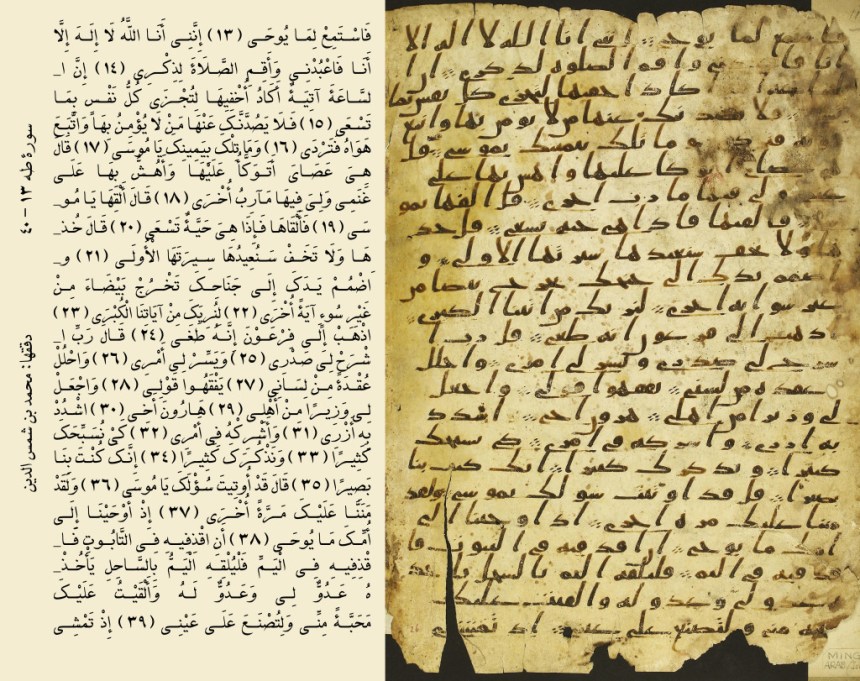
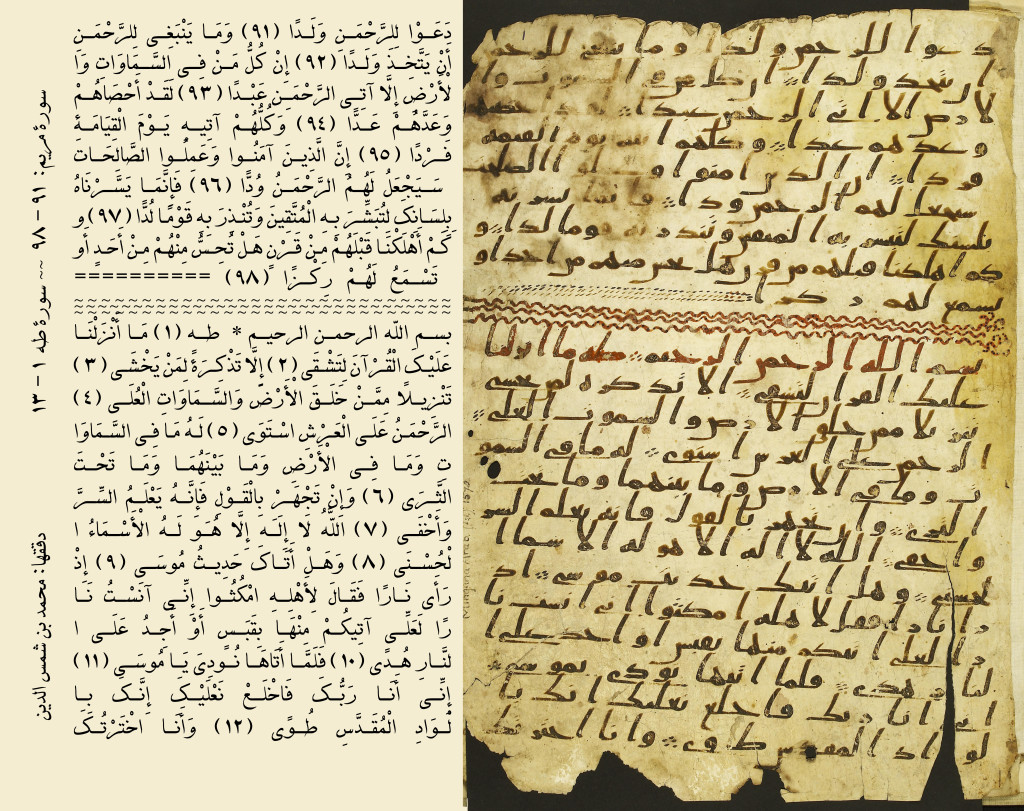
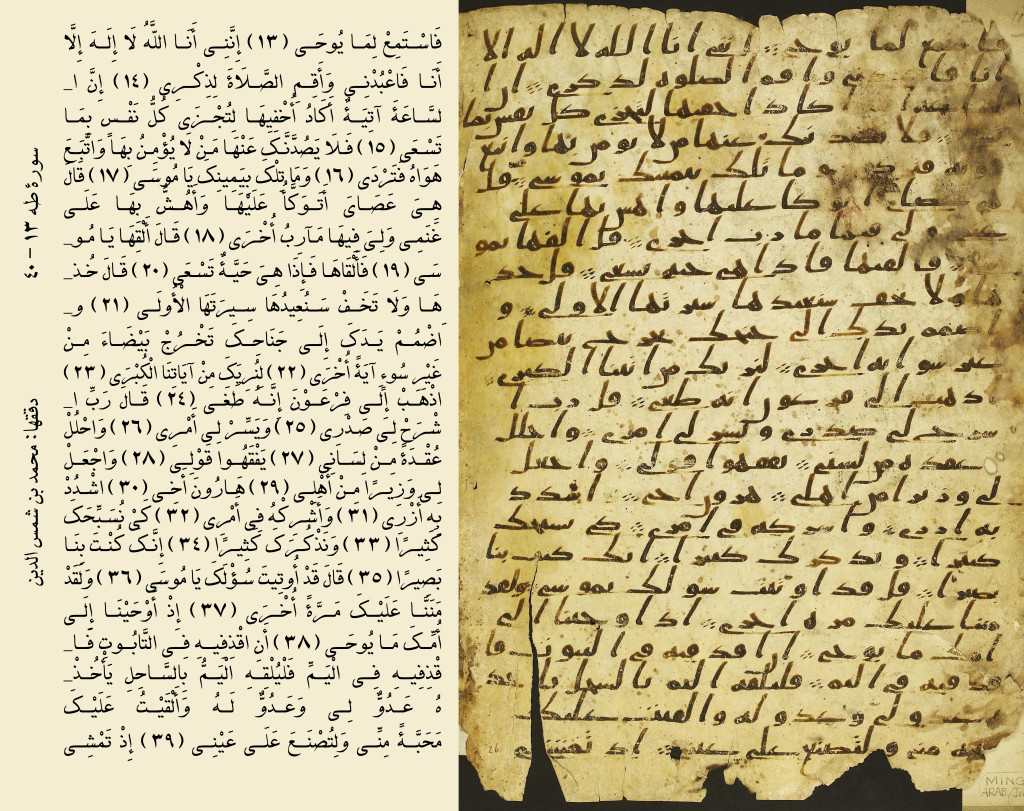
3. Smith claims that the 4 folios (pages) do contain variants when compared with the Qur’an of today. To the contrary, the manuscript contains 0 variants (orthography aside). What it does contain are two words that the scribe changed from the reading of Ibn Masud, and Isa b. Amr and Al-Thahak b. Muzahim on lines 13 and 30, to the reading of ‘Uthman. Therefore, the manuscript, in its state as left by the scribe does conform to the Qur’an of today. Even if the scribe had preferred the reading of one word (واشدد), it is from the Qira’at of the Prophet (ﷺ) through Ibn Masud, or if the scribe had preferred the reading of the other word (طاوى) through Isa b. Amr and Al-Thahak b. Muzahim, it is also from the Qira’at, both of which are from the Qur’an. Therefore, by all measurements, there are no variants except for the notable difference in use of the letter “alif” which is due to orthographic development.

4. Smith claims that BBC sensationalized the story by leaving out the mention that the original scribe chose to conform to the ‘Uthmani recitation in two words. Since this is an autographic text and the scribe chose to write the text according to the ‘Uthmani rasm, then it is not a variant, as it already agrees with the modern text. If the scribe had chosen to keep the two different words (one due to use of an ‘alif), it would still conform as it is from the Qira’at of the Prophet (ﷺ), which the textual critic Alba of Birmingham University also mentions.

5. Smith refers to intentional changes to conform to the published edition from his friend’s Dan’s thesis, which I tore apart as being unqualified in my paper here. Not only does Dan confuse the orthography of the Arabic language with “intentional” changes, he seemed unable to find the most basic variants that belonged to the Qira’at. Most of his paper focused on him being unable to find the variants in the Qira’at literature, yet somehow I was able to find several and without much time.

6. Smith refers to orthographic differences as “scribal errors”. I suggest he reads any book on language development or of textual criticism. Lapsus calami, or scribal errors, do not include orthographic development. If that were the case, almost all medieval NT manuscripts would then have to be considered erratic en toto because of the shift of majuscule scriptio continua to miniscule polytonic. In other words, not only is he wrong, he spent 20 years not understanding the basics of textual criticism, for someone the age of all his years of study to correct him on it (me).

7. Lastly, Smith argues that Muslims have no complete manuscript of the Qur’an:

“…it is striking that we cannot find any complete manuscripts of the Qur’an at all from any of the vast area they dominated.”

I suggest he Google’s the term manuscript. The very folios we are looking at right now from Birmingham do contain a manuscript (folio, leaf, page) that has no lacunae (Smith, this term means gaps or missing data), the recto and verso of Mingana Arabica 1572a which contains Surah 20, is complete. You’re free to see the scans yourself, which I am sure you are able to access, as I have been. You’re free to point out to me, which lines from 1 to 40 on the manuscript are incomplete. At that point, when you realise you were wrong, feel free to contact me and I’ll forgive you and pray for you.

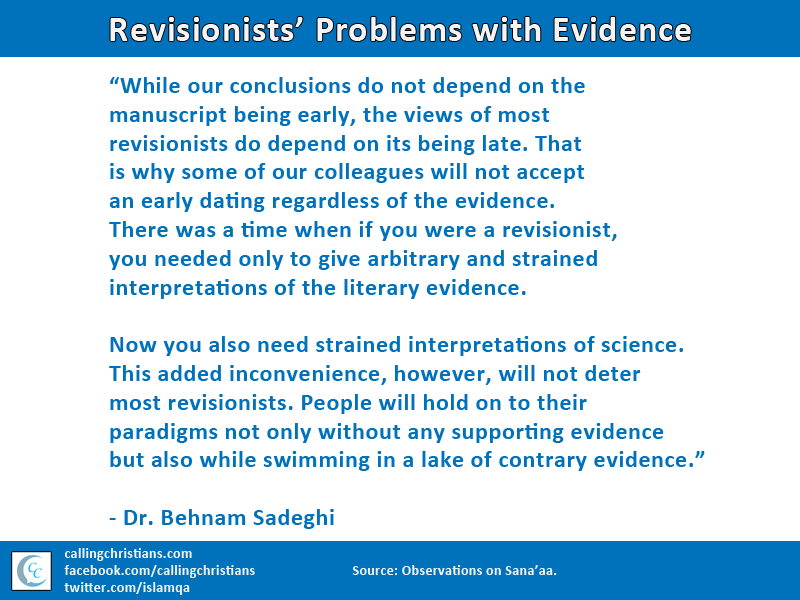
Spencer mentioned in his Jihad Watch article that the manuscripts from Birmingham cannot be dated so early due to the use of diacritical marks. However as Sadeghi has pointed out, this is a feature also from the Sana’aa C1 text:

“Surprisingly, the lower script on occasion appears to use what are possibly diacritics, in the form of perfectly round dots, to signify short vowel marks (and possibly elided alifs, i.e. hamzat al-waṣl). These dots are in the same ink as the rest of the lower writing and do not appear to have been added later.” – Arabica 57 (2010), page 359.

Why is this of significance? Well, because according to his latest datings, as linked to us by Goudarzi himself (Dr. Sadeghi’s research partner), Dr. Sadeghi dates Sana’aa C1 to the first half of the first century hijrah, the same as our Birmingham manuscripts. The same can also be found, in Qaf 47, which is also dated to the same time as our Birmingham manuscripts. In other words, Spencer is not a textual critic and as it stands, these non-Muslim textual critics seem to be in unanimous agreement about the early datings of several folios and their use of diacritical marks in the early hijazi script. Ergo, Spencer is wrong.

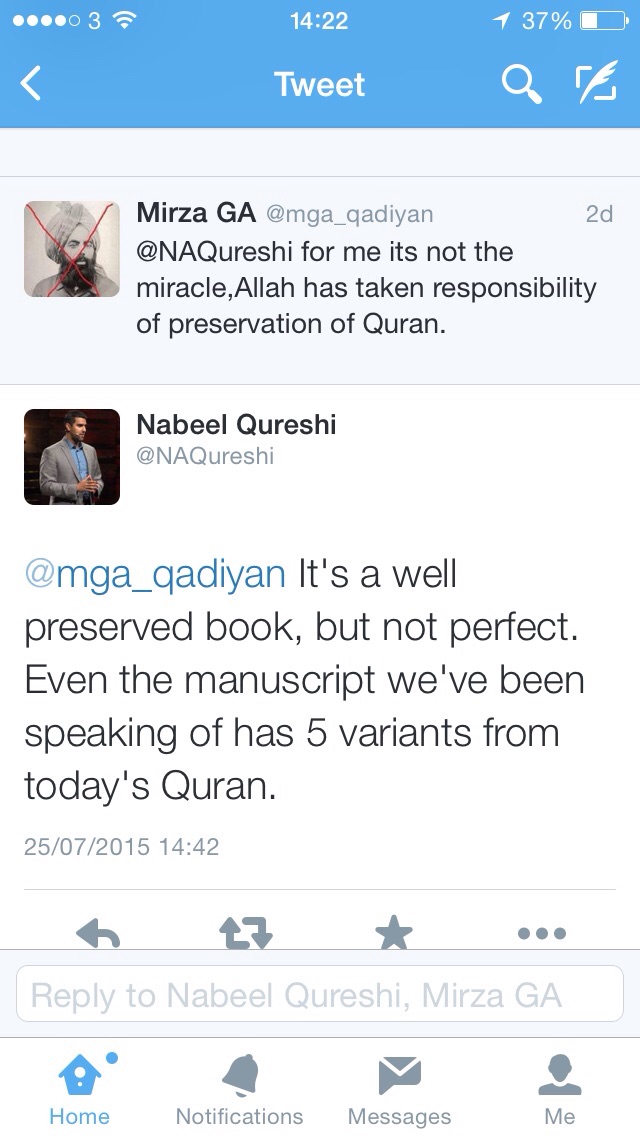
As a closing point, I’ve dealt with Spencer and Smith’s ridiculous claims and for the fun of it, I’ve decided to include my favourite Qadiani-Trinitarian into the mix. Nabeel, you cannot count, nor can you read. I’m sorry if you feel insulted by this, but you posted something wrong in public and it is my job to correct you when you slip up. Which these days, seems to be quite often.
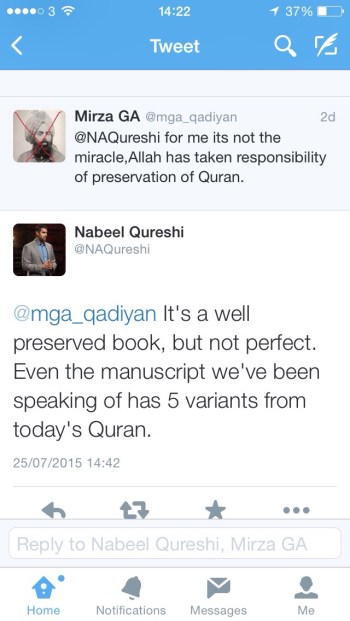
wpid-wp-1438013490889.jpeg

The same goes to you as it did to Smith. There are no variants in the manuscript. None. Except, if we are to be pedantic, that there are changes the original scribe made, then at the very least we can stretch to say there are two “variants”. How 2 = 5, I do not know. Hopefully, once you solve the mystery of the Trinity, you can help me solve how 0 = 5 or, for the sake of argument, how 2 = 5. I’m afraid your logic does not follow with me, and I am pretty bad at math.

Addendum:

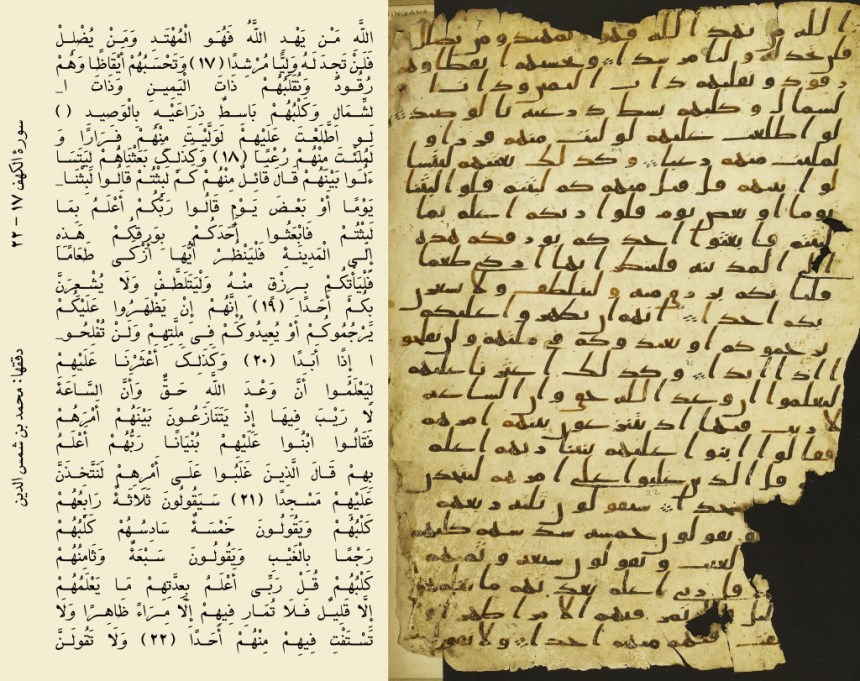
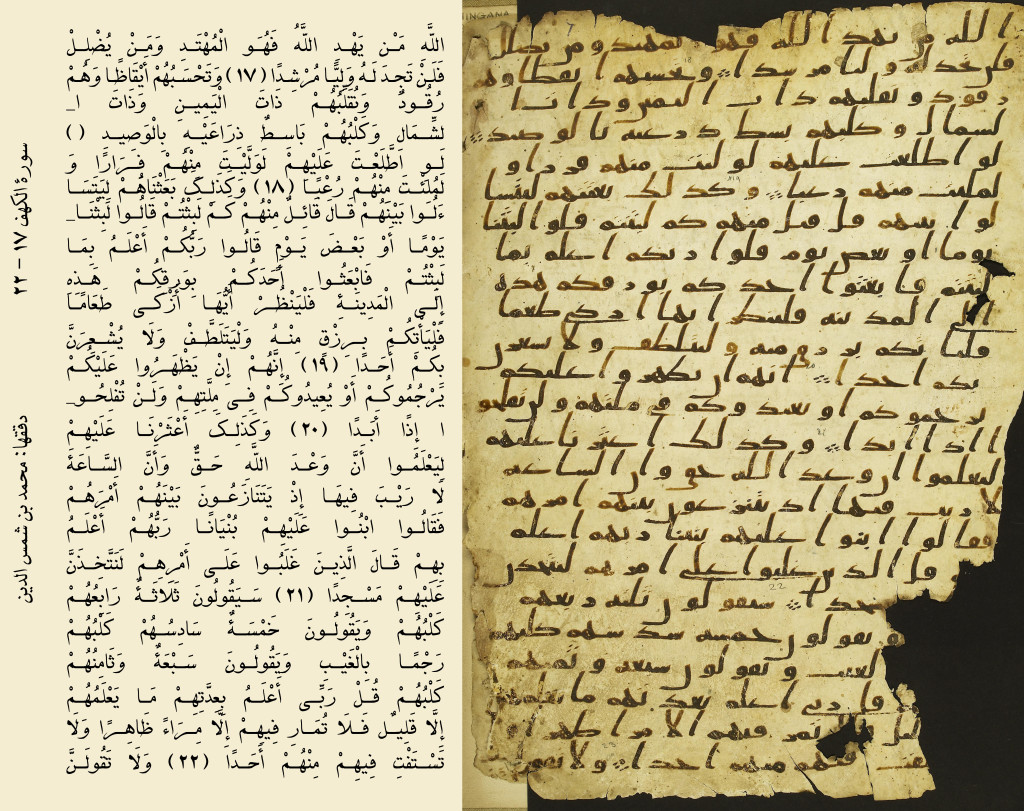
Br. محمد بن شمس الدين has done a nice comparison image of the folios for us and he has also created a handy image, explaining what some of the symbols and numbers mean (source).
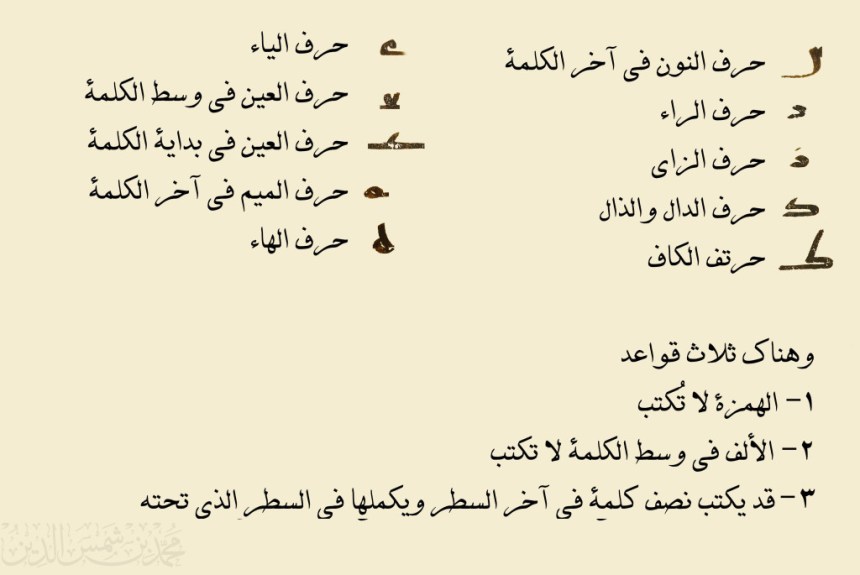
cc-2015-m1572comp1 cc-2015-m1572comp2 cc-2015-m1572comp3 cc-2015-m1572comp4 cc-2015-m1572comp5

Lastly, another brother has created a PDF responding to each possible variant claim (mostly orthographic and from the qira’at) that any missionary can bring forth as an argument of “changes”. He has given me permission to publish it at my will. I will do so accordingly. It is in English and explains the Arabic quite succinctly.

and God knows best.

Understanding the Birmingham University’s Find of the Oldest Qur’anic Manuscripts

General Information:

The collection at Birmingham University is known as the Mingana Arabic 1572 collection. It consists of 9 manuscripts (leaves, pages, folios). Earlier today, Birmingham University re-classified the dating of 2 of the manuscripts from the collection. The collection was then split into two classifications: Mingana Arabic 1572a and Mingana Arabic 1572b.

The collection that was carbon dated to between 568 CE and 645 CE with a 95% probability is Mingana Arabic 1572a. This collection can be understood as follows:

  • It consists of 2 manuscripts (pages, leaves, folios).
  • Each manuscript contains writing on its recto (front) and verso (back).
  • The manuscript is made of parchment (goat or sheep skin).
  •  Of the 9 manuscripts, the 2 in this newly classified collection are manuscripts 1 and 7.
  • The style of writing or the script (orthography) is Hijazi (writing originating in the Western Arabic Peninsula).

The manuscripts are readable and its writing is easy to identify, Ilm Feed has produced a wonderful comparison:

cc-2015-ilmfeedminganacomparison

Another person has superimposed the modern text of the Qur’an over the text of one of the manuscripts, the accuracy is incredible:

cc-2015-minganaimposed

Click to Enlarge

Question and Answer:

Does this make it the earliest known Qur’anic manuscript(s)?

Yes, it does. The earliest manuscript before this was the C1 text of the Sana’aa Palimpsest (DAM 01 – 27), which dated to before 671 CE with a probability of 99%, before 661 CE with a probability of 95.5% and a before 646 CE with a probability of 75%. See Behnam Sadeghi, Mohsen Goudarzi, “Sana’aa and the Origins of the Qur’an”, Der Islam (2012), Vol. 87, p. 8.

Do these manuscripts contain vowels?

Yes, there are several dots and verse endings, otherwise known as “diacritical marks”. These however, may not have been written by the original “author” (scribe) and could have been added by a later one seeking to update the text or to make it readable.

What style of Arabic Script is it written in?

It’s written in Hijazi script, which is one of the oldest Arabic scripts known. It’s referred to as Hijazi because it was developed or most prominently used in the Western Arabian Peninsula’s region of the Hijaz (alt: Hejaz), which includes the cities of Makkah and Madina.

Do we know who wrote it?

In regard to the identity of the author or the scribe, or the amanuensis, we may never know their identity. It is equally probable that it was written by a Companion of the Prophet (ﷺ) during or after the Prophet’s lifetime (ﷺ), or by a student of a Companion.

Why split the collection into two different collections?

This is to help palaeographers and textual critics differentiate between the manuscripts they are studying and it is purely done for academic purposes. The other 7 manuscripts, remain dated to within the 1st century of the Hijrah (622 to 722 CE).

What parts of the Qur’an do these manuscripts contain?

Manuscript 1 (Recto/ Front) contains: Qur’an 19:91 – 20:13.

Manuscript 1 (Verso/ Back) contains: Qur’an 20:13 – 20:40.

Manuscript 7 (Recto/ Front) contains: Qur’an 18:17 – 18:23.

Manuscript 7 (Verso/ Back) contains: Qur’an 18:23 – 18:31.

I’ll update this post according to the questions received. If you’d like a question answered, send us a message or post it in the comments section.

and Allah knows best.

« Older Entries Recent Entries »