Ijaz Ahmad
Jonathan McLatchie Makes a Fundamental Error About the Bible
The Bible consists of many forms of revelation, including ‘literal inscriptions’ from ‘finger of God’ according to Exodus 31:18. Jonathan didn’t know this and as agreed by his friends, he did make an error. We do expect him to say that the video takes him “out of context”, so we do invite everyone to watch the video of his appearance on the Trinity Channel (YouTube) between minutes 44 to 52, for full context of his mistake.
We’d like to thank Jonathan for sending his friends over to spam the page, at the very least we got a candid admission from one of his friends and admirers and he indeed was not taken “out of context”, this time, and that he did indeed make an error fundamental to the theology of his faith.
and God knows best.
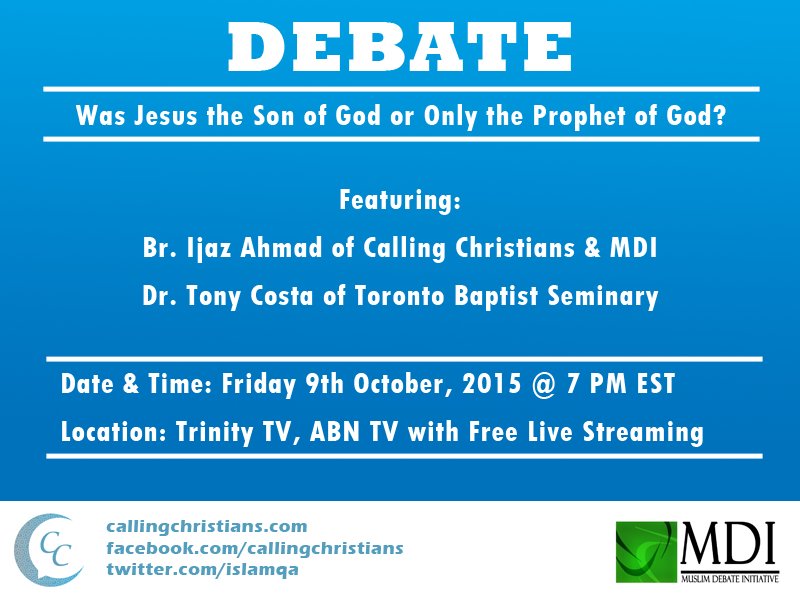
Upcoming Debate: Is the Muslim Denial of Jesus’s Death by Crucifixion Valid? – Br. Ijaz and Keith of Answering Islam
Keith Thompson is a Christian apologist who runs Reformed Apologetics Ministries and has been writing for Answering-Islam.org since 2008. He is a debater having debated opponents such as Inamullah Mumtaz, Sami Zaatari, Nadir Ahmed, Peter Dimond and others. He resides in Canada and will be completing his seminary studies shortly.
and Allah knows best.
Has Evangelist Ravi Zacharias Lied About His Credentials?
The following is a guest post by three individuals who have taken it upon themselves to investigate the academic credentials of Ravi Zacharias. They have included their names, and their own academic qualifications and can be contacted by commenting on the post. Any comments or questions posted, will be sent to them.
WHO WE ARE
We are two atheists and a Christian who are concerned that a prominent evangelist, Mr. Ravi Zacharias, has engaged in misconduct that undermines academic integrity and that tends seriously to mislead the public at large. We issue this Press Release with two primary goals in mind. First, we wish to draw attention to what we believe are the dishonest practices of Ravi Zacharias. Second, we hope the facts presented here will prompt professional journalists and investigators to continue the work we have started.
- Steve Baughman is an attorney and part time philosophy student at the Graduate Theological Union in Berkeley, CA. He holds a Masters Degree in Asian Studies from University of California at Berkeley. He is the creator of the YouTube channel Friendly Banjo Atheist, which first presented the matter of Mr. Zacharias’ credentials to the public.
- Tom Lunal has a B.S. in Mathematics from U.C. Santa Barbara and an M.S. in Computer Science from USC. He worked for Microsoft before moving to a position at New York Life.
- Andy Norman is a professor of philosophy at Carnegie Mellon University (CMU). He has a PhD from Northwestern University and has published widely on the norms of responsible discourse.
ABOUT RAVI ZACHARIAS
A. SUMMARY OF CONCERNS
THE CAMBRIDGE CLAIM
Ravi Zacharias has claimed for many years that he was a “visiting scholar at Cambridge University.” He presents this claim prominently in his press bios and in his memoirs. He makes frequent mention of it in his public appearances (in about 90% of his youtube videos). It is by far the most impressive item in his academic portfolio.
The claim is absolutely false. The University of Cambridge press office has confirmed the same to us.
We recently contacted Mr. Zacharias and informed him of our belief that he has misrepresented having been a “visiting scholar at Cambridge University.” We informed him of our intent to go public with this information and we asked him for a response. None came.
Shortly thereafter Mr. Zacharias deleted the claim from his official website bio.
THE CAMBRIDGE CLAIM
In his memoirs Mr. Zacharias states the following: “By 1990, the load of ministry had gotten so heavy that I decided to take a sabbatical for the first time since I had started in the ministry. I spent part of that year at Cambridge University in England with my family, and it was a very special time for us.”
Until several weeks ago, Mr. Zacharias’ website bio at RZIM.org stated, “Dr. Zacharias has been a visiting scholar at Cambridge University.” Mr. Zacharias is frequently introduced at his university appearances as having been “a visiting scholar at Cambridge University.” The President of Liberty University said “Ravi was a visiting scholar at Cambridge university” when awarding him an honorary doctorate recently. The claim also appears on the jacket of his book, The Real Face of Atheism and a few of his books claim in the back cover that he was educated at Cambridge University.
A Google search of [“Ravi Zacharias” “visiting scholar at Cambridge University”] reveals thousands of pages in which the claim is repeated.
The claim is false as mentioned earlier, and Mr. Zacharias withdrew it shortly after we asked him for a response to our concern that he has misrepresented his Cambridge visiting scholar status.
How do we know it is false? We contacted the University of Cambridge Office of External Affairs and Communications and asked whether Mr. Ravi Zacharias was ever a visiting scholar at their university. We were told in writing the following:
1. “We can confirm that Mr. Zacharias spent a sabbatical term at Ridley Hall in the city of Cambridge.” He was there for a mere 12 weeks (1 term).
2. “Ridley Hall is independent from Cambridge University and trains people for effective work in the Church of England”.
3. “Attending lectures and classes at the University of Cambridge whilst on sabbatical at Ridley Hall would not confer University of Cambridge Visiting Scholar status on a student. Ridley Hall is not and has never been a constituent part of the University of Cambridge and has different criteria for granting Visiting Scholar status.”
FIRST ANTICIPATED DEFENSE FROM RAVI ZACHARIAS
No it does not. We note that his website was recently changed to state that “Dr. Zacharias has been a visiting scholar at Ridley Hall, Cambridge (then affiliated with Cambridge University, now more recently allied with Cambridge and affiliated with Durham University) where he studied moralist philosophers and literature of the Romantic era.) This is totally false. It makes it seem as if Ridley Hall was a constituent Hall of Cambridge University back when he was there. The officials at Cambridge University and Ridley Hall confirmed that it has never has that affiliation. Ridley Hall has always been an independent clergy training school and never part of Cambridge University.
However, we acknowledge the close affiliation between the University of Cambridge and Ridley Hall. Both are in the town of Cambridge, and both are part of the Cambridge Theological Federation (CTF). There are various institutions that are a part of the Cambridge Theological Federation and the students and others are allowed to utilized the facilities, libraries at these various schools. They are also able to take a few Cambridge, Durham etc. accredited courses. That’s it, no more, no less. No one can ever claim that being at one equals to being at the other as Ravi Zacharias might claim.
Now we move to the designation of visiting scholar status. The official record at Ridley Hall says that he was on Sabbatical for one term (12 weeks). You can check it out independently. Just call them! We acknowledge that the term “visiting scholar” is used both formally and informally. In its formal sense it carries great prestige, especially at respected institutions like Cambridge University. In its informal sense, it can mean nothing more than attending lectures and classes for a short period while on sabbatical at a given institution.However, the informal designation cannot be utilized for official purposes. For instance, if I go to Cambridge and do some research for a few months and interact with faculty/students, I could unofficially call myself a visiting scholar but unless the university has officially invited me I cannot claim so in official documents. This, however, is precisely what Ravi Zacharias has done. His official records show that he was on sabbatical at Ridley Hall but he claims that he was visiting scholar at Cambridge University. He writes in his autobiography that he was “invited by Cambridge University.” This is not a case of stretching the truth, its a case of telling an absolute lie.
Mr. Zacharias clearly intends us to understand his “visiting scholar at Cambridge University” claim in the formal, prestigious sense. It is, quite simply, the crown jewel of his otherwise very unremarkable academic history. It is a claim he has trumpeted loudly and widely.
REMAINING CONCERNS:
We believe that Mr. Zacharias’ deception is clearly established. Nevertheless, we believe that we might gain greater clarity as to the depth of that deception if several outstanding questions be answered.
CONCERN 1:
Who invited Mr. Zacharias to be a “visiting scholar at Cambridge”? Which office at Cambridge University invited him? They have absolutely no record of him being there. Did Mr. Zacharias formally take classes at Cambridge? Or did he merely audit? Were these graduate classes? (See p. 205-206 of Walking From East to West where Mr. Zacharias specifically claims to have been invited to be a visiting scholar at Cambridge University.)
CONCERN 3:
Mr. Zacharias claims to have “lectured at the world’s most prestigious universities.” (See for example the jacket of his book The Real Face of Atheism. In his autobiography he states, “I have spoken on almost every major campus – Berkeley, Princeton, Cornell, you name it. If we haven’t been to a major school it is more often than not because we haven’t had the time to accommodate the request.” Walking from East to West, p. 209.
We are concerned about the extent to which Mr. Zacharias’ claim implies that his appearances at such universities have been pursuant to invitations from the faculty or the institutions. It is our understanding that Mr. Zacharias’ appearance at prestigious universities has been primarily, if not exclusively, pursuant to invitations from student clubs and Christian evangelical organizations or local churches. For instance, many of Mr. Zacharias’ appearances at prestigious universities have been sponsored by the Veritas Forum, a Christian campus ministry that promotes discussion “about life’s hardest questions and the relevance of Jesus Christ to all of life.” Mr. Zacharias is closely connected to the organization, appearing in their promo video and writing the preface to the Veritas founder’s book. http://veritas.org/about/#link1. He has never been invited by Harvard, Yale or Princeton universities i.e., officially by the universities for any lectures. However, he often refers to his lectureships at various leading universities in the world. Misleading at best and false at worst. None of the schools he mentions, like Harvard, Yale or Princeton have officially invited him to give a lecture. He was just on their campus at the sponsorship of the Christian organization, the Veritas Forum.
Jonathan McLatchie Continues to Misrepresent Himself
Two days ago, Jonathan wrote an article responding to my review of the debate with Dr. Shabir. I wrote my response, to his response sometime after 6 PM in the night, in the spare hour I had between classes (on Friday) and published it when I finished the last two paragraphs the next day (on Saturday). Then I went to bed, saw that I referred to one of his arguments as circular, discussed it with him and his friends for some two hours, then consulted one of our many resident scholars, realised I made an error and corrected myself. On this, Jonathan says in his new article:
…but only after he had attempted to settle the matter by blocking myself and his other critics from commenting on his page and deleting our comments. He has since deleted the entire thread from his Facebook page. After having consulted his “resident scholar” and being told that I was right and he was wrong, he went into damage control mode.
I’m trying to give Jonathan the benefit out of the doubt, but I am sincerely running out of reasons for doing so. “Damage control”, really Jonathan? When someone makes an error, it is expected that they cease perpetuating that error and they correct themselves and make every effort for that correction to be known. Jonathan though, curtains this “correction” with malice and refers to it as “damage control”. Would he have rather I let the error stay? Would he have rather I didn’t try to remove the error? In my world, it is called being responsible. Once you find the error, you find all sources of the error, correct it, make the correction known and that’s how it’s done. Thus, I am quite surprised that Jonathan, with all of his good intentions would look down upon someone trying to correct an error, that does say a lot about his character. In his words, that would be very uncharitable.
As one would expect, Jonathan was quite upset at my article responding to his, and he did bring some friends along with him to argue with me. I don’t mind that he did that. After two hours of him repeating himself, and his friends posting in various places on the page, ranging from discussing his xenophobic tirades to arguments, whether he qualified them or not. I decided to put an end to it. Once I was able to establish contact with one of our resident scholars, who could either affirm I was correct, or disagree and point out my error, I decided to focus on one thing and unfortunately for Jonathan, that one thing was not to argue with him on Facebook. So, I blocked him and his 2 friends from the page, while I discussed the matter. Once I was corrected by our resident scholar, I unblocked them and allowed them to comment as they willed. This, again, although wanting to be seen as malicious by Jonathan, was merely “crowd” control. Following that, Jonathan was indeed blocked again, but this is because he had blocked the main account for the page, my account. One can read about this here. Therefore, unlike Jonathan, I am willing to publicly correct myself and apologize, when I’ve done something wrong. On that same note, should Jonathan be willing to apologize for his hate speech against Muslims, I would not chastise him for doing so, and I certainly wouldn’t call that back peddling or damage control, in other words, I don’t have a hateful mind that seeks to demonize everything a person does merely because they disagree with me. Moving on to Jonathan’s next point, he said:
Wrong again. As I explained here, I did not make the statement attributed to me at all. Although my word-choice was unquestionably unfortunate, I neither described Muslim communities nor any individuals as “cancer” or a “virus”. Ijaz, as he always does, simply represented what I said in the most uncharitable way conceivable. As far as I recall, I never claimed that anyone had “lied” about me.
It is unfortunate that he continues to deny making the statement. All one has to do is look at my example. Once I quickly realised my error, I apologized and corrected myself. Jonathan on the other hand, simply denies he made any error at all. I’ll leave this lovely recording of Jonathan for interested readers to make up their minds. He then proceeded to say:
Wrong again. I defy anyone to show me where “Muslims who practice Islam are compared to ISIS terrorists” in any video I have shared.
Well let me show you (also, see article here)….
He then said:
Ijaz Ahmad accuses me of deception because I stated that he failed to mention any of Shabir’s weaknesses in his opening statement, such as his misuse of Greek grammar in relation to John 1:1 (documented here). Ijaz says that I am dishonest because he did mention John 1:1 in his review of the debate.
But this is precisely the point.
Ijaz simply repeated this poor argument, despite the fact that it has been refuted ad nauseum.
This is Jonathan’s problem. He does not correct himself and say that I didn’t omit any mention of Dr. Shabir’s use of Greek grammar. Instead of apologizing for this mistake, or false claim, he decided to shift the goalposts. Now the issue was not that I had failed to mention the use of Greek grammar, the issue was that I did not remark more about it. All Jonathan had to do was correct himself, he did not need to shift the goalposts. He then said:
I never claimed that Shabir did not argue that the Trinity was contrary to the Old Testament. He did claim that. I happen to think he is wrong in claiming that, but Ijaz contends that Shabir in claiming this pre-empted this statement from my opening remarks, which is simply not the case.
This is quite disingenuous from him. Did Dr. Shabir address the Bible (read as “Christian scripture”), which included both the Old and New Testaments, in his opening statement? Yes, he did. So then, on that basis, how can Jonathan claim that this did not happen. Dr. Shabir, pre-empted Jonathan’s appeal to scripture, by arguing based on that very scripture in his own opening remarks. There is nothing to be mistaken of here. Jonathan just does not want to accept this fact. He then said:
Ijaz then back peddles with his claim from his review that I had made the argument about the eternality of the Qur’an in my opening statement. He said “In my review, I did not claim that he made this argument, I specifically said that he referred to it.”
What exactly has been back peddled? I said in my review you referred to it, and I said in my response to your review that you referred to it. Nothing’s changed. Your problem seems to be that I criticized you for referring to it. In which case, your criticism would be wrong. He then proceeded to argue:
Ijaz also contends that, if I am consistent, I would have to say that the angel of death is a fourth member of the Trinity. But this is simply mistaken — there is no verse in the Bible to my knowledge where we are told that God alone actively brings about death…
This is correct, in Christianity, death is a rival to God and not an action that God can do of his own volition. According to Christian scripture, death in fact had mastery and power over God. Although it should be mentioned that I did refer him to 1 Thessalonians 4:16, which does mention that his God needs the voice of an archangel for the resurrection. Therefore, again, an agent of God according to Jonathan is sharing in the divinity of God. Or, perhaps I can make it even simpler for him. God creates, yet women also create life, women are agents of God’s creation. According to Jonathan’s logic, does he now need to add 3 billion women to the Godhead? He has not interacted with the argument of agency, or how it responds to his argument. Rather, he has opened a can of worms for Christianity, and I applaud him for that. He then argued:
I am giving the historical interpretation of this text. Is Ijaz really prepared to say that ibn Kathir, al-Tabari, al-Qurturbi and ibn Ishaq all got it wrong, and that we had to all wait for Ijaz to show up in order to give us the correct meaning of the text?
Except it’s the case that Ibn Kathir disagrees with Jonathan. It’s a rather lengthy read, so I’ll link to it here. That’s called proof by contradiction. We should take note of the language that Jonathan uses, he says:
The meaning of the text that I gave seems to me to be clearly the most plausible and the most clear-reading of the texts. Ijaz’s explanation seems rather ad hoc.
He outs himself. The meaning of the text he gave. You’d notice in the debate he also didn’t cite or quote anyone’s interpretation of those passages, and today he admits it was the meaning which he gave. I think that says a lot. Jonathan then proceeded to shift the goalposts again, he says concerning the Gospel being the Injeel….
He may have mentioned it, but he certainly offered no comment by way of response to the argument.
Yet, his problem with me, was that I did not mention it. Now his problem is that I didn’t respond to the argument. So it’s not that I misheard him or misrepresented him. Rather, in almost every instance he has proven to be wrong, he shifts the goalposts, at first I didn’t mention it or comment on it, then it’s, I did mention and I did comment on it, but not mentioning or commenting enough. It’s either one or the other, and at this point he truly is wasting my time.
Lastly, Jonathan said in his xenophobic tirade…
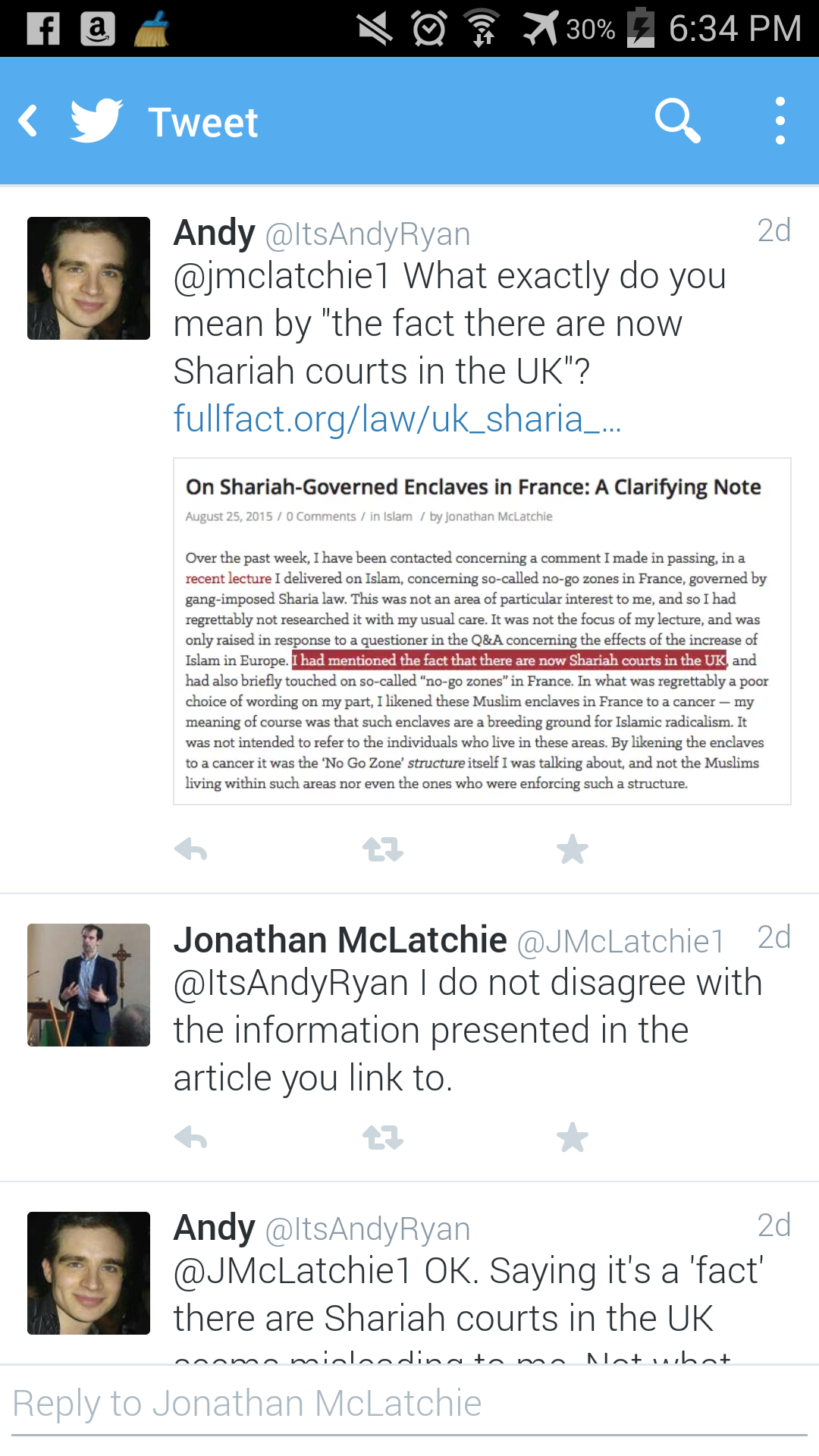
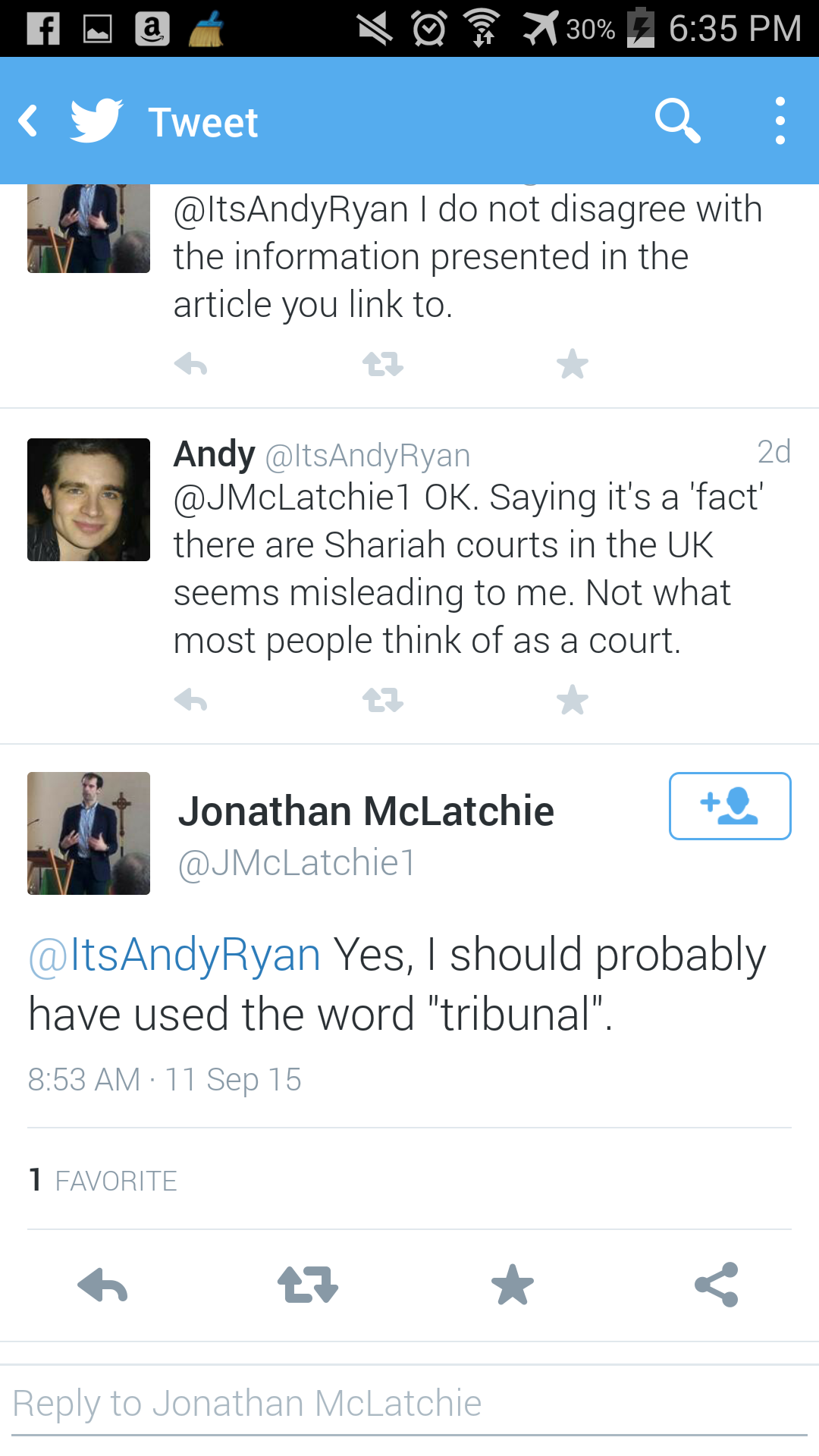
Islam is certainly on the rise, and I think it will have greater and greater influence….there are Shari’ah courts in the UK. France has a bigger problem with Islam at the moment.
What does France have a problem with? Islam. It should be noted that others did call Jonathan out on this mistake of referring to Shari’ah Courts as a “fact”:
As Jonathan has repeatedly said, he has, “no problems with Shari’ah Law per se“. Which leads us to the end of his quote, which says:
Which is essentially tantamount to inviting a virus into your civilization, which is not…
It’s basically like inviting a cancer into your civilization, it’s going to expand..
So now, everyone, a process of elimination. The problem with France is….Islam! Who practises Islam? Muslims. Do you know who else thought a minority in Europe with different customs and a religious law was like a virus?
“. . . the discovery of the Jewish virus is one of the greatest revolutions that has taken place in the world. The battle in which we are engaged today is of the same sort as the battle waged, during the last century, by Pasteur and Koch. How many diseases have their origin in the Jewish virus!” – Adolf Hitler (quoted in Burleigh and Wippermann, Racial State, p. 107)
and God knows best.
Jay Smith on the Birmingham Manuscripts’ Dating
and God knows best.
A Response to a Review of a Review
After finding no one from the Christian community willing to perform a review of his debate with Dr. Shabir Ally, Jonathan McLatchie has finally taken the onus upon himself to “review” my review of their debate. It is unfortunate that Jonathan believes that I “misheard” or “misread” him, as this is a common excuse he uses when confronted with any criticism. Last month it was brought to the inter-faith community’s attention that Jonathan had described Muslim communities in France as a virus and a cancer to European society. If one were to compare his “review” of his debate, with the excuses used when confronted with his xenophobic statements, we’d quickly realise that Jonathan is being perpetually misunderstood by everyone. At first he claimed he never made such a statement, everyone had simply lied about him! Then, it was a statement he made, but everyone simply misunderstood him! Then, it was a statement he made, but it was not referring to Muslims but a cultural structure of extremism, everyone simply hadn’t given him enough time to explain himself! Then, he posts a video in which Muslims who practise Islam are compared to ISIS terrorists and we’re not supposed to be offended by that. The 19,000 people who viewed that article and the 3500 people that watched that video, all seem to have “misheard” and “misunderstood” him.
As one Christian apologist put it, “Jonathan is simply oblivious to any form of self criticism”. When I announced news that a Christian had accepted Islam following the debate between Dr. Shabir and Jonathan, Jonathan found it impossible that anyone would disagree with his remarks in that debate, such to the extent their faith would be questioned. I remarked to him at that point, that it doesn’t matter what you think of your own arguments, it is up to the audience to decide that. He disagreed, that just could not be a possibility, his remarks were without fault. Jonathan lives in a world, where everyone who disagrees with him, either perpetually misunderstands him, or they misread him, or they mishear him. It’s almost never the case that he has said something wrong, or that he has made a mistake, and this is exactly what we find in his “review” of my review. What sort of debater, reviews someone’s review? I mean, there’s the occasional post-debate rejoinder, but I’ve never seen anyone who considers themselves to be a professional, review their own debate. That’s what the community does, that’s not what the debaters themselves do. Jonathan though, does not like to be criticized, and so when my review criticized him, he could not contain himself.
Let’s take a brief look at some of his claims. He began with saying:
Ijaz briefly summarises Shabir’s opening statement, curiously omitting any mention of the numerous problems with Shabir’s Biblical argumentation (such as his misuse of Greek grammar in regards to John 1:1).
Yet, this is simply deceitful. I didn’t omit mention of Dr. Shabir’s use of Colwell’s rule, as stated in my review:
At this point, Dr. Shabir began to speak on the language used in regard to Jesus in the Gospel ascribed to John. John 1:1c is problematic as the attribution of total deity to the Word (later identified as Jesus), is uncertain due to Colwell’s rule. Grammarians do dispute about the definiteness of attributing deity to the Word in this verse due to the absence of a defining article which the original author purposely left out, this opened the wording and subsequent understanding of the verse to dispute. If the author wanted to ascribe total deity to the Word, then they would not have intentionally left out the defining article and thus, total deity cannot be ascribed to Jesus the Christ given the author’s grammatical intentions.
Let’s take a look at another one of his criticisms, he says:
The first point to note here is that I never stated that “the Bible is a wholly Trinitarian text”. It is my view that one can demonstrate a multiplicity of divine persons from both the Old and New Testaments, while the doctrine of the Trinity reaches its fullest expression in the New Testament where we read of the incarnation of the Son of God.
Yet, this is exactly what he said, I even quoted him and put the timestamp to the exact moment in the video in which he makes this very statement:
(timestamp in video, he says, “The Gospel of our Lord Jesus Christ is thoroughly Trinitarian.”)
If Jonathan believes that the words “thoroughly” and “wholly”, are different, then he must consult a dictionary. They mean the same thing. He should also note, that in my very review, I quoted him as saying, “thoroughly”, so on that basis, where exactly does he believe this was something he did not say? Strangely enough, he proceeded to argue that Dr. Shabir did not pre-empt his appeal to the Bible (read as “scripture”), but he did. One of Dr. Shabir’s most important points was “the texts of scripture”. So while Jonathan may disagree, it doesn’t make him right, to the contrary it makes him seem desperate to create points of imaginative disagreement. Perhaps, what is most puzzling of all, is Jonathan’s inability to see that he is deluding himself. Take for example this statement:
That’s not quite what I said. My first premise was that, from a Muslim perspective, “If Tawhid is true, it must be consistent with the Qur’an.” My second premise was that Tawhid is not consistent with the Qur’an.
What’s not quite what he said? At this point, he mentions that I presented his premises for this particular argument incorrectly, yet when we read what I wrote, I literally wrote, word for word, the exact same words that he used:
P1 – If Tawhid is true, it must be consistent.
P2 – Tawhid is not consistent.
C – Therefore Tawhid must not be true.
The exact same words he uses to dispute what I wrote, are the exact same words I wrote. How then, is this “not quite what I said”? If this is not being deceitful, then what is? I find this to be desperation of the grossest order. Jonathan then made, what I consider to be one of the most absurd comments I have ever heard:
Yes, this is a Modus Tollens argument. I don’t know why Ijaz seems to think that the need to demonstrate the truth of the premises in order to support the conclusion is a problem with this manner of argumentation.
I don’t know if he understands how logic works, but one needs to qualify their premises before assuming the conclusion as being true. This is referred to as sequential logic. Your individual premises must be consistent, before your conclusion could be seen as true (or valid). My criticism, was that he did not qualify his premises, thus his conclusion was contrived. I do not understand how he can disagree that he needs to first prove his claims before arriving at a conclusion. This is common sense. He then went on to state:
The only problem is that I did not make this argument in my opening statement at all. I noted that Nabeel had made this argument in his debate with Shabir, and that I was going to be making a different argument instead.
What argument is he referring to? He’s referring to the argument that the Qur’an is the incarnate word of God. Yet, his disagreement here is unfounded and is again, something derived from the depths of his imagination. In my review, I did not claim that he made this argument, I specifically said that he referred to it:
All he did was refer (timestamp in video, he says “Those who saw Shabir’s debate with Nabeel Qureishi would’ve been exposed to the problems with reconciling the eternality of the Qur’an with the doctrine of Tawhid.”) to the argument that Nabeel used regarding the Qur’an being the eternal word of Allah, yet physical and created.
Perhaps he needs to check the definition of the word, “refer”, for this disagreement makes absolutely no sense to a reader with a command of simple vocabulary. Reading comprehension is not difficult and it should not be this difficult for Jonathan. He then spent an inordinate amount of time attempting to validate his bad argument that the Spirit (of God) is the same as Allah. Yet, he does not validate his bad argument, he merely repeats it without meaningfully responding to the criticism leveled against it. As the Qur’anic verse itself mentions, God the one true Creator, sent the Spirit as a messenger to Mary. The Spirit itself cannot create of its own volition, it is an agent of creation, in the same way the Angel of Death is an agent of the opposite of creation, death. According to Jonathan’s logic, if an agent of God does something by God’s will, this means that the agent is itself also divine. If we follow through with this logic, since the Angel of Death takes away life, does this also mean the Angel of Death in Christianity (the archangel in 1 Thess. 4:16) shares in the divinity of God? According to Jonathan it does, and hence his Trinity now includes a 4th person that shares in the divinity of the other three persons.
Interestingly, Jonathan provides a quote from a commentary that doesn’t address this response at all. The commentary does not mention anything about agency of power or authority, and so while I am thankful he has atleast tried to quote something, what he quoted was irrelevant and useless. His argument remains, really bad. As with the other recommendations in this article, I highly encourage him to learn about God’s ontology in Islam and in Christianity. An agent of God has no inherent power or ability, except by the will of God, in which those powers or abilities are temporal, and by such a definition they could never be in and of themselves, “divine” or of a “Godly” nature. Rather agents of God are temporal in their very attributes and as such, cannot and do not share in the divinity of God. Jonathan attempted to say he addressed this argument by presenting a verse which mentions the phrase, “My Spirit”. It was at this point I gave up any hope that Jonathan was being serious and I began to realise that his article was satirical in nature. I mean, it can’t be that he didn’t realise that the Qur’an uses, “Spirit” in different contexts right, and that not every reference to the Spirit refers to the Holy Spirit (Angel Gabriel), right? It can’t be that he merely saw the word “Spirit” and assumed it meant the same thing throughout the entire Qur’an, while being used in different contexts and forms. Yet, this is exactly what he did. I fully believe he searched an English translation for the word “Spirit” and assumed every instance of it referred to the Holy Spirit in Islam. Ergo, not only was his initial argument bad, so was his response and so was his depth of research and understanding of the Qur’an.
Jonathan proceeded to mention that he didn’t think one of his arguments was circular, he says:
There is no way in which the above argument can possibly be construed as circular. The Qur’an makes a prediction about what we should expect to find (namely, that the disciples believed Islamic doctrines such as Tawhid). I then set out to falsify this prediction, in my judgement successfully. Nothing circular about it.
Edit:
I incorrectly referred to this form of argumentation as circular because I viewed the first premise as entailing itself, “If Tawheed is inconsistent”, which is self-reliant and thus circular. In other words it entailed itself, despite being in the form of modus ponens. After discussing with our resident scholar, I (Br. Ijaz) am indeed wrong. Although the first premise is indeed invalid (it does not logically follow if Tawheed could be inconsistent, that the Trinity is true), and needs to be qualified, the form is valid, but the first premise needs to be proven. So the argument itself is invalid, but the form correct. Apologies to Jonathan for this error.
End of Edit.
He went on to say, concerning the dominance of the companions of Christ:
But the Qur’an does specify that Allah would “place those who follow [Jesus] above those who disbelieve up to the Day of Resurrection.” This strongly suggests a continuity of dominance, right from day one.
Where does it specify what form the dominance would take? It doesn’t. Which is what I mentioned in my review of the debate. Where does it specify in the Qur’an what form the dominance takes? He chose not to answer this question, even though claiming this is what he was doing, rather he chose to mention that some Tafseer commentators agreed with him. Perhaps he should mention that those commentators presuppose that belief, with first believing that Paul’s true teachings, like Christ’s, became corrupted by later Christians. I fully believe he did not do his research on this topic and at this point, he’s repeating himself without addressing my criticisms. Lastly, he said:
Ijaz offered no comment on the third argument I presented in the debate, namely that the Injeel (i.e. the gospel) is Trinitarian and that the Injeel is affirmed by the Qur’an.
I actually did offer a comment on it, from my review, I said:
If we were to identify his main arguments, they would be easily recognizable by anyone who is familiar with Islamic and Christian inter-faith discourse, namely that the Qur’an validates the New Testament, that the disciples believed Jesus was God and that the Bible is historically accurate. He did not present any new arguments, nor any new research, nor did he seek to upgrade any of the arguments he copied from other Christian debaters.
In conclusion, Jonathan’s review of my review, is a bad attempt at trying to defend his poor arguments used in his debate with Dr. Shabir. At the most, he merely repeated himself, and at the worst he claimed he was misheard. Unfortunately for him, I was able to quote him word for word, and cite numerous places from my review in which I did address the concerns outlined in this review of his. All in all, this comes down to a lack of professionalism. If the Christian community is unwilling to do a review of his debate, and he is left to respond personally to everyone who criticizes him, this says a lot about the community’s perception of his role as a Christian apologist.
and God knows best.
Jonathan McLatchie Endorses View that “True Islam” Belongs to ISIS
In continuing his diatribe against Muslims, Jonathan McLatchie has shared a very spiteful video about Muslims. Before sharing this video, I asked Jonathan about his position on the statements in the video he shared:
You endorse the view that if Muslims follow Islam, they naturally act like ISIS?
Jonathan’s xenophobic response was as follows:
if you follow the example of Muhammad, then yes.
He then proceeded to no longer respond to questioning about his behaviour and hateful view of Muslims.
Previously, using publicly verified information by the US Government and international news agencies, we crunched the numbers and found that ISIS represented exactly 0.001% of all Muslims worldwide. How then, can Jonathan hold to his racist, xenophobic and hateful view of Muslims, when 99.999% of Muslims disagree with and are not part of the ISIS terrorist group? In Jonathan’s hateful eyes, 0.001% “Muslims” are the same as 100% of Muslims.
and God knows best.


You must be logged in to post a comment.