Missionary Mishap: Priest in Church
I’m not exactly sure what’s going on here, but I’m pretty sure this isn’t normal.
and God knows best.

Search
I’m not exactly sure what’s going on here, but I’m pretty sure this isn’t normal.
and God knows best.
I often choose not to respond to vicious character attacks, whether they come from a major Christian apologist or a beginner in the inter-faith field. Recently Jonathan McLatchie decided to go on a string of unfortunate articles where he has targeted several Muslims in the inter-faith field. Collectively, we’ve decided to forgive him. I myself forgive him for what he has said about me, the issue(s) we have with him are purely professional, not personal. Therefore, when I saw his last few posts and articles attacking some of my colleagues, I knew that he’d have to eventually write about me. I’m okay with him having done that, I’m okay with his name calling, his insults, his mistakes. After all, he’s only human. He’s quite young, and as he matures he’d quickly find that such behaviour is inappropriate.
Now unfortunately, Jonathan seeks to blame me for sharing the words that came out of his mouth. I previously had shared a clip of one of his lectures where he openly derides Islam and Muslims as inviting a cancer and virus into European civilization. I’ll gladly share that clip again:
He insists that I’ve somehow misunderstood what he’s said. However, he does go on to state that he made a mistake in his wording, that he said something wrong:
“While I try to present information with a high level of factual accuracy (and I think I succeed in doing this for the most part), occasionally I can make a mistake or change my mind on something that I have said. I take full responsibility for anything that I say that is not accurate, and I hope to always correct those when brought to my attention.”
The problem here is with Jonathan’s thinking. Any sensible person would quickly realise that if you admit that you made a mistake, then whatever was understood from your mistaken words, you are responsible for that mistake. So, what does Jonathan do? He claims to have taken responsibility for those inappropriate words. That begs the question, if I misunderstood him, then why did he find the need to acknowledge what he said as a mistake? If I had misrepresented him as he claims, then it would mean that his words were not mistaken. However, the opposite is true. He’s admitted that he spoke mistakenly, therefore acknowledging that whatever he said was indeed wrong. That’s simple logic, it’s common sense. So from Jonathan’s own words, he said something wrong.
If I have rightfully corrected him on his mistake, then in what sense have I misrepresented him? Therefore, what we are seeing from his behaviour is pure immature nonsense. We need to look at his next statement:
“That mistake on my part aside, did I really describe “Muslim immigrants of an ethnic background to be cancers and viruses that are invading Europe”?”
He says he didn’t say this, he says what he meant was:
In what was regrettably a poor choice of wording on my part, I likened these Muslim enclaves in France to a cancer — my meaning of course was that such enclaves are a breeding ground for Islamic radicalism. It was not intended to refer to the individuals who live in these areas. By likening the enclaves to a cancer it was the ‘No Go Zone’ structure itself I was talking about, and not the Muslims living within such areas nor even the ones who were enforcing such a structure.”
Let’s stop right here. In the first line what does he say? He says he likened Muslims. Fullstop. That’s it. He’s admitted that he’s lying about me. In his own words, he’s clearly stated that when he spoke in the Church about enclaves being cancerous and like a virus, he was specifically referring to Muslims. So which is it Jonathan? Did I lie when I said you were referring to Muslims, when you yourself have said you referred to Muslims. You’ve vindicated me. You’ve thoroughly demonstrated that in your haste to insult me, you did not consider what you had written. In his later explanation, as quoted above, he indicates that he didn’t mean people, he meant structures. Yet, in the very first sentence he says he’s referring to Muslims – people! In the space of one paragraph he has demonstrated his dishonesty. At this point, I have no reason to continue this article. He’s demonstrated for me, through his own words that he was dishonest, deceitful and deceptive. I will continue just to illustrate the lengths through which he is willing to lie, he said:
“To support his allegation, Ijaz links to a video on his YouTube channel, highlighting a lecture I shared on Facebook back in September of 2015. The only problem is that nowhere in the video is it claimed that ISIS is normative for all, or most, Muslims.”
I’ll link the video here:
If anyone watched the video, the lady explicitly says that following the Prophet’s teachings (peace be upon him), naturally leads to behaving like ISIS. The majority of Muslims worldwide follow in some capacity the Prophetic Sunnah, whether Sunni or Shi’i. Therefore, what is normative for Jonathan, if not what the majority of Muslims follow? It would either mean that he lied, that he did not watch the video, or he does not know what the term normative means. I’m inclined to believe all three. Jonathan further argued that I somehow did not represent him correctly regarding his comments about Khalid Yasin. In that very article, click here to read it, I explicitly said:
Should Jonathan correct himself, I will edit this post to reflect this.
Did Jonathan ever message me to tell me that he corrected himself? Yes, he did. Earlier today right before he posted his article complaining about it. What does that say about him? I publicly offered to correct the article if the information was incorrect and Jonathan knowing this, chose to mention he did correct himself shortly before making a post to whine about it. Integrity is important. All he had to do was give me a heads up and I’d gladly have corrected the article, but he chose not to do so. This means that he wanted an opportunity to complain about. He waited for weeks before opening his mouth. This is simply inappropriate behaviour for a person who dares call others names.
As many would know, Jonathan has upset quite a few people in the inter-faith community, both Muslim and Christian. There was a point in time that I asked him, why he joined out of all people, David Wood and Sam Shamoun as partners in his apologetics. There were many other people he could have aligned himself with, Dr. White, RZIM, etc. Instead he chose people who lack credibility in their own Christian circles. He chose to align himself with people that identified with his ideas, beliefs and vitriolic views. Therefore, I find it quite funny that he speaks with such hate against me. His problem isn’t that I misrepresented him, it’s that I dared to publicize his statements. As we’ve seen above, he’s clearly admitted to referring to people as cancerous and as a virus. There is quite literally nothing to debate about, his own words have settled that matter.
Interestingly, it’s almost a weekly occurrence where he says he wants nothing to do with me. Guess what happened today? After posting his article, we exchanged a few e-mails again. He says one thing publicly and another thing in private. I’d like to share something posted by Br. Yahya recently directed at Jonathan‘s deceptive behaviour:
A quick note to Jonathan McLatchie [pass it on to him please]
Firstly, if you introduce me again with such underhand negativity…like you did just now and in your previous comments in your response on the Son of Man (which I let slide) I will be on the brink of playing tit-for-tat with you. That will mean, I will introduce you negatively every time I mention you, right now I’m leaning towards calling you a plagiarist (a true epithet for you…you’ve been found out on a few occasions IIRC).
I can handle negativity, insults and even arrogance. Here’s something I recently received from (perhaps one of your co-religionists):“Muslims are filthy pig swill….. Go to hell. I would rather fight you cunts till I die than become one of you”
Now, I have a thick skin and don’t usually respond in kind. Sticks and stones break your bones but names…
However, one thing I will not stand for is two-faced behaviour. When you say you want to improve relationships and even want to meet up for a cup of coffee and then continue with underhand slights there’s an issue. It’s an issue with your sincerity.
Another thing I was willing to let slide, you liking comments calling people idiots (namely myself:)) and liking other negative comments about Ijaz Ahmad and perhaps others. You’re ‘notorious’ for it. You seem like a passive aggressive type….your buddy Shamoun beats his cheat and really gets his hands dirty (normally in the act of picking up ‘pig swill’ and hurling at Muslims). Your other buddy Wood strips down and gets into his wife’s undies to have a go. Your buddy Pastor Najm rattles off his anti-Muslim diatribes facing the camera. Those boys, sure their acts are deplorable and betraying their spiritual natures, but you do get the feeling they will stab while you’re facing them. The same with the two con men from Egypt, ‘Prince’ and Dakdok (not entirely sure if they are your buds). You on the other hand wait lull me into a false sense of security and wait for me to turn my back and then get your drawing pin out and prick me…what’s the end game, death by a thousand cuts?
In the end, I forgive Jonathan for his behaviour, his insults, his misrepresentations. He’s young, he’ll make mistakes and hopefully he can find a route to more mature discussion.
and God knows best.
Last week we covered the poor arguments of a young polemicist who tried to mimic one of Jonathan McLatchie’s atrocious arguments (which he later recanted). Unfortunately, this young and impressionable missionary, France Francis has done it again. He’s made the Missionary Mishap list for a second week running…

Unashamedly, this missionary considers people like Jonathan McLatchie and Sam Shamoun to be his heroes. That’s surely no surprise for anyone here.
and God knows best.
Question:
Missionaries often claim that Jesus said x or said y in the New Testament. I have seen you say that the NT does not contain the actual words of Jesus, is this a Muslim claim?
Answer:
It is disingenuous for Christians to claim that Jesus said anything based on New Testament quotes. Traditionally in Graeco-Roman literature, under which the New Testament falls there are two main forms of quotations, ipsissima verba (the very words) and ipsissima vox (the very voice). The majority of New Testament quotes claimed to be said by Jesus fall under the category of ipsissima vox, meaning that someone has interpreted Christ’s alleged words and developed this quote according to their understanding of what was said. Similarly, this form of quotation also refers to invented quotes, where authors spoke (wrote) on behalf of others, based on the reasoning that they believe the quotes would have been accepted by the original speaker. Thus, it was and is common in Graeco-Roman literature to find works being written in other people’s names or quotes being manufactured and attributed to other people. Daniel Wallace, a conservative Christian scholar has said something similar regarding this topic:
Myth 2: Words in red indicate the exact words spoken by Jesus of Nazareth.
Scholars have for a long time recognized that the Gospel writers shape their narratives, including the sayings of Jesus. A comparison of the Synoptics reveals this on almost every page. Matthew quotes Jesus differently than Mark does who quotes Jesus differently than Luke does. And John’s Jesus speaks significantly differentyly than the Synoptic Jesus does. Just consider the key theme of Jesus’ ministry in the Synoptics: ‘the kingdom of God’ (or, in Matthew’s rendering, often ‘the kingdom of heaven’). Yet this phrase occurs only twice in John, being replaced usually by ‘eternal life.’ (“Kingdom of God” occurs 53 times in the Gospels, only two of which are in John; “kingdom of heaven” occurs 32 times, all in Matthew. “Eternal life” occurs 8 times in the Synoptics, and more than twice as often in John.) The ancient historians were far more concerned to get the gist of what a speaker said than they were to record his exact words. And if Jesus taught mostly, or even occasionally, in Aramaic, since the Gospels are in Greek the words by definition are not exact.
A useful distinction is made between the very words of Jesus and very voice of Jesus, known as ipsissima verba and ipsissima vox, respectively. Only rarely can we say that we have the very words of Jesus, but we can be far more confident that what is recorded in red letters in translations is at least the very voice of Jesus. Again, if ancient historians were not as concerned to get the words exactly right, we should not put them into a modernist straitjacket in which we expect them to be something they were never intended to be. – Source.
It is very difficult to claim that a quote belongs to the second category of ipsissima verba, that is, verbatim speech. Scholars differ on the very few instances where they believe Christ’s true speech may have been recorded. There is very little general agreement regarding these instances and each case needs to be inspected and qualified critically. Additionally, since we do not have the original words of Christ in their original language, there exists a difficulty in translating where language devices have been used. As such, this matter of a different language, after already being re-interpreted by someone other than Jesus makes the matter of knowing what Jesus actually said quite complicated. This is especially true in places where we have single quotes attributed to Jesus, without any other witnesses. How would we know that the one listening and recording, understood what was said? There is no way to know.
Therefore, the next time a missionary claims to have the very words of Christ, you may want to point out that this is historically untrue and that the quote itself requires extensive examination before qualification.
and God knows best.
Everyone wants to be a debater. Today, all it takes is a keyboard and adding a title to one’s name. In this case we have a callow missionary by the name of Evangelist France Francis. He has previously boasted that he is a friend of Jonathan McLatchie (a quick perusal of Jonathan’s timeline indicates that ‘France’ comments often on his page). With that said, while Jonathan has accepted that he made an error with regard to his claim that nowhere does Allah say: ‘I am God, Worship Me’ in the Qur’an, his young missionary friend has yet to get this memo:
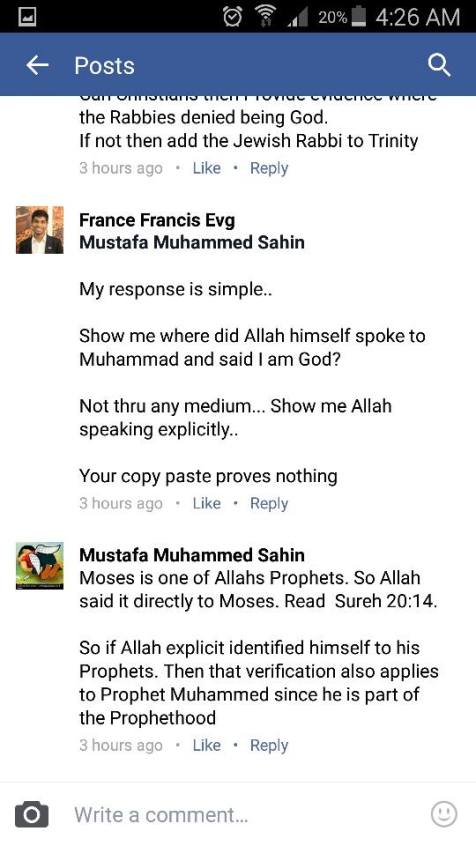
As can be seen, Br. Mustafa Sahin an up and coming Muslim apologist and debater, knocks France the Evangelist out of the park. His Qur’anic reference directly refutes the missionary:
Indeed, I am Allah. There is no deity except Me, so worship Me and establish prayer for My remembrance. –20:14.
It truly is amazing just how fast bad arguments can spread. Even when the missionary you allegedly learn from recants his position, missionaries still insist on using those bad arguments. It’s quite embarrassing to say the least.
and God knows best.
Question:
Missionaries argue that an angel would not choke someone or be violent, and so the “angel” that Muslims believe to be Gabriel was actually a demon. Some claim this was a demon parading as an angel because of this act of choking. What can we say to them?
Answer:
You can advise them to study their Bible(s) more often. If acting violent means that an Angel is actually a demon, or that the one being hurt by the Angel is evil, what happens to the story of the Angel (of the Lord) wrestling with Jacob (Israel)? The main story is found in Genesis 32:22-31, however the story itself is referenced in Hosea 12:4 and clarifies with whom Jacob (Israel) wrestled with:
Yes, he wrestled with the angel and prevailed; He wept and sought His favor. He found Him at Bethel And there He spoke with us,
Following the missionaries’ logic, it would either mean that the Angel (of the Lord) was evil and demonic, that Jacob (Israel) – the Father of the Twelve Tribes was evil and demonic or that both of them were evil and demonic. Irrespective of which choice they choose, the argument negates a major aspect of their faith. That in itself discredits the argument. Even if we were to forego this one major incident, there are many instances where angels were violent in the Bible, one significant example of that is as follows:
Then the angel of the Lord went out and put to death a hundred and eighty-five thousand in the Assyrian camp. When the people got up the next morning—there were all the dead bodies! – Isaiah 37:36.
Thus, this is not a very good argument and it would benefit the Muslim to encounter a missionary using it, as it can allow us to invite them to Islam. Thank you for your question.
and Allah knows best.
Question:
Missionaries often claim that the canon of the New Testament was not decided by a Council, and that its authors were guided by God. They also claim that since a Council was not needed and that all of Christendom accepted the books, it is a divine proof from God that Christianity is the truth. How do we respond to this?
Answer:
This is factually incorrect. The proto-orthodox Church whose canon of scripture later came to be known as the New Testament, did in fact have two Ecumenical (Unity) Councils regarding the canon of their scripture. The Councils of Carthage in 393 and 397 CE respectively, are historically considered to be when the Church ‘confirmed’ the canon. Most Christians seem to be unaware of these Councils and so make this claim that the canon was not decided by any Council, and so the emergence of their scripture is a divine truth. Even if we were to forego these two Councils, this is in itself a poor argument. This argument, is in essence stating that a divine truth does not need a Council to determine beliefs.
However, Christianity’s history is replete with Ecumenical Councils regarding the very basic tenets of their faith, most notably those of Nicaea, Constantinople and Chalcedon. Thus, if the lack of Councils demonstrate divine truth then the very existence of the aforementioned Councils discount Christianity’s most foundational beliefs as divine truths. As absurd as this argument may seem, I myself have experienced it firsthand. I recall an incident some years ago with a group of Jehovas Witnesses came to preach to us and we had a discussion regarding errors in the New Testament. One Elder quipped that the canon was determined by God, and that no human chose their canon. To say the least, that discussion did not last very long once they learned of Carthage.
Interestingly, Islam did not need any Councils to determine our beliefs. Thus, if a missionary was consistent, the lack of Councils in Islamic history to determine our beliefs is an evidence of the divine truth of Islam. This argument actually discounts Christianity as a divine truth and establishes Islam as the truth. Yet, given that so many missionaries use this argument one does have to wonder if they truly ponder what they’re saying before they say it. It’s truly quite a peculiar argument that seems to be extremely common. Unfortunately it’s also quite a bad one.
and God knows best.
Jonathan is known for making mistakes, whether that’s being ignorant of the Bible (he didn’t know God literally inscribed the ten commandments according to Exodus), or ignorant of the Qur’an:
In this amazing video from Br. Yahya Snow, Jonathan claims that nowhere in the Qur’an does Allah say: I am God, worship me. That’s unfortunate, for the Qur’an says:
Indeed, I am Allah. There is no deity except Me, so worship Me and establish prayer for My remembrance. – 20:14.
Br. Yahya has a ton more clips of Jonathan to be released in the coming days. Subscribe to his YouTube channel here: Yahya Snow.
and God knows best.
Earlier today I watched a dialogue between Jonathan and someone named Inamullah on the topic of, “Is Jesus God?”. I found a statement of Jonathan’s to be quite peculiar and made a post about it. If you’re unfamiliar with Jonathan, he’s the guy that referred to immigrants in Europe as “cancers” and “viruses”. Also the guy that believes Br. Khalid Yasin, is a Caucasian man, despite being…..African American. So what was the problem?
Moderated debates follow formats. Typically, something along the lines of:
There’s an alternation between the speakers, as can be seen above. What should also be noticed is that there are Opening Statements and then Rebuttals. This is common sense, but Jonathan does not seem to understand this. In the Opening Statements, each speaker open’s….with….their…..statements! Shocking, I know! This is where each speaker presents their arguments, their research, their ideas. Following this, the speakers then rebut, that is, respond to the arguments and claims made in each others’ Opening Statements. That’s not difficult to understand, it’s pretty much common sense. Jonathan however, does not seem to understand this basic concept. In his dialogue with Inamullah, following Inamullah’s Opening Statements, Jonathan during his 1st Rebuttal asks Inamullah why he (Inamullah) did not rebut Jonathan during his (Inamullah’s) Opening Statement.
In other words, Jonathan gave his Opening Statement. Then Inamullah gave his Opening Statement. Then Jonathan gave his 1st Rebuttal. However, it is during this 1st Rebuttal that Jonathan asks why Inamullah did not respond to Jonathan’s Opening Statement. I made a post on Facebook asking Jonathan why he expected Inamullah to rebut him, when his (Inamullah’s) 1st Rebuttal had not yet occurred. He replied:
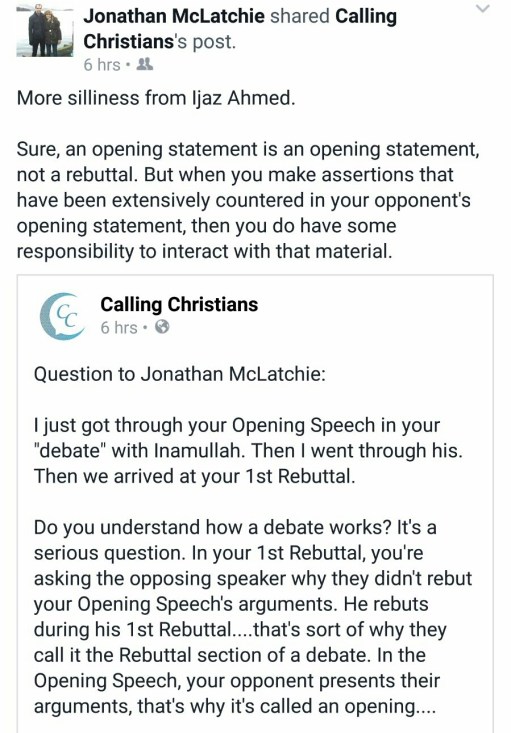
You’d notice that Jonathan immediately falls into his Christian character and must find a need to insult me. I don’t mind this behaviour, after all, Jonathan did mention that Muslims were like cancer, so his hate is understandable. Follow what he says carefully though. While he acknowledges that his opponent’s rebuttal should have come during his rebuttal period, he still and amazingly so….argues that his opponent must also rebut him during their Opening Statement. I agree with Jonathan, your opponent does have a responsibility to engage with your material, that’s why there’s a Rebuttal period! There’s a solution for that Jonathan, it’s built into the format of the debate, it’s called Rebuttal periods.
The problem here is quite a good example of Jonathan’s inability to deal with criticism. There was no need for him to be condescending and rude during the debate, by speaking down to his opponent directly after his Opening Statement. You don’t demand things of people during a debate, you most certainly don’t order them around if you don’t like what they’re saying. If only there wasn’t a moderator, how much more uncouth would he have been?
and God knows best.
Question:
Christians often argue that since the Qur’an is 600 years after Jesus, it is a less reliable witness than the New Testament. How do we respond to this?
Answer:
Consistency is key here, and the response is quite simple. The Christian accepts the first five books of the Old Testament which are usually attributed to Moses (عليه السلام). Yet, these books contain histories ranging from hundreds of years to thousands of years before Moses (عليه السلام) is alleged to have written them. Some Christians consider the accounts in Genesis 1 regarding the creation of the universe to be a historical account. Others consider it to be a phenomenological rendition of the creation of the universe. Either way, Christians accept these accounts as accurate despite the distance (disparity) between the time of Moses (عليه السلام) and that of the creation of the universe.
Consistency is key. Moses (عليه السلام) lived several generations removed from that of Noah (عليه السلام). Yet Christians accept and view the account of Noah (عليه السلام) in the Old Testament as a historical witness. The account of Noah (عليه السلام) is far more than 600 years between himself and Moses (عليه السلام) , yet Christians do not doubt an iota of what the Old Testament says. If we apply the scales of consistency regarding this topic, it would be seen that Christians do not adhere to a sensible methodology for judging what is and what is not historical. Theologically speaking, when it comes to matters of revelation, time is irrelevant. Since God is all knowing, it can be inferred that when He inspired Moses or Muhammad (عليه السلام) to write about the past, then it is assumed that what they wrote was historically accurate.
If missionaries applied the same criteria to their scriptures, they’d have to deny them as well as declare them as being historically inaccurate due to the gaps of time between the events themselves and the later authorship which recounted them. It should also stand to reason that not all accounts closest to an incident would be accurate, and that there exists the possibility of a later writing based on a stronger oral tradition. In such a case, the closest account may be inaccurate but the later writing could be more accurate. In conclusion, this is a very poor argument and it is an excellent example of poor thought processes.
Edit:
This answer is only in response to the argument of time being used, that is, the number of years between Muhammad (peace be upon him) and Jesus (‘alayhi as salam). It isn’t about whether Muslims consider the New Testament historical, or if Christians consider the Qur’an historical, or whether the histories of either writing corresponds with each other. This answer is only in response to the argument by Christians that 600 years is a factor in accepting or rejecting history.
and God knows best.
 Calling Christians
You must be logged in to post a comment.