Author Archives: Ijaz Ahmad

Missionary Mishap: McLatchie’s Mystery Math™

When promoting yourself as leading an “academy”, it might be in your best interest to know how to count. Unfortunately, McLatchie’s Mystery Math™ strikes again. In a previous incident, McLatchie argued that God was 1/3 of God, leading to much ire from the Christian community and much backpedaling to no avail. Today, McLatchie’s Mystery Math™ strikes again:

cc-2017-jm-refuteislam10mins2

If it’s any consolidation, the inability to count does indeed indicate the quality of argument that the video offers. That being, little to none. It does serve as a warning to the video about the leaps in logic, reasoning, bias that the ~14 minute video presents.

Looks like we weren’t the only ones to heed the warning about the quality of content from Jonathan.

and God knows best.

Christian in Indonesia Speaks Up for Muslims

Following a recent visit to Dearborn, Michigan, Mark Zuckerberg spoke about his meeting with young Muslims who attend the University of Michigan-Dearborn. He had a lot to say, so I’ll share his post here:

His post did have an important message, but as with all messages on immigrants and Muslims, some really angry people found their way into the comments section. They didn’t have much pleasant things to say about Muslims, or immigrants. There was a lone voice that stood out though, a voice that few noticed, but which still stood up in support of Muslims. A Christian from Indonesia had this comment to offer us:

cc-2017-news-christianinindonesiablurred

I’ve blurred the name because I don’t want those angry people who disagree with their message being directed to this kind and considerate Indonesian Christian. The Qur’an speaks about Christians like these, it says:

“…and you will find the nearest of them in affection to the believers those who say, “We are Christians.” That is because among them are priests and monks and because they are not arrogant.” – Qur’an 5:82.

and God knows best.

The Trinity – A Simple Explanation

Do you find the Trinity difficult to understand? Many Christians do. This video offers a simple, step by step guide on how one can make sense of the Trinity.

YouTube Mirror: The Trinity – A Simple Explanation

This clip is taken from a debate between Mr. Joe Ventilacion of Iglesia Ni Cristo and Mr. Chauncey Killens of Church of God in Christ. This is from the first cross-examination of the debate, where Mr. Ventilacion had the opportunity to ask Mr. Killens about his opening statement which defended the doctrine of the Trinity as being Biblical. The debate took place in Salina (California, USA) on February 27th, 2010.

and God knows best.

The Preservation of the Qur’an Explained in Detail

Br. Adnan Rashid and Br. Mansur have delivered an exceptional lecture on the preservation of the Qur’an. Dozens upon dozens of common claims made against the Qur’an’s preservation are completely and totally refuted in what can only be described as having been done in an academic yet accessible form:

I would highly recommend this lecture for those who are interested in the Qur’an’s preservation. I would also recommend subscribing to the channel that the video is posted on, they have excellent content and even better videos will be appearing soon.

and Allah knows best.

Joseph (Jay) Smith Hates Free Speech

Joseph Smith, otherwise known as Jay Smith, a notorious panderer who has been known to promote fear and hate about other immigrants to the UK, primarily Muslims, has found himself in another scandal.

Jay_Smith

Joseph (Jay) Smith – Anti-immigrant Immigrant to the UK

His religio-political anti-Muslim group, otherwise known as Pfander, has claimed in the past that they stand for free and open discussion about religion, usually those of Islam and Christianity. On the Pfander website, in their About section, it reads:

“Understanding other religions is often difficult, and can cause either intrigue or fear, and misunderstandings. Therefore, it is important to listen carefully and to learn about the beliefs of another religion, as well as research its very foundations. That is why Pfander is passionate about transparent and open debate between Christians and Muslims. Such discourse is rare, but it is a vital preparatory step to discovering truth. It is important for people to realise that Christianity and Islam each makes its own (often competing) truth-claims, this is the point where debate is necessary and right.”

It is ironic that the group claims to engage in open and transparent debate, but at the same time, the group is banning Muslims who engage with their social media pages. In the last few weeks, after spending a considerable amount of donation money on Facebook advertising (post boosts) to gain user views for a specific video about Muslims, they became quite upset when Muslims began to engage with their Facebook page, banning and removing comments en masse.

We’ve received numerous complaints from Muslims who took Pfander up on their offer for open and transparent debate being banned from commenting on the Pfander page, simply by asking questions or trying to engage in polite dialogue with the notorious group. Very recently, up and coming Muslim apologist, Br. Mustafa Ahmed was also banned for asking questions about claims made by Pfander’s Lizzie Schofield. As such, we feel that this should be the new header on their website:

cc-2017-js-panderinglogo

We hope that Joseph (Jay) Smith, Sarah Foster, Lizzie Schofield, Beth and Hatun can begin to engage with Muslims in an honest, open and transparent fashion, after all, this is what their group was allegedly created for.

and God knows best.

William Lane Craig Concedes That Old Testament Stories Are Problematic

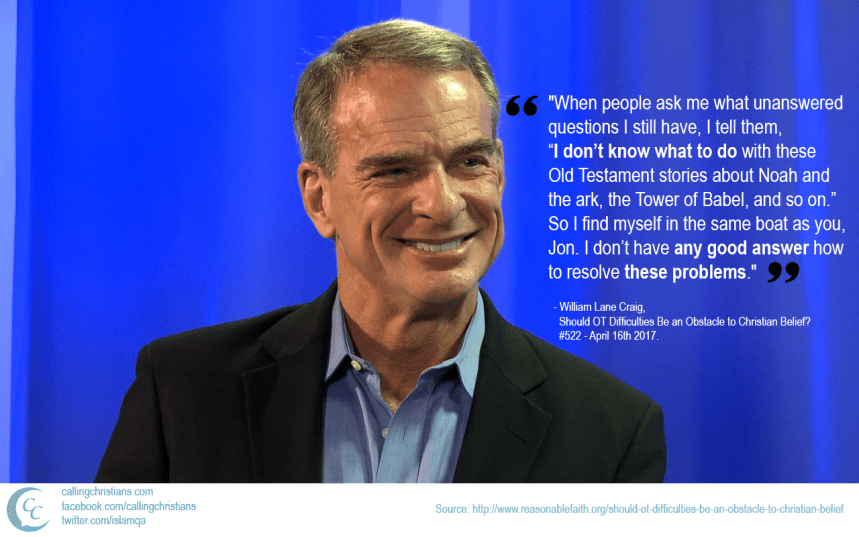
In a stunning admission, William Lane Craig, in response to a question sent to him has acknowledged that he has no good answer to problematic Old Testament stories. He says:

When people ask me what unanswered questions I still have, I tell them, “I don’t know what to do with these Old Testament stories about Noah and the ark, the Tower of Babel, and so on.” So I find myself in the same boat as you, Jon. I don’t have any good answer how to resolve these problems. Yet these unanswered difficulties have not kept me from Christian faith or from abandoning Christian faith. Why not?

Well, a large part of the reason, as you note, is that the truth of what C. S. Lewis called “mere Christianity” doesn’t stand or fall with such questions.

In essence, he’s claiming that the problems with the stories in the Old Testament should not effect some beliefs of Christianity, so it’s okay not to have answers to those questions. The problem here is that they do affect core Christian beliefs, namely the reliability of scripture, the truthfulness of scripture, the preservation of scripture and even salvation as it pertains to Jesus’s ability to hold or share false beliefs:

Since I have good reason to believe in his deity, as explained above, I would sooner admit that Jesus could hold false beliefs (that ultimately don’t matter) rather than deny his divinity.

Apparently Jesus who is God, can have false beliefs that “shouldn’t matter”. In other words, it’s okay if “God as a human”, was fallible with respect to his own theology! Quite the disaster this is.


and God knows best!


Easter Message: Death has Dominion, Mastery and Power over the Christian God

It’s Easter, so today you’d be seeing a lot of celebrations over God’s “victory over death”. Slogans en masse such as, “He is Risen!” Perhaps though, one of the most popular verses of the Bible one would see is as follows:

  • For we know that since Christ was raised from the dead, he cannot die again; death no longer has mastery over him. – Romans 6:9 (NIV).
  • We know that Christ, being raised from the dead, will never die again; death no longer has dominion over him. – Romans 6:9 (ESV).
  • knowing that Christ, having been raised from the dead, is never to die again; death no longer is master over Him. – Romans 6:9 (NASB).
  • because we know that Christ, having been raised from the dead, will not die again. Death no longer rules over Him. – Romans 6:9 (HCSB).

That last line is of great interest. If death no longer rules over God, does it mean that death at one point have power, dominion, mastery, rule over God? Gill’s Exposition of the Entire Bible, says of this passage:

“death hath no more dominion over him: it once had dominion over him; it held him under its power for a time, according to the divine determination”

If God is all powerful, then how is it possible for death to be greater than God, to have power and mastery over God? Some Christians have tried to explain this by saying that God allowed Himself to “temporarily surrender” His own dominion over death, but this leads us to the inevitable problem of the Christian God losing one of its attributes, thus rendering God, powerless. What’s worse is, if God gave up His power over death, and then death overcame God – it would stand to reason that death would be more powerful than God and thus God could never “defeat” death.

In conclusion, this passage is vital for a Muslim’s da’wah to Christians. They quote it and share it, which makes it easier for us to reach out to them. This passage leads to unsettling beliefs for the Christians, God sets up rivals to Himself, God loses essential attributes, God is no longer all powerful, or at the least it can lead them to denying the hypostatic union (two natures in Christ, one divine, one human), by them arguing that death had power over one of the natures – the human or the divine, which is in itself blasphemy since the natures are unified and it is heresy to split them apart.

In contrast, in Islam, God is the master of life and death:

“How can you disbelieve in Allah when you were lifeless and He brought you to life; then He will cause you to die, then He will bring you [back] to life, and then to Him you will be returned.” – Qur’an 2:28.

and Allah knows best.

Is Jesus the Passover Lamb? The Ultimate Sacrifice?

Introduction: Explaining the Jewish Significance and Christian Significance (and Teaching) of Passover. 

The most significant theme of the Passover festival as celebrated by Christians is the representation of Jesus the Christ as the Passover Sacrifice (Korban Pesach). In simple terms, his sacrifice (read as: death) is seen as the sacrifice of all sacrifices through which their salvation was earned, mirroring the salvation of the Israelites from Pharaoh by YHWH (Cf. Leviticus 17:11, 1 Corinthians 5:7). Early and contemporary Christian Churches have attempted to equate the Korban Pesach with the alleged death of Jesus the Christ to establish a theological foundation for their doctrine of salvation (Cf. soteriology). Such a doctrine is best explained in the following words:

“The early Jewish believers in Jesus considered him the fulfillment of the Passover lambs that were yearly sacrificed. Thus Paul, a Jewish Christian who had studied under Rabbi Gamaliel, wrote, “Messiah, our pesach, has been sacrificed for us” (1 Corinthians 5:7). John in his gospel noted that Jesus died at the same time that the Passover lambs were being slaughtered in the Temple (see John 19:14) and that like the Passover lambs, none of his bones were broken (the others being crucified had their leg bones broken by the Romans—John 19:32, 33, 36). The idea behind all this was that just as the Israelites were redeemed from Egyptian slavery by an unblemished lamb, now men could be freed from slavery to sin by the Messiah, the Lamb of God.”[1]

Read more

[Live] Debate: Is the Crucifixion a Fact?

Today at 2 PM (EST – New York, Trinidad), 7 PM (GMT – London) Br. Aqil Onque will be debating Pastor Angelos Kyriakides on the topic of the Crucifixion. The stream will go live on YouTube at the above mentioned times.

Questions for the debaters can be submitted in the YouTube Live video’s chat and will be read to the debaters during the Question and Answer session. Please indicate whether you are a Christian or a Muslim at the start of your question. Not all questions are guaranteed to be asked and the length of the Question and Answer session is dependent upon the debaters’ discretion.

and God knows best.

Palm Sunday in the New Testament

Given that today is Palm Sunday, I decided to read the Gospels’ narratives of the day that Jesus allegedly rode into Jerusalem. When one reads the stories as they are presented going from Matthew to Mark to Luke to John, there’s a trend that cannot be ignored.

If anyone says anything to you, just say this, ‘The Lord needs them.’ And (he will send – αποστελει) them immediately. – Matthew 21:3 (NRSV).

The text here in Matthew reading that the owner will send the colt immediately.

If anyone says to you, ‘Why are you doing this?’ just say this, ‘The Lord needs it and will (send it back – αποστελλει παλιν) here immediately.’ – Mark 11:3 (NRSV).

The text here in Mark reads that the person sending the colt is Jesus, he is sending it back or returning it. The word being used here is παλιν (palin) to differentiate between sending, and sending back or returning. How then does Luke treat this narrative? Who does he decide is the one sending the colt? He fixes this contradiction by omitting the second quote of Jesus in the passage altogether, his version reads:

If anyone asks you, ‘Why are you untying it?’ just say this, ‘The Lord needs it.’ – Luke 19:31 (NRSV).

That leaves us with the Gospel of John, does this Gospel break the tie between Matthew and Mark to let us know which version is correct? Not exactly, John takes a different approach. Instead of the version presented in Matthew, Mark and Luke, John’s version omits the request sending altogether and in its place has Jesus finding a donkey himself:

Jesus (found – ευρον) a young donkey and sat on it; – John 12:14 (NRSV).

I suppose one lesson we can take away from Palm Sunday as it is written in the New Testament, is that if there’s a contradiction, one easy and quick way to solve it is to just omit the contradiction altogether.

and God knows best.

« Older Entries Recent Entries »