Tag Archives: Salvation

Debate: Yusuf Ismail vs William Lane Craig [Identifying Jesus: Is he man or both man & God?]

Bismillahir Rahmanir Raheem
بِسۡمِ ٱللهِ ٱلرَّحۡمَـٰنِ ٱلرَّحِيمِ ,

Most people have probably never heard of Br. Yusuf Ismail, and that’s a shame, he is one of the best present day debaters in the world of theology, especially from the Muslim side. This is one of his greatest debates, although it does date back to 2010, it really demonstrates how weak Christians can become (intellectually) in front of a Muslim whose been educated in the same exact fields, read the same books, used the same arguments. William Lane Craig clearly underestimated Br. Yusuf, if you’re looking for a debate to fancy your interests, learn a thing or two, we certainly recommend this one:

wa Allaahu Alam.
[and God knows best.]

Neither Shaken nor Stirred: The Qur’aan and Science on Alcohol Consumption

Bismillahir Rahmanir Raheem
بِسۡمِ ٱللهِ ٱلرَّحۡمَـٰنِ ٱلرَّحِيمِ ,

Though it is evident that wine has a few medical benefits, scientific researches have proved that the harms of wine and alcohol in general exceed by far their benefits, both on the individual and social levels, even among moderate drinkers. And surprisingly this is how Quran addresses Wine:

“They question thee about alcohol (wine) and games of chance. Say: In both is great sin, and some utility (benefits) for men; but the sin(harms) of them is greater than their usefulness.” –  Qur’aan : Surat al-Baqarah (2) : 219.

Thus alcohol in Islam is forbidden (haram).
Science confirms this Qur’aannic fact:

WEDNESDAY, May 2 (HealthDay News) — While it might help your heart, drinking even moderately could shrink your brain, U.S. researchers say.

Alcohol is more harmful than heroin or crack when the overall dangers to the individual and society are considered, according to a study in the Lancet

Moderate drinking shrinks the brain: researchers at the Johns Hopkins Bloomberg School of Public Health and other institutions found a link between low to moderate alcohol consumption and a decrease in the brain size of middle-aged adults.

‘Moderate’ drinking is harmful to younger people, says study.

Alcohol Linked to Cancer Risk in Women: Study Shows Even Low-to-Moderate Drinking Raises Risk of Cancer.
Feb. 24, 2009 — Women who drink as little as one alcoholic beverage a day — be it beer, wine, or hard liquor — have an increased cancer risk, a study shows. Based on their findings, the researchers estimated that alcohol could be to blame for 13% of these cancers in women.

The largest ever study published in 2009 reveals that as little as a glass of wine a day may be too risky for women.

Alcohol increases breast cancer risk.

Alcohol effects on Fetal Development: Fetal alcohol exposure is a leading cause of birth defects and developmental disorders. Recent estimates of the number of US children affected by fetal alcohol exposure range from 1 per 2,000 live births to 1 per 100 live births.”

Alcohol is the worst attack on society: Alcoholic drinks are much more dangerous than drugs. According to a home survey on Alcohol and Drugs from the National Plan on Drugs, alcohol is the substance that is consumed most by a population between the ages of 15 and 64, with a consumption prevalence of 78.7 per cent.

Alcohol and drug abuse also poses a public health risk. The abuse of these substances causes a variety of cancers, diseases, and other health problems. Each year, society pays $16 billion in healthcare costs due to drugs and alcohol.

This article authored by Brother Muhyiddine of Dubai.

wa Allaahu Alam.
[and God knows best.]

Prophetic Miracle of Muhammad {saw}: Desert Arabs Competing in Building Skyscrapers

Bismillahir Rahmanir Raheem
بِسۡمِ ٱللهِ ٱلرَّحۡمَـٰنِ ٱلرَّحِيمِ ,

“The Hour will not be established-till the people of the desert (the camel shepherds) compete with one another in constructing high buildings.”
Prophet Muhammad (peace be upon him) on the minor signs of the last day.

On being asked on the signs of the last day, the Prophet (peace be upon him) mentions: “you shall see the barefoot, naked, penniless shepherds competing in constructing high buildings.” This hadith describes people who become rich all of a sudden and then build not for need but only in competition.

The Gulf Arab States, enjoying the proceeds of record-high oil prices, are rushing to build the tallest tower in world, reports Kuwait Times.

As reported by MEED (Middle East Economic Digest), Saudi Arabia has been the latest among the Gulf States to join the race, with a plan to build a 1600m tower in the Red Sea City of Jeddah. The project, which is expected to surpass the super-tall skyscrapers in the neighboring Dubai and Kuwait, confirms that the competition is on, to build the world’s tallest tower in the Gulf region.

Among all other super-tall structures that are under construction around the globe, none exceeds 700m in height. MEED says that although the companies involved in the Saudi-based project are kept secretive, it is said that Britain’s Hyder Consulting and Arup are working in a joint-venture, and the cost of the project is expected to cost up to $10 billion. The tower, known as
“Mile-High Tower” will have the US Engineering giant Bechtel as construction manager, and Saudi-based Omrania as the project architect.

Read more on the planned tower at this link.

This article provided by Brother Muhyiddine of Dubai.

wa Allaahu Alam.
[and God knows best.]

[Updated x3!] CL. Edwards Caught Lying: Can’t Make Up His Mind!

Bismillahir Rahmanir Raheem
بِسۡمِ ٱللهِ ٱلرَّحۡمَـٰنِ ٱلرَّحِيمِ ,

After posting this article, Mr. Edwards decided to publicly shame himself, I’m not sure why he decided to do so, but I must say it was a pleasure to see his act. To begin with, his response to said article was:

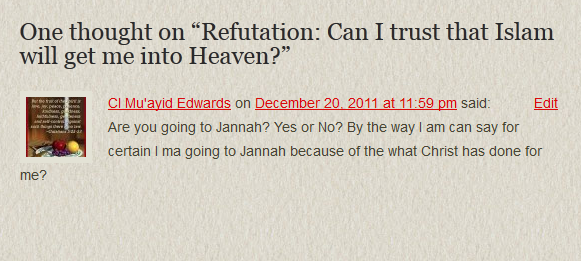
Mr. Edwards, sir, you did not say, “Only God can for a certainty determine where I will go”. Sir you actually said the following, let me refresh your mind for you:

You actually said the opposite,”By the way I can say for certain I ma going to Jannah because of what the Christ has done for me…“.

Mr. Edwards, at this point, I must ask you, which is it?
(1) You can say for sure you’re going to heaven.
(2) You let God decide where you go.

You’re singing two songs here sir, does your own deceit know no end? What I must admit, is that this guy cannot stop fumbling, if we take a look at the second comment from the first photo, he proposes a question to me:

“…do you Ijaz have assurance of Salvation..”

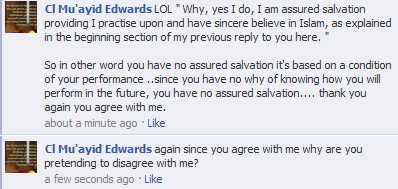
Why, yes I do, I am assured salvation providing I practise upon and have sincere believe in Islam, as explained in the beginning section of my previous reply to you here.

Please learn to read Mr. Edwards, I don’t have the time to have to constantly fix your inequities.

[Updated:]

After showing Mr. Edwards this post, he still couldn’t find the answer to his question, which I have now put in red and bold for his viewing pleasure. Here you can see that I clearly linked to him the post, with his answer being in the second to last line of this very response [article, see in red above]:

[Updated x2:]

I’m not sure if he’s colorblind or illiterate, but this was his response, he still could not find my answer which was in bold and red letters:

[Updated x3]:

Again, Mr. Edwards is simply grasping for straws, after answering his question above, which was not only in this post and my previous post, he decided to create a strawman and attack it. What was my answer to his question?

Why, yes I do, I am assured salvation providing I practise upon and have sincere believe in Islam, as explained in the beginning section of my previous reply to you here.

Do you all see the word, “YES“, in that quote, because I do, unfortunately Mr. Edwards sees the word no, so I’m not sure if he’s being petulant or simply can’t accept the YES which I gave:

wa Allaahu Alam.
[ and God knows best.]

CL. Edwards Responds: Certainty in Jannah

Bismillahir Rahmanir Raheem
بِسۡمِ ٱللهِ ٱلرَّحۡمَـٰنِ ٱلرَّحِيمِ ,

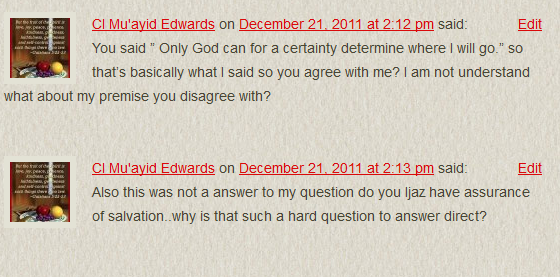
Mr. Edwards decided that he wouldn’t respond to the entire post, so he’d just post a comment because as in his own words, my exposition was “too long”. Not a problem, let’s see what estranged concept he brings to the table this time:

Edwards' Comment

His question is rather absurd, but to humour him, the answer is quite simple. Only God can for a certainty determine where I will go. I do not know the future and I don’t speak on behalf of God. However, the Qur’aan tells us what we need to believe in and what we need to practise upon to gain Jannah and as Muslims we strive towards that, knowing that God’s mercy is greater than His anger. It’s absurd to say, “yes”, because I am not God, I do not know the future and I do know what God’s judgement upon me will be, as I, like all other humans, are a sinner.

The Qur’aan does not make it difficult though, so what does a Muslim need to act upon and believe to gain heaven?

This is the Book; in it is guidance sure, without doubt, to those who fear Allah;

Believe in the Qur’aan, use it as a form of guidance, so that we develop taqwa (God consciousness).

Who believe in the Unseen, are steadfast in prayer, and spend out of what We have provided for them;

Believe in what Allaah has ordained for us and what He has told us, but which we have yet to know or experience. Perform praise and worship of God and live life within the means He has provided for us in a righteous way.

And who believe in the Revelation sent to thee, and sent before thy time, and (in their hearts) have the assurance of the Hereafter.

Belief in the Qur’aan, Injil, Tawrah Zabur, Suhuf al Ibrahim. As for assurance of the hereafter:

(And in the Hereafter they are certain) that is the resurrection, the standing (on the Day of Resurrection), Paradise, the Fire, the reckoning and the the Scale that weighs the deeds (the Mizan). The Hereafter is so named because it comes after this earthly life. – Tafsir ibn Kathir : Suratul Baqarah (2) : 4.

Lastly:

They are on (true) guidance, from their Lord, and it is these who will prosper.

Meaning:

(They are) refers to those who believe in the Unseen, establish the prayer, spend from what Allah has granted them, believe in what Allah has revealed to the Messenger and the Messengers before him, believe in the Hereafter with certainty, and prepare the necessary requirements for the Hereafter by performing good deeds and avoiding the prohibitions.

(And they are the successful) meaning, in this world and the Hereafter. They shall have what they seek and be saved from the evil that they tried to avoid. Therefore, they will have rewards, eternal life in Paradise, and safety from the torment that Allah has prepared for His enemies. Tafsir ibn Kathir : Suratul Baqarah (2) : 4.

Therefore the Qur’aan is extremely clear, it essentially spells it out for all Muslims, that sincere belief and God sanctioned actions would secure one a place in heaven. Of course Mr. Edwards doesn’t believe in this doctrine. He believes that no matter what he does, he gets to go to heaven, which brings up the question, does God reward sin? Funny enough, his friend and long time partner in crime (of deceit), Antonio Santana did admit to us that God rewards sinning in Christianity:

Antonio - Skype Convo

It’s absolutely nonsensical for one to say he knows where he is going in the afterlife merely based on some inconsistent and incoherent belief of “salvation in Christianity”, which has been thoroughly refuted here. They’re self claimants to their own misigivings, even the Jesus of the Bible lets it be known that merely believing in him will not benefit you in the least:

Not everyone who says to me, ‘Lord, Lord,’ will enter the kingdom of heaven, but only the one who does the will of my Father who is in heaven. – Bible : Matthew (7) :21.

So who are these people who won’t go to heaven then?

The sense of this verse seems to be this: No person, by merely acknowledging my authority, believing in the Divinity of my nature, professing faith in the perfection of my righteousness, and infinite merit of my atonement, shall enter into the kingdom of heaven, shall have any part with God in glory. – Adam Clarke’s Exegesis : Matthew (7) : 21.

In fact, the Bible wages sin and deceit for the one who speaks on God’s behalf, specifically when it comes to God’s will (judgment, doings etc):

Will you speak wickedly on God’s behalf?  Will you speak deceitfully for him?- Bible : Job (13) : 7.

The meaning of this verse is made much clearer by a scholarly Christian’s commentary:

“In order to support your own cause, in contradiction to the evidence which the whole of my life bears to the uprighteousness of my heart, will ye continue to assert that God could not thus afflict me, unless fragrant iniquity were found in my ways; for it is on this ground alone that ye pretend to vindicate the providence of God. Thus ye tell lies for God’s sake, and this ye wickedly contend for your maker.” – Adam Clarke’s Exegesis : Job (13) : 7.

See, Job in this verse or rather, this chapter, is condemning the people to whom he was sent to preach. It is because they began to play God and judge who is righteous and sinful among themselves. Decided who God afflicted and whom God did not afflict with punishment. They claimed because Job was afflicted, that he was a sinful man (yet it was not the case, he was purer than them all), whereas they perverted the truth (much like Mr. Edwards) and cast righteous judgement on themselves:

“Will you speak wickedly for God?
As he suggests they did, they spoke for God, and pleaded for the honour of his justice, by asserting he did not afflict good men, which they thought was contrary to his justice; but: then, at the same time they spoke wickedly of Job, that he being afflicted of God was a bad man, and an hypocrite; and this was speaking wickedly for God, to vindicate his justice at the expense of his character, which there was no need to do, and showed that they were poor advocates for God…”- The New John Gill Exposition of the Entire Bible : Job (13) : 7.

Well, atleast through Biblical means, his own scripture and by extension his own God, has deemed him a wicked and hypocritical man. Casting judgement on himself (for righteousness) whereas condemning others, when he does now know what God knows is in their hearts. I suppose he needs to be rewarded with Grace for his sin. God rewarding sin, what a joke.

wa Allaahu Alam.
[and God knows best.]

Refutation: Can I trust that Islam will get me into Heaven?

Bismillahir Rahmanir Raheem
بِسۡمِ ٱللهِ ٱلرَّحۡمَـٰنِ ٱلرَّحِيمِ ,

Response to: Can I trust that Islam will get me into Heaven?
By: C.L. Edwards from Calling Muslims website.

It is always interesting to read how Extremist Christians, anti-Muslims think. One such person is the propagandist Mr. Edwards. One of his more recent attacks against Islam, sponsored by his inanity rests on the topic of Salvation. Let’s take a look at what he says:

Most Muslims believe they will enter Jannah(Islamic heaven) based on their confession of the Shahadah(Statement of Faith) and doing good deeds, like Praying, giving Zakat(Charity) etc. Most Muslims fill some assurance they will make it into Jannah despite knowing they sin just like every other human being, because of their status of being Muslims. But consider these facts taken from authentic Islamic sources.

What is quite funny is that Mr. Edwards begins his intellectually fraudulent discourse by appealing to the fallacy of hasty generalization, and then he quite expectedly, rests his assertion upon not a single citation, to show atleast some majority of Muslims believe what he asserts. It is a common problem for persons who are wholly uneducated in Islam to understand the vast topic of Salvation within the faith. To begin with, Muslims do not believe that “despite sinning”, that we gain heaven. We believe that through repenting for our sins and through God’s mercy that He will grant us Jannah (Paradise):

Our Lord, and make us Muslims [in submission] to You and from our descendants a Muslim nation [in submission] to You. And show us our rites and accept our repentance. Indeed, You are the Accepting of repentance, the Merciful. – Suratul Baqarah (2) : 128.

Except for those who repent and correct themselves and make evident [what they concealed]. Those – I will accept their repentance, and I am the Accepting of repentance, the Merciful. – Suratul Baqarah (2) : 160.

What’s even more embarrassing for him, is that the Qur’aan also clearly states that Allaah does not accept those sinners who do not repent from their evils, for they would be punished:

And that repentance is not of those who constantly commit sins, and when death approaches one of them, he says, “I repent now”, nor of those who die as disbelievers; for them, We have kept prepared a painful punishment. – Suratul Baqarah (4) : 18.

So Mr. Edward’s assertion is contradicted by the Qur’aan which clearly states that only those who sincerely repent gain His mercy of Jannah and those who sin and do not repent are to be painfully/ severely punished. He then goes on to say:

Yet he doesn’t tell them forcertain that if they do good works they will be forgiven.

After quoting Suratul Hujurat (49) : 14 about an ayat of hypocrites, Mr. Edwards continued to display his ignorance of Islamic theology. The problem here is that he is saying, Muhammad {saw} doesn’t guarantees these people heaven (as from the context of the ayah), because he (Muhammad {saw}) wasn’t sure of his own salvation. While that is an entire topic by itself, his interpretation is wrong. The proper theological exegesis (interpretation) of this ayat is that Muhammad {saw} is addressing munafiqeen (hypocrites), thus their doing of good works is hypocritical, therefore it will not avail them in the least:

The ignorant said, “We have accepted faith”; say, (O dear Prophet Mohammed – peace and blessings be upon him), “You have surely not accepted faith, but you should say ‘We have submitted’, for faith has not yet entered your hearts; and if you obey* Allah and His Noble Messenger, He will not reduce the reward of any of your deeds; indeed Allah is Oft Forgiving, Most Merciful.” (* By accepting faith and then obeying the commands). – Suratul Hujurat (49) : 14.
“According to Imam Bahgawi, this verse was revealed in connection with the Tribe of Banu Asad. A few members of that tribe came up to Prophet Muhammad {saw} in Madinah during a severe drought. These people were not sincere believers. They had expressed their Islam merely to demand help from the Muslim Sadaqat funds. As they were not believers in the real sense of the word, they were unaware of Islamic injunctions and manners. They spread filth and excrement on the streets of Madinah.” – Tafsir Maar’iful Qur’aan, page 148.   

He then forwards his ill fated premise based on his clearly laughable eisegesis (intellectually fraudulent interpretation), by ignoring the context of the ayah (hypocrites and their actions), he mistakenly (due to ignorance) attributes it to a hadith where it is said:

…..He (Muhammad {saw}) said, “As to him, by Allah, death has overtaken him, and I hope the best for him. By Allah, though I am the Apostle of Allah, yet I do not know what Allah will do to me,”….. – Sahih al Bukhari : Volume 5 : Book 58 : Hadith 266.

He then on the same note goes on to make some statements of the same understanding:

……So we see that one may consider themselves Muslim, even a believer(Mumin) but you have no objective way of really knowing if you truly are in Allah’s eyes, at least until you die and are resurrected. Not even Muhammad himself could be sure what his fate would be……

To begin with, the hadith in Sahih Al Bukhari is not referring to whether or not Muhammad {saw} will be granted Jannah as he himself says he would cross the Pulsiraat (the bridge between being judged and the gates of Jannah) first:

Allah will call them, and As-Sirat (a bridge) will be laid across Hell and I (Muhammad) shall be the first amongst the Apostles to cross it with my followers. – Sahih al Bukhari : Book 12 : Hadith 770.

As for the statement that He does not know what the Lord of the Worlds (Allaah) will do to him, then I do not see the problem with the statement, it is referring to the ‘Ilm ul Ghayb (Knowledge of the Unseen):

“Say: “None in the heavens and the earth knows the Ghaib (Unseen) except Allaah, nor can they perceive when they shall be resurrected” – Suratul Naml (27) : 65.

“And with Him are the keys of the Ghayb (all that is hidden), none knows them but He. And He knows whatever there is in the land and in the sea; not a leaf falls, but He knows it. There is not a grain in the darkness of the earth nor anything fresh or dry, but is written in a Clear Record” – Suratul An’aam (6) : 59.

Even this is confirmed in the Bible, that God knows, or God’s knowledge is not equal to man’s knowledge:

“No one knows about that day or hour, not even the angels in heaven, nor the Son, but only the Father.” – Bible: Matthew 24 : 36.

Mr. Edward’s arguments are so completely devoid of any logical reasoning, I consider it child’s play to have to write this rebuttal. I am deeply discontented with his challenge, a simple reading of the Qur’aan dispels all of his arguments and knowledge of some of the most common ahadith are enough to lay his inanity to rest, however let’s see more of what this propagandist has to offer:

“Here is more conclusive proof that no matter how hard you believe or how many good deeds you strive to do for Allah, He may decided to over ride what you have done and damn you to Hell anyway! Please read this authentic hadeeth that says, its your destiny not your faith or works that determine your end in Islam. “

What was his conclusive proof? A hadith that says that a good man can do evil, and in the end go to hell, whereas an evil man can do good and then go to heaven:

“Abdullah (b. Mas’ud) reported that Allah’s Messenger (may peace be upon him) who is the most truthful (of the human beings) and his being truthful (is a fact) said: Verily your creation is on this wise. The constituents of one of you are collected for forty days in his mother’s womb in the form of blood, after which it becomes a clot of blood in another period of forty days. Then it becomes a lump of flesh and forty days later Allah sends His angel to it with instructions concerning four things, so the angel writes down his livelihood, his death, his deeds, his fortune and misfortune. By Him, besides Whom there is no god, that one amongst you acts like the people deserving Paradise until between him and Paradise there remains but the distance of a cubit, when suddenly the writing of destiny overcomes him and he begins to act like the denizens of Hell and thus enters Hell, and another one acts in the way of the denizens of Hell, until there remains between him and Hell a distance of a cubit that the writing of destiny overcomes him and then he begins to act like the people of Paradise and enters Paradise.” – Sahih Muslim : Book 33 : Hadith 6390.

God is all knowing, therefore God knows what a person’s life is destined to be, part of being all knowing, is to know the past (to us), present (to us) and future (t0 us). However God knows the past, present and future. Therefore God will know what will happen to persons. A man may be a believer and then up becoming a disbeliever (acting like the people of the fire). It makes perfect sense, this has nothing to do with God removing ‘aql (free will) from man and damning them to hell. It has to do with God knowing what will happen to these two sets of people, one may start as a believer and end up as a disbeliever and vice versa.

Mr. Edwards then returns with his deceits once more:

“……but Islam teaches that everyone will enter Hell Fire, not just non-Muslims.”

You can pretty much predict the ayat he would use:

” Not one of you there is, but he shall go down to IT; that for thy Lord is a thing decreed, determined.” – Mr. Edward’s interpretation of Suratul Maryam (19) : 71.

What does “go down to it” even mean? They ayah is referring to the Siraat or the Bridge which one would have to cross over to go to Jannah, as referenced above:

Allah will call them, and As-Sirat (a bridge) will be laid across Hell and I (Muhammad) shall be the first amongst the Apostles to cross it with my followers. – Sahih al Bukhari : Book 12 : Hadith 770.

Which is why the ayah really says:

“Not one of you but will pass over it: this is, with thy Lord, a Decree which must be accomplished.” – Suratul Maryam (19) : 71.
وَإِنْ مِنْكُمْ إِلَّا وَارِ‌دُهَا ۚ كَانَ عَلَىٰ رَ‌بِّكَ حَتْمًا مَقْضِيًّا

Look at the difference between his statement, and what the Qur’aan actually says, for him to fight against Islam, as the Christian he is, he had to reinterpret the ayah and reject the real meaning! Perhaps he can show us where in the Arabic which I provided above it says everyone will enter hell. The challenge stands Mr. Edwards. What’s funny is how over enthusiastic he became after he incorrectly quoted the ayah:

“Did you catch that? Everyone will go down into “it”  and the context tells you the “it” that is being discussed is Hell.”

Somehow I have a very strong notion that he will not be able to defend his errors when confronted with them. It is clear as day that he has emendated (changed for the purpose of bettering his argument) the interpretation and English text of the Qur’aan. It is indeed a shameful plunge into the realms of intellectual dishonesty that this Extremist Christian Polemic has ended up within.

He then goes on to state:

“Islam offers no sure way of ever saving yourself, no assurance of salvation, because even if you think you really believe and have done goods, you can not know for sure until you die and are resurrected and find out if you get rescued out of Hell.”

Actually, the very second page (Chapter 2) of the Qur’aan would like to differ, how funny is it that the refutation for his statement comes from the second Surah of the Qur’aan? The very first 5 lines (ayat) are the answer to his question:

“This is the Book; in it is guidance sure, without doubt, to those who fear Allah; Who believe in the Unseen, are steadfast in prayer, and spend out of what We have provided for them; And who believe in the Revelation sent to thee, and sent before thy time, and (in their hearts) have the assurance of the Hereafter. They are on (true) guidance, from their Lord, and it is these who will prosper. – Suratul Baqarah (2) : 2 – 5.

He then goes on to further contradict Islamic sources:

“And your Shaykh, your Imam, not even Muhammad himself can save you.”

Whereas the hadith says:

“The Messenger or Allah (may peace be upon him) observed: So they would come to me and I would ask the permission of my Lord and it would be granted to me, and when I would see Him, I would fall down in prostration, and He (Allah) would leave me thus as long as He would wish, and then it would be said: O Muhammad, raise your head, say and you would be heard; ask and it would be granted; intercede and intercession would be accepted.” – Sahih Muslim : Book 1 : Hadith 373.

He has been fully refuted, as usual, he ends his posts with erratic, misconstrued and illogical posts from the Bible, specifically about Jesus being the source of salvation for their sins, this has been previously responded to in this article.

Can Mr. Edwards respond in an academic manner to this post or shall he Call Muslims yet not be able to answer them?
wa Allaahu Alam.
[and God knows best].

Edgar J. Godspeed on the Success of the Early Church

Bismillahir Rahmanir Raheem,
بِسۡمِ ٱللهِ ٱلرَّحۡمَـٰنِ ٱلرَّحِيمِ ,

“Yet Christianity was not failing. It was winning an amazing success, but in the Greek, not in the Jewish, world. Christianity was, in fact, rapidly becoming a Greek religion. But this success of Christianity in the Greek world only increased the difficulty of the problem. It was nothing like what the prophets had said would happen when the Messiah came.

Paul had seen this difficulty and grappled with it in Romans, chapters 9-11. He cherished the hope that eventually the Jewish people would turn and accept their own Messiah. But in the years that had since passed matters had gone steadily the other way.”

An Introduction to the New Testament – Edgar J. Godspeed; pages 159 and 160, “Matthew”.

Inconsistencies in the Doctrine of Salvation

Bismillahir Rahmanir Raheem,
بِسۡمِ ٱللهِ ٱلرَّحۡمَـٰنِ ٱلرَّحِيمِ ,

SALVA┼ION IN CHRIS┼IANI┼Y
Salvation, in order to discuss what this is, we must first build a concept about it, to do so we must first understand the definition of salvation:

“deliverance by redemption from the power of sin and from the penalties ensuing from it” [1]

The Bible confirms this by stating:

“and to wait for his son from heaven, whom he raised from the dead—Jesus, who rescues us from the coming wrath.” [2]

We round up the definition of the word salvation, by what it means to be saved, a derivative of salvation or of being salvaged:

“saved – rescued; especially from the power and consequences of sin; “a saved soul” [3]

From this we conclude, to be saved, is to have salvation and vice versa.

Now that we know what it is to be saved and have salvation, in Christianity how does one attain this?

Mark 16:15-17
“He said to them, “Go into all the world and preach the good news to all creation. Whoever believes and is whelmed (βαπτίζω) will be saved, but whoever does not believe will be condemned. And these signs will accompany those who believe: In my name they will drive out demons; they will speak in new tongues;”

Acts 2:21-22
“And everyone who calls on the name of the Lord will be saved.’ Men of Israel, listen to this: Jesus of Nazareth was a man accredited by God to you by miracles, wonders and signs, which God did among you through him, as you yourselves know.”

Acts 15:10-11
“Now then, why do you try to test God by putting on the necks of the disciples a yoke that neither we nor our fathers have been able to bear? No! We believe it is through the grace of our master (κύριος) Jesus that we are saved, just as they are.”

Acts 16:30-31
“He then brought them out and asked, “Sirs, what must I do to be saved?” They replied, “Believe in the master (κύριος) Jesus, and you will be saved—you and your household.”

One has to either call on God’s name (interestingly, what is it?), believe in his heart that God perished for his sins or simply believe in Jesus.

What did Jesus do, to give us salvation and what is the punishment for not believing in him?

“For God so loved the world that he gave his one and only son, that whoever believes in him shall not perish but have eternal life.” [4]

Protestant exegetical writer, Adam Clarke says concerning this statement in his exegesis:

“That those who believe receive a double benefit: 1. They are exempted from eternal perdition-that they may not perish. 2. They are brought to eternal glory-that they may have everlasting life. These two benefits point out tacitly the state of man: he is guilty, and therefore exposed to punishment: he is impure, and therefore unfit for glory.” [5]

Note that it says believe, it does not say to believe in (condition), it simply says “believe in him (Jesus)”. The condition most Christians would demand we believe in to be saved, is not mentioned as a condition in the Bible by Jesus or by any of his 12 disciples! Yet Christians falsely make it a prerequisite to be saved, to believe in a death of a pseudo demi-God, whereas the latter part of John 3:16 simply asks for belief in Jesus the Christ, which is what Acts 16:30-31 says.

The Greek for the word believe is:

“πιστεύω” pronounced, pist-yoo’-o.

According to Strong’s Greek Lexicon [6] number G4100, this means:

“From G4102; to have faith (in, upon, or with respect to, a person or thing), that is, credit, – believe (-r), commit (to trust), put in trust with.”

Nothing in the Bible ever states, unequivocally that one needs to believe in Jesus’ death or resurrection to have salvation or to be saved, but just to simply believe (in him).

Now the reason Jesus, “died”, is so that we may be free from sin (as mentioned in the definition and explanation of salvation).

Sin means:
“Theology
a. Deliberate disobedience to the known will of God.
b. A condition of estrangement from God resulting from such disobedience.” [7]

So Jesus died for all of our sins. Our past, present and future sins.

This is confirmed by the Bible as it says:

“For Christ died for sins once for all, the righteous for the unrighteous, to bring you to God. He was put to death in the body but made alive by the Spirit,” [8]

This clearly states that Jesus died for the sins (as a righteous person) for the unrighteous (ἄδικος – heathen, disbeliver). So from Biblical hermeneutics, we deduce the Christian theological fact that Jesus died for the sins of the disbelievers, infidels, heathens [9].

Thus for once and for all proving, that although you can disbelieve in him, you will be punished, but seeing as he clearly died for your sins, surely his death would not be a waste, and since he died for the heathens sins, then the heathen is also sinless, as he clearly states he died for them. Since the heathen is sinless, he cannot obtain eternal perdition, as he earns a grace of being sinless through the death of the Christian God as the Bible unequivocally states so that you will be brought to God.

Simple flow chart of sinless state of disbelievers who will be sent to God:

Jesus died, for the world.
|
|
V
Unbelievers, disbelieve, ergo, by disbelief they are sinning.
|
|
V
Yet, Jesus clearly states that he died specifically for their sins in 1 Peter 3:18.
|
|
V
Since Jesus died for their sins, they are sinless.
|
|
V
Being sinless means one cannot be punished, thus one has salvation.
|
|
V
Heaven.

The only time that it is mentioned one has to believe that Jesus died is by Paul, in Romans 10:8-10, referencing Devarim 30:14, which is an incorrect understanding of the verses, see verses 10-14 for context.

It is also mentioned again 325 years after Jesus by the Nicene Creed:

“We believe in one God the Father Almighty, Maker of heaven and earth, and of all things visible and invisible.
And in one Lord Jesus Christ, the only-begotten Son of God, begotten of the Father before all worlds, God of God, Light of Light, Very God of Very God, begotten, not made, being of one substance with the Father by whom all things were made; who for us men, and for our salvation, came down from heaven, and was incarnate by the Holy Spirit of the Virgin Mary, and was made man, and was crucified also for us under Pontius Pilate. He suffered and was buried, and the third day he rose again according to the Scriptures, and ascended into heaven, and sitteth on the right hand of the Father. And he shall come again with glory to judge both the quick and the dead, whose kingdom shall have no end.
And we believe in the Holy Spirit, the Lord and Giver of Life, who proceedeth from the Father and the Son, who with the Father and the Son together is worshipped and glorified, who spoke by the prophets. And we believe one holy catholic and apostolic Church. We acknowledge one baptism for the remission of sins. And we look for the resurrection of the dead, and the life of the world to come. Amen.” [11]


[1] – Collins English Dictionary – Complete and Unabridged © HarperCollins Publishers 1991, 1994, 1998, 2000, 2003
[2] – 1 Thessalonians 1:10
[3] – Saved, Based on WordNet 3.0, Farlex clipart collection. © 2003-2008 Princeton University, Farlex Inc.
[4] – John 3:16 (NIV).
[5] – Adam Clarke Commentary, John Chapter 3, Verse 16, part 6.
[6] Strong’s Lexicon references:

G907 – Mark 16:15-17
βαπτίζω
baptizō
bap-tid’-zo
From a derivative of G911; to make whelmed.

G2962 – Acts 16:30-31 and Acts 15:10-11
κύριος
kurios
by implication Mr. (as a respectful title): – lord, master, sir.

G94 – 1 Peter 3:18
ἄδικος
adikos
ad’-ee-kos
From G1 (as a negative particle) and G1349; unjust; by extension wicked; by implication treacherous; specifically heathen: – unjust, unrighteous.

[7] – The American Heritage® Dictionary of the English Language, Fourth Edition copyright ©2000 by Houghton Mifflin Company. Updated in 2009. Published by Houghton Mifflin Company. All rights reserved.
[8] – 1 Peter 3:18 (NIV).
[9] –  Heathen

1. pagan, infidel, godless, irreligious, idolatrous, heathenish a heathen temple

2. uncivilized, savage, primitive, barbaric, brutish, unenlightened, uncultured to disappear     into the cold heathen north
Collins Thesaurus of the English Language – Complete and Unabridged 2nd Edition. 2002 © HarperCollins Publishers 1995, 2002
[11] – The Nicene Creed.

Does Judaism Promote Child Sex?

Bismillahir Rahmanir Raheem
بِسۡمِ ٱللهِ ٱلرَّحۡمَـٰنِ ٱلرَّحِيمِ ,

Does Judaism Promote Child Sex?

Evidences are being used from the Talmud which according to Encyclopaedia Judaica its authority is quite clearly defined:

After the completion of the Talmud as a work of literature, it exercised a twofold influence as a historical factor in the history of Judaism and its followers, not only in regard to the guidance and formulation of religious life and thought, but also with respect to the awakening and development of intellectual activity. As a document of religion the Talmud acquired that authority which was due to it as the written embodiment of the ancient tradition, and it fulfilled the task which the men of the Great Assembly set for the representatives of the tradition when they said, “Make a hedge for the Torah” (Ab. i. 2). Those who professed Judaism felt no doubt that the Talmud was equal to the Bible as a source of instruction and decision in problems of religion, and every effort to set forth religious teachings and duties was based on it; so that even the great systematic treatise of Maimonides, which was intended to supersede the Talmud, only led to a more thorough study of it. In like manner, the Shulḥan ‘Aruk of Joseph Caro, which achieved greater practical results than the Mishneh Torah, of Maimonides, owed its authority to the fact that it was recognized as the most convenient codification of the teachings of the Talmud; while the treatises on the philosophy of religion which strove as early as the time of Saadia to harmonize the truths of Judaism with the results of independent thinking referred in all possible cases to the authority of the Talmud, upon which they could easily draw for a confirmation of their theses and arguments. The wealth of moral instruction contained in the Talmud exercised a profound influence upon the ethics and ideals of Judaism. Despite all this, however, the authority enjoyed by it did not lessen the authority of the Bible, which continued to exercise its influence as the primal source of religious and ethical instruction and edification even while the Talmud ruled supreme over religious practise, preserving and fostering in the Diaspora, for many centuries and under most unfavorable external conditions, the spirit of deep religion and strict morality.[1]

So what does the Talmud, say about sex with children? Well, we’ve got to define the term “child” in order to continue:

A child is one who has not entered into the age of sexual maturation. This meaning the age at which one is able to begin sexual reproduction.

“Puberty is the stage of life during which you become biologically and sexually mature. It is the entry into adolescence, a period of tremendous changes in the body, emotions, attitude, values, intellect and relationships. This is the transition from the world of the child that gives way to the world of the adult.”[2]

A standard definition of a child, supports the above claim:

A child is defined as:
child (chīld)
n. pl. chil·dren (chĭl’drən)

1. A person between birth and puberty.
2. A person who has not attained maturity or the age of legal majority.
3. An unborn infant; a fetus.
4. An infant; a baby.[3]

Thus in simple terms, a child, is one who has not attained the age of puberty, i.e. sexual maturation.

So what does the Talmud say about child marriages and intercourse with innocent, young, infants?

An infant is defined as:

in·fant (ĭn’fənt)
n.
1. A child in the earliest period of life, especially before he or she can walk.[4]

How many kids under the age of 4 (four) do you know who can walk?

What does the Talmud say?

“Our Rabbis taught: It is related of Justinia the daughter of ‘Aseverus son of Antonius that she once appeared before Rabbi ‘Master’, she said to him, ‘at what age may a woman marry?’. ‘At the age of three years and one day’, he told her. ‘, And at what age is she capable of conception?’ ‘At the age of twelve years and one day’, he replied. ‘I’, she said to him, ,
married at the age of six and bore a child at the age of seven; alas for the three years that I have lost at my father’s house’. But can a woman conceive at the age of six years? Did not R. Bibi recite in the presence of R. Nahman: Three classes of woman may use an absorbent in their marital intercourse: A minor, and an expectant and a nursing mother. The minor,20 because otherwise she might become pregnant and die.”[5]

What exactly did we just read?

1. Jews can have sex with infants who are at the age of 3 years and 1 day old.
2. It was common practise to do so, as the woman admits she became pregnant from intercourse.
3. The merciful side to this is, have sex with an infant, but you something to absorb the sperm so she won’t die from intercourse.

It Only Gets Worse From Here.

IF ONE WAS YOUNGER THAN THIS AGE, INTERCOURSE WITH HER IS LIKE PUTTING A FINGER IN THE EYE. It was asked, Do the features of virginity disappear and reappear again or is it possible that they cannot be completely destroyed until after the third year of her age? In what practical respect could this matter? — In one, for instance, where her husband had intercourse with her before the age of three and found blood, and when he had intercourse after the age of three he found no blood. If you grant that they disappear and reappear again [it might well be assumed] that there ‘was not sufficient time for their reappearance, but if you maintain that they cannot be destroyed until after the age of three years it would be obvious that a stranger cohabited with her. Now what is your decision? — R. Hiyya son of R. Ika demurred: But who can tell us that a wound inflicted within the three years is not healed forthwith, seeing it is possible that it is immediately healed and it would thus be obvious that a stranger had cohabited with her? Rather the practical difference is the case, for instance, where her husband had intercourse with her while she was under three years of age and found blood and when he had intercourse after the age of three he also found blood. If you grant that the features disappear and reappear again the blood might well be treated as that of virginity, but if you maintain that they cannot be destroyed until after the age of three years, that must be the blood of menstruation. Now what is your decision? — R. Hisda replied, Come and hear: IF ONE WAS YOUNGER THAN THIS AGE, INTERCOURSE WITH HER IS LIKE PUTTING A FINGER IN THE EYE; what need was there to state, LIKE PUTTING A FINGER IN THE EYE’ instead of merely saying: IF ONE WAS YOUNGER THAN THIS AGE, INTERCOURSE WITH HER IS of no consequence’? Does not this then teach us that as the eye tears and tears again so do the features of virginity disappear and reappear again.[5]

wa Allahu Alam.

Sources:
[1] – Talmud, It’s Authority, The Jewish Encyclopaedia {Encyclopaedia Judaica}, 1901-1906.
http://www.jewishencyclopedia.com/view.jsp?artid=32&letter=T&search=Talmud#149

[2] – Entry into Adolescence, Stage of Biological and Sexual Maturity, Puberty, Young People.
http://www.ifsha.org/yp/puberty.htm

[3] – Dictionary.com
http://dictionary.reference.com/browse/child

[4] – Dictionary.com
http://dictionary.reference.com/browse/infant

[5] – Babylonian Talmud : Tractate Niddah, Folio 45a
http://www.come-and-hear.com/niddah/niddah_45.html

Recent Entries »