Tag Archives: new testament

Comparison: Scribes of the Qur’an vs Scribes of the New Testament (Part 1)

A quick comparison on the identities of the scribes of the Qur’an and the scribe(s) of the New Testament. Quite the disparity!
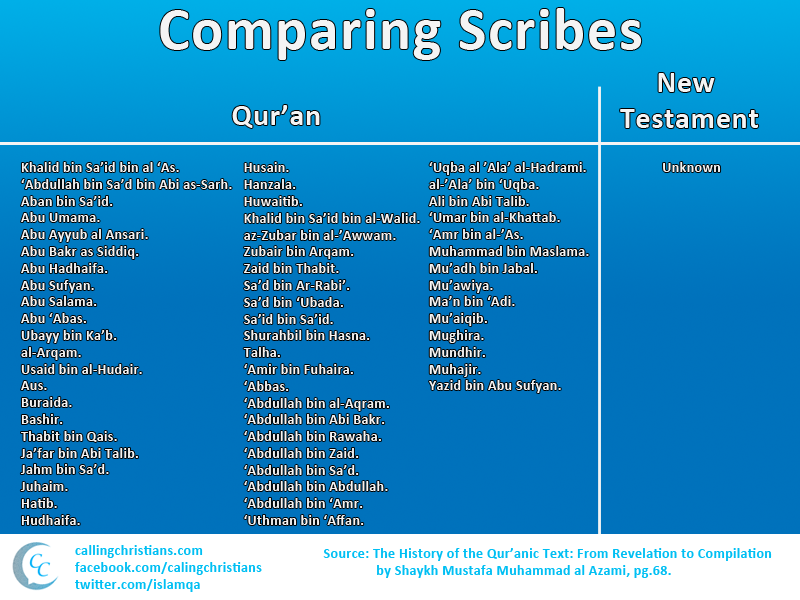
cc-2015-qscribesvsntscribes

Click to Enlarge

The list of names of the Qur’anic scribes was transcribed from Shaykh Muhammad Mustafa al Azami’s work on the Qur’an’s preservation[1]. To understand why the New Testament has unknown scribes, it should be noted that Irenaeus in 185 CE, was the first to name the authors of the New Testament gospels[2][3]. Prior to this, no name was attached to them and none of their authors were known. Moreover, since none of their authors were known, we know of none of their scribes. Comparisons are usually made between the hadith corpus and that of the New Testament. However, this is the fallacy of false equivalency, as the conditions for establishing a narration as da’eef, or weak is not met by the New Testament literature:

The Riwaayah of an unknown person is not acceptable because if his name is not known then his Haal (condition) cannot be defined (as to whether he is reliable or not). The Saheeh (correct) verdict is that a Mubham (unknown) Raawi cannot be declared as Aadil (reliable).[4]

On this basis, at the very least, the New Testament does not compare to a single weakly graded tradition from the hadith corpus.

Note: Yazid ibn Abi Sufyan (d. 640 CE), is not to be confused with Yazid ibn Mu’awiyah (d. 683 CE), they are two different persons.

and Allah knows best.

Sources:

  1. Al Azami, Muhammad Mustafa. The History of the Qur’ānic Text: From Revelation to Compilation : A Comparative Study with the Old and New Testaments. Leicester: UK Islamic Academy, 2003. 68. Print.
  2. Ehrman, Bart. “The Gospels Are Finally Named! Irenaeus of Lyons.” The Gospels Are Finally Named! Irenaeus of Lyons. – Christianity in Antiquity (CIA): The Bart Ehrman Blog. 18 Nov. 2014. Web. 3 July 2015.
  3. Irenaeus, Saint. Adversus Haereses. Vol. 3. Print.
  4. Al Asqalani, Ibn Hajr. Nukhbat Al-Fikar Fī Muṣṭalaḥ Ahl Al Athar. 62. Print.

John 3:16 Teaches Us Unconditional Love

I would like to encourage missionaries to stop making this claim in regard to John 3:16. The verse does not teach unconditional love. It does not. You simply have to read the verse and you’ll realise this. So, let’s take a look at the verse:

For God so loved the world that he gave his one and only Son, that whoever believes in him shall not perish but have eternal life. – John 3:16 (NIV)

The love of God in giving His Son to us, is pivoted on the condition of whoever believes in this happening. Only those who believe that God sent His Son, would earn the merits of God sending the Son and by extension, loving the world. The verse is saying that due to God’s love for the world, He gave His Son, and in giving His Son we will have eternal life and will not perish, if we believe. This love for the world in giving us His Son, is conditional on us believing. Therefore, a condition does exist, you have to believe. For those who God does not love, they will perish and you can only perish if God does not love you.

In conclusion, John 3:16 does not teach that God’s love is unconditional, as the condition of belief exists. Therefore, those who make such a claim most likely have not read the verse properly. Considering it’s one of the most famous, if not the most famous verse of the Bible, it’s pretty ridiculous that anyone can understand it this wrongly.

and Allah knows best.

Scholar Relates Gospel Traditions to the “Telephone” Game!

Question Mark

Speaking candidly on the historicity of the gospel traditions, especially its transmission, New Testament Scholar Bart Ehrman makes the following intriguing comparison:

“You are probably familiar with the old birthday party game “telephone.” A group of kids sits in a circle, the first tells a brief story to the one sitting next to her, who tells it to the next, and to the next, and so on, until it comes back full circle to the one who started it. Invariably, the story has changed so much in the process of retelling that everyone gets a good laugh. Imagine this same activity taking place, not in a solitary living room with ten kids on one afternoon, but over the expanse of the Roman Empire (some 2,500 miles across), with thousands of participants – from different backgrounds, with different concerns, and in different contexts – some of whom have to translate the stories into different languages. The situation, in fact, was even more complicated than that.” (The New Testament – A Historical Introduction to the Early Christian Writings, Chapter 3, Where it All Began: The Traditions of Jesus in Their Greco-Roman Context, p.44)

One of the very reasons why Qur’an had to be revealed with narrations of Jesus (peace be upon him) in it was because, as evident from above, the actual revelations given to or the words uttered by Jesus (peace be upon him) were lost in their transmission. With this the actual message of Christ (peace be upon him) was also lost. As on mere conjectures eternal fates could not be banked, the final Messenger (peace be upon him) was given divine glimpses of the life of Jesus (peace be upon him).

We also need to make a healthy parallel comparison of the transmission of Gospel traditions to that of Qur’an and Hadith. It was an extremely imperative, prudent and monumental task undertaken by Muslim scholars to protect the chain of transmission of Qur’an and Sunnah in the form of “Isnads”.

We have detailed biographies of all the people involved in the transmission of Islamic narratives right from the beginning. Just vicariously imagine the chaos which was circumvented by preserving transmission chains of Qur’an and Hadith – it was not let to take form of some “Telephone” game!

Recent Entries »