Tag Archives: islam

The Problem of Luke 23:34

Introduction

Luke 23:34 is perhaps one of the most interesting verses in the New Testament narrative of Jesus, the son of Mary’s alleged crucifixion. It reads as follows[1]:

Jesus said, “Father, forgive them, for they do not know what they are doing.”[c] And they divided up his clothes by casting lots.

Our interest is primarily focused upon the prayer[2] of Jesus. The questions which are being asked are, why is Jesus praying for these men’s forgiveness? What purpose does it convey? What does it achieve? These questions need to be asked, as Jesus’ prayer in this case, occurs before his eventual death on the cross which is supposed to have ushered in a new covenant with God, a new doctrine of salvation. His death and resurrection which establishes itself as the pillar upholding the veracity and validity of the Christian faith as declared by Paul of Tarsus:

And if Christ has not been raised, our preaching is useless and so is your faith.[3]

Summarily, we are seeking to establish the reasoning for this prayer of forgiveness, in regard to its timing of the slaying of the lamb[4] for the forgiveness of the sins of the world[5], inclusive of those of the Jews and Romans who were no doubt instrumental in the events leading to the crucifixion event.

New Testament Textual Criticism of Luke 23:34

It would be inane to discuss the consequences of the verse in question at length, before establishing its place in the New Testament canon. Most would be unaware that this verse’s place in the canon is one of disputation and doubt. It would be of note to mention that the verse is recorded in the following versions of the English Print Editions of the New Testament [6]:

  • New International Version
  • New Living Translation
  • English Standard Version
  • New American Standard Bible
  • King James Bible
  • Holman Christian Standard Bible
  • International Standard Version
  • NET Bible
  • Aramaic Bible in Plain English
  • GOD’S WORD® Translation
  • Jubilee Bible 2000
  • King James 2000 Bible
  • American King James Version
  • American Standard Version
  • Douay-Rheims Bible
  • Darby Bible Translation
  • English Revised Version
  • Webster’s Bible Translation
  • Weymouth New Testament
  • World English Bible
  • Young’s Literal Translation

It had become necessary to list the instances of its presence in the English translations, as it is the language in which this article is being written. It was also necessary, so as to demonstrate its undoubted and frequent presence in the most accessible New Testament print editions in the English language. A noted citation in the NIV[7] translation reads as follows:

c. Luke 23:34 Some early manuscripts do not have this sentence.

Its presence in most translations is due to the verse’s presence in the modern critical editions of the Greek New Testament. As of this writing, it remains in the critical editions as is demonstrated by the Nestle-Aland 28th Greek New Testament[8]:

ὁ δὲ Ἰησοῦς ἔλεγεν· πάτερ, ἄφες αὐτοῖς, οὐ γὰρ οἴδασιν τί ποιοῦσιν. διαμεριζόμενοι δὲ τὰ ἱμάτια αὐτοῦ ἔβαλον κλήρους.

Codex Aleph  (א- Sinaiticus) does contain this verse[9], although atleast one of its suggested scribes or editors is thought to have edited or corrected the verse in question[10]. However Codices B (Vaticanus) and D (Bezae) do not contain this verse[11], thus explaining the citation in the NIV translation. At the time of this writing, I do not have access to the apparatus of the Nestle Aland 28th Edition Greek New Testament, therefore I was unable to attain the reasons or sources it outlines for the inclusion of the verse. However, in reading the erudite work of Bruce Metzger and Bart Ehrman, we note that it states the following in regard to its intentional omission in other codices[12]:

…an omission that makes particular sense if Jesus is understood to be asking God to forgive the Jews responsible for his crucifixion.

Their understanding of the omission is in the context of Jewish-Christian relations, more specifically, anti-Jewish Christian scribes within the first centuries of Christianity and the consequential promulgation of their views in Christian literature. The omission was meant to remove the view that Jesus the Christ had prayed for the forgiveness of the Jews for their role in his crucifixion[13]. There is also a Textual Critical maxim, which reads as follows: “lectio difficilior potior” – the more difficult/nonsensical reading is more evidential. Given that their is a possibility of intentional omission, then their is great possibility it was included in the earlier copies of the Gospel.

Having explored its place in the canon and the evidences for its inclusion, there is now no doubt that at the time of this writing, New Testament Textual Critics adhere to its inclusion despite its omission from two important early sources.

The Prayer in Light of the New Covenant & its Soteriological Plan

The traditional Christian soteriological belief in this doctrine of salvation by the Christ’s crucifixion can be understood in the following quote[14]:

Christ upon the cross, is gracious like Christ upon the throne. Though he was in the greatest struggle and agony, yet he had pity for a poor penitent. By this act of grace we are to understand that Jesus Christ died to open the kingdom of heaven to all penitent, obedient believers.

With his sacrifice, the gates of heaven were opened to the world[15]. The Gospel accounts inform us that Jesus the Christ a priori knew that he had to be crucified, we read:

And he said, “The Son of Man must suffer many things and be rejected by the elders, the chief priests and the teachers of the law, and he must be killed and on the third day be raised to life.”[16]

The Son of Man will go as it has been decreed. But woe to that man who betrays him!”[17]

‘The Son of Man must be delivered over to the hands of sinners, be crucified and on the third day be raised again.’ ”[18]

The Son of Man will go just as it is written about him. But woe to that man who betrays the Son of Man! It would be better for him if he had not been born.”[19]

Since it is established in the narrative, as ascertained from the verses listed previously that his eventual crucifixion and death would lead to the payment of the sins of the world, then it is a strange occurrence that the Christ would pray for someone’s forgiveness. If he knew his death was imminent and with that, forgiveness would be brought upon the world, why would he beseech the Father for the forgiveness of others? Perhaps an analogy can demonstrate the peculiarity and absurdity of this event. It is as if I had a letter in my possession. Knowing that I’m about to use a photocopying machine to duplicate that letter, just before I use the photocopier, I choose to handwrite the letter on a sheet of blank paper and then photocopy the original letter. It’s redundant, anachronistic, futile. Jesus undoubtedly knows that the entire world, inclusive of those men before him; that he is about to pay for their sins, yet he prays to the Father just before his death that their sins should be forgiven. Regardless of someone’s theological, philosophical or personal views, the oddity of this occurrence is striking.

Such an understanding is noted by the exegete Matthew Henry, for he states[20]:

As soon as Christ was fastened to the cross, he prayed for those who crucified him. The great thing he died to purchase and procure for us, is the forgiveness of sin.

In essence, he prayed for the same thing that his death would achieve. Some might postulate that this is a sign of Jesus’ mercy and love for mankind, as is held by Stier et al; we read from the Pulpit Commentary the following[21]:

Then, as always, thinking of others, he utters this prayer, uttering it, too, as Stier well observes, with the same consciousness which had been formerly expressed, “Father, I know that thou hearest me always.” “His intercession has this for its ground, though in meekness it is not expressed: ‘Father, I will that thou forgive them.”

While such an apologetic exegesis would placate some, I do not find it to be sensible. For, if Jesus the Christ, who is also the Son; a deity capable of forgiving sin as is claimed from Luke 7:48[22], then why did the Son simply not forgive the sins of the world, or the sins of the Roman and Jewish persecutors? He clearly had the ability to do so, the authority to do so, so why would the Son choose not to do this? Instead, the Son as we are led to believe, chooses to beseech the Father! This prayer therefore leads to an even greater problem, (it implies) subordination and hierarchy within the Trinitarian dogma. Beliefs tantamount to heresy when tested against the proto-orthodoxical Nicaean creed[23], which establishes the Son as co-equal to God[24]:

Such is the genuine doctrine of Arius. Using Greek terms, it denies that the Son is of one essence, nature, or substance with God; He is not consubstantial (homoousios) with the Father, and therefore not like Him, or equal in dignity, or co-eternal, or within the real sphere of Deity.

Jesus the Christ, otherwise known to Christendom as the Son, had the ability to forgive sins, he did not need to request that the Father do this. If he prayed out of love, mercy, grace and compassion for the forgiveness of the sins of the Roman and Jewish persecutors, then why did he not use this love, mercy and grace to absolve them of their sins? He is in essence, praying for something he could already grant them, therefore this excuse is redundant and unremarkable, in clear contradiction of this fanciful idea of proposed love, mercy, grace and compassion.

Did They Need to be Forgiven?

Whether the prayer was uttered in reference to the Jews, the Romans, or some combination of those peoples; did they need to be forgiven? Forgiving them would readily imply that their actions were sinful, criminal, morally wrong. However as we are well aware, and as I have previously stated, the sacrificing of a sacrificial lamb is the purpose[25] of Christ’s earthly mission. This prayer for forgiveness would then have us believe that the sacrifice was morally wrong according to Jesus himself! The significance of such a prayer is now very telling, it is detrimental to the sacrificial imagery steadily enforced throughout the New Testament and as referenced previously[26]. Christians do not believe that Christ’s sacrifice was sinful or wrong, it is the very foundation of their faith as we had read from the Apostle Paul[27]!

We are at an unfortunate dilemma, Christ’s prayer now seems to be undermining the very pillars of proto-orthodox Christian belief. If it was God’s will that the world be saved from their sins by the hands of the Romans and Jews, then it is absurd that we should consider the persons responsible for the crucifixion as sinful individuals. Rather, if the Christian world is to be consistent with their beliefs, these men should be celebrated, just as the cross is celebrated. However, if it is the case that Jesus considered his persecutors that led to his crucifixion as criminals, as murderers, then the possibility of Jesus’ death being labeled as a crime and an injustice done to him is significantly more appropriate and honest. Such a view would be in blatant violation of the Christian world view on salvation. Perhaps what is more troubling is the position of those who perform the Passover sacrifice, we read the following[28]:

“Get rid of the old yeast, so that you may be a new unleavened batch—as you really are. For Christ, our Passover lamb, has been sacrificed.”

If Jesus the Christ is to be considered the sacrificial lamb, then those who perform the sacrifice for Passover have been atoned of their sins as is clearly stipulated in the Pentateuch[29]:

For the life of a creature is in the blood, and I have given it to you to make atonement for yourselves on the altar; it is the blood that makes atonement for one’s life.

If we are to believe that Luke 23:34 is in relation to the Jews, then Jesus’ prayer of forgiveness for them is troubling, for it would then imply that the very God of the Jews, did not know that the sacrificing of the Passover lamb was not a crime, but an act of atonement for the Jews.

Conclusion

There are very few cases in which we can understand the purpose of this prayer. One scenario is that Jesus did not expect his death to open the gates of forgiveness and that he did not have the ability to forgive sins by his own will and authority, therefore his prayer to God was one in sincerity. However, if he did know that his eventual death would lead to the world’s forgiveness and that he had the ability to forgive sins without any sacrifice, then his prayer to God seems out of place and problematic to the narrative, rendering his prayer to be completely redundant and meaningless.

Another case in which we can perhaps derive some closure on the issue, is that if Jesus was in fact the sacrificial Passover lamb, then his prayer for forgiveness for the Jews, would mean that he either did not know the laws of the Pentateuch, or that he did not consider himself to be a sacrificial Passover lamb; the latter belief would then render Paul a liar and would cause the Christian faith to be false as per his declaration in 1 Corinthians 15:14.  The former argument would then have us believe that Jesus could not be a deity as he is ignorant of the very law which he would have instructed the Jews himself.

Whichever way the prayer is examined, as I have aptly demonstrated it is of grave detriment to the Christian faith and without a doubt its place in the Biblical canon is of service to those who which to prove that Jesus the Son of Mary, is not and has never been a deity.

and Allaah knows best.

Sources (APA Style):

[1] –  Holy Bible, New International Version®, NIV®. (2011). Luke 23:34. Retrieved from http://www.biblegateway.com/passage/?search=Luke%2023&version=NIV

[2] – Concise Commentary on the Whole Bible by Matthew Henry. (2003). Luke 23:34. Retrieved from http://biblehub.com/commentaries/mhc/luke/23.htm

[3] – Holy Bible, New International Version®, NIV®. (2011). 1 Corinthians 15:14. Retrieved from http://www.biblegateway.com/passage/?search=1+corinthians+15%3A14&version=NIV

[4] – Holy Bible, New International Version®, NIV®. (2011). Revelation 5:12. Retrieved from http://www.biblegateway.com/passage/?search=Revelation+5%3A12&version=NIV

[5] – Holy Bible, New International Version®, NIV®. (2011). John 3:16. Retrieved
from http://www.biblegateway.com/passage/?search=John+3%3A16&version=NIV

[6] – Bible Hub’s Parallel Verses. (2014). Luke 23:34. Retrieved from http://biblehub.com/luke/23-34.htm

[7] – See: [1]

Note: The Pulpit Commentary, Ibid, relates the same conclusion as I have written:

” These words are missing in some of the oldest authorities. They are found, however, in the majority of the most ancient manuscripts and in the most trustworthy of the old versions, and are undoubtedly genuine.”

[8] – Nestle-Aland Novum Testamentum Graece. (2013). Luke 23:34. Retrieved
from http://www.nestle-aland.com/en/read-na28-online/text/bibeltext/lesen/stelle/52/230001/239999/

[9] – Codex Sinaiticus. (2009). Luke 23:34. Retrieved
from  http://codexsinaiticus.org/en/manuscript.aspx?book=35&chapter=23&lid=en&side=r&verse=34&zoomSlider=0

[10] – Ibid. See the transcription notes, Editor cb2.

[11] – Cambridge Bible for Schools and Colleges. (1891). Luke 23:34. Retrieved from http://biblehub.com/commentaries/cambridge/luke/23.htm

[12] – Ehrman, B., & Metzger, B. (Eds.). (2005). The Text of the New Testament: Its Transmission, Corruption and Restoration (4th ed.). New York, NY: Oxford University Press.

[13] – Ibid.

[14] – See: [2]

[15] – See: [5]

[16] – Holy Bible, New International Version®, NIV®. (2011). Luke 9:22. Retrieved
from http://www.biblegateway.com/passage/?search=Luke+9%3A22&version=NIV

[17] – Holy Bible, New International Version®, NIV®. (2011). Luke 22:22. Retrieved
from http://www.biblegateway.com/passage/?search=Luke+22%3A22&version=NIV

[18] – Holy Bible, New International Version®, NIV®. (2011). Luke 24:7. Retrieved
from http://www.biblegateway.com/passage/?search=Luke+24%3A7&version=NIV

[19] – Holy Bible, New International Version®, NIV®. (2011). Matthew 26:24. Retrieved
from http://www.biblegateway.com/passage/?search=Matthew+26%3A24&version=NIV

[20] – See: [2]

[21] – The Pulpit Commentary. (2010). Luke 23:34. Retrieved from http://biblehub.com/commentaries/pulpit/luke/23.htm

[22] – Holy Bible, New International Version®, NIV®. (2011). Luke 7:48. Retrieved
from http://www.biblegateway.com/passage/?search=luke+7%3A48&version=NIV

[23] – The Nicaean Creed. (n.d.). The Nicaean Creed. Retrieved from http://www.creeds.net/ancient/nicene.htm

[24] – Barry, W. (1907). Arianism. The Catholic Encyclopedia. New York: Robert Appleton Company. Retrieved June 11, 2014 from New Advent: http://www.newadvent.org/cathen/01707c.htm

[25] – See: [16], [17], [18], [19]

[26] – See: [4]

[27] – See: [3]

[28] – Holy Bible, New International Version®, NIV®. (2011). 1 Corinthians 5:7. Retrieved
from http://www.biblegateway.com/passage/?search=1%20Corinthians%205:7&version=NIV

[29] – Holy Bible, New International Version®, NIV®. (2011). Leviticus 17:11. Retrieved
from http://www.biblegateway.com/passage/?search=Leviticus%2017:11&version=NIV


Christian Love for Br. Ijaz

I’m not sure what ticked off this individual, but he does seem quite upset at Muslims and particularly at me. I don’t know who he is or why he’s messaging me, but he sure is angry. Based on his other messages, he does seem to be under the impression that I’m an immigrant to the UK though, which isn’t true, as we Trinidadians often say “I’m Trini to de bone“. I do often get hate mail in this form, nasty insults, threats, etc, this is just a sample of the messages sent:

cc-2014-jimmuir-insults


On the other hand, this bloke might just be completely crazy and his faith of choice is completely coincidental. Experience though, and the many other messages strongly suggest that may not be the case. I pray that God guides this person and that they can live their lives being at peace with those who disagree with them. Ameen.

and God knows best.

Scientific Miracles in the Qur’aan?

Question:

There are many people who do da’wah by showing scientific miracles in the Qur’aan. However, I have seen that they can easily be dismissed because some words are stretched to the limits of reason to accommodate these so called miracles. Many non-Muslims say that this is a sign that Islam struggles with science and that Muslims are desperate for converts so we use deceit.

Answer:

I do agree that this is a problem that is negatively affecting the sincere work of da’wah. To begin with, there is a serious warning by the Prophet (salallahu ‘alayhi wa salam) about reading into the Qur’aan, the meanings or views that they want to see, and not necessarily what the text says. This is called eisegesis:

Rasoolullah (sallallahu alayhi wasallam) warned: “He who interprets The Quran without knowledge let him prepare his place in Hell-fire.” (Tirmizhi) Another hadith qualifies the term “without knowledge”. Also narrated by Imam Tirmizhi, it states: “He who interprets The Quran with his own opinion and is correct, has indeed erred.” This hadith makes two telling points: one, that personal or self-opinionated interpretation of Quran is regarded as interpretation without knowledge.

Islam therefore prohibits such self-interpretation, and considers it a sinful action. We should therefore refer to the experts, the scholars of the interpretation of the Qur’aan, the mufassireen. There are many tafaseer (plural of tafseer/ commentary) of the Qur’aan by reliable scholars, namely Tafseer Ibn Kathir and Maar’iful Qur’aan. I am not saying that these commentaries of the Qur’aan by the scholars is perfect in their attribution of scientific miracles to some ayaat of the Qur’aan, as some scholars have interpreted according to the science of their respective times. What I am saying, is that the lay man is unfamiliar with the limits of tafseer and the science of tafseer, therefore it is safer to leave interpretation of the Qur’aan to those who know the limits.

However, we must take into consideration that the Qur’aan does contain scientific miracles. By this, I mean that it conveys accurate information about the physical world in which we exist. There is a point of great importance that must be emphasized, the language of science and the human terms applied to the physical world may not ever match the wording of the Qur’aan. Let’s take a general example:

And We made the sky a protected ceiling, but they, from its signs, are turning away. – Qur’aan 21:32.

If the creator did reveal this as a message to us about natural phenomena, then what can we expect Him to say? The terms used must convey the most general meaning as is possible so that we can identify the terms used with natural phenomena. So the Qur’aan in 21:32 says the sky is a protected ceiling. Someone might argue and say that this verse is false because there is no ceiling or roof covering the earth and the sky is not a physical tangible object. Yet, if we look at the verse more carefully, it states that the sky is some sort of a protection, like a ceiling or roof. Is there such a thing covering the world in what we consider to be the sky? Yes, the ozone layer. This layer protects us from the sun’s harmful rays and preserves life on earth. Due to our atmosphere, meteorites of certain sizes disintegrate while passing through it.

Obviously, the Qur’aan does not use the term “ozone layer”, even if it did and it mentioned those exact terms; at the time of its revelation, that term would be meaningless to those people and for all we know, humans could’ve called what we refer to the ozone layer another name, perhaps the rubber ducky layer. The wisdom of God is beautiful, we can see that He uses terms that are common and general, but with which we can identify and make sense of. To understand how difficult it is to describe something to people who are wholly unfamiliar or ignorant of it, try describing a cellphone to 1st century CE Romans. What would you say? Terms like Wi-Fi, cellular reception, Amoled screen, RAM, etc, are unknown and would be gibberish to them. If you told them you could use something smaller than the size of your palm that uses invisible waves to allow your voice and face to be heard and seen to someone from China or Russia, they would think you are crazy.

Therefore it is a baseless and silly notion that some people expect the Qur’aan to use specific terms that perhaps only English speaking 21st century people can. We must examine the full spectrum of meanings that a word can be used for, even if such a use is rare. By we, I mean the scholars capable of interpreting the Qur’aan. I do not believe, that applying the rare meaning of a word to a term in the Qur’aan is desperation or dishonesty, if the word historically has been used in such a way, to reflect a particular meaning then that is not deceit. It’s the opposite, it’s applying a meaning which was once actually used. As Muslims, we need to understand that the Qur’aan will mention facts about the natural phenomena of the physical world in which we exist. Our expectations of scientific miracles needs to be delimited (determining the limits of interpretation). While there are many other examples of scientific related information in the Qur’aan, we should not abuse such information by overstating or inflating the information it expresses to us. Take into consideration, the website of Harun Yahya that lists miracles far beyond what the Qur’aan is stating. He is misusing verses and when he does this, Muslims like you and I are labeled as uneducated about science or tampering with the meaning of the verses or as being deceitful.

In conclusion, we accept two things, (1) There are people who falsely interpret verses of the Qur’aan to reflect scientific data, (2) There is accurate information about science in the Qur’aan. There may be verses which are ambiguous in their relation to our current scientific data, but that does not mean the verse is wrong or false, it can simply reflect that either humans are understanding it wrongly, or that scientists will eventually reach the same view, of which the Qur’aan is expressing. It is our duty as Muslims to remind the brothers and sisters who interpret scientific information and attempt to relate it to verses of the Qur’aan, that they should be qualified in that field of science themselves and they must know and have the authority to interpret the Qur’aan. Not everyone has these qualifications, and it is with that said, I want to remind the Muslims doing da’wah that they need to interact with the relevant scholars before jumping to conclusions.

and Allaah knows best.

Bart Ehrman and Muslims

Polemicists and Evangelicals far too often misconstrue the use of Bart Ehrman’s materials by Muslims. The record needs to be cleared, because somewhere along the lines of inter-religious discourse, Bart Ehrman’s works are quickly becoming the pinnacle of Evangelical appeals to scholastic authority. Muslims do not use Bart’s works because of his views, which most Evangelicals would consider liberal to say the least. His agnosticism being based upon his views on evil do not translate well into Islamic belief about God, the fact that he left Christianity for agnosticism is not an Islamic ideal.

cc-2014-bartehrman

So why do Muslims use Ehrman’s works? The answer is quite less controversial than one would be looking for – he writes for mass market appeal. He isn’t writing books for use in a theological seminary, or for his academic colleagues, he’s writing it for the Divergent series reader, the Harry Potter reader, the whatever-is-popular-on-NYTimes’-best-seller-list reader. In other words, he’s writing for the casual reader who may be interested in Christ or the Bible. I’m not saying scholars don’t read his works, they do, and I’m also not saying that some Universities don’t use his books in courses, they do. What I’m saying is that those people aren’t his target audience, but the level of scholarship dedicated to his authorship means that his works can scale easily into the hands of the layman, the University student or a scholar.

The vast majority of Muslims don’t have any reason to bother themselves with understanding Christian teachings. Just as the average Christian isn’t going to dedicate their time to reading the entire Seerah an Nabawiyyah or Qasas ul Anbiya. For the Muslims who are interested in understanding the Christian faith, they are most likely to find his books accessible and easy to read, as well as understand. It takes almost no effort to find his books, they’re readily available in most bookstores, you don’t need a study guide or teacher to walk through his books with you, it’s easy to just pick one up and understand what’s written inside of it. There’s no secret that this is the honest answer as to why Muslims use Ehrman’s works. If we consider the popular works of other Christian authors, which one of them has the mass appeal and ease of use as any of Ehrman’s works?

How many Muslims are going to come across something by Immanuel Tov, Raymond E. Brown, K. and B. Aland? How many Muslims can sit and read E.P. Sanders’, “Paul, the Law and the Jewish People” and find it comparable in ease to Ehrman’s books? How many Muslims will even know his name? Not very many, not very many at all. Therefore, I find it quite funny to see some Polemicists and Evangelicals placing Ehrman on a pedestal of everything wrong with liberal Christianity or of critical Christian scholarship simply because Muslims read his works. If there was another Christian scholar that wrote on the same topics, with a similar writing style and ease of reading, Muslims would also purchase that work – but there simply is no other person doing this, so Ehrman is the go to guy in this case.

There are some in the inter-faith dialogue community who condemn Muslims for being hypocritical for accepting some views of Ehrman and not all of his views. Why should Muslims accept all of Ehrman’s views? His views aren’t part of Islamic teachings, and if he writes something that is somehow related to Islamic teachings and some Muslims want to adopt those views because of a correlation, then they are free to weigh which views are acceptable and which aren’t. Rejecting some of his views is part of the critical thinking process, it is far too infantile to generalize Ehrman’s views and dictate that Muslims must either accept them all or reject them all, that’s clearly an appeal to the fallacy of a false dichotomy. There is a third option, weigh what he says against Islamic beliefs and use them accordingly.

In conclusion, Ehrman is not the be all and end all of information on Christianity. He certainly isn’t for me, but his views, especially on the Bible’s preservation are shared by vast portions of the textual criticism community, even if Muslims had to disregard anything written by Ehrman there is still quite a significant array of literature and authors who agree with him that we can learn from. Therefore, we say to those who condemn Muslims for reading his works, it’s silly to focus on the man behind the work, the real problem lies with the information he makes accessible to the Muslim community, the Christian community and to the larger public. So, focus on dealing with the information and not the person. Far too many Evangelicals and Polemicists are zealous in their abuse of Muslims for reading his works, when most of them are unaware of what his works actually contain. What a sad state such people are in.

and God knows best.

James White Issues Debate Challenge to Ijaz Ahmad

In an email received a few minutes ago, James White of Alpha and Omega Ministries has indicated his intention to issue a debate challenge (one to Sheikh Awal and another to myself) in today’s edition of his religious talk commentary radio show, the Dividing Line. He’s also posted a pre-show statement on his website:

cc-2014-jameswhite-debatechallenge

The crux of the matter is quite clear. Regardless of what last minute cover up and face saving James has to do later today, the fact remains that the original and unedited debate has not been provided to Sheikh Awal. If it has taken this long for the debate to be provided to Sheikh Awal, then any response by James should be taken with a grain of salt. It seems that he’s only willing to defend his actions and to discuss the contentious issues surrounding the event when his integrity is called into question. Whereas when he demeaned the character of the erudite da’ee, Sheikh Awal, he, did not respond in a like manner – Alhamdulillah (praise be to God).

It is with great interest that I will listen to this evening’s program and should the debate challenge be issued by James, I will give an appropriate response in a timely manner.

I do hope that James does have a better excuse than “Sheikh Awal is lying about me”, this evening, because as it stands, he has not yet provided the raw audio-video of the debate to Sheikh Awal, despite his numerous requests.

and Allaah knows best.

Samuel Green Admits to Polytheism, Believes in 2 YHWHs

In orthodox Trinitarian belief, Christians state that there is one God but three Persons. One Elohiym but three Persons. One YHWH but three Persons.However, Pastor Samuel Green agreed with and promoted a post by a fellow Christian polemic which clearly stated that Jesus the Christ was a second YaHWeH.

cc-2014-samuelgreen-yhwh1

cc-2014-samuelgreen-yhwh2

I honestly ask, do Christians believe in more than one YHWH? Or isn’t the orthodox belief, that YHWH is one but many persons?

cc-2014-samuelgreen-yhwh3


As you can see from the above photo. Pastor Green has since seen my message to him, inquiring about his change of doctrine and has decided not to respond. This clearly indicates he either screwed up badly or did not realise what he was supporting. I pray that he responds on the matter in a timely fashion.

and God knows best.

Pastor Samuel Green: Human will overpowers God’s will

I’m not sure how many Christians would be willing to agree with Pastor Samuel Green’s view that humans can perform actions which God has not willed into existence or permitted. In essence, the Pastor is teaching that human will, overpowers God’s will. Do Christians agree with the Pastor’s message that humans are greater than the Christian God?

cc-2014-samuelgreen-godswill


If the creation of God, can overcome the will of their Creator, then as humans – we are more powerful than the weak Christian God. This is not a polemical claim, this is based on the doctrinal statements of Pastor Green.

and Allaah knows best.

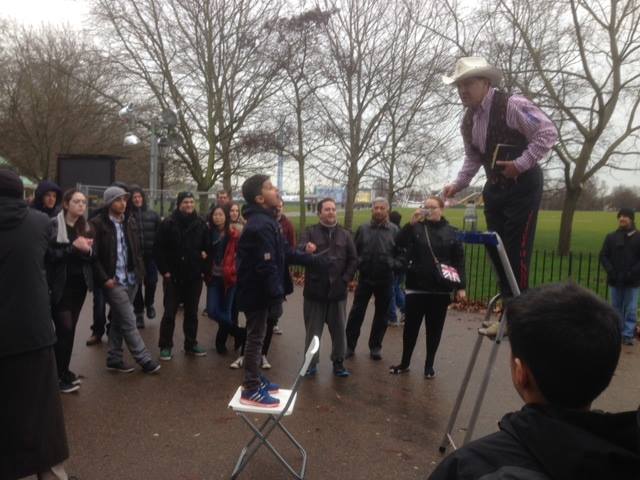
Brave 10 year old Stands Up against Christian Missionary

Br. Haroon Qureishi of iERA, recounts the event:

I was at hyde park speakers corner today and there was an offensive Christian missionary who was attacking Muhammad PBUH.

A little boy aged 10 took my chair and started challenging the man while the large crowd gathered around and started chairing on the little boy (Even non Muslims were cheering him on)!

Some time later his dad came and was shocked and impressed at what his son was doing!

MASHALLAH!

May Allah give us all confident children who will stand up for the deen inshallah.

cc-2014-hpd-littleboy

Amazing stuff from the British brothers.

and Allaah knows best.

Emanuel Ionescu

I’ve received a touching testimonial of one former Christian’s Journey to Islam, please do share this man’s journey to the truth:

My name is Emanuel Ionescu. I reverted to Islam in 2011 at the age of 21. The reason I say revert and not convert is because Muslims believe that we are all born with Islam as our faith, but as we get older, if we are not in a Muslim family we may be raised cc-2013-quranreadingto believe something else and in my case I was raised as an Orthodox Christian. Throughout my life I was interested in religion and as I got older I was reading more and talking more about religion with people. I always defended Christianity as the true faith even when people would tell me it is a corrupt faith. I would tell them that if Christianity was really corrupt, God would not let us believe in something corrupt without correcting it. Little did I know at the time that in fact God did so by sending the final Prophet Muhammad (pbuh) to correct us where we went wrong and bring us back to the original truth. I should note though that many people I spoke to about Christianity were Atheists and from some other religions but I had never met a Muslim to speak to them about religion while I was Christian.

I had to discover Islam on my own and I am glad I was able to. Maybe I would have been Muslim earlier if I had contact with Muslims but then again, sometimes I think that if a Muslim would try to convince me that Christianity was wrong I probably would not have accepted Islam because I would not like other people to tell me that my faith is wrong as others already did. I believe it was Allah’s purpose for me to come to Islam in my own and that this was the best way for me to understand Islam as I will detail further on.

I knew very little about Islam while I was in high school and I tried to look into it a little more only for the reason that I knew they believed in the same God that Jews and Christians did. I was interested to see what they say about Jesus (pbuh) in the Quran and when I found out that they say he was not the son of God nor crucified I refused to believe that and so for some time I kind of left Islam aside, but I was being unfair really because all I did was read the verses about Jesus and not the entire Quran to see why they said this. As time went on though Islam seemed to always be in the back of my mind. I do not know why because as a Christian I was fine with everything they taught, except that I believed that Jesus (pbuh) was the son of God, not God himself but other than that I had no doubts about Christianity.

I should also note though that as I grew older I stopped calling myself Orthodox Christian and I was only calling myself Christian. The reason for this was that I was disappointed to see thousands of denominations in Christianity and it bothered me that they were all saying that they were the only correct path to heaven. I believed that Jesus (pbuh) did not teach us to separate into different sects and that to be a true Christian was to follow the Bible and what Jesus (pbuh) taught.

Anyway, so Islam was always in the back of my mind for reasons I can’t really explain since I didn’t agree with what they said about Jesus (pbuh) but I respected their devotion to Allah through their 5 daily prayers and that they were dressing modestly and believed in the same God Jews and Christians did. The turning point in my life with regards to Islam was in the summer of 2011 when I went to visit my godfather in Cyprus. He was living near the border of Northern Cyprus which was the Turkish part. I would go there daily and I went to visit the mosque and was intrigued at how they did not decorate the mosque with images or statues of Prophets, which I liked. I also heard the Athan for the fist time and that was a very nice thing to hear. When I returned home I finally decided to give Islam a more serious look by watching some documentaries to get a better idea of the history of Islam. After watching those I was interested even more and began to actually read the whole Quran this time and not just some verses.

I finally truly accepted Islam after reading the whole Quran and if it wasn’t for one specific verse in the Quran, I would probably still not have accepted Islam. The verse that I believe my whole reversion rested upon was Surah 2:79 which spoke of previous scriptures being corrupted. It was a sudden understanding in my mind which I had no doubts about what I had just read and it made me fully understand why they said Jesus (pbuh) was not the son of God or crucified. The reason was that the scriptures were corrupted and that they lied about Jesus (pbuh) and many other things. My whole idea that Christianity was the truth because God did not tell us otherwise was finally revealed to me that God did in fact speak again through Muhammad (pbuh) who did in fact tell us that the scriptures were corrupted as mentioned in that verse. A person may wonder, why did I accept that verse so easily and not investigate to see if what it claims is true? Well I did investigate, but not because I had any doubts, but just to reaffirm what I had now believed as the truth and to increase my knowledge and understanding of why the Quran claimed this thing, and my beliefs were found to be true with my investigations.

In the end Islam made sense because it taught the belief in the one true God, which Jews and Christians also believe in, it also taught to believe in all previous Prophets send by Allah from Adam (pbuh) to Muhammad (pbuh) which made more sense compared to the Jews who stopped at Moses (pbuh) and the Christians who stopped at Jesus (pbuh). Why stop and not also believe in the final Prophet Muhammad (pbuh) too? To believe in all prophets was like a complete belief, from beginning of revelation to the end of revelation. Islam also taught that the original scriptures such as the Torah and Gospel of Jesus were true but were corrupted as I noted earlier and it made sense with what I learned about them after reading that in the Quran. Now when people ask me I why believe Islam is the truth I can say to them the same thing I said when I was a Christian and that is that if Islam was corrupt, Allah would tell us and bring us back on the right path, but for 1400 years there were no more revelations and no need cause Islam truly is the final revelation. Islam completed the whole revelation of Allah with a book that was not changed as previous scriptures were and this in itself is a big proof for Islam as the true faith. Allah did not allow anymore corruption to take place and preserved it to this day.

I had no problem with my Christian beliefs UNTIL I read the Quran. I would like all Christians to read the Quran for themselves and really ponder upon what it is saying. Christians and all other people of other faiths may be OK with their current beliefs but there is something better out there and that is ISLAM.

« Older Entries Recent Entries »