Tag Archives: islam

New Early Manuscript Copy of the Qur’an Discovered?

As brought to my attention by Br. Kaleef of Discover the Truth, a recent news article has been circulating mentioning the “discovery” of an extremely early Qur’anic manuscript in Tubingen University in Germany:

Scholars at the Coranica Project, part of the University of Tübingen, examined a manuscript written in Kufic script, one of the oldest forms of Arabic writing. Using carbon-14 dating on three samples of the manuscript parchment, the researchers concluded that it was more than 95 percent likely to have originated in the period 649-675 AD.

The manuscript is one of more than 20 fragments of Kufic script held by the Tübingen University Library. This particular item was donated to the university in the 19th century.

However, as Dr. Saifullah has duly pointed out, Islamic Awareness has been aware of this collection of manuscripts since 2010 and has for sometime possessed photos of them which have been published on the site, they were already dated to the first century AH as well. We’d like to finally thank the rest of the world for catching up with us!

and Allah knows best.

Is an Afterlife Rationally Conceivable?

Viktor Frankl an Austrian neurologist and psychiatrist says in his book, A Man’s Search for Meaning:

After a while I proceeded to another question, this time addressing myself to the whole group. The question was whether an ape which was being used to develop poliomyelitis serum, and for this reason punctured again and again, would ever be able to grasp the meaning of its suffering. Unanimously, the group replied that of course it would not; with its limited intelligence, it could not enter into the world of man, i.e., the only world in which the meaning of its suffering would be understandable.

Then I pushed forward with the following question: “And what about man? Are you sure that the human world is a terminal point in the evolution of the cosmos? Is it not conceivable that there is still another dimension, a world beyond man’s world; a world in which the question of an ultimate meaning of human suffering would find an answer?”

Is it not cynical for man to think that he is the pinnacle of intelligent life? That the human world is an end point, the boundary of existence? Surely, if an ape can experience the world around them with all their senses and still be veiled from higher reasoning, can we too not conceive that perhaps we are also veiled?

Or, perhaps it is that some wish for this boundary to exist willingly at the cost of their own bravado…..

cc-2014-mancoveringeyes


and Allah knows best.

Attacks on Muslims Increase: American and Australian Incidents

Horrifying news out of Australia yesterday. A Muslim woman was attacked by a male assailant for being Muslim in appearance. The woman was grabbed by the neck and hair, then repeatedly and violently slammed into the train’s carriage. He continued to scream and shout anti-Muslim and racial slurs at her while continuing to physically harm her. As the train approach the station, he threw her off of the train, severely hurting her. Read shocking and terrifying full news report here

Another video, also taken this week in midtown New York features a group of Muslim women being insulted, and violently screamed at by another male assailant. The language in the video is unsuitable for minors and those sensitive to abusive terms. Click here to see the Live Leak video. These attacks will continue to grow as more rhetoric against Muslims is published in the media. It is the duty of the males in the Muslim community to accompany the women of our Ummah, so that we may be able to the best of our legal ability escort and thereby protect them during these times.

The disturbing trend is that these attacks are carried out by males against females and almost never by males against males. I do not know what these aggressive sycophants are capable of and it is clear they will prey on the women in our communities, even if they are in large groups as seen in the Live Leak video above. These attacks are random and without provocation, where even in public areas our women can still be attacked. Safety in numbers does not guarantee that our mothers and sisters will be safe. So I encourage the males in our community to be a bit more aware and careful with our women and I hope that these instances do not escalate any further.

We must however, continue to observe this growing trend of attacks with close and pedantic attention. It would be helpful for Imams and Muslim Organizations in areas where hostility has historically been expressed or where tensions have recently escalated to consult with their local Police Departments and to have consultations with other community groups to foster goodwill and to raise some awareness of this growing issue. If you or someone you know has been attacked verbally or otherwise, please contact your local Police Department and inform them of the location and the threat you have experienced. Silence is not an option in these times and it is necessary for us to be vigilant in our affairs.

and Allaah knows best.

Mari Kaimo: Religious Beliefs Not to be Discussed in Group About Religious Discussion

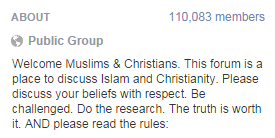
I’m not exactly sure if I’ve lost my sanity or if I’m misunderstanding something. Let’s take a look at this group’s definition:

cc-2014-mari2


If I’m reading this correctly, this is a group created for the purpose of Muslim and Christian Discussion. Just to ensure I’m understanding this, I checked the group’s “about” definition:


cc-2014-mari6


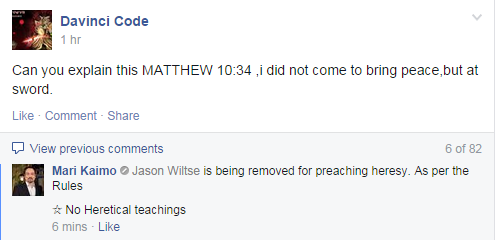
I was a bit surprised while scrolling through my newsfeed to see the following:

cc-2014-mari1

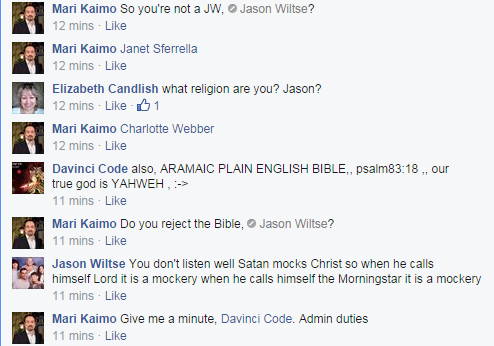
An Anglo-Christian person being removed for heresy, in a group which its purpose is to discuss religious belief…..that’s….odd? So I decided to look a bit closer:

cc-2014-mari3

Mari Kaimo wastes no time, if you reject the Bible – you’re a heretic, which is odd in a group that is dedicated to Christian and Muslim dialogue. It suddenly made sense why I could find at most 1 or 2 active Muslims commenting in the group. They’ve been banning Muslims in a Christian-Muslim religious dialogue group because to them, Muslim beliefs were heretical.

piccard facepalm


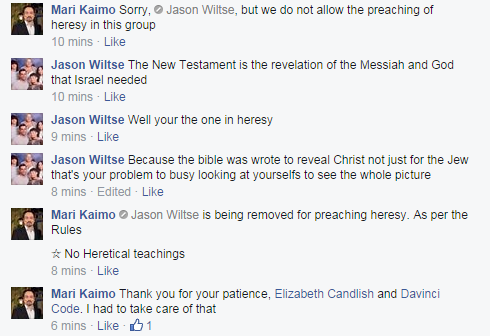
Surely, this “Preacher” and friend of Shamoun would know that in a dialogue group about religion, there would be users who practised different religions in all their forms and differences. Surely? I guess not:

cc-2014-mari4

Where is this leading…?

cc-2014-mari5

I had just one reaction, this just sums it up entirely:

flip table


I’ve seen some pretty ridiculous things in my life. This is by far, one of the single most absurd things I have ever had the displeasure of witnessing. I probably stared at my screen for a few minutes, in sheer awe at the line of reasoning being played out in front of me. To recap….., this is a group created for the purpose of inter-faith dialogue and discussion. However, if you practise a religion which Christianity (as believed in by Mari Kaimo) disagrees with, you’re going to be kicked out/ removed. Surely, there are smarter people out there in the world. I’ve said it once before and I’ll say it again, this guy is a walking, talking, breathing contradiction inside and out. I pray that this is bad sarcasm at work, there is nothing, no excuse that can allow anyone to rationalize the absurdity of such a situation. If this is anything to go by, I thank God that these are the Christian Apologists and Missionaries that currently lead the Christian faith. They have made our job of conveying Islam so much easier. With people like these, there is no question as to why so many Christians quite literally get frustrated and leave the faith. I feel embarrassed for the Christian community because of this guy, in no way does this person represent a religion with 2000 years worth of study behind it.

and God surely, very surely, knows best.

Can Muslims be friends with non-Muslims?

cc-2014-friends

Ustadh Tabraze Azam of Seekers Guidance answers this popular question:

Question: Assalamu alaykum,

I have been recently highly agitated by what I have read in Islamic sources about friendship between Muslims and non-Muslims. Essentially what I have understood is that friendship with non-Muslims is wrong. That so much as eating or chatting with non-Muslims is haram. There is also fatwas insisting that close friendship with non-Muslims is haram.

This seems horrible to me, as well as bigoted. Why is this haram?

Answer: Wa alaikum assalam wa rahmatullahi wa barakatuh,

I pray that you are in the best of health and faith, insha’Allah.

No, it is not unlawful nor disliked to befriend non-Muslims. Thinking otherwise is a misunderstanding of divine revelation and prophetic guidance.

The Qur’anic Verses

Allah Most High says, “The believers should not make the disbelievers their [supporting] allies rather than other believers– anyone who does such a thing will isolate himself completely from God– except when you need to protect yourselves from them.” [3.28]

And, “You who believe, do not take the Jews and Christians as [supporting] allies: they are [supporting] allies only to each other. Anyone who takes them as an ally becomes one of them– God does not guide such wrongdoers.” [5.51]

To read the full answer and its explanation, click here to go to the Seekers Guidance website.

Dr. Michael Brown’s Inflammatory Posts About Muslims

Religion is supposed to cross ethnic, cultural and socio-economic divides. Unfortunately, it has become quite too easy and quite too profitable for some religious individuals to misuse religious ideals to demonize those they disagree with. Below is a post by Dr. Michael Brown, a Christian scholar and missionary who many in the Christian community respect due to his knowledge about Judaism and his works in converting the Jewish peoples. To my displeasure, I saw an inflammatory post by Dr. Brown regarding Muslim beliefs and it is because of this I have decided to share my thoughts on his disrespectful and immature statements. While I understand that he supports the illegal State of Israel, and he is free to do so, and while I understand his ire with ISIS, I cannot allow him to demonize the entire Islamic community by defacing the message of the Qur’aan. Out of all people, he himself should know that it is irresponsible and intellectually dishonest to misrepresent what scripture teaches. Below, we can read the image he has been circulating quite proudly, one may note his watermark in the lower right corner of the image:

askdrbrownI produced the following image, which I encourage Muslims to share with their Christian and Right-Wing friends, including Dr. Michael Brown on his Facebook page.

cc-2014-askdrmichaelbrown

and God knows best.

Islam: The Path of Appreciation and Thanks in Brotherhood

Human relations is perhaps one of the most difficult and treacherous roads in navigating this life of ours. Man is easy to offend, difficult to please, stubborn to forget. There is a truth which Satan the accursed has spoken, whether one chooses to believe in him or not, it is a truth that can be seen and understood by every man, he says:

ثُمَّ لَآتِيَنَّهُم مِّن بَيْنِ أَيْدِيهِمْ وَمِنْ خَلْفِهِمْ وَعَنْ أَيْمَانِهِمْ وَعَن شَمَائِلِهِمْ ۖ وَلَا تَجِدُ أَكْثَرَهُمْ شَاكِرِينَ

“Then I will come to them from before them and from behind them and on their right and on their left, and You will not find most of them grateful [to You].” – Qur’aan 7:17.

It is true that most men are not grateful to God, or that higher power they ascribe to, what some men today call the Universe. Some call it karma, what goes around comes around, an ironic if not cynical cycle of self debasement without realization. Whatever it is that men ascribe to, by and large they are difficult to please and are generally ungrateful to themselves, others and that which they worship or hold to be the power which holds the worlds together. One of the most successful books of the 20th century focused on this very topic, human relations and navigating them. Written in 1937, Dale Carnegie’s “How to Win Friends and Influence People” focused a great deal on advising men in this regard. It is regarded as a must read, and quotes from some of history’s most famous personalities on acquiring the skills needed to establish meaningful friendships and practising empathy towards our fellow man. In reading the book, it mentions:

Lincoln once began a letter saying: ‘Everybody likes a compliment.’ William James said: ‘The deepest principle in human nature is the craving to be appreciated.’ He didn’t speak, mind you, of the ‘wish’ or the ‘desire’ or the ‘longing’ to be appreciated. He said the ‘craving’ to be appreciated.

The book goes on to mention:

I have among my clippings a story that I know never happened, but it illustrates a truth, so I’ll repeat it:

According to this silly story, a farm woman, at the end of a heavy day’s work, set before her menfolks a heaping pile of hay. And when they indignantly demanded whether she had gone crazy, she replied: ‘Why, how did I know that you’d notice? I’ve been cooking for you men for the last twenty years and in all that time I ain’t heard no word to let me know you wasn’t just eating hay.’

When a study was made a few years ago on runaway wives, what do you think was discovered to be the main reason wives ran away? It was ‘lack of appreciation.’ And I’d bet that a similar study made of runaway husbands would come out the same way. We often take our spouses so much for granted that we never let them know how we appreciate them.

A member of one of our classes told of a request made by his wife. She and a group of other women in her church were involved in a self-improvement programme. She asked her husband to help her by listing six things he believed she could do to help her become a better wife. He reported to the class: ‘I was surprised by such a request. Frankly, it would have been easy for me to list six things I would like to change about her – my heavens, she could have listed a thousand things she would like to change about me – but I didn’t. I said to her, “Let me think about it and give you an answer in the morning.”

“The next morning I got up very early and called the florist and had them send six red roses to my wife with a note saying: ‘I can’t think of six things I would like to change about you. I love you the way you are.’

“When I arrived at home that evening, who do you think greeted me at the door: That’s right, my wife! She was almost in tears. Needless to say, I was extremely glad I had not criticised her as she had requested.

“The following Sunday at church, after she had reported the results of her assignment, several women with whom she had been studying came up to me and said, “That was the most considerate thing I have ever heard.” It was then I realised the power of appreciation.’

Yet, in the 7th century CE, some 1200 years before Dale’s book enlightened the educated, free, modern man; Prophet Muhammad ﷺ spoke this very advise. What Dale wrote an entire book on, quoting some of the most famous men in history, the Prophet Muhammad ﷺ spoke in one powerful sentence:

“Whoever is not grateful to the people, he is not grateful to Allah.”

قَالَ رَسُولُ اللَّهِ صلى الله عليه وسلم ‏ “‏ مَنْ لَمْ يَشْكُرِ النَّاسَ لَمْ يَشْكُرِ اللَّهَ ‏” – at-Tirmidhi: Volume 4, Book 1, Hadith 1995. “Chapter on Righteousness and Maintaining Good Relations with Relatives”. 

cc-2014-islamthanks

This sublime Prophet narration is graded as authentic by the scholars of hadith. It is the mark of a great mind, a great man to elucidate the masses by enunciating the wisest of teachings in the simplest of ways. What this Prophetic narration proposes, is that gratefulness, appreciation, thanks to our fellow man is needed to establish a relationship with the Creator, the Lord of the Worlds. That is the most important relationship anyone can have, and to achieve this, one must appreciate his brothers, sisters, spouse, friends, parents – everyone. This is all that anyone has to say on the matter. An entire book is not needed. We can extract more of such beautiful teachings from among the Prophetic narrations:

“O Abu Hurairah, be cautious, and you will be the most devoted of people to Allah. Be content, and you will be the most grateful of people to Allah. Love for people what you love for yourself, and you will be a (true) believer. Be a good neighbor to your neighbors, and you will be a (true) Muslim. And laugh little, for laughing a lot deadens the heart.”

قَالَ رَسُولُ اللَّهِ ـ صلى الله عليه وسلم ـ ‏ “‏ يَا أَبَا هُرَيْرَةَ كُنْ وَرِعًا تَكُنْ أَعْبَدَ النَّاسِ وَكُنْ قَنِعًا تَكُنْ أَشْكَرَ النَّاسِ وَأَحِبَّ لِلنَّاسِ مَا تُحِبُّ لِنَفْسِكَ تَكُنْ مُؤْمِنًا وَأَحَسِنْ جِوَارَ مَنْ جَاوَرَكَ تَكُنْ مُسْلِمًا وَأَقِلَّ الضَّحِكَ فَإِنَّ كَثْرَةَ الضَّحِكِ تُمِيتُ الْقَلْبَ ‏”‏ ‏.‏ – Sunan ibn Majah, Volume 1, Book 37, Hadith 4217. “The Book of Zuhd”.

Appreciation comes in many forms, not just in mere words. The Prophetic narrations mention:

The Prophet (ﷺ) said, “A man felt very thirsty while he was on the way, there he came across a well. He went down the well, quenched his thirst and came out. Meanwhile he saw a dog panting and licking mud because of excessive thirst. He said to himself, “This dog is suffering from thirst as I did.” So, he went down the well again and filled his shoe with water and watered it. Allah thanked him for that deed and forgave him. The people said, “O Allah’s Messenger (ﷺ)! Is there a reward for us in serving the animals?” He replied: “Yes, there is a reward for serving any animate (living being).”

‏”‏ بَيْنَا رَجُلٌ بِطَرِيقٍ، اشْتَدَّ عَلَيْهِ الْعَطَشُ فَوَجَدَ بِئْرًا فَنَزَلَ فِيهَا فَشَرِبَ، ثُمَّ خَرَجَ، فَإِذَا كَلْبٌ يَلْهَثُ يَأْكُلُ الثَّرَى مِنَ الْعَطَشِ، فَقَالَ الرَّجُلُ لَقَدْ بَلَغَ هَذَا الْكَلْبَ مِنَ الْعَطَشِ مِثْلُ الَّذِي كَانَ بَلَغَ مِنِّي، فَنَزَلَ الْبِئْرَ، فَمَلأَ خُفَّهُ مَاءً، فَسَقَى الْكَلْبَ، فَشَكَرَ اللَّهُ لَهُ، فَغَفَرَ لَهُ ‏”‏‏.‏ قَالُوا يَا رَسُولَ اللَّهِ وَإِنَّ لَنَا فِي الْبَهَائِمِ لأَجْرًا فَقَالَ ‏”‏ فِي كُلِّ ذَاتِ كَبِدٍ رَطْبَةٍ أَجْرٌ ‏”‏‏.‏ – Sahih al Bukhari, Book 46, Hadith 27. Alternatively, Sahih al-Bukhari 2466.

The Prophetic example has emphasized the importance of appreciating others in words, thought and action. If we wish to adhere to the command of God, we must adhere to the Prophetic example of Muhammad ﷺ. Whether you are a Muslim, or not, this is indispensable advice as articulated by him, or as later given by men throughout history. Either way, one can only benefit from the path of appreciation and giving thanks to others.

and Allaah knows best.

China’s Violent Christian Cult [BBC]

You won’t find this as an example of religious extremism on David Wood’s site or on Atlas Shrugs. I’d like to emphatically state that this cult is not representative of all Christians or of the Christian faith. What this video is an example of, is the end result of radical, violent, hateful figures who prey on those who don’t agree with their extremist rhetoric. Humans partake in religion, humans are violent, religious humans can be and will be violent – it’s human nature and they’ll justify their violence through whatever philosophy or ideology or religion that allows them to do so. What people like Sam Shamoun and David Wood are afraid to come forward and say is that Christians have been and can be violent too. It’s just under reported. They will celebrate and gladly announce how the Christian Church is growing in China, but they will never say that it as a result of violent, hateful Churches like these, producing cults!

Maybe someone can shoot David Wood or Pamela Geller an email and ask them why they don’t also highlight the growing trend of violent Chinese Christian cults?

and God knows best.

The Problem of Luke 23:34

Introduction

Luke 23:34 is perhaps one of the most interesting verses in the New Testament narrative of Jesus, the son of Mary’s alleged crucifixion. It reads as follows[1]:

Jesus said, “Father, forgive them, for they do not know what they are doing.”[c] And they divided up his clothes by casting lots.

Our interest is primarily focused upon the prayer[2] of Jesus. The questions which are being asked are, why is Jesus praying for these men’s forgiveness? What purpose does it convey? What does it achieve? These questions need to be asked, as Jesus’ prayer in this case, occurs before his eventual death on the cross which is supposed to have ushered in a new covenant with God, a new doctrine of salvation. His death and resurrection which establishes itself as the pillar upholding the veracity and validity of the Christian faith as declared by Paul of Tarsus:

And if Christ has not been raised, our preaching is useless and so is your faith.[3]

Summarily, we are seeking to establish the reasoning for this prayer of forgiveness, in regard to its timing of the slaying of the lamb[4] for the forgiveness of the sins of the world[5], inclusive of those of the Jews and Romans who were no doubt instrumental in the events leading to the crucifixion event.

New Testament Textual Criticism of Luke 23:34

It would be inane to discuss the consequences of the verse in question at length, before establishing its place in the New Testament canon. Most would be unaware that this verse’s place in the canon is one of disputation and doubt. It would be of note to mention that the verse is recorded in the following versions of the English Print Editions of the New Testament [6]:

  • New International Version
  • New Living Translation
  • English Standard Version
  • New American Standard Bible
  • King James Bible
  • Holman Christian Standard Bible
  • International Standard Version
  • NET Bible
  • Aramaic Bible in Plain English
  • GOD’S WORD® Translation
  • Jubilee Bible 2000
  • King James 2000 Bible
  • American King James Version
  • American Standard Version
  • Douay-Rheims Bible
  • Darby Bible Translation
  • English Revised Version
  • Webster’s Bible Translation
  • Weymouth New Testament
  • World English Bible
  • Young’s Literal Translation

It had become necessary to list the instances of its presence in the English translations, as it is the language in which this article is being written. It was also necessary, so as to demonstrate its undoubted and frequent presence in the most accessible New Testament print editions in the English language. A noted citation in the NIV[7] translation reads as follows:

c. Luke 23:34 Some early manuscripts do not have this sentence.

Its presence in most translations is due to the verse’s presence in the modern critical editions of the Greek New Testament. As of this writing, it remains in the critical editions as is demonstrated by the Nestle-Aland 28th Greek New Testament[8]:

ὁ δὲ Ἰησοῦς ἔλεγεν· πάτερ, ἄφες αὐτοῖς, οὐ γὰρ οἴδασιν τί ποιοῦσιν. διαμεριζόμενοι δὲ τὰ ἱμάτια αὐτοῦ ἔβαλον κλήρους.

Codex Aleph  (א- Sinaiticus) does contain this verse[9], although atleast one of its suggested scribes or editors is thought to have edited or corrected the verse in question[10]. However Codices B (Vaticanus) and D (Bezae) do not contain this verse[11], thus explaining the citation in the NIV translation. At the time of this writing, I do not have access to the apparatus of the Nestle Aland 28th Edition Greek New Testament, therefore I was unable to attain the reasons or sources it outlines for the inclusion of the verse. However, in reading the erudite work of Bruce Metzger and Bart Ehrman, we note that it states the following in regard to its intentional omission in other codices[12]:

…an omission that makes particular sense if Jesus is understood to be asking God to forgive the Jews responsible for his crucifixion.

Their understanding of the omission is in the context of Jewish-Christian relations, more specifically, anti-Jewish Christian scribes within the first centuries of Christianity and the consequential promulgation of their views in Christian literature. The omission was meant to remove the view that Jesus the Christ had prayed for the forgiveness of the Jews for their role in his crucifixion[13]. There is also a Textual Critical maxim, which reads as follows: “lectio difficilior potior” – the more difficult/nonsensical reading is more evidential. Given that their is a possibility of intentional omission, then their is great possibility it was included in the earlier copies of the Gospel.

Having explored its place in the canon and the evidences for its inclusion, there is now no doubt that at the time of this writing, New Testament Textual Critics adhere to its inclusion despite its omission from two important early sources.

The Prayer in Light of the New Covenant & its Soteriological Plan

The traditional Christian soteriological belief in this doctrine of salvation by the Christ’s crucifixion can be understood in the following quote[14]:

Christ upon the cross, is gracious like Christ upon the throne. Though he was in the greatest struggle and agony, yet he had pity for a poor penitent. By this act of grace we are to understand that Jesus Christ died to open the kingdom of heaven to all penitent, obedient believers.

With his sacrifice, the gates of heaven were opened to the world[15]. The Gospel accounts inform us that Jesus the Christ a priori knew that he had to be crucified, we read:

And he said, “The Son of Man must suffer many things and be rejected by the elders, the chief priests and the teachers of the law, and he must be killed and on the third day be raised to life.”[16]

The Son of Man will go as it has been decreed. But woe to that man who betrays him!”[17]

‘The Son of Man must be delivered over to the hands of sinners, be crucified and on the third day be raised again.’ ”[18]

The Son of Man will go just as it is written about him. But woe to that man who betrays the Son of Man! It would be better for him if he had not been born.”[19]

Since it is established in the narrative, as ascertained from the verses listed previously that his eventual crucifixion and death would lead to the payment of the sins of the world, then it is a strange occurrence that the Christ would pray for someone’s forgiveness. If he knew his death was imminent and with that, forgiveness would be brought upon the world, why would he beseech the Father for the forgiveness of others? Perhaps an analogy can demonstrate the peculiarity and absurdity of this event. It is as if I had a letter in my possession. Knowing that I’m about to use a photocopying machine to duplicate that letter, just before I use the photocopier, I choose to handwrite the letter on a sheet of blank paper and then photocopy the original letter. It’s redundant, anachronistic, futile. Jesus undoubtedly knows that the entire world, inclusive of those men before him; that he is about to pay for their sins, yet he prays to the Father just before his death that their sins should be forgiven. Regardless of someone’s theological, philosophical or personal views, the oddity of this occurrence is striking.

Such an understanding is noted by the exegete Matthew Henry, for he states[20]:

As soon as Christ was fastened to the cross, he prayed for those who crucified him. The great thing he died to purchase and procure for us, is the forgiveness of sin.

In essence, he prayed for the same thing that his death would achieve. Some might postulate that this is a sign of Jesus’ mercy and love for mankind, as is held by Stier et al; we read from the Pulpit Commentary the following[21]:

Then, as always, thinking of others, he utters this prayer, uttering it, too, as Stier well observes, with the same consciousness which had been formerly expressed, “Father, I know that thou hearest me always.” “His intercession has this for its ground, though in meekness it is not expressed: ‘Father, I will that thou forgive them.”

While such an apologetic exegesis would placate some, I do not find it to be sensible. For, if Jesus the Christ, who is also the Son; a deity capable of forgiving sin as is claimed from Luke 7:48[22], then why did the Son simply not forgive the sins of the world, or the sins of the Roman and Jewish persecutors? He clearly had the ability to do so, the authority to do so, so why would the Son choose not to do this? Instead, the Son as we are led to believe, chooses to beseech the Father! This prayer therefore leads to an even greater problem, (it implies) subordination and hierarchy within the Trinitarian dogma. Beliefs tantamount to heresy when tested against the proto-orthodoxical Nicaean creed[23], which establishes the Son as co-equal to God[24]:

Such is the genuine doctrine of Arius. Using Greek terms, it denies that the Son is of one essence, nature, or substance with God; He is not consubstantial (homoousios) with the Father, and therefore not like Him, or equal in dignity, or co-eternal, or within the real sphere of Deity.

Jesus the Christ, otherwise known to Christendom as the Son, had the ability to forgive sins, he did not need to request that the Father do this. If he prayed out of love, mercy, grace and compassion for the forgiveness of the sins of the Roman and Jewish persecutors, then why did he not use this love, mercy and grace to absolve them of their sins? He is in essence, praying for something he could already grant them, therefore this excuse is redundant and unremarkable, in clear contradiction of this fanciful idea of proposed love, mercy, grace and compassion.

Did They Need to be Forgiven?

Whether the prayer was uttered in reference to the Jews, the Romans, or some combination of those peoples; did they need to be forgiven? Forgiving them would readily imply that their actions were sinful, criminal, morally wrong. However as we are well aware, and as I have previously stated, the sacrificing of a sacrificial lamb is the purpose[25] of Christ’s earthly mission. This prayer for forgiveness would then have us believe that the sacrifice was morally wrong according to Jesus himself! The significance of such a prayer is now very telling, it is detrimental to the sacrificial imagery steadily enforced throughout the New Testament and as referenced previously[26]. Christians do not believe that Christ’s sacrifice was sinful or wrong, it is the very foundation of their faith as we had read from the Apostle Paul[27]!

We are at an unfortunate dilemma, Christ’s prayer now seems to be undermining the very pillars of proto-orthodox Christian belief. If it was God’s will that the world be saved from their sins by the hands of the Romans and Jews, then it is absurd that we should consider the persons responsible for the crucifixion as sinful individuals. Rather, if the Christian world is to be consistent with their beliefs, these men should be celebrated, just as the cross is celebrated. However, if it is the case that Jesus considered his persecutors that led to his crucifixion as criminals, as murderers, then the possibility of Jesus’ death being labeled as a crime and an injustice done to him is significantly more appropriate and honest. Such a view would be in blatant violation of the Christian world view on salvation. Perhaps what is more troubling is the position of those who perform the Passover sacrifice, we read the following[28]:

“Get rid of the old yeast, so that you may be a new unleavened batch—as you really are. For Christ, our Passover lamb, has been sacrificed.”

If Jesus the Christ is to be considered the sacrificial lamb, then those who perform the sacrifice for Passover have been atoned of their sins as is clearly stipulated in the Pentateuch[29]:

For the life of a creature is in the blood, and I have given it to you to make atonement for yourselves on the altar; it is the blood that makes atonement for one’s life.

If we are to believe that Luke 23:34 is in relation to the Jews, then Jesus’ prayer of forgiveness for them is troubling, for it would then imply that the very God of the Jews, did not know that the sacrificing of the Passover lamb was not a crime, but an act of atonement for the Jews.

Conclusion

There are very few cases in which we can understand the purpose of this prayer. One scenario is that Jesus did not expect his death to open the gates of forgiveness and that he did not have the ability to forgive sins by his own will and authority, therefore his prayer to God was one in sincerity. However, if he did know that his eventual death would lead to the world’s forgiveness and that he had the ability to forgive sins without any sacrifice, then his prayer to God seems out of place and problematic to the narrative, rendering his prayer to be completely redundant and meaningless.

Another case in which we can perhaps derive some closure on the issue, is that if Jesus was in fact the sacrificial Passover lamb, then his prayer for forgiveness for the Jews, would mean that he either did not know the laws of the Pentateuch, or that he did not consider himself to be a sacrificial Passover lamb; the latter belief would then render Paul a liar and would cause the Christian faith to be false as per his declaration in 1 Corinthians 15:14.  The former argument would then have us believe that Jesus could not be a deity as he is ignorant of the very law which he would have instructed the Jews himself.

Whichever way the prayer is examined, as I have aptly demonstrated it is of grave detriment to the Christian faith and without a doubt its place in the Biblical canon is of service to those who which to prove that Jesus the Son of Mary, is not and has never been a deity.

and Allaah knows best.

Sources (APA Style):

[1] –  Holy Bible, New International Version®, NIV®. (2011). Luke 23:34. Retrieved from http://www.biblegateway.com/passage/?search=Luke%2023&version=NIV

[2] – Concise Commentary on the Whole Bible by Matthew Henry. (2003). Luke 23:34. Retrieved from http://biblehub.com/commentaries/mhc/luke/23.htm

[3] – Holy Bible, New International Version®, NIV®. (2011). 1 Corinthians 15:14. Retrieved from http://www.biblegateway.com/passage/?search=1+corinthians+15%3A14&version=NIV

[4] – Holy Bible, New International Version®, NIV®. (2011). Revelation 5:12. Retrieved from http://www.biblegateway.com/passage/?search=Revelation+5%3A12&version=NIV

[5] – Holy Bible, New International Version®, NIV®. (2011). John 3:16. Retrieved
from http://www.biblegateway.com/passage/?search=John+3%3A16&version=NIV

[6] – Bible Hub’s Parallel Verses. (2014). Luke 23:34. Retrieved from http://biblehub.com/luke/23-34.htm

[7] – See: [1]

Note: The Pulpit Commentary, Ibid, relates the same conclusion as I have written:

” These words are missing in some of the oldest authorities. They are found, however, in the majority of the most ancient manuscripts and in the most trustworthy of the old versions, and are undoubtedly genuine.”

[8] – Nestle-Aland Novum Testamentum Graece. (2013). Luke 23:34. Retrieved
from http://www.nestle-aland.com/en/read-na28-online/text/bibeltext/lesen/stelle/52/230001/239999/

[9] – Codex Sinaiticus. (2009). Luke 23:34. Retrieved
from  http://codexsinaiticus.org/en/manuscript.aspx?book=35&chapter=23&lid=en&side=r&verse=34&zoomSlider=0

[10] – Ibid. See the transcription notes, Editor cb2.

[11] – Cambridge Bible for Schools and Colleges. (1891). Luke 23:34. Retrieved from http://biblehub.com/commentaries/cambridge/luke/23.htm

[12] – Ehrman, B., & Metzger, B. (Eds.). (2005). The Text of the New Testament: Its Transmission, Corruption and Restoration (4th ed.). New York, NY: Oxford University Press.

[13] – Ibid.

[14] – See: [2]

[15] – See: [5]

[16] – Holy Bible, New International Version®, NIV®. (2011). Luke 9:22. Retrieved
from http://www.biblegateway.com/passage/?search=Luke+9%3A22&version=NIV

[17] – Holy Bible, New International Version®, NIV®. (2011). Luke 22:22. Retrieved
from http://www.biblegateway.com/passage/?search=Luke+22%3A22&version=NIV

[18] – Holy Bible, New International Version®, NIV®. (2011). Luke 24:7. Retrieved
from http://www.biblegateway.com/passage/?search=Luke+24%3A7&version=NIV

[19] – Holy Bible, New International Version®, NIV®. (2011). Matthew 26:24. Retrieved
from http://www.biblegateway.com/passage/?search=Matthew+26%3A24&version=NIV

[20] – See: [2]

[21] – The Pulpit Commentary. (2010). Luke 23:34. Retrieved from http://biblehub.com/commentaries/pulpit/luke/23.htm

[22] – Holy Bible, New International Version®, NIV®. (2011). Luke 7:48. Retrieved
from http://www.biblegateway.com/passage/?search=luke+7%3A48&version=NIV

[23] – The Nicaean Creed. (n.d.). The Nicaean Creed. Retrieved from http://www.creeds.net/ancient/nicene.htm

[24] – Barry, W. (1907). Arianism. The Catholic Encyclopedia. New York: Robert Appleton Company. Retrieved June 11, 2014 from New Advent: http://www.newadvent.org/cathen/01707c.htm

[25] – See: [16], [17], [18], [19]

[26] – See: [4]

[27] – See: [3]

[28] – Holy Bible, New International Version®, NIV®. (2011). 1 Corinthians 5:7. Retrieved
from http://www.biblegateway.com/passage/?search=1%20Corinthians%205:7&version=NIV

[29] – Holy Bible, New International Version®, NIV®. (2011). Leviticus 17:11. Retrieved
from http://www.biblegateway.com/passage/?search=Leviticus%2017:11&version=NIV


« Older Entries Recent Entries »