Jonathan McLatchie Attacks White Converts to Islam

yahyasnow's avatarYahya Snow's Blog

Jonathan McLatchie, who appears to be writing for numerous blogs/websites nowadays, made some interesting comments on ‘white converts’ to Islam recently – he was  arguing the majority of white converts from Christianity to Islam are ignorant of Christian doctrine (he based this conclusion on two ‘white’ converts and a black convert who he mistakenly thought was white. I’m not too sure why there was such a focus on the white demographic but it became quite apparent that McLatchie had not bothered to even research the ‘white’ converts he was attacking. Or perhaps his research uncovered Khalid Yasin used to be white:)

Having said that his criticism was not consistent as Jonathan McLatchie openly admits the majority of church-goers are ignorant of the Trinity concept – thus it seems redundant for him to bash ‘white’ converts, from Christianity to Islam, for having a knowledge base on par with the average Christian…

View original post 35 more words

Is David Wood an ISIS Apologist?

An apologist is one who presents a ‘reasoned defense’ of something, whether that be a faith, an ideology, an argument, a belief, etc. David Wood of the anti-immigrant, right-wing blog Answering Muslims, is a self-professed ISIS apologist (he defends ISIS’ beliefs), supporter (supports their theological beliefs as the ‘true Islam’) and recruiter (condemns Muslims who do not ‘truly follow their Islam’).

cc-davidwood

David Wood 

For many years, David has repeatedly sought to defend and promote ISIS’ violent beliefs. He’s shared many of their common beliefs about the Qur’an and Islam. In a video published last year, David Wood sought to legitimize ISIS’ medieval and violent interpretation of the Qur’an by arguing that the terrorist group’s approach to the Qur’an was not only valid, but the most appropriate and most valid means of understanding the Islamic scripture. He further argued in the video, that ISIS’ version and brand of violent Islam, was the ‘truest form of Islam’, that ‘correctly represented the teachings of the Islamic Prophet’.

As can be seen in the above video, David, who is a career apologist in the interfaith community, attempted to justify and qualify ISIS’ actions and beliefs by appealing to the Islamic scripture. The video which has garnered over 250, 000 views is one of the very few ISIS videos used to defend and legitimize the terrorist group’s brand of Islam. ISIS supporters have traditionally attempted to legitimize their violent actions by re-interpreting the Qur’an and Prophetic Sunnah to suit their violent message. David’s video sought to legitimize ISIS’ actions by presenting a select few passages of the Qur’an and by providing his own interpretation of those passages within a violent context.

This ISIS recruitment video, which has been shared on YouTube, seeks to encourage Western Muslims to believe that ISIS’ faith is the correct faith to follow. David argues that Muslims who do not follow these violent interpretations of the Qur’an are actually failing to practise Islam properly. As an ISIS supporter, David rejects the notion of a true Islam, outside of ISIS’ teachings (in a debate with anti-ISIS Muslim Osama Abdallah, David argues that ISIS is the true Islam that Muslims must follow). Similarly, as an ISIS recruiter, David is against Muslim migration to Europe and the Americas. He shares the terrorist group’s belief that Muslims must stay in the newly created ‘Khilafa’, and that they must be rejected from entering Western nations, adhering to the belief that Western nations are Dar al Harb.

In an attempt to further legitimize and promote ISIS’ ideology, David justified the Paris attack by ISIS as a ‘true Jihad’. This however, should have been expected, as David had previously released a video teaching the ‘three stages of Jihad’, at one point in his video lesson he proclaims that the third and final stage is to practise terrorism against non-Muslims. These two videos are part of ISIS’ attempt to recruit Muslims who are following other forms of Islam, the traditional forms of Sunni Islam. David’s videos are ISIS tutorials on their approach to, and understanding of the Islamic scriptures and beliefs. As an ISIS apologist, legitimizer, and recruiter, David has perhaps the largest audience of them all. In a Twitter post dated December 4th 2015, David Wood posted another tweet endorsing and teaching the belief that Muslims must, ‘fight those who do not believe in Allah’.

It remains whether to be seen why David, despite his popularity as an ISIS recruiter, who openly teaches and shares video lessons about their doctrine, is being allowed to remain actively spreading ISIS’ message on social media. His video lessons about following the true teachings of ISIS’ brand of Islam are also being funded through donations. As recently as a few months ago, David openly called for donations to fund equipment for his recruitment videos. In one post he claims to have received over $1999 (USD), to purchase cameras to use in his debates, one of which he argued that ‘Muslims should be violent because the Qur’an teaches them to be so’ (see his debate, is the Qur’an a book of peace?).

As a Muslim who opposes the message, teachings and actions of ISIS, I am appalled at David Wood’s public legitimizing and defending of ISIS’ beliefs. I reject ISIS’ beliefs and consider them to be heretical, whereas David Wood considers their beliefs to be authentic and the ‘true Islam’.

and God knows best.

Donald Trump Wants Ban on Muslims

Donald Trump, the current Republican presidential front runner recently proposed that Muslims should be banned from entering the United States of America:

“Without looking at the various  polling data, it is obvious to anybody the hatred is beyond comprehension. Where this hatred comes from and why we will have to determine,” Trump said in a statement. “Until we are able to determine and understand this problem and the dangerous threat it poses, our country cannot be the victims of horrendous attacks by people that believe only in Jihad, and have no sense of reason or respect for human life.” – CNN.

donald trump

Donald Trump

However, we do know at least one of the major motivating factors. Former Senator Warren Rudman who served on the President’s Foreign Intelligence Advisory Board from 1997 to 2000, and who co-chaired a bipartisan commission on national security, in an interview with PBS stated:

“These are fundamentally very, very sick people, who believe it is all right to take thousands of lives because they believe that their basic beliefs and geopolitical views are not being observed by the United States government.” – PBS.

“Are you telling me there are people who disagree totally with our foreign policy? You bet there are. You bet there are. And is it a potential contributor to this problem? You bet it is. Question: What do we do about it?” – PBS.

Former CIA intelligence officer Michael Scheuer, stated that events on September 11th occurred due to America’s “horrid” foreign policy strategies.

Special Supervisor with the FBI, Agent James Fitzgerald, stated:

“At the 12th and final public hearing of the 9/11 commission on 16 June, 2004, in Washington DC, a phalanx of senior law-enforcement and intelligence officials from the US government arrived to offer their testimonies. “You’ve looked [at] and examined the lives of these people as closely as anybody … What have you found out about why these men did what they did?” asked Lee Hamilton, the former congressman and vice-chair of the commission. “What motivated them to do it?” The answers to these questions were provided by supervisory special agent James Fitzgerald of the FBI. “I believe they feel a sense of outrage against the United States”, he said. “They identify with the Palestinian problem, they identify with people who oppose repressive regimes and I believe they tend to focus their anger on the United States.” – NY TimesThe Guardian.

A study by the National Bureau of Economic Research further states that, “civilian casualties in Afghanistan at the hands of foreign troops creates enemies and causes people to become radicalised“. As the report itself states, “In Afghanistan we find strong evidence that local exposure to civilian casualties caused by international forces leads to increased insurgent violence over the long-run, what we term the ‘revenge’ effect.”

Therefore, it’s not a case of “we” having to determine and understand this problem, we already know what the problems are. The research indicates to us what the problems are. As a Muslim, while I myself reject and denounce the barbaric killing of innocents, there is a mountain worth of data available for anyone willing to understand why these attacks occur. His proposal therefore, is unadulterated rhetoric meant to pander to his audience. It has nothing to do with preventing terrorism, or with trying to remedy the issues that contribute to terrorism. His ignorance of the data, does not excuse him from his responsibility to make statements based on rational and informed thinking.

and God knows best.

Sam Shamoun Demonizes Dr. James White

In light of a recent video being circulated regarding Dr. James White’s views on terrorism and Islam, and another video using Dr. White’s video by Br. Yahya Snow, Sam Shamoun has taken it upon himself to vilify Dr. White:

cc-2015-ss-jameswhite

Whether or not Sam deletes this post, or removes his insulting comments, his claim against Dr. White has nothing to do with the contents of White’s latest video on terrorism and Islam. Apparently Sam has been holding a vitriolic view of Dr. White for sometime, going as far back as maligning another Christian scholar Craig (not sure if WLC – bad Trinity analogy?, Evans or otherwise).

After encouraging his ‘fan base’ to attack Dr. White, it remains to be seen whether Sam will apologize for breaking some tenets of his faith:

These six things doth the Lord hate: yea, seven are an abomination unto him:

1) A proud look,
2) a lying tongue, and
3) hands that shed innocent blood,
4) An heart that deviseth wicked imaginations,
5) feet that be swift in running to mischief,
6) A false witness that speaketh lies, and
7) he that soweth discord among brethren.

– Proverbs 6:16-19 (Sourced by Francis Turretin).

and God knows best.

Are there Chains of Transmissions for Early Patristic Witnesses?

Question:

A Christian polemicist who previously compared Muslims to a cancer in Europe, and who denied that God inscribed the 10 commandments on tablets to Moses, has claimed that there is a chain of transmission linking the apostles of Jesus to the early Church Fathers. Is this true? How, do we respond to this?

Answer:

There is nothing to respond to. The author of the aforementioned article does not seem to understand the basics of hadith criticism, and reduces the science of hadith criticism to merely throwing some names together and linking them through obscurity. It should be noted that in reading that poor article, the author depends solely on one disciple and solely on one Patristic, with two extremely obscure quotes whose works we no longer have the autographs (originals) for. After several hundred words, the author could not sum his evidences to provide a basis for a single da’eef (weak) chain of transmission. Under hadith criticism, especially that of mustalah or rijal, the hadith sciences would have no other option to regard that claim of a “chain”, as nothing more than hearsay.

Regarding his quotes, Papias and Polycarp are said to have been contemporaries of each other. Eusebius in the 4th century, corrects Papias in his assertion that he knew John the apostle. It is disputed which John that Papias knew. If Papias and Polycarp were contemporaries, and the Christians of the 4th century couldn’t identify which of the four Johns he knew (John the apostle, John the elder, John of Patmos or a John with a combination of any of the previous identities), how can someone 2000 years later claim to make that identification for Papias’ contemporary, Polycarp? Furthermore, it should be noted that Polycarp himself not once quotes or references John the apostle in any of his extant writings, and Iraeneus who in the late second century recorded the claim that Polycarp knew John, heard this in his childhood. There are literally no other sources which can corroborate something that Iraeneus writing in the late second century, claims to have heard in his childhood, much less so from any of the extant writings of Polycarp himself.

The author of the aforementioned article, in a case of pure desperation attempts to quote Ignatius’ work to qualify the claim of early Trinitarian beliefs, whereas it should be known that Ignatius’ works are only survived through Eusebius in the 4th century, with absolutely no verifiable chain of transmission between the two. In other words, it has been demonstrated that the author himself is unfamiliar with the hadith sciences to the point he could not offer a single chain of transmission or the chain’s grading, or a jarh of any of the names mentioned in the overly lengthy article. His sole reliance on one obscure quote without any other witness or comment by Iraeneus himself, demonstrates the desperation of the author to forcibly create an instance of a chain of transmission. In my debate earlier this year, I consulted with a New Testament Professor and a scholar of the hadith sciences to examine the chains of transmission in the early Church. A basic summary of the results of our labour can be found in that debate:

It is clear that the author of the article was not attempting to present a studied argument. Due to the nature of the blog he posted the article to, it can thus be deduced that he was pandering to lay-Christians with no scholastic interest in either Christianity or Islam. I forwarded his article to both the New Testament Professor and hadith scholar I worked with on examining Patristic chains of transmission, and both of them replied quite negatively. Another brother, who discussed this topic with a prominent Christian New Testament scholar and historian, also replied negatively to the claims in the article (not to the article itself). I have not sought permission from any of these persons to reproduce their comments on this website. Should the case arise for me to do so, I will, with great pleasure. However, it is saddening that the Christian author has chosen to align himself with an anti-immigrant polemicist, whose venom Dr. James White in a recent video attempted to dissuade Christians from endorsing. It would then seem, that the author is more interested in pandering to a racist crowd, that conforms to his views, than to do objective, intelligent and honest academic research.

In this article, using a single criteria from the hadith sciences, I demonstrated that the New Testament does not meet the criteria of a da’eef (weak) narration.

In this article, using a single criteria from the hadith sciences, I demonstrated that none of the New Testament literature, can be validated or verified as being from Jesus ‘alayhi as salaam or his apostles, since none of the alleged transmitters can stand up to rijal al hadith.

and Allah knows best.


Does Isaiah 9:6 Ascribe Divinity to Jesus?

Question:

Missionaries claim that Isaiah 9:6 refers to Jesus. They state that this proves he is God. How do we respond to this?

Answer:

Let’s begin by quoting Isaiah 9:6

For a child has been born for us;
a son has been given to us.
And the dominion will be on his shoulder,
and his name is called Wonderful Counselor, Mighty God,
Everlasting Father, Prince of Peace.

Missionaries tend to focus on one aspect of the text, the terms “son” and “Mighty God”. However, a quick look at the text proves that this passage does not refer to Jesus. The child has already been born, the verb is in the past tense, “has been born”. Since Jesus had not yet been born, then this disqualifies him from being the subject in the passage. Furthermore, it is said that the child would be called, “everlasting Father”. Since Jesus is the Son, and not the Father, then this passage most certainly does not refer to him.

The missionary might claim that the term, “everlasting Father” is just a description of divine attributes, not meant to be taken literally. In that case, we need to ask, how can that be when you have already interpreted the title “Mighty God”, literally? Either you accept the text as is and interpret all the names figuratively, or you interpret all of them literally. Thus, this verse is not a proof text for the divinity of Jesus. It is a proof text against the divinity of Jesus and most Christians do not read this passage carefully or sensibly.

and Allah knows best.

A Brief Refutation of the Gharaniq (Satanic Verses) Claim

A Brief Refutation of the Gharaniq (Satanic Verses) Claim by Hamza AA

This topic has been often been used by missionaries and Islamophobes to cast doubts about Islam, as such it merits at least a brief response.

What is the Gharaniq (Satanic Verses) Claim?

According to the fictional story, the Prophet Muhammad (peace be upon him) wished that Allah would reveal verses (of the Qur’an) so that he could have reconciled with his tribe. Satan took this opportunity to manipulate the Prophet Muhammad’s (peace be upon him) mind with certain words, which he mistook for Qur’anic verses, and recited them in praise of pagan idols.

By the Star when it sets, your comrade does not err, nor is he deceived; nor does he speak out of (his own) desire …

and when he came to the words:

Have you thought upon al-Lat and al-Uzza and Manat, the third, the other?

Satan cast on his tongue (because of his desire for reconciliation with his tribe) the words:

These are the high-flying cranes; verily their intercession is accepted with approval

Upon hearing these verses, the Muslims and pagans jointly prostrated in worship. Later, Angel Gabriel appeared to Prophet Muhammad (peace be upon him) and informed him that he (Gabriel) had not revealed those words to him. The Prophet got very upset with himself for having lied about God and falsely promoting the worship of idols. God then comforted him with the claim that such confusion had happened to all Prophets (peace be upon them) in the past:

And We did not send before you any messenger or prophet except that when he spoke [or recited], Satan threw into it [some misunderstanding]. But Allah abolishes that which Satan throws in; then Allah makes precise His verses. And Allah is Knowing and Wise. (22: 52)

The Prophet then publicly retracted the false verse:

He certainly saw of the greatest signs of his Lord. (53:18) So have you considered al-Lat and al-‘Uzza? (53:19)  And Manat, the third – the other one? (53:20)

This in turn angered the pagans who rejected and hated Islam.
An example From Tabari [1192-1193], vol. 6, pp. 108-110 reads:

“Ibn Humayd – Salamah – Muhammad b. Ishaq – Yazid b. Ziyad al-Madani – Muhammad b. Ka’b al-Qurazi: When the Messenger of God saw how his tribe turned their backs on him and was grieved to see them shunning the message he had brought to them from God, he longed in his soul that something would come to him from God which would reconcile him with his tribe. With his love for his tribe and his eagerness for their welfare it would have delighted him if some of the difficulties which they made for him could have been smoothed out, and he debated with himself and fervently desired such an outcome. Then God revealed:

By the Star when it sets, your comrade does not err, nor is he deceived; nor does he speak out of (his own) desire …and when he came to the words:

Have you thought upon al-Lat and al-Uzza and Manat, the third, the other?

Satan cast on his tongue, because of his inner debates and what he desired to bring to his people, the words:

These are the high-flying cranes; verily their intercession is accepted with approval.

When the Quraysh heard this, they rejoiced and were happy and delighted at the way in which he spoke of their gods, and they listened to him, while the Muslims, having complete trust in their Prophet in respect of the messages which he brought from God, did not suspect him of error, illusion, or mistake. When he came to the prostration, having completed the surah, he prostrated himself and the Muslims did likewise, following their Prophet, trusting in the message which he had brought and following his example….The Quraysh left delighted by the mention of their gods which they had heard, saying, ‘Muhammad has mentioned our gods in the most favorable way possible, stating in his recitation that they are the high-flying cranes and that their intercession is received with approval.’

…Then Gabriel came to the Messenger of God and said, ‘Muhammad, what have you done? You have recited to the people that which I did not bring to you from God, and you have said that which was not said to you.’ Then the Messenger of God was much grieved and feared God greatly, but God sent down a revelation to him, for He was merciful to him, consoling him and making the matter light for him, informing him that there had never been a prophet or a messenger before him who desired as he desired and wished as he wished but that Satan had cast words into his recitation, as he had cast words on Muhammad’s tongue. Then God cancelled what Satan had thus cast, and established his verses by telling him that he was like other prophets and messengers, and revealed:

Never did we send a messenger or a prophet before you but that when he recited (the Message) Satan cast words into his recitation (umniyyah). God abrogates what Satan casts. Then God established his verses. God is knower, wise.

Thus God removed the sorrow from his Messenger, reassured him about that which he had feared and cancelled the words which Satan had cast on his tongue … Those two phrases which Satan had cast on the tongue of the Messenger of God were in the mouth of every polytheists …”

Brief Rebuttal:

Although a minority of scholars have adopted the Gharaniq story, such as Tabbari in his exegetical work, Ibn Ishaq, and Al-Wahidi in his renowned classic work Asbab al Nuzul, the vast majority of scholars have rejected it. We should further add that the story neither exists in the Qur’an, nor is it located in any main hadith collection (at least what is considered as Sahih). As for the narration and authors that narrate the story we must ask several questions:

Is the Isnad (Line of Transmission)  and Matn (content) reliable ?

1)  a) It’s absurd to place any source whose accuracy of preservation or narration is not equivalent to that of the Qur’an or as equally credible (muttawatir).

These are the verses of Allah which We recite to you in truth. Then in what statement after Allah and His verses will they believe (Quran  45:6)

b)  In the beginning of Al Tabbari’s work on the History of the Prophet (peace be upon him) he warns the readers of the following:

Let him who examines this book of mine know that I have relied, as regards everything I mention therein which I stipulate to be described by me, solely upon what has been transmitted to me by way of reports which I cite therein and traditions which I ascribe to their narrators, to the exclusion of what may be apprehended by rational argument or deduced by the human mind, except in very few cases. This is because knowledge of the reports of men of the past and of contemporaneous views of men of the present do not reach the one who has not witnessed them nor lived in their times except through the accounts of reporters and the transmission of transmitters, to the exclusion of rational deduction and mental inference. Hence, if I mention in this book a report about some men of the past, which the reader of listener finds objectionable or worthy of censure because he can see no aspect of truth nor any factual substance therein, let him know that this is not to be attributed to us but to those who transmitted it to us and we have merely passed this on as it has been passed on to us  (Source: Abu Ja`far Muhammad bin Jarir al-Tabari, Tarikh al-Tabari: Tarikh al-Umam wal-Muluk, 1997, Volume I, Dar al-Kutub al-‘Ilmiyyah, Beirut (Lebanon), p. 13.)

In other words, Al Tabbari informs us that he gathered informative records as they were passed on to him and if we find any errors, we should disregard those records.

c) Ibn Ishaq has been criticized for the inaccuracies of his work:

– Imam Ahmad Ibn Hanbal was asked about the solitary reports of Ibn Ishaq if they are considered reliable. He said “No!”. See Tahdhib al-Tahdhib, Da’ira Ma’arif Nizamia, Hyderabad, 1326 A.H. vol.9 p.43

– Imam Malik was not the only contemporary of Ibn Ishaq’s to have problems with him. Despite writing the earliest biography of Prophet Muhammad, Scholars such as al-Nisa’I and Yahya b. Kattan did not view Ibn Ishaq as a reliable or authoritative source of Hadith. (Jones, J.M.B. Ibn Ishak. Vol. IV, in Encyclopaedia of Islam, edited by Ch. Pellat, and J. SchachtV.L.M.B. Lewis. London: Luzac & Co., 1971: pages 810-811)

d) It is clear that Waqidi is in fact the senior partner. Ibn Sa’d, known of course as ‘Katib al-Waqidi’, was a secretary-editor of his master and of the materials he had assembled and then amplified. Waqidi was attacked for loose isnad usage by strict practitioners of Hadith. (T. Khalidi, Arabic Historical Thought In The Classical Period, 1994, Cambridge University Press, p. 47 , 48)

2) It is irrational to claim that the Prophet (peace be upon him) would be confused in reciting verses praising idols, whichwould flat out contradict the basic fundamental teaching of Islam, the Tawhid (The oneness of God).

Indeed, Allah does not forgive association with Him, but He forgives what is less than that for whom He wills. And he who associates others with Allah has certainly fabricated a tremendous sin. (Quran 4:48)

Indeed, Allah does not forgive association with Him, but He forgives what is less than that for whom He wills. And he who associates others with Allah has certainly gone far astray.  (Quran 4:116)

And it was already revealed to you and to those before you that if you should associate [anything] with Allah , your work would surely become worthless, and you would surely be among the losers.” (Quran 39:65)

3) Historically the Gharaniq story does not add up. According to the story:

– The Satanic verses were revealed roughly around the Fifth year of the Prophetic call (Eight years before the Prophet made Hijrah [Migration to city of Madinah]).

–  The Gharaniq story states that verses 73-75  of Surah 17 were revealed to reprimand the Prophet (please note: the correct context of these verses is provide in point 4, section C) for reciting the so called satanic verses. Yet, it is known that these verses were not revealed before the Miraj event (when the Prophet [peace be upon him] ascended to heaven). This event is historically dated no earlier than the 10th year of the Prophet’s (peace be upon him) call (in other words at least three years before the Prophet’s Hijrah [Migration) to the city of Madina].

–  The Qur’anic verse 22:52 was revealed the first year of Hijrah.

Taking the above details into consideration, how rational is it that the satanic verses would be revealed in the fifth year before the Prophet’s (peace be upon him) Hijrah and as such, God’s admonishment and rectification of these false narrations would be revealed roughly 5 to 9 years later? Are we to presuppose that the Prophet (peace be upon him) and his Muslim companions would be associating partners with Allah (shirk) for at least 6 years before these verses were nullified and rectified?

4) Had the Gharaniq story been historically true, the Qur’an would have to explicitly address it, while on the contrary:

a) The Qur’an provides assurances that it is divinely protected and impenetrable by falsehood:

Indeed, it is We who sent down the Qur’an and indeed, We will be its guardian. (Quran 15:9)

Indeed, those who disbelieve in the message after it has come to them… And indeed, it is a mighty Book. Falsehood cannot approach it from before it or from behind it; [it is] a revelation from a [Lord who is] Wise and Praiseworthy. (Quran 41:41-42)

b) The Qur’an clearly confirms that had the Prophet (peace be upon him) recited any falsehood he would swiftly be punished:

So I swear by what you see (69:38)  So I swear by what you see (69:39) [That] indeed, the Qur’an is the word of a noble Messenger. (69:40) And it is not the word of a poet; little do you believe. (69:41) Nor the word of a soothsayer; little do you remember. (69:42) [It is] a revelation from the Lord of the worlds. (69:43) And if Muhammad had made up about Us some [false] sayings, (69:44)  We would have seized him by the right hand; (69:45) Then We would have cut from him the aorta. (69:46)  And there is no one of you who could prevent [Us] from him. (69:47)

c) The Qur’an states the Prophet (peace be upon him) was protected from being seduced by the disbelievers. Had he followed the disbelievers, he would have been severely punished:

And indeed, they were about to tempt you away from that which We revealed to you in order to [make] you invent about Us something else; and then they would have taken you as a friend. (17:73) And if We had not strengthened you, you would have almost inclined to them a little. (17:74) Then [if you had], We would have made you taste double [punishment in] life and double [after] death. Then you would not find for yourself against Us a helper. (17: 75)

d) The Qur’an states that when the Prophet (peace be upon him) preached the Qur’anic revelation, he spoke not of his own desires but from that of divine inspiration:

Your friend (Muhammad) was not astray, nor was he deceived. (53:2) Nor was he speaking out of a personal desire.(53:3) It was divine inspiration (53:4)

5) Clarifying the misinterpreted verses in the Gharaniq Story.
a) A closer look at Qur’an 53:18:28 –

He certainly saw of the greatest signs of his Lord. (53:18) So have you considered al-Lat and al-‘Uzza? (53:19) And Manat, the third – the other one? (53:20)  Is the male for you and for Him the female? (53:21) That, then, is an unjust division. (53:22) They are not but [mere] names you have named them – you and your forefathers – for which Allah has sent down no authority. They follow not except assumption and what [their] souls desire, and there has already come to them from their Lord guidance. (53:23) Or is there for man whatever he wishes? (53:24) Rather, to Allah belongs the Hereafter and the first [life]. (53:25) And how many angels there are in the heavens whose intercession will not avail at all except [only] after Allah has permitted [it] to whom He wills and approves. (53:26) Indeed, those who do not believe in the Hereafter name the angels female names, (53:27)  And they have thereof no knowledge. They follow not except assumption, and indeed, assumption avails not against the truth at all. (53:28)

The above verses sarcastically rebuff the pagan idols and it would make no sense to glorify the pagan idols after verses 53:18-20. The Qur’anic verses accuse the pagans of falsely attributing names and authority to idols, basing their belief on nothing but assumptions.

In other words, what kind of divine revelation would in one sentence praise the idols, while later on deprecating them with such vehemence and intensity? How could such a blatant contradiction within two consecutive sentences be explained or justified?

b) A closer  look at Qur’an 22: 52-54 –

And We did not send before you any messenger or prophet except that when he spoke [or recited], Satan threw into it [some misunderstanding]. But Allah abolishes that which Satan throws in; then Allah makes precise His verses. And Allah is Knowing and Wise. (22:52) [That is] so He may make what Satan throws in a trial for those within whose hearts is disease and those hard of heart. And indeed, the wrongdoers are in extreme dissension. (22:53) And so those who were given knowledge may know that it is the truth from your Lord and [therefore] believe in it, and their hearts humbly submit to it. And indeed is Allah the Guide of those who have believed to a straight path. (22:54)

There is no explicit understanding that shows Satan confused the Prophet (peace be upon him) to recite those false verses. On the contrary, whatever malicious words Satan tried to throw in order to confuse the Prophet (peace be upon him) are nullified, the Prophet (peace be upon him) was protected from these temptations, and Allah’s words prevailed.

6) It would be ironic that once the Prophet (peace be upon him) recited these Satanic verses that both the companions of the Prophet (peace be upon him) and pagans without hesitation and defiance would prostrate themselves willingly.

For instance, in a previous historical event the Companions of the Prophet (peace be upon him) grew angry and objected that the Prophet (peace be upon him) signed a certain treaty (The Treaty of Hudaybiah; little did they know it was for their benefit) with the Quraish pagans and agreed not to enter Mecca until the next year. If the companions were willing to object to such an event of less importance, why would they not be willing to rebuke in anger the Prophet’s (peace be upon him) allegedly contradictory words, while prostrating to idols in total submission?

As for the pagans, after years of fighting the Prophet (peace be upon him) and his beliefs (Tawheed), why would they simply bow their heads to verses that were recited without hesitation or questioning.

7) Had the Gharniq story actually happened, the damage would have been irreparable:

a) It would have caused a drastic confusion in regards to the authenticity of what was being revealed (the Qur’an). The believers wouldn’t have known whether the recited words were divine or satanic.

b) If Satan had succeeded to confuse the Prophet (peace be upon him) once, he could have successfully done it several times.

c) Contradictory statements would have lead believers to leave Islam.

d) If the Prophet (peace be upon him) was confused by Satan, what would prevent the same thing from happening to the companions of the Prophet (peace be upon him) upon reciting the Qur’an or anything else?

Conclusion:

Regardless from which perspective we examine this claim, the Satanic Verses allegation fails every test of authenticity, whether historically, chronologically, contextually, and logically. Therefore, this claim should be disregarded without thinking twice.

Nestorianism in Light of Modern Christian Apologetics (Part 2)

In a previous post, I commented on an inter-Christian theological controversy regarding modern Christians and the heresy of Nestorianism. Many Christians were unaware that such a debate existed within their faith today, primarily between the Protestant sects of Lutheranism and Reformed/ Calvinist theology. I had first raised my argument using the study of the philosophy of religion regarding the ontology (nature of being) of the incarnate Christian God during my recent debate with Dr. Tony Costa. Quite a few lay-Christians thought I’d misidentified orthodox Christian beliefs (Dr. Costa and his supporter Anthony Rogers are guilty in this regard), that I as a Muslim did not understand Christian beliefs and as such my claim was based out of ignorance. Rather, through my subsequent posts a number of Christians have come to realise that I had actually raised an argument that Christian theologians themselves had raised, it was in fact the lay-Christians who were ignorant of their own modern day Christological controversies. In his erudite work on Systematic Theology, Louis Berkhof wrote:

1. UP TO THE NINETEENTH CENTURY. The Reformation did not bring any great changes in the doctrine of the person of Christ. Both the Church of Rome and the Churches’ of the Reformation subscribed to the doctrine of Christ as it was formulated by the Council of Chalcedon. Their important and deep-seated differences lay elsewhere. There is one peculiarity of Lutheran Christology that deserves special mention. Luther’s doctrine of the physical presence of Christ in the Lord’s supper led to the characteristically Lutheran view of the communicatio idiomatum, to the effect “that each of Christ’s natures permeates the other (perichoresis), and that His humanity participates in the attributes of His divinity.” It is held that the attributes of omnipotence, omniscience, and omnipresence were communicated to the human nature of Christ at the time of the incarnation.

Even prominent Calvinist theologian RC Sproul wrote in, “What Is the Trinity?”:

I have Lutheran friends, and I always refer to them as “my monophysite friends.” They refer to me as their “Nestorian friend,” but I always say, No, I don’t separate the two natures, I just distinguish them.”

It’s not an argument or claim invented by myself, it’s quite a well known common argument that many Protestant and Eastern Orthodox Christian sects regard Calvinists as Nestorians. It is not difficult to see why. I tried to convey an argument that lay-Christians would be able to understand during my debate with Dr. Costa, but I will have to use a little bit of mathematics to better illustrate my point. The heresy of Nestorianism, entails that despite Christ having two natures, they are distinguished from each other to the point that Jesus becomes two Persons. Jesus with a divine nature and Jesus with a human nature. Surely in Islam, this enters the realm of polytheism. For the time being, let’s express how Reformed/ Calvinistic Theology about Jesus’s Hypostatic Union is Nestorian.

  • Jesus is a Person.
  • Jesus has a Divine Nature.
  • Jesus has a Human Nature.
  • Jesus = {Divine Nature, Human Nature}

If we were to say that Jesus suffered, does that mean the Person of Jesus with two natures suffered? Calvinists would readily say yes, but they would then additionally say, as James White has claimed, that only the human nature suffered. Thus, logically speaking it is a contradiction in thinking.

  • Jesus the Person with a Divine and Human Nature suffered.
  • Jesus the Person’s Divine Nature did not suffer.
  • Jesus the Person’s Human Nature did suffer.

Thus, this in effect breaks Jesus up into two Persons. They speak of Jesus in terms of only his human nature and of Jesus in terms of only his divine nature. Hence, regardless of their cries of orthodoxy, their ideas concerning the nature of Christ are inherently self-defeating and self-contradicting, thus eliciting charges of advocating the Nestorian heresy. In conclusion, as we have seen, Christians themselves did not know of these inter-Christian debates. That’s why I raised the argument in the first place. To bring attention to a problem that only their scholars seem to argue about, I merely wanted to demonstrate that Christians after 2000 years fundamentally disagree about the nature of God and cannot reconcile the God-man doctrine about Christ.

Why wrestle with confusion, when the solution is simply, there is no God but Allah….

and Allah knows best.

Sam Shamoun and Matt Slick’s Heretical Beliefs Outed By Anthony Rogers (Updated)

As expected, Anthony Rogers is now in damage control. Last night I posted an article indicating that most Christian polemicists do not care about their theology, using their very own words. In that article, I included a discussion with Anthony where he declared that a specific belief contradicted Christian orthodoxy. I immediately pointed out that two of his colleagues, Sam Shamoun and Matt Slick, openly use (to defend Christianity), believe in and promote this doctrine.

cc-2015-ar-insane

Realising that he had just called his close associates heretics, he quickly turned the discussion to a typo I had made in spelling a Latin phrase. True to form, he later himself made a typo in spelling that same phrase, but as an adult, unlike the mentally inchoate Rogers, I chose not to spend several minutes writing three paragraphs about an obvious spelling error. I insisted that he address the issue that a belief he claimed ‘contradicted orthodoxy’, was believed in and promoted by his fellow Christian colleagues. After having duly embarrassed himself by having a rabid rant over a typo and declaring his friends heretics, he quickly left the conversation. In trying to do some damage control after my article had gone public, he’s posted some of the conversation and strangely enough, continued his fixation with the typo.

So, let’s have some fun. What did Rogers say?

However, Tony Costa does not believe in this doctrine of the “communicatio idiomatum” (nota bene: the Latin word is ‘idiomatum,’ not ‘idiomatium’), and that doctrine is not taught in but rather is contradicted by the orthodox definition of the incarnation authoritatively set down in the Chalcedonian Creed (q.v. “inconfusedly,” and “the distinction of natures being by no means taken away by the union, but rather THE CHARACTERISTICS OF EACH NATURE BEING PRESERVED…”).

According to Rogers, the doctrine of the ‘communicatio idiomatum’, ‘is contradicted by the orthodox definition of the incarnation’. This doctrine, contradicts orthodoxy. This is otherwise known as….heresy! A belief that goes against, or contradicts orthodoxy is heretical. A person who believes in heresies is a heretic. Simple so far? Yes, but maybe not for Rogers.

If a person believes in a doctrine that contradicts orthodox beliefs, they are heretical. Simple.

Do Sam Shamoun and Matt Slick believe in this doctrine, promote it, or use it to defend Christian beliefs about the incarnation? Yes, they do. In this article, Sam Shamoun uses it to defend the incarnation. Similarly, in this article, Matt Slick promotes this doctrine and considers it orthodoxy. All in all, Rogers called a belief heretical, and his colleagues, believe, share and promote that heretical belief, thus making them heretics.

Well done Rogers.

Updated:

Rogers updated his blog post with continued ad hominem attacks, while continuing to demonstrate his inability to understand the consequences of his own statements, and his disability of knowing how to spell.

1. Rogers as an adult, thinks that making a typo in a YouTube comment means I can’t spell a word.

2. Rogers as an adult, also later made a typo in spelling the same Latin phrase.

3. To absolve himself of abject embarrassment, of #1 and #2, he later argued, that although his spelling of the Latin was wrong, in the English it ‘still meant the same thing’. If you made a typo in the Latin, you got the Latin wrong. I think that’s common sense, not so for Anthony (nota bene: spelling ‘social’ in Spanish as ‘socials’, even if  ‘socials’ is a word in a completely different language like English, does not make the wrong spelling in Spanish correct. It’s still wrong in Spanish.) Thus, it’s apropos that Rogers would conflate the two.

4. Rogers tries to excuse himself of referring to Sam and Slick as heretics, by claiming he was responding to ‘my’ definition of communicatio idiomatum. Yet, this is not what his very comments said, to quote him:

…that doctrine is not taught in but rather is contradicted by the orthodox definition of the incarnation authoritatively set down in the Chalcedonian Creed…

No two ways about it. Rogers has been caught out. Trying to lie isn’t going to help him now.

5. Rogers continues to be deceitful, placing words in my mouth, claiming that I have taught that Jesus’s attributes were ‘mashed together like a sausage’, it would be honest of him to not place words in my mouth to suit his audience and Christian needs, but is Rogers the kind of man we can expect that from? No, he isn’t.

6. It’s cute that he thinks I don’t know what the doctrine teaches. However, as have been noted by his crass comments, uneducated claims and ad hominem attacks, it would clearly seem as if he has not acquainted himself with any modern work of Systematic Theology. One of note, is by Louis Berkhof who writes:

1. UP TO THE NINETEENTH CENTURY. The Reformation did not bring any great changes in the doctrine of the person of Christ. Both the Church of Rome and the Churches’ of the Reformation subscribed to the doctrine of Christ as it was formulated by the Council of Chalcedon. Their important and deep-seated differences lay elsewhere. There is one peculiarity of Lutheran Christology that deserves special mention. Luther’s doctrine of the physical presence of Christ in the Lord’s supper led to the characteristically Lutheran view of the communicatio idiomatum, to the effect “that each of Christ’s natures permeates the other (perichoresis), and that His humanity participates in the attributes of His divinity.” It is held that the attributes of omnipotence, omniscience, and omnipresence were communicated to the human nature of Christ at the time of the incarnation.

Thus, it’s not a case of me interpreting Christian beliefs wrongly. Rather, it’s a case of Rogers not being educated about what Christians other than himself, believe.

Will Rogers publicly correct himself after putting words in my mouth? No, he most definitely will not.

Will Rogers publicly correct himself for misspelling a Latin phrase important to Christology? No, only his typos are typos, mines are somehow, intentional.

Will Rogers concede that what he’s labelled as characteristically “my interpretation” of Christian beliefs, is actually a belief of Christians “other than himself”? He won’t, even with the quote given above.

Will Rogers take down his post now that he’s been absolutely refuted? Definitely not.

Do I have further time to waste on Rogers? Nope.

(What’s strange is that Rogers, along with speaking with the Holy Spirit, Sam and Slick, somehow believes I interpreted Slick’s belief in the communicatio idiomatum. I merely referenced the article and asked Rogers if he agreed with Slick’s belief. Somehow, Rogers takes asking a question about his belief, as interpreting Slick’s. Dishonest? Quite so.)

and God knows best.

Do Christian Apologists Care About Theology?

Many in the inter-faith dialogue community would be surprised to know that most Christian apologists and polemicists do not care about theology. In fact, most of them ban, delete and criticize Christians who try to discuss inter-Christian theological matters. For the purposes of this article, I’m referring to Protestant Christians, since they tend to be the ones engaging most with Muslims. Theology necessarily deals with the doctrines about God, the nature of God, what salvation is, who is saved, and how one should use scripture. These are topics that a necessary for every faithful and devout Christian to have studied. Yet, most Christian apologists and polemicists are agnostic when it comes to declaring their beliefs. Most Protestant Christians fall under Arminian or Calvinist beliefs. The differences between being one or the other are vast, how one is saved, predestination, freewill, redemption, atonement and grace are all disputed between these two doctrines. Believing one or the other, often leads to accusations of apostasy and heresy. So where do Christian polemicists like Sam Shamoun and David Wood fall on these important beliefs?

Sam Shamoun

cc-2015-ss-calvinism

Sam doesn’t care whether his explanation of scripture goes against important creeds and doctrines based on the Bible. To him, important doctrines do not matter. So what if an explanation he gives contradicts an important Biblical creed? In his words, so be it!

David Wood

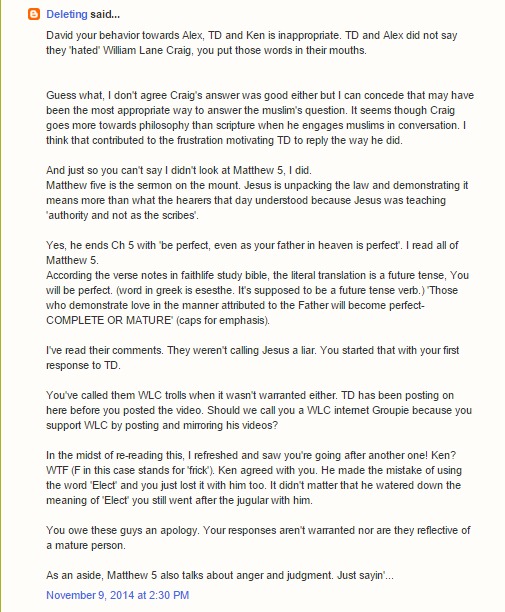
David gets really angry when Christians try to discuss important and necessary topics about Christian beliefs about salvation, he does not identify with either Arminian theology or Calvinist theology, he flutters somewhere in between and is an agnostic when it comes to his theology. During one discussion about the nature of God’s love, he expressed his rage inducing anger on fellow Christians, reacting rabidly towards them:

cc-2015-dw-calvinism

Another devout Christian was shocked at David’s disregard for an honest and heartfelt discussion between fellow Christians on the nature of God’s love in Christianity:

cc-2015-dw-calvinism3

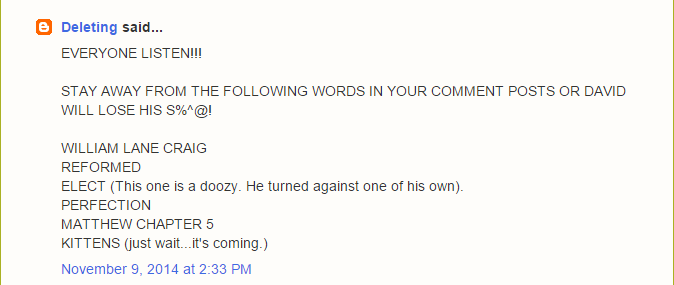
What were the topics David did not want Christians discussing with him? Christian theology, election (how you are saved by God, is it predetermined or not), the perfection of God…..

cc-2015-dw-calvinism2

What was David’s response to all of this?

cc-2015-dw-calvinism4

Distract them with Islam! You can only speak to David about Islam! Don’t you dare try to discuss Christian theology, especially salvation and the nature of God, you can only discuss Islam! According to David, his theology concerning the nature of God, salvation, scripture, is all determined by, “the only side I take on this issue is the opposite of whoever is trying to disrupt a conversation…“. So just like Sam Shamoun, David doesn’t care about Christian theology, he flip flops between essential creeds that determine the nature of God and how you are saved, based on whoever he’s arguing with. He doesn’t care about Christian theology, he just prefers distracting Christians with Islam.

Matt Slick, Anthony Rogers, Sam Shamoun and Tony Costa

Recently Anthony went bobbing for apples and drowned in three inches of water. He decided to criticize some of the arguments I used in my debate with Tony Costa. Unfortunately for him, he ended up declaring the beliefs of Shamoun and Slick to be heretical. Regarding my arguments, he realised my arguments were based upon the Christology (what a Christian believes about the nature of Jesus) of his friends, and not on his own personal Christology. This led to the revelation that the beliefs of his Christian apologist friends were heretical. Anthony proclaimed:

However, Tony Costa does not believe in this doctrine of the “communicatio idiomatum” (nota bene: the Latin word is ‘idiomatum,’ not ‘idiomatium’), and that doctrine is not taught in but rather is contradicted by the orthodox definition of the incarnation authoritatively set down in the Chalcedonian Creed (q.v. “inconfusedly,” and “the distinction of natures being by no means taken away by the union, but rather THE CHARACTERISTICS OF EACH NATURE BEING PRESERVED…”).

What’s that? The doctrine of ‘communicatio idiomatum’ is a contradiction of orthodoxy? That makes it heretical to believe in. Yet guess who believes in and defends Christianity using a doctrine that Anthony considers to be…..”contradicting orthodoxy”? His very friends, Sam Shamoun and Matt Slick!

Sam Shamoun uses the doctrine to defend the dual nature of Christ against Muslim objections: Click this link.

Matt Slick who operates CARM and is often featured alongside Sam and Wood on ABN/ Trinity TV also promotes and believes in this doctrine: Click this link.

What did Anthony do when he realised my arguments in the debate with Tony Costa was based on the Christology of his friends? He decided to correct a typo in one of my sentences by dedicating three paragraphs and two comments on YouTube about it. Yet, I persisted, he had made an error. He had wrongly criticized me, and at the same time had claimed that the beliefs of Sam and Matt contradicted orthodoxy, thus declaring them heretics. As expected, realising his error, he quickly left the conversation. The entirety of which can be read here.

Update 4/11/15:

Anthony was kind enough to post the conversation for me. Here’s the link to the images. For some reason he edited out the last two comments of the conversation, and chose not to link directly to the source as I did. As can be noted, when caught out, he resulted to arguing about a single typo. Such is the level of polemics he chooses to engage in, and of which I will not lower myself to.

James White

He’s considered to be one of the leading Calvinist apologists today. Debating Catholics, Jehovas Witnesses, Arminians and more. Yet, when it comes to his very own Christian friends like Sam and Wood, he fails to correct them. Fails to teach them. He’d readily criticize a Muslim for speaking incorrectly about Christian theology, yet he abjectly fails when it comes to educating fellow Christian apologists about central creeds and beliefs necessary for their salvation. It would be interesting to see if White would be consistent this time around. Here we have Shamoun and Wood openly disregarding Calvinist theology. These are statements made in the public domain.

Surely then, White, as a staunch defender of Calvinist theology would not stand for this. Given that he can condemn literally almost every other Christian sect that disagrees with Calvinist theology, it should be expected that he would also in like, publicly reprimand Shamoun and Wood for their gross misconduct regarding core theological beliefs. However, this is unlikely. White would not dare criticize the theology of Shamoun or Wood, regardless of how critical they are of Calvinist theology. If a Muslim had criticized Calvinist theology, we could have expected a 2 hour long Dividing Line episode on their lack of consistency. Such is the standard that White holds himself and his faith up to.

Conclusion

So where does this leave us? These polemicists do not care about Christianity. Studying and defending Christian theology is not important to them. Believing in heretical beliefs is of no importance. They go to extreme odds to prevent discussion about inter-Christian theological differences. The next time a Christian interacts with Sam, Wood, Rogers and Slick, ask them, do you care about your theology? Do they care that none of their Christologies are compatible, that they each differ about the very nature of God and the means of salvation in Christianity? Do they care? The answer is an unequivocal, no.

and God knows best.

« Older Entries Recent Entries »