Missionary Mishap: How to Share the Gospel

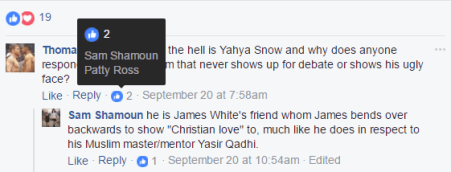
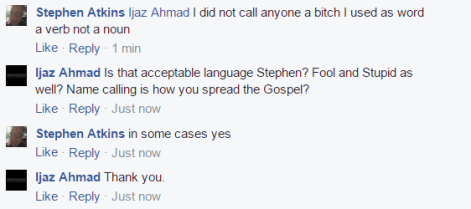
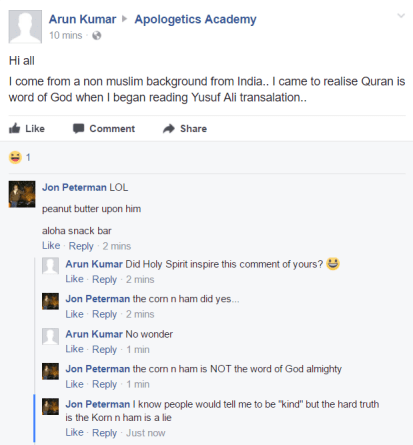
I often come across Christians telling me how they share the Gospel. This missionary claims that using words such as “b*tch”, “fool” and “stupid” are an accurate means of sharing the Gospel.

cc-2017-sa-bitchstupidfool

We recommend that Stephen study his Bible, for 2 Timothy 2:25 says the opposite:

“Opponents must be gently instructed, in the hope that God will grant them repentance leading them to a knowledge of the truth”.

Pray for Stephen and his hateful heart.

A Variant of One Letter

Can one letter make a difference?

Over the years I have demonstrated various textual issues with the New Testament. One of the more common questions I am frequently asked is to what extent a variant of one letter can impact the reliability or lack thereof, of the New Testament. Today I’d like to answer this question with a simple example.

The letter η (eta) is a defining article.

Consider the case of saying “the boy” and “a boy”, in the case of the letter η (eta) it means “the”, which specifies a noun. The car, the boy, the house all refer to something specific and not something general. Thus, we read from John 5:1 (NIV) –

“Some time later, Jesus went up to Jerusalem for one of the Jewish festivals.”

Some translations render the section in bold as “a feast”, however there is a variant in Codex Sinaiticus which renders the text as “the feast”, thus specifying this feast as not a general feast but as a specific feast. By inserting the letter η (eta) before the noun “feast” (ἑορτὴ), the context of this passages changes entirely. The NET Bible’s commentary explains:

“The textual variants ἑορτή or ἡ ἑορτή (Jeorth or Jh Jeorth, “a feast” or “the feast”) may not appear significant at first, but to read ἑορτή with the article would almost certainly demand a reference to the Jewish Passover.”

In other words, while at first it may not appear significant, by referring to the feast as “the feast”, it therefore indicates that this was the feast of Passover. This presents several problems. The initial problem is that if this feast refers to the Passover it would mean that Jesus preached for 4 years and not 2 1/2 years. The Cambridge Bible for Schools and Colleges states:

“He gives us three Passovers; to make this a fourth would be to put an extra year into our Lord’s ministry for which scarcely any events can be found, and of which there is no trace elsewhere.”

Thus, it would either mean that the timeline presented for Jesus’s ministry according to the Gospels attributed to Matthew, Mark and Luke exclude one year of Jesus’s ministry or that the Gospel attributed to John has created an additional 4th year (more than 3 years) which would stand against the testimony of the other Gospels. If the former is true it would mean that the authors of the synoptic Gospels chose to exclude and ignore an entire year’s worth of teaching by Jesus, thereby bringing into question the reliability of their collective testimony. Why would his followers want to exclude an entire year of his public ministry? Surely if he chose to preach at that time it must have been for a reason, therefore on what grounds can an author ignore or prevent other Christians from reading and learning from 25% of Jesus’s ministry?

However, if the latter is true, it would mean that the authors of the Gospel attributed to John created and attributed an additional year of preaching to Jesus’s ministry. This would then indicate that the Gospel attributed to John lies about Jesus and thus brings into question its authenticity, reliability and accuracy. The Pulpit Commentary expands on this issue a bit more:

“Now, “the feast” of the Jews could hardly be any other than the second Passover, while John 6:4 would indicate a third. “The feast” referred to in John 4:45 undoubtedly means the first Passover. “A feast” would leave the question open, though by no means excluding positively the second Passover, as the anarthrousness of the word might be chosen with a view to call special attention to it. However, the indefinite ἑορτη has been identified by commentators with every feast in the calendar, so there can be no final settlement of the problem.”

So far, commentators on this verse describe it as being “significant” and a “problem”, yet we need to keep in mind that this is the consequence of one letter being present in one manuscript. The Jamieson-Fausset-Brown Bible Commentary explains to what extent this variant affects the harmony of the Gospels:

“1. a feast of the Jews—What feast? No question has more divided the Harmonists of the Gospels, and the duration of our Lord’s ministry may be said to hinge on it. For if, as the majority have thought (until of late years) it was a Passover, His ministry lasted three and a half years; if not, probably a year less. Those who are dissatisfied with the Passover-view all differ among themselves what other feast it was, and some of the most acute think there are no grounds for deciding. In our judgment the evidence is in favor of its being a Passover, but the reasons cannot be stated here.”

Addendum:

It should be noted that commentators have not randomly decided that the phrase “the feast” refers to the Passover, this is a conclusion drawn from the Church Father Irenaeus from the 2nd century who writes in Against Heresies (Book II, Chapter 22) the following:

But it is greatly to be wondered at, how it has come to pass that, while affirming that they have found out the mysteries of God, they have not examined the Gospels to ascertain how often after His baptism the Lord went up, at the time of the passover, to Jerusalem, in accordance with what was the practice of the Jews from every land, and every year, that they should assemble at this period in Jerusalem, and there celebrate the feast of the passover.

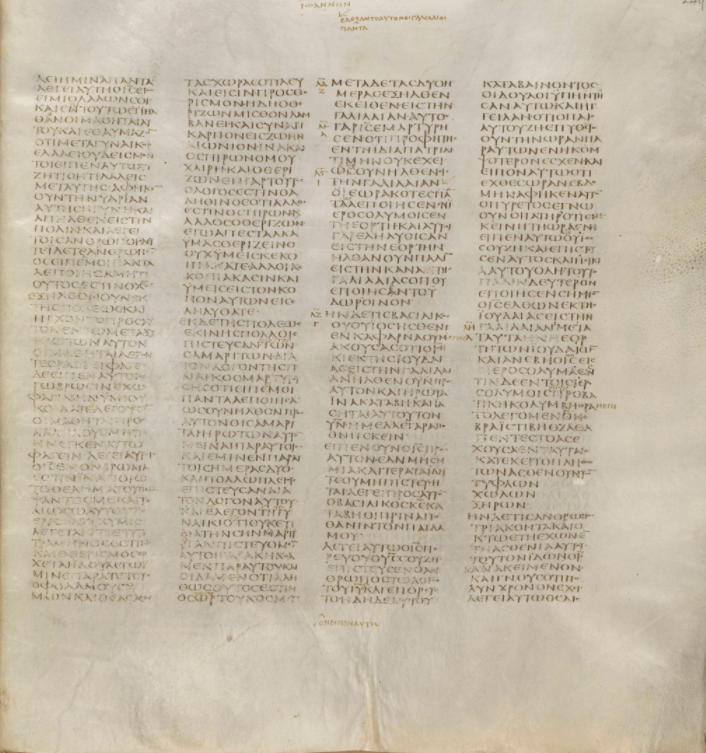
We can see the variant by comparing the same passage from Codex Sinaiticus and Codex Alexandrinus. In the image below, we see folio 249 (recto) from Codex Sinaiticus:

1

The variant can be seen here, it reads as “Η ΕΟΡΤΗ” (the letter Η is the capital letter equivalent of η) :

The image below is from Codex Alexandrinus, we see folio 69 (recto):

3

The variant can be seen here, it reads as “ΕΟΡΤΗ” (the letter Η is the capital letter equivalent of η) :

4

6

What therefore, can we conclude from this difference?

If the Gospel attributed to John (from Codex Sinaiticus) is correct, it would mean that the Gospels attributed to Matthew, Mark and Luke excluded more than 25% of Jesus’s ministry from those Gospels, and thus brings their reliability into question.

If the Gospel attributed to John (from Codex Sinaiticus) is wrong, it would mean that the authors of this Gospel invented an additional year of Jesus’s ministry, thus bringing into question the reliability, authenticity and accuracy of the Gospel itself.

If the authors of the New Testament’s Gospels cannot be reliable enough to determine whether Jesus preached for 3 years or 4 years, how could we trust them otherwise? One letter can make a very big difference and this is but one example of such a case.

and God knows best.

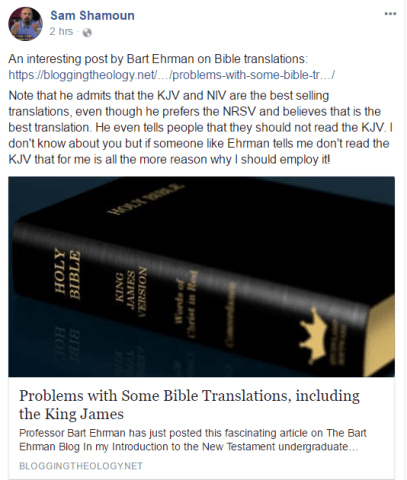
Missionary Mishap: Sam Shamoun and Reaction Formation

I came across this post on Facebook and immediately cringed because Sam Shamoun was demonstrating a psycho-social phenomenon that is quite easily identifiable. Let’s take a quick look at his post:

cc-2017-ss-reactionformation

Consider his argument:

  • If x says not y, I do y.
  • If Ehrman says don’t use the KJV, I use the KJV

In psychology this is called reaction formation:

Reaction formation is a type of defense mechanism in which a person acts in the exact opposite manner to his own disturbing or socially unacceptable thoughts or emotions. This behavior is often unconscious and appears exaggerated, perhaps in an effort to overcompensate for the embarrassment, guilt or repulsion the person feels regarding his private thoughts.

By using reaction formation, one’s self-identity remains “safe” as the ego is kept in ignorance of the person’s true motives. For example, a highly religious man with lustful urges toward women might react with exaggerated disgust upon seeing a woman in revealing clothes, or he may go into long lectures about modesty. Or a woman who harbors racist feelings may go out of her way to be overly kind to people of another race. Or a man who fears that he is falling in love with his new girlfriend begins to pick fights and lash out at her in anger.

Behavior due to reaction formation is often extremely exaggerated, compulsive and inflexible. These behaviors don’t vary due to changes in emotion as do natural behaviors. For example, a father who feels guilt at resenting his child may go above and beyond to express showy love to the child under all circumstances. These behaviors based on fake emotions are often easy to spot. Therapists often observe reaction formation in patients who claim to strongly believe in something and become vehemently angry at everyone who disagrees.

Does the last line remind you of anyone?

and God knows best.

The Problem of the Thief and the Crucifixion

Introduction

In perhaps what is one of the most perplexing passages of the New Testament, we find a story during the alleged crucifixion of Jesus the Christ that challenges the very core of commonly held Christian beliefs about Christ and salvation. We read from Luke 23:39-43 (NIV) the following:

39 One of the criminals who hung there hurled insults at him: “Aren’t you the Messiah? Save yourself and us!”

40 But the other criminal rebuked him. “Don’t you fear God,” he said, “since you are under the same sentence? 41 We are punished justly, for we are getting what our deeds deserve. But this man has done nothing wrong.”

42 Then he said, “Jesus, remember me when you come into your kingdom.”

43 Jesus answered him, “Truly I tell you, today you will be with me in paradise.”

The Problem

If we were to ask a confessional Christian today (one that knows of and adheres to the doctrinal confessions of the faith) what one needed to believe in for salvation, we would perhaps have a very long list. It would likely include belief that Jesus died for the sins of all, that Jesus was God, that Jesus was both man and God (belief in the hypostatic union), belief that the New Testament is the word of God, belief in the Godhead, in the Personhood of each member of the Godhead who were all co-equal and co-substantial to each other.

Yet the 5 verses from the Gospel eventually attributed to Luke present a severe theological problem that strikes at the very core of Christian theology. The question before us is, what did the thief say, believe and do to be granted salvation? When we examine the verses we can identify only two things:

  1. That Jesus was an innocent man.
  2. That Jesus was a King (or would become one at some point).

All the thief had to do to be granted salvation was to accept that Jesus was innocent and thus did not deserve to be crucified, and that Jesus would survive in some form such that he would become a king or have a kingdom. By this standard, all Muslims will be granted entry into the kingdom of God. The thief did not have to believe in the New Testament, did not have to accept the Old Testament, did not have to express belief in the Trinity, did not have to believe in the Godhead, did not have to believe in the two natures of Christ, did not have to even accept Jesus as the Messiah! He did not have to believe Jesus was the incarnate word of God, he did not have to believe that Jesus was the 2nd person in the Godhead…in other words, the thief did not have to believe in anything that Christians today hold to be true.

There is perhaps an even greater issue here. The thief claims that Jesus was innocent and thus did not deserve to be punished. See, Christians necessarily believe that while Jesus was innocent, he deserved to suffer and be punished, because he came to suffer for our sins as an act of grace:

“For God so loved the world that he gave his one and only Son, that whoever believes in him shall not perish but have eternal life.” – John 3:16 (NIV).

“And he said, “The Son of Man must suffer many things and be rejected by the elders, the chief priests and the teachers of the law, and he must be killed and on the third day be raised to life.” – Luke 9:22 (NIV).

According to the above passages, Christ must suffer and must be killed. However, the thief on the cross, seemingly disagrees with these teachings. The thief explicitly says that not only is Jesus innocent, but that he did not deserve to die. In other words, the thief is expressing an Islamic position that Muslims would agree with. Jesus did not deserve to die, he did not deserve to suffer and he was an innocent man. In other words, Jesus rewards a thief and claims the thief would be in the Kingdom of God with him because he denied the core tenets of Christianity while affirming core beliefs of Islam.

The thief in no uncertain words explains that his crucifixion on the cross is justified, but Jesus’s isn’t, however, confessional Christians would argue that in order for sin to be paid, it had to be justified through the death of Jesus the Christ. This presents a problem for Christianity. Jesus rewards a man and accepts him into the Kingdom of God for expressively, clearly and absolutely, rejecting core Christian beliefs about salvation!

Comments by Scholars

These 5 verses deliver a devastating blow to the consistency of the doctrine of salvation in Christianity. These verses essentially approve of Islamic beliefs and indicate that Muslims according to Jesus…would be in the Kingdom of God, since we believe that he was innocent and that the alleged crucifixion was not justified in any way. These are things a Christian today cannot deny, these are things a Christian today has to believe in, yet a thief with Islamic beliefs only accepted two tenets, both of which agree with core Islamic beliefs, and was rewarded and praised by Jesus! The scholars have had difficulty in understanding these passages. It must first be noted that only one Gospel records this incident and this is the Gospel of Luke:

“Luke’s account is noticeably independent of the other three. The three sayings of Christ’s, round which his narrative is grouped, are preserved by him alone. We shall best grasp the dominant impression which the Evangelist unconsciously had himself received, and sought to convey, by gathering the whole round these three words from the Cross.” – MacLaren’s Expositions.

The other three Gospels are noticeably silent on the thieves, except for the case of demonizing them:

“In the same way the rebels who were crucified with him also heaped insults on him.” – Matthew 27:44 (NIV).

“Those crucified with him also heaped insults on him.” – Mark 15:32 (NIV).

The final Gospel, later attributed to John (which John, we don’t know), does not mention any of the words of the thieves, it does not even identify them as thieves or rebels. Instead, this is all the Gospel as to say:

“The soldiers therefore came and broke the legs of the first man who had been crucified with Jesus, and then those of the other.” – John 19:32 (NIV).

Resolving the Problem

Some Christian commentators (exegetes) have attempted to navigate around this narrative disaster by implying that the thief/ rebel had other beliefs, that he believed Jesus was a God or that Jesus was meant to die for his sins and thus was saved because of this. The problem with such an argument is that the only Gospel to mention this incident does not indicate any of these things. The Gospel does not indicate that the thief/ rebel believed in anything other than what was recorded. In other words, this is a poor attempt at reading between the lines and should therefore be rejected. If scripture is sufficient for understanding salvation, then the plain reading of these 5 passages should be accepted without having a need to insert anything into scripture, to force it to say something it does not.

Conclusion

These five passages are a disaster for any Christian who takes their faith seriously. Every core tenet that one needs to believe in to be considered a confessional Christian is necessarily discarded by the thief and approved of by Jesus himself. In fact, the very beliefs that Jesus was an innocent man and did not deserve to die, that his death is unjustifiable is an Islamic belief. Thus, there are two arguments to be claimed here:

  1. According to Jesus, all one has to do to be granted entry into the Kingdom of God is to accept that Jesus is innocent and that his death was unjustified (which affirms Islam’s beliefs about Jesus). Therefore the beliefs of most Christians have been deemed unnecessary and useless by Jesus himself.
  2.  That belief in Jesus dying for the sins of the world is unjustified and that Jesus affirms this, thereby establishing that him dying does not acquit us of our sins (essentially refuting core Christian beliefs about the purpose behind Jesus’s death in the first place).

May God guide our Christian brothers and sisters to the truth of Jesus the Christ, which is to the Oneness of God.

and Allah knows best.

William Lane Craig: In His Own Words

I didn’t create this video, but a Christian, apparently upset at some of the fantastic answers that WLC has provided did.

Original video: YouTube

Video Sources:

  • Clip 1: Does the Unbeliever Have to Approach the Bible as Divinely Inspired?
  • Clip 2: Dr. Craig on Collins vs Dawkins on Design of Universe.
  • Clip 3: WL Craig, PS Williams vs. A Copson, A Ahmed – Cambridge Union Society God
    Debate, Oct 2011.
  • Clip 4: Incensed Atheist Questions William Lane Craig.
  • Clip 5: Dr. Craig on Collins vs Dawkins on Design of Universe.
  • Clip 6: Incensed Atheist Questions William Lane Craig.
  • Clip 7: WL Craig, PS Williams vs. A Copson, A Ahmed – Cambridge Union Society
    God Debate, Oct 2011.
  • Clip 8: Life, the Universe and Nothing: Why is there something rather than
    nothing?

and God knows best.

The Real God of American Christianity?

By their fruit you will recognize them. – Matthew 7:16.

Take a look at a typical American Evangelical’s Facebook profile, what do you see? You’re sure to find pictures of Trump, the American flag, some anti-Muslim memes, Bible quotes and mostly political posts demonizing Muslim-Americans, Democrats and Liberals. See, there is a trend here, today’s Evangelical American Christians worship the state more than they do Jesus. That might seem like a controversial statement, but recently there have been some events that qualify this argument. In responding to a right-wing Evangelical American, Dr. James White says as follows (emphasis mines):

There is FAR more evidence in your own timeline that you have adopted a politically oriented Christianity than there is that I have adopted anything from Islam.

Steve, but when did the gospel become something you only explain to people who look like you and have the same political views?

YQ is a Muslim scholar with a large following and a large impact in the United States and abroad. Hence, when he and I talk, the resultant discussion will be useful to both Christians and Muslims in the United States and in all English speaking locales. What on earth do his political views have to do with it?

And no, Steve, I don’t see almost any concern on the part of my critics, including you, about such things. I see a lot of politics, making America great again, building walls and the like—but I see very little interest in breaking down walls of prejudice and fear and misunderstanding in confidence that what we have to give to the Muslims is the greatest thing in all the world.

Your words are disgusting, Steve. You are speaking as a political zealot, trained in the presidential election of 2015-2016, not as a minister of the gospel.

If you think Dr. White is wrong here for making those statements, then you need to watch the First Baptist Dallas’ “Freedom Sunday” service where they literally idolized and worshiped the American flag. Patheos author Jonathan Aigner, says as follows (emphasis mines):

First Baptist Church in Dallas bowed before a red, white, and blue altar yesterday.

The snare pierces the silence, and the choir and orchestra launch us into the national anthem of American Christianity, which also happens to be the national anthem of the United States.

Our opening hymn proudly proclaims, “You’re a grand old flag, you’re a high-flying flag, and forever in peace may you wave.” (This is idolatry, folks. Nothing short of it.) The fireworks explode (you read that correctly), and audience members wave their miniature flags while singing praises to a red, white, and blue cross.

You read that correctly, American Christians during a Church service…bowed to an altar with the American flag, and in place of singing hymns that traditionally glorify God, they glorified the American flag in God’s place. You’ll notice that the Patheos author literally wrote that he considered the congregation’s actions to be worship, idolatrous worship of the American flag.

Several Churches and Church leaders were very outspoken about the literal replacing of God, for America and American symbols in a Church service, we read from the Christian Post (emphasis mines):

Several critics have denounced the “idolatry” of “Freedom Sunday” worship June 25 at First Baptist Church in Dallas, pastored by Robert Jeffress, who prominently campaigned for Donald Trump during last year’s election.

The critics include Messiah College historian John Fea, a United Methodist pastor, and a Presbyterian church music minister. Click their respective links to read their perspectives, each of which is unique, but all are agreed in accusing First Baptist of “idolatry” for venerating America on “Freedom Sunday” a week before July 4.

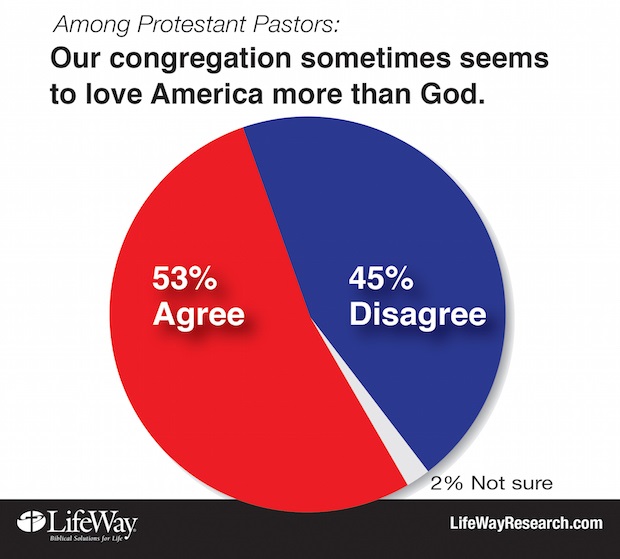
A survey by Life Way, a major American Evangelical organization, had this surprising information for us:
lifeway

A Christianity Today article goes on to say about this issue (emphasis mine):

Also worth noting, the same survey found that 53% of Protestant pastors felt that their congregations sometimes love America more than they love God.

Regardless of your view of patriotic worship services, this number should be of concern. (When we love something more than God, the Bible calls that idolatry, and that’s the last thing that Christians should want.)

So, this weekend be sure you love your country and worship God…and never confuse the two.

Back in 2010, other Christian authors began to notice this disturbing trend of American Christianity’s idolatry (emphasis mine):

I’ve been a part of numerous churches that celebrated American Independence Day with abandon: 80-foot flags hanging from the ceilings, singing the “Star Spangled Banner” and “I’m Proud to Be an American” and even— most disturbing to me as I reflect back—saying the Pledge of Allegiance during our corporate worship.

If some visitor had asked us on those Sunday just what we were worshiping, I think that might have been a very perceptive question.

Going back to Dr. James White, I noticed that folks like David Wood, Sam Shamoun, Usama Dakdok and Robert Spencer also worship America, more than they do Jesus. See, following Dr. White’s dialogue with Dr. Yasir Qadhi, Sam Shamoun went on a rampage against Dr. James White. What I quickly realised was that White was attacked for three things:

  1. Ecumenicalism (accepting some Islamic beliefs, which was a false accusation).
  2. Inviting a Muslim into a Church to speak without rebuttal (it was a dialogue about differences in beliefs).
  3. Associating with a Muslim that has ties to major American Muslim organizations.

Here’s the problem, as Dr. White himself said, many Christians chose to politicize the issue. Qadhi was labelled as a terrorist, a jihadist, someone who wants to install Shari’ah law, that he worked with extremist organizations, that in the past before changing his views he had said bad things about non-Muslims…and on and on. You may think that their issue with Dr. White was theological, but then why speak about terrorism and terrorists? Why speak about Qadhi’s association with CAIR (a Muslim-American advocacy group)? Why association Dr. Qadhi and Dr. White with liberalism and liberal political ideologies? See, while on the surface they claimed (falsely) that the disagreement with the dialogue that Dr. Qadhi and Dr. White had, was theological, it was clearly political.

Where did any of these guys speak out against the “Freedom Sunday” worship?

Where did any of these “Christian apologists” speak a single word against replacing a hymn meant to glorify God, with a song glorifying the state?

Where did any of these guys speak out when the Bible Answers Man, Hank Hanegraaff converted from Protestantism to the Greek Orthodox Church that has distinctly heretical teachings about the nature of Jesus, the nature of Mary and how salvation is attained?

Where did any of these guys speak about against ABN/ Trinity Channel for preaching false doctrines and for promoting the heretical prosperity gospel? Sam Shamoun, the genius he is, made one single Facebook post about ABN, but spent 10 months, every other day, attacking Dr. White for his dialogue with Dr. Qadhi! Where is the consistency?

By their very actions, the things that they occupy themselves with, are not theological but political.

In other words, it is clear that American Christians have a new God and it is not Jesus. The Orthodox Church of America has been founded, its God, the State (and its symbols, such as the flag and anthem), its disciples, politicized Christians such as David Wood, Sam Shamoun, Usama Dakdok and Robert Spencer.

By their fruits we now know who they worship and the State is their new God.

Missionary Mishap: High Level Apologetics

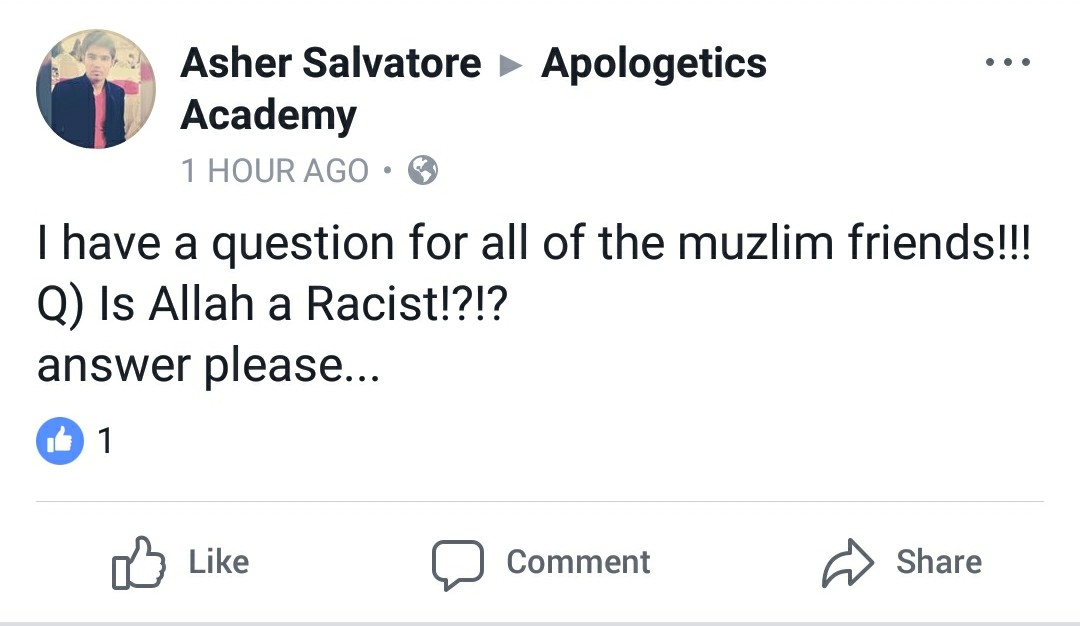
It’s practically impossible for me not to be amused by the high level of apologetics that Jonathan McLatchie’s “Apologetics” “Academy” is producing. I think this image sums up the scholastic work he’s doing with his “Academy”:

If the goal of the “academy” is to produce jaw dropping arguments like these, then I applaud Jonathan for his hard work.

Well done!

Missionary Mishap: Jonathan McLatchie at Speaker’s Corner

This should not surprise anyone, but in making his transition from debater of atheists to “critic” of Islam, to “critic” of evolution and now to “apologetics/ motivational speaker” we find Jonathan once again making erratic and frankly, silly comments about those he necessarily hates.

cc-2017-jm-muslimsatspeakerscorner1

For a quick recap, Jonathan came to Speaker’s Corner where Christians and Muslims and Jews and Atheists and Black Hebrew Israelites and folks of all ideologies have been having dialogue for decades. He didn’t have a good time at Speaker’s Corner, because after coming to the corner, he had to retract statements he had made, issue clarifications, in two cases he had to make 3 hour long videos with a 15 year old to clarify and respond to Muslims from Speaker’s Corner, instead of returning to dialogue with them face to face.

It’s therefore not odd to find him disparaging Muslims at Speaker’s Corner, mostly because in the past he has begged for, and pushed for debates with Muslims from Speaker’s Corner who want nothing to do with him because of his statements and behaviour. There is the case where he attacked the Muslim debater Darren Hamza Myatt after trying to get a debate away from Speaker’s Corner with him. There was the case where he did the same to Br. Mansur. I’ve collected some of those ridiculous comments and events by Jonathan here.

The fact remains, for a guy who hates Muslims, he sure finds it profitable to speak about them often.

and God knows best.

« Older Entries Recent Entries »