Look What Just Arrived In the Mail…

Search
Tis the season to be jolly, but should Christians hold this holiday in such high esteem? In this article, we look at three reasons why Christians should reject celebrating Christmas –

1. The Earliest Christians Didn’t Celebrate Christmas
As shocking as it might seem, the earliest Christians – including the apostles and disciples of Christ, had no such celebration. The early Church Fathers Iraenaeus and Tertullian omit any mention of it from their list of Christian feasts. The Church Father Origen argues that only sinners celebrate their birthdays. Furthermore, the early Christian apologist Arnobius ridiculed the pagan Graeco-Romans for celebrating the ‘birth’ of their gods.
Notoriously absent from any of the four gospel accounts is the mention of a yearly celebration of Jesus’s birth. During Jesus’s ministry, no such celebration is ever recorded. During the formative years of the Church, as recorded in the Acts of the Apostles, no such celebration is ever mentioned. One needs to ask, if such a celebration was essential to the Christian faith, wouldn’t Christ, his mother, his apostles and disciples have mentioned it? Whether Catholic or Protestant, Christian tradition does not record any yearly celebration or feast of Jesus’s birth in the Bible, nor is there any record of any yearly celebration or feast of Jesus’s birth in the early Church tradition until the 3rd century CE.
When mention of this celebration did occur, the dates listed were the 20th of May, the 19th or 20th of April and the 28th of March. Even if one wanted to celebrate the birth of Christ due to some late Church tradition, it would not be held in December. So, if you’re a Catholic or adhere to the doctrine of Sola Scriptura, it’s going to be quite difficult to claim that Christmas is an essential Christian feast that merits the Christian faith. According to all historical records, Christmas is a later development, far removed from the time of Christ and early Christian apologists ridiculed the pagans for celebrating the ‘birth’ of their pagan gods.[1]
2. Christians Once Banned Christmas and Condemned it as a Heretical Festival
Citing a lack of ‘Biblical Justification’ and its ‘derivation from the Catholic tradition’, Protestant Christians in England banned Christmas in 1644. In further condemnation of the festival, the English’s Long Parliament in June 1647 passed an ordinance confirming the abolition of the feast of Christmas. Protestant Christians in England considered Christmas Trees, decorations and Christmas foods to be unholy pagan rituals.[2] Across the Atlantic, Christians in America soon followed suit. Christmas was banned in Boston from 1659 to 1681, and it did not become a legal holiday in the New England until 1856.[3]

3. Christmas in a Christian Perspective
The festival now known as ‘Christmas’ is derived from the Old English phrase Cristes Maesse, first noted in 1038 CE.[4] While the first use of Christmas Trees – the Evergreen Fir Trees, was adopted from the pagan usage of them for decorating their homes during the winter solstice. Similarly, it is documented that pagans also used them for decorating their temples during the festival of Saturnalia. The first documented use of the Christmas Tree was in the cities of Tallinn in Estonia (1441 CE) and Riga in Latvia (15010 CE).[5]
Taking into consideration the previous evidences – there was no yearly celebration of Christ’s birth recorded to be done by Christ, his family, the apostles or the disciples. No mention of a yearly celebration of Christ’s birth by the early Church, and early renunciations of this practise as a pagan festival by at least one noted Christian apologist. The dates for Christ’s birth are not only historically uncertain, none of the recorded date coincide with the month of December. The festival itself was banned by Christian nations, with those prohibitions being based on a lack of scriptural evidence and an acute similarity to pagan festivals.
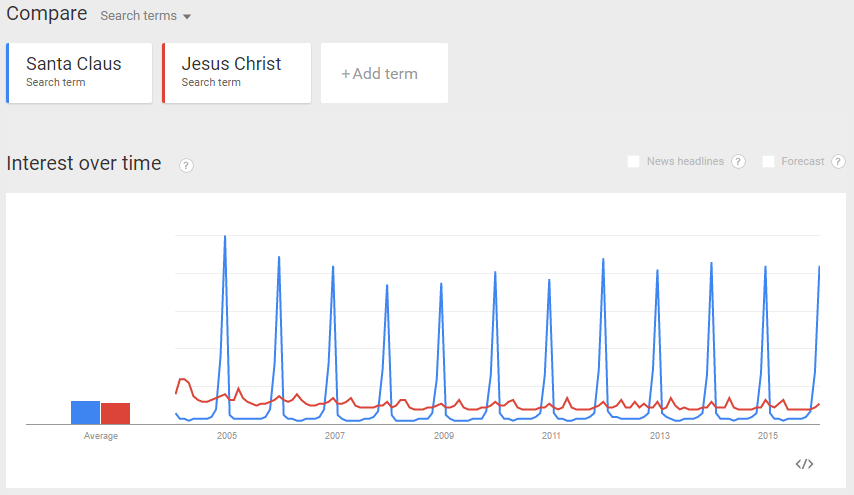
Christmas itself is not, and has not been for a long time about the nativity or Jesus. The most famous character during the Christmas season is Santa Claus. Worldwide search trends since 2004 record Santa Claus being the dominant search term, exponentially outpacing Jesus Christ on a year to year basis during the Christmas Season by a factor of 7:
Commercialization. Holiday sales account for at least 1/5th or ~20% of retail industry’s sales in the US. The holiday season accounts for more sales than Mother’s Day, Father’s Day, Valentine’s Day, Halloween, Easter, and St. Patrick’s Day combined.

Notably, the only time Jesus is said to have reacted violently, is recorded in the Gospels when money changers were using the Temple as a marketplace. In essence, people were using something holy for commercial means, not unlike what we find with the commercialization of the Christ-mass season today. A cursory reading of Matthew 21:12-13 or of John 2:14-17 makes it absolutely clear that the commercialization of Jesus’s name is something of great disrepute.
All in all, Christmas is not about Jesus. It’s not essential to the Christian faith and it’s not a practise found in the early Christian tradition. Christians who practise Christmas today are practising a festival that took hundreds of years to develop, a festival which adopted pagan practises, a festival which has no Biblical basis, a festival that is more about retail sales and Santa Claus than it is about the person of Jesus the Christ.
Christians have an important decision to make. Either you go against the grain and reject this pagan-commercialized syncretic holiday or adopt a non-Biblical modern commercial holiday:
Aggravation is better than merriment
because a sad face may lead to a glad heart.
4 The wise heart is in the house that mourns,
but the foolish heart is in the house that rejoices.
5 It is better to obey the reprimand of the wise
than to listen to the song of fools,
6 because the fool’s merriment
is like nettles crackling under a kettle.
That too is pointless.
and God knows best.
Sources:
1 – “Christmas.” The Catholic Encyclopedia. Vol. 3. New York: Robert Appleton Company, 1908. 24 Dec. 2015 <http://www.newadvent.org/cathen/03724b.htm>.
2 – Burton-Hill, Clemency. “When Christmas Carols Were Banned.” BBC. BBC, 19 Dec. 2014. Web. 24 Dec. 2015. <http://www.bbc.com/culture/story/20141219-when-christmas-carols-were-banned>.
3 – Melina, Remy. “The Surprising Truth: Christians Once Banned Christmas.” LiveScience. TechMedia Network, 14 Dec. 2010. Web. 24 Dec. 2015. <http://www.livescience.com/32891-why-was-christmas-banned-in-america-.html>.
4 – Ibid – 1.
5 – “The History of Christmas Trees on Whychristmas?com.” The History of Christmas Trees. Web. 24 Dec. 2015.<http://www.whychristmas.com/customs/trees.shtml>.
Trinidad & Tobago’s majority religious demographic is that of Christianity. Earlier this year I received a number of books from Dr. Shabir Ally, and had decided to read some of these books while on campus at one of our Universities. The book I chose to start with was John Loftus’ The End of Christianity. I hadn’t considered the reaction I would receive from walking around with a book of that title, I did receive reactions and those reactions are not what I expected them to be.
It started in class, I had taken out the book to read because I was either bored or had finished an in-class assignment early. A classmate who I knew to be Christian asked me to see the book. In that moment, I wondered if the book’s title had upset the person. They took the book, read the cover, checked the table of contents and even flipped through the book, skimming as they went along. The classmate asked me what I thought of the book, I answered quite honestly (I’m paraphrasing here): it’s new atheist dribble, but it has some nice points I hadn’t thought of as yet.
They weren’t offended, they were interested in the book. That was just the first encounter, over the course of the next 3 months, I met students throughout the campus that not only wanted to skim through the book, but many of them wanted to borrow it. This had taken me by surprise. The positive reactions from so many of my Christian colleagues had me wondering what was going on. Why would they react so positively to a book that critiqued their faith? I knew that my generation was less conservative than the previous generations. I knew that more young adults were less religious than those found in previous generations, but had this decrease in religiousity been more than I thought it to have been? As it turns out, while most of the young adults my age came from Christian families, most of them no longer considered themselves Christian. Not only were young adults apostating from Christianity, they were interested in exploring other religions, while taking an active role in leading their peers out of Christianity.
This book sparked more conversations than I am able to recall, this book gave my peers the opportunity to speak out and renounce Christianity. I never could have imagined that merely carrying a book around by this title would have this much of an effect on the people around me. What this experience taught me, was that many young adults are desperate to leave Christianity, they want to reject Christianity, they are tired of the message of the Cross and of its ineffectual teachings. These last few months gave me the opportunity of a lifetime, it opened my eyes and allowed me to reach out and apostate many Christians. At most, it took 4 conversations for me to bring someone out of Christianity. Most of the people that engaged me in discussion abandoned Christianity during the first conversation! They were just waiting for someone to reach out and agree with them, to give them the motivation to abandon the message of the Cross. This year, a simple book cover allowed me to bring many young adults out of Christianity and get them interested in Islam. While the book itself has a few interesting arguments, its overly wordy and most of its essays are okay at best.
and Allah knows best.
In light of a recent video being circulated regarding Dr. James White’s views on terrorism and Islam, and another video using Dr. White’s video by Br. Yahya Snow, Sam Shamoun has taken it upon himself to vilify Dr. White:

Whether or not Sam deletes this post, or removes his insulting comments, his claim against Dr. White has nothing to do with the contents of White’s latest video on terrorism and Islam. Apparently Sam has been holding a vitriolic view of Dr. White for sometime, going as far back as maligning another Christian scholar Craig (not sure if WLC – bad Trinity analogy?, Evans or otherwise).
After encouraging his ‘fan base’ to attack Dr. White, it remains to be seen whether Sam will apologize for breaking some tenets of his faith:
These six things doth the Lord hate: yea, seven are an abomination unto him:
1) A proud look,
2) a lying tongue, and
3) hands that shed innocent blood,
4) An heart that deviseth wicked imaginations,
5) feet that be swift in running to mischief,
6) A false witness that speaketh lies, and
7) he that soweth discord among brethren.– Proverbs 6:16-19 (Sourced by Francis Turretin).
and God knows best.
Question:
Missionaries claim that Isaiah 9:6 refers to Jesus. They state that this proves he is God. How do we respond to this?
Answer:
Let’s begin by quoting Isaiah 9:6 –
For a child has been born for us;
a son has been given to us.
And the dominion will be on his shoulder,
and his name is called Wonderful Counselor, Mighty God,
Everlasting Father, Prince of Peace.
Missionaries tend to focus on one aspect of the text, the terms “son” and “Mighty God”. However, a quick look at the text proves that this passage does not refer to Jesus. The child has already been born, the verb is in the past tense, “has been born”. Since Jesus had not yet been born, then this disqualifies him from being the subject in the passage. Furthermore, it is said that the child would be called, “everlasting Father”. Since Jesus is the Son, and not the Father, then this passage most certainly does not refer to him.
The missionary might claim that the term, “everlasting Father” is just a description of divine attributes, not meant to be taken literally. In that case, we need to ask, how can that be when you have already interpreted the title “Mighty God”, literally? Either you accept the text as is and interpret all the names figuratively, or you interpret all of them literally. Thus, this verse is not a proof text for the divinity of Jesus. It is a proof text against the divinity of Jesus and most Christians do not read this passage carefully or sensibly.
and Allah knows best.
Our Brother Ahmed Shaker’s post on Early Qur’anic Manuscripts has been published on the IQSA blog. Check it out.

by Ahmed Shaker*
There are numerous Qur’an manuscripts, complete and partial, dating from the first century A.H. onward. Although there is no official count of Qur’an manuscripts in existence today, Muhammad Mustafa Al-A‘zami (2003) estimates the number at about 250,000. They may be found in mosques, museums, libraries, and institutions all over the world. In the past century, several early manuscripts have been published in facsimile editions, which reproduce as closely as possible the texts in their original manuscript forms, and may be purchased from specialized centers like IRCICA or borrowed from university libraries. Facsimile editions offer researchers in Qur’anic studies and Arabic paleography easy—if indirect—access to early Qur’an manuscripts.
The following is a concise chronological survey of select facsimile editions of early Qur’an manuscripts, including original title, date of publication, and—when possible—an estimated percentage of the total text of the Qur’an represented in the manuscript/facsimile.
View original post 650 more words
A fantastic video by Br. Darkness2Noor, demonstrating that Christians disagree about the most basic and fundamental beliefs about their God. Quite a shocking contrast between the human developed Trinitarian doctrine and the simplicity of the divinely revealed doctrine of Tawheed.
and God knows best.
Note: The following is an article by Br. Andrew Livingston, regarding one of the most popular Christian works in recent times,“The Case For Christ” by Lee Strobel. Br. Andrew’s writings can be found at taqwamagazine.com. In this article, Br. Andrew takes an honest and critical look at the ‘questions for reflection’ included in the book.
Answers to the “Questions For Reflection” in “The Case For Christ” by Lee Strobel
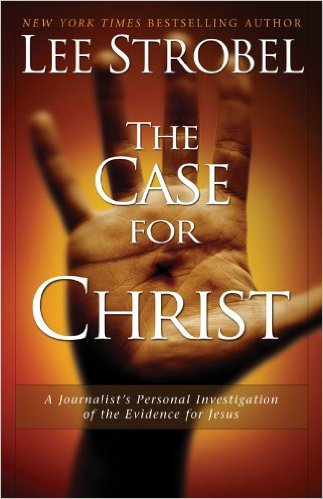
I haven’t read Lee Strobel’s original book “The Case for Faith”. I *have* skimmed large chunks of it and read reviews and what not. What I can tell you is that “The Case for Faith” chronicles Lee Strobel’s going on what he still believes to this day was a genuine journey of discovery ultimately leading to his embracing Jesus (meaning, of course, the Jesus of modern day western evangelical Protestant Trinitarian Christianity). In actual fact what he did was hold a series of interviews exclusively with Christians of the aforementioned stripe, over and over and over again, until he was convinced. A true journalistic investigation would have involved Strobel alternating between different kinds of interview subjects: now you’re interviewing a Christian, now a Muslim; now a Christian, now an atheist; now a Christian, now an agnostic; and now one of those awful “liberal” Christians people will often complain about in the book I’m here to discuss now, the follow-up: “The Case for Christ”. [1]
If Strobel had any excuse for his lopsided approach before, he certainly doesn’t now. Once again we find him holding interview after interview with scholars who seem carefully selected to tell Christian readers exactly what they want to hear. That is all the book consists of. Strobel will pose a new issue (the Gospels’ reliability, the empty tomb, et cetera) to a different person in most every chapter, and it’s always an evangelical Christian. No voice of opposition is allowed at any point except in the form of quotations (generally from one person, Michael Martin), which in each case serve strictly as a set-up for the inevitable apologetic takedown. And with no exceptions whatsoever Strobel *always* cedes the point, no matter how minor the issue. If nothing else proves how stacked the deck is this passage from page 108 should:
“…The case for Christ, while far from complete, was being constructed on solid bedrock. At the same time, I knew there were some high-profile professors who would dissent. You’ve seen them quoted in ‘Newsweek’ and being interviewed on the evening news, talking about their radical reassessment of Jesus. The time had come for me to confront their critiques head-on before I went any further in my investigation. That meant a trip to Minnesota to interview a feisty, Yale-educated scholar named Dr. Gregory Boyd.”
I don’t know whether it’s already obvious but Strobel was referring to the Jesus Seminar. He wanted to confront their critiques head-on!—so he…interviewed an apologist who doesn’t like them. What, he’s not going to interview a *member* of the Seminar? Of course not. Because then the book wouldn’t be so one-sided. What we’re looking at here is *anything* but an “investigation”—which was exactly Strobel’s intention from the start.
Indeed, there are passages that suggest to me that the book could be an outright work of deceit. A coldhearted cash grab intended to sucker Christians into thinking that they’re going to read about a journey toward conversion (i.e. the first book or something much like it) before they actually make the purchase and read the whole text, or in case they don’t read carefully enough. It’s unlikely that anyone casually picking up this book in a store and skimming through a few pages here and there will know that it comes from someone who’d already become a Christian years before—and sometimes the book looks like it’s deliberately written so as to give the opposite impression. For example, why would Strobel ever say that anyone was “offended” by his “admittedly barbed remark” (page 230)? Why would he ever feel “a bit chastened” after hearing a rebuttal (page 195)? Why would he “demand” anything “in a tone that sounded more pointed than he had intended” (page 208)?
Whatever the intentions behind the book there are certainly few surprises—for anyone familiar with Christian apologetics, anyway. After a while you get to where you can recite the contents of the old broken record in your sleep: why-would-the-apostles-have-been-martyred-for-something-they-knew-to-be-a-lie-lord-lunatic-or-liar-First-Corinthians-fifteen-this-scholarly-majority-that.
I’ve decided to answer some of those “questions for reflection or group study” included at the end of each chapter. I originally set out to answer *all* of the questions—and then I quickly realized that I’d wind up with a twenty-thousand-word article. I’ve therefore decided to keep to a selection of six questions which are centered on the identity of Jesus (bless him), and which should collectively show you a few interesting things.
1. “How have your opinions been influenced by someone’s eyewitness account of an event? What are some factors you routinely use to evaluate whether someone’s story is honest and accurate? How do you think the gospels would stand up to that kind of scrutiny?” (Page 36)
A face-to-face encounter with someone who’s briefly describing a recent occurrence is very different from a detailed, pages-long recounting of a conversation that took place fifty years ago. The latter is more the sort of thing we find in the Gospels. Craig Blomberg, in his interview, predictably argued that oral tradition in ancient times had a baffling capacity to preserve details accurately (pages 43-4). In that case you should find more agreement between the Gospels. There is more on this subject below but for now let me give an example. The book of Mark frequently depicts Jesus as performing miracles privately, telling people not to reveal who he is, that sort of thing. John, on the other hand, has him never hiding his identity: indeed each time he performs a miracle he gives an elaborate speech explaining the theological significance of it. Compare Mark 8:27-30 to John 4:5-41. This does not look to me like the result of everybody faithfully remembering everything. *Someone* must have gotten it wrong. Yet it’s not mutually exclusive for two sources to *both* be wrong at the same time.
2. “Overall, how have [Craig] Blomberg’s responses to these eight evidential tests affected your confidence in the reliability of the gospels? Why?” (Page 53)
Those “eight evidential tests” being referred to (“the ability test”, “the character test”, et cetera) aren’t any sort of real and mainstream method of historical assessment. As far as I know Strobel may have made them up. This kind of thing is quite commonplace. [2] To be sure, Blomberg did touch on the normal criteria of biblical scholarship: specifically, he referred to the Gospels’ inclusion of embarrassing material. So what did he *do* with the data? Now this is interesting. He said, “Mark 6:5 says that Jesus could do few miracles in Nazareth because the people there had little faith, which seems to limit Jesus’ power.” (Page 49) (He added that this is perfectly fine because of Philippians 2:5-8. I thought we were talking about the Gospels?) Yet what happens when you consider the Markan verse in isolation is less relevant than what happens if you compare it to the Matthean parallel. As the commentary in The New American Bible explains:
“Matthew modifies his Marcan source (Mt 6:1–6). Jesus is not the carpenter but the carpenter’s son (Mt 13:55), ‘and among his own kin’ is omitted (Mt 13:57), he did not work many mighty deeds in face of such unbelief (Mt 13:58) rather than the Marcan ‘…he was not able to perform any mighty deed there’ (Mt 6:5), and there is no mention of his amazement at his townspeople’s lack of faith.” [3]
This is but one demonstration of many: the earlier the version of a narrative the more human Jesus seems to get.
3. “What, do you think, are some reasons why Jesus was evasive in disclosing who he was to the public? Can you imagine some ways in which an early proclamation of his deity could have harmed his mission?” (Page 142)
*Was* he evasive? As I’ve explained, it seems to go either way. Personally I’m beginning to wonder about the “mission” part too. *What* mission? If Jesus’s role was to die for our sins, why would it be necessary for him to spend any time as a prophet beforehand? There had already been a slew of those. Or perhaps I have it backwards. If God’s going to be His own prophet, why then send any others at all? Wouldn’t Jesus be enough? What, we’ve got God Incarnate as a prophet and we *still* need all of these other guys too? Seems superfluous to me. In any case there’s no need for an incarnate Deity to play both roles: prophet *and* self-sacrifice. If he was here to die for our sins then couldn’t he have simply appeared in human form, gotten himself crucified, risen from the dead and left it at that? [4]
Could it not simply be that Jesus *was* in fact only a prophet and it’s the dying for our sins part that got tacked on later?
4. “What are some of the differences between a patient in a mental hospital claiming to be God and Jesus making the same assertion about himself?” (Page 154)
I doubt very much that mental patient would refer to “my Father and your Father…my God and your God” (John 20:17). [5] Unless, that is, he suffers from multiple personalities. Of course all I did was merely quote a Bible verse without first establishing its accuracy—but then that seems to be a nasty habit of the interview subjects in this book too.
Nobody out there, as far as I know, is actually saying that Jesus was a madman, any more than they’re saying that the early Christians were willingly living a lie. Why do Christian apologists always bring up these straw men?
5. “As [William Lane] Craig pointed out, everyone in the ancient world admitted the tomb was empty; the issue was how it got that way. Can you think of any logical explanation for the vacant tomb other than the resurrection of Jesus? If so, how do you imagine someone like Bill Craig might respond to your theory?” (Page 223)
Craig did indeed *try* to establish that everyone knew the tomb was empty et cetera, but his arguments were rooted in that frustratingly inevitable belief that it takes a vast amount of time for legendary embellishment to develop. This claim gets reiterated all throughout the book and even made quite a point of in the conclusion (pages 264-5). Human communication simply does not work that way. The Bible itself concedes that during Jesus’s own ministry there was mass confusion over his identity due to word of mouth creating all sorts of different views (Mark 8:27-8). If Craig honestly believes that “Mark [getting] his…whole passion narrative…[from a source] written before A.D. 37” makes it “much too early for legend to have seriously corrupted it” (page 220) then he needs to spend more time reading Snopes. (Of course this is assuming that the whole “before A.D. 37” thing is true in the first place but what have you.)
During his interview Craig appealed or referred to the idea of following the scholarly majority five times. I may have missed one or two. So that probably should give you a sense of how he’d respond to me.
6. “What are your most cherished beliefs? What would it take for you to abandon or radically rethink those treasured opinions—especially if you truly believed you were risking the damnation of your soul if you were wrong? How does your answer relate to the historical fact that thousands of Jews suddenly abandoned five key social and religious structures shortly after the crucifixion of Jesus [as J.P. Moreland explained]?” (Page 257)
One way or another you’d have to do more than Moreland, or anyone in any of these interviews, did. Throughout the book people baldly assert things to be historical fact and do very little to explain why I should believe them. With Moreland we get a whole interview built around this principle. The apostles all believed in the Resurrection; they all preached the Resurrection from the start; the stories of their martyrdom are true; “Josephus tells us that James…was stoned to death because of his belief in his brother” (page 248). (Look up the Josephus passage and see. It doesn’t take long.) And so forth. These are *not* facts, they’re claims, and I often don’t understand why it is I’m supposed to accept them. Let alone why I should accept them from a man who clearly demonstrates his bias by asserting (just as much without supporting argument) that the followers of Muhammad (bless him) “‘converted’…by the sword”, moments before carefully glossing over early Christian history by leaving it that Christianity “eventually overwhelmed the entire Roman empire” (pages 249, 254).
I mentioned the book’s conclusion. I’ve found something interesting there. Do you want to see some truly stunning proof of just how far Christian apologists will go in repeating the same arguments ad infinitum?
“When German theologian Julius Muller in 1844 challenged anyone to find a single example of legend developing that fast anywhere in history, the response from the scholars of his day—and to the present time—was resounding silence.” (Strobel, page 265)
“Muller challenged his nineteenth-century contemporaries to produce a single example anywhere in history of a great myth or legend arising around a historical figure and being generally believed within thirty years after that figure’s death. No one has ever answered him.” (Kreeft and Tacelli, “Handbook of Christian Apologetics”—a book printed four years earlier) [6]
In this conclusion I’m encouraged to “reach my own verdict”. Which again is kind of offensive considering how said encouragement comes after such a one-sided “investigation”.
But very well. If I have learned anything new from this book, it’s a confirmation of a preexisting suspicion. Or anyway my suspicion has slightly grown. A suspicion that evangelical Christians are ultimately concerned with pretty much nothing except validating the inerrancy of The Bible. Any talk of historical evidence—in a way, even the act of focusing on the Resurrection in particular—is either an outward show or an inner rationalization.
This may be most clearly demonstrated (as far as the book is concerned, anyway) with the case of Craig Blomberg. First he argues that it would be suspicious were there too much consistency between Gospel accounts, seeing as that would make it look like the various sources were all colluding with each other. Again, I’ve heard it before—but it is food for thought. Then what does Blomberg go and do a moment later? He goes out of his way to resolve every tiny contradiction claim that happens to come up. Mixed messages there. (Pages 45-8)
Gary Habermas does something similar in pages 232-3. One moment he’s talking like it’s irrelevant if there are little inconsistencies here and there in the biblical Resurrection accounts; the next, he’s making a point of placing the “five hundred brethren” from 1 Corinthians 15 within the framework of the Matthean storyline. What exactly *are* his priorities?
John McRay first says that “archaeology…certainly can’t prove whether the New Testament is the Word of God”…and then says that the reason why Luke 18:35 and Mark 10:46 appear to contradict each other (with “approached Jericho” vs. “leaving Jericho”) is because archaeology shows how there were at least four different locations for Jericho, and so it’s “like moving from one part of suburban Chicago to another part of suburban Chicago” (pages 95, 98). It’s like these people can’t help it!
I’ve seen this exact phenomenon a lot in interfaith debates, wherein the Christian debater carefully keeps himself at arm’s length from the topic of biblical inerrancy while somehow nonetheless guarding that same doctrine with all of the protectiveness of the sphinx. So strange is these people’s doublethink that in their minds The Bible can be confirmed as true by being shown to contain a lie. I’m not making that up. They do it in this very book. When Habermas is asked about the women at the empty tomb not showing up in Paul’s account of the Resurrection in 1 Corinthians 15 he says that “since women were not considered competent as witnesses in first-century Jewish culture, it’s not surprising that they’re not mentioned here” (page 233). It is this very claim I’ve heard several times before. Somehow it’s supposed to confirm Paul’s account as trustworthy—by calling him a liar.
You know what? I take it back. I *don’t* understand what’s going through these people’s minds, and I don’t think I ever will.
NOTES:
[1] “The Case for Christ: A Journalist’s Personal Investigation of the Evidence for Jesus” by Lee Strobel. 1998 Zondervan. It’s a large paperback.
[2] For instance Google “explanatory scope explanatory power plausibility” and see what kinds of sites pop up in the results. It’s Christian apologetics and Christian evangelism as far as the eye can see. Nary a sign of a secular historical discussion. Yet in their debates William Lane Craig and Mike Licona will treat these criteria like we’re supposed to take them for granted.
[3] From the online version. http://www.usccb.org/bible/matthew/13
Accessed Saturday, September 19th, 2015.
[4] The parable of Dives and Lazarus in Luke 16:19-31 is now, for me, looking more awkward in its present context than ever.
[5] Always assume, unless I say otherwise, that I’m using the New Revised Standard Version. As indeed I am here.
[6] “Handbook of Christian Apologetics: Hundreds of Answers to Crucial Questions” by Peter Kreeft and Ronald K. Tacelli, page 191. 1994 IVP Academic, an imprint of InterVarsity Press. It’s another large paperback book.
Quite a number of people have messaged me concerning this debate. The circumstances and timing surrounding the debate were unfortunate, and so there is a lot of confusion regarding what occurred. Below, I have answered some of the questions I have received:
Did the debate happen?
Yes, the debate did happen.
When and where did the debate occur?
The debate occurred on Monday 28th September, on Paltalk.
Was this a public debate?
No, the debate occurred in a private Paltalk chat between myself and Keith.
Why wasn’t the debate public?
My internet connection was weak. It was extremely slow and dysfunctional, as such, even the connection between Keith and myself was unable to be sustained the duration of the debate.
Why was the debate rescheduled, postponed and cancelled?
The debate was rescheduled a total of 3 times, postponed 1 time, and cancelled 1 time. I was ill on the two occasions that the debate was supposed to take place. After postponing twice, Keith cancelled the debate. Due to public interest, the debate was eventually rescheduled.
Will a recording of the debate be published?
Unfortunately, my connection was extremely poor. This led to the audio recording being of bad quality. Our voices are completely unintelligible, with intermittent blank audio. As such, there is no viable recording to be uploaded. Both Keith and myself have agreed not to upload the debate.
Will either of you provide us with your opening statements?
Yes, I am willing to share my opening statement. To attain a digital copy, visit our Contact Us page, and send a message to request it. At this point, I do not know if Keith will be publishing or distributing his opening speech.
Will you be debating Keith in the future?
At present, this is uncertain, although there has been some consideration regarding a possible event in 2016.
I pray that this answers the queries regarding the debate.
and Allah knows best.
Nothing dodgy here.
Miraculous indeed!
This is the problem, when a faith presupposes that there must be a Spirit which makes every believer “charismatic” (gifted). No Christians, you can’t do miracles. You don’t talk to Jesus either. If any of you actually did that, we’d be able to cure diseases and solve the world’s poverty problems.
and God knows best.
 Calling Christians
You must be logged in to post a comment.