Category Archives: Muslim and Non-Muslim Dialogue

Does Jesus’ Holy Spirit Make him Divine?

بِسۡمِ ٱللهِ ٱلرَّحۡمَـٰنِ ٱلرَّحِيمِ ,

Responding to the Christian claim that Jesus’ body was human and his human spirit was replaced with the Holy Spirit (God). Therefore when Jesus died on the cross it was the body that died and not the spirit (of God) which is eternal.

Such a claim placed forward adds further complications to the divinity problem of Christ:

1) The above statement is in conflict with the catholic understanding of Jesus whose body and spirit are fully human and fully divine.

“461 Taking up St. John’s expression, “The Word became flesh”,82 the Church calls “Incarnation” the fact that the Son of God assumed a human nature in order to accomplish our salvation in it. In a hymn cited by St. Paul, the Church sings the mystery of the Incarnation:

Have this mind among yourselves, which is yours in Christ Jesus, who, though he was in the form of God, did not count equality with God a thing to be grasped, but emptied himself, taking the form of a servant, being born in the likeness of men. And being found in human form he humbled himself and became obedient unto death, even death on a cross.83

“464 The unique and altogether singular event of the Incarnation of the Son of God does not mean that Jesus Christ is part God and part man, nor does it imply that he is the result of a confused mixture of the divine and the human. He became truly man while remaining truly God. Jesus Christ is true God and true man.”

“469 The Church thus confesses that Jesus is inseparably true God and true man. He is truly the Son of God who, without ceasing to be God and Lord, became a man and our brother:

“What he was, he remained and what he was not, he assumed”, sings the Roman Liturgy.95 And the liturgy of St. John Chrysostom proclaims and sings: “O only-begotten Son and Word of God, immortal being, you who deigned for our salvation to become incarnate of the holy Mother of God and ever-virgin Mary, you who without change became man and were crucified, O Christ our God, you who by your death have crushed death, you who are one of the Holy Trinity, glorified with the Father and the Holy Spirit, save us!”96”

“470 Because “human nature was assumed, not absorbed”,97 in the mysterious union of the Incarnation, the Church was led over the course of centuries to confess the full reality of Christ’s human soul, with its operations of intellect and will, and of his human body. In parallel fashion, she had to recall on each occasion that Christ’s human nature belongs, as his own, to the divine person of the Son of God, who assumed it. Everything that Christ is and does in this nature derives from “one of the Trinity”. The Son of God therefore communicates to his humanity his own personal mode of existence in the Trinity. In his soul as in his body, Christ thus expresses humanly the divine ways of the Trinity:98

The Son of God. . . worked with human hands; he thought with a human mind. He acted with a human will, and with a human heart he loved. Born of the Virgin Mary, he has truly been made one of us, like to us in all things except sin.99

– Source http://www.vatican.va/archive/ccc_css/archive/catechism/p122a3p1.htm

2) A human being is composed of a human body and a human soul in order to be fully human, a divine being (God) in His perfection is not attributed to any weaknesses. The replacement of the human spirit with a divine spirit, clearly does not state one being is fully divine and fully human, but instead partly human and clearly not divine.

3) If the Christians insist on such a definition for the divinity of Jesus, as his human spirit was replaced with the Holy Spirit, and therefore Jesus is worshipped. We would further have to conclude that any object or being that is filled with the Holy Spirit should be worshipped as well. For Instance:

– Bezalel was filled with the Holy Spirit:

Then the LORD said to Moses, “See, I have chosen Bezalel son of Uri, the son of Hur, of the tribe of Judah, and I have filled him with the Spirit of God, with skill, ability and knowledge in all kinds of crafts- – Exodus 31:1-3 (NIV)

What is interesting about Bezalel is that he was filled with the Spirit of God to build the tabernacle. When we think of people filled with the Spirit, does a builder come across your mind? How about an accountant? A doctor? A housewife? When we see the ramifications of Bezalel, we see that God’s anointing is not just for pastors on Sunday services with music, but God’s empowerment was meant for all areas of life. Find out that you are uniquely empowered by God to do, then do it with all your might.

Today’s commentary by:
Dave Whitehead, Senior Pastor, GraceNYC.org

– The Disciples of Jesus (at Pentecost) were filled with the Holy Spirit:

Acts 2:1-4
When the day of Pentecost came, they were all together in one place. 2 Suddenly a sound like the blowing of a violent wind came from heaven and filled the whole house where they were sitting. 3 They saw what seemed to be tongues of fire that separated and came to rest on each of them. 4 All of them were filled with the Holy Spirit and began to speak in other tongues[a] as the Spirit enabled them

– The Tabernacle (including the temple) should be worshiped as well as it was filled with the Spirit of God:

Exodus 40:34-38
34 Then the cloud covered the tent of meeting, and the glory of the LORD filled the tabernacle. 35 Moses could not enter the tent of meeting because the cloud had settled on it, and the glory of the LORD filled the tabernacle.
36 In all the travels of the Israelites, whenever the cloud lifted from above the tabernacle, they would set out; 37 but if the cloud did not lift, they did not set out—until the day it lifted. 38 So the cloud of the LORD was over the tabernacle by day, and fire was in the cloud by night, in the sight of all the Israelites during all their travels.

Matthew Henry’s Concise Commentary:

40:34-38 The cloud covered the tabernacle even in the clearest day; it was not a cloud which the sun scatters. This cloud was a token of God’s presence to be seen day and night, by all Israel, that they might never again question, Is the Lord among us, or is he not? …

4) With respect to the death of Jesus (God) , if Jesus’ body was the only part to die while the spirit lives on as God and does not die. Then how can the flesh of a human body (as humans are born with the original sin) bear the sins of mankind?

Ecclesiastes 7:20
There is not a righteous man on earth who does what is right and never sins.

Job 15:14
“What is man, that he could be pure, or one born of woman, that he could be righteous?

In the end, we conclude that the division of the nature of Jesus is a baseless, irrational and a self-contradictory claim. We praise Allah for guiding us to Islam, for Allah’s attributes are perfect leading us to one decisive conclusion that no other being (spirit, man, rock, cow … ) besides Allah is worthy of being worshipped.

Quran 112: 1-4
1 Say: He is Allah, the One and Only;
2 Allah, the Eternal, Absolute;
3 He begetteth not, nor is He begotten;
4 And there is none like unto Him.

For additional reading on the Christian concept of the Soul, Spirit and Body, please see:

Refutation: Jesus said that all authority was given to him, … which means that Jesus cannot be God.

بِسۡمِ ٱللهِ ٱلرَّحۡمَـٰنِ ٱلرَّحِيمِ ,

Question:

It is reported in Matthew’s Gospel that Jesus said that all authority was given to him in heaven and earth (cf. Mat. 28:18), which means that someone else gave it to him. That someone else must be greater than Jesus, which means that Jesus cannot be God. After all, how can God be given all authority when he already has it to begin with?

Answer:

Sam’s answer is extremely similar to the others, at this point I’ve decoded the method he’s using:

  1. Claim that the person asking the question does not understand the nature of God.
  2. Claim that God can only exist in a multi-personal form.
  3. Does not prove that God is multi-personal.
  4. Since God is multi-personal, the questioner is wrong.
  5. The answer is that God does have X attribute(s) because questioner is wrong and God is multi-personal.

Therefore, Sam does not necessarily answer the question, as opposed to really denying that there could be a problem while claiming the solution to the question at hand is to repeat as many times as is possible that God is multi-personal. Now, we must understand that if God is multi-personal and for the sake of Sam’s argument I am going to accept this premise, then in order for one ‘person’ to give to another, it would have to mean that one ‘person’ possesses something that the other person does not. Sam does not explain how one person can give another person something he already has, if we are to assume that he already had it.

That is where the problem lies, Shamoun insists that Christ is God, and he claims that God already had authority:

It is true that no one outside of God can give God anything, since God is the One who owns everything and gives his creatures all that they have:

“…the Father, the Son (the Lord Jesus), and the Holy Spirit are all God, even though they are personally distinct from one another.”

“It is true that no one outside of God can give God anything, since God is the One who owns everything and gives his creatures all that they have…”

With the above having been said, if Christ is God, and God already has all possible authority/ dominion over all things, how can one God – person, give another God – person, something they both are already supposed to have. This has several ramifications, namely:

  1. Matthew 28:18 is a lie.
  2. God the Father is a Supreme God and Jesus is a lesser God missing an attribute of Power.
  3. (2) cannot be true since Christ is a full God in the Godhead which means (1) has to be true.
  4. (2) can be true since Sam admits their is a hierarchy and thus gives credence to the possibility of a lesser God.
  5. (1) and (2) can both be true as both the Bible and the Trinity are products of man.

Sam, realising the possibility of his logic being absolutely erroneous, he then tries to reason it out:

But this says absolutely nothing about God’s own inner life and internal communion. For instance, let us assume for the moment that God is a Triune Being, that there are three distinct Persons who exist as one Being. Then passages where Jesus is said to have received something from someone really pose no problem for Trinitarianism since you can have one of the divine Persons granting authority to another, or for one member of the Godhead to be in subjection to another (or to the others). After all, Christ is called God’s Son for a reason, since this relationship implies a subjection of some kind on the part of the Son to the Father. Yet, much like earthly fathers can be greater in authority than their sons without this implying that the sons are inferior beings, the divine Father giving authority to his divine Son in no way implies that the latter is not God or is an inferior Being.

I really wish that Sam would understand the meanings of the words he uses. If each person in the Godhead is co-equal, then one cannot be subject to another, as this implies that they are not co-equal, in other words, that is a contradiction. Therefore either they are co-equal to each other or they are not co-equal and are in a hierarchy. Since Sam accepts that they can be subject to each other, then they are in a hierarchy, with one God being superior to another God person. Since they are not co-equal and one is greater than the other, we can accept that the most superior God has some attribute or numerous attributes to make Him greater than the two lesser gods in the Godhead.

I can prove this, and thus prove that the latter two gods are less superior, as the Bible itself claims that God – the Father, gave another god – Christ, an attribute, the attribute of power. Thus by this verse, Matthew28:18, it subsequently proves that:

  1. Within the Trinity, there is one supreme God – the Father and two lesser gods who lack attributes the Father has.
  2. One attribute which one lesser god – Christ did not have, would have been the authority over heaven and earth which he was then gifted.

Sam then goes on to say:

“Having greater authority doesn’t necessarily mean that the person is greater in essence, or that the one who is in subjection to another is inferior in nature to the other. To assume otherwise is to make a categorical mistake, a category fallacy, treating two distinct categories (nature and authority) as if they were one and same.”

What he does not realise is that God’s nature is to be all powerful, part of being all powerful is also having authority over the heavens and earth. Since it is God’s nature to be all powerful, then it is impossible for God to not have power, also known as authority, over the heavens and earth. Thus if there exists a God which lacks this attribute, this nature, then this God can no longer be considered a God, but a lesser god or if we are monotheists, not a God at all, but subject to the power and authority of an all powerful God. He continues:

“”Then comes the end, when he delivers the kingdom to God the Father after DESTROYING every rule and every authority and power. For he must reign until he has put all his enemies under his feet. The last enemy to be destroyed is death. For ‘God has put all things in subjection under his feet.’ But when it says, ‘all things are put in subjection,’ it is plain that he is excepted who put all things in subjection under him. When all things are subjected to him, then the Son himself will also be subjected to him who put all things in subjection under him, that God may be all in all.” 1 Corinthians 15:24-28

Here is a classic example of how one member of the Godhead can give to another member something without this implying that one of them isn’t God. Note that the Father subjected all things to the Son, and that the Son gives to the Father the kingdom. Christ’s sovereignty and supremacy is clearly seen in this passage since he has the ability to destroy all other powers and authorities, bringing them into complete subjection to the Father. Thus, the Son receiving authority to rule no more disproves that he is God then the Father receiving the kingdom from his Son disproves that he is God also. Another thing to keep in mind is that, according to the Scriptures, Christ voluntarily came down from heaven in order to assume the role of a slave, a servant.”

Sam is assuming that the kingdom in the aforementioned verse does not belong to the dominion of God. This is not the case, what the verse is simply saying is that in the end, all Kingdoms would be ruled by God’s law and not by pagan, infidel (unChristian) leadership. If Sam’s former logic is what he believes to be true, then he accepts that if a nation is not ruled by a Christian under Christian laws, then that nation is not under the power, authority or dominion of God. This would mean that the King of Saudi Arabia, or Barak Obama, or Emir of the UAE were rivals to his God as they have dominion where his God is powerless, therefore Sam’s God is powerless to man. This however, is inconsistent theology, as Sam’s Bible says that all rulers, rule by God’s power, see Romans 13:1-7.

Secondly, I’m not sure whether to laugh, or cry. Shamoun seems to think, and quite absurdly so, that by the Son being able to rule an earthly Kingdom, he is showing that God has the ability to receive authority. Seeing as the Son is an inferior God (as he received authority over all things from a God with all authority over all things), why is Sam then surprised that the Son will eventually rule over a Kingdom? If he is inferior in authority and will gradually assume authority over things that God already has authority over, this does not make him a God, rather it makes him subject to God’s already established and constant power, refer once more to Romans 13:1-7, or Jesus accepting God’s authority over him in John 5:30-31. Sam then decides to prove my point by demonstrating how the inferior god – the Son, obeys commands from a Supreme authority:

While on earth, the Lord Jesus subjected himself to the authority of the Father, doing nothing of his own initiative, but only doing the very thing that the Father commanded and desired:

“And when the ten heard it, they were indignant at the two brothers. But Jesus called them to him and said, ‘You know that the rulers of the Gentiles lord it over them, and their great ones exercise authority over them. It shall not be so among you. But whoever would be great among you must be your servant, and whoever would be first among you must be your slave, even as the Son of Man came not to be served but to serve, and to give his life as a ransom for many.'” Matthew 20:24-28

“For I have come down from heaven, not to do my own will but the will of him who sent me.” John 6:38

“Have this mind among yourselves, which is yours in Christ Jesus, who, though he was in the form of God, did not count equality with God a thing to be grasped, but made himself nothing, taking the form of a servant, being born in the likeness of men. 8And being found in human form, he humbled himself by becoming obedient to the point of death, even death on a cross.” Philippians 2:5-8

Therefore, in conclusion, Sam has openly conceded to the fact that if there is a Trinity and Christ is a member of this Trinity, he is considered to be a lesser god, thereby lacking the attributes of a Supreme God – the Father. Since this is the case, Sam demonstrates the ways in which the Son subjugated himself to the power and will of an authority greater in nature and respect to him, a subject of God’s majesty. It is my understanding then, that Shamoun has not demonstrated Christ’s divinity, but he has demonstrated, and quite clearly so, explicit reasons for Christ’s human nature and lack of credence for Christ’s alleged divine nature.

wa Allaahu ‘Alam.

Masses of Christians Rush to Embrace Islam in iERA 2012 Africa Tour

بِسۡمِ ٱللهِ ٱلرَّحۡمَـٰنِ ٱلرَّحِيمِ ,


African Christians are tired of a faith which grounds them in servitude to humans and a book which offers no clear guidance. Therefore, it came as no surprise then, that mass groups of Christian men and women in Africa, have openly apostated from the Christian religion and accepted Islam. During iERA’s 2012 Africa tour in Burundi, Brothers Yusuf Chambers and Abdurraheem Green and Adnan Rashid brought masses of Christians into Islam. Check out the amazing video:

May Allaah guide more of Africa into accepting the truth that is Islam, Ameen.

wa Allaahu ‘Alam.

No War on Christmas

بِسۡمِ ٱللهِ ٱلرَّحۡمَـٰنِ ٱلرَّحِيمِ ,

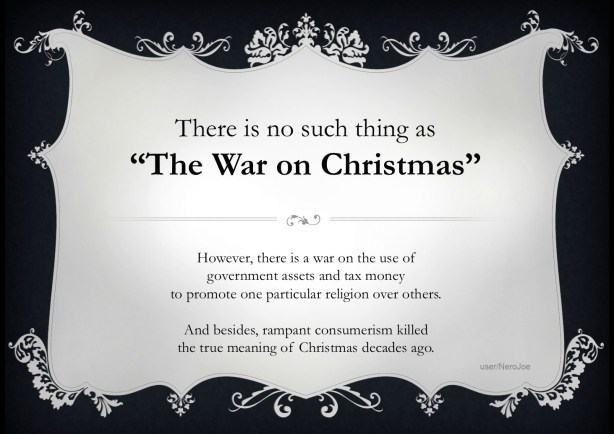
As a Muslim, I identify with the sentiments of the secular population. Most governments have holidays for Christmas, use state funds to purchase Christmas decorations and host Christmas parties. For us Muslims, we don’t have this luxury for ‘Eid, for our Hindu brothers in humanity, they don’t have this privilege for their religious festivals either. Even Jews don’t get a holiday for Hannukah or Passover. Christmas, or the Celebration of Jesus the Christ is solely a Christian holiday, not a secular holiday such as a Republic Day or Independence Day holiday.

Islam has no qualms with Christians celebrating Christmas, but as a Muslim, I do wish that governments would stop showing favour to one religion’s festivals and celebrate all accordingly.

War on Christmas

wa Allaahu ‘Alam.

Refutation: Jesus says that the Father is greater than he is, proving that he is not God.

بِسۡمِ ٱللهِ ٱلرَّحۡمَـٰنِ ٱلرَّحِيمِ ,

Question:

Jesus says that the Father is greater than he is, proving that he is not God. There is no one who is greater than God.

Answer:

Sam introduces the passage upon which the question is based, it reads:

“You heard that I said to you, ‘I go away, and I will come to you ‘ If you loved Me, you would have rejoiced because I go to the Father, for the Father is greater (meizon) than I.” John 14:28

His immediate response is to confuse himself, he says and I quote:

Yet, if God is a Trinity, a Trinitarian Being (i.e. one eternal God existing in three distinct, yet inseparable Persons), then it is quite possible for one member or Person of the Godhead to be greater in some sense than the other members. It would be true that nothing outside of the Holy Trinity’s own existence could ever be greater, but this doesn’t necessarily imply that there cannot be some type of authority structure or ranking within the internal life and relationships of the Trinity itself.

Logically speaking, this form of reasoning is highly fallacious. Since each member of the Godhead is fully God, and God is perfect in each and every way, to have one God being superior to another God, has to mean that the definition and understanding of God has to change. We must accept that God is perfect, one perfect being cannot be superior to another unless one is less perfect than the other. If a being who is assumed to be a God is not absolutely perfect, then this being cannot by very definition, be considered a God. Hence for there to be a hierarchy within the Godhead, we are dealing with one superior God and two lesser Gods. This presents a theological conundrum, as it must be understood that if the first God in the hierarchy is perfect and there is a second God, then this second God is less perfect than the first, thus it logically follows that the third God would therefore be less perfect than both the first and second Gods. With this in mind, it would be best that Sam disuse the premise that their could possibly be a hierarchy within the Godhead. Notwithstanding the evidential fact that the Godhead in itself is polytheistic in nature.

Polytheistic in the sense that if God is one, then in what sense is this God, multi-personal? In what way is God considered a ‘person’ (an individual of specified character)? If I am to believe that God has specific traits, how can God then be multi-personal without increasing or decreasing His traits amongst distinct individuals, exclusive of Himself? Thus, consequentially, by this very description of God being multi-personal (i.e. the nature of the Godhead), God has been relegated to a person among other persons, therefore equating to multiple Gods. Rather, to foster a more comprehensive and accurate understanding of the Godhead in light of personhood, it would equate itself to God with gods. Seeing that I have aptly demonstrated the incredulous nature of a hierarchy within the Godhead and the illogical and polytheistic nature of the Godhead, let’s continue to examine Sam’s fallacious reasoning:

“For now, let us deal with what Jesus intended to convey to his disciples that the Father was greater than he. In the first place, the term for “greater” (Greek – meizon) does not necessarily imply one who is greater in nature or essence. It can refer to someone or something being greater in position and/or authority

Since God’s nature is to be all powerful and all perfect, how does Sam seek to qualify his statement in the response he has given? If God is perfect, then he cannot increase or decrease in position, without losing or gaining Godly traits, thus becoming a lesser God or greater god. Therefore the notion that God increasing or decreasing in position or authority means that it does not affect His nature, is highly erroneous and non-sensible. He continues:

“A careful look at the entire chapter of 14 shows the Lord Jesus claiming to have all of God’s omni-attributes:

“And I WILL DO whatever you ask IN MY NAME, so that the Son may bring glory to the Father. You may ask ME for anything in my name, AND I WILL DO IT.” John 14:13-14

Christ is capable of personally answering all prayers that are directed to him or are addressed in his name. The only way that Christ can both hear and answer all these prayers is if he is both omniscient and omnipotent!”

Sam contradicts himself. At first he claims that their is a hierarchy, now he claims Christ is equal to God. After he has spent a lengthy period demonstrating that the word meizon in Greek can be used to differentiate in power and authority, to promote the understanding that it does not refer to nature (which I have demonstrated is quite ridiculous), he then makes an about turn, negates his previous arguments and tries to demonstrate that Christ is equal to God. This is a sign of a clearly confused individual, trying to reconcile an imperfect doctrine. If Jesus does have all of God’s attributes, then how is he distinct from the person of the Father? Sam’s statement, therefore negates the logic behind the Godhead, well done Sam. On that note, let’s see what the Greek of the verse also indicates. We must be reminded that the Greek of the Biblical text, as with all other languages, has depth. Subsequent to this depth, translations are often consequent to their context. In the case of the Bible, which is a religious scripture, it is quite obvious that the Christian rendition of the text, would attempt to signify Christ’s importance and stature. However, when examining the Greek, as a Muslim, I am able to explore the depth of the text and consider alternate renditions in accordance with the definitions of the words thereby employed. It is with this in mind, that I present an alternate translation based on the Greek of the text:

“And I will do whatever you ask (αιτέω) by (εν) my (μου) authority (ονομα), so that the Son may glorify to the Father. You may ask me for certain things (τίς) by (εν) my (μου) authority (ονομα), and I will do it.” – John 14:13-14, based on the GNT of the Nestle Aland 26th Codex, by way of Strong’s Greek Lexicon.

A Christian would obviously disagree with this rendition because of his presupposed theological views. However, a person who is objective and willing to examine the text for what it is, without biased presuppositions, will be able to accept this English rendition based on the depth of the words used in the verses. This is not perverting the text, as it is normal to find one Biblical verse being rendered in various ways throughout the multitude of Bible translations available to us. In fact, Sam accepts this rendition of the words from the verse used above, as he demonstrates in this article:

I have come in My Father’s name, and you do not receive Me; if another comes in his own name, you will receive him.” John 5:43

Just as the late, renowned NT Greek grammarian and scholar, A.T. Robertson noted in his comments on Matt. 28:19:

… The use of name (onoma) here is a common one in the Septuagint and the papyri for power or authority… (Robertson’s Word Pictures of the New Testamentonline source; underline emphasis ours)

Thus, Sam’s reliance on one translation is very narrow minded and negates other interpretations of the Greek text, which removes Jesus’ alleged assumption of deity. It is clear from the Greek rendition provided above, that Christ is saying he can do only what he can, by which his authority allows him, therefore he is not omnipotent. Sam does say that Christ is capable of answering all of a Christian’s prayers, so I am going to apply the principle of proof by contradiction and challenge Sam to pray to Christ and ask for a unicorn to appear in front of me, as his rendition of the verse claims that you can ask Christ for anything and he would do it. Since this is not true, and a unicorn will not appear, it is then quite understandable that the verse’s rendition and the conclusions of which Sam has derived from it, are highly inaccurate. He continues by appealing to another verse:

“On that day you will realize that I am in my Father, and you are in me, AND I AM IN YOU. Whoever has my commands and obeys them, he is the one who loves me. He who loves me will be loved by my Father, and I too will love him and show myself to him.” John 14:20-21″

Again, with returning to the Greek of the text, Sam’s conclusions can be easily negated:

“On that day you will know that I am before/ wherewith (εν) my Father, and you are before/ wherewith (εν) me, and I am before/ wherewith (εν) you. Whoever has my commandments and obeys them, he is the one who loves me. He who loves me will be loved by my Father, and I too will love him and show myself to him”. – John 14:20-21, based on the GNT of the Nestle Aland 26th Codex, by way of Strong’s Greek Lexicon.

The word “before” is used in the sense that you are in the presence of someone (e.g. I can’t talk now, I’m before the judge), hence the inclusion of the alternate word, wherewith, meaning with a person.This makes the most sense, as Jesus would show himself to those persons and therefore will be before (in the presence of) them and the Lord. Sam makes an interesting interpretation of the verse, he says:

“Christ says that he is IN all the disciples, an impossible claim if he was only a man, or even an angel. But since Jesus is God, and since God is omnipresent, it therefore makes perfect sense for Christ to say he is able to dwell in all the believers at the same time.”

What does he mean that God will be ‘in the disciples’? Does he mean physically? Spiritually? This doesn’t prove Christ’s deity, rather it raises a rather serious theological issue, what does God mean that He will be ‘in’ us? This clearly brings to the forefront, more questions than answers, but if it is one thing Sam’s statements does in this case, it is clearly not proving Jesus’ deity. Sam continues:

“Jesus replied, ‘If anyone loves me, he will obey my teaching. My Father will love him, and WE will come to him and make OUR home with him.’” John 14:23

Both the Father and the Son make their home with all true believers! Christ is clearly claiming co-equality with the Father since he is present with every believer in the same way that the Father is!”

Sam’s logic is that if God accompanies the believers with Christ, then Christ is claiming he is co-equal to the Father. Using Sam’s logic, since the believers are going to be present with the Lord in the same way Christ is present with the Lord, then the believers are all ‘clearly claiming co-equality’ with the Father. Since the latter is nonsensical, how can the former be true? Sam’s logic is clearly infantile, if it cannot work both ways, why does he expect it to work one way? This then, manipulates the full meaning of the text beyond its intended scope. Sam spends the rest of his time trying to equate Christ with the Lord, all of which are easily explained and debunked with employing basic logic and reasoning.

One problem with Sam’s understanding, is that if Sam is promoting the belief that their is a hierarchy, why is he investing so much time into explain ways in which Christ is equal to the Father? Does he not understand how a hierarchy works? By claiming the Father can be greater than the Son, and then demonstrating how the Father is not equal to the Son, Sam is actually contradicting himself. Therefore, in light of Sam’s rivalling explanations, I must ask him, do you believe that the Son is equal to the Father or that the Son belongs in a hierarchy with the Father? The both cannot be true, as either the Son is on par with, or below or greater in rank and authority than the Father. Lastly, Sam claims:

“Thus, the Father was greater in position and rank, not in essence and nature. The questioner is, therefore, committing a categorical fallacy. He/she is confusing the category of position and rank with the category of essence and nature, erroneously assuming that if one is greater in one way, i.e. position and authority, than he/she must be greater in every way, i.e. essence and nature. In light of these clear biblical truths, such is not the case at all.”

Sam’s conclusion is beyond absurd and borders dogmatic arrogance. How can the Father’s rank not describe his essence? How can the Father be greater in rank, but equal in nature? This is like saying, in a track race, the three fastest runners are equal, but the one track runner is first, another second and another third. There clearly is a contradiction in his reasoning and the more he tries to explain it, the more he seems to put his foot in his mouth.

Think of it this way, if the Father is the exact same to the Son in essence and nature, in what way does the Father differ to be superior (greater) than the Son? Sam’s answer is that being greater means that the Son is still the same with the Father, therefore it is either that Sam does not understand the meaning of the word ‘greater’, or the word ‘hierarchy’ or he does not understand the meaning of both those words and the logic behind them. Since this is the case, consider this to be another case of Shamounian logic.

wa Allaahu ‘Alam.

Refutation: The Muslim blogger shows why attempting to have adult dialogue with him is useless

بِسۡمِ ٱللهِ ٱلرَّحۡمَـٰنِ ٱلرَّحِيمِ ,

It seems as though Chessie has had enough and decided to make one final stab at gaining some level of dignity before disappearing for a few months, he states and I quote:

I do not have the time and energy to even attempt to comprehend the nonsense of the Muslim blogger..maybe in a few more months, if I have free time and am bored.

Chessie seems unable to be willing to understand the nature of Christ or to engage in a proper study of Christology, in fact, after reading his last reply I am happy that he’s seen the light and decided to go back into his cave and hide for several months once more. He concedes to the fact that he is unable to, and unwilling to understand what I have written, since that is the case, it explains why all of his points thus far have been erroneous and without much reason. He says:

“When it is said Jesus Christ was the incarnation of the Word/Son that doesn’t mean the Spirit had no involvement, yet just because the Spirit had his role in the  incarnation doesn’t mean he was the one incarnated.”

I’m growing very tired of repeating myself, so I’ll make this into bullet points:

  • In Christianity, a human has both a soul and a spirit.
  • Jesus had a man’s soul, thus he was human in nature.
  • Jesus had a spirit, the Holy Spirit, thus he was guided and supported by this Spirit.

Thus, the Spirit of Christ, is the Holy Spirit, which is confirmed in the following verse:

You, however, are controlled not by the sinful nature but by the Spirit, if the Spirit of God lives in you. And if anyone does not have the Spirit of Christ, he does not belong to Christ. – Romans 8:9.

Chessie has failed to grasp this and has argued against this, in doing so he is not only arguing against myself, but the Pauline literature as well. I then referenced a quote from St. Athanasius’ epistle to Serapion, which read:

When the Word came upon the Blessed Virgin Mary, the Spirit entered her together with the Word; in the Spirit the Word formed a body for himself and adapted it to himself, desiring to unite all creation through himself and lead it to the Father” – St. Athanasius’ Epistle, Ad Serapion.

He was again, unable to understand the relationship between the Spirit and the Word, our focus being on the portion which reads, ‘in the Spirit the Word formed a body for himself‘, see the Word, while it is in the Spirit, formed the flesh of Christ. I suppose that the words, ‘in the Spirit‘, means little to nothing to Chessie. I then quoted a portion of Tertullian, which reads:

Nay, but he adds, And that which is born of the Spirit is Spirit,3 because God is spirit,4 and He was born of God:5 this certainly has him in view, the more so if it has also those who believe in him.’ Then if this too applies to him, why not also that other? For you cannot divide them, this to him, the other to the rest of men: for you do not deny the two substances of Christ, that of flesh and that of spirit. But if he possessed flesh no less than spirit, when he makes a statement concerning the condition of the two substances which he bore within himself, he cannot be thought to have made a pronouncement concerning spirit as being his but flesh as not his. Thus, since he was himself by the Spirit of God (and the Spirit is God) born of God, he was also of human flesh and as man conceived and born in the flesh.” – Tertullian, De Carne Christi, 18.

Chessie says after reading this:

Nothing in this statement says anything about that it was the Holy Spirit who was incarnated and not the Son, the blogger simply reads his own ideas into something he does not understand.

Except the part which says that Christ was of the Spirit and of the Flesh and that the two are inseparable. Guess he missed that/

God is spirit that is no doubt, this simply means Father, Son and Holy Spirit are not material or of the material world. Christ being born of the Spirit does not mean the person of God the Holy Spirit was incarnated instead of God the Son, it means the power of the Holy Spirit over came the virgin when the Son was incarnated in her as a child(the same exact thing the Athanasius says). Notice how it says ” this certainly has him in view, the more so if it has also those who believe in him. ” those who believe, believe under the power of the Holy Spirit and are spiritual, imbued with eternal life inside them spiritually, but that does not mean they stop being their own individual selves. No you can not divide the believer from the Holy Spirit the same way you cannot divide the believer from the Father or the Son.

I don’t see how what he’s written here is relevant to what I have said or quoted. He most certainly went off into a tangent of some sort to perhaps make his article seem longer. The quote clearly says, “for you do not deny the two substances of Christ, that of flesh and that of spirit“. Intentional ignoring of the evidences and rambling onwards to inanity will not help you Chessie, reading the quotes help. He goes on to say:

“The Muslim blogger continues debating about who or what was incarnated and gives us his eisegesis of 1 Peter chapter 1. Again reading his own prejudices into another text to suit his agenda. For one the subject matter of 1 Peter 1 is not the nature of the incarnation its prophecy. “

It seems as if Chessie has learned a new word, ‘eisegesis’, yet what he doesn’t do, is show my source, in fact he never copies the link for any of the sources which I provided for all of my quotes. There was in fact no eisegesis done on my behalf, I in fact had referenced and used Matthew Henry’s Exegesis:

“The revelations of God to his church, though gradual, and given by parcels, are all perfectly consistent; the doctrine of the prophets and that of the apostles exactly agree, as coming from the same Spirit of God. (5.) The efficacy of the evangelical ministry depends upon the Holy Ghost sent down from heaven. The gospel is the ministration of the Spirit; the success of it depends upon his operation and blessing.” – Matthew Henry’s Exegesis, 1 Peter 1:11.

Had he quoted this, then his charade of saying that I committed eiesgesis and that the verse was solely about prophecy would have been debunked, therefore he had to intentionally claim I did not use an exegesis. Look at the desperation and dishonesty of this despot. He continues by saying:

“Now what I have pointed out about 1 Peter 1 is not my private interpretation, many others see the text the same way…”

Except that the one commentary he references is not focusing on which ‘Spirit’ came to the Prophets. The commentary I referenced focused on and explained that the Spirit of Christ which came to the previous Prophets was the Spirit of God. That the Spirit of Christ and the Spirit of God are one and the same, something which Chessie for some odd reason does not want his readers to grasp. He spends a few paragraphs trying to use his newly found word of eisegesis, which he ends up using quite appallingly:

(The same verse Muslims eisegesis by reading Muhammad into it)…

This sentence is wrong in so many ways, I personally had to take a deep breath and compose myself after reading such an incomprehensible sentence. This is probably the first time he’s using the word eisegesis and in a bout to attempt to sound smart, he tried using it again, unfortunately for him, his excitement to use a word he does not understand falls flat on his face. Quite hilarious to say the least, but I cannot say I expected more from a man twice my age, currently in a faith and mid-life crisis. Then he does something out of pure desperation that I think even he was too low to do, but then again, this is Chessie Edwards:

The blogger then makes the astonishing illogical self refuting statement…
” If the Spirits and Soul of Christ did not perish, and the flesh also did not perish, as the flesh returned to life “

Except that’s not what I said. If you’re going to quote someone and call them illogical, atleast try not to quote them partially:

If the Spirits and Soul of Christ did not perish, and the flesh also did not perish, as the flesh returned to life, then what sacrifice was actually done if nothing died?  This leads to my third argument from my original article of which Chessie has also failed to address, it reads:

“If we take John 3:16 as a literal study, then we have numerous paradoxes being applied, for if the Son did ‘die’, but did not truly ‘die’, then the ‘sacrificial death’ was not fulfilled. If you claim the sacrificial death was fulfilled, then this is disproven by Thomas touching a physical body of Christ, whose wounds he felt. Thus if Christ was meant to be an ultimate sacrifice but did not die, but merely suffered wounds and continued to live, then there was no actual sacrifice.”

Lastly, Chessie closes off with saying:

I still as of yet do not know why a immaterial spirit or soul has to cease to exist in order for someone to be truly dead, he has yet to explain this. Also If Christ’s body did not die how did it come back to life ? You have to die to come back to life.

As I told Chessie and as I would tell him again, to die is to cease to live, if Christ died, then which Christ died? Did the Christ of the flesh or the Christ of the Soul and Spirit die? If the soul does not die, how does he interpret Ezekiel 18:20 which reads, “The soul who sins is the one who will die.” If Christ’s flesh perished, then this was not a true sacrifice as God created something and killed the creation, not Christ himself. In closing, Chessie will now return to his shack in the woods and will pop out when he needs more schooling on his despotic faith. I look forward to him returning into hiding once more.

wa Allaahu ‘Alam.


Refutation: The Muslim Blogger Angrily Replies to “The Irrational Muslim Blogger Strikes Again”

بِسۡمِ ٱللهِ ٱلرَّحۡمَـٰنِ ٱلرَّحِيمِ ,


I’m still waiting for Chessie Edwards to explain how he refuted me. He continues to incessantly claim this, yet all he has done is state that Muslims believe in a Ruh and that according to two Qur’anic ayat he has supposedly refuted a Christological question. Yet, as I have aptly demonstrated, he has not answered my criticisms, and as such, he is merely pussyfooting around for some attention. I’m not going to waste much time on him as I reiterate the notion that he is of no importance to the apologetic community, he says and I quote:

This just proved my point that Muslim apologists do not have a accurate grasp of Christian theology just like whom ever wrote the Quran didn’t.

He makes this absurd statement in response to my claim:

” Christians believe the flesh (a body) has both a soul and a spirit and Christ became God in flesh when the Holy Spirit became incarnate in the body of Jesus and replaced the human spirit. “

Since Chessie believes that the above is wrong, then he believes that the body does not have a soul and a spirit, which would be in contradiction to mainstream Christian beliefs:

From this, we now know that Chessie has apostated from mainstream Christian belief, or he is a Christian who is highly uneducated about basic Christian doctrine. He denies basic beliefs which he is not even knowledgeable about and expects me to respect him or to even consider him as worthy of my attention, since this is the case, I suggest that he goes study his faith before arguing about it with someone with superior study. I will come to the matter of the Holy Spirit being incarnate in Christ, but first I want to highlight his denial of this lower down. Before I do so, let’s examine his other statements:

I have to point out that Muslim’s also believe a body contains a metaphysical consciousnesses as well..he doesn’t see the logical implications of that.

I really have to stop and ask Chessie if he has lost the plot at this point. Let me break this down for him, I asked:

  • Did Christ’s human nature die, or divine nature, if so, what does it mean to die?

Chessie’s response to this question, was to claim:

  • Muslims believe in a ruh and I somehow don’t see the logical implication of that.

We refer to this in logic as a non-sequitur argument, in addendum to being known as a argumentum ad ignorantium, as Chessie himself is arguing from a position of ignorance on basic Christian doctrine concerning the soul and spirit, not to forget his complete foregoing of responding to my Christological question on Christ’s nature. Now, returning to the issue of the Holy Spirit being incarnate, he denies this (to his peril) and says:

The part he is wrong in is that Christ is the incarnation of the Holy Spirit, no Christ is the incarnation of the Word of God i.e the Son. Speaking of John chapter one Athanasius states …”  For this purpose, then, the incorporeal and incorruptible and immaterial Word of God entered our world.(1) ”

Maybe the Muslim blogger doesn’t think its expedient to be accurate about the doctrines he is speaking about or maybe he doesn’t care?

Hang your head in shame ignoramus, for the same St. Athanasius says:

“When the Word came upon the Blessed Virgin Mary, the Spirit entered her together with the Word; in the Spirit the Word formed a body for himself and adapted it to himself, desiring to unite all creation through himself and lead it to the Father” – St. Athanasius’ Epistle, Ad Serapion.

Yet, I will not cease in embarrassing you there, I now turn to Tertullian who says:

“Nay, but he adds, And that which is born of the Spirit is Spirit,3 because God is spirit,4 and He was born of God:5 this certainly has him in view, the more so if it has also those who believe in him.’ Then if this too applies to him, why not also that other? For you cannot divide them, this to him, the other to the rest of men: for you do not deny the two substances of Christ, that of flesh and that of spirit. But if he possessed flesh no less than spirit, when he makes a statement concerning the condition of the two substances which he bore within himself, he cannot be thought to have made a pronouncement concerning spirit as being his but flesh as not his. Thus, since he was himself by the Spirit of God (and the Spirit is God) born of God, he was also of human flesh and as man conceived and born in the flesh.” – Tertullian, De Carne Christi, 18.

Please study your religion before you try to discuss it with others Chessie, you only seek to show how weak and uneducated you are and I will not hesitate to lay the law down on some petulant ignoramus whose ranting does not befit my time. He continues:

He states the following which is basically a restatement of the same question he raised that I refuted already.

” My question was and remains, if Christ died, is it the soul that perished, or the Holy Spirit that perished, or just the flesh (which according to him did not die but resurrected itself), or some combination of all three? ”

He actually claims I never answered the question, yet I did answer the question.. that is what the whole post was about. Either he could not understand what I wrote, which would not be a shock considering the Word of God says non believers suffer from spiritual blindness(and Islam is the religion of confirmation bias), or this is some Jihad of the pen tactic. I am going to assume it was just that he didn’t understand me, so allow me to restate my argument in other terms.

I searched Mr. Edwards’ previous post and the only ‘answer’ I saw to my questions was that Muslims believe in a ruh. Although Chessie believes this is an answer, I do not see how this answer of what Muslims believe in, somehow answers my statements concerning a Christological belief. It’s as if I asked Chessie, what is the nature of your Christ’s death, and he responds by telling me that Muslims believe in an afterlife and soul. I am sorry Chessie, but this is wishful thinking on your part, you did not answer my claims and if you think you did, then you would have simply referenced your previous article, but since you know you did not answer my claim, you finally give an answer in this present article which I am responding to, wherein you state:

No his soul did not perish, no the Holy Spirit did not perish especially since it was not the Holy Spirit who incarnated, and no it was not a combination of the three.

So Christ’s human soul did not perish and according to Chessie, the Spirit of Christ is not the Holy Spirit, which contradicts the Bible:

 Concerning this salvation, the prophets, who spoke of the grace that was to come to you, searched intently and with the greatest care, 11 trying to find out the time and circumstances to which the Spirit of Christ in them was pointing when he predicted the sufferings of the Messiah and the glories that would follow. 12 It was revealed to them that  they were not serving themselves but you, when they spoke of the things that have now been told you by those who have preached the gospel to you by the Holy Spirit sent from heaven.” –  1 Peter 1:10 – 12.

In these verses (which clearly Chessie have not read), in relation to the quotes from Tertullian and St. Athanasius, the Spirit of Christ is the Holy Spirit which was of Christ and is that which prophesied about the Messiah to the Prophets of old. This is confirmed by Matthew Henry’s exegesis which says of the Spirit of Christ in 1 Peter 1:11;

“The revelations of God to his church, though gradual, and given by parcels, are all perfectly consistent; the doctrine of the prophets and that of the apostles exactly agree, as coming from the same Spirit of God. (5.) The efficacy of the evangelical ministry depends upon the Holy Ghost sent down from heaven. The gospel is the ministration of the Spirit; the success of it depends upon his operation and blessing.” – Matthew Henry’s Exegesis, 1 Peter 1:11.

Clearly, Chessie is out of his league and does not know much about Christology, I wish that he does study this matter more sincerely before making more of a fool out of himself. He continues:

As I stated in the last post which he never addresses the question itself is illogical, non-physical things can not experience physical death. The physical death of a person does not mean there immaterial existence stops existing. Again this is the same thing Islam teaches, and this is what common sense tell us.

While I am happy to see the Chessie concedes that what Islam teaches is common sense, I must take him to task on his other statements. If the Spirits and Soul of Christ did not perish, and the flesh also did not perish, as the flesh returned to life, then what sacrifice was actually done if nothing died?  This leads to my third argument from my original article of which Chessie has also failed to address, it reads:

“If we take John 3:16 as a literal study, then we have numerous paradoxes being applied, for if the Son did ‘die’, but did not truly ‘die’, then the ‘sacrificial death’ was not fulfilled. If you claim the sacrificial death was fulfilled, then this is disproven by Thomas touching a physical body of Christ, whose wounds he felt. Thus if Christ was meant to be an ultimate sacrifice but did not die, but merely suffered wounds and continued to live, then there was no actual sacrifice.”

Chessie continues:

So my question to the Muslim blogger is this, are you arguing that the immaterial soul dies and stops existing at the point of physical death ? “

You mean to say that you have written two articles, told me I am wrong, that I have been deceptive and that I am not educated on the issue of which I am speaking, yet after your second reply, you are now asking what it is I am actually arguing?  If you want to know what I am arguing, read this article: Some Musings About Jesus’ Death.

wa Allaahu ‘Alam.

Refutation: The Irrational Muslim Blogger Strikes Again

بِسۡمِ ٱللهِ ٱلرَّحۡمَـٰنِ ٱلرَّحِيمِ ,

After a period of mourning for his apologetics career, Chessie Edwards, our resident court jester has decided to make a triumphant return. I say triumphant because he has resumed his role as a court jester instantaneously. Let it be known that I do not consider Chessie Edwards to be of any academic, spiritual, theological or human value. I’m really only writing this response to his article because I’m waiting for my post-op medication to kick in and I needed something to do, to pass the time that is. I came home from the hospital and after a long nap, I checked the website in almost more than a week to see that he had commented on a post of mines. Now, before I continue, it should be known that Chessie does not have a good history with me. Time and time again, I’ve embarrassed him into oblivion and every few months when he needs views on his website he posts an article about me, hoping to gather some much needed attention. I oblige with his requests because, well, because I have no good reason save for me enjoying routing the guy. So Chessie, I’m going to do you a favour, if anyone wants to read an article probably written during a druken stupor about his mid-life crisis as a failed Christian apologist, then please visit Chessie Edward’s website:

http://www.callingmuslims.com/2012/11/the-irrational-muslim-blogger-strikes.html

When you go to his website, on the left you’d see a donate link, if you would like to provide Chessie with some beer and stripper money, I am not going to stop you (although as a Muslim, I have to advise against doing so, but we both know where those funds go buddy!).  After you visit his website, you can then visit my refutation page that puts anything remotely close to ‘popular’ on his website to rest. I put popular in apostrophes because the highest rated article hasn’t changed in two years and I’ve yet to see a single Christian quote, cite, reference or use it. Heck, I don’t think I’ve ever seen anyone comment on it (as of 30-11-2012 there still are no comments on his most popular post, which I suggest you read my response to or this new article of mines on the Sana’a codex).

Chessie’s claim to fame is that this website (Calling Christians) was created by copying his website:

I SAW THE FOLLOWING ON THE SITE OF A MUSLIM BLOGGER WHO I HAD SO MUCH INFLUENCE OVER HE COPIED THE NAME OF MY BLOG.

Now, I’m not sure why he’s written this in all caps, perhaps his caps lock key is broken, or maybe he is angry, either way this isn’t a good start for him. If I had copied his blog’s name, this website would be called, “Calling Muslims”. I’m not sure, but this website’s name is actually “Calling Christians”, maybe Chessie assumed by using the word “calling”, he had copyrighted it or something, I don’t know what he was thinking when he wrote that. The truth is however, that one day, Chessie began to boast he had a website on a mutual friend’s wall on Facebook. To let him know how silly this claim to fame was, I created a website, responded to his most popular articles, shamed him on every response he attempted to make, reducing his blog to something he updates once every few months or so. You’d think by now that he’d learn not to piss off the one kid that made him a laughing stock among Christian polemics, then again, you can’t expect the old and senile to learn new tricks (wait, that’s now how that saying goes, oh well…). He continues:

OUR BROTHER IN HUMANITY CLAIMS THAT JESUS DEATH WAS NOT A REAL SACRIFICE BECAUSE ONLY HIS FLESH DIED AND NOT HIS SPIRIT.

Chessie, I am not your brother in any way, shape and or form. Please do not associate me with you, spare me the embarrassment. I believe Chessie is confused, you see, Christians believe the flesh (a body) has both a soul and a spirit and Christ became God in flesh when the Holy Spirit became incarnate in the body of Jesus and replaced the human spirit. My question was and remains, if Christ died, is it the soul that perished, or the Holy Spirit that perished, or just the flesh (which according to him did not die but resurrected itself), or some combination of all three? You’d notice that he never answers this question, which forces me to ask: If you didn’t write this to answer my question, why did you write it at all?

THAT BEGS THE QUESTION DOES ISLAM TEACH THAT SPIRIT OR ROOH IN ARABIC DIES? SPIRITS ARE IMMATERIAL AND METAPHYSICAL..SO HOW COULD SOMETHING THAT’S NOT PHYSICAL EXPERIENCE PHYSICAL DEATH? NO ONES SPIRIT DIES, IF WE ACCEPT THIS PERSONS “LOGIC” THAN NO ONE IN HISTORY HAS EVER DIED. ISLAM TEACHES THE METAPHYSICAL ASPECT OF MAN SURVIVES PHYSICAL DEATH AND GO’S ON TO LIVE IN THE BARZAKH A SPIRITUAL REALM.

Chessie decides to divert from the topic completely and rambles on incoherently about the Islamic concept of the soul (we do not believe in soul and spirit, just one unified ‘soul/ spirit’ – ruh). Which puzzles me as he then makes this statement:

THE WHOLE POST JUST SHOWS THAT MUSLIM APOLOGISTS HAVE A WEAK UNDERSTANDING OF CHRISTIAN THEOLOGY.

Chessie, if you bothered to read your previous paragraph, you didn’t demonstrate Christian theology, you were actually speaking about Islamic theology. Therefore, how can you claim I have a weak understanding of Christian theology, if all you’ve done thus far is speak about Islamic theology? Something doesn’t add up here. I fully believe that no adult man can write such a disjointed post without being influenced by alcohol or some opioid. If he did write this without the aid of an intoxicant, then I hang my head in shame, knowing that the human race has hit a new low in functional retardation. He continues:

CHRISTS HUMAN NATURE WAS NOT JUST FLESH IT WAS A REAL ACTUAL HUMAN NATURE, HE WAS A REAL ACTUAL HUMAN BEING AND HE HAD A REAL ACTUAL DIVINE NATURE, HE WAS REALLY THE DIVINE LOGOS. TO EVEN ASK IF CHRIST’S DEATH WAS THE PHYSICAL DEATH OF NON PHYSICAL SPIRIT SHOWS A LACK OF LOGICAL THINKING. SOME MUSLIMS ARE SO DESPERATE TO OPPOSE CHRIST THEY REACH OUT FOR ANY ARGUMENT THEY CAN FIND WITHOUT EVEN STOPPING TO THINK IT THROUGH.

I fail to see how this is anything more than Chessie shouting, “IT’S REAL”, without answering the paradoxes I presented here. Somehow begging me to think it’s the truth by repeatedly saying the word, “real”, does not convince me. I’m looking for something more of an explanation, an argument, a structured discussion, maybe a few academic references, I don’t know, maybe I’m setting my standards (and hopes) too high for Chessie’s sake. He continues:

A SHAHEED IS A ARABIC TERM USED TO DESCRIBE MUSLIM MARTYRS WHO HAVE DIED IN THE PATH OF ALLAH USUALLY WHILE FIGHTING JIHAD. THE QURAN SAYS ABOUT THEM THE FOLLOWING…

Yay! Free Arabic lessons from Mullah Chessie.

” ALLAH HATH PURCHASED OF THE BELIEVERS THEIR PERSONS AND THEIR GOODS; FOR THEIRS (IN RETURN) IS THE GARDEN (OF PARADISE): THEY FIGHT IN HIS CAUSE, AND SLAY AND ARE SLAIN:…” SURAH 9:111

Can’t wait for the major argument he is building!

THE ABOVE CLEARLY SAYS THEY ARE SLAIN I.E THEY DIE, BUT LOOK AT WHAT THE FOLLOWING SURAH SAYS ABOUT THEM…

“THINK NOT OF THOSE WHO ARE SLAIN IN ALLAH’S WAY AS DEAD. NAY, THEY LIVE, FINDING THEIR SUSTENANCE IN THE PRESENCE OF THEIR LORD; THEY REJOICE IN THE BOUNTY PROVIDED BY ALLAH: AND WITH REGARD TO THOSE LEFT BEHIND, WHO HAVE NOT YET JOINED THEM (IN THEIR BLISS), THE (MARTYRS) GLORY IN THE FACT THAT ON THEM IS NO FEAR, NOR HAVE THEY (CAUSE TO) GRIEVE. ” SURAH 3:169-170

THIS SURAH SEEMS TO BE CONTRADICTING THE FIRST ONE, THE LOCAL IMAM AT THE MOSQUE WILL TELL YOU THERE IS NO CONTRADICTION. ONE SURAH IS SPEAKING OF THE SHAHEEDS PHYSICAL LIFE IN THIS WORLD AND THE OTHER IS SPEAKING OF THEIR IMMATERIAL SOUL AND SPIRIT IN THE SPIRITUAL WORLD. SO JUST LIKE THERE IS NO CONTRADICTION HERE THERE IS NO CONTRADICTION IN CHRIST’S DEATH .

That was simply mind blowing! Excuse my sarcasm, but now on to my real thoughts:

Really?

Really?

I’m not sure how to tell Chessie this, but thank you for pointing out that while people die in this world, they are alive in the afterlife. Hence why it’s called the after life. Get it? After, life. Maybe I need to break it down a little bit more for my friend Chessie.

When you die in this world, you’re dead. When you’re alive in this world, you’re living.

When you die in this world, you’re in the after life, you no longer exist in this world, but are alive in the after life.

Now, I don’t think by superimposing Islamic theology on Christology is the best way to refute me. You’re confusing two different religious doctrines without really refuting my points which were based on Christian theology. If you wanted to respond to me, you would have clearly explained the nature of life and death in Christianity, then gone on to explain Christ’s nature and lastly, based on the last two notions, then proceed to explain how my logic was wrong in light of Christology. I am not your teacher, I don’t need to tell you how to write a refutation, but when you insist on mocking yourself, I will give you the attention your idiocy so much deserves.

Some might say that my words to Chessie are harsh and uncalled for, but I write this with the hope that Chessie puts his big boy pants on and learns not to interfere when adults are speaking.

wa Allaahu ‘Alam.

David Wood Cowers from a Muslim’s Questions

بِسۡمِ ٱللهِ ٱلرَّحۡمَـٰنِ ٱلرَّحِيمِ ,


I’ve never really seen David Wood as a Christian scholar, at best he’s someone who has partially read Muhammad ibn Ishaq’s (ibn Yasar’s) works and maybe a few Answering Islam articles on Qur’anic ayat. His debate with Ali Ataie really demonstrated his inability to argue beyond this knowledge limitation which he possesses, while he constantly demonstrates a vast ineptitude in Biblical studies. Therefore, it comes as no surprise that when David is questioned on the Bible, he sticks his tail between his legs and avoids discussing his book’s wanton genocide and terrorism. Check out this 15 minute video clip as Br. Paul Bilal Williams, a former Christian, takes David to task:

wa Allaahu ‘Alam.

Christ Saved Me

بِسۡمِ ٱللهِ ٱلرَّحۡمَـٰنِ ٱلرَّحِيمِ ,

I was hospitalized on Friday the 23rd of November, I was admitted as an emergency case and subsequently needed surgery. For many days I was heavily medicated, unable to move as my body and mind slowly deteriorated. I asked God to guide and protect me, and I was soon answered with good news.

On one particular night, my body was aching with horrible pains. My head pulsed with torment, while my back shivered with anxiety, my mind entered into a state of disarray. You see, the lights were on, it was late at night and the patients who were also heavily medicated were arguing with one another. I was ill and suffered for a number of days. I needed relief, I needed salvation from this horrendous situation I had found myself in.

Suddenly, the room became quiet, and the lights dimmed. Perhaps this was me falling asleep. I looked up and saw a dim light, growing in intensity, yet my eyes were not strained. At first a figure appeared, but I thought it was Allaah, but then I thought it was Muhammad [saws], but no, a man of great immense beauty approached me from the light. In my heart, I knew who this man was. It was Christ, the son of God. I was confused, but then I remembered that this was the answer to my prayer which I had made earlier. God was answering me, in the flesh, through His Son.

Out of all the persons in the world, I who wrote against His word and denied his crucifixion, denied his rising, Christ chose me. A relief and calm over came me as I gazed upon his face. I could hear nothing and feel nothing, I basked in the glory that is Christ, something I had never experienced with Islam. Christ spoke to me and said to me, “I am the Son which you have persecuted, but by my Grace you shall be saved.” At that moment, I accepted the grace of the Christ into my heart and proclaimed myself a Christian. God had answered my prayers by coming personally to me and revealing his glory to me.

To be quite honest, the only true part of this article is the very first paragraph. I have always been amused by persons claiming that Christ spoke to them and cured them. You see, if Christ can visit Paul and change his ways, why did the Christ not come and grant me salvation while I was suffering in the hospital? Why does Christ only visit televangelists who make money off of producing fictional stories like the one I authored above? I based the above story on a TV series called, “A Muslim’s Journey to Hope”, also off of Lebanese Christian Kamal Saleem’s supposed conversion story. Anyone can make up stuff like this, yet people still hold on to these fables as if they were unquestionable. If Christ really visited these people under such conditions, why does he only seem to visit Pastors and Televangelists who are able to make millions off of their congregations? Quite odd if you ask me.

wa Allaahu ‘Alam.

« Older Entries Recent Entries »