Category Archives: Muslim and Non-Muslim Dialogue

Quick Commentary on the Law of Apostasy in the Bible

بِسۡمِ ٱللهِ ٱلرَّحۡمَـٰنِ ٱلرَّحِيمِ ,

It is absurd that Christians argue against the law of Apostasy when their own God commanded that apostates be killed:

“If your very own brother, or your son or daughter, or the wife you love, or your closest friend secretly entices you, saying, “Let us go and worship other gods” (gods that neither you nor your ancestors have known, gods of the peoples around you, whether near or far, from one end of the land to the other), do not yield to them or listen to them. Show them no pity. Do not spare them or shield them. You must certainly put them to death. Your hand must be the first in putting them to death, and then the hands of all the people. Stone them to death, because they tried to turn you away from the Lord your God, who brought you out of Egypt, out of the land of slavery.” – Deuteronomy/ Devarim 13:6-10.

Jesus did not comment on this law, nor did he abolish it, for he said:

““Do not think that I have come to abolish the Law or the Prophets; I have not come to abolish them but to fulfill them.  For truly I tell you, until heaven and earth disappear, not the smallest letter, not the least stroke of a pen, will by any means disappear from the Law until everything is accomplished. Therefore anyone who sets aside one of the least of these commands and teaches others accordingly will be called least in the kingdom of heaven, but whoever practices and teaches these commands will be called great in the kingdom of heaven. For I tell you that unless your righteousness surpasses that of the Pharisees and the teachers of the law, you will certainly not enter the kingdom of heaven.” – Matthew 5:17-20.

When Jesus says that he came to fulfil the law, it means that he came to complete it. How did he complete it? By rectifying six laws, as is found in verses 20 and beyond, regarding: Murder, Adultery, Divorce, Oaths, Eye for an Eye and Loving Your Enemies. In fact, YHWH makes it clear that His laws are eternal:

“All your words are true; all your righteous laws are eternal.” – Psalm 119:160.

Concerning this verse, the exegete, Barnes, says:

Since any one of thy laws is as certainly founded in truth as any other, it must be that all alike are eternal and unchanging. It must be so with all the essential principles of morality. Mere regulations in regard to rites and ceremonies may be altered, as local and municipal laws among men may be; but essential principles of justice cannot be. A civil corporation – the government of a city or borough – may change its regulations about streets, and culverts, and taxes; but they can never enact laws authorizing murder or theft; nor can they alter the essential nature of honesty and dishonesty; of truth and falsehood.”

Jesus himself never comments on the law of apostasy and in that, he also never repeals it. Opposingly, we have clear, extant, explicit words from him and from YHWH about the laws of God being eternal and to never be discarded, as such there is no reason, whether from the Old Testament, New Testament, YHWH, Jesus or the Disciples that any Christian can argue from, that the Law of Apostasy as given by YHWH is now defunct and inapplicable without lying about their own scripture and God.

wa Allaahu ‘Alam.

Muslim and Jewish Students told to eat Pork or have no Substitute Protein for Lunch

بِسۡمِ ٱللهِ ٱلرَّحۡمَـٰنِ ٱلرَّحِيمِ ,

Shocking news out of one French city today, as the Mayor of Arveyres has decided to remove substitute protein meals when pork is being  served to a school in his village. The school contains some 180 students, 30 of which do not consume pork due to either being Muslim or Jewish. The Local (French News in English) reports:

“Parents of some of those pupils affected have taken umbrage to the decision.

“We are not asking for halal or kosher meat,” one mother told France blue radio. “We just want a meal with substitute protein.”

Certain parents had even offered to cook meals for the children and bring them to school but their offer was dismissed by the town’s mayor because it would be “logistically hard to implement and ethically shocking”.

The mayor of Arveyres, Benoit Gheysens told AFP the move was being taken because of the cost of providing alternative meals, many of which went to waste.

“Often children who did not take the substitute dinner complained as well and left the pork. It distressed the staff to see how much food was wasted,” Gheysens said.

The mayor, who believes the school in Arveyres is not the only one in France facing such a dilemma, has vowed that the children will get all the protein they need saying vegetables, salads and lentils will be offered when pork is on the menu.

The mayor said pork was served no more than once a week.”

wa Allaahu ‘Alam.

10 Questions that Christians do not like to answer!

بِسۡمِ ٱللهِ ٱلرَّحۡمَـٰنِ ٱلرَّحِيمِ ,

In this list, I intend to present 10 questions which critique the Christian faith in an indepth manner. Whether you’re a Christain who is well educated or lesser educated, these questions are meant to provoke deeper thinking concerning your faith:

  1. If the earliest Christians within the first two centuries after Jesus did not need a New Testament to qualify their faith, why do modern Christians have such a need? If they did not sanction or consider any other writing beside the Old Testament to be scripture, then isn’t it a digression from the ‘true faith‘ of the earliest believers to incorporate something new as scripture? The first New Testament was codified and canonized by the heretic Marcion who believed that the Jewish YHWH was not the true God, the first time the largest Christian Church sanctioned a New Testament was during the 2nd Ecumenical Council of Carthage in 397 CE, some 360+ years after Jesus.

  2. In continuing with the New Testament, most scholars accept that Paul’s writings were the first of the New Testament to be written. Dr. Dale B. Martin dates 1st Thessolonians to be from 47 CE, Prof. Bart Ehrman dates it to be from 49 CE, either way the earliest Christian New Testament ‘scripture’ can theoretically be traced back to a man who admitted to being a fool (2 Cor. 11:1, 16), to being demon possessed by a satan sent by Christ (2 Cor. 12:6-11), who stole the name of a Pagan Roman leader (Acts 13:7-9), and who disagreed with the brother of Jesus, even fighting with the Disciples who lived with Christ and referring to them as not true believers! Heck, he even denounces a significant portion of two Gospels by criticising the biographies included in them in Titus 3:9.
  3. If Christ died for the sins of mankind, then by his sacrifice we are all sinless. On the cross and before his death he did not specify any criteria for his sacrifice to be upon us. He never put such conditions as belief in him as a deity or that we must accept the yet to be announced religion of ‘Christianity’ or to profess belief in the ‘Trinitarian Godhead’. If there are conditions, (let’s say to believe in him), then mere belief in his existence satisfies this condition. If Christ did die, then he died for you, me and everyone else and we are therefore sinless through his death. If it is claimed that he died only for the elect, then his death was useless as he claimed to die for all (John 3:16), but his death was not good enough to save everyone. The logic behind his death is also of great interest.
  4. According to Psalm 37:28, God would not forsake the faithful and just, He would protect them forever. Jesus on the cross claimed to be forsaken, as such, if Jesus did claim this, then according to Psalm 37:28, he was not faithful and just. The verse also mentions that the wicked would perish, since Christ died/ perished, then this verse would lead us to believe that God considered Christ to be wicked. If Psalm 37:28 does not apply to Jesus, what is the reasoning for this claim?
  5. If the Bible is the Word of God, and Psalm 119:89 claims that there is one eternal scripture preserved in the heavens, then which Old Testament and New Testament should we believe in? If you are a Bible believing Christian, this is a serious issue as no Bible post-John Mill’s GNT is derived from one holistic text but from a compendium of MSS codices, see the Nestle-Aland GNT. For more information, see here for an expansion of this line of questioning.
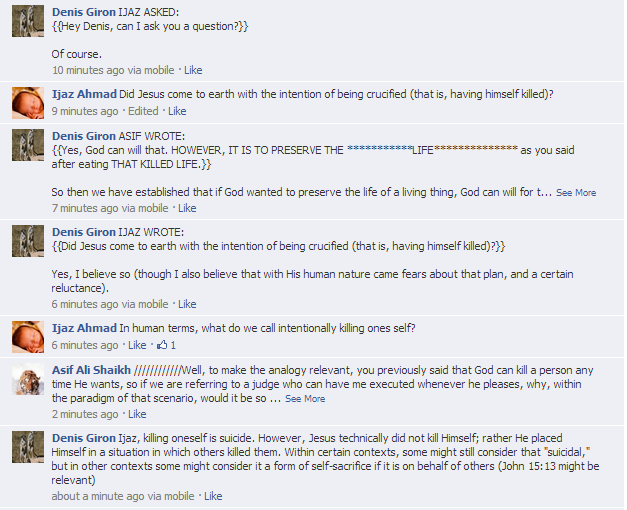
  6. If Jesus came with the intention of dying for everyone’s sins, then it must be understood that ‘intentionally killing one’s self‘ is considered to be suicide. Therefore Jesus’ death is suicide. If God is the Most Loving, why would he (a) murder his own son instead of forgiving (as He did for those who repented) or (b) commit suicide? Both of these are sinful acts. Can salvation be obtained through murder-suicide?
  7. Since Jesus said the ‘Father is greater than I‘ and we understand that God the son is co-equal to God the Father, then this is an inherit contradiction in the doctrine of the Trinity. For if one is greater than the other, how can God be greater than God? If one God is greater than another God we have a bigger issue as they are therefore not co-equal and are two distinct entities, therefore they are two Gods and not one. For if they are one, how can one be greater than the other?
  8. Who exactly is YHWH? Is YHWH Jesus, the Son and the Holy Ghost? Or is YHWH solely the Father? If the son-Jesus is YHWH, why does He never identify himself as such? Despite this problem/ confusion as to who YHWH actually is, another issue has arisen. According to 2 Corinthians 12:4, the inexpressible name of YHWH is actually a man made name, derived to substitute the loss of the real name of God. Yes, Christians and Jews do not really know the name of God. Exegete Adam Clarke explains in detail this conundrum. How can you call people to Christianity, if you don’t actually know who God is?
  9. The doctrine of the Immaculate Conception refers to Mary’s purity from the original sin upon conception. According to the doctrine of the Original Sin, all born of women, inherit the sin of Adam and Eve. Since Jesus is born of a woman, then he automatically inherits this sin. However, he doesn’t, because of the sinless nature of Mary. Whether you are Catholic or not, in order for Jesus to have been born sinless, then you must believe that Mary at one point or another did not have the original sin and was thus sinless. The question therefore begs itself, where does the Bible say Mary is sinless or was born sinless? To further this argument, if we do inherit the sin of Adam and Eve, why do we not also inherit their repentance and good deeds?
  10. We’ve covered the Bible, Paul, Jesus, Creeds and Doctrines, Christology/ Theology, the Law and Salvation/ Soteriology. For the last question, I ask something very simple. Since God is the Creator and He created us, it is fitting that God should tell us our purpose of life or why we were created. Therefore, I’m asking for where in the Bible does God-YHWH-the Son-the Spirit or Paul, mention why God created us?


Some Christian Responses and my Refutations:

The following responses are by the former Atheist and Islamophobe, now quasi-Catholic anti-Muslim Denis Giron – located here.

Question #1:

The fact that, at one point in time, believers adhered to texts which some believers may not have been aware of at previous points in time can easily be explained within the context of progressive revelation, or a system where the details of the faith are unfolded over time. Such is not a “digression” if such was part of God’s plan. On a side note, it is worth noting that there are various 2nd century writers who quote many of the texts of the New Testament, and some scholars date the Muratorian fragment to the 2nd century, ergo it seems much (if not all) of the New Testament was used as Scripture by Christians within the first two centuries after Jesus.

He does not directly answer my question. I have asked that since the first Christians did not need to believe in the New Testament to be considered Christians, why does it matter if Christians today believe in the New Testament or not? His answer? To say that Christians did believe in the New Testament by offering a 2nd century quasi-canon. He makes an assumption, that because a list of books existed that all Christians believed in it. I’m not sure if his answer was a joke or if he assumes that I am functionally retarded, but to respond to him, when Athansius’ list was produced there is no evidence that all Christians believed in those books which is why some 30 years later two more Councils had to be held to declare them as scripture. Therefore given that bit of history, the existence of a list does not mean that some, all or most believed those books to be scripture, that is simply wishful thinking. The very fact that it took 2 centuries for the list to develop and be published, yet it took two other centuries after that for a majority of Christians to then accept those books of scripture, proves my point quite well enough.

Question #2:

The charge that he was demon possessed seems a bit of a leap. Many Christians would simply read the relevant text as referring to some trial he had to undergo, which was inflicted upon him by a messenger of Satan. This could be in reference to illness, mockery, or something else. Others, such as Job, were similarly afflicted.

Likewise, the charge that he stole the name Paul from a pagan leader is not supported by Acts 13:7-9. At best we can say they had the same “name” (Paulos meaning “small”). Surely Ijaz is not arguing that if two people have the same name, then one must be stolen from the other… e.g. is Ijaz’ own surname, Ahmad, “stolen” from Mirza Ghulam /Ahmad/? Of course, the answer is no, which would mean it is possible for two people to employ the same “name” without one being stolen from the other.

What this Christian calls a leap, I call reading the text and observing the works of the famous exegetes. In the link I provided and as the text states, he (Paul) was afflicted by a Messenger of Satan, which some exegetes have determined to be a demon troubling him. Unfortunately, this Christian ignores Church authority (while claiming to be a Catholic), the exegete Burkitt says in his notes about this verse:

“This thorn in the flesh is called the messenger of Satan, from whence St. Chrysostom concluded that it was some evil angel that was permitted and impowered by God to scourge and buffet him. The sufferings of the best and holiest persons in the flesh, may be the buffetings of a messenger of Satan , and yet be from God. Satan certainly intendeth our hurt, but God over-rules him as an instrument to do us good: It is no proof that a man is not a child of God, because Satan has a permission to torment his flesh. The messenger of Satan was sent to buffet me, says St. Paul, lest I should be exalted.”

I’m sorry that Denis does not read commentaries about such claims about Paul from among his own religious brethren, on the other hand I do and I have qualified my claim. He begins his defense of Paul’s stolen name by stating the text does not support it, to the contrary, immediately after Paul meets a Roman proconsul with the name Paulus, he changes from Saul to Paulus (also known as Paul). He didn’t change his name in either of the two contradicting narrations about his conversion, but miraculously he changes it after meeting someone with the same name, how ‘coincidental’ is that? Lastly, he gives a bad analogy, as my name is not derived from Mirza Ghulam, but derived from the one after which Ghulam was named, i.e. Ahmad, also known as Muhammad (peace be upon him).

Question #3:

One would think that Christ expects believers to believe what He taught (ergo, that would include believing that His blood was shed for the sins of others, et cetera), so it would seem more than mere belief in His existence is required.

This is again, wishful thinking. What Christ taught and said is not determined by your preconceived notions about his message. I think that if we are to be honest with ourselves, what Christ taught and did is of no consequence to us as his blood was already shed for us. Denis’ answer does not respond to my question, it raises the importance of my question. Christ does not say, not once in the Bible that we must believe he died for us to in order that we may receive salvation. Therefore whether we believe that he did x, y, or z does not matter as what truly matters is that he paid for our sins and whether I believe or disbelieve, does not affect his already having died.

Furthermore, Christians do not reduce obligatory doctrine to only that which Christ is quoted as teaching in the Bible. For example, Christ is not quoted as teaching the Virgin Birth, yet mainstream Christians would nonetheless hold that belief in such is obligatory. Ijaz’s methodology, if taken to its logical conclusion, would allow people to wave off the Virgin Birth, and thus it strikes me as a form of reverse-da3wa.

Denis decides the best method of deflecting from the core of my question is to jump to an irrelevant rant about Islam’s belief about the Virgin Birth. My question has nothing to do about empirical evidence about miracles, my question quite simply is meant to deal with a theological dilemma. What’s worse is that the only reason Denis is throwing this irrelevant statement into the mix about some supposed ‘methodology’ (which he does not indicate what it is), was written because of a previous discussion he had with me. In that discussion, I asked about the zombies in Matthew which came out of the grave upon Jesus’ alleged murder which some unknown author some 60 years later wrote about. Denis didn’t like that question, so he spent weeks running past it and it still frustrates him to this day, so he asked me to prove the Virgin Birth, thus doing reverse missionary work and throwing doubt on his own beliefs.

As for Christ’s sacrifice, the Bible makes clear that it makes salvation available to us, but it also makes clear that proper belief and sincere repentance are also needed.

Nowhere does the Bible say that we must believe in the Trinity as proper ‘belief’ to be absolved through Christ’s murder. This is once again, wishful thinking.

Question  #4:

Ijaz’ assertion that Jesus claimed to be forsaken is far from an agreed upon point among Christians. A great many Christians hold that Christ wasn’t actually expressing a belief that He had been forsaken; rather He was paraphrasing in Aramaic the opening of the 22nd Psalm. It is worthy of note that the 22nd Psalm has been historically interpreted by some Jews as referring to a Messianic figure suffering for the sins of others. Ergo, Christ was alluding to Scripture and subtly noting that, while observers might have thought that was the end of Him, there is more to the story.

To correct the Christian, he is trying to say that “Jesus did not mean what he said, his words are not to be taken literally”. Why is it not to be taken literally? He claimed to be “forsaken” in no uncertain terms, so why should I understand this to be something else? Does the Christian not take the “I AM” statement to be literal? Does he not take the “Father and I are one” statement to be literal, so why in this specific case should we be led to believe that Christ did not mean what he meant to say? This is the Christian mindset, where it suits them, something is literal and when it destroys their faith, then it must not be taken literally. The question still stands, why is it not to be taken literally in this incident, when he word for word, literally quoted Psalm 22?


As for Psalm 37:28, it does not mean that all righteous persons in this life will be spared from death or that only wicked people will suffer death in this life. Such a view would leave no room for the possibility of martyrdom, or even the mere fact that even righteous people do die. The Hebrew text’s declaration of “l`olam nishmaroo” (i.e. to eternity they [i.e. the chaseedeem of God] are preserved) gives the impression that it is referring to a scale of time which extends beyond death in this world.

The verse in question mentions being forsaken and then perishing. A martyr knows that he is not forsaken, but that his death is something beautiful, destined by God, in God’s plan. Jesus however, when allegedly on the Cross, uses the word “forsaken” and he cries out, questioning his God/ Daddy. In this regard, Christ does not see himself as a martyr or a righteous person, as the words he uses establishes him as a doubter in God’s plan and as one who feels forsaken by God’s love and mercy which is why some Christians point to Galatians 3:13 to emphasize the despair of Jesus.

Question #5:

The precise make-up of Scripture is indeed an interesting question, and has been so for much of Christian history (e.g. consider Jerome’s criticisms of the Septuagint in favor of the Hebrew Text he had access to). Regarding the New Testament, while different Christians will have different Greek corpora they prefer (e.g. a minority might side with the Textus Receptus, others, such as myself, might point instead to one of the more recent editions of the Nestle-Aland platform), none of these corpora will agree perfectly, letter for letter, with any known ancient corpus. Having said that, however, it does not seem that the differences among the different corpora necessitates a change in doctrine. For example, James White and the Jeho___’s Witnesses are pretty much in agreement on what the Greek text should look like, but they disagree doctrinally, while there were no doubt 17th century Calvinists who followed a Greek text essentially like that of the Textus Receptus who were nonetheless in doctrinal lockstep with the positions held by Dr. White, today. Beyond that, as far as the modern editions of the Greek NT are concerned, the points of dispute have become quite minor. It is quite telling that even a hyper-skeptic like Bart Ehrman admitted, in his debate with the aforementioned Dr. White, that were he to produce his own best attempt at reconstructing the Greek NT, it would differ less from the current Nestle-Aland platform than does the Textus Receptus. So perhaps one can go with a standard Greek NT, and we can discuss specific readings within verses which might be at the centers of disputes.

As for the OT, as far as Christian history is concerned, the variations there are far more egregious than is the case with the NT. I suppose in the end one is left to wonder whom to trust (e.g. the disbelieving Jews, the ancient Catholic Church, et cetera). I would say run with the Septuagint, supplementing it with the Masoretic Text along the way.

He does not address my question. In fact, he highlights and proves to me that he cannot fulfil the criteria of Psalm 119:89 of one holistic text. His conclusion based on his argument is that a hodge podge of various texts constitutes something as a ‘best attempting at reconstruction’. Best attempt at recreating scripture does not mean that you actually have the scripture, it means that you have something like it, something similar to it, but not the actual text for certainty. Therefore Denis has proven that his scripture is not certain and thus fails its own criteria to establish it as being from God.

Question #6:

 I would think there should be a distinction between putting oneself in a position where one might die so that others may live, on the one hand, and suicide simpliciter, on the other. For example, if a would-be assassin fired a gun at the Queen of England, and one of her body guards stepped in between her and the oncoming bullets, and he died as a result of his wounds, I do not think he would be waved off as merely a suicide.

As for the question of how we reconcile God’s love with the system of vicarious atonement proposed by Christianity (or even mildly similar systems of vicarious atonement proposed by Rabbinic Judaism), I would agree that, on the surface, it seems difficult. However, upon deeper reflection, I would think human beings are not in a place to speak on God’s love and justice.

This is the same Denis that also said that it was suicide (i.e. he agreed it was suicide):

giron suicide1

Regarding the question “can salvation be obtained through murder-suicide?,” I would say that salvation depends, in part, on the individual (cf. Philippians 2:12). If we rephrase the question, can the death of a person play a role in the atonement of the sins of others, just as Rabbinic Judaism would answer yes, so too would I.

This is quite funny, he concedes that murder-suicide plays a role in salvation. Where in Rabbinic Judaism is suicide sanctioned as a means of salvation, similarly, since when does  a quasi-Catholic accept the rulings of Rabbinic Judaism?

Question #7:

The Father being greater than the Son, on the one hand, and the Father and Son being equal, on the other, need not be a contradiction if we understand the former as referring to a difference in rank established since the Incarnation (and continuing to this day), and the latter as referring to their shared divine nature. That is to say, as is alluded to in Philippians 2:5-7, Christ and the Father, as two divine Persons sharing a common divine nature, were equal in nature, but in acquiring a human nature, Christ also took on the role of a servant of the Father, hence establishing a hierarchy of rank from the perspective of that second nature.

Again, the Christian here tries to wiggle away from the apparent contradiction before him. He uses the words ‘rank’, and ‘hierarchy’. Both indicate that one is not equal to the other, he qualifies my contradiction by demonstrating that when the Son assumed a human nature, he became subservient to the Father, therefore God who is eternal, changed to become not eternal and assume a lower position that His former self. Due to this, God is not equal to Himself, but also at the same time, allegedly equal to Himself, in logic, we call this a contradiction.

Question #8:

The being whose Name is the Tetragrammaton is the one God. That is to say, the Trinity. Nonetheless, that being comprises three Persons, and any one of those Persons can bear the Name or titles of the one God they are within (ergo we can use the Tetragrammaton to refer to one of the Persons within the one God whose Name is the Tetragrammaton).

As for 2 Corinthians 12:4, in no way does it lead to the conclusion that the Tetragrammaton is a man-made construction.

If YHWH is both 3 and also one distinct person – at the same time – as Denis indicates then where is this indicated in the Old Testament? Since YHWH is not found in the New Testament (as the Christian God did not known how to represent His name in His Greek revelation). Similarly, Jesus in the New Testament does not call himself YHWH and the Holy Spirit does not call itself YHWH, nor does the YHWH of the Old Testament identify itself as Jesus, Immanuel or as Mal’ak YHWH, but simply as YHWH. Lastly, 2 Cor. 12:4 does indicate the tetragrammaton is a man made construction, as even Matt Slick of CARM concedes that Christians cannot claim to know the real name of God or how to pronounce God’s true name.

Question #9:

Now, while I personally do believe in the Immaculate Conception, it is perhaps worth noting that non-Catholics are not forced to believe it. Case in point, some Orthodox take a view similar to that of Aquinas, and many Protestants take the view that, rather than God uniquely purifying Mary, Christ’s divinity simply gave that unique purification to His own human nature.

Regarding the question at the end of the ninth paragraph – “if we do inherit the sin of Adam and Eve, why do we not also inherit their repentance and good deeds?” – I would first it might help to ask what, exactly, we inherit from Adam and Eve, but, beyond that, I would say such is God’s will.

Nothing to respond to, or refute, as he pretty much says that this is what he believes and it’s God’s will, i.e. a dogma with no proof from scripture.

Question #10:

Colossians 1:16 states that all things were created for Christ. Philippians 2:10 states that it is God’s will that every person will eventually bow their knees at the Name of Christ. Ergo, from these two verses, all humans were created, in part, for the purpose of serving and acknowledging Christ (whether willingly or by force).

Colossians 1:16, simply says that all things were created by God, it does not say for what purpose. I didn’t ask who created us, my question simply was, ‘where in the Bible does God say why He created us’, telling me that He created us because He is the Creator, does not tell me why we were created, but who created us. I already knew that God created us, I am asking why. He simply did not answer the question. As for bowing to Christ, the Bible also says that God died for my sins, so I think it is more a case of God being created-incarnated to pay for my sins and suffer for me, which is a far worse prospect as I would see it to be, i.e. insulting towards God.

wa Allaahu ‘Alam.

Editor’s Note: User Disclaimer

بِسۡمِ ٱللهِ ٱلرَّحۡمَـٰنِ ٱلرَّحِيمِ ,

As the administrator of this website, it’s my responsibility to respond and to clarify some notions/ perceptions that surround our operations. To some, our content may be seen as offensive or even distasteful, however I must insist that posting such materials is not the modus operandi of this website. It must be understood that religion is a sensitive topic, it is the closest thing to a man’s heart, mere disagreement can be seen as insulting and disparaging. Due to this we do try to take into serious consideration what we post, however we cannot operate this website while maneuvering on egg shells. There are certain delimitations through which we must operate and we accept this. To clarify what I mean by these statements, in summation I can say that our intention is not to be offensive by any means but to offer a wealth of information for persons to make educated theological decisions. Our modus operandi can therefore be listed as such:

  • To post articles that operate within the permissibility of the Shari’ah.
  • To critique and respond to detractors of Islam.
  • To educate and inform.
  • To expound upon theological and logical dilemmas, contradictions and abuses.
  • To defend Islam and by extension, the Qur’aan, Sunnah, Scholars and Muslims, et al.
  • To raise awareness of anti-Islamic hypocrisy and bigotry.

This website’s purpose and aim, is not to attack Christianity or Christians, but to ‘Call, to invite Christians to Islam‘. Sometimes our posts may seem harsh, generalizing or perhaps too critical of one individual or group. I must reiterate that we don’t aim to mock, abuse, insult or cast aspersions on any person or group of persons, however we have and will continue to frame our articles/ rebuttals / rejoinders / responses within academic standards. We have a growing Christian and Muslim audience, and from them we haven’t had many complaints thus far which is both good and bad. Good in the sense that we are reaching our target audience, but bad in the sense that we are unable to know when we’ve crossed the line from being critical, to being outright offensive. I do apologize if we have unduly offended anyone, and we gladly invite persons to contact us if they find an article to be too offensive (consideration will be taken and the appropriate action taken). Most importantly, I’m young, barely out of my teens and as such, I do not consider myself to have full oversight as to the extent of the effects of my words. Due to this, we do have elders (some who most of you know and others who you don’t) who freely criticise this website, while guiding and correcting us where the need be.

In closing, it must be made quite clear that our intent is not to offend, but to be critical. We have many new writers (as of March 2013) and they may be unfamiliar with our editorial standards, so please do excuse them if they do make a mistake or two as they too are fairly new to this realm. That does not mean that the appropriate action won’t be taken, rest assured that we take discipline, accountability and responsibility into consideration at all times, for as the Qur’aan states:

 Therefore, by thy Lord, We will of a surety, call them to account (92) For all their deeds.
“فَوَرَبِّكَ لَنَسۡـَٔلَنَّهُمۡ أَجۡمَعِينَ (٩٢) عَمَّا كَانُواْ يَعۡمَلُونَ ” – Qur’aan 15:92-93.

wa Allaahu ‘Alam,
Br. Ijaz Ahmad – CC Director.

Does New Testament deny followers of Jesus (p) to be “Muslims”?

Does New Testament deny followers of Jesus (p) to be “Muslims”?

A look into New Testament beyond mere “Christian” disciples of Jesus (p)


Question Mark


Introduction

In the last installment we proved that Qur’an does not lend any veracity to the “Bible”. We also quoted that Qur’an does claim the original followers of Jesus (peace be upon him) to be Muslims (c.f. Qur’an 3:52, 5:111); this obviously offends Christians like Sam Shamoun who claims that Qur’an is at historical “error”.

Therefore, in this part, we would consider New Testament itself for the validity of the Qur’anic assertion. We would see that there were many “other-apostles” of Jesus (peace be upon him) albeit, sarcastically called as “chief-apostles” by Paul (c.f. 2 Corinthians 11:5), and put under extremely negative light (as expected) who, interestingly, had beliefs very similar to the Qur’anic claim!

Let Loose the Letters


Most of the Epistles of the New Testament were written to address specific issues which the fledgling first century (earliest) churches were facing. In this regard, Pauline epistles to Corinthians are of immediate interest to us since they relate to our investigation quite precisely.

However, before we actually delve into the epistle, it is important to observe the tone which Paul has used. Consider the following “verses”:

     “From Paul, who was called by the will of God to be an apostle of Christ Jesus, and from our brother Sosthenes –” (1 Corinthians 1:1)

Note that Paul starts off by strongly emphasizing that it was by the “will” of God Himself that he became an apostle of Jesus (peace be upon him). In other words, he wanted to assert his apostolic authority over the Corinthians. This phenomenon is interspersed throughout the epistle. Consider a similar emphasis again merely eight verses later:

     “By the authority of our Lord Jesus Christ I appeal to all of you, my brothers…” (1 Corinthians 1:10)

Paul did not find it redundant to reiterate his “apostolic” authority one more time:

     “So then, we do not speak in words taught by human wisdom but in words taught by the spirit” (1 Corinthians 2:13)

Why was Paul so concerned to exert his apostolic authority so often? Probably because masses were not recognizing him as any so-called “apostle” of Jesus (peace be upon him). In fact, as we would soon explore, Paul was indeed unrecognized to have any “apostolic authority”. This would have a close link with our principal investigation: whether Jesus (peace be upon him) had Muslim followers? We would start from the very reason why Paul was made to write the letters to the Corinthians!

Paul had been informed that there was a vitriolic schism in the “Christian” community of Corinth and so he dispatches letters to the Corinthians addressing the issue; exhorting people to unite (c.f. 1 Corinthians 1:11). However, the nature of the dispute is very crucial because the earliest “Christian” community was divided over the apostles:

     “Let me put it this way: each one of you says something different. One of you says, “I follow Paul”; another, “I follow Apollos”; another, “I follow Peter”; and another,     “I follow Christ.”” (1 Corinthians 1:12, Good News Edition)

The above quotation indicates that the preaching of different apostles were different. (And they differed very arduously as we would subsequently observe.) Otherwise it makes no sense that the community would be divided over apostles if they were monolithic.

Moreover the last part of the citation is utmost important since it alludes to a particular group in the community which denied to follow any so-called “apostles” than Jesus (peace be upon him) himself! Who could be these people? New Testament provides meager information about these “Christ-followers”; however, we can be sure that they cannot be Jews since they recognized Jesus (peace be upon him) as “Christ”. Similarly, they cannot be “Christians” either, that is, the “orthodox” Pauline Christians – believing cross, alleged death and resurrection and deity of Jesus (p) – since they rejected Paul to follow Jesus (peace be upon him); be mindful that there was a certain group who was claiming to be “Paul-followers”; and these “Christ-followers” did not coincide with them in their declaration! Thus, if this group was neither Jewish nor Christian, then obviously there remains a big question as to who were these people?

Moreover, why this group choose to follow Jesus (peace be upon him) himself rejecting multiple “apostles” at their disposition who were readily, in turn, claiming to follow Jesus (peace be upon him), Paul for example (c.f. 1 Corinthians 11:1). Did not they know that these were “apostles” either handpicked or ‘supernaturally’ chosen en-route Damascus by Jesus (peace be upon him) himself? The only reason they would reject “apostles” to follow Jesus (peace be upon him) is when the apostles differed from Jesus (peace be upon him) so much so that they thought it is best to follow Christ (peace be upon him) himself rather than following differing apostles!

We cannot even dash off these Christ-followers as “heretics”; they can only be condemned as heretics when the condemner is presupposed to be an “orthodox”! In other words, it depends on the perspective one is looking from. For it is sure that Paul and his preaching were “heretical” for these “Christ-followers”, as we would soon observe through the pages of New Testament!

And thus, as discussed above, if this particular group was neither Jewish nor Christian then it certainly opens up the contention that followership of Jesus (peace be upon him) was not merely restricted to those who became positively famous through the pages of New Testament and subsequently in the “orthodox” churches as “Christians”. And so, for the rest of the paper we would further substantiate this notion. In the course, we would indirectly glean intriguing deductions that groups like “Christ-followers” denied deity of Jesus (peace be upon him) to consider him as mere mortal thus further corroborating the Qur’anic assertion that original followers of Jesus (peace be upon him) were Muslims.

Finally, it is worthwhile to note that the historical, Muslim followers of Jesus (peace be upon him) had to follow Jesus (peace be upon him) himself than any other “apostle” just like contemporary Muslims have to follow Mohammad (peace be upon him) than any other teacher no matter how influential s/he is and if s/he differs from Mohammad (peace be upon him) himself! So in this context, these Christ-followers come very close to the Qur’anic assertion that Jesus’ (peace be upon him) original followers were Muslims: following him (p); rejecting intricate philosophies (trinity, vicarious atonement) of “apostles”, to submit their wills to God alone.

“Apostle” Paul rejected at Corinth

Remember that the first Pauline letter to the Corinthians was written because particular groups in the community chose individual apostles for themselves. It was not merely an issue of choosing one from the wide range of apostles, rather it entailed with it rejecting others while choosing the one for the particular group. As such those group who chose apostles other than Paul, or even those who ultimately chose Christ (peace be upon him) himself, rejected Paul (obviously for his preaching):

“Am I not a free man? Am I not an apostle? Haven’t I seen Jesus our Lord? And aren’t you the result of my work for the Lord? Even if others do not accept me as an apostle, surely you do! Because of your life in union with the Lord you yourselves are proof of the fact that I am an apostle.” (1 Corinthians 9:1-2)

Recall that at the start of this paper we noted that Paul, in this first letter to the Corinthians, chose a tone to defend his apostleship at Corinth, albeit, hitherto, indirectly. However, at this point in the letter, things just went out of hand where he had to make explicit appeal for his apostleship. Nevertheless, in a way, they also provide information as to the objections which the opponents of Paul raised. Paul appeals that because he has “seen” Jesus (peace be upon him) and “worked” for him with results, therefore, he must be a bona fide apostle!

However, why did Paul felt the need to appeal these specific notions? Probably because these were the primary arguments, amongst others, raised against his apostleship!: Corinthians were sure that Paul never consorted with Jesus (peace be upon him) in real time and the only information about Paul “seeing” Jesus (peace be upon him) comes after Jesus’(p) alleged death and only through hearsay to the Corinthians (in fact to almost everybody for that reason).

Similarly, Paul’s “work” could well have been another reason for his opposition. To be sure, Paul’s primary “work”, in other words, his preaching, was salvation through the alleged death and resurrection of Christ (peace be upon him) on cross. This could have gone unintelligible with his Corinthian opponents:

“For God in his wisdom made it impossible for people to know him by means of their own wisdom. Instead, by means of the so-called “foolish” message we preach, God decided to save those who believe. Jews [1.] want miracles for proof and Greeks look for wisdom. As for us we proclaim the crucified Christ, a message that is offensive to the Jews and nonsense to the Gentiles, this message is Christ, who is the power of God and the wisdom of God. For what seems to be God’s foolishness is wiser than human wisdom, and what seems to be God’s weakness is stronger than human strength” (1 Corinthians 1:21-25)

And therefore, Paul appeals to support these notions with a hope that even if other factions have denied his apostleship, at least, those who are apparently loyal to him would not doubt them.

More Issues with Paul and His preaching in Corinth

It was not that opposing groups in Corinth were merely following their apostles or “Christ”; in fact they were on full-fledged ministry against Paul and his preaching:

“I wish you would tolerate me, even when I am a bit foolish. Please do! I am jealous for you, just as God is; you are like a pure virgin whom I have promised in marriage to one man only Christ himself. I am afraid that your minds will be corrupted and that you will abandon your full and pure devotion to Christ – in the same way that Eve was deceived by snake’s clever lies. For you gladly tolerate anyone who comes to you and preaches a different Jesus, not the one we preached; and you accept a spirit and a gospel completely different from the Spirit and the gospel you received from us!” (2 Corinthians 11: 1-4) [2.]

Notice that “apostles” in Corinth were teaching a “different Jesus” and a “gospel completely different”. This gospel preaching about Jesus (peace be upon him) was so fundamentally different from Paul that he had premonitions that people might abandon “full” and “pure” “devotion” to Christ (peace be upon him).

According to standard Pauline, Trinitarian theology, “devotion” to Christ (peace be upon him) means services to Jesus (peace be upon him) while bearing him as “divine” “God” – the “second” in the divinity of “three”! Thus, inferably, we have a proof in the above polemical passage that opposing “apostles” in Corinth were specifically preaching a non-divine Jesus (peace be upon him). As celebrated Bible expositor Albert Barnes specifically comments on the same:

Ye might well bear with him – Margin, “with me.” The word “him” is not in the Greek; but is probably to be supplied. The sense is, there would then be some excuse for your conduct. There would be some reason why you should welcome such teachers. But if this cannot be done; if they can preach no other and no better gospel and Saviour than I have done, then there is no excuse. There is no reason why you should follow such teachers and forsake those who were your earliest guides in religion. – Let us never forsake the gospel which we have until we are sure we can get a better. Let us adhere to the simple doctrines of the New Testament until some one can furnish better and clearer doctrines. Let us follow the rules of Christ in our opinions and our conduct; our plans, our mode of worship, our dress, and our amusements, engagements, and company, until we can certainly ascertain that there are better rules. A man is foolish for making any change until he has evidence that he is likely to better himself; and it remains yet to be proved that anyone has ever bettered himself or his family by forsaking the simple doctrines of the Bible, and embracing a philosophical speculation; by forsaking the scriptural views of the Saviour as the incarnate God, and embracing the views which represent him as a mere man; by forsaking the simple and plain rules of Christ about our manner of life, our dress, and our words and actions, and embracing those which are recommended by mere fashion and by the customs of a frivolous world. (2 Corinthians 11:4, Albert Barnes’ Notes on the Bible)


As expected Barnes has a tone-down for any gospel message portraying Jesus (peace be upon him) other than as portrayed by Paul simply because he assumes/believes Paul (and himself) to be an “orthodox” Christian! And therefore, the Pauline opponents, for him, would have to be “heretics” incompetent of producing anything better than Paul. Nevertheless, as we argued earlier, the other-apostles at Corinth would have assumed exactly the same for their opponents. For them, they were “orthodox” and Paul and his supporters were “heretics”. However, in any case, no matter from which perspective we are looking from, for sure, we had groups as early as Paul, preaching a Jesus (peace be upon him) who was a “mere man” than any pagan influenced “incarnate god”.

Likewise, noted New Testament commentator Vincent also informs that at Corinth a Jesus (peace be upon him) of different “identity” and “nature” was proposed:

Another Jesus – another Spirit (ἄλλον  – ἕτερον)


Rev., another Jesus, a different Spirit. See on Mat_6:24. Another denies the identity; a different denies the similarity of nature. It is the difference of “individuality and kind” (Alford). (2 Corinthians 11:4, Vincent’s Word Studies)


As touted in churches, the “orthodox” Pauline “identity” and “nature” of Jesus (peace be upon him) was that he was “divine” Son of God, a “divine” savior and intercessor, the very “divine” second god-person of Trinitarian godhead, same in essence with divine Father (the “nature”); nevertheless, inferably, all of these were categorically denied by Pauline opponents when preached a Jesus (peace be upon him) of different “identity” and “nature”.

No surprises that contemporary Bible giants like James Dunn assert that “earliest” Jesus (p) traditions have no hint for his divinity:

 “There is no real evidence in the earliest Jesus traditions of what could fairly be called a consciousness of divinity.” (James Dunn, Christology in the Making, p.60)

It is for such notions that professors like John Hick claim that to impute divinity upon “historical” Jesus (peace be upon him) is not merely “devoid” in sense but its gradual evolution has pagan influences:

“For to say, without explanation, that the historical Jesus of Nazareth was also God is as devoid of meaningthat Jesus was God the Son incarnate is not literally true, since it has no literal meaning, but it[s] an application to Jesus of a mythical concept whose function is analogous to that of the notion of divine sonship ascribed in ancient world to a king.” (John Hick, The Myth of God Incarnate (London: SCM Press, 1977), p. 178)


Interestingly all of this is expressly important for the Qur’anic assertion that original followers of Jesus (peace be upon him) were “Muslims” since as Muslims they would not recognize him as divine in any sort since. Consider the following was the express teaching of Jesus (peace be upon him):

And behold! Allah will say: “O Jesus the son of Mary! Didst thou say unto men, worship me and my mother as gods in derogation of Allah’?” He will say: “Glory to Thee! never could I say what I had no right (to say). Had I said such a thing, thou wouldst indeed have known it. Thou knowest what is in my heart, Thou I know not what is in Thine. For Thou knowest in full all that is hidden. “Never said I to them aught except what Thou didst command me to say, to wit, ‘worship Allah, my Lord and your Lord’; and I was a witness over them whilst I dwelt amongst them; when Thou didst take me up Thou wast the Watcher over them, and Thou art a witness to all things. (Qur’an 5:116-117)

They do blaspheme who say: “Allah is Christ the son of Mary.” But said Christ: “O Children of Israel! worship Allah, my Lord and your Lord.” Whoever joins other gods with Allah,- Allah will forbid him the garden, and the Fire will be his abode. There will for the wrong-doers be no one to help. (Qur’an 5:72)

The forgoing could well be the reason that respected Christian sources like Compton’s Encyclopedia states that it was difficult to distinguish earliest “Christians” from Jews since the “only” difference between them was that they accepted Jesus (peace be upon him) to be “Messiah” while their Jewish counterparts did not:

“The early Christians were all Jews. They remained in Jerusalem and partook in the religious observance in the Temple. They differed from their fellow Jews ONLY in that they believed that the Messiah had come. Had they kept quiet about their conviction, they might well have remained a sect within Judaism…” (Compton’s Encyclopedia, ‘Christianity,’ (CD-ROM Home Library, 1997.)


So, the only difference was Messiah consciousness as opposed to divinity consciousness. And “Muslim” followers of Jesus (peace be upon him) had to recognize him as “Messiah”! (c.f. Qur’an 3:45). Now compare this with Pauline opponents at Corinth who claimed that they were “Christ”-followers, denyingfull and pure devotion to Christ” (c.f. 2 Corinthians 11:3).

Furthermore, it would be incorrect to restrict the scope of the Pauline verse to divinity of Jesus (peace be upon him) alone since, we know, Paul centered his theology on crucifixion and its redemptive capacity as well. Therefore, if Paul so staunchly complains that other “apostles” were preaching a “gospel completely different” about a completely “different” Jesus (peace be upon him) then his opponents were disparaging the importance and implications of cross! As Paul clarifies that many were rejecting crucifixion and philosophies entailed around it:

For the message about Christ’s death on the cross is nonsense to those who are being lost; but for us who are being saved it is God’s power.” (1 Corinthians 1:18)

It is interesting to note the place where Paul places the above “verse”. He wrote them just after introducing the division in the Corinthian church implying strongly that it was inside the Corinthian church where crucifixion and subsequent redemption was rejected and Paul was reproaching the same. This is further proven by the words Paul has chosen in the quoted “verse”. Note he writes that for only a particular few in the community – “for us” – the “message” about crucifixion is “power”; Paul is obviously addressing to those few who were loyal to his preaching; implying again that there were other rejecting cross and its efficacy (if any).

Contemporary New Testament authority Bart Ehrman also speculates that the author of ‘Q’ – a contemporary with Paul and firsthand source, for evangelists Matthew and Luke – denied vicarious atonement through the cross of Jesus (peace be upon him) – a philosophy which was corner stone for Paul:

The author of Q, too, may have thought that it was the sayings of Jesus that were the key to a right relationship with God. If so, in losing Q we have lost a significant alternative voice in the very earliest period of early Christianity. Most scholars date Q to the 50s of the Common Era, prior to the writing of the Synoptic Gospels (Mark was some ten or fifteen years later; Matthew and Luke some ten or fifteen years after that) and contemporary with Paul. Paul, of course, stressed the death and resurrection of Jesus as the way of salvation. Did the author of Q stress the sayings of Jesus as the way? Many people still today have trouble accepting a literal belief in Jesus’ resurrection or traditional understandings of his death as an atonement, but call themselves Christian because they try to follow Jesus’ teachings. Maybe there were early Christians who agreed with them, and maybe the author of Q was one of them. If so, the view lost out, and the document was buried. In part, it was buried in the later Gospels of Matthew and Luke, which transformed and thereby negated Q’s message by incorporating it into an account of Jesus’ death and resurrection. One more form of Christianity lost to view until rediscovered in modern times. (Lost Christianities, The Battles of Scriptures and the Faiths We Never Knew, p. 59)

What is still interesting is the result which these opposing apostles were receiving in Corinth for their “missionary activity”! Reconsider the following passage:

 For you gladly tolerate anyone who comes to you and preaches a different Jesus, not the one we preached; and you accept a spirit and a gospel completely different from the Spirit and the gospel you received from us!” (2 Corinthians 11: 4)

The rapid success of his opponents frustrated Paul to such an extent where he even started to act like “fools”:

I am acting like a fool – but you have made me do it. You are the ones who ought to show your approval of me. For even if I am nothing, I am in no way inferior to those very special “apostles” of yours. The many miracles and wonders that prove that I am an apostle were performed among you with much patience. (2 Corinthians 12: 11-12)

Note that, according to the above citation, it is now not people of other camp who are deserting Paul rather they are the very people about whom Paul was confident will accept him as “apostle”. It is natural that in such scenarios people would act like “fools”!

In fact, to make matters worse for Paul, these much anticipated followers of Paul were the same who even demanded proofs from Paul for his apostleship:

You will have all the proof you want that Christ speaks through me.” (2 Corinthians 13:3)

Notice, even though Paul asserted that the “miracles and wonders” he ironically “performed among [them]” (c.f. 2 Corinthians 12:12, quoted above) were the very proofs for his apostleship yet Corinthians demanded proof from him! This certainly makes sense because according to Jesus (peace be upon him) even charlatans would be able to achieve miraculous feats:

“For false Messiahs and false prophets will appear. They will perform miracles and wonders in order to deceive even God’s chosen people, if possible. Be on your guard! I have told you everything before the time comes.” (Mark 13: 22-23)

It is very plausible that by “proof”, Corinthians demanded a doctrine compatible with Jesus’ (peace be upon him) message and human cognizance. They could neither see Jesus’ (peace be upon him) stamp or compatibility in the Pauline preaching about his deity nor could they fathom any logic in the theories of cross and vicarious atonement there from. Not much surprise, it came to them as “foolish”.

Such embarrassing response at Corinth by his own faction led Paul emotionally appeal against his rejection:

Dear friends, in Corinth! We have spoken frankly to you; we have opened our hearts wide. It is not we who have closed our hearts to you; it is you who have closed your hearts to us. (2 Corinthians 6:11)

Due to brevity of this paper we have not documented that Paul was strongly opposed at most places he preached like Galatia, Ephesus, Antioch, and even in Jerusalem. What is very interesting to note is that the oppositions in Antioch and Jerusalem did not come from any revolting “heretical” faction but from “brother of Christ” (peace be upon him) James himself! The one thing which all of these do prove is that there were various faiths prevailing amongst the earliest communities!


Conclusion


We saw that the earliest “apostles”, as early as Paul himself, were divided over doctrines. Many apostles contemporary to Paul at Corinth came to oppose him for his most fundamental theories, like, vicarious atonement through alleged crucifixion of Jesus (peace be upon him) and his divinity.

This made university scholars like Dr. A. Meyer (Prof. of Theology at Zurich University) to conclude that the “Christianity” we know of was not the religion Jesus (peace be upon him) came to promulgate rather it was a complex philosophy that Paul coined:

If by ‘Christianity’  we understand faith in Jesus Christ as the heavenly son of God, who did not belong to Earthly humanity, but who lived in the divine likeness and glory, who came down  from heaven to earth, who entered humanity and took upon himself a human form through a virgin, that he might make propitiation for men’s sins by his own blood on the cross, who was them awakened  from death and raised to God as the Lord of his own people, who believe in him, who hears their prayers, guards and leads them, who shall come again to judge the world, who will cast down all the foes of God, and will bring his people with him unto the house of heavenly light so that they may become like his glorified body – if this is Christianity, the[n] such a Christianity was founded by Paul and not by Jesus.” (Meyer, Jesus or Paul, p. 122)

All of this are conducive to conclude that earliest community of “Christians” were not merely composed of “Christians”, that is, those believing in redemptive capacity of cross and divinity of Jesus (peace be upon him). And thus, subjective Christians like Shamoun, merely to falsify Qur’an, try to restrict the followership of Jesus (peace be upon him) only to those who became positively recognized in the pages of New Testament. Consider the following parochial note that he wrote:

Contrary to the Quran’s assertions, Christ’s disciples proclaimed that Jesus is the divine Son of God who died on the cross and rose from the dead three days later. They also testified that he sits enthroned in heaven alongside the Father as the sovereign Lord of all creation, and that he will return to the earth in order to judge the living and the dead. They even went as far as to worship Christ as their risen and exalted Lord!

Note that some (self-claimed) “disciples” of Jesus (peace be upon him) did imply his divinity in some sort and did promulgate his alleged crucifixion and entailing salvation theories. However, these were not the “only” disciples. There were others contemporary to Paul (i) who denied “full and pure devotion to Christ”, (ii) they denied the preaching of Paul which, evidently, relied heavily around the alleged crucifixion and vicarious atonement there from, yet these at the same time also (iii) claimed that they were “Christ-followers”! So next time Shamoun claims that “There is simply no way around this fact”, he needs to suggest what name other than “Muslims” could he give to these opponents of Paul? Pick one! It seems like, “There is simply no way around this fact” that original followers of Christ (peace be upon him) were “Muslims”!

Even if we allow that these Pauline opponents were not “Muslims” yet there mere presence at such odds with “orthodox” Christians (Paul, for example) is enough to open up the contention that the followership of Jesus (peace be upon him) was not only restricted to those who were labeled as “Christians”. This in itself makes the Qur’anic fact further viable that original followers of Jesus (peace be upon him) were “Muslims”! Subsequently, from a historians’ point of view, the Qur’anic assertion is not at any “historical error”.

There is still vast amount of information which has to be unearthed from New Testament about Paul and his ways which we would definitely do in future, inshAllah. For the time being since Paul asserts that everybody else opposing him were “false apostles” and, Shamoun disdains original follower of Jesus (peace be upon him) to be Muslims; therefore, in the next installment – the final installment of the series – we would turn our attention to the well-known New Testament disciples and see how much of a ‘disciple’ they were! We do have some important stuff coming up, inshAllah.

Footnote:

[1.]       At first glance, many would be tempted to interpret that the “Jews” mentioned in the verse are those traditional Jews who hated Jesus (peace be upon him); and not the Corinthian Jews who came to believe in him. However, this cannot be precisely correct in the overall context of the epistle. Consider the following issues:

Firstly, in the context of the epistle we have differing factions in the Corinthian community split over apostles for their preaching. Now notice the sarcastic tone which Paul has used in the subject passage: “foolish message”. Therefore, the first target audience for this sarcasm has to be those Corinthians who rejected Paul to accept Christ (p) himself (or some other apostle for that reason) labeling his message as “foolish”. If this was not true then Paul’s sarcasm would make no sense since the letter was not going to Jerusalem – the haven of Christ (peace be upon him) killers; it was going to a supposedly “Christian” community of Corinth.

Secondly, we know for a fact that Paul’s most fundamental preaching was the alleged crucifixion and philosophies around it! Now as Corinthian opponents rejected Paul they did not reject the “man” Paul with two eyes and one nose. They precisely rejected his preaching which has to be the alleged crucifixion and this made Paul write that the crucifixion comes as “foolish” and “offensive” to the Jews – the believing Jews of Corinth in the context; and, likewise, “nonsense” to the Gentiles. If these were not valid, it makes no sense that many Corinthian groups “rejected” Paul.

[2.]       The King James Version of the Bible renders the word “simplicity” in place of your “full and pure devotion”:

“But I fear, lest by any means, as the serpent beguiled Eve through his subtilty, so your minds should be corrupted from the simplicity that is in Christ.” (2 Corinthians 11:3)

Nevertheless, it hardly makes any difference in the interpretation of the verse when we look at it like a Christian would. For this “simplicity” in Christ (peace be upon him) is the quality of him being the divine Son of God who desires pure and simple devotion to him; and the “simplicity” comes because of his alleged sacrificial death on the cross. Consider some standard expositions of this rendering:

From the simplicity that is in Christ –


(1) From simple and single-hearted devotedness to him – from pure and unmixed attachment to him. The fear was that their affections would be fixed on other objects, and that the singleness and unity of their devotedness to him would be destroyed.

(4) from the simplicity in worship which the Lord Jesus commended and required. The worship which the Redeemer designed to establish was simple, unostentatious, and pure – strongly in contrast with the gorgeousness and corruption of the pagan worship, and even with the imposing splendor of the Jewish temple service. (Albert Barnes’ Notes on the Bible, 2 Corinthians 11:3)

And,

3. The simplicity that is in Christ] i.e. the pure gospel that salvation is by faith in Christ alone. (A Commentary on the Holy Bible Edited By J.R. Dummelow)


Notes:

  • Unless otherwise mentioned, all Qur’anic text taken from Yusuf Ali Translation.
  • Unless otherwise mentioned, all biblical text taken from Good News Edition.
  • Emphasize wherever not matching with original is ours.

Pastor in Court for Illegal Trading and Sale of Protected Animal Species

بِسۡمِ ٱللهِ ٱلرَّحۡمَـٰنِ ٱلرَّحِيمِ ,

In my home country of Trinidad and Tobago, there is a lot of treachery among the Christian preaching class. Today’s report brings such treachery to a new low. A Pastor has been arrested for the illegal detention, sale and trade of protected animals:

“A PASTOR yesterday admitted to the court that he was in possession of protected animals at his pet store. Desmond Ramlogan was chastised by the magistrate, who said he should set a better example.

Yesterday, a cage containing four morocoys and three cages, each occupied by two monkeys, were taken into the Third Court. Defence attorney Sunil Seecharan said his client was the father of two teenagers and this was his first offence. He said Ramlogan was the pastor at Redeeming Life Ministries. He asked for leniency for his client.

Prince (the judge) said for financial gain, people have been capturing and selling such animals. “The court cannot condone that. Four morocoys on top of each other…they are not supposed to be living like this. We have to be humane to animals just as we have to be humane to our own species, human beings,” he said. The magistrate said the maximum sentence was $1,000 or three months in prison.

For the possession of the morocoys, Prince fined him $500. In default, he will serve three months in prison. Ramlogan was also ordered to pay $700 for possession of the monkey or will also serve a three-month prison term. The money had to be paid immediately.”

You can read the full news article here.

wa Allaahu ‘Alam.

Bible: Jesus was Impure

Jesus’ Divine Birth .

To Trinitarian Christians, ‘The word ‘(God) became flesh ,

John 1: 14
The Word became flesh and made his dwelling among us. We have seen his glory, the glory of the one and only Son, who came from the Father, full of grace and truth.

How did God become flesh?

Luke 1: 35
The angel answered, “The Holy Spirit will come on you, and the power of the Most High will overshadow you. So the holy one to be born will be called the Son of God.

Now as we can see from above in accordance to Christian belief, baby (god) Jesus was in the womb of Mary for around nine months and then delivered into this world acting like all babies do crying, eating, drinking, secreting faeces … who would then later grow in wisdom and age.

Luke 2:52
And Jesus grew in wisdom and stature, and in favor with God and man.

What is more puzzling is the idea that the birth of (god) Jesus would leave his mother (Mary) unclean, We read in Luke 2: 22-24:

22 When the time came for the purification rites required by the Law of Moses, Joseph and Mary took him to Jerusalem to present him to the Lord 23 (as it is written in the Law of the Lord, “Every firstborn male is to be consecrated to the Lord”]), 24 and to offer a sacrifice in keeping with what is said in the Law of the Lord: “A pair of doves or two young pigeons.

Why a pair of doves and what does it mean? In order to clearly understand, we would have to go to Leviticus 12

Purification After Childbirth
12 The LORD said to Moses, 2 “Say to the Israelites: ‘A woman who becomes pregnant and gives birth to a son will be ceremonially unclean for seven days, just as she is unclean during her monthly period. 3 On the eighth day the boy is to be circumcised. 4 Then the woman must wait thirty-three days to be purified from her bleeding. She must not touch anything sacred or go to the sanctuary until the days of her purification are over. 5 If she gives birth to a daughter, for two weeks the woman will be unclean, as during her period. Then she must wait sixty-six days to be purified from her bleeding.6 “‘WHEN THE DAYS OF HER PURIFICATION FOR A SON OR DAUGHTER ARE OVER, SHE IS TO BRING TO THE PRIEST AT THE ENTRANCE TO THE TENT OF MEETING A YEAR-OLD LAMB FOR A BURNT OFFERING AND A YOUNG PIGEON OR A DOVE FOR A SIN OFFERING. 7 He shall offer them before the LORD to make atonement for her, and then she will be ceremonially clean from her flow of blood.“‘These are the regulations for the woman who gives birth to a boy or a girl. 8 But if she cannot afford a lamb, she is to bring two doves or two young pigeons, one for a burnt offering and the other for a sin offering. In this way the priest will make atonement for her, and she will be clean.’”

The act of delivering a child leads to:

  • The mother (Mary) becoming unclean.
  • She (Mary) is to offer a sin sacrifice for delivering a child (baby Jesus -god).
  • If the mother delivers a boy it will take her “thirty-three days to be purified” while if she delivers a girl then it will take her “sixty-six days to be purified”.

In conclusion such beliefs attribute weakness and uncleanness to God, contradicting His eternal and unlimited characteristics. If the heavens and the earth cannot contain God even according to the Bible how then could baby Jesus ?

1 Kings 8:27
“But will God really dwell on earth? The heavens, even the highest heaven, cannot contain you. How much less this temple I have built!

2 Chronicles 6:18
“But will God really dwell on earth with men? The heavens, even the highest heavens, cannot contain you. How much less this temple I have built!

2 Chronicles 2:6
But who is able to build a temple for him, since the heavens, even the highest heavens, cannot contain him? Who then am I to build a temple for him, except as a place to burn sacrifices before him?


The simple reasonable and logical answer to the above dilemma would be to accept Jesus as a Prophet of God.

Quran 4:171

يَا أَهْلَ الْكِتَابِ لَا تَغْلُوا فِي دِينِكُمْ وَلَا تَقُولُوا عَلَى اللَّهِ إِلَّا الْحَقَّ ۚ إِنَّمَا الْمَسِيحُ عِيسَى ابْنُ مَرْيَمَ رَسُولُ اللَّهِ وَكَلِمَتُهُ أَلْقَاهَا إِلَىٰ مَرْيَمَ وَرُوحٌ مِنْهُ ۖ فَآمِنُوا بِاللَّهِ وَرُسُلِهِ ۖ وَلَا تَقُولُوا ثَلَاثَةٌ ۚ انْتَهُوا خَيْرًا لَكُمْ ۚ إِنَّمَا اللَّهُ إِلَٰهٌ وَاحِدٌ ۖ سُبْحَانَهُ أَنْ يَكُونَ لَهُ وَلَدٌ ۘ لَهُ مَا فِي السَّمَاوَاتِ وَمَا فِي الْأَرْضِ ۗ وَكَفَىٰ بِاللَّهِ وَكِيلًا

O People of the Book! Commit no excesses in your religion: Nor say of Allah aught but the truth. Christ Jesus the son of Mary was (no more than) a messenger of Allah, and His Word, which He bestowed on Mary, and a spirit proceeding from Him: so believe in Allah and His messengers. Say not “Trinity”: desist: it will be better for you: for Allah is one Allah: Glory be to Him: (far exalted is He) above having a son. To Him belong all things in the heavens and on earth.

Jesus in Christianity and Islam: Rowan Williams and Paul Williams

بِسۡمِ ٱللهِ ٱلرَّحۡمَـٰنِ ٱلرَّحِيمِ ,

A few days ago our esteemed Br. Paul Bilal Williams and Lord Rowan Williams had a discussion (I must emphasize that this was not a debate) on the topic of Jesus in Islam and Christianity. The intention of the discussion was to unite Muslims and Christians on a common, positive and good understanding of Jesus the Christ. Worth the watch simply because of the two names involved!

wa Allaahu ‘Alam.

St. Thomas Aquinas and Islamic Influence

بِسۡمِ ٱللهِ ٱلرَّحۡمَـٰنِ ٱلرَّحِيمِ ,

There is no doubt that the greatest Philosopher and Theologian to come out of the Christian faith is none other than Thomas Aquinas, more commonly known as Saint Thomas Aquinas. His book, Summa Theologica has had a significant, positive impact on the development, teaching and continued persistence of Christian teachings since the 13th century CE, well into our times. Yet, what most Christians who rely on the arguments and reasoning of Christianity’s biggest and best intellectual mind fail to mention is best summed in the following quote:

“Averroes’ greatest influence was as a commentator. His doctrines had a varying fortune in Christian schools. At first they secured a certain amount of adherence, then, gradually, their incompatibility with Christian teaching became apparent, and finally, owing to the revolt of the Renaissance from everything Scholastic, they secured once more a temporary hearing. His commentaries, however, had immediate and lasting success. St. Thomas Aquinas used the “Grand Commentary” of Averroes as his model, being, apparently, the first Scholastic to adopt that style of exposition; and though he refuted the errors of Averroes, and devoted special treatises to that purpose, he always spoke of the Arabian commentator as one who had, indeed, perverted the Peripatetic tradition, but whose words, nevertheless, should be treated with respect and consideration. The same may be said of Dante’s references to him. It was after the time of St. Thomas and Dante that Averroes came to be represented as “the arch-enemy of the faith”.” – The Catholic Encyclopedia, “Averroes”.

Some through their ignorance might focus on Aquinas’ refutation of the errors of Averroes, however anyone who has actually read the works of the revered Christian saint and teacher would understand that these “refutations” were more in defense of philosophical positions and creeds which Christians held dear. It is clear that if anyone were to read Averroes’, “”Kitab al Fasl al Maqal – On the Harmony Between Religions and Philosophy”, most of Aquinas’ arguments are explicitly based on the logical positions expounded upon within. A free download of the book is available here and is essential reading for any Muslim.

wa Allaahu ‘Alam.

« Older Entries Recent Entries »