Category Archives: Muslim and Non-Muslim Dialogue

Debate Video Pulled! Br. Shadid Lewis vs Bob Siegel

The now infamous and controversial debate video between MDI’s Br. Shadid Lewis and CRD’s Bob Siegel on the Reliability of the New Testament, has been mysteriously pulled from the YouTube Channel of the Church where the series of debates were held. A few days ago, I posted that the videos were uploaded for public viewing, however, earlier yesterday afternoon – the video was pulled without reason.

According to several insiders, the Church disliked the content of the video, given Bob’s antics which were seen as an embarrassment by the wider Christian community, therefore the Church’s technician who uploaded the videos, was told to take them down as the content was inappropriate for the Church’s Ministerial purposes. Luckily for us, my Brother in Islam, MuslimByChoice, had downloaded and re-uploaded the entire debate!

and Allaah knows best.

Christians Racially Abuse Br. Shadid Lewis

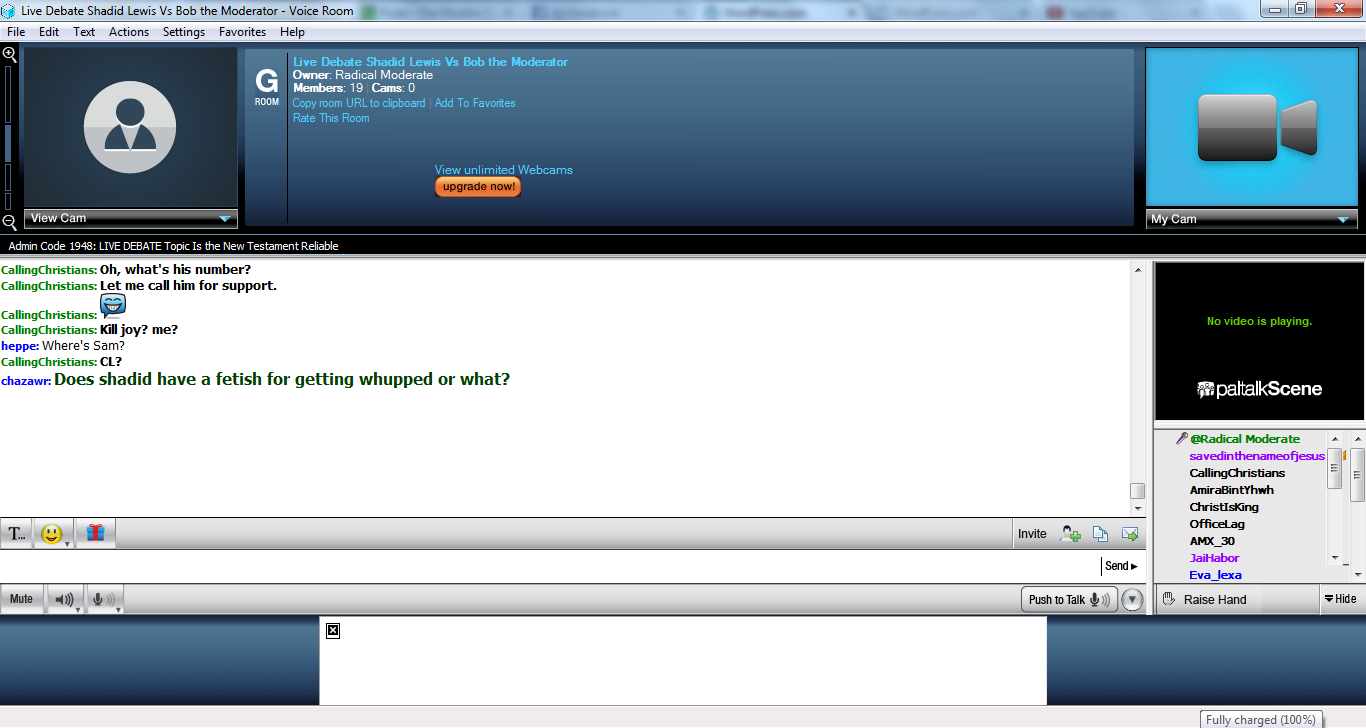
It is no secret that the Answering Muslims Blog is operated by extremist right-wing American Christians, David Wood himself is a very active member of the anti-iimigration, anti-Muslim organization Act4America!, and several of their posts are very critical of the US President simply because of his ethnicity. Therefore, it should come as no surprise that the persons who often view their blog, think similarly to them. Unfortunately, they have no shame in what they say, despite claiming to be religious folk and a few of their members let their racism openly be known directly on the Answering Muslims Blog and via one of their friend’s Paltalk rooms of which Anthony Rogers (under the pseudonym, Charles Martel), frequently visits and supports:

shadid whip

Click to Enlarge

This particular Christian found it particularly pleasant to refer to Br. Shadid’s ‘fetish‘ for being whipped. It is quite well known that African slaves in America were punished via the whip, or lashes with whips as is described in violent beatings referred to as ‘lynchings’. Therefore, this person’s insinuation is that Br. Shadid is a black Muslim who like those before him, likes to be whipped by his Caucasian Christian superiors.

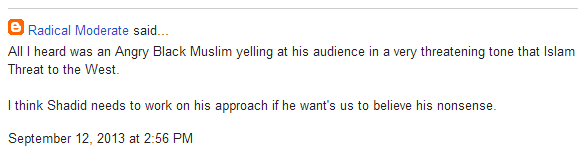
cc-2013-shadidracism1

This comment is a bit more direct and was featured prominently on the Answering Muslims blog. Here we can see a Caucasian Christian, insinuating that Br. Shadid was an angry black Muslim, who was very threatening to those in the West. Why would the color of his skin need to be mentioned, and why the adjective angry? It’s fairly common to see racists referring to Afro-Americans as ‘Angry Black Persons‘, in this case, Br. Shadid is rendered as an ‘Angry Black Muslim Man‘, who is ‘very threatening‘, and was ‘yelling‘ at his audience. Whereas Bob Siegel who debated Br. Shadid, was screaming and making strange noises on stage, but never once was he described as ‘loud‘, ‘yelling‘ or ‘angry‘.

Neither David Wood nor Anthony Rogers who commented on the same post on their blog, found it to be inappropriate that Br. Shadid’s color of skin was used as a criticism against him, which only goes to show that they agree with what this person wrote. As Muslims, we do not allow racism to be a part of our religion, even if we dislike a certain culture, we dislike the culture itself and not the persons, as it is easy to dislike a sin, but not to hate the sinner – as no one is devoid of God’s mercy and guidance.

We kindly ask Answering Muslims to issue an apology to the Muslim and African communities in regards to their racism and we hope to see that they shall take punitive measures to curb the racist culture which is bred amongst their fan base. I decided to send an e-mail to Anthony Rogers (smprparatus@aol.com), asking him to address the issue:

Good Day Mr. Rogers,
I am quite appalled to have seen several racist comments issued by your fan base in regards to Br. Shadid Lewis, including mentions of him liking to be whipped and that he was also an angry black man. I do not know if you condone, or if your faith allows you to pursue such views (viz a viz the curse of Ham), but as a Muslim I have found those remarks to be quite distasteful and abusive.

In this article I have screenshotted said comments issued by your fan base:

https://callingchristians.com/2013/09/13/christians-racially-abuse-br-shadid-lewis/

Will you be intending to address the racist culture bred amongst your fan base, or is this behaviour something you and your faith condones? Looking forward to a reply given the serious nature of this situation.

Br. Ijaz Ahmad
http://www.callingchristians.com

and Allaah knows best.

The Commenting Situation

Dear Visitors,

There’s a significant backlog of comments and a greater backlog is being created by persons commenting on why all of their comments are not being approved. This has been an issue since our inception, the original plan was to allow for comments to be posted on articles and for the author(s) to discuss with our readership, but the sheer quantity of comments and emails, not to mention our vast amount of  Facebook comments and inbox messages, makes it almost impossible to dedicate our free time to responding to each and every argument, especially those that continue for months without end.

A lot of you send really great points, rebuttals, even refutations against some of our more popular articles, and we do read them, but it’s difficult to reply to a 500 word refutation, and then another and another each night. I’m unsure as to whether or not I’ll temporarily disable commenting until we clear up the backlog. I apologize to those of you who enjoy commenting on a regular basis, but this is the situation as it is, and God willing, it will improve given the measures we plan to institute soon.

Thank you for your time.
and Allaah knows best.

Bob Siegel and the Center for Religious Debate

Bob Siegel is a Muslim hero. After his debate with Br. Shadid Lewis, there can be no doubt that Bob secretly works for Muslims. I say this because Bob seemed to offend, almost insult and argue against Christianity in last night’s debate. Not only did he not defend the reliability of the New Testament (as was the topic of focus), but he successfully argued against it, while embarrassing himself in one of the most absurd displays of immaturity I have ever been privy to witness.

Unfortunately for Bob, I have a very strong feeling that he would now be the focus of many Muslim-Christian debates, because of his self refuting nature, it’s impossible that anyone debating him could actually lose. In a debate where Bob had to defend the reliability of the Christian New Testament, Bob said, in no uncertain terms:

one scribe writes something stupid and another scribe crosses it out

According to Bob Siegel, the hero of Muslims everywhere (Calling Christians is probably going to consider forwarding him a proposal to make him our spokesperson), during the writing of his scripture, people wrote stupid things in it, or a scribe copied stupid things that God said and other scribes crossed out what they felt was stupid. Now isn’t that funny, in a book that he’s supposed to be defending as reliable – he argues that arbitrary editing on the count of something being apparently stupid – was done. If that isn’t arguing against his own point, then I don’t know what to call it.

This however, wasn’t the worse thing that Bob did, at one point Bob decided to break out into song and dance – yes, singing and dancing during an academic discourse because he felt like it. Flailing arms, animated speaking, voice impersonations and more, Bob is a man of many talents, but what he is not is a professional debater, nor an academic. To be quite honest, I’d pay money to have Bob entertain me, he’s good at it, he’s very theatrical, a great singer, amazing dancer, his voice impersonations would make you laugh – it was a blast! Yet, this was neither the place nor the occasion for Bob to showcase his dramatic talents.

This was a debate, on behalf of the Center for Religious Debate. His arguments were poor, so poor that during his opening statement I successfully only counted one argument about the reliability of the New Testament. One, just a single stand alone argument. Other than that, Bob was largely a dud, nothing intelligent came out of his mouth and with each passing moment he seemed to slowly poison the well of Christian thought and belief. Besides negating the reliability of the New Testament and declaring the Bible to contain stupid man made writings, he happened to use awful analogies and at the very worse, emotional ranting.

Emotional Bob, this should be his stage name, and this is not meant to be insulting. Bob started his defense of the reliability of the New Testament by declaring that he spoke to God, he knows God and therefore nothing can be said to change his mind about the reliability of the New Testament. Isn’t that funny? For an academic discussion, you’d like to assume that one would provide evidences, maybe discuss or mention a theory or two, perhaps reference some famous scholarly works, but not Bob, he decided to throw thousands of years of Christian scholarship into a liberal trash can and figured his best plan of defending the reliability of the Bible is to declare that God literally, told him it was reliable.

Now, Bob wasn’t all that horrible, he did have some good, hard hitting points. His discussion on the cayaf (?, cayaph, kayaf, kayaph) was very insightful. Bob, what in the heck is a kayaf and what did it have to do with your debate last night? Apparently ‘kayaf’ is something Islamic that no Muslim knows about…

cc-2013-bobsiegelkayaf

Sorry Bob, but I just had to make you into a meme, did God also tell you I was going to do that? If not, maybe you should try to figure out what that voice in your head was, I’m thinking that it wasn’t God.

Now, Bob spoke largely about the Qur’aan and Islam, perhaps for 75% of the time he was speaking. This was a debate about the reliability of the New Testament, but I don’t think Bob got the memo that this was a debate or what the topic of the debate was. At one point, he asked the moderator how much time he had left and decided to forego 2 and 1/2 minutes of speaking time during his rebuttal period. Funnily enough, he later complained that he was not given enough time to speak.

Bob, you are the hero of Muslims everywhere. I pray that one day I do get to debate you, because you’d be the easiest person to debate. I’m hoping that you do more debates with Muslims, especially focusing on the topic of Christianity, perhaps you’d bring more Christians to Islam than is possible – you’re a great spokesperson for Islam and we wouldn’t have it any other way.

Debate Review: Is the Trinity Polytheism? Shadid Lewis vs Anthony Rogers

Update: Sent this debate review to Anthony himself. If he responds or comments, I’ll post it here, if not, then his silence will speak volumes.

Update #2: As of 7:20 pm both his and my time, he viewed my message, no response as yet.

Opening Statements:

I’m not sure Anthony knew what debate he was showing up to, I sat with Sami Zataari and we took in Anthony’s opening together, our impressions were the same. Anthony most likely misunderstood the topic of the debate, this doesn’t mean that his contribution wasn’t meaningful, nor does it mean that he didn’t argue well, but what he did argue was largely irrelevant to the debate’s topic. I mean, if the debate topic was perhaps one of the few below, his points and evidences would have been relevant:

  • Is the Trinity in the Bible?
  • Are Christians Polytheists According to the Qur’aan?
  • Does the Islamic View of the Trinity Reconcile with that of the Bible’s?

Unfortunately for Mr. Rogers, the topic was not centered on what either the Qur’aan says, or what the Bible says, and this is key to both debaters’ arguments. I’ve debated Anthony before, and he suffers from the same weaknesses that he’s been unable to grow out of. He’s largely very verbose and his comments are usually irrelevant, it’s as if he’s puffing up his statements to get a few jabs in, but they’re largely not contributing to the topic. He also has a intellectual disability whereas, he’s unable to mature or think outside of his articles, for the greater portion of his opening sermon, you’d have bet he was reading from his, “The Trinity in the Old Testament” article which I cited in my recent article, here.

Positives for Anthony would be that he spoke with a lot of confidence, there’s no denying that he’s a talented orator, Shadid on the other hand not so much, but this doesn’t count for much beyond appearances, we’re looking at the arguments, the content and the logic presented.

Br. Shadid did something quite surprising, he didn’t take Anthony’s bait. In my recent debate review between him and Robert Spencer, I criticised him for furthering Spencer’s irrelevant arguments, arguing away from the topic. Not sure if he took my criticism to heart, or if he upped the ante in his debate with Anthony, but both Sami and I were quite pleased to see him stick to the topic, define the topic and to attack the topic from the get go. Whereas Anthony spent a lot of time focusing on what the Qur’aan considers the Christians to be, he spent almost 3/4 of his opening statement’s time on this, Br. Shadid went straight to the philosophical and rational theological reasons for why the Trinity is polytheistic in nature. He did mention a few Bible verses to support his claims, but for the better part of his opening statement, he focused on the logical and philosophical nature of the Trinity in light of general monotheism.

As mentioned previously, his speaking style leaves a lot to be desired, but that did not detract from his arguments. To my surprise, he stood his ground and waited for the rebuttal period to criticise his opponent’s deceits. He did not give in to Anthony’s emotional jabs and he kept his statements quite professional. I’d like to think that Anthony tried to get a rise out of Br. Shadid by mentioning that at the end of the debate he’d have to surrender his Qur’aan, kudos to Br. Shadid for disarming Anthony’s ridiculous emotional jab.

Rebuttals:

Anthony replied to all of Br. Shadid’s points, but it seems he still didn’t understand the topic well, or seem to realise this was the rebuttal period as he continued to speak on what the Qur’aan considers Christians to be. I hope that for the other debates he has with Shadid that he can atleast improve on sticking to the format of the debate, if I were supporting him, I’d be quite embarrassed to see a so-called Christian Apologist, lack any sense of relevance to the debate topic, while seeing him make crass and unprofessional statements about his opponent’s scripture. He did provide a lot of solid points against Br. Shadid’s arguments, but during this period, he still never actually conveyed how the Trinity is monotheistic, to be quite honest, I don’t think he spent any time at all discussing this point – which should have been his mainstay.

As for Br. Shadid, he did provide convincing rebuttals to Anthony’s filibustering, their counter-arguments seemed to be on par, but Br. Shadid did seem to have the stronger outcome here, as he stuck to the topic and focused on his premises, how can Jesus Christ have a God, how can Jesus pray to God, how can Paul claim to see Jesus sitting to the right hand of God – then who is Jesus in this case, etc. Anthony did not provide a response to these points, but focused on Br. Shadid’s quotes, largely ignoring the theological/ Christological components of Shadid’s points and instead focused on their exegetical applications – showing once again that Anthony clearly missed the mark and that he failed to grasp the topic of the debate fully.

Conclusions:

I was quite insulted by Anthony’s closing statements, as it failed to be relevant at all to the debate topic and I must congratulate Br. Shadid on labeling it as an unwanted sermon. It seemed more like preaching, than a discussion on Br. Shadid’s points. Closing statements are not meant to be sermons, it is not meant to be a time to preach to the audience, and I was greatly turned off by his indecency, to me it felt as if Anthony was not prepared for, or he did not care about this debate and used it as a stage to stroke his ego and to preach to Christians, as opposed to have an academic discussion on the theological implications of the Trinity.

For me, this is where Br. Shadid clearly won, he didn’t give us a Khutbah – Islamic sermon, he honed in his points, qualified his premises and criticised Anthony’s improper, indecent and unqualified sermon, as opposed to doing a closing statement, as should have been given. He capped off his arguments and asked the audience to decide for themselves what the truth about the Trinity was. This debate by Br. Shadid was much better, much more classier and professional than his debate with Spencer. As for Anthony on the other hand, he did not seem prepared, and he chose to ignore the topic, I actually feel quite sorry for him given the mess that he caused – perhaps in this way he’s enlightened many Christians and drove them to doubt the Trinity, atleast that is what I conclude from his behaviour on that night.

and Allaah knows best.

Is (Trinitarian) Christianity Monotheistic?

Introduction

Christianity inherits monotheism from the Jewish faith, as Christianity primarily is – Messianic Judaism. Therefore, before we begin our quest in solving the title’s question, we must ask another important question. Is Judaism monotheistic? The answer for our purposes is yes. Both Muslims and Jews can agree on the Shema Yisrael which is found in Deuteronomy 6:4, it reads:

Sh’ma Yis’ra’eil Adonai Eloheinu Adonai echad.
Hear, Israel, the Lord is our God, the Lord is One.

This is essentially the same as what is presented to us in Surat al Ikhlas (Ch. 112) in the Qur’aan:

Say: He is Allaah the One.

If we are to be honest and if we wish to examine Christianity as the post-Christ Judaic faith of which it presents itself as, then our understanding of monotheism must be based on the Shema Yisrael. The problem therefore is, does Christianity adhere to the Shema Yisrael?

Read more

Church of England Invests Millions in Weapons Firm

The Independent (UK) reports:

The Church of England has invested up to £10m in one of the world’s major arms firms, which supplies systems and technology for unmanned drones and jets to conflicts around the world. The discovery, on the eve of what is set to be the biggest day of protests against DSEi – the UK’s leading arms fair – in Docklands, London, tomorrow, has led worshippers to accuse church leaders of profiting from conflict.

The Church Commissioners and Church of England Pensions Board are both shareholders in General Electric (GE), with shareholdings up to £10m. Yesterday, the Church defended the investment, claiming less than 3 per cent of GE’s business was based in arms sales.

But the firm, along with its key subsidiary General Aviation, is a leading supplier of “integrated systems and technologies” for combat aircraft, military transport, helicopters, land vehicles and unmanned aerial vehicles – better known as drones.

It is the 20th-highest-ranking firm in the world when it comes to defence sales, which accounted for almost 3 per cent of its total revenue last year – an estimated £4bn.

While the Church of England is not breaching its own rules by investing in the firm – investments in companies that derive less than 10 per cent of turnover from strategic military sales are allowed – some church members reacted angrily to the news.

Keith Hebden, an Anglican priest who was arrested earlier this year for breaking into RAF Waddington – from where drones used in Afghanistan are remotely controlled – said the Church of England’s policy was wrong. He explained: “We’re going to end up with problems. This means we have a stake in wanting there to be war.”

Read the full article here. I wonder how Christian apologists (read: it means those who defend, not those who apologize), will defend a Christian Church having monetary stakes in a weapons manufacturing company. What if a Masjid decided to invest their donation money into a Saudi Arabian arms dealer or a Sudanese weapons manufacturing company? At the end of the day, the Church of England invested in a weapons manufacturer and the only way they can make a profit is through war and combat, the Church, we can say – is making money off of violence.

and God knows best.

Pastor Condemns Christians Who Pray for Forgiveness

This is an absolutely priceless video. Pastor Martin Richling of the ‘Scripture Alone Bible School’,has released a video, confirming what Muslims have been saying to Christians for centuries.

Why do you pray for forgiveness if Christ already died for your sins?

Forgiveness is to ask for the sin to be absolved by God – the absolute moral authority. Yet, how can you ask God to forgive you, if He’s already forgiven you? Seems a bit redundant, but nevertheless, it’s still being done by the Christian faithful. The Calvinists did try to answer this theological dilemma by claiming only the elect are forgiven, because although all are open to salvation, only the elect have accepted this sacrificial gift by Christ.

He provides Muslims will a solid rebuttal to Christian apologists by reminding us of these verses:

13 When you were dead in your sins and in the uncircumcision of your flesh, God made you[a] alive with Christ. He forgave us all our sins, 14 having canceled the charge of our legal indebtedness, which stood against us and condemned us; he has taken it away, nailing it to the cross. 15 And having disarmed the powers and authorities, he made a public spectacle of them, triumphing over them by the cross. – Colossians 2:13-15.

According to these verses, he’s already forgiven the sins of all of us, there is no need to repent or ask for forgiveness.

Thank you for raising this moral dilemma, will perhaps Dr. James White respond to him, or perhaps Shamoun can provide some of his famous logic for us?

The Historicity of the Kabaah

By Kaleef K. Karim.
Edited by Ijaz Ahmad (spelling, formatting, content, etc).

One of the recent things I have heard from Christian missionaries, when debating with them is that they say, the Ka’bah in Mecca where Muslims go for pilgrimage annually has no history before the advent of the Prophet Muhammad (peace be upon him). These ridiculous and fictitious claims have no basis whatsoever. I shall now bring forth evidences that Kabaah in Makah did exist before the coming of Muhammad (peace be upon him).

The Kabah stone In Mecca

Diodorus Siculus (Born: 90 BC – Died: 30 BC)

Diodorus Siculus was a Greek historian, who wrote works of history in the 1st Century BC. He is known for the monumental universal history Bibliotheca historica. Diodorus is the first known Historian long before the coming of Islam that makes mention of Mecca.

Reverend Charles Augustus Goodrich a Christian, was an American author and Congregational minister comments on Kaaba and Mecca, although, he is not fond of the Prophet Muhammed (pbuh), but he is sincere in admitting that Ka’bah existed at time of Patriarchs. He says:

“Among the variety of fabulous traditions which have been propagated by the followers of Mahomet, concerning the origin of this building, we find it asserted, that its existence is coeval with our parents, and that it was built by Adam, after his expulsion from paradise, from a representation of the celestial temple, which the almighty let down from heaven in curtains of light and placed in Mecca, perpendicular under the original. To this the patriarch was commanded to turn his face when he prayed, and to compass it by way of devotion, as the angels did the heavenly one. After the destruction of this temple by the deluge, it was rebuilt by Abraham and his son Ishmael on the same spot, and after the same model, according to directions, which they received by revelation; and since that time, it has continued to be the object of veneration to Ishmael’s descendants. Whatever discredit we may give to these, and other ravings of the Moslem imposter concerning the Caaba its high antiquity cannot be disputed; and the most probable account is, that it was built and used for religious purposes by some of the early patriarchs; and after the introduction of idols, it came to be appropriated to the reception of the pagan divinities. Diodorus Siculus, in his description of the cost of the Red Sea, mentions this temple as being, in his time, held in great veneration by all Arabians; and Pocoke informs us, that the linen or silken veil, with which it is covered, was first offered by a pious King of the Hamyarites, seven hundred years before the time of Mahomet.” [1]


John Reynell Morell says:

“…historically speaking, Mecca was a holy city long before Mohammed. Diodorus siculus, following agatharcides, relates that not far from the red sea, between the country of the Sabeans and of the Thamudites there existed a celebrated temple, venerated throughout Arabia.”[2]

Encyclopædia Britannica: Or, A Dictionary of Arts, sciences and Miscellaneous Literature, Edited by Colin Macfarquhar says:

“the science of astronomy was cultivated at Babylon; but the school of the Arabs was a clear firmament and a naked plain. In their nocturnal marches, they steered by the guidance of the stars: their names and order, daily station were familiar to the curiosity and devotion of the bedoween; and he was taught by experience to divide in 28 parts the Zodiac of the moon, and to bless the constellations who refreshed, with salutary rains, the thirst of the desert. The reign of the heavenly orbs could not be extended beyond the visible sphere; and some metaphorical powers were necessary to sustain the transmigration of the souls and the resurrection of bodies: a camel was left to perish on the grave, that he might serve his master in another life; and the invocation of departed spirits implies that they were still endowed with consciousness and power. Each tribe, each family, each independent warrior, created and changed the rites and the object of this fantastic worship; but the nation in every age has bowed to the religion as well as to the language, of Mecca. The genuine antiquity of the Caaba extends beyond the Christian era: in describing the coast of the Red Sea, the Greek historian Diodorus has remarked, between the Thamaudites and the Sabeans a famous temple, whose superior sanctity was revered by ALL THE ARABIANS: the linen or silken veil, which is annually renewed by the Turkish Emperor, was first offered by a pious King of the Homerites, who reigned 700 years before the time of Mahomet.“ [3]

Andrew Crichton also comments on the ‘Kabah’ in his book; ‘The history of Arabia, ancient and modern.’ He says:

“From the celebrity of the place, a vast concourse of pilgrims flocked to it from all quarters. Such was the commencement of the city and the superstitions fame of Mecca, the very name of which implies a place of great resort. Whatever credit may be due to these traditions, the antiquity of the Kaaba is unquestionable; for its origin ascends far beyond the beginning of the Christian era. A passage in Diodorus has anobvious reference to it, who speaks of a famous temple among the people he calls Bizomenians, revered as most sacred by all Arabians.” [4]

Claudius Ptolemy (Born: 90 AD – Died: 168 AD)

Claudius Ptolemy was a Greco-Roman writer of Alexandria, known as a mathematician, astronomer, geographer; is another person, centuries before Islam who makes mention of Makkah. He uses the name ‘Makoraba’ for Makkah.

In the Book: ‘The New Encyclopedia of Islam’, written by Cyril Glassé says that Ptolmey in the second century mentioned Makkah. Here is what he wrote:

“Mecca (Makkah al-Mukarramah, lit ‘Mecca the blessed’). For thousands of years Mecca has been a spiritual center. Ptolemy, the second century Greek geographer, mentioned Mecca, calling it ‘Makoraba’. Some have interpreted this to mean temple (from Maqribah in south Arabian) but it may also mean ‘Mecca of the Arabs’.” [5]

Ilya Pavlovich Petrushevsky (1898–1977) was an Professor of History of the Near East at the University of Leningrad for twenty years, he also makes mention that Ptolemy in the second Century mentions Makkah:

“On the caravan route from Syria to the Yemen, in the Hijaz neighbourhood, lay Mecca. Ptolemy, the Greek geographer, mentions it as early as the second century calling it Makoraba, which is derived from the south Arab word Maqrab meaning ‘sanctuary’. [6]

Michael Wolfe:

“Mecca lies midway along the west coast of Arabia in a mountainous barrier region named the Hijaz. This narrow tract of land about nine hundred miles long with the Tropic of Cancer passing through its center. The second-century Greco-Egyptian geographer Ptolemy called the city Makoraba, the temple.” [7]

Paul Wheatley:

“it was its virtual monopoly of Hijaz commerce which made of Mecca, in the words of the Quran, ‘a city secure and at peace; provisions flowing in from every side’. But all this is concerned with the expansion of the influence of a city which already existed. The name Mecca (strictly transliterated as Makkah) had been mentioned in the Ptolmaic corpus in the 2nd century AD under the orthography Makoraba, which itself derived from the Sabaean Makuraba, meaning ‘sanctuary’. Long before Muhammad the Ka’bah had served as the central shrine of a group of clans, each of whom had deposited its ritual stone, symbolizing its own god, in the sacred precinct.” [8]

In the book ‘A Comparative Study of Thirty City-state Cultures: An Investigation’, edited by Mogens Herman Hansen; in Note 24 makes clear when Ptolemy mentioned the name ‘Macoraba’ he meant Mecca:

“Ptolemy in Geographies refers to Mecca as Macoraba.” [9]

Conclusion:

From all the evidences which I have presented from objective and academic sources, it can clearly be seen that it is a fact that Kabaah existed before the advent of Islam and Muhammad (peace be upon him).  Sealing my arguments, I refer you to Reverend Charles Augustus Goodrich, a Christian historian, who admitted that the Kabaah existed and was built by the Patriarchs. In his own words, he says, “Caaba its high antiquity cannot be disputed; and the most probable account is, that it was built and used for religious purposes by some of the early patriarchs.”

References:

[1] Religious Ceremonies and Customs, Or: The Forms of Worship Practised by the several nations of the known world, from the earliest records to the present time Charles Augustus Goodrich [Hartford: Published by Hutchinson and Dwine 1834] page 124
[2] Turkey, Past and Present: Its History, Topography, and Resources By John Reynell Morell page 84
[3] Encyclopaedia Britannica: Or, A Dictionary of Arts, sciences and Miscellaneous Literature Constructed on a Plan Volume 2, Part 1 edited by Colin Macfarquhar page 183 – 184
[4] The history of Arabia, ancient and modern Volume 1 [second edition] By Andrew Crichton page 100
[5] The New Encyclopedia of Islam By Cyril Glassé page 302
[6] Islam in Iran by I. Pavlovich Petrushevsky page 3
[7] One Thousand Roads to Mecca: Ten Centuries of Travelers Writing about the Muslim pilgrimage Michael Wolfe introduction xv
[8] Paul Wheatley The Origins and Character of the Ancient Chinese City: volume 11 page 288
[9] A Comparative Study of Thirty City-state Cultures: An Investigation, Volume 21 edited by Mogens Herman Hansen page 248 NOTE 24

The Limits of Da’wah

Salaam ‘Alaykum,

It is common for the lay Muslim to engage in da’wah and today this is most frequently done online, sometimes Facebook, Twitter and also on Paltalk. Unfortunately there are those in our growing community that have mimicked the da’wah of the Christians and Atheists – without being aware of what they are doing. So what is da’wah? Da’wah is literally, an invitation to Islam, and from this, da’wah is not to:

  1. Belittle your opponent.
  2. Be emotional with your opponent.
  3. Enter into discussion about a topic in which you have no knowledge, the foremost being ‘aqeedah.
  4. Show off (demonstrate your ‘skills’ at debating or demonstrate ‘knowledge’ you possess).
  5. Prove your opponent wrong.

If we limit ourselves to not doing these five ills, and this is the way of the Christians and Atheists, then we will only then begin to perfect our da’wah.

How is this the method of the Christians?

Christians tend to look down on infidels (this is a Christian term, meant to mean unfaithful to Christ), in the sense that we do not possess the Spirit and thus do not have clear insight into the reality of the world and their scriptures. This causes them to be emotional and to use primarily emotional arguments, viz a viz: Christ has changed me, I spoke with him, you’re Satan because you disagree with him etc.

One of the more odd experiences I’ve faced is Christians copy pasting copious amounts of text and copying missionary literature and then spamming you with it. No, the 50th time you’ve left me a pamphlet or sent me an e-mail does not convince me of your faith, rather it convinces me that you just want to shut me out and not listen to me. Even top Christian apologists fall prey to this, they would write or speak for long periods of time on irrelevant discussion to the topic at hand, and when questioned, they again repeat speaking or writing on something off topic, just to tire you out. Remember, stopping a person from speaking is not guiding them, it’s simply screaming, “I’m right and you’re wrong“, over and over again.

How is this the method of Atheists?

Now when I mean atheist, I’m implying agnostics and militant atheists, although I’m not generalizing but this is usually my experience with them. Now, not many know this, but by study and trade – I am a Scientist. In fact, my field specializes in the area of logic. Logic is the foundation of and the pillar of my field. Many times I’ve come across atheists who employ the belief that all theists do not use reason and logic. When in fact it is these people who have never actually used logic, nor is it used in their day to day operations. At University where I often have discussions, it’s pretty funny to see persons trying to explain to me why faith cannot be reconciled with science, reason and logic. Except for the fact that faith is often based on science, reason and logic – something which the Qur’aan emphasizes.

Often times, I’ve found it easier to explain that the atheistic model of life is morbidly self hating. We are nothing and our lives are without purpose (I’m looking at you Lawrence Krauss). This is their modus operandi, this is what they want us to believe, so the question begs itself, if our lives are worth nothing and therefore has no purpose – why don’t they off themselves? If not, then they imply that they do have a purpose, and if so, purpose implies intent, for no one can have a thought about something without intending to think about that something.

What is the Best Da’wah?

On the authority of Abu Hamzah Anas bin Malik (may Allah be pleased with him) – the servant of the Messenger of Allah (peace and blessings of Allah be upon him) – that the Prophet (peace and blessings of Allah be upon him) said :

“None of you will believe until you love for your brother what you love for yourself.”

(Related by Bukhari & Muslim).

Your brother in this case means your brother in humanity. We must love for ourselves to be guided, to be treated in a calm and respectful way, to not be argued with for the sake of arguing or disagreed with for the sake of disagreeing and most of all, to be treated with honesty. Due to this, the Prophetic advice is clear, treat others as we would want to be treated and this in turn, will be the best da’wah possible. We must remember than da’wah is for Allaah and Him alone – and if done with this methodology, then He – the Changer of Hearts, can guide anyone to the truth.

and Allaah knows best.

« Older Entries Recent Entries »