Category Archives: Muslim and Non-Muslim Dialogue

Why Do Muslims Insist on Referring to the Arabic Literary Sources?

Question:

When Christians post information about Islam and we ask that they refer to the Arabic, they say to us that Muslims always evade discussing a quote by wasting time on going to the Arabic language and want to debate the translation, etc. What is your response to this?

Answer:

Indeed, this is a very common claim about the Muslim and God willing, it shall be dealt with in detail using extensive examples in this article. In responsible discourse, the parties who exchange information implicitly accept the position of accountability for the quotes they present, with the understanding that it should be properly referenced/ cited. This is common in academic discourse and a responsible individual will not object to the validating of references or of quotations. The question must be asked to the non-Muslim, whether they be a Christian, Atheist, Hindu or Jew, on why they are evading their academic responsibility of ensuring that their quote is accurate or that their citation is reliable? Surely, if everything is accurate with the information presented, they would have no reason to object to their information being double checked and verified.

The question therefore begs itself. Do Muslims have a reason or a need to verify and validate information about Islam as presented by non-Muslims? The Qur’aan answers this for us by stating:

“O you who have believed, if there comes to you a disobedient one with information, investigate, lest you harm a people out of ignorance and become, over what you have done, regretful.” – Qur’aan 49:6.

From this verse, a Muslim must understand that verifying information about Islam from non-Muslims is not a matter of evading discussing the quote or reference, rather it is a religious duty as commanded by God that this verification process is done. If one wishes, this verse should be presented to the one who claims that Muslims are evading the discussion, atleast with this being presented they will be able to understand that you do intend to discuss the quotes/ references, but that you must at the very least be able to validate that what you are discussing is accurate information.

Examples of Manipulation of Islamic Texts by Orientalists and Christian Apologists

Case 1:

We read from Christian Apologist Nabeel Qureishi the following quote , sourced from an unverified and critically poor translation. Despite Nabeel’s University education, he failed to validate the translation he was using:

Ibn Masud does not think highly of today’s Quran, the one collected by Zaid. In comparing himself to Zaid, he says:

The people have been guilty of deceit in the reading of the Qur’an. I like it better to read according to the recitation of him (Prophet) whom I love more than that of Zayd Ibn Thabit. By Him besides Whom there is no god! I learnt more than seventy surahs from the lips of the Apostle of Allah, may Allah bless him, while Zayd Ibn Thabit was a youth, having two locks and playing with the youth.” (Ibn Sa’d, Kitab al-Tabaqat al-Kabir, Vol. 2, p.444) –

This is a wrong translation. The translation should actually be:

So conceal the manuscripts! I like it better to read according to the recitation of him (Prophet) whom I love more than that of Zayd Ibn Thabit. By Him besides Whom there is no god! I learnt more than seventy surahs from the lips of the Apostle of Allah, may Allah bless him, while Zayd Ibn Thabit was a youth, having two locks and playing with the youth.”

Not only is the translation wrong, the actual Arabic text does not include the phrase, “in the reading of the Quran“.

فَغَلَّوُا الْمَصَاحِفَ. فَلأَنْ أَقْرَأَ عَلَى قِرَاءَةِ مَنْ أُحِبُّ أَحَبَّ إِلَيَّ مِنْ أَنْ أَقْرَأَ عَلَى قِرَاءَةِ زَيْدِ بْنِ ثابت. فو الذي لا إِلَهَ غَيْرُهُ لَقَدْ أَخَذْتُ مِنْ فِيِّ رَسُولِ اللَّهِ – صَلَّى اللَّهُ عَلَيْهِ وَسَلَّمَ – بِضْعًا وَسَبْعِينَ سُورَةً. وَزَيْدُ بْنُ ثَابِتٍ غُلامٌ لَهُ ذُؤَابَتَانِ يَلْعَبُ مَعَ الْغِلْمَانِ

The issue with the translation pertains to the meaning of the word “فَغَلَّوُا ” (the first word in the sentence), transliterated as “ghalla”. The Christian missionary asserts that it means “deceit”, which is contrary to the basic meaning of the word, which is “to hide/ conceal”. In a similar report in Jami’ Tirmidhi, the wording is given as:

قَالَ عَبْدُ اللَّهِ بْنُ مَسْعُودٍ: ” يَا أَهْلَ العِرَاقِ اكْتُمُوا المَصَاحِفَ الَّتِي عِنْدَكُمْ وَغُلُّوهَا فَإِنَّ اللَّهَ يَقُولُ: {وَمَنْ يَغْلُلْ يَأْتِ بِمَا غَلَّ يَوْمَ القِيَامَةِ} فَالقُوا اللَّهَ بِالمَصَاحِفِ

Abdullah bin Mas’ud said: ‘O people of Al-Iraq! Keep the Musahif that are with you, and conceal them. For indeed Allah said: And whoever conceals something, he shall come with what he concealed on the Day of Judgement. So meet Allah with the Musahif.'” (Jami’ Tirmidhi, Hadith 3104)

What is odd here, is that we can see from the Christian’s translation, they maintain the word to mean “conceal”, why didn’t they translate it to be “deceit” as they did before? We should also note that at the end of the narration it says, “Meet Allah with the masahif”. If “ghalla” was to be translated as “deceit” then the entire narration would be incomprehensible! In Kitab al-Masahif of Ibn Abi Dawud Khumayr bin Malik says:

سَمِعْتُ ابْنَ مَسْعُودٍ يَقُولُ: ” إِنِّي غَالٌّ مُصْحَفِي، فَمَنِ اسْتَطَاعَ أَنْ يَغُلَّ مُصْحَفًا فَلْيَغْلُلْ، فَإِنَّ اللَّهَ يَقُولُ: {وَمَنْ يَغْلُلْ يَأْتِ بِمَا غَلَّ يَوْمَ الْقِيَامَةِ}

“I heard Ibn Masud saying: I have concealed my Mushaf. Whoever can conceal his mushaf he should conceal it. For Allah says, “And whoever conceals something, he shall come with what he concealed on the Day of Judgement.”” (Kitab al-Masahif, Narration 52)

In this narration, if we were to translate “إِنِّي غَالٌّ مُصْحَفِي“, it would mean, “I have deceived my mushaf”, in English it would be akin to saying, “I lied to the book”, as opposed to saying “I concealed my book”. This therefore, should illustrate the absurdity of Christian missionaries tampering with translations.

Case 2:

In the book, “The Collection of the Qur’an, (Cambridge: Cambridge University Press, 2010)“, by Christian missionary John Burton, on page 242,  254 we read his translation of the following narration:

وكان الرجل يجيء بالورقة والأديم فيه القرآن، حتى جمع من ذلك كثرة، ثم دخل عثمان فدعاهم رجلا رجلا فناشدهم لسمعت رسول الله صلى الله عليه وسلم وهو أملاه عليك؟ فيقول: نعم

He translates this as:

“One would come with a parchment or a scrap of leather with a Qur’an verse on it until there was gathered great store of such.’Uthman adjured them one by one, ‘You heard the Prophet recite this?’ They would answer that that was so.”

However, the portion of the narration, ” وهو أملاه عليك” (emphasized in bold above), is purposefully excluded from the translation. The complete translation would read:

“One would come with a parchment or a scrap of leather with a Qur’an verse on it until there was gathered great store of such.’Uthman adjured them one by one, ‘You heard the Prophet recite this while he dictated it to you?’ They would answer that that was so.”

The exclusion of this portion of the narration is a serious attempt at negating the Prophet’s (salallaahu ‘alayhi wa salam) personal role in dictating the Qur’aan to scribes in their presence. It is intentional he excluded this portion of the narration as the reference he gives for the narration includes it entirely, this being Arthur Jeffery’s (the editor of the book), “Kitab al-Masahif”, page 24. Thus far, we have seen purposeful mistranslations and in this case, exclusion of a portion of the narration.

Case 3:

A narration from ‘Abdullah bin ‘Umar quoted by Hafidh as-Suyuti (d. 911 A.H.) in his, “al-Itiqan fee ‘Uloom al-Qur’an”, has become a source of joy for some missionaries. However, their contextual rendition of many of its quotes is so deceptive, it is astounding that they would publicly risk such dishonesty! In this case, Sam Shamoun presents us with this translation:

‘Abdullah bin ‘Umar reportedly said: “Let none of you say, ‘I have got the whole of the Qur’an.’ How does he know what all of it is? MUCH OF THE QUR’AN IS GONE. Let him say instead, ‘I have got what has survived.’”

This narration is contained under the title of the chapter which reads as follows, “Section forty-seven: About the Abrogating and the Abrogated“. In Abu ‘Ubayd’s (d. 228 A.H.) work, from which as-Suyuti quotes this, it is the first narration in the chapter titled, “[About] what all was abrogated from the Qur’an after revelation and is not put in the Masahif.” Essentially, what was abrogated was forgotten, as the Qur’aan itself states:

“We do not abrogate a verse or cause it to be forgotten except that We bring forth [one] better than it or similar to it. Do you not know that Allah is over all things competent?” – Qur’aan 2:106.

Shahab ud-Deen al-Alusi’s (d. 1270 A.H.) comment helps explain the issue:

أجمعوا على عدم وقوع النقص فيما تواتر قرآنا كما هو موجود بين الدفتين اليوم، نعم أسقط زمن الصديق ما لم يتواتر وما نسخت تلاوته … وعليه يحمل ما رواه أبو عبيد عن ابن عمر قال: لا يقولن أحدكم قد أخذت القرآن كله وما يدريه ما كله قد ذهب منه قرآن كثير ولكن ليقل قد أخذت منه ما ظهر

“Verily they (i.e. people of Sunnah) have agreed on there being no loss in the Qur’an as is continuously reported like we today find between the two bindings. Yes during the time of (Abu Bakr) as-Sidiq the part which was not reported continuously and was (rather) abrogated was dropped (out of the official mushaf)…and to this relates that which is reported by Abu ‘Ubayd from Ibn ‘Umar, who said: ‘None of you should say that he has taken the whole of the Qur’an; how could he know what all of it was! A lot of the Qur’an has passed him by! Let him say instead: I have taken of the Qur’an that which became apparent.’”

As can be seen, Sam Shamoun intentionally removed the narration from its context to make it appear to state that a companion of the Prophet (salallaahu ‘alayhi wa salam) had stated most/ much of the Qur’aan has been lost, when in fact he had confirmed what Allaah has said in the Qur’aan, that the abrogated verses would be made to be forgotten. Therefore, verifying sources is not merely about checking the text for mistranslations or excluded content, it can also be about removing the information from its authorial context. In regards to the translation, the word “MUCH”, it must be understood that this word can be used to mean “less than (what it is being compared to)”. The evidence for this is seen the below narration:

قُلْتُ: يَا رَسُولَ اللَّهِ، أُوصِي بِمَالِي كُلِّهِ؟ قَالَ: «لاَ» ، قُلْتُ: فَالشَّطْرُ، قَالَ: «لاَ» ، قُلْتُ: الثُّلُثُ، قَالَ: فَالثُّلُثُ، وَالثُّلُثُ كَثِيرٌ

“I said, ‘Should I give two-thirds of my property in charity?’ He said, ‘No.’ I asked, ‘Half?’ He said, ‘No.’ Then he added, ‘One-third, and even one-third is much (wal-thuluthu kathir).’”

Clearly, one third of an amount is not the most of something or “much” of something. This missionary not only removed the narration from its context, he also misrepresented what the narration was saying by being ignorant of its meaning.

Case 4:

This is a much more famous lie, Sam Shamoun in this case, presents a narration and claims that it states that the Prophet Muhammad (salallaahu ‘alayhi wa salam) is a cross dresser:

Narrated by Ismail, narrated by his brother, narrated by Sulaiman, narrated by Hisham Ibn Urwah, narrated by his father, narrated by Aisha who related that the wives of the prophet were divided into two groups. One group consisted of Aisha, Hafsa, Safiya and Sawdah while the other group consisted of Um Salamah and the rest of the women that belonged to the prophet. The Muslims had learned of the great love that the prophet had for Aisha so that if one of them had a gift he desired to give to the prophet, he would delay giving it until the prophet came to Aisha’s house. Then the group who sided with Um Salamah came to Um Salamah and asked her to tell the prophet that he should command the people that if any of them had a gift to give to the prophet, they should give it him in whatever house of his wives the prophet was in at the time. So Um Salamah went and talked with the prophet but he did not respond to her. When the group asked her what the prophet said she told them that he did not respond. So they asked her to go talk to him again until he responds… then the prophet said to her, “Do not hurt me with Aisha, for the inspiration did not come upon when I was (wearing) A WOMAN’S CLOTHES (Thowb) EXCEPT THAT OF AISHA.” (Source- http://hadith.al-islam.com/Display/Display.asp?hnum=2393&doc=0)

He provides the source in Arabic and then translates it himself. However, Sam Shamoun does not speak the Arabic language, nor is he capable of reading it, so one does need to ask how he was able to translate something from a language he is ignorant of. The portion of the hadeeth we are focusing on is where he translates “thawb”, as “woman’s clothes”:

لَا تُؤْذِينِي فِي عَائِشَةَ فَإِنَّ الْوَحْيَ لَمْ يَأْتِنِي وَأَنَا فِي ثَوْبِ امْرَأَةٍ إِلَّا عَائِشَةَ

The correct rendition of this portion of the narration should read:

“Do not hurt me regarding Aisha, as the Divine Inspirations do not come to me when I am in the [thawb]cloth (i.e. blanket) of any of wives except [in that of] Aisha.” – Sahih Bukhari, Hadith 2393.

This translation of  “thawb“, can be clarified by a similar narration which reads:

لَا تُؤْذِينِي فِي عَائِشَةَ فَإِنَّهُ وَاللَّهِ مَا نَزَلَ عَلَيَّ الْوَحْيُ وَأَنَا فِي لِحَافِ امْرَأَةٍ مِنْكُنَّ غَيْرِهَا

“Don’t trouble me regarding ‘Aisha, for by Allah, the Divine Inspiration never came to me while I was under the blanket of any woman amongst you except her.” – Sahih Bukhari, Hadith 3491.

The word “blanket”, being “lihaaf” is quite clear in its meaning. One needs to ask Sam Shamoun how he arrived at such an incorrect and outlandish translation, and if it was mistaken, why does he insist it is accurate despite the evidences to the contrary?

Case 5:

Commenting on the phrase:

(قال: قد زعم ذلك زيد) in Sahih Bukhari Hadith 3787.

Muhammad Asad writes in “Sahih al-Bukhari- The Early Years of Islam“, (Gibraltar: Dar al-Andalus, 1981), page 109:

In the French version of the Sahih by Houdas and Marcais (vol.III, 5 in two places) we find the ridiculous translation: “C’est Zeid qui pretend cela” (“It is Zayd who pretends this”) – thus twisting Ibn Abi Laylah’s answer into a discrediting criticism of the authenticity of this narration. The French translators were evidently not aware of the fact that the primary meaning of za’ma is equivalent to qala (“he said”); cf. Lisan al-‘Arab XV, 156.

Conclusion

I have demonstrated several forms of misrepresentation of Islamic quotes and references by contemporary and previous missionaries and Orientalists. Some of the forms we have noted are listed as the following:

  1. Mistranslating a term/ word.
  2. Excluding a portion of the original text.
  3. Misrepresenting a quote by removing it from its context.
  4. Providing an Arabic source but self translating and incorrectly claiming that the translation is authentic.

These are very serious attempts at distorting Islamic academic sources by Christian missionaries and Orientalists. Therefore, the command of Allaah ta ‘aala in Surah 49, verse 6 should be taken seriously, very seriously. The apprehension of Muslims towards the quotes and references by polemicists is not unwarranted as the previous examples have illustrated that this manipulation of the quotes and references is a common pattern of behaviour. With this being noted, if the party entering into a discussion with you on Islamic information does not wish to verify the source or the content, then unless they do so – the Muslim should not continue the discussion. We must be careful and use our discretion in giving audience to those who are unable to maintain basic academic standards.

In my own experience with a zealot missionary, Darren Amos of the UK, he quoted a book for me entitled “al-Kitab”. I asked him, who was the author of al-Kitab or if he even knew that the book title meant. He refused to comment on the quote and its fictitious citation and instead claimed I was evading discussing the topic. I did not relent, I pressed for the validation of the reference and eventually he discontinued the discourse. I encourage my Muslim brothers and sisters to be firm in their criticism of sources, if we do not, the missionaries will gladly invent quotes as they wish without any guilt whatsoever, for as Paul states, “But what does it matter? The important thing is that in every way, whether from false motives or true, Christ is preached. And because of this I rejoice. Yes, and I will continue to rejoice.” – Philippians 1:18.

I would like to thank Br. Waqar for providing me with the references and examples of distortion by missionaries and Orientalists. I have listed his corpus of writings below, as they relate to the claims made above. I highly recommend reading his extensive and scholastic refutations to missionary polemics. May Allaah ta ‘aala reward him for his efforts, Ameen.

Sources:

and Allaah knows best.

Christian Love for Br. Ijaz

I’m not sure what ticked off this individual, but he does seem quite upset at Muslims and particularly at me. I don’t know who he is or why he’s messaging me, but he sure is angry. Based on his other messages, he does seem to be under the impression that I’m an immigrant to the UK though, which isn’t true, as we Trinidadians often say “I’m Trini to de bone“. I do often get hate mail in this form, nasty insults, threats, etc, this is just a sample of the messages sent:

cc-2014-jimmuir-insults


On the other hand, this bloke might just be completely crazy and his faith of choice is completely coincidental. Experience though, and the many other messages strongly suggest that may not be the case. I pray that God guides this person and that they can live their lives being at peace with those who disagree with them. Ameen.

and God knows best.

How Murder Benefits the Christian Faith

I sometimes like to hope that my Christian brothers and sisters throughout the world would be willing to put an end to their propaganda machines. As the years go by, it’s beginning to seem that Christianity cannot survive without thriving on news of the dead or by claiming that every Muslim wants to kill them. Today I saw a Christian post circulating a photo of a man weeping over the bodies of his children and wife. The caption attached to it stated the following:

“VERY TOUCHING STORY *GRAPHIC; BUT MUST READ*

The man sitting on the floor, dressed in white, is a Christian pastor who lives in Syria, Middle East. In the morning, he went out to preach the Gospel, and when he returned home that afternoon, he found all his children dead, four children murdered by people against CHRISTIANITY.

He asked, before the bodies if he would stop preaching Christ. He replied: “That’s not me. Nobody will silence my voice. Will speak the word of the Lord. More than ever, I proclaim Christ and His Salvation.”

“Blessed are they which are persecuted for righteousness’ sake, for theirs is the kingdom of heaven, blessed are ye when men shall revile you and persecute you and falsely say all kinds of evil against you because of me. Rejoice and be merry you, because great is your reward in heaven: for so persecuted they the prophets which were before you. “(Matthew 5:10-12)

SHARE this message and encourage someone today to remain strong in the WORD of the LORD JESUS CHRIST.“

I won’t post the photo, but I will post a link to the photo as I am not fond of showing images of a man’s dead family. A quick reverse image search, indicates that the image originated from Demotix, a photojournalism website. The image contains the following description as provided by the photojournalist who took the photo themselves:

“Syrian children were amongst some of those killed after a Syrian Air Force fighter jet loyal to President Bashar al-Assad fired missiles at Kafr Awaid, near Idlib according to activists at the scene.”

A Google reverse image search on the photo shows that the Demotix website is the main source of the image as of the 15th of September, 2012. In 2013, Christian websites en masse began to circulate the photo to promote the belief that Christians were being targeted in Syria. Obviously, not all Christians are this petty or need to deceive and invent stories about false persecution to promote their faith. However, this pattern of behaviour, of claiming that this man’s family died for Christianity and for Christ seems to be the only tool that can help in propping up this decaying and dying 2000 year old year old faith. We call for Christians to stop feeding off of the dead and suffering in the world so that Christianity may profit. What good is profiting the Christian faith by using a man’s grief, dead wife and children?

Feasting on the basis of a tragedy is abhorrent and disgraceful, clearly some Christians are willing to use the dead to profit Christianity. Sad.

and God knows best.

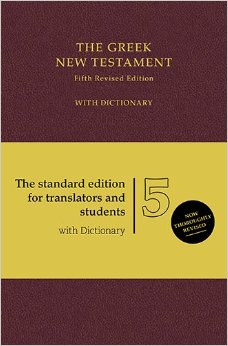
Newest Critical Bible to be Released: UBS 5th Ed. Greek New Testament

The latest critical edition of the Greek New Testament is to be released sometime between the months of May and June of this year (2014). Critical Editions (Editio Critica Maior) of the New Testament text refers to the Greek text which is most likely representative of the original (autograph) version from which all other copies (manuscripts) were made (archetypal text) based on the surviving (extant) manuscripts.

cc-2014-UBS5-cover

Cover of the UBS 5th Ed. Greek New Testament

In 2012, the Nestle-Aland 28th Ed. Novum Testamentum Graeca (Greek New Testament) was published, and can be read online here. The United Bible Societies’ 5th Ed. will have the identical Greek Text as that of the Nestle-Aland 28th Ed. These books are comprised of two major sets of data: (1) The Greek Text (2) The Apparatus of the Text. The Greek Text in the Nestle-Aland 28th Ed. contained changes/ updates to the Greek Text in relation to the Catholic Letters of the New Testament. The UBS 5th Ed., will contain the same Greek Text with those updated changes, with some paragraph and punctuation differences. The apparatus for the texts, refers to the manuscript data, references/ citations, lexical/ philological dictionaries, charts, statistics and calculations, as well as classification criteria/ determination of the variants’ details. A Critical Edition of the Greek New Testament is updated primarily when the Greek Text undergoes some change, due to manuscript evidence. The variants refer to passages, verses, phrases and words that differ in spelling or content between the 5500+ surviving (extant) manuscripts (MSS). When the Greek New Testament scholars settle on one reading from the other readings, the change is made to the Greek Text and thus it becomes the latest Critical Edition of the Greek New Testament.

When Greek New Testament scholars sometimes state that the New Testament is 99% certain, what they mean is that based on the current manuscripts, they have decided that out of all the varying readings that this one specific reading is probably more accurate than the other readings contained in the remaining manuscripts. In other words, they are 99% certain that one variant is more accurate than another variant. This belief however, stems from the Evangelical Greek scholars, their level of certainty differs vastly with the scholars of the Nestle-Aland and UBS committees. There is a persistent need for clarification and correction purposes as Evangelicals seem to misunderstand what the editions represent. The Critical Edition of the New Testament is meant to envision what the original may have looked like, based on the manuscripts which have existed to this day, and out of those manuscripts – the specific readings chosen out of the thousands of other variants, is 99% more correct than the other variants. It does not mean that the current Greek New Testament is 99% certain or representative of what may have existed during the 1st century CE. It’s 99% certainty in the choice of the variants, above the other variants. This disparity in understanding, is sometimes extremely difficult for polemicists and lay Christians to understand, which is problematic for them as it wholly misrepresents what the Critical Editions are meant to convey.

I previously mentioned that there was a classification criteria which the scholars apply to the Critical Editions, the criteria for the UBS3 and UBS4 Editions is as follows (“The Greek New Testament”, fourth revision edition, Stuttgart: Deutsche Biblegesellschaft, 1994, p.3):

  • The letter A indicates that the text is certain.
  • The letter B indicates that the text is almost certain.
  • The letter C indicates that the committee had difficulty in deciding which variant to place in the text.
  • The letter D indicates that the committee had great difficulty in arriving at a decision.

The ratings are as follows (E.J. Edwards, “On Using the Textual Apparatus of the UBS Greek New Testament”, in The Bible Translator, 28, p.122):

  • A – Ratings: 8.7%
  • B – Ratings: 32.3%
  • C – Ratings: 48.6%
  • D – Ratings: 10.4%

This would mean, that out of the thousands of variant readings, when the Greek New Testament scholars decided upon one specific reading they were 59%  greatly uncertain about their choices. In other words, those who claim that Greek scholars are 99% certain in their choice of variant readings are grossly wrong. Merely 8.7% of those choices were certain and 32.3% almost certain. This understanding sometimes goes over the heads of the Evangelical inerrantists which leads to false beliefs about the preservation and accuracy of the modern Biblical text. When changes are made to these two Critical Editions, new translations of the New Testament are produced based on these changes. It therefore should be noted, that the Greek New Testament is constantly being updated, it is primarily a dynamic text which continues to evolve time and time again. Those who believe that the New Testament is absolute in what it expresses clearly do not understand that the very Bibles in their hands are very different from the earlier editions of the Bible.

They sometimes state during their proselytizing that although there are new and varying translations of the New Testament, the Greek Text is absolute and certain, they postulate that the varying and new translations are solely meant to make it easier for non-Greek speakers to understand. Clearly, they are unaware that changes and updates to those translations are as a consequence of the ever changing, constant evolution and development of the Greek New Testament.

and God knows best.

Pastor Samuel Green Proves Biblical Errancy

This must be embarrassing for the Pastor, because this outrageous outcome is contrary to what he was trying to do – defend the inerrancy of the Bible. His problem begins with Mark 2:26, which reads:

In the days of Abiathar the high priest, he entered the house of God and ate the consecrated bread, which is lawful only for priests to eat. And he also gave some to his companions.”

This statement is contrary to the Tanakh (Old Testament), which in 1 Samuel 21:1, which reads:

David went to Nob, to Ahimelek the priest. Ahimelek trembled when he met him, and asked, “Why are you alone? Why is no one with you?”

The dilemma in this case is, either Abiathar or Ahimelek could be the High Priest of the Temple when David entered to eat the consecrated bread. Following what Christians usually do when a conflict occurs, the Pastor immediately harmonized the two incidents and stated they both were the High Priests of the Temple at the same time:

cc-2014-samuelgreen-priesterror

This method of harmonization is often employed generously by evangelical inerrantists. How this method works is explained in the following manner: There are two books, X and Y. From this, X says 2 people were present at an event, Y says that 3 people were present at the same event. In using harmonization, evangelicals like the Pastor can claim:

  • There were both 2 persons and 3 persons, the recording of the number of persons differed according to the time. At one point there were 2 persons and later a third joined them.
  • There were 5 people present, but X saw only 2 and Y saw only 3.

If we were to look at the Pastor’s comment, he utilizes this method by claiming the two were High Priests at the same time. However, this is impossible, as there can only be one High Priest of the Temple at a time. The Pastor demonstrates that he is ignorant of Jewish religious tradition, by applying a Christian understanding to the Jewish faith. What makes this hilarious, yet perilous to his inerrantist stance, is that the author of Mark either lied in his gospel, made a historical error or confused Ahimelek with his son, Abiathar. The only conclusion we can draw from this is that their is a historical error and thus this presents a problem for Samuel Green’s faith.

One exegesis on the error of Mark 2:26 says:

In the days or Abiathar the high priest: and yet from the history it is clear, that it was in the days of Ahimelech the high priest, the father of Abiathar; wherefore the Jew charges (k) Mark with an error, and Matthew and Luke too: whereas the two last make no mention of the name of any high priest; and it might be observed, that in the Persic version of Mark it is rendered, “under Abimelech the high priest”; and in an ancient copy of Beza’s, the whole clause is omitted; though it must be owned, that so it is read in other Greek copies, and in the ancient versions, the Vulgate Latin, Syriac, Arabic, and others: wherefore let it be further observed, that the fact referred to was done in the days of Abiathar, though it was before he was an high priest; and the particle may be so rendered, about, or “before Abiathar was high priest”, as it is in Matthew 1:11. – Gill’s Exposition of the Bible.

We can see that this error in Mark has embarrassed Christians for centuries as the manuscript record shows. Matthew and Luke, both of which were written after Mark, and which were based on Mark, exclude the name of the High Priest. The scribe of codex Bezae excludes the verse completely. Gill, in trying to gloss over this error, happens to make it worse:

that the names of the father and the son are sometimes changed; Ahimelech is called Abiathar, and this Abiathar is called Ahimelech, the son of Abiathar, 2 Samuel 8:17, and Abimelech the son of Abiathar, 1 Chronicles 18:16. And it seems as if both father and son had two names, and were sometimes called by the one, and sometimes by the other: for as the father is sometimes called Abiathar, the son is called Ahimelech, or Abimelech – Ibid.

Apparently, the Jews in writing the Tanakh, confused the father with the son at some point, and so the various other narratives that mention their names continued the error as they could not decipher which one of them was the father or the son. So not only has this error demonstrated that the Gospels are incapable of being from God, as they contain factual errors which embarrassed Christians, it also demonstrates the incompetency of the Jewish scribes to preserve their scripture. I’m not sure whose attempt at harmonization is worse between Pastor Samuel Green and John Gill, as Gill actually tries to use the error in the Tanakh to prove that Jews considered the names of a father and son to be interchangeable, as opposed to the scribes confusing the father and the son.

and God knows best.

James White versus 2 Christian Hate Preachers

Can you imagine these guys debating? I think James White would wipe the floor with both of them – at least White appears to have read the Bible and know Greek while the other two, Sam Shamoun and David Wood seem clueless. In fact their ignorance of the Bible led them to insult it to the extent that one of them effectively said he fears the Christian view of God. Yet these guys are Christian apologists? Wow.

James White to debate two Christians?

James White in his book states (What Every Christian Needs to Know About the Quran):

“…God sent a lying spirit into the mouths of false prophets as a means by which He brought just punishment on those who rebelled against Him (1 Kings 22:23), and just as the New Testament warns those who refuse to love the truth will be caused to love a lie (2 Thessalonians 2:10-11)…” (Page 114). Quote sourced from this link.


Nabeel Qureshi Questioned…

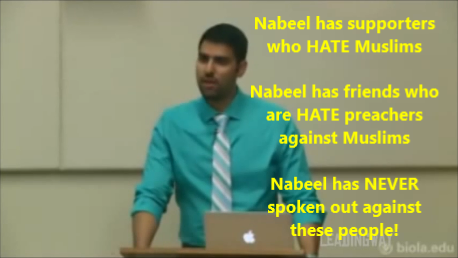
Now, this man who goes by the name ‘Radical Moderate’ gives cash to the Christian hate preacher, David Wood, who nudged Nabeel Qureshi towards Christianity. Here’s his anti-Muslim comment that he sent to me via email in which he rejoices in the death of Muslims and hopes for more:

“But Muslim terrorists blowing up other Muslim terrorists using homicide bombers is Manna from heaven. Lets hope that trend continues.” – Radical Moderate (minion of David Wood).


I understand Dr Nabeel Qureshi didn’t make this comment and nor does he have any control over those who have followed/supported him in the past but it’s really worrying that Nabeel has never gone on public record to disassociate himself with his former associates who are effectively radicalised hate-preachers against Muslims.

The comment above is coming from somebody who has informed me that he has committed serious amounts of money to Nabeel Qureshi’s hate preacher friend, David Wood. As David and Nabeel worked together in the past, it’s not unreasonable to imagine some of that money went to Nabeel Qureshi. How does Nabeel feel about the possibility of having received cash from such hate-filled supporters? How does Nabeel feel about having teamed up with radicalised Christian hate preachers in the form of David Wood and Sam Shamoun. How does Nabeel Qureshi feel knowing that his former colleague Negeen Mayel denounced his best friend as self radicalised?

This is something Nabeel Qureshi needs to look into. Is it odd that he has never made a statement on his radicalised Christian hate-preacher associates? Never denounced the hate-filled lies and mockery that his associates have spewed in the direction of Muslims? Never added to his former colleague’s rejection of his radicalised Christian hate preacher friends?

Scientific Miracles in the Qur’aan?

Question:

There are many people who do da’wah by showing scientific miracles in the Qur’aan. However, I have seen that they can easily be dismissed because some words are stretched to the limits of reason to accommodate these so called miracles. Many non-Muslims say that this is a sign that Islam struggles with science and that Muslims are desperate for converts so we use deceit.

Answer:

I do agree that this is a problem that is negatively affecting the sincere work of da’wah. To begin with, there is a serious warning by the Prophet (salallahu ‘alayhi wa salam) about reading into the Qur’aan, the meanings or views that they want to see, and not necessarily what the text says. This is called eisegesis:

Rasoolullah (sallallahu alayhi wasallam) warned: “He who interprets The Quran without knowledge let him prepare his place in Hell-fire.” (Tirmizhi) Another hadith qualifies the term “without knowledge”. Also narrated by Imam Tirmizhi, it states: “He who interprets The Quran with his own opinion and is correct, has indeed erred.” This hadith makes two telling points: one, that personal or self-opinionated interpretation of Quran is regarded as interpretation without knowledge.

Islam therefore prohibits such self-interpretation, and considers it a sinful action. We should therefore refer to the experts, the scholars of the interpretation of the Qur’aan, the mufassireen. There are many tafaseer (plural of tafseer/ commentary) of the Qur’aan by reliable scholars, namely Tafseer Ibn Kathir and Maar’iful Qur’aan. I am not saying that these commentaries of the Qur’aan by the scholars is perfect in their attribution of scientific miracles to some ayaat of the Qur’aan, as some scholars have interpreted according to the science of their respective times. What I am saying, is that the lay man is unfamiliar with the limits of tafseer and the science of tafseer, therefore it is safer to leave interpretation of the Qur’aan to those who know the limits.

However, we must take into consideration that the Qur’aan does contain scientific miracles. By this, I mean that it conveys accurate information about the physical world in which we exist. There is a point of great importance that must be emphasized, the language of science and the human terms applied to the physical world may not ever match the wording of the Qur’aan. Let’s take a general example:

And We made the sky a protected ceiling, but they, from its signs, are turning away. – Qur’aan 21:32.

If the creator did reveal this as a message to us about natural phenomena, then what can we expect Him to say? The terms used must convey the most general meaning as is possible so that we can identify the terms used with natural phenomena. So the Qur’aan in 21:32 says the sky is a protected ceiling. Someone might argue and say that this verse is false because there is no ceiling or roof covering the earth and the sky is not a physical tangible object. Yet, if we look at the verse more carefully, it states that the sky is some sort of a protection, like a ceiling or roof. Is there such a thing covering the world in what we consider to be the sky? Yes, the ozone layer. This layer protects us from the sun’s harmful rays and preserves life on earth. Due to our atmosphere, meteorites of certain sizes disintegrate while passing through it.

Obviously, the Qur’aan does not use the term “ozone layer”, even if it did and it mentioned those exact terms; at the time of its revelation, that term would be meaningless to those people and for all we know, humans could’ve called what we refer to the ozone layer another name, perhaps the rubber ducky layer. The wisdom of God is beautiful, we can see that He uses terms that are common and general, but with which we can identify and make sense of. To understand how difficult it is to describe something to people who are wholly unfamiliar or ignorant of it, try describing a cellphone to 1st century CE Romans. What would you say? Terms like Wi-Fi, cellular reception, Amoled screen, RAM, etc, are unknown and would be gibberish to them. If you told them you could use something smaller than the size of your palm that uses invisible waves to allow your voice and face to be heard and seen to someone from China or Russia, they would think you are crazy.

Therefore it is a baseless and silly notion that some people expect the Qur’aan to use specific terms that perhaps only English speaking 21st century people can. We must examine the full spectrum of meanings that a word can be used for, even if such a use is rare. By we, I mean the scholars capable of interpreting the Qur’aan. I do not believe, that applying the rare meaning of a word to a term in the Qur’aan is desperation or dishonesty, if the word historically has been used in such a way, to reflect a particular meaning then that is not deceit. It’s the opposite, it’s applying a meaning which was once actually used. As Muslims, we need to understand that the Qur’aan will mention facts about the natural phenomena of the physical world in which we exist. Our expectations of scientific miracles needs to be delimited (determining the limits of interpretation). While there are many other examples of scientific related information in the Qur’aan, we should not abuse such information by overstating or inflating the information it expresses to us. Take into consideration, the website of Harun Yahya that lists miracles far beyond what the Qur’aan is stating. He is misusing verses and when he does this, Muslims like you and I are labeled as uneducated about science or tampering with the meaning of the verses or as being deceitful.

In conclusion, we accept two things, (1) There are people who falsely interpret verses of the Qur’aan to reflect scientific data, (2) There is accurate information about science in the Qur’aan. There may be verses which are ambiguous in their relation to our current scientific data, but that does not mean the verse is wrong or false, it can simply reflect that either humans are understanding it wrongly, or that scientists will eventually reach the same view, of which the Qur’aan is expressing. It is our duty as Muslims to remind the brothers and sisters who interpret scientific information and attempt to relate it to verses of the Qur’aan, that they should be qualified in that field of science themselves and they must know and have the authority to interpret the Qur’aan. Not everyone has these qualifications, and it is with that said, I want to remind the Muslims doing da’wah that they need to interact with the relevant scholars before jumping to conclusions.

and Allaah knows best.

Islamic Terrorists and Sudan: The Broken Narrative

In the years leading up to the secession of South Sudan from Sudan, the narrative being proposed by the media and many Christian polemics, insisted that the Christian majority south of Sudan needed a separate state because of the brutality and genocide they face from the Muslim majority north of the country. So, in 2005 talks between rival factions began which eventually led to the 2011 split up of the North African country. Thus, South Sudan was now going to be a utopia of Christian rule and freedom from the brutality of Muslims whose only purpose it seemed was to oppress the feeble South Christian majority.

That was the narrative, and now that the Christian majority south is free from their Muslim oppressors, what happened? Well, nothing changed. As it turned out, South Sudan is unstable more now, than it ever was. The narrative given before couldn’t work now, Muslims couldn’t be blamed, suddenly the massacres by Christians against Christians in South Sudan is based on ethnic tribal disputes and not based on religion. Varying Christian majority ethnic groups began to kill and fight for control of the new country:

The country has been in turmoil since President Salva Kiir accused Mr Machar a week ago of attempting a coup. The BBC’s former Sudan correspondent James Copnall says the situation now looks very much like civil war. At least 500 people have been killed since the fighting began with the government struggling to keep control of the capital, Juba. UN Secretary-General Ban Ki-moon called on both men to “find a political way out of this crisis”. – BBC News.

Continuing since the inception of the newest country in the world, in December 2013 massacres en masse began occurring by the Christian majority ethnic groups:

Thousands of people must have been killed in the past week of violence in South Sudan, the top UN humanitarian co-ordinator there has told the BBC. Toby Lanzer, who is in Bentiu in northern Unity state, said it had been “a devastating week for South Sudan”. The UN Security Council on Tuesday voted unanimously to almost double the number of peacekeepers to 12,500. Earlier President Salva Kiir said his forces had recaptured the key town of Bor days after it was seized by rebels. – BBC News.

As of last week, another genocide occurred, leaving over 1 million Christians reeling from the fighting and blood shedding by their co-religionists:

Hundreds of people were killed because of their ethnicity after South Sudan rebels seized the oil hub of Bentiu last week, the UN has said. They were targeted at a mosque, a church and a hospital, the UN Mission in South Sudan said in a statement. It added that hate speech was broadcast on local radio stations, saying certain groups should leave the town and urging men to rape women. The Nuer community are seen as supporters of rebel leader Riek Machar. President Salva Kiir is a member of the country’s largest group, the Dinka. Although both men have prominent supporters from various communities, there have been numerous reports of rebels killing ethnic Dinkas and the army targeting Nuers since the conflict broke out in December 2013. Since then, more than a million people have fled their homes in what was already among the world’s poorest nations. – BBC News.

It would seem then, that when South Sudan was given independence all the violent and maniac Muslim crazies killing the innocent Christians in the south, stopped and disappeared into thin air. Following that magical occurrence, the massacres between the Christian majority south ethnic groups began to happen. It’s tragic how this narrative has developed. Muslims were demonized for what we can call the benefit of no one, when the real issue was the violence between the ethnically divided Christian majority south. This had nothing to do with Muslims. It had everything to do with inter-religious, tribal, Christian violence in the south of the country.

What a shame.

and God knows best.

[Updated] Nabeel Qureishi and Islam?

Update: One Christian extremist is defending Mirza Ghulam as not being a God according to Qadiani beliefs, I strongly suggest that he sticks to his religion of Christianity which encourages gross forms of deceit and intellectual misconduct. Here is an excerpt from Mirza’s own writings, point #6 where he claims to be God incarnate. It would seem that this Christian extremist is unable to stand up to even the most minute forms of intellectual criticism.

Original Article:

Christian evangelists are lauding Nabeel Qureishi’s change from Islam to a now full time Christian apologist. Let’s just put this into perspective, before celebrating any victory. Nabeel Qureishi was a Qadiani (equitable to what Unitarians are to Trinitarians in Christianity), who went from believing that a 20th century Indian man, was a Prophet, Messiah and God, to believing that a 1st century Hebrew man was a Prophet, Messiah and God.

Somehow changing the year and ethnicity, doesn’t strike me as a major change.

Christians though are invited to explain to me how orthodox Islam which disbelieves and discredits any claim for one man to be a Prophet, Messiah and God; at anytime in history, can be equated with orthodox Islamic beliefs? Or how to hold one’s Christology from a 20th century Indian man to a 1st century Hebrew man, can be equated with orthodox Islamic belief?

In other words, if Nabeel goes from believing in an Indian Jesus archetype, to a Hebraic Jesus archetype, it really isn’t bad news for us Muslims. It helps us demonstrate that Qadianism, founded by the self claimant to Prophecy, Messiahship and Godship declare themselves to be Christians with a 20th century flavour. For in pure honesty, Qadianism is Christianity with an Indian man instead of a Hebrew one.

Just to make it easy for comparison, Nabeel’s faith development:

  • Mirza Ghulam Ahmad – 20th century, Indian male, Messiah, Prophet, God.
  • Jesus the Christ – 1st century, Hebrew male, Messiah, Prophet, God.

What…a…change!

« Older Entries Recent Entries »