Category Archives: FAQS

Response to James White on Qur’an 10:94

In a short clip, spanning roughly 20 minutes long, Dr. James White sought to address my article on Qur’an 10:94. He generally had three main points of dispute:

  1. That you have to “jump” from Qur’an 10:94 to Qur’an 46:10 to understand the verse.
  2. That Qur’an 10:94 uses plural for the People of the Book but Qur’an 46:10 is singular therefore it does not apply.
  3. Islamic scholars disagree on whether Qur’an 46:10 was revealed in Makkah (earlier) or Madina (later).

On the first point, there is not a need to respond to it. One of the first rules of exegesis is to let scripture interpret scripture. I am not aware of anyone opening John 1:1, and then complaining that they have to “jump” all the way back to Genesis 1:1 for a comparison to derive further context, I don’t believe a Christian would complain that they had to “jump” (to use Dr. White’s phrase) some 43 books to understand the relation between the two passages. Perhaps he can expand on his surprise and awe of scripture being referenced in such a fashion. As per my own understanding, it is a strawman and faux criticism.

It should be noted that one often has to jump more than a dozen books or more in some cases to reference Isaiah or the Psalms when reading the New Testament, I am not aware of this being a problem until Dr. White expressed it as such.

On the second point, yes, the Qur’an does use the term “those” as in the plural but that is because there were many witnesses at that time, including but not limited to Salman al Farsi, Abdullah ibn Salam and Zaid ibn Sanah. However verse 46:10 is generally referring to one person, while Qur’an 10:94 can refer to multiple witnesses. Therefore, there is no issue here whatsoever.

On the third point, if we argue Qur’an 46:10 is earlier and is therefore a prophecy of a Person of the Book who testifies to the truth of the Qur’an, then it is a prophecy par excellence given the witnesses I mentioned above. If it was revealed in Madinah, then it confirms a truth publicly known and acknowledged, thus verifying the verse itself and the Qur’an. There is no discrepancy here and Dr. White does not seem to follow through on his own logic, he merely states he disagrees with it but does not provide any justifiable reason for making such claims.

Throughout the 20 minutes or so in which he addresses my article, he made statements regarding whether or not there is such a thing as hermeneutics for the Qur’an, while at the same time reading from a Tafseer I quoted in my article. It’s a bit like driving in my car and then asking if I have a car. In case there is any doubt, yes Dr. White, there is and it’s called ‘Uloom al Qur’an, I am fairly certain every single Tafseer books mentions this in some capacity. Perhaps you were being facetious but it came across as being quite uninformed.

and Allah knows best.

Book Review: Mahdi – The Promised Caliph

We live in an increasingly confusing world, the religio-political domain is in a state of constant flux, in times like these we need to take a step back and truly understand our faith so as to ensure we don’t fall prey to misguidance and propaganda. It is in this context that a book on the Mahdi plays an instrumental role.

Mahdi Book

This book tackles quite a few fundamental questions that are being asked today by young Muslims worldwide:

  • Who is the Mahdi and is he an imaginatory figure of Islamic mythos?
  • Are extremist groups representative of a Caliphate?
  • Are the hadiths about the end times fabricated?

The book is written for the layman and scholar alike, for the Muslim and non-Muslim. It’s language is plain and simple, Islamic terms are thoroughly explained and the writing style is straightforward. Meaning then, that there are no complex theories here, there is no obfuscation by the author, no flowery language, they get straight to the point. This is no better displayed than in the first chapter where the author explains why there is no mention of the Mahdi in the Qur’an. In answering this question, they set a foundation from which to explain the traditional Islamic understanding of who the Mahdi is. He is not some fanciful, legendary figure with magical powers who with the flick of his fingers will fix all the ills of the world. This is simply, not the traditional Islamic perception of the Mahdi.

It is important to understand that eschatology (end time beliefs) is a highly contentious topic, with speculation as its mainstay. A lot of people will be familiar with Islamic personalities who apply various narrations to modern day countries and groups based on highly problematic interpretations that seem to change with whatever direction the wind is blowing in. Many Muslims have been mislead by the series the Arrivals, others by Imran Nazar Hosein, who as it should be known is a countryman of myself, we are fellow Trinidadians. No one doubts the importance of studying Islamic teachings on eschatology, we all in some way want to understand how these narrations relate to our world today. In one way, it’s a means of removing existential doubt as we find our place in the world today, on the other hand it is also a means of hoping for a better future for the world. This is another place where a book like this becomes instrumental, it lets us know that yes we can in some cases apply some narrations from the hadith corpus to today’s world but it also makes it clear that there is a lot we can’t know for certain and that the authentic narrations may not apply to our generation at all.

A point of note is the author’s handling of recent extremist groups such as ISIS and al Qaeda. The author dutifully points out in a systematic and objective way that the interpretations of the hadiths used to give legitimacy to the aforementioned groups are purely speculative and absolutely false. In no uncertain words, the author plainly states that neither ISIS nor al Qaeda have any relation to the Mahdi or a genuine Caliphate, he agrees that they are extremist groups and their claims for a Caliphate or Khilafa are absolutely illegitimate. Here’s an excerpt of the author’s analysis of a hadith used by extremist groups:

The primary meaning of Harith is tiller or ploughman. If Usama meant a farmer or a villager it would have made more sense, however, it means lion and hence does not apply. Saying that one of the meanings of Harith is a young lion is also a stretch and leads one to incorrect conclusions. Using this logic, we find that one of the meanings of happy is willing whereas the primary meaning is being glad or feeling pleasure. A person may be happy to help and hence willing in that sense but this does not change the main meaning of the word. Such dodgy logic has been used for both Usama and Zawahiri.

Harith, Harrath, Mansur, Usama, and Laden are all Arabic words and it does not make sense at all that the Prophet (ﷺ) would use one Arabic name to describe another Arabic name. Describing a president (in English) as Ameer (in Arabic) or a mayor (in English) as Haakim (in Arabic) makes sense but describing one Arabic name with another is actually insulting the Prophet (ﷺ) because the Prophet (ﷺ) did not speak in confusing terms – he was concise, clear, and eloquent.

Simple and straight to the point. For a young Muslim to read this, they will surely see through the propaganda of extremist groups, and as for a non-Muslim, it demonstrates that Islam does not endorse or provide an intellectual basis for extremist groups. In other words, this section of the book serves two purposes, a means of guiding young Muslims away from extremist groups by grounding them in a traditional understanding of Islam, and on the other hand it does da’wah towards our non-Muslim brothers and sisters by demonstrating the intellectual beauty of Islam.

Towards the end of the book the author has compiled a vast collection of fabricated and weak hadith narrations from various hadith collections. This is important, as I am not aware of someone having done so in English previously. The internet has fueled the use of “fake news”, and Islamic eschatology has not escaped this onslaught of fake news. To this end, the author has some 29 pages of the book dedicated to this collection of weak and fabricated narrations. This in effect provides Muslims with a reliable resource to refer to when reading or seeing end times media on the internet. It is astounding to see the number of weak narrations that are used by those who profit off of making “prophecies” on behalf of Islam. The author has no doubt done a dutiful service to the religion of Islam in providing us with such an extensive collection of fabricated and weak narrations on this topic.

Lastly, the author provides a breakdown of the general order of events that will occur before, during and after the time of the Mahdi. This is important because if left to our own devices to delineate the series of events that should take place, we would be no better off than watching a random YouTube video on the topic. By providing us with a simple progression of events, a lot of the propaganda out there is rendered useless. Not only does the author go through each narration in detail throughout the book, the chronology that summarizes the events at the end of the book serves as an excellent conclusion. In a sense some scholars of literature have referred to this as the inclusio literary device, a powerful language device used to aid a reader in fully understanding what has been written. This in itself demonstrates the level of careful detail and planning that went into the development of this book. While I must admit I am not one who is fond of or interested in Islamic eschatology, this book has provided me with a comprehensive study of the topic, one that has given me meaningful and useful knowledge about Islam and Islamic thought. I would definitely recommend this book, it’s only been available for a few days but I honestly see it as something which is needed in our time.

The book is now available and can be bought at the following links:

For further works by the same author please see their Qur’an Answers website.

and God knows best.

Consistent Calvinism and Textual Criticism

Can one be a consistent Calvinist/ Reformed and use Textual Criticism to affirm the New Testament…? This major Calvinist scholar says no. Herman Bavinck says as follows:

“Those who make their doctrine of Scripture dependent on historical research into its origination and structure have already begun to reject Scripture’s self-testimony and therefore no longer believe that Scripture. They think it better to build up the doctrine of Scripture on the foundation of their own research than by believingly deriving it from Scripture itself.”

Source: Herman Bavinck, Reformed Dogmatics: Prolegomena, p. 424.

Bavinck on the self-testimony of Scripture (1--424)

For more information on Bavinck, please click here for his Wikipedia page.

When I initially posted this on my personal Facebook profile, I was immediately reproached by Dr. James White. His argument varied, but it began with claiming I didn’t understand what Bavinck was saying, it then moved to the claim that Bavinck was not referring to textual criticism and finally it moved on to whether or not historical criticism includes textual criticism or not.

The point being, that Dr. White was clearly uncomfortable with this quote and the consequences it bore on his position as recently rebuked by James Simpson, Sam Shamoun and other Christians. I was most disappointed with his response, because as far as I and other Muslims viewed his comments, it seems as if he took the post personally. Beside the point, when I tried to explain that Bavinck’s quote could be applicable and inclusive of textual criticism, I included this statement:

I don’t disagree, read the page, historical-critical, it absolutely includes higher criticism, no one doubts that. Then again, no one else disagrees that there is a distinction between higher and lower criticism, any longer. There’s a bit of both involved in each discipline. Thanks for the fruitful replies though!

I think my statement was quite clear, when it comes to historical-critical study, there is an overlap, a bit of both higher and lower criticism. For some reason, which we all now know why, Dr. White chose to ignore that qualifying phrase of  “a bit of both” and invectively chose to represent my argument as referring to absolutely no distinction between higher and lower criticism. It’s quite obvious that isn’t what I said but it’s the position he chose to stake his claim upon, shifting the goalposts if you would, and quite disappointing for someone who seeks to understand his opponents’ points of view. I forgive him for that.

In any case, yes, historical-critical research does include higher and lower criticism, which encompasses textual criticism. In the end, this quote does have ramifications for Reformed folk who choose to view the New Testament through the eyes of history to validate variant units. I gave one such example to qualify my point which was noted by all, that Dr. White intentionally chose to ignore:

With all due respect, when using philology to develop an authorial profile to help us with stemmata, don’t we have to refer to historical information/ data in that very process?

We look for language development, basically the way someone represents language changes over time and so we can demarcate eras of language use within the written tradition and delineate forms of writing over time. To do so, especially in textual criticism, we have to be aware of the language, its form, variations, standards, etc. In conclusion, distractions aside, this quote is damning for some of the more prolific Christian apologists and the untenable positions they hold to.

and God knows best.

Textual Criticism Versus Evangelical Beliefs

There has been a trend of late where evangelical apologists are trying to normalize the cc-2018-sitenews-clashingheadsuse of textual criticism in their understanding of the New Testament. This however, leaves them in an untenable position trying to balance the divergence of textual critical axioms, arguments and evidences with those of their normative faith. This can be seen with apologists such as Dr. White, Dr. Licona and Dr. Wallace. All three are studying or have studied textual criticism to some degree and there stands a myriad of obvious issues that need be sorted out.
Consider the case of the nature of revelation itself. On a recent Dividing Line program Dr. White along with Dr. Brown chose to argue that the Greek Septuagint was stronger in its wording than the Masoretic Text and Dead Sea Scrolls were when it came to prophecies about Jesus (John Calvin notably argued the same for Paul’s use of the Septuagint and its associated divergences). The obvious issue here is that according to their own classical beliefs, the Old Testament was not revealed (and written) in Greek. Surely then, according to the confessions, it is traditionally understood that inerrancy primarily refers to the autographs. In other words, God chose the men who wrote the “books” of the Old Testament in a specific language. God chose men, again, according to their beliefs to word scripture to the best degree of accuracy and understanding possible. How is it then possible that a translation by unknown people can represent scripture better than the people that God chose to represent His teachings for Him? That does not make sense. Yet this is the position they now hold to, a position that is absolutely advantageous for Muslims doing da’wah.

Then there is the other argument of the Old Testament (as per the program responded to here), that it descended to us in various streams and that different scribes (as well as copyists) chose one variant over another because they completed the exposition of a verse better, as Dr. White referred to it, “sermonic expansion”. So there was addition to the text, addition not by the initial authors whom God chose, yet somehow this is not corruption. Odd reasoning here. Clearly cognitive dissonance at work. What then do we make of the claim that there were different streams? Yes, we agree, but did God intend to give authority to each stream? If that was the case then the later Masoretic Text would have authorial primacy and importance, rather than a translation in the form of the Septuagint that came before it, if we were to consider it with respect to chronology. Yet we find most Christian apologists referring and giving importance to the Septuagint while wholly ignoring the Latin and Samaritan texts, are those too not viable streams? Who then, gave the scribes authority to choose from those streams? Those anonymous and unknowable scribes? Again, problems arise.

What then do we make of the claim that there existed actual men within the first century by the names of Matthew, Mark, Luke and John who would be considered the initial authors? Isn’t it the case in New Testament Textual Criticism through stemmatics and philology that each Gospel is a composite work, the result of more than one author in various periods throughout history? How then can Matthew be one man and yet many, not existing at one time, but many simultaneously? Yes, I do recognize such thinking to be absurd, which is why I find it almost impossible to take anyone seriously who argues for a singular, inspired authorship, yet still accepts – at the same time – that there were multiple authors to one text as is the standard position. Yes, you are right in asking that no right thinking evangelical would accept composite authorship, yet today in the Nestle-Aland Greek New Testament, the standard critical text that the aforementioned men believe in, contains conjectural emendations. These are instances where the textual critic has decided that their version of a passage best represents the original without any manuscript evidence for their version ever having existed. Surely, today’s evangelicals don’t hold to the position that the folks on the Nestle-Aland committee are inspired by God, so wouldn’t that then confirm they accept the words of multiple people for one Gospel, rather than one individual from the 1st century? It does, yet again we arrive at a problem.

So while I am happy that today’s Christian apologists are becoming more liberal towards the New Testament and affirming the Qur’an’s claims about their attitude to Scripture, I also mourn for the aloofness that abounds otherwise.

and God knows best.

Sin, Pride and Christianity

cc-2018-sitenews-pride

Coming closer to God. What exactly does this catch all phrase mean? It’s a question that has given rise to two distinct and competing ideologies, Islam and Christianity. Both of these faiths offer completely distinct solutions to this question, and at the heart of that solution lies salvation. How then, does one understand how these faiths address this question? In this article that is what I ultimately seek to answer.

Christianity answers this question in having God lower Himself, humble Himself by becoming a human being and taking on flesh. These beliefs are drawn from the crystal clear Biblical verses that follow:

The Word became flesh and made his dwelling among us. We have seen his glory, the glory of the one and only Son, who came from the Father, full of grace and truth. – John 1:14 (NIV).

Who, being in very nature God, did not consider equality with God something to be used to his own advantage; rather, he made himself nothing by taking the very nature of a servant, being made in human likeness. – Philippians 2:6-7 (NIV).

The Christian solution to this question is to lower God’s stature amongst men, to make Him one of us, an idea that has pervaded the thoughts of mankind spanning more than a millennia. To the Graeco-Romans, humans shared divinity with God as is seen with Hercules and Apollonius, with the Hindus, divinity also shared humanity as is seen in the appearance of a “Murti”. Christianity finds this in the form of Jesus. This idea is not new, and as was explicated upon recently, the Jesus of Christianity finds its metaphysical basis in Aristotelian thought. Instead of us coming closer to God, God came closer to us.

Islam on the other hand offers a much more robust proposition. God is not one of us. We are not gods. God is not arrogant such that He has to “lower” Himself and “humble” Himself. Rather, we accept an unassailable axiom, that we are beholden to God and He needs no change. To come closer to God, it is our humanity that needs to be reigned in, our desires and sins, our evil actions that need to submit to the authority to the ultimate judge and jury, God and God alone. We are not in competition with God, we are not rivals to His divinity, we are and never will be equals. The problem is not with God misunderstanding humanity or having a need to manifest Himself in our likeness, that is the arrogance of man to assume the fault is with God, such that the solution is that He needs to be more like us!

It is ironic that both Muslims and Christians agree that the downfall of Satan/ Iblees was due to his arrogance, that he would not submit to God’s authority. Yet born out of that fall was the belief of Christians that the solution for our world is that God should be one of us, the direct opposite of submission, the sin that fell Satan himself. As the Qur’an then says:

Do they seek other than the religion of Allah (the true Islamic Monotheism – worshipping none but Allah Alone), while to Him submitted all creatures in the heavens and the earth, willingly or unwillingly. And to Him shall they all be returned.  – Qur’an 3:83 (Mohsin-Khan Translation).

The idea that God need not only “humble” Himself (this assumes God is inherently arrogant), but that He should also die due to our actions against Him, that is sin, is the height of arrogance itself. God need not pay for my sins against Him. God need not suffer due to my inequities. I need to humble myself and accede to His authority, His mercy and His love. This is why I believe Islam answers the question of how we come closer to God, by recognizing His authority over us, by submitting our souls to Him it is then and only then can we truly know Him.

and God knows best.

Is the Bible a Requirement for Salvation?

Five years ago, I wrote a quick article on questions that Christians do not like to answer. Recently, there’s been some controversy/ buzz about the first question I posed in that article. Here’s the question:

If the earliest Christians within the first two centuries after Jesus did not need a New Testament to qualify their faith, why do modern Christians have such a need? If they did not sanction or consider any other writing beside the Old Testament to be scripture, then isn’t it a digression from the ‘true faith‘ of the earliest believers to incorporate something new as scripture? The first New Testament was codified and canonized by the heretic Marcion who believed that the Jewish YHWH was not the true God, the first time the largest Christian Church sanctioned a New Testament was during the Synod of Hippo in 393 CE, some 360+ years after Jesus.

One of the more telling issues with the questioned posed above is that those who have responded to it believe that the question was tricky to answer. I agree it is tricky to answer, that’s the very reason I asked it in the first place! I therefore, don’t find that description of the question to be a problem, it’s more an affirmation that I framed the question properly in the first place. I’m essentially asking one question:

Is the New Testament required to be believed in for salvation in Christianity?

In other words, can someone be a believing Christian without having need for, or being dependent on the New Testament? Can someone reject it and yet, still be saved? This is effectively how the earliest Christians lived, without a New Testament. Some have tried to respond with the following passages:

  • “Repent and believe in the gospel” (Mark 1:15)
  • “believe in the Lord Jesus Christ, and you will be saved” (Acts 16:31)

These verses do not answer my question. What these verses teach is that you should believe in the good news, but it does not require belief in this or that or any other Gospel. The authors of Mark, over its centuries of development, never emended the text to say, “repent and believe in this gospel,” there’s a reason for that, the verse is conveying the point that it’s good to believe in what Jesus brought, i.e. his message, not the documents written by people decades later who never knew him. Rather, what is emphasized for belief is in him, Jesus, not any written work by any man. That’s the point I’m trying to make here. There is no requirement to believe in the New Testament as God’s inspired revelation to be saved in Christianity. Consider for a moment, this very important passage:

All Scripture is God-breathed and is useful for teaching, rebuking, correcting and training in righteousness, so that the servant of God may be thoroughly equipped for every good work. – 2 Timothy 3:16-17 (NIV).

It’s useful for lots of things, except for salvation. This passage does not state that belief in scripture is a requirement to be saved. Scripture is useful for many things, but it’s not a requirement. It’s like the difference between having an umbrella in the rain and not having one. Sure, the umbrella is useful and it is good for many things when it’s raining, but it’s not a necessity or requirement for when you’re going into the outside world. This is the distinction between something’s usefulness and it’s necessity, one is clearly not the other.

So then, the question begs itself, doesn’t it? Do you require the canonized and codified New Testament, to be believed in, as a requirement for your salvation in Christianity? The earliest Christians did not seem to think so, so why do you?

and God knows best.

Pagan Influences in Christian Theology

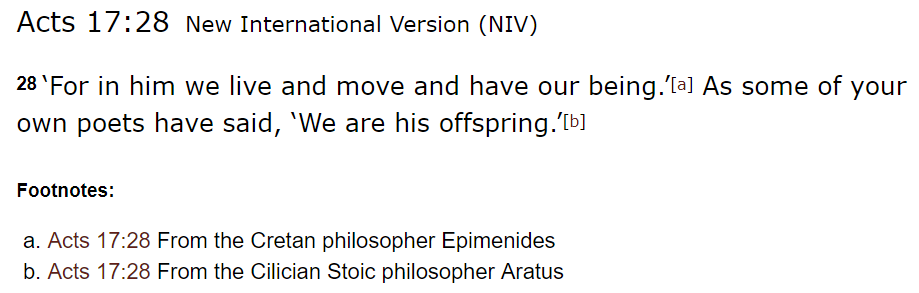
I recently read from a budding South African theologian of Ad Lucem Ministries that the New Testament’s concept of God is not based on Graeco-Roman philosophy. Yet this does not seem to be the case…(see attached photo), Acts 17:28 (NIV):

cc-2018-jw-acts1728

It is quite peculiar that the New Testament uses the term “ειμι” (to exist) for God but never in the present participle form of “ὤν” (being). What’s interesting is that New Testament’s translators continue to replace in their translations “ειμι” for “ὤν” in English, almost as if the allegedly inspired texts in and of themselves use insufficient language…

We see further examples of a dependency on Platonic-Aristotelian metaphysics in Philippians 2:6, where “μορφε” (form) is translated as “nature or essence”, a completely Platonic-Aristotelian pre-Christian concept in philosophy, referring to the “material whole”.

The Trivium Final

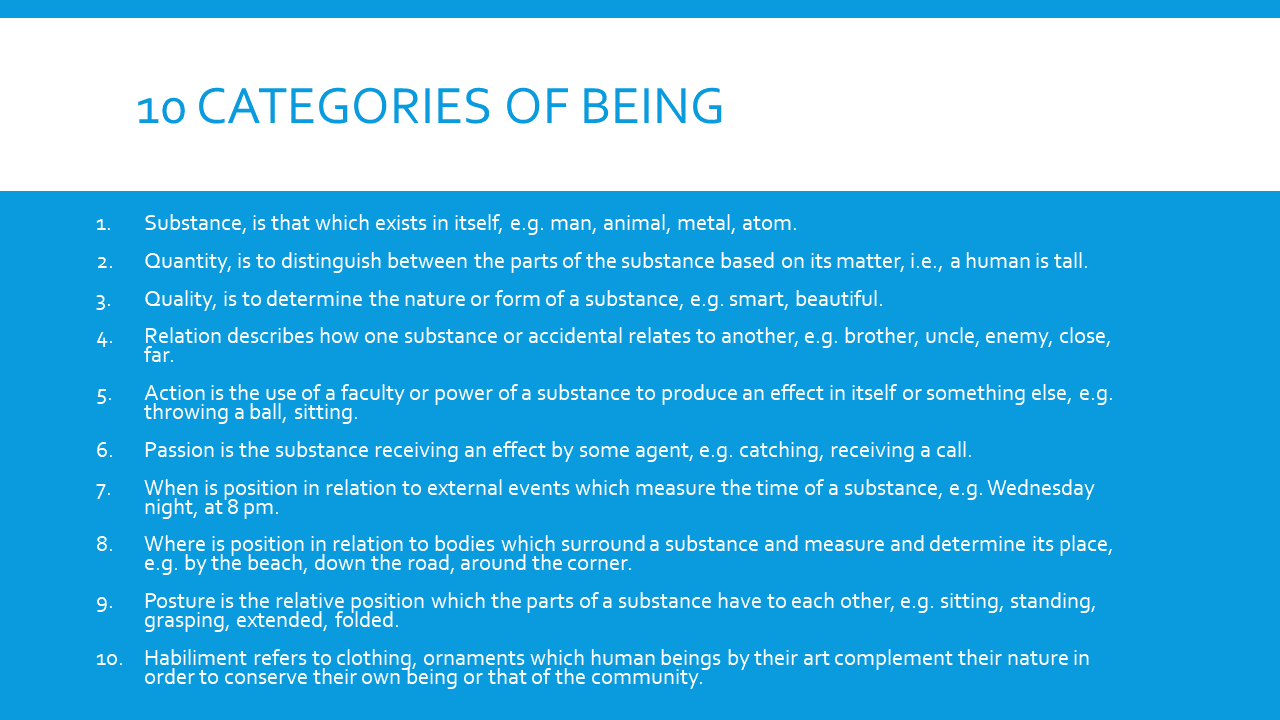
This is why in Christianity, God who is a “ουσια” (substance) can also be immanent, because it fits into the Aristotelian pre-Christian concept of an “accident” (a substance that exists in another substance), i.e. God (a being) in flesh (another substance). This can also be seen in the sense of passion, from the “Praedicamenta”/ 10 Categories of Being, where God (a being) uses a form and thus can experience pain in one sense and not in other because this Being can distinguish between itself (read as quantitatively, therefore “Persons” in the Godhead) and can have various forms (read as qualitatively) hence the hypostatic union.

The Trivium Final

While some Christian apologists deny these dependencies on Platonic-Aristotelian pre-Christian philosophies, by using these terms, they are implying an already understood meaning, which in this case would be the predominant Platonic-Aristotelian metaphysics for their onto-theology of “God”.

It should be noted that this is the reasoning behind Justin Martyr’s statement of:

“And when we say also that the Word, who is the first-birth of God, was produced without sexual union, and that He, Jesus Christ, our Teacher, was crucified and died, and rose again, and ascended into heaven, we propound NOTHING DIFFERENT from WHAT YOU BELIEVE regarding those whom you esteem sons of Jupiter.”

Source: Justin Martyr, The First Apology, Chapter 21.

Some apologists have argued that Justin was using “hyperbole”, this is an ignorant claim, without understanding of basic Graeco-Roman metaphysics.

and Allah knows best.

Jerusalem and the Fulfillment of Prophecy

In a narration recorded by al Musharrah ibn al Murajja al Maqdisi in his work, Fada’il Bayt al Maqdis, we read a prophecy about ‘Umar’s (may Allah be pleased with him) peaceful conquest of Jerusalem. What makes the prophecy special, is that the Prophet Muhammad (peace be upon him) also described al Quds al Sharif in great detail to the point that ‘Umar (may Allah be pleased with him) who had never been to Jerusalem before was able to locate al Quds al Sharif (the Temple Mount) solely based on the Prophet’s detailed and highly accurate description. This video brings to life that narration:

YouTube Mirror: Jerusalem and Umar’s (ra) fulfillment of Prophecy

The Changes to the First Words in the New Testament

Last month I published a paper on how the very first words in the New Testament evolved over time. It was entitled, “The Inscriptio of the Gospel Attributed to Matthew.” Today we have produced a 2 minute video that simplifies and summarizes the research from that research paper:

Alternative YouTube Link: Click Here.

For more information, you can see a quick 15 minute talk on how the Old Testament was corrupted (including the Shema Yisrael!). To view or download the presentation slides from the 15 minute video, please click here.

To download or read the paper mentioned in this post, please click here.

and God knows best.

The Inscriptio of the Gospel Attributed to Matthew

For many Christians the authorial identity behind the first Gospel (as per the Augustinian order), commonly attributed to Matthew usually appears to be a matter of little or no concern. This is in part due to the inscriptio of the Gospel itself as is found in most modern translations of the New Testament. Without this inscriptio, the first mention of the name Matthew appears in Matthew 9:9. While at first this may not seem like an issue of note, a critical examination of the inscriptio with respect to its inception, and eventual adoption and evolution can give us deep insight into the perception of this document by those contemporaneous to its creation and development.

Who was authorship ascribed to, if anyone at all in the manuscript tradition? Was it considered to be scripture from inception? How has the use of the inscriptio in today’s modern translations affected the belief that an individual identified as Matthew did indeed write the first Gospel?

For those who would prefer to download the document or access it through other means, here are some alternative options:

This is the first article in a series of articles that will cover the New Testament and the Qur’an in light of textual criticism.

and Allah knows best.


« Older Entries Recent Entries »