Category Archives: Debates

Sam Shamoun and Lying by Dr. Shabir Ally – Part 2

Shabir Ally

October 1, 2015

Now that I am back in Toronto, and have access to my books, I am able to write a more telling response to Sam and his accusation about lying. I also had a chance to review the recording of what I said during the debate, and Sam’s interaction with me during the Q&A.[1]

Two things (at least) will become evident below:

  • I correctly cited that book of Robert Gundry to which I was referring;[2]
  • In order to generate his proof that I misquoted Robert Gundry, Sam actually misquoted me!

This is a sad day for Muslim-Christian dialogue.

Having listened to the recording, I still have the question that I had put to Sam during that conversation. Sam had said that he had two books right in front of him: one book is Robert Gundry’s commentary on the New Testament; the other book is Gundry’s commentary on Matthew’s gospel in particular. Sam read a portion from the commentary on the New Testament which obviously includes a brief commentary on Matthew’s gospel.[3] That is not the book I had cited. I had studied and cited the other book: the commentary on Matthew’s gospel in particular.

So, I asked Sam for the page number of the relevant section of the commentary on Matthew’s gospel in particular. Instead of supplying this simple piece of information, Sam kept telling me pages 135-36 of the book which he had read from. I asked him why he could not simply tell me the page number of the relevant section of Robert Gundry’s commentary on Matthew’s gospel which he said he also had in his possession at the time. Sam admitted that the page numbers he was giving me were from Gundry’s commentary on the entire New Testament, But when I asked him again for the page number of the commentary dedicated to Matthew’s gospel, there was a definite silence. I thought he had hung up. But he was still on the call. Why the silence?

Moreover, in listening to the recording I realized all the more how bizarre was the conversation between me and Sam. I kept asking him for the page number of a book which he claimed to have with him. In response, he kept challenging me to read a book which I did not claim to have in my possession at the moment. Naturally, I could not read a book I did not have in my hands; I could only accurately quote the most relevant line from my head. But, for some reason, Sam was unable to give me the page number of the book he had in his hands even though the relevant page number is easy to find. The commentary progresses from the start to the end of Matthew’s gospel, and the page headers show the progression verse by verse. It would have been a snap for Sam to thumb through the commentary following the page headers to chapter 28 and then to its verse 19 and give me the page number.

Obviously, he later located the relevant page number of a commentary on Matthew’s Gospel, this being the first book Sam referred to in his article composed on that same date.[4] It would be interesting to trace the relationship between this commentary and the one I was citing. It seems that the one Sam is referring to is the second edition of the same book, now with a different subtitle.[5] The page numbers of the relevant sections are the same, and the wording is strikingly similar, though the subtitles are different.

Now, the book I was citing really said on p. 596 what I cited it to say. So too does the second edition, as is evident from Sam’s citation in his article. But both of these are dissimilar to the book which Sam was reading on air.

To understand what is going on here between me and Sam, one has to see the big picture, as follows. In debates between Muslims and Christians, Muslims argue that in the Old Testament Yahweh is the only God. Jews agree. Many Christians also agree. Consequently, for Jesus to be God, he would have to be Yahweh. But if he is Yahweh, then he is the only God, and therefore the Father and the Holy Spirit would not be God.

In response to this clear logic, some Christians cite Matthew 28:19 as proof that the Father, Son, and Holy Spirit are each Yahweh, and yet altogether Yahweh. In that verse, Jesus directs his followers to baptize in the name of the Father, the Son, and the Holy Spirit. Christians point out that the name here is singular, though the named persons are three. Hence they insist that Jesus is Yahweh, the Holy Spirit is Yahweh, the Father is Yahweh; yet altogether the three are Yahweh.

This is the big picture, the context within which I am using the citation from Robert Gundry. I am saying that according to Robert Gundry the verse does not imply that the three persons bear the same name. According to him, the verse is not actually referring to their name; rather, the verse is saying that the baptism should be done with fundamental reference to the Father, Son, and Holy Spirit. Here is an approximate transcript of what I said, as evidenced by the video recording:

In Matthew’s gospel towards the end where Jesus says, “Go and baptize in the name of the Father, Son, and Holy Spirit,” some will take that as an expression of Trinitarian doctrine. But in fact, as Robert Gundry says in his commentary on Matthew’s Gospel, it does not actually mean that—it does not mean that the three of them have just one name—it means, ‘Go and baptize with fundamental reference to the Father, Son and Holy Spirit.’ It does not mean that the three are one. In fact, there is no passage in the New Testament gospels or in any of the writings of the New Testament that says that the three—the Father Son, and Holy Spirit—are together as one God.[6]

This is what Sam needs to address. Instead, he changes the subject to me. But attacking me will not remove the problem. The problem, as the clear logic above indicates, is that there is only one God Yahweh, as Jews, Christians and Muslims agree.[7] According to Matthew 12:18, Jesus is the servant of Yahweh. This too Muslims and even Christians accept. But Christians insist that, in addition to being the servant of Yahweh, Jesus is also Yahweh himself. I have been refuting this latter claim with my clear logic. And now Sam wants to attack me. But my logic is not exclusively mine. Logic is universal. To get rid of this problem, Sam does not need to attack me, he needs to battle with the fundamental laws of nature, or the designing work of God who fashioned us to think logically. He needs to battle with his own thoughts which cannot escape the same logic.

When Sam called, he accused me of claiming that Robert Gundry in his commentary on Matthew’s gospel denies that Mt. 28:19 is a Trinitarian text.[8] But that is not what I claimed.

In the above transcript of the relevant portion of my speech, I started out with my own statement, cited Gundry, and then ended with my own statement. I can see where at first glance it may not be clear to others where I intended to end my citation of Gundry. But if that was not clear at first, during the call I explained to Sam:

In that commentary, Robert Gundry says very plainly that the idea that the mention of Father, Son and Holy Spirit should mean that they share the same name—that is not the idea. He is saying that the idea there is that the baptism should be done with fundamental reference to the Father, Son and Holy Spirit. I am not saying anything more than this.[9]

Notice that last sentence: ‘I am not saying anything more than this.’ Now it should be clear that I am only claiming as follows: in a particular book, Gundry denies that Mt 28:19 implies that the three persons bear the same one name.

Despite my taking pains to clarify the point on air, however, Sam charges in his writing composed after the debate:

Ally basically claimed that Gundry denies that this text supports the Triune nature of God.[10]

That is not what I claimed.

I am not saying that Gundry is not a Trinitarian, or that he denies that Mt. 28:19 can be put to Trinitarian use, etc. It should be clear to all students of logic that a statement of the form,

‘A does not imply B’

does not mean the same as,

‘A implies that B is not the case,’

and it does not mean the same as,

‘I deny B.’

In what follows, I will replace B with ‘the Father, Son and Spirit share the same name.’

Logically, therefore, when I cite Gundry to say,

‘Mt. 28:19 does not imply that the Father, Son and Spirit share the same name,’

that is not the same as citing him to say,

‘Mt. 28:19 implies that the Father, Son and Spirit do not share the same name.’

And it does not mean the same as citing him to say,

‘I deny that the Father, Son and Spirit share the same name.’

It is really sad to see Sam misquoting me to prove his charge that I misquoted someone else. Sam does not like my message. But does that justify shooting the messenger? Dialogue between Muslims and Christians need to move beyond such tactics. We need to listen to each other, learn, and pray to God asking him to guide us all.

Finally, the book I was citing was published in 1982 for an academic level of readership. It caused a stir in evangelical circles leading to Gundry’s resignation from the Evangelical Theological Society. The book Sam read on air was published 28 years later in the year 2010 for a more common readership.

This latter work, from which Sam’s read to me on air, and which he cited second in his article, clearly supports Sam’s contention that Gundry believes that the three divine persons are included in ‘the name.’ I am grateful for this information. I did not know it until Sam pointed it out. And I am glad that I did not overstate my case in citing Gundry. However, if I do cite him again, on this matter, it will be appropriate for me to add that Gundry apparently changed his mind about this as is evident from his later writing. Why he apparently changed his mind would be interesting to learn. Is it that the two books were meant for two different audiences, in which case he was willing to tease the academic community but not the masses? Did the negative response to his earlier book cause him to be more cautious? Or, did he find new evidence to convince him that his earlier statement was incorrect?

In short,

  • I correctly cited Gundry’s earlier statement,
  • I am willing to incorporate his later statement in future citations, and
  • I am grateful to Sam for alerting me to this, but
  • I find it at least ironic that Sam would misrepresent me to prove that I misrepresented Gundry.

[1] The recording can be viewed here: https://www.youtube.com/watch?v=idHxegbSunQ&feature=youtu.be. Sam’s call comes in at 2 hours and 14 minutes into the recording. My thanks to Brother Nazam for pinpointing this location.

[2] Robert H. Gundry, Matthew: A Commentary on His Literary and Theological Art (Grand Rapids: Eerdmans, 1982) p. 596.

[3] Sam was referring to Gundry, “Matthew,” Commentary on the New Testament: Verse-by-Verse Explanations with a Literal Translation (Grand Rapids: Baker Academic 2010) pp. 135-136.

[4] http://www.reformedapologeticsministries.com/2015/09/catching-shabir-ally-red-handed.html?m=1

[5] Robert Gundry, Matthew: A Commentary on His Handbook for a Mixed Church Under Persecution, 2nd edition (Grand Rapids: Eerdmans, 1995).

[6] This begins at approximately 19:55 and lasts for about 40 minutes.

[7] Though Muslims call him by another name Allah, which is also in the Bible in Arabic translations. See Genesis 1:1.

[8] At 2:14 in the recording.

[9] At 2:16:40.

[10] http://www.reformedapologeticsministries.com/2015/09/catching-shabir-ally-red-handed.html?m=1

Sam Shamoun and Lying by Dr. Shabir Ally – Part 1

Shabir Ally

September 30, 2015

During my debate with David Wood on ABNSAT, Sam Shamoun called in to challenge one of my statements. According to my statement, Robert Gundry said that the formula in Matthew 28 does not imply that the three persons, Father, Son, and Holy Spirit share the same name. Rather, the formula means that baptism should be done with fundamental reference to the Father, Son and Holy Spirit. Sam claimed that Gundry wrote no such thing, and he had Gundry’s books to prove it. I pointed out that I was referring to another book by Gundry. But Sam was not convinced by my plea. Rather, he was convinced that I was lying. Hence he wrote to that effect here:

http://www.reformedapologeticsministries.com/2015/09/catching-shabir-ally-red-handed.html?m=1
In that document, Sam cites two books of Gundry, and links to a third, all to prove that Gundry did not voice the view I attributed to him.

However, in each case he is referring to a book other than the one I was referring to. As I am away from my hometown at the moment, I cannot check the reference at the moment, but here is something I found on my laptop that I had written elsewhere complete with a reference to the book I was referring to.

As for the apparent Trinitarian formula of Matthew 28:19, Robert H. Gundry writes that “Matthew seems to be responsible for the present formula.”[1]

As will be immediately clear, this is not the same as any of the three books Sam cited or referred to in his above linked article. It should also be clear that Gundry is saying that Matthew is responsible for the saying whereas we would expect Christians to think that Jesus actually said this.

Sam apparently assumed that the books he came across are the only books that Gundry wrote on the subject. Instead of hastily composing an article claiming that I was lying, he should have asked me for the reference to the specific book I was citing, and then check the reference in that book. As it turns out, people these days are too quick to assume the worst about other people but the best about themselves.

Even if it turns out that the book I was referring to does not contain the material I cited, does this necessitate a charge of lying? Or, could it be a case of citing from memory and recalling incorrectly as humans sometimes do?

During the debate itself, I cited many other books, some of which I had on the desk before me. These too I cited from memory, as is my usual style in debates. I do not claim that my memory is impeccable. However, in how many cases did Sam find a significant discrepancy between my citations and my named sources? If it is just this one, does that require such a serious charge? Is Sam here exhibiting the usual charitableness of Christians? If we go about slinging such uncharitable accusations against each other will that lead to better dialogue and mutual understanding?

When I get back to Toronto, I will check again to see if my memory serves me correctly, and thus that Gundry said what I cited him to say. Otherwise, I will issue a public retraction. But if what I cited is correct, will Sam retract his article and issue an apology for his false accusation?

Meanwhile, it is interesting to know that after Gundry published this critical commentary in 1982, some evangelical scholars called for his resignation from the Evangelical Theological Society. He resigned in 1983.

Does that sound like Gundry was saying in this book what Sam wants to hear?

[1] Robert H. Gundry, Matthew: A Commentary on His Literary and Theological Art (Grand Rapids: Eerdmans, 1982) p. 596.

Dr. Shabir Ally’s Debate – Who Gives Us The Truth About Jesus

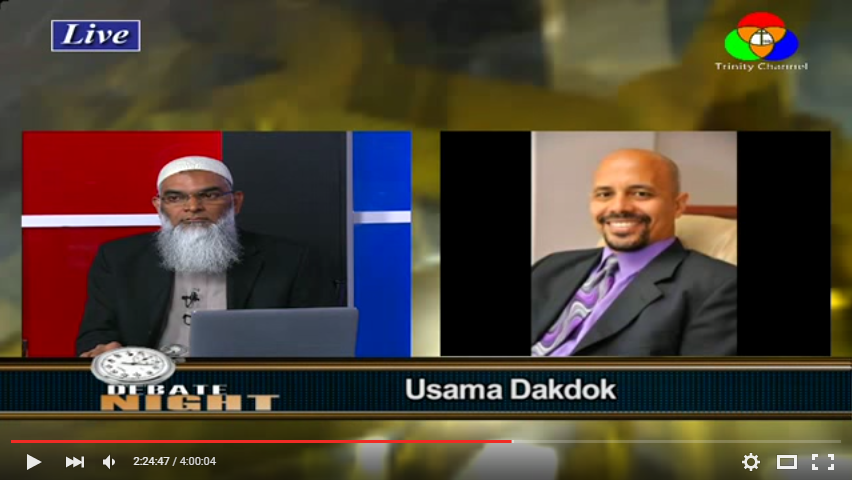
A peculiar incident occurred last night during the call-in section of the debate between Dr. Shabir Ally and David Wood. In a pre-planned call, Usama Dadok was allowed to scream and shout insults, while using obscene language in a stunt meant to provoke a response out of Dr. Shabir.

cc-2015-sa-dd1

In what can only be described as an abject failure by the moderator Chris Con-way to “moderate” the debate, what was a peaceful debate became a comedy of errors. Dakdok’s job was to bring the “demon” out of Dr. Shabir by insulting and using obscene language towards the religion of Islam. Dakdok is of the belief that Muslims are demons incarnate:

Yet, Dakdok failed in his objective. The plan by Shamoun and Wood, meant to discredit Dr. Shabir by provoking him into anger did not come into fruition. Rather, the only person who behaved in a “demonic” way was Dakdok himself. Frothing at the mouth during his rabid diatribe, the insults and abuses he hurled did not cause the desired effect. Rather, the Muslims watching the debate immediately became disinterested in the discussion and whatever audience that Shamoun and Wood had intended to reach out to with the message of Christianity, quickly disappeared.

Those viewing the debate, took note of Dr. Shabir’s response to Dakdok’s obscenities. Dr. Shabir demonstrated the Islamic Prophetic example of patience and professional decorum. It is ironic, in the sense that in trying to provoke Dr. Shabir by insulting the Prophet (ﷺ), Dakdok allowed Dr. Shabir to demonstrate the ideals of the Prophetic Sunnah:

Narrated Abu Huraira:

A man said to the Prophet (ﷺ) , “Advise me! “The Prophet (ﷺ) said, “Do not become angry and furious.” The man asked (the same) again and again, and the Prophet (ﷺ) said in each case, “Do not become angry and furious.”

Thus, as a consequence of Wood and Shamoun’s planning, in trying to use Dakdok to defame Dr. Shabir, the opposite outcome occurred. Dr. Shabir’s calm and collected demeanour demonstrated to the audience that Islamic principles and teachings, had not made Dr. Shabir a spiteful and hateful person. Rather, the incident gave the audience a reason to sincerely listen to and pay attention to Dr. Shabir’s message about Islam.

Clearly then, Wood and company have demonstrated their inability to have an academic discourse without having to use childish tactics and games. The Muslim community’s perception of Wood and Shamoun have now fully been qualified, they are certainly an embarrassment to world Christianity. It is without a doubt that Wood knew he would not win a debate against Dr. Shabir and so he pandered to his audience.

cc-2015-sa-dd2

The type of Christians that watch the Trinity Channel, are those that enjoy seeing Muslims being demonized and brutalized. The point of the debate was not to win converts or to have a fruitful dialogue, it was to finally have their chance at getting revenge against Dr. Shabir due to the extensive work he has done in bringing Christians to Islam.

and God knows best.


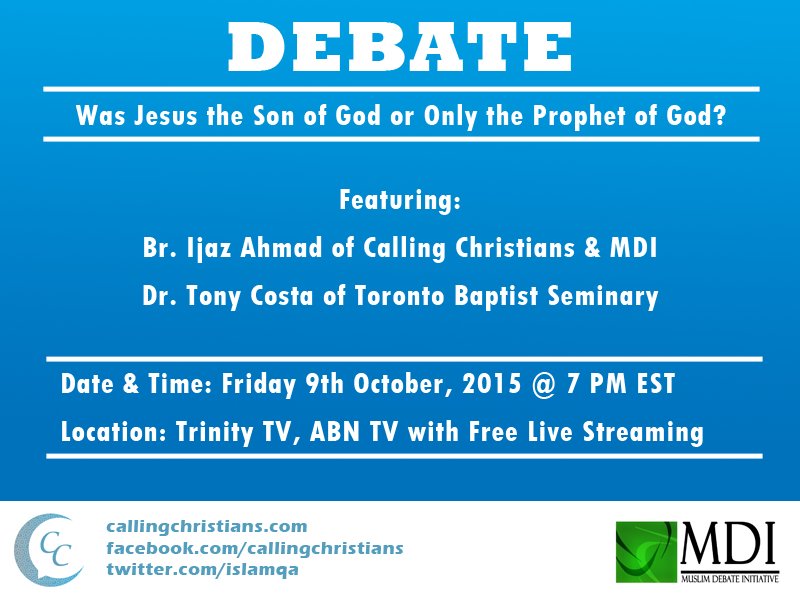
Upcoming Debate: Was Jesus the Son of God or Only the Prophet of God? – Dr. Tony Costa and Br. Ijaz

Quick Information:
Topic: Was Jesus the Son of God or Only the Prophet of God?
Debaters: Br. Ijaz Ahmad of Calling Christians/ MDI and Dr. Tony Costa of the Toronto Baptist Seminary.
Date: Friday 9th of October, 2015.
Time: 7 PM EST.
Location: ABN TV, Trinity TV and YouTube.
Moderator: TBA.
cc-2015-debatewithcosta
Note: Br. Ijaz is not an Imam, the error has been made aware to the channel.
and God knows best.

Upcoming Debate: Is the Muslim Denial of Jesus’s Death by Crucifixion Valid? – Br. Ijaz and Keith of Answering Islam

Quick Information:
Topic: Is the Muslim Denial of Jesus’s Death by Crucifixion Valid?
Debaters: Br. Ijaz Ahmad of Calling Christians and Keith Thompson of Answering Islam.
Date: Saturday 26th of September, 2015.
Time: 10 PM EST.
Location: Paltalk, Answering Christianity Room.
Moderator: Sister Waduha.
A little background on the Christian debater:
keith thompson

Keith Thompson of Answering Islam

Keith Thompson is a Christian apologist who runs Reformed Apologetics Ministries and has been writing for Answering-Islam.org since 2008. He is a debater having debated opponents such as Inamullah Mumtaz, Sami Zaatari, Nadir Ahmed, Peter Dimond and others. He resides in Canada and will be completing his seminary studies shortly.
This will be my (Br. Ijaz’s) third debate for the year, with one final (fourth) debate to be announced shortly. The final debate will be with a well known Christian scholar and will be televised (and is expected to be streamed live). The debate is to be held on Friday October the 9th, 2015 (tentative dating).


If you don’t use Paltalk and would still like to view the debate between Keith and myself, alternative arrangements may be made for a YouTube streaming of the event (tentative), or a recording should be available within a week’s time (on YouTube via Nazam44’s and MuslimByChoice’s channels).
cc-2015-debatewithkiethflyer
If you or someone you know is interested in debating me, do send a request via our contact us form.

and Allah knows best.

Debate Review: What is God Like – Tawhid or Trinity? – Dr. Shabir & Jonathan McLatchie (Part 1)

At the outset, it’s best to say that if you saw Dr. Shabir’s debate with Nabeel on this topic and if you saw Jonathan’s debate with AbdurRaheem Green, also on this topic, then there was no real need for this debate. Most of what each speaker presented was contained within those two previous debates. There were no new arguments from either debater. Although touted as a dialogue, Jonathan’s approach was more debate minded, whereas Dr. Shabir was laid back and more or less relaxed in his use of technical arguments (compared to his demeanor and approach in his debate with Nabeel).

Dr. Shabir’s Introduction

He began by repeating the same three points he articulated in the debate with Nabeel.

  • T – for the text of scripture.
  • H – for history.
  • R – for reason.

Dr. Ally argued that according to the Bible, God declared that He was not a man and that only He should be worshiped. This God whose name we do not know with certainty, but whom we refer to as Yahweh due to combining the consonants of the tetragrammaton with the name of Adonai (Lord), cannot be Jesus as Jesus is a man. To further his point of allowing scripture to interpret scripture, he mentioned that there can only be one Yahweh and according to Isaiah 42, Yahweh sends his servant, this servant is identified as Jesus in Matthew 12. Thus, Jesus cannot be Yahweh as the Bible identifies him as the servant which Yahweh sends. He further argues that according to the Christology of the New Testament, Jesus is an intermediary of God who the Jews came to identify as an agent of creation. The language of the New Testament is also vague regarding Jesus’s station. He is constantly referred to as Lord, which is a term used to describe humans of varying stations. The term Lord in and of itself cannot deify someone.

At this point, Dr. Shabir began to speak on the language used in regard to Jesus in the Gospel ascribed to John. John 1:1c is problematic as the attribution of total deity to the Word (later identified as Jesus), is uncertain due to Colwell’s rule. Grammarians do dispute about the definiteness of attributing deity to the Word in this verse due to the absence of a defining article which the original author purposely left out, this opened the wording and subsequent understanding of the verse to dispute. If the author wanted to ascribe total deity to the Word, then they would not have intentionally left out the defining article and thus, total deity cannot be ascribed to Jesus the Christ given the author’s grammatical intentions. In John 20:17, Jesus allegedly states to Mary Magdelene that he was ascending to “my God” and “your God”, thus denying that he was God himself. We also see where during the time of Paul, he himself was also deified, as within his historical milieu he was considered Zeus and sacrifices were offered to him as attested in Acts 14.

Dr. Shabir focused more on the text of scripture, than the other two points of history and reason. I do believe that he should have reduced the amount of time he spoke on the Bible, as logically, once he established that the scripture was both historically unreliable and not reasonable, he would have negated the authority of the scripture itself. While his three pronged argument of THR is intelligent and concise, I do disagree with the acronym he chose and the order in which he articulated those points. He would have known that Jonathan would have heavily depended upon quoting the Bible as a proof for his beliefs, and I expected that he would have pre-empted this appeal to authority by demonstrating the use of the Bible as an authoritative source as useless. Thus, leaving Jonathan without any credible options of arguing in favour of the Trinity, as he would not have any other arguments in store but for appealing to the Bible. I used this approach myself in my debate with Chessie Edwards, who admitted after the debate that the rug was pulled from under him, and he could not articulate his belief in Jesus as a God, beyond appealing to the Bible.

The reason for doing this, is that once one allows a Christian to appeal to the Bible, the debate becomes focused on interpreting the Bible. Which would mean that the debate would be about whose interpretation was more correct and not many people will be convinced of a Muslim interpreting their scripture for them. I adopted this reasoning from Professor Burton Mack who argued that we should not allow an appeal to the New Testament to count as an authoritative argument. I highly suspect that Dr. Shabir chose to ease the burden of Jonathan, by sticking to basic, common, popular arguments which would be simple. The reason for this is twofold, primarily because he may have felt the debate of the same topic with Nabeel would have been too technical and thus alienated his core audience, and secondly, he may have wanted to take it easy on Jonathan given this was his first stage debate. Dr. Shabir is quite a kind person and he does not argue to win, but more to build relationships and to open the floor to dialogue and understanding. This isn’t a fault, but some may misconstrue his kindness as being lax with missionaries. My only other complaint would be that he did not spend much time speaking on Tawhid, while he did qualify the Trinity as a problematic belief, he did not dedicate enough time to offering the belief of Tawhid as a superior doctrine.

Jonathan’s Introduction

He began by defining what the doctrine of the Trinity was. This is something I strongly agree with, opening a debate by delimiting the scope of the discussion. As a proponent of socratic thinking, this was a pleasant and welcomed feature of his presentation. As previously mentioned, it was expected that Jonathan would base his arguments about the nature of God by mainly appealing to the Bible. He opened by declaring that the Bible was a wholly Trinitarian text (timestamp in video, he says, “The Gospel of our Lord Jesus Christ is thoroughly Trinitarian.”), which unfortunately for him, was pre-empted by Dr. Shabir who demonstrated it was not, thus Jonathan’s first argument was already weakened by Dr. Shabir. Jonathan then presented three other arguments which he felt negated the validity of the doctrine of Tawhid.

  • Tawhid has its own internal problems.
  • The disciples were Trinitarian.
  • The Injeel is Trinitarian.

Of his first argument, he stated:

P1 – If Tawhid is true, it must be consistent.
P2 – Tawhid is not consistent.
C  – Therefore Tawhid must not be true.

Technically, this (form of argument) is referred to as Modus Tollens. The problem here, is that you have to prove the premises before you can qualify and validate your conclusion which is expected to be a tautology. In attempting to do this, Jonathan disappointed me greatly. All he did was refer (timestamp in video, he says “Those who saw Shabir’s debate with Nabeel Qureishi would’ve been exposed to the problems with reconciling the eternality of the Qur’an with the doctrine of Tawhid.”) to the argument that Nabeel used regarding the Qur’an being the eternal word of Allah, yet physical and created. I was disappointed because this is an argument copied from Jay Smith, which Samuel Green tried to use on me in my debate with him, which Nabeel later picked up and tried to use against Dr. Shabir. The problem here is that Dr. Shabir already addressed this argument, and so have I. Jonathan merely repeated Nabeel’s poor argument. He did not try to revamp the argument, he did not add anything to the argument, he did not articulate it differently, he did not try to incorporate Dr. Shabir’s response to Nabeel into the argument. He quite literally just repeated the argument, which was already responded to. Naturally, I would expect, that if he did his homework and decided to use an argument which was already refuted, that he’d adjust the argument in some way. He didn’t do that. He presented nothing new. It was at that point I wondered why he even offered to debate the same topic if he was merely going to repeat the same points from the previous debate of the same topic by offering nothing new.

At this point, he presented another argument, namely that there are other creators other than Allah. He did not seem to understand that what he presented was the fallacy of false equivalency, wherein the Qur’an mentioned numerous times that there were agents of God who had abilities attained by the “leave/ permission of Allah”, which are temporal and not absolute. Logically, this would mean their abilities are not inherent and eternal, but appropriated by God, thus his argument was non-sequitur from the get go. I firmly believe that he did not critically consider this argument beyond a cursory copy and paste from Answering Islam’s website. Ironically, he attempted to present this argument in syllogistic form, but the argument was inherently non-sequitur due to its format including the fallacy of false equivalency. How he did not realise this, was impossible to understand, if he is using logic, he should know what fallacies are and how they inhibit his premises. What’s troubling is that in the same sentence he declares that Allah has no partners, then states in the same breath that the Holy Spirit shares in the divinity of God. That’s a contradiction, so either it is his argument and conclusions were wrong, or he forced a false conclusion which he himself did not notice.

His second argument was that the disciples of Jesus were Trinitarian. Interestingly, I had a debate on this topic earlier in the year and demonstrated that according to the proto-orthodox Christian tradition, the disciples were definitely not Trinitarian. At this point he introduced a very strange argument.

P1 – If the Disciples of Jesus were Trinitarian then the Islamic concept of God is false.
P2 – The Disciples of Christ were Trinitarian.
C   – Therefore the Islamic concept of God is false.

Jonathan cannot make such an argument and believe that he is arguing logically. This is known as the fallacy of circular reasoning. What is worse was his attempt at drawing out the logical routes. He presumed that Dr. Shabir could refute his argument in one of two ways, firstly that the disciples were later misled or secondly, that the disciples were overcome (by other groups). Jonathan posited that the second option was impossible as the Qur’an says they were victors. The problem therein with his reasoning is that the Qur’an does not say in what way they were victors. He assumes that it has to be in the promulgation of their beliefs, which the Qur’an does not state itself. It is alleged that the early Christians were persecuted and the religion did not become “accepted” until Constantine’s conversion. According to Jonathan’s appeal to the Qur’an, he alleged that the Qur’an mentioned the disciples of Christ were victorious. Yet the Church was not accepted or mainstream until 300 years after them, so in what way were the disciples victorious according to his reading of the Qur’an? It would then mean that his interpretation was wrong, given that victory was not achieved as he understood it to be during the time of the disciples and so the victory being referred to here is not what he is asserting. The victory may have very well been that they themselves held on to their true faith despite persecution and in this way they were victorious in the sight of God. I do not believe that Jonathan spent more than a minute thinking of this argument, for if he did so, he’d realise instantly that the disparity between his idea of the normative proto-orthodox Church’s “victory” and that of the disciples exceeded the bounds of the Qur’an’s teaching.

At this point, he began to appeal to the New Testament as a historical witness, but for those of you familiar with Dr. Shabir’s works and my own, we already know that the New Testament en toto is not historically viable nor accurate. I have explicitly explained this in great detail in my debate with Steven on the very topic of the beliefs of the disciples using palaeography, papyrology, form criticism, textual criticism and historical criticism. The following links should be sufficient to refute his appeal to the New Testament as a historical witness, especially in his appeal to the Patristics:

He began to close his argument by referring to hadith criticism’s use of the isnad or chain of transmission. Unfortunately, he merely referred to the use of the chain of transmission by Islamic scholarship, what he utterly failed to do was qualify the authority of these alleged chains of transmission by applying the methods of hadith criticism to the chains themselves. I myself did this in my debate with Steven, in fact this was one of the arguments I researched in great detail and whose historicity the early Church itself disputed. Thus, by both Christian historical traditions and the methodology of hadith criticism, the chains of transmission in regard to John used by Jonathan are known to have been falsified and are historically inaccurate. I do not believe that Jonathan spent more than a few minutes constructing this argument, nor do I believe he consulted any major works of Patristic criticism, especially due to the reason his sole academic source seemed to be Richard Bauckham, whom I also referenced in my debate. I do believe he rushed through this portion of his opening statement, and I do not believe he himself knew in any great detail the methodologies of hadith criticism, and so his appeal to this Christian isnad was mere buzz word dropping.

What can we take away from Jonathan’s presentation? We need to take into consideration that this was his first stage debate and this was a debate with Dr. Shabir of all people. With that in mind, his preparation was not up to standard and he seemed to rely on previously used arguments from Nabeel’s debate and his debate of the same topic with AbdurRaheem Green. If we were to identify his main arguments, they would be easily recognizable by anyone who is familiar with Islamic and Christian inter-faith discourse, namely that the Qur’an validates the New Testament, that the disciples believed Jesus was God and that the Bible is historically accurate. He did not present any new arguments, nor any new research, nor did he seek to upgrade any of the arguments he copied from other Christian debaters. Most of his presentation seemed to comprise of quickly assembled syllogistic arguments that were not critically assessed or put together with much thought and research behind them. He did not seem to put a lot of effort into his opening presentation, it almost seems rushed and half done, with most of his content directly sourced from his debate of the same topic with AbdurRaheem Green. I really wonder if he thought AbdurRaheem Green and Dr. Shabir were on the same level of study about the Christian religion. That is the impression he gave me. I strongly believe that he did not prepare his debate statement with Dr. Shabir’s education in mind.

One major difference between this debate and the one with AbdurRaheem Green was Jonathan’s comfort level. He certainly seemed uneasy and nervous, and at times he just appeared to be uncomfortable with addressing the crowd. His nerves may have gotten the better of him. Most notably, he rushed through his presentation, he spoke quite quickly and I fear that coupled with his accent, most of the audience would not have followed what he said. In contrast, Dr. Shabir almost seemed to be too relaxed and at times engaged with persons in the audience. As a Muslim though, I do not believe that Jonathan stuck to the topic. Although he began with defining the Trinity, he never really explained or spoke about the teachings of the Trinity, how they made sense, what the value of the Trinity was, why God would or could be a Trinity, how the Trinity was superior to Tawhid. Rather, what I got from Jonathan’s presentation is everything but the Trinity itself. His entire focus seemed to be on establishing that the Trinity was historically viable through the teachings of the Qur’an, and in doing so, he never dealt with the Trinity itself. I did not gain any new knowledge about the Trinity, I didn’t hear him speak on the reasoning of why God had to be a Trinity of persons or how it was possible for an immutable and impassible God to become a man and suffer. Jonathan just seemed to miss the mark spectacularly. As a Muslim, Jonathan’s opening simply did not present the Trinity to me and that is perhaps his greatest failure in this debate.

In Part 2, I’ll cover the Rebuttals.

and God knows best.

Debate Event: What is God Like – Tawhid or Trinity? – Dr. Shabir and Jonathan McLatchie

Tonight features a follow up debate to Qadiani Nabeel Qureishi’s debate with the erudite, Dr. Shabir Ally, on the topic of Tawhid and the Trinity.

cc-2015-shabirdebatejonathan

See the Facebook Event’s page here. The event will be livestreamed on YouTube, via this link. At present, I intend to do a live review of the debate as it happens, as I did with the previous debate between Dr. Shabir and Nabeel.

and Allah knows best.

Debate Review: Jay Smith and Yusuf Ismail – The Biblical and Quranic Approach to Peace & Violence

You can view this debate for yourself to see Jay Smith’s arguments get pulled apart by Yusuf Ismail. Jay does not only get branded as inconsistent by Yusuf but also as dishonest. I’ve made a few points on this debate below to serve as a review and rebuke of some sort. There’s nothing positive to be said about Jay Smith’s scholarship, that’s for sure. This man seems determined to lead Christians down an unpleasant road.

Listen to Yusuf Ismail’s opening statement, his arguments and  his comments towards Jay Smith. If that makes you want to expose your ears to the yapping of Jay Smith then here’s the full debate. Yusuf’s OS is quite lively – definitely will get a few pulses racing so if you’re of a disposition where you really could do without an increased heart beat this one just is not for you. However, read the points below.

The Biblical and Quranic approach to Peace and Violence – Yusuf’s Opening Statement

Jay Smith is disingenuous and inconsistent in this debate. What’s new? This is not new for Jay Smith. It’s this type of inconsistency and disingenuous argumentation that drives away the more thoughtful and astute Christians away from Christian apologists.

Read more

Debate Review: What Was the True Faith of Jesus’s Disciples? – Br. Yahya Snow

I review a debate entitled “What Was The True Faith of Jesus’ Disciples?

The Debaters:

  • Br. Ijaz Ahmad of Calling Christians
  • Rev. Steven Martins of Nicene International Ministries Canada.

Note: I did the bulk of the review a while ago but never managed to finish it in the detail I would have liked but never got back to it through procrastination and other priorities I’ve quickly tidied up what I had and rolled it out.

“None of the Apostles could have written or sanctioned these stories about themselves” – Br. Ijaz Ahmad

Were the Gospel Accounts eye-witness reports

Steven Martins’ approach was to draw upon the New Testament in his attempt to present what he believes the disciples believed. Steven believes the Gospels are the historical eye-witness records of  the disciples. This was rejected outright by Ijaz Ahmad who pointed out the 4 Gospels were not contemporary to Jesus p and nor are the writers of these Gospels known so how can somebody take these works as eye-witness accounts? None of the authors of the documents which make up the NT were eye-witnesses. Paul himself indicates this of himself (and his writings are the earliest written amongst the NT writings). On top of this the authors of the 4 Gospels are anonymous (these names Mark, Matthew, Luke and John were later given to the anonymous authors). So weighing up all these points it’s sad to hear Steven insist these writings were eye-witness accounts. Perhaps this is what he was taught by his mentors and other Christian apologists but that does not make it true.

Also, just knowing these two basic facts would preclude one from claiming the authors were eye-witnesses – the Gospels are written by highly literate Greek speakers while the companions of Jesus were considered to be illiterate and Aramaic speakers (these people were lower class men). This suggestion they were unschooled is backed up by the writer of Acts as Ijaz cites:

When they saw the courage of Peter and John and realized that they were unschooled, ordinary men, they were astonished and they took note that these men had been with Jesus. [Acts 4:13]

This may seem odd to us folk living in the 21st Century but the vast majority of the ancient world did not know how to read and write.

Ijaz Ahmad offers an analysis that many may have never come across – the alleged chains of transmission of the Gospel accounts. 4 out of the 6 lead to what Trinitarians would call heretical beliefs and the other two are anonymous – further highlighting the range of differing beliefs amongst early Christians. Ijaz states these chains of transmission indicate Peter, Matthew and John rejected a belief in the death of Jesus (which as Ijaz says, it sounds like they had an Islamic belief!).

Do the Gospels contain myths and legends

Ijaz argues there are erroneous stories in the Gospels. One of Steven Martins’ arguments against the claim the Gospels contains myth and legend is that there was not enough time between Jesus’ life and the recording of the Gospels for myth and legend to enter. He then concludes the Gospels are historical based on this.

Has Steven considered William Lane Craig’s unease at the biggest resurrection story in all of Christian literature – that of the resurrection of the many saints in Matthew. He finds it difficult to accept as a literal event, see here:

William Lane Craig Doubts Resurrection Story is Historical (‘The Resurrection of the Saints’) Matthew 27

Now, if Steven Martins believes this story literally then why does nobody else mention it? A story of many dead people coming out of their graves, is that not something that would get people writing according to Steven? Or does he think this is a myth that was added to the account?

However, a point that it is not unrelated to Steven’s theory, Ijaz Ahmad ran through early Christian history pointing out there were multiple competing Christian traditions which all differed from each other – there were even Gospels which differed from each other. So if at the time of Paul there were different Gospels (now lost) then how can Steven be so confident to believe there are no myths and legends in the four Gospels he has ended up with?

In addition the theology amongst various Christian groups in early Christianity was radically different to the Trinitarian theology the majority of modern-day Christians subscribe to.

There were Christian groups which believed in 2 gods, 12gods and 365 gods. Ijaz Ahmad mentions the Arian controversy as a case in point to demonstrate rival factions were competing with each other. This is a good example to highlight as Arianism is Non-Trinitarian and it drew upon the same scriptures as the Trinitarian faction/s as well as it being a good demonstration of how popularity and a sympathy with the ruling elite promoted one faction over another

Arianism taught that Jesus was created by God and was distinct from God. This belief had it’s scriptural basis in John 14:28

These varying theologies within early Christianity should be something Steven should look into further.

Ijaz taught Paul did not mention or use the four Gospels which modern-day Christians use today so even Paul did not sanction these Gospels. Is it possible Paul was unaware of these Gospels? Not that Paul is a criterion of right and wrong but is it possible Paul would have considered some of the writings in the four Gospels spurious?

Another point mentioned, by Steven I think, Paul abolished circumcision. The question is, who gave him authority to do so?

These are further points for Steven to consider.

Object of worship?

Steven Martins claims throughout the Gospels Jesus is the object of worship – paradoxically he mentions this in the same breath as his mentioning of Satan tempting Jesus p. Think about it, he effectively claimed Jesus was God and Jesus was tempted by Satan. Playing games with the belief of the hypostatic union is not going to get the Bible believing Trinitarian away from this problem. Ijaz Ahmad refers to original language of the scripture to show Steven that the word he uses does not denote the type of worship God receives.

‘Son of God’ title

Steven emphasises the ‘Son of God’ attribution given to Jesus in one of the Gospel narratives after Jesus performed a miracle (walked on water) but this just simply meant somebody who was chosen by God – as taught by Prof. Bart Erhman.

The Gospel of John


Rather predictably, Martins in his attempt to prove Jesus was divine, leans heavily on the Gospel of John. Almost as though the Gospel of Mark (the earliest Gospel) does not exist!

The irony is, Steven Martins tells Ijaz Ahmad to give priority to the earlier sources (Gospels) when Ijaz brought up the church history. Sadly, many Christians don’t do this with the Gospels and they lean disproportionately to the last Gospel – John’s Gospel.

Another Christian apologetics argument presented is that some doubted in the story where Jesus is said to have been worshipped. Martins claims the story must be true because it mentions ‘doubt’. I guess he’s utilizing the idea of a criterion of embarrassment argument here.

Martins rattles off the ‘he who has seen me has seen the Father’ argument in his attempt to prove Jesus was divine. Similarly Martins uses the Gospel teaching of  Jesus pre-existing before his birth and the ‘I am’ statements.

Martins states Jesus was omnipotent and omniscient as well as being capable of forgiving sins in order to prove his Trinitarian case. Martins also claims Jesus was called by the name of God, ‘my Lord my God’

Steven Martins would do well to look at where these things are written. Are they written in the Gospel of Mark, the earliest Gospel, or the latest one which is the most Christologically developed whose author is effectively described as a liar by Christian apologist Mike Licona (accused of changing stories to make theological points – thus he was forging stories to get his theology across).This anonymous author (later named John) is not the person Steven wants to be going to to get important aspects of theology or proof texts!

What Every Christian Should Know About The Gospel Of John

Peter
Gleeson Archer is cited by Martins to support the claim that the authorship of 2 Peter should not be corrected. Bart Ehrman teaches us that virtually all scholars (with the exception of conservative evangelicals) are unified that 2 Peter is not from Peter. The bombshell is that Prof.Ehrman does not believes 1 and 2 Peter are not written by Peter at all as hebelieves Peter was illiterate.

And would Ijaz’s citation of Acts not support the view that disciples were illiterate?

When they saw the courage of Peter and John and realized that they were unschooled, ordinary men, they were astonished and they took note that these men had been with Jesus. [Acts 4:13]

Miracles
Martins acknowledges other Prophets performed miracles but he tries to draw a distinction between the miracles performed by Jesus and the other Prophets. Martins intimates, erroneously, that these were done by Jesus independently while the miracles of the other Prophets were done by the authority of God. Has Steven got any proof of this? Does he even have a quotation attributed to Jesus to this effect?
There is something in the Gospel of John that militates against Steven’s claim:
but Jesus said to them, “I have shown you many good works from the Father. For which of these do you stone me?” [10:32]
Steven Martins starts talking about the Quran
I’m not sure why he did this but he just presented dated and already refuted Christian missionary material.
Martins mentions the Quran 10:94 and 5:47. Martins claims the Bible was already in existence at the time of the Quran revealed. Martins just presents the standard intellectually dishonest and shallow Christian apologist material on this.
Ijaz touches on this here:

https://callingchristians.com/2013/02/14/does-quran-validate-bible/

Bassam Zawadi here:

http://www.call-to-monotheism.com/refuting_the_argument_regarding_the_qur_an_ordering_the_jews_and_christians_to_judge_by_their_scriptures

I think Steven Martins also used one of these missionary arguments too:

http://www.call-to-monotheism.com/does_the_quran_affirm_the_teachings_of_paul_

Steven Martins and IjazAhmad on Paul of Tarsus
Ijaz Ahmad focuses on the historicity of multiple traditions within early Christianity which were competing against each other contemporaneously. To support this claim, Ijaz cites Paul twice

Galatians 1:6

I am astonished that you are so quickly deserting him who called you in the grace of Christ and are turning to a different gospel [ESV]

Romans 2:16

on that day when, according to my gospel, God judges the secrets of men by Christ Jesus. [ESV]

Ijaz makes a point worthy of consideration, when Paul mentions ‘gospel’ he’s not referencing the 4 we see in the New Testament as he wrote his letters prior to those 4. Ijaz supports this conclusion through the absence of references from those 4 Gospels within Paul’s letters. So here, ‘my gospel’ is referring to ‘my teachings of Christ’.
Steven Martins offers his argument for Paul being truthful, yet if Steven thinks about it, the throwing yourself into hardship from comfort argument can be used with much greater force to show Prophet Muhammad (p) was truthful. Think about it, just read his life  – the Prophet risked his life and was rejected by his tribe. The argument Steven presents is better suited for Prophet Muhammad (p). If Steven is consistent and objective he would accept Prophet Muhammad (p).
When Reverend Steven Martins wrongly claimed Paul’s writing constituted 75% of the NT it suggested to me that Reverend Steven Martins WAS just eager to deliver a response to defend his already-held world view. Is Steven at home thinking about the points presented deeply and re-evaluating his beliefs, is he searching for the truth or is he simply searching for material to offer in defence of his already-held beliefs?
Ijaz argues Paul turned towards the Gentiles in his preaching because he was weak in his arguments and thus was rejected by the Jews, hence why he turned towards the Gentiles – whom Ijaz believes Paul considered to be an easier audience. Interestingly enough, the Gentiles came from pagan backgrounds where mythology was rampant, this fits in with why the stories about Jesus (p) would have presented him as a god-man, the pagans were accustomed to such stories.
This also ties in with the discussion Ijaz and Steven have on why Paul did not quote from the Gospels. The hardest hitting point as made by Ijaz: Paul was being rejected by the Jews yet he never quoted from the Gospels, why would he not quote something that he believes to be authority to people who were rejecting him?

Disingenuous claim by Christians about Bart Ehrman
I’ve heard this before from Christian apologists. Steven Martins makes the same appeal, claiming even Ehrman believed in the death of Jesus p. However, what Christian apologists always do, they never mention that Ehrman is not accepting miracles and thus is of course going to believe a man who was born over 2000 years ago has died. Thus Ehrman, as a historian, accepts the most popular early story about Jesus p and thus he believes he died. Christians really should stop making this point, it’s not like Ehrman believes in the resurrection belief despite the story of the resurrection is in the same account as the death by crucifixion story.
Controlled or Uncontrolled Texts
Ijaz Ahmad offers a good rebuttal to the James White-style attempt in trying to take a positive out of the lack of a controlled text within early Christianity. The Quran, which was controlled in it’s copying, was scribed in a more suitable environment for accuracy. Chunks were being added to the Gospels by dishonest scribes, so clearly the environment in which the scribes were operating in did not offer restrictions against such doctoring of texts.
If I recall correctly Steven mentioned Uthman. Many Christians are fed misinformation regarding Uthman’s burning of manuscripts. Here’s an expert to explain it:

Why did the Third Caliph Uthman Burn the Copies of Quran?

A really bad argument by Steven pounced on by Ijaz
Martins appeals to the fact that Herod, Pontius Pilate, the pool of Siloam are mentioned in the Gospel accounts as being testimony to the historicity of the Gospels. This is an odd argument – it’s absurdly odd.
To be honest, Steven opened himself up to ridicule when he continued with the argument that geographical locations being mentioned in the Gospels as being evidence for their authenticity. Ijaz hit back by pointing out that the same argument could be used on Harry Potter as it includes King’s Cross station (London). What I’d like to know is, from where did Steven get this line of argumentation? Was it an argument from a Christian apologetics school which he accepted blindly?  And would Steven be consistent enough to now claim Islam is true because in Islamic sources real people and real places are mentioned?

The Christian tradition in 7th century Arabia
I feel it’s misleading when Christian apologists bang on about how their canon was formed by this time and thus assume people in Arabia had the modern-day Bible in their possession in the 7th century as though they were Trinitarian Pauline Christians exactly as we find them in a Baptist church somewhere in Texas.

Christians really need to stop making this assumption and they need to stop basing arguments on this erroneous assumption that all Christians had the same books.
Ijaz Ahmad refutes the superficial (and intellectually dishonest) argument It’s obvious this is not the case. Ijaz mentions Christians and Jews converting to Islam during the time of Prophet Muhammad. I would recommend Reverend Steven Martins looks into the story of Salmam Al Farsi, who converted to Christianity, before the coming of Prophet Muhammad, from a Zoroastrian tradition.
Salman Al-Farsi, the son of a Zoroastrian priest, met a Christian monk inPersia and converted to Christianity at the hands of the monk. Salman Al-Farsi ran away to Syria and joined the monk’s Christian sect which was dying sect. Salman Al-Farsi learned, from his Christian sect, of a Prophet to come who was predicted by Jesus (p). He was told of three signs the Prophet would meet:

He shall appear in a land full of dates.

He will have a physical mark on his back.

This man will accept gifts but never accept charity.
From Syria, Salman Al-Farsi ended up in Yathrib after being enslaved. He wound up toiling away as a slave for decades. A time came when talk spread about Prophet Muhammad (p) emigrating to Medina. Salman Al-Farsi heard of this talk and came to Prophet Muhammad (p), he soon realised Prophet Muhammad (p) fulfilled all three signs and converted to Islam.
Salman’s story indicated how few real Christians were left at the time of Prophet Muhammad (p).

Another story illustrating this was that of the Emperor Heraclius, who received a letter from Prophet Muhammad (p). In the account, Heraclius mentions that there are Scriptures in which a Prophet is predicted to come after Jesus (p) and that Prophet Muhammad (p) fits the description.

Both stories indicate that there were Scriptures that the majority of Christians at the time did not have access.

http://thefactsaboutislam.blogspot.co.uk/2015/01/christianity-before-islam-in-arabia.html

City of Village?

The difference between a village of a city – the village of Bethsaida. Ijaz Ahmad picks on the author of John for making an error of anachronism. Luke also calls it a city. Perhaps it was one of those loose Gospel scribes writing after it was changed to a city. Whatever the case may well be (the Gospel authors or the scribes), it’s an interesting point raised by Ijaz Ahmad to possibly further impugn the reliability of those texts.
Ijaz accuses the author of John of an anachronistic error regarding the city of Bethsaida and Ijaz spends some time relaying discrepancies concerning the Gospel accounts. I think he could have offered more examples to the audience of discrepancies but perhaps he wanted to focus on stories involving companions of Jesus rather than the standard show of contradictions between the Gospels such as what Barth Ehrman presents here:

https://www.youtube.com/watch?v=CuvEmajcaiQ
If clear evidence is shown of discrepancies and changes within the Gospels then the question the truth-seeker may ask is, how can these texts be trusted to think they weren’t changed in other ways to the extent that the texts do not even represent the theology of Jesus?

Conclusion

What’s established from the debate, the Trinitarian narrative is not sound. The Gospels are not reliable. There were competing Gospels and traditions. Basing one’s beliefs entirely on the New Testament is effectively accepting conjecture.

Ijaz Ahmad

Clearly he, for such a young man, has a burgeoning apologetics CV. He and Zakir Hussain could well be the mainstay of Muslim debates with Christians for the next few decades.
It’s also nice to hear an accent other than a North American or British accent.
I think Ijaz rushed his positive case for the disciples being Muslims. Ijaz shows links between Jewish Christianity and Islam. His focus was heavily leaning on refuting Reverend Steven Martins and the Trinitarian narrative – this he achieved easily in clearly demonstrating the Trinitarian narrative is not sound.
Another point I would pick on here, Ijaz went for the more complex points which for an audience tuned in to apologetics may well have been suitable but I’d imagine the majority of the live audience and those viewers of the recorded debate are not too familiar with the bread and butter points regarding Gospel contradictions and textual criticism.

Ijaz possesses faith shattering information for the Christian, it would be wise to always ensure the audience is invited to Islam at the end of the debate. Most apologists and debaters don’t do this but surely we want them to come to the truth of Islam rather than not invite them to the truth after effectively destroying their faith.

Where does Ijaz go from here? Well, I’d imagine on his island the scope for engaging with seasoned apologists is quite limited so I’d personally like him to debate local pastors. People want to see apologists debate but let’s see Muslims go to churches to dialogue with pastors (who have flocks of people following them). I would also hope the pastors aren’t marred by some of the dishonest arguments Christian apologists are plagued with today so the discussion is easier – less rubbish to wade through before engaging the Christians productively.
Ijaz has charisma and seems like a nice guy too so these qualities could well endear him to Christians which can only be a good thing in witnessing the truth of Islamic monotheism to Christians

Steven Martins of Nicene International Ministries

For me, Steven was visibly struggling in this debate. This should be a sign to Steven that he’s not on the right side of the fence.

I think he’s a victim of bad information from those who has learned from. The person who gave him the argument he was making based on the mention of geographical locations should be banned from apologetics!

I really think Steven should not debate again. He’s better off just remove himself from Christian apologetics and begin a search for the truth. Think about some of the questions raised. Think about why Jesus p never mentioned a man called Paul or 4 books that he wanted people to believe were ‘Gospels’.

Research Islam with an open heart and mind.

From my experience with Christians, it appears many have been hooked by emotional preaching. It’s not that they have been convinced intellectually to accept the idea of the Trinity or the god-man concept.

Think deeper.

Reverend Steven Martins on the History of Mecca

Rebuking Rev. Steven Martins of Evangelium & Apologia Ministries – ‘Western Values’

Christian apologetics to Muslims, more women in Hell Hadith

Tackling Christian Apologetics on Polygamy (Polygyny) in the Bible and the Quran

More about the Paraclete

Prophecies of the Messiah – Reza Aslan

Christians having dreams and converting to Islam

Learn about Islam

Email: yahyasnow@yahoo.co.uk

« Older Entries Recent Entries »