Category Archives: Apologetics

Sam Shamoun and Lying by Dr. Shabir Ally – Part 2

Shabir Ally

October 1, 2015

Now that I am back in Toronto, and have access to my books, I am able to write a more telling response to Sam and his accusation about lying. I also had a chance to review the recording of what I said during the debate, and Sam’s interaction with me during the Q&A.[1]

Two things (at least) will become evident below:

  • I correctly cited that book of Robert Gundry to which I was referring;[2]
  • In order to generate his proof that I misquoted Robert Gundry, Sam actually misquoted me!

This is a sad day for Muslim-Christian dialogue.

Having listened to the recording, I still have the question that I had put to Sam during that conversation. Sam had said that he had two books right in front of him: one book is Robert Gundry’s commentary on the New Testament; the other book is Gundry’s commentary on Matthew’s gospel in particular. Sam read a portion from the commentary on the New Testament which obviously includes a brief commentary on Matthew’s gospel.[3] That is not the book I had cited. I had studied and cited the other book: the commentary on Matthew’s gospel in particular.

So, I asked Sam for the page number of the relevant section of the commentary on Matthew’s gospel in particular. Instead of supplying this simple piece of information, Sam kept telling me pages 135-36 of the book which he had read from. I asked him why he could not simply tell me the page number of the relevant section of Robert Gundry’s commentary on Matthew’s gospel which he said he also had in his possession at the time. Sam admitted that the page numbers he was giving me were from Gundry’s commentary on the entire New Testament, But when I asked him again for the page number of the commentary dedicated to Matthew’s gospel, there was a definite silence. I thought he had hung up. But he was still on the call. Why the silence?

Moreover, in listening to the recording I realized all the more how bizarre was the conversation between me and Sam. I kept asking him for the page number of a book which he claimed to have with him. In response, he kept challenging me to read a book which I did not claim to have in my possession at the moment. Naturally, I could not read a book I did not have in my hands; I could only accurately quote the most relevant line from my head. But, for some reason, Sam was unable to give me the page number of the book he had in his hands even though the relevant page number is easy to find. The commentary progresses from the start to the end of Matthew’s gospel, and the page headers show the progression verse by verse. It would have been a snap for Sam to thumb through the commentary following the page headers to chapter 28 and then to its verse 19 and give me the page number.

Obviously, he later located the relevant page number of a commentary on Matthew’s Gospel, this being the first book Sam referred to in his article composed on that same date.[4] It would be interesting to trace the relationship between this commentary and the one I was citing. It seems that the one Sam is referring to is the second edition of the same book, now with a different subtitle.[5] The page numbers of the relevant sections are the same, and the wording is strikingly similar, though the subtitles are different.

Now, the book I was citing really said on p. 596 what I cited it to say. So too does the second edition, as is evident from Sam’s citation in his article. But both of these are dissimilar to the book which Sam was reading on air.

To understand what is going on here between me and Sam, one has to see the big picture, as follows. In debates between Muslims and Christians, Muslims argue that in the Old Testament Yahweh is the only God. Jews agree. Many Christians also agree. Consequently, for Jesus to be God, he would have to be Yahweh. But if he is Yahweh, then he is the only God, and therefore the Father and the Holy Spirit would not be God.

In response to this clear logic, some Christians cite Matthew 28:19 as proof that the Father, Son, and Holy Spirit are each Yahweh, and yet altogether Yahweh. In that verse, Jesus directs his followers to baptize in the name of the Father, the Son, and the Holy Spirit. Christians point out that the name here is singular, though the named persons are three. Hence they insist that Jesus is Yahweh, the Holy Spirit is Yahweh, the Father is Yahweh; yet altogether the three are Yahweh.

This is the big picture, the context within which I am using the citation from Robert Gundry. I am saying that according to Robert Gundry the verse does not imply that the three persons bear the same name. According to him, the verse is not actually referring to their name; rather, the verse is saying that the baptism should be done with fundamental reference to the Father, Son, and Holy Spirit. Here is an approximate transcript of what I said, as evidenced by the video recording:

In Matthew’s gospel towards the end where Jesus says, “Go and baptize in the name of the Father, Son, and Holy Spirit,” some will take that as an expression of Trinitarian doctrine. But in fact, as Robert Gundry says in his commentary on Matthew’s Gospel, it does not actually mean that—it does not mean that the three of them have just one name—it means, ‘Go and baptize with fundamental reference to the Father, Son and Holy Spirit.’ It does not mean that the three are one. In fact, there is no passage in the New Testament gospels or in any of the writings of the New Testament that says that the three—the Father Son, and Holy Spirit—are together as one God.[6]

This is what Sam needs to address. Instead, he changes the subject to me. But attacking me will not remove the problem. The problem, as the clear logic above indicates, is that there is only one God Yahweh, as Jews, Christians and Muslims agree.[7] According to Matthew 12:18, Jesus is the servant of Yahweh. This too Muslims and even Christians accept. But Christians insist that, in addition to being the servant of Yahweh, Jesus is also Yahweh himself. I have been refuting this latter claim with my clear logic. And now Sam wants to attack me. But my logic is not exclusively mine. Logic is universal. To get rid of this problem, Sam does not need to attack me, he needs to battle with the fundamental laws of nature, or the designing work of God who fashioned us to think logically. He needs to battle with his own thoughts which cannot escape the same logic.

When Sam called, he accused me of claiming that Robert Gundry in his commentary on Matthew’s gospel denies that Mt. 28:19 is a Trinitarian text.[8] But that is not what I claimed.

In the above transcript of the relevant portion of my speech, I started out with my own statement, cited Gundry, and then ended with my own statement. I can see where at first glance it may not be clear to others where I intended to end my citation of Gundry. But if that was not clear at first, during the call I explained to Sam:

In that commentary, Robert Gundry says very plainly that the idea that the mention of Father, Son and Holy Spirit should mean that they share the same name—that is not the idea. He is saying that the idea there is that the baptism should be done with fundamental reference to the Father, Son and Holy Spirit. I am not saying anything more than this.[9]

Notice that last sentence: ‘I am not saying anything more than this.’ Now it should be clear that I am only claiming as follows: in a particular book, Gundry denies that Mt 28:19 implies that the three persons bear the same one name.

Despite my taking pains to clarify the point on air, however, Sam charges in his writing composed after the debate:

Ally basically claimed that Gundry denies that this text supports the Triune nature of God.[10]

That is not what I claimed.

I am not saying that Gundry is not a Trinitarian, or that he denies that Mt. 28:19 can be put to Trinitarian use, etc. It should be clear to all students of logic that a statement of the form,

‘A does not imply B’

does not mean the same as,

‘A implies that B is not the case,’

and it does not mean the same as,

‘I deny B.’

In what follows, I will replace B with ‘the Father, Son and Spirit share the same name.’

Logically, therefore, when I cite Gundry to say,

‘Mt. 28:19 does not imply that the Father, Son and Spirit share the same name,’

that is not the same as citing him to say,

‘Mt. 28:19 implies that the Father, Son and Spirit do not share the same name.’

And it does not mean the same as citing him to say,

‘I deny that the Father, Son and Spirit share the same name.’

It is really sad to see Sam misquoting me to prove his charge that I misquoted someone else. Sam does not like my message. But does that justify shooting the messenger? Dialogue between Muslims and Christians need to move beyond such tactics. We need to listen to each other, learn, and pray to God asking him to guide us all.

Finally, the book I was citing was published in 1982 for an academic level of readership. It caused a stir in evangelical circles leading to Gundry’s resignation from the Evangelical Theological Society. The book Sam read on air was published 28 years later in the year 2010 for a more common readership.

This latter work, from which Sam’s read to me on air, and which he cited second in his article, clearly supports Sam’s contention that Gundry believes that the three divine persons are included in ‘the name.’ I am grateful for this information. I did not know it until Sam pointed it out. And I am glad that I did not overstate my case in citing Gundry. However, if I do cite him again, on this matter, it will be appropriate for me to add that Gundry apparently changed his mind about this as is evident from his later writing. Why he apparently changed his mind would be interesting to learn. Is it that the two books were meant for two different audiences, in which case he was willing to tease the academic community but not the masses? Did the negative response to his earlier book cause him to be more cautious? Or, did he find new evidence to convince him that his earlier statement was incorrect?

In short,

  • I correctly cited Gundry’s earlier statement,
  • I am willing to incorporate his later statement in future citations, and
  • I am grateful to Sam for alerting me to this, but
  • I find it at least ironic that Sam would misrepresent me to prove that I misrepresented Gundry.

[1] The recording can be viewed here: https://www.youtube.com/watch?v=idHxegbSunQ&feature=youtu.be. Sam’s call comes in at 2 hours and 14 minutes into the recording. My thanks to Brother Nazam for pinpointing this location.

[2] Robert H. Gundry, Matthew: A Commentary on His Literary and Theological Art (Grand Rapids: Eerdmans, 1982) p. 596.

[3] Sam was referring to Gundry, “Matthew,” Commentary on the New Testament: Verse-by-Verse Explanations with a Literal Translation (Grand Rapids: Baker Academic 2010) pp. 135-136.

[4] http://www.reformedapologeticsministries.com/2015/09/catching-shabir-ally-red-handed.html?m=1

[5] Robert Gundry, Matthew: A Commentary on His Handbook for a Mixed Church Under Persecution, 2nd edition (Grand Rapids: Eerdmans, 1995).

[6] This begins at approximately 19:55 and lasts for about 40 minutes.

[7] Though Muslims call him by another name Allah, which is also in the Bible in Arabic translations. See Genesis 1:1.

[8] At 2:14 in the recording.

[9] At 2:16:40.

[10] http://www.reformedapologeticsministries.com/2015/09/catching-shabir-ally-red-handed.html?m=1

Upcoming Debate: Is the Muslim Denial of Jesus’s Death by Crucifixion Valid? – Br. Ijaz and Keith of Answering Islam

Quick Information:
Topic: Is the Muslim Denial of Jesus’s Death by Crucifixion Valid?
Debaters: Br. Ijaz Ahmad of Calling Christians and Keith Thompson of Answering Islam.
Date: Saturday 26th of September, 2015.
Time: 10 PM EST.
Location: Paltalk, Answering Christianity Room.
Moderator: Sister Waduha.
A little background on the Christian debater:
keith thompson

Keith Thompson of Answering Islam

Keith Thompson is a Christian apologist who runs Reformed Apologetics Ministries and has been writing for Answering-Islam.org since 2008. He is a debater having debated opponents such as Inamullah Mumtaz, Sami Zaatari, Nadir Ahmed, Peter Dimond and others. He resides in Canada and will be completing his seminary studies shortly.
This will be my (Br. Ijaz’s) third debate for the year, with one final (fourth) debate to be announced shortly. The final debate will be with a well known Christian scholar and will be televised (and is expected to be streamed live). The debate is to be held on Friday October the 9th, 2015 (tentative dating).


If you don’t use Paltalk and would still like to view the debate between Keith and myself, alternative arrangements may be made for a YouTube streaming of the event (tentative), or a recording should be available within a week’s time (on YouTube via Nazam44’s and MuslimByChoice’s channels).
cc-2015-debatewithkiethflyer
If you or someone you know is interested in debating me, do send a request via our contact us form.

and Allah knows best.

The Sun Sets on Nabeel Qureishi

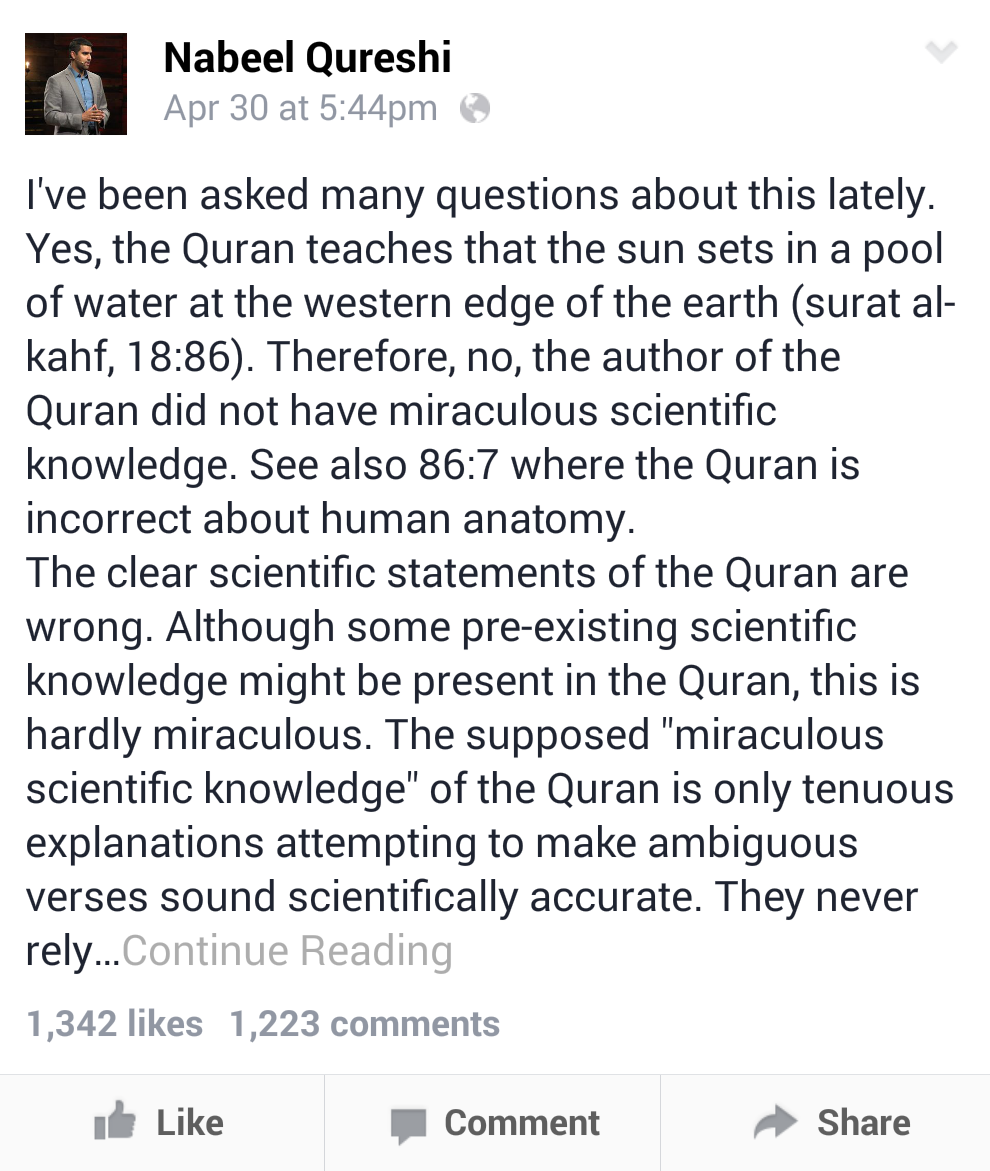
Most people understand that language has depth. That language has devices that are used to convey ideas, thoughts and beliefs beyond a one dimensional literalistic paradigm. Most people are familiar with the sciences of exegesis and hermeneutics, which are often employed in helping us to understand scripture. Now, that is most people and not all people. One of those people who doesn’t understand these things is Nabeel Qureishi. For example, he recently posted this:

wpid-2015-05-15-11.34.35.png.png


Now, see if he had read his Bible, even given it a cursory glance he’d come to realise that the phraseology of the Semitic people who wanted to describe a limit or boundary as given by the sea would often use the language of, “where the sun sets”. So for example, we read in the Qur’an 18:85-86:

He set out (westwards) on an expedition, Until, when he reached the setting of the sun, he found it [as if] setting in a spring of dark mud, and he found near it a people.

So, as these passages state, he set out on a journey through the land until he reached a limit where he found a people. What was used to describe this limit? The sea and the sun setting. This was a phrase used to describe the limit of one’s journey being bounded by some body of water be it a sea or an ocean, a lake etc. In Nabeel’s very Bible, such phraseology is used:

“From the wilderness and this Lebanon, even as far as the great river, the river Euphrates, all the land of the Hittites, and as far as the Great Sea toward the setting of the sun will be your territory.” – Joshua 1:4

“See, I have apportioned to you these nations which remain as an inheritance for your tribes, with all the nations which I have cut off, from the Jordan even to the Great Sea toward the setting of the sun.” – Joshua 23:4

Some translations don’t use a literal rendering of the words, they try to contextualize them. So in the NASB, NIV and other similar translations they try to translate a text according to its usage and not according to its literal meaning. The Qur’an in most cases uses a literal rendition of the Arabic. The literal rendition of the above Bible passages, uses the exact same terminology that the Qur’an does. We read from the ISV:

Your territorial border will extend from the wilderness to the Lebanon Mountains, to the river—that great River Euphrates—all the land of the Hittites—as far as the Mediterranean Sea where the sun sets.

In one instance, there had to be a citation note explaining why a portion of this passage was excluded from the main translation:

Now look, I have allocated these nations that remain as an inheritance for your tribes, including all of the nations that I have eliminated, from the Jordan River to the Mediterranean Sea to the west.[b]

b. Joshua 23:4 Lit. Sea that faces the setting sun

The reason that most Christians are unfamiliar with this phrase is because most English Bible translations, translate “the setting of the sun into the sea” or “the setting of the sun by the sea”, to “the west” or to “the Mediterranean Sea”. So when they see such a phrase in the Qur’an, they don’t make the connection between a descriptive term and its use in scripture by the language of the people at that time. This is what happened in the case of Nabeel. He is not familiar with the language of the Bible, nor with the language of the Qur’an.

To aid Nabeel, I’ve used a popular language device in the title of this post. “The Sun Sets on Nabeel Qureishi,” is an oft used language device. Given that Nabeel seems to read things literally, I wanted to point out to him that not everything can or should be read literally. Here’s some examples of language devices being used in sentences and they aren’t meant to be understood literally:

  • I want to address the elephant in the room.
  • The rolling hills of the countryside.
  • It’s raining cats and dogs.
  • The sun set on Jim’s career.

So, Nabeel, I’m addressing you, the guy in this picture:

cc-2015-nabeelqureishi

“The Sun Sets on Nabeel Qureishi,” does not mean that I think the sun is literally falling on top of you. It does not mean that I want the sun to harm you. It does not mean that I think the sun goes up or down. It quite simply, does not mean anything literally. In modern English, the sun setting for someone can have varying meanings. It can mean they’re shining less brightly as a person, and just so I don’t confuse you, by shining brightly I mean they are not performing according to expected standards of normalcy. In some cases it also means the person is dim (again not literally, but in terms of wit, see: dimwitted), or in decline (again not literally in decline, like as if they’re sitting or stooping, I mean performance or career wise) in some way.

I hope you’ve learned something very valuable today. You can swap a t-shirt for a suit, but it doesn’t make you any smarter. As for his claim on Qur’an 86:7, I didn’t want to confuse him any further than he already is, but for everyone else here’s an excellent article explaining the basic Arabic usage of the terms in the passage.

and God knows best.

Nabeel Qureishi on Tawhid

Nabeel of RZIM and I had a discussion on Twitter about one of his claims during his debate with Dr. Shabir that the word “tawheed/ tawhid” was not found in the hadith corpus. I pointed him to this (source – Saheeh hadith):

دَّثَنَا هَنَّادٌ، حَدَّثَنَا أَبُو مُعَاوِيَةَ، عَنِ الأَعْمَشِ، عَنْ أَبِي سُفْيَانَ، عَنْ جَابِرٍ، قَالَ قَالَ رَسُولُ اللَّهِ صلى الله عليه وسلم ‏ “‏ يُعَذَّبُ نَاسٌ مِنْ أَهْلِ التَّوْحِيدِ فِي النَّارِ حَتَّى يَكُونُوا فِيهَا حُمَمًا ثُمَّ تُدْرِكُهُمُ الرَّحْمَةُ فَيُخْرَجُونَ وَيُطْرَحُونَ عَلَى أَبْوَابِ الْجَنَّةِ ‏.‏ قَالَ فَيَرُشُّ عَلَيْهِمْ أَهْلُ الْجَنَّةِ الْمَاءَ فَيَنْبُتُونَ كَمَا يَنْبُتُ الْغُثَاءُ فِي حِمَالَةِ السَّيْلِ ثُمَّ يَدْخُلُونَ الْجَنَّةَ ‏”‏ ‏.‏ قَالَ هَذَا حَدِيثٌ حَسَنٌ صَحِيحٌ وَقَدْ رُوِيَ مِنْ غَيْرِ وَجْهٍ عَنْ جَابِرٍ ‏.‏

Jabir narrated that the Messenger of Allah (s.a.w) said:

“Some of the people of Tawhid will be punished in the Fire until they are coals. Then the Mercy (of Allah) will reach them, they will be taken out and tossed at the doors of Paradise.” He said: ” The people of Paradise will pour water over them, and they will sprout as the debris carried by the flood sprouts, then they will enter Paradise.
What was interesting, is that Nabeel gave this reply (source):
wpid-2015-04-10-21.20.42.png.png
I learned something from this experience. Nabeel does not know what the word Tawheed/ Tawhid in Arabic looks like, so here it is:
توحيد‎
As a former Qadiani/ Ahmadi, it does not surprise me that the one word fundamental to Muslim ‘aqeedah (doctrine/ creed), is a word he doesn’t know. At least this incident explains to us the extent to which his “Islamic” education reached.
cc-2015-nabeelqureishi
He just had a debate on the Trinity and Tawheed, and he didn’t even know what Tawheed looked like in the Arabic language, a word that is practically in every Muslim book on creed. I’m not sure what’s worse, that he didn’t know or that because he didn’t know, he made erratic claims that now can no longer be substantiated. I’m sorry Nabeel, there is no excuse for this level of ignorance, especially when you’re debating these topics in an academic setting. Thank you for demonstrating to the Muslim world, the extent of your Islamic knowledge. You’ve done an amazing job. And God knows best.

Christian Militants Fighting in Ukraine: Protestant Churches vs Orthodox

A recent video by Vice news, purports to show Christian militants fighting each other over sectarian beliefs in Ukraine. Russian Orthodox militants versus that of Protestant militants. Very interesting that not a single Christian leader has come out to condemn these Christian militants who claim to kill in the name of Christ.

A Christian militant at 8:43 in the video says:

Reporter: What is this building?


Militant: This building used to be a Baptist sect.


Reporter: What happened to them?


Militant: I don’t know, when the war started they disappeared. I guess they left. There is only one faith, Orthodoxy. I am Orthodox. It was left to us by our ancestors and the Baptists are schismatics. It’s American propaganda. Which fills the head of our people, the Russians, the Slavs, which results in what you see now, the war.


Reporter: Will you allow them to return?


Militant: Personally I wouldn’t let them come back. Not the Baptists, not the Evangelists, not the Catholics, not the Greek Catholics. None of them. Because I took up arms so that we could have an Orthodox State.

The DPR’s Deputy PM said at 14:41 in the video:

The issue could be forced eviction, but it’s possible that the issue was that the Protestants for the most part do not support us.

At 15:00 in the video, the interview continued:

Reporter: How important is the Orthodox Church to the DPR and to you?


DPR Dept. PM: It’s very important. According to the ideology we are building, we would very much like to maximally integrate the Orthodox Church into areas that concern morals, in areas that concern family values, and so on. If the Church has more direct influence – Let’s say the state even makes the Church a part of the state in certain areas. Orthodoxy is one of the foundations of our statehood….

We have yet to see a single Christian leader condemn this violence in the name of the Christian faith. Baptists such as James White, or apologists such as David Wood, Sam Shamoun, Walid Shoebat, or even Islamophobes such as Pamela Geller or Robert Spencer. They all usually have a lot to say when Muslims are involved, but they are eerily silent when it comes to Christian on Christian terrorism and militancy.

and Allah knows best.

Shaykh Ahmad Deedat’s Role in Modern Muslim Apologetics

The legacy of Shaykh Ahmad Deedat is and continues to be undisputed, as it should be. In the post-colonial era where Muslim lands had been subject to metrople rule for centuries, and where Orientalist scholarship had dominated the religious discourse, his voice was a light in an era of darkness. Most believe that by his efforts, the Shaykh effectively kickstarted the modern da’wah and apologetics movement. To this day, his debates are still studied, watched, shared and treasured. His works and efforts stand as a testimony of his contribution, to the extent that some 30 years later, generations of Muslims still stand in awe of his legacy. There are many things we can learn from the example of Shaykh Deedat, but the most important lessons we can derive from his legacy was his willingness to learn, develop new arguments and sincerely study his religion. Shaykh Deedat did not simply stagnate in age old arguments, with every new debate he introduced a better, stronger argument. Similarly, he didn’t repeat the same arguments ad nauseum, he invested his time into studying the scriptures of Islam and Christianity. This is what made him a potent speaker, he brought something new to the table and spent his time perfecting his trade.

I previously mentioned that to this day, many Muslims who are interested in interfaith dialogue and debate, spend their time studying the Shaykh’s debates. While I do agree that there are many good arguments we can derive from the Shaykh’s debates, we should not be over reliant on them. Most of his debates occurred some 20 to 30 years ago. Muslims today, especially young Muslims must understand that Christians have had 30 years to develop responses to his arguments. A cursory search of YouTube will return dozens upon dozens of video responses to the Shaykh’s arguments. In that 30 year period of time, Muslim interfaith argumentation has stagnated. This stagnation wholly contradicts the ethos and legacy of Shaykh Ahmad Deedat. He did not wait or depend upon a few arguments, and he did not give the missionaries time to catch up to him. As he used one argument in one debate, he’d develop a new argument for the next. This is why he was a popular debater, he offered something new, something different, something challenging. Unfortunately, the young debaters of today have no interest in following the Shaykh’s example, they’re more interested in repeating his arguments.

What’s worse is that most young debaters today repeat those arguments without understanding them. That might sound silly, but I’ve repeatedly seen young Muslims be quick to point out apparent contradictions in the Bible and when challenged, they are unable to explain their reasoning. In other words, they know it’s a contradiction because the Shaykh mentioned it but they don’t understand how it’s a contradiction! Shaykh Deedat also spent his time studying his own religion and in many videos we see him spontaneously recalling Qura’nic ayah after Qur’anic ayah. Most young Muslim debaters today read the Bible more than the Qur’an, while being ignorant of the basic tenets of Islamic belief (re: creed; ‘aqeedah). This behaviour betrays the legacy of Shaykh Deedat. Most young Muslims today either misunderstand or rather, neglect to understand what they’re supposed to adopt from the Shaykh’s legacy and this is very upsetting. If Muslim debaters today want to live up to the legacy of Shaykh Deedat and if they want to attain his level of success, then they need to invest more time in studying and less time in vapid argumentation.

The legacy of Shaykh Deedat is one of rigorous study, sincere seeking of knowledge and honest intentions. Anything less, and I can definitely say that they have the wrong motivations.

and Allah knows best.

Recent Entries »