Author Archives: Ijaz Ahmad

All Non-Christian Prison Chaplains Fired from Canadian Prisons

Bismillahir Rahmanir Raheem
بِسۡمِ ٱللهِ ٱلرَّحۡمَـٰنِ ٱلرَّحِيمِ ,

Persecution of non-Christians residing in Christian majority nations has reached a high point this week. Once more, we have to fight for our rights that Christians themselves enjoy. Yet, it’s not Muslims being discriminated, we’re also being joined by every other non-Christian faith! As it turns out, in Canadian prisons, all non-Christian Chaplains are being fired from their positions of counselling prisoners. It should be noted that a significant majority of Canada’s prison population is majority Christian, here are the percentages from CBC Canada:

There are nearly 15,000 inmates in federal custody and a large majority of them identify themselves as Christian:


  • 37.5% are Catholic.
  • 19.5% are Protestant.
  • 4.5% are Muslim.
  • 4% First Nations spirituality
  • 2% are Buddhist.
  • less than 1% are Jewish.
  • less than 1% are Sikh.

The article goes on to mention just how discriminatory the move is:

Figures obtained by CBC News show that before the contract cancellations — which will take effect by the end of March 2013 — there were about 80 full-time chaplains across the country and all but one are Christian. There are about 100 part-time chaplains, 20 of them non-Christian. The total cost of the chaplain program is about $6.4 million a year and it’s not clear what amount will be saved by the cancellations.

This is most likely a move to convert non-Christians to Christianity, there can be no other motive. When you have men who stare at 4 walls all day long and live day to day not knowing if another inmate can murder them, it’s significantly depressing. These men are emotionally and mentally fragile, perfect fruit for Christian Chaplain-Missionaries to, ‘spread the message’ of their human-worship centric faith.

We hope that God allows the non-Christian prisoners to be guided through their own faiths and that they are not forced into having Christianity shoved down their throats, as many of us have experienced this in the past (myself included). Please see this CBC News link for a video interview and comments by Rabbis and Imams from Canada on this depressing issue.

wa Allaahu Alam,
and Allaah knows best.

The Bible Command Christians to Obey Islamic Governance

Bismillahir Rahmanir Raheem
بِسۡمِ ٱللهِ ٱلرَّحۡمَـٰنِ ٱلرَّحِيمِ ,

Often times we hear Christians (see: Pamela Geller, David Wood, Sam Shamoun, Christians on FFI, Answering Islam, Answering Muslims), who align themselves with political groups claiming that the, “Shari’a” is immoral, backward, barbaric, archaic and ‘harmful to society’. Yet, if we were to ask them to define what Shari’a is, they wouldn’t seem to know. Some may point you to a Fiqh manual titled, “Reliance of the Traveller“, or quote for you some ahadith (plural of Hadith) or Qur’anic ayah as evidence of, “the creeping Shari’a“. However, they don’t know what the Shari’a actually is. The Shari’a is a body of law, which is both interpersonal and intrapersonal. It is sourced from the Qur’an, the Sunnah (Ahadith, Seerah), Ijma (consensus of scholars based on Qur’an and Sunnah) and Qiyas (analytic deduction). Therefore, as it is, there is no one ‘fiqh’ manual that embodies the Shari’a as a whole for Muslims. Fiqh can be defined as Islamic jurisprudence. What does this mean?

Shari’a is not:

  • Based on one man’s opinion.
  • Based on one scholar’s opinion.
  • Based on one fiqh manual.
  • Based on crowd justice (there are courts to try criminals!).
  • Based on a few Ahadith.
  • Based on a few Qur’anic verses.
  • Based on a few men’s opinions.

Shari’a depends on a vast consensus of scholars who hold positions verified and validated through noted certification by institutions of high academic standards (see: Umm al Qura University, the University of Madina, Al Azhar, Dar al Ulum, etc). A single mufti’s (Molvi, Maulana, Shaykh, Sheikh, Ustadh, Sidi, etc) legal ruling (fatwa) is not binding because it is one man’s legal opinion, unless it is verified through Qur’an, Sunnah and Ijma (previously defined above).

Intrapersonal Shari’ah:

This involves the personal beliefs and actions of an individual, this can involve performing Salaah, eating halaal, dressing appropriately, using appropriate language etc). In other words, it’s your personal moral standing that is dependent upon you and the Shari’a intends that you do good actions and not sin.

Interpersonal Shari’ah:

This involves the dealings and interactions of one person with another person, group of persons, his community and his legal obligations to the state. Usually this involves providing food for one’s family, obeying traffic laws, not stealing from others, not injuring or causing undue harm to anyone, paying taxes etc. In this form of Shari’a, this is what Islamophobes usually refer to as the creeping Shari’a. Nowhere in the Shari’a is one allowed to take justice into their own hands, we often hear of public whippings, beheadings, honour killings etc. However nowhere in the Shari’a are Muslims or non-Muslims for that matter, allowed to take justice into their own hands, in fact we have courts that are governed by Judges (a judge is a Qadhi), where matters are dealt with. One popular misconception is the rulings concerning rape and the punishment of the victim in Islam, I have previously written on this topic here.

The Bible Commands the Following of the Islamic Shari’a:

This might surprise many Christians, but the Bible actually commands its adherents to obey Islamic law. If you’ve read Macbeth or almost any Shakespearean play, you’d have come across the ‘Divine Right of Rulership’, wherein it is believed that rulers are destined by God to rule and therefore to rebel against a monarch would mean rebelling against God. Protestant England and Shakespeare did not invent this belief, it’s actually based on one of Paul’s Epistles:

Let everyone be subject to the governing authorities, for there is no authority except that which God has established. The authorities that exist have been established by God. Consequently, whoever rebels against the authority is rebelling against what God has instituted, and those who do so will bring judgment on themselves. For rulers hold no terror for those who do right, but for those who do wrong. Do you want to be free from fear of the one in authority? Then do what is right and you will be commended. For the one in authority is God’s servant for your good. But if you do wrong, be afraid, for rulers do not bear the sword for no reason. They are God’s servants, agents of wrath to bring punishment on the wrongdoer. Therefore, it is necessary to submit to the authorities, not only because of possible punishment but also as a matter of conscience.

This is also why you pay taxes, for the authorities are God’s servants, who give their full time to governing.  Give to everyone what you owe them: If you owe taxes, pay taxes; if revenue, then revenue; if respect, then respect; if honor, then honor. – Bible : Romans (13): 1 – 7.

If I could have put that entire passage in bold, I would have. Clearly it is saying that the one in power, the governing authorities are instituted by God. Your God. What does this mean? Well, quite simply, if you are a Christian living in Muslim lands and their are Islamic laws, you must obey them. That’s right, this means living under Shari’a is condoned by Jehova, YHWH, Yeshua, Jesus, or whatever you call him. It doesn’t get much better for Tea Party followers in the United States, as opposing your President is tantamount to opposing God, similarly campaigning against Muslim politicians or liberties allowed by the law for Muslims, means you’re practically incurring God’s wrath upon yourselves.

Some might dismiss this understanding of the aforementioned passage by claiming that I’m a Muslim, therefore I am twisting ‘scripture’, therefore in response to this claim, let’s examine Christian Exegete, Adam Clarke’s commentary on the verses:

This is a very strong saying, and most solemnly introduced; and we must consider the apostle as speaking, not from his own private judgment, or teaching a doctrine of present expediency, but declaring the mind of God on a subject of the utmost importance to the peace of the world; a doctrine which does not exclusively belong to any class of people, order of the community, or official situations, but toevery soul; and, on the principles which the apostle lays down, to every soul in all possible varieties of situation, and on all occasions. And what is this solemn doctrine? It is this: Let every soul be subject to the higher powers. Let every man be obedient to the civil government under which the providence of God has cast his lot. 

As God is the origin of power, and the supreme Governor of the universe, he delegates authority to whomsoever he will; and though in many cases the governor himself may not be of God, yet civil government is of him; for without this there could be no society, no security, no private property; all would be confusion and anarchy, and the habitable world would soon be depopulated. In ancient times, God, in an especial manner, on many occasions appointed the individual who was to govern; and he accordingly governed by a Divine right, as in the case of Moses, Joshua, the Hebrew judges, and several of the Israelitish kings. In after times, and to the present day, he does that by a general superintending providence which he did before by especial designation. In all nations of the earth there is what may be called a constitution-a plan by which a particular country or state is governed; and this constitution is less or more calculated to promote the interests of the community.

The civil governor, whether he be elective or hereditary, agrees to govern according to that constitution. Thus we may consider that there is a compact and consent between the governor and the governed, and in such a case, the potentate may be considered as coming to the supreme authority in the direct way of God’s providence; and as civil government is of God, who is the fountain of law, order, and regularity, the civil governor, who administers the laws of a state according to its constitution, is the minister of God. But it has been asked: If the ruler be an immoral or profligate man, does he not prove himself thereby to be unworthy of his high office, and should he not be deposed? I answer, No: if he rule according to the constitution, nothing can justify rebellion against his authority. He may be irregular in his own private life; he may be an immoral man, and disgrace himself by an improper conduct: but if he rule according to the law; if he make no attempt to change the constitution, nor break the compact between him and the people; there is, therefore, no legal ground of opposition to his civil authority, and every act against him is not only rebellion in the worst sense of the word, but is unlawful and absolutely sinful. – Adam Clarke’s Commentary, Romans 13:1-2.

Conclusion:

Therefore, in closing, I conclude that those who fear Islamic Shari’a do not have a holistic and educated teaching of what it actually is, that they are playing on emotional fears for their own gain, whether monetary or otherwise (see: Argumentum ad Baculum). Following the Shari’a is no different to following a constitution of any nation where you reside according to Pauline doctrine, whom according to the Christian’s own belief is taught/ inspired by God Himself. Political Christians who are opponents of Shari’a simply do not understand it and are going against Biblical teachings.

wa Allaahu Alam,
and Allaah knows best.

Atheist Attacks Hamza Tzortzis and Nabeel Alkhalidy Responds

Bismillahir Rahmanir Raheem
بِسۡمِ ٱللهِ ٱلرَّحۡمَـٰنِ ٱلرَّحِيمِ ,

Sarf (Arabic morphology) is completely different from using a lexicon to get the base meaning of a tri-root Arabic word. This is where pseudo-intellectualism manifests itself among faux scholarship. Arabic is not like English, there is no equivalent to Arabic Sarf in the English language, therefore interpreting an arabic word, by relegating it to mere dictionary definition, removes the very understanding of the language itself. In other words, Br. Nabeel exposes an Atheist’s ignorance of Arabic very beautifully:

wa Allaahu ‘Alam,
and Allaah knows best.

Debate: James White vs Sami Zataari, “Was Christ Crucified?” – Video

Bismillahir Rahmanir Raheem
بِسۡمِ ٱللهِ ٱلرَّحۡمَـٰنِ ٱلرَّحِيمِ ,

MDI has finally released their video of Sami’s debate with James. For a quick review, if you’ve ever heard James speak, then expect nothing new from him. Sami responded well, kept up with James, easily nullified James’ arguments and ran rings around the Alpha and Omega Ministry man:

wa Allaahu Alam,
and Allaah knows best.

US Soldiers Still Use Rifles with Bible Passages

Bismillahir Rahmanir Raheem
بِسۡمِ ٱللهِ ٱلرَّحۡمَـٰنِ ٱلرَّحِيمِ ,


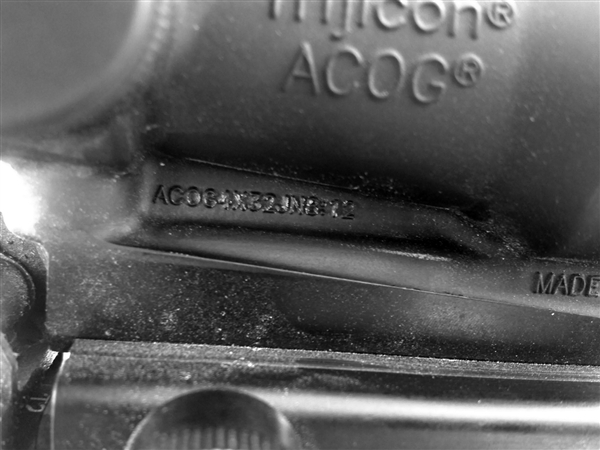
Rifles manufactured for US soldiers stationed in Afghanistan were found to contain references to Bible passages in 2010. Shortly thereafter, when the engravings were discovered, public outrage caused the US Department of Defense to have the engravings removed from the weapons. Some 2 years later and soldiers are still being deployed to Afghanistan with Bible passages clearly cited on their rifles. MSNBC reports:

When the so-called “Jesus rifle” came to light in Jan. 2010, it sparked constitutional and security concerns, and a maelstrom of media coverage. The Pentagon ordered the removal of the secret code referring to Bible passages that the manufacturer had inscribed on the scopes of the standard issue rifles carried by U.S. soldiers into battle in Iraq and Afghanistan. Nearly three years later — despite the military’s assertion that is making “good progress” — the code remains on many rifles deploying to Afghanistan, which some soldiers argue is endangering their lives by reinforcing suspicions that the United States is waging a crusade against Muslims.

The rifle sights are also engraved with other Biblical citations by the Michigan based, Crusade minded weapons manufacturer:

The code stamped into the metal of the soldier’s ACOG (Advanced Combat Optical Gunsight) ends with the model number with “JN8:12.” which refers to the New Testament passage, John 8:12, which reads: “Then spake Jesus again unto them, saying, I am the light of the world: he that followeth me shall not walk in darkness, but shall have the light of life.”

Other rifle scopes among some 250,000 provided by Michigan-based manufacturer Trijicon were imprinted with codes that point to passages in Matthew, Mark, Luke, Corinthians and Revelations, ABC News reported when it broke the news in 2010. Trijicon, reportedly had been following this practice for at least two decades, and it was well known to gun enthusiasts.

Are Christians truly waging a ‘crusade’ – Christian Holy War, against Muslims? That’s a question for you to answer, however, these Bible passages on weapons do not detract from such a notion.

wa Allaahu Alam,
and Allaah knows best.

Catholic Church in Germany Imposes Tax or Excommunication

Bismillahir Rahmanir Raheem
بِسۡمِ ٱللهِ ٱلرَّحۡمَـٰنِ ٱلرَّحِيمِ ,

It seems as if giving charity is not good enough for the religion of Paul, apparently you also have to give 8% of your yearly income to the German Catholic Church for your sins to be forgiven. That doesn’t spell good news for the struggling Church, according to the BBC News, the German Catholic Church has voted to excommunicate members if they don’t pay up. So it’s either you give us your money or as it turns out, you won’t get saved!

A German bishops’ decree which has just come into force says anyone failing to pay the tax – an extra 8% of their income tax bill – will no longer be considered a Catholic.

The Church itself has been struggling to survive, essentially facing a mass exodus of believers from Christianity into other ideologies such as Islam, atheism and agnosticism:

Catholics make up around 30% of Germany’s population but the number of congregants leaving the church swelled to 181,000 in 2010, with the increase blamed on revelations of sexual abuse by German priests. Alarmed by their declining congregations, the bishops were also pushed into action by a case involving a retired professor of church law, Hartmut Zapp, who announced in 2007 that he would no longer pay the tax but intended to remain within the Catholic faith.

As it turns out, the Vatican also supports the mafia like tactics:

“This decree makes clear that one cannot partly leave the Church,” Germany’s bishops’ conference said last week, in a decision endorsed by the Vatican.

The situation is much more dire than it seems, what exactly not paying the religious tax means, is muddled, but borders along excommunication, refusal to be buried under  religious rites and more:

Unless they pay the religious tax, Catholics will no longer be allowed receive sacraments, except before death, or work in the church and its schools or hospitals. Without a “sign of repentance before death, a religious burial can be refused,” the decree states. Opting out of the tax would also bar people from acting as godparents to Catholic children. “This decree at this moment of time is really the wrong signal by the German bishops who know that the Catholic church is in a deep crisis,” Christian Weisner from the grassroots Catholic campaign group We are Church told the BBC. Until now, any German Catholic who stopped payment faced eventual excommunication. Although the measures laid out in the decree are similar to excommunication from the church, German observers say the word is carefully avoided in the decree.

Our prayers go out to the Christians of Germany and we hope that they are guided to the truth of Islam, Ameen.

wa Allaahu Alam,
and Allaah knows best.

Some Comments on James White and Adnan Rashid’s Debate

Bismillahir Rahmanir Raheem
بِسۡمِ ٱللهِ ٱلرَّحۡمَـٰنِ ٱلرَّحِيمِ ,

I was taken aback by some of James White’s arguments in yesterday’s debate with Br. Adnan Rashid, however I was pleased with the simplicity of his presentation. The topic being debated was, “Was the Qur’an or the Bible Reliably Transmitted? ” and what a show it was. James’ presentation was rather straight forward, to the point and predictable. Admittedly, he’s a seasoned orator which would impress the lay Christian, but as a person who studies the Christian scriptures and their textual history, I felt nothing but shame for James White. His arguments were borderline facetious, if not absurd and really demonstrated a lack of honesty on his part. I’m not sure if he would be willing to defend his statements, but many of his comments were dishonest to say the least. Let’s examine his main point:

  • An Uncontrolled Text is Superior to a Controlled Text.

James’ reasoning, revolved around the idea that if multiple people, at multiple places, at multiple times wrote a documents which ‘largely agreed’ with one another, the autograph would be more preserved and thus rendering the text, ‘reliably transmitted’. This view is largely held by neo-inerrantist Christian scholars such as Maurice Robinson, William Pierpont, Zane Hodges and Aruthur Farstad. There view can be summed up in this excerpt:

“from a transmissional standpoint, a single Textform would be expected to predominate among the vast majority of manuscripts in the absence of radical and well-documented upheavals in the manuscript tradition.” – Maurice Robinson, “The New Testament in the Original Greek According to the Byzantine/Majority Textform”, Preface to the 2nd Ed.

It must be understood however, that this understanding is not due to the science of textual criticism, but based on faith that God preserved the Bible, see Dr. B. Metzger and B. Ehrman, ‘The Text of the NT: It’s Transmission, Corruption and Restoration, 4th Ed, pg 219, Citation #29. Therefore James’ position is not based on sound research and study, which he alluded to, but based upon dogmas. It is with this in mind that I’d like to contest his view of preservation through ‘uncontrolled copying‘, by providing a simple example:

  • Scribe writes epistle.
  • Some time passes.
  • Later scribe copies epistle (emendations/ interpolations occur).
  • Some time passes.
  • Another scribe copies the mistakes of the previous scribe and adds mistakes of his own.
  • At this point the original epistle is lost and the autographs of the two later scribes are preserved.

The question we’d have to ask James, is which manuscript autograph would he give precedence to? Would his criteria be based upon dating or level of variance after comparison with his current New Testament codex? If it’s a combination of both, then what would be common to both manuscripts would be the errors of the first copyist and the recopied errors by the second copyist, thus leaving us with something vastly variant to the original:

In some cases the evidence will be found to be so evenly divided that it is extremely difficult to decide between two variant readings. – Dr. B. Metzger and B. Ehrman, ‘The Text of the NT: It’s Transmission, Corruption and Restoration, 4th Ed, Preface XV.

Occasionally, none of the variant readings will commend itself as original, and one will be compelled either to choose the reading that is judged to be the least unsatisfactory or to indulge in conjectural emendation. – Dr. B. Metzger and B. Ehrman, ‘The Text of the NT: It’s Transmission, Corruption and Restoration, 4th Ed, pg 343.

However, let’s say that we oppose James’ view and we examine a controlled text.

  • A Controlled Text is Superior to an Uncontrolled Text.

What if the original scribe oversaw the copying of his manuscript, and left instructions that any copy henceforth would have to be double checked with his manuscript. That’s a level of control that at the minimum preserves the text by one generation. If this method is continued, essentially all generations of copyists would be able to preserve the original scribe’s works. This is essentially what the Ijaza is in Islam. A person is given the authority to transmit knowledge/ data, because they have achieved a level of approval according to the one who has received authority from one with authority to transmit the knowledge/ data. We know that later Christianity adopted controlled textual transmission, because it better preserved the texts:

It is a striking feature of our textual record that the earliest copies we have of the various books that became the New Testament vary from one another far more widely than do the later copies, which were made under more controlled circumstances in the Middle Ages. – Dr. B. Metzger and B. Ehrman, ‘The Text of the NT: It’s Transmission, Corruption and Restoration, 4th Ed, pg 275.

The vast majority of Christian texts which have survived are from the Middle Ages:

Furthermore, the work of many ancient authors has been preserved only in manuscripts that date from the Middle Ages (sometimes the late Middle Ages), far removed from the time at which they lived and wrote. – Dr. B. Metzger and B. Ehrman, ‘The Text of the NT: It’s Transmission, Corruption and Restoration, 4th Ed, pg 275.

The end of the twentieth century saw a resurgence of interest in the Byzantine text type among those who believe that the original text is best preserved in the vast majority of witnesses produced in the Middle Ages.’ – Dr. B. Metzger and B. Ehrman, ‘The Text of the NT: It’s Transmission, Corruption and Restoration, 4th Ed, pg 218.

Therefore the correlation being that texts which are controlled, have been vastly more preserved as opposed to the earlier uncontrolled texts of which are sparse and often vastly variant with one another:

Complaints about the adulteration of texts are fairly frequent in early Christian literature. Christian texts, scriptural and nonscriptural, were no more immune than others from vicissitudes of unregulated transmission in handwritten copies. In some respects they were more vulnerable than ordinary texts, and not merely because Christian communities could not always command the most competent scribes. Although Christian writings generally aimed to express not individual viewpoints but the shared convictions and values of a group, members of the group who acted as editors and copyists must often have revised texts in accordance with their own perceptions. This temptation was stronger in connection with religious or philosophical texts than with others simply because more was at stake. A great deal of early Christian literature was composed for the purpose of advancing a particular viewpoint amid the conflicts of ideas and practices that repeatedly arose within and between Christian communities, and even documents that were not polemically conceived might nevertheless be polemically used. Any text was liable to emendation in the interest of making it more pointedly serviceable in a situation of theological controversy. – H. Y. Gamble, Books And Readers In The Early Church: A History Of Early Christian Texts, 1995, Yale University Press: New Haven & London, pp. 123-124.

It is with the above being said, I must thereby conclude that James White’s position in his debate with Br. Adnan Rashid is unscholarly, deceptive, displays a significant level of ignorance of the history and the science of textual criticism and is nothing short but a disgrace to the field of academia. I pray that God guides James White to admitting his erroneous position and that he corrects himself, sooner rather than later.

wa Allaahu Alam,
and Allaah knows best.

Christians Have Blasphemy Laws Too

Bismillahir Rahmanir Raheem
بِسۡمِ ٱللهِ ٱلرَّحۡمَـٰنِ ٱلرَّحِيمِ ,

Lately, there has been a lot of grandstanding by our Christian counterparts about blasphemy laws in Muslim countries. They seem to forget that they too have blasphemy laws that are still in use to this day. As it turns out, it was used this week against a former Christian, who ran a Facebook group about his apostasy. The Huffington Post reports:

A 27-year-old man has been arrested by Greek police  for what the authorities called “malicious blasphemy,” according to a HuffPost translation of a press release. Police allege that the man managed a Facebook page that lampooned the deceased Eastern Orthodox monk Elder Paisios , a widely popular religious figure, using the name “Gerontas (Elder) Pastitsios.” Pastitsios is a Greek pasta dish, and the page parodied the monk and his work in the vein of Pastafarianism, a lighthearted, satirical movement that promotes irreligion. In a screen shot of the group’s Facebook page, which now appears to have been removed from the social network, Elder Paisios is shown with a plate of pastitsios .

The Business Insider News website, has secured a translation of the police press release on the issue:

24-09-2012: H Cyber Crime Unit arrested 27-year old domestic for malicious blasphemy and kathyvrisi religions via Facebook
Athens, 24 September 2012

PRESS RELEASE

H Cyber Crime Unit arrested 27-year old domestic for malicious blasphemy and religious kathyvrisi through Facebook

The 27 year old managed page on Facebook with profane and abusive content for Elder Paisios and Orthodox Christianity

From Cyber Crime file formed Flagrant process against domestic 27 years old, who is accused of blasphemy and malicious kathyvrisi religions known through social networking sites Facebook.

More specifically, the Cyber Crime spotted recently in the famous social networking site Facebook, with data page ( http://www.facebook.com / gerontas.pastitsios ), which contained blasphemies and insults against Elder Paisios and Orthodox Christianity.

While the profane and blasphemous content of this page, the Cyber Crime has received thousands of e-complaints coming from residents of different countries around the world.

From police digital survey, conducted in conducting preliminary investigation calibrated logs (logfiles) and electronic trail of administrator – user page issue.

Then Friday (21-09-2012) morning team of specialist officers Cyber Crime held a proper inquiry, presence Prosecutors at his home at 27 years old Psachna Evia.

During the investigation found and confiscated a laptop computer (laptop). On the ground in this autopsy found that a computer administrator page in question was the 27 year old, who was arrested and the file that was formed against him led to Attorney Athens.

Recalled that, in such cases, citizens can contact the Cyber Crime, the following contact details.

Here are the blasphemy laws according to the Greek constitution which criminalizes insults against the Christian Church:

Article 198 – Malicious Blasphemy

1. One who publicly and maliciously and by any means swears blasphemes God shall be punished by imprisonment for not more than two years.

2. Except for cases under paragraph 1, one who by blasphemy publicly manifests a lack of respect for the divinity, shall be punished by jailing for not more that six months or by pecuniary penalty of not more than 3,000 euros.

Article 199 – Blasphemy Concerning Religions

One who publicly and maliciously and by any means blasphemes the Eastern Orthodox Church of Christ or any other religion tolerated in Greece shall be punished by imprisonment for not more than two years.

Waiting for the outcry of ‘creeping Christianity‘ or ‘freedom marches‘ against the ‘barbarism of Christianity‘ because of their ‘blaspheme laws‘ which are ‘archaic‘. Pretty sure you won’t see this piece of news on Jihad Watch or Answering Muslims.

wa Allaahu Alam,
and Allaah knows best.

Debate: Br. Zakir Hussein vs James White [Video]

Bismillahir Rahmanir Raheem
بِسۡمِ ٱللهِ ٱلرَّحۡمَـٰنِ ٱلرَّحِيمِ ,

Do check out my initial review of the debate here.

Br. Zakir did a wonderful job, this was his first debate in such a capacity and performed really well. Entertaining, informative and  important to both religions. A bit disappointed with James and his mistakes, expected better from a so called, ‘seasoned veteran’, nonetheless, it’s worth the watch.

wa Allaahu Alam,
and Allaah knows best.

Codex Sana’a and the Qur’an

Bismillahir Rahmanir Raheem
بِسۡمِ ٱللهِ ٱلرَّحۡمَـٰنِ ٱلرَّحِيمِ ,

There have been numerous articles, books, lectures given on the topic of the Sana’a MSS (manuscripts), but they always seem to fall short of explaining the reality of the manuscripts. What does the existence of the manuscripts mean for the Muslim and Christian community? Does it truly prove that the Qur’an has been ‘corrupted’? How reliable are the findings? Insha Allaah (God willing), I seek to answer a few of these questions and more, while aiding in the understanding of the manuscript tradition (Ulum al Qur’an, Textual Criticism) in light of the Sana’a codex.

An Introduction to the Sana’a Codex:

A codex is simply a ‘collection‘, so the Sana’a codex is the ‘collection of manuscripts from Sana’a, Yemen‘. The Sana’a manuscripts were discovered accidentally, the event is actually, quite famous history:

The manuscripts, thought to be the oldest surviving copies of the Koran, were discovered in the ancient Great Mosque of Sa’na in 1972, when the building was being restored after heavy rainfall, hidden in the loft in a bundle of old parchment and paper documents. They were nearly thrown away by the builders, but were spotted by Qadhi Isma’il al-Akwa, then president of the Yemeni Antiquities Authority, who saw their importance and sought international assistance to preserve and examine them.

From thereon, the services of Dr. Gerd Puin had been consulted:

Al-Akwa managed to interest Puin, who was visiting Yemen for research purposes in 1979. Puin in turn persuaded the German government to organise and fund a restoration project. The restoration revealed that some of the parchment pages dated from the seventh and eighth centuries, the crucial first two centuries of Islam, from which very few manuscripts have survived.

Dr. Gerd Puin’s Findings and Conclusions:

Puin noticed minor textual variations, unconventional ordering of the chapters (surahs), as well as rare styles of orthography. Then he noticed that the sheets were palimpsests – manuscripts with versions written even earlier that had been washed off or erased. These findings led Dr Puin to assert that the Koran had undergone a textual evolution. In other words, the copy of the Koran that we have is not the one believed to have been revealed to the prophet. – [1]

Understanding the Findings and Conclusions:

It is far too easy to condemn (if you’re Muslim) or support (if you’re non-Muslim) something when it’s aiding or detracting from your cause/ belief. For the Muslim, these findings are supposed to prove the Qur’an is corrupted and thus their word of God is false, to the Christian missionary, this is finally their opportunity after many failed attempts to prove that the Qur’an is not the original word of God, an argument made popular by Muslims against Christendom for several centuries. Yet, do the findings really reflect these views? For the learned, we’d answer with an emphatic “no“. Let’s examine what the findings state and then put them into context:

  • Minor textual variations.
  • Unconventional orderings of Chatpers/ Surahs.
  • Rare styles of Orthography.

Yet, before we examine the three main points above, there is a key argument that we’ve ignored, and now I’d like to bring it to light. The topic of ‘palimpsests‘.

Palimpsests and the Qur’an:

A palimpsest can be defined as, “a parchment or the like from which writing has been partially or completely erased to make room for another text. – [2]”, usually this is the missionary’s main argument when using the historicity of the Sana’a codex. They assert that because the manuscripts show that there was a ‘previous text’ before which was removed and then the current text written, the conclusion has to be that errors were made, and then emendations (alterations to text for improvement) were made, hence the current version of the Qur’an is an update from the imperfect older version as is seen in the Answering Islam article, “The End of the Qur’an as Muslims Know It“, and Faith Freedom’s,  “Ancient Qur’anic Manuscripts of Sana’a and Divine Downfall“.

However, this argument can only be blamed on abject desperation and a severe lack of education in the field of textual criticism. The world, for a vast amount of its history relied upon liturgical (oral – speaking and aural – listening) transmission of data and information. The use of texts as a primary form of transmitting data, that is, textual transmission did not become standard in the late 15th century with the advent of the printing press:

Printing with movable type had existed in East Asia at least since 1377 when the Jikji, an abbreviated title of a Korean Buddhist document was printed in Korea during the Goryeo Dynasty, however, the invention had not spread to Europe where everything people read still had to be copied by hand or printed from wood blocks carved by hand. In about 1440, the German goldsmith, Johannes Gutenberg, developed a movable type. Gutenberg made separate pieces of metal type for each character to be printed. With movable type, a printer could quickly make many copies of a book. The same pieces of type could be used again and again, to print many different books.

Printing soon became the first means of mass communication. It put more knowledge in the hands of more people faster and more cheaply than ever before. As a result, reading and writing spread widely and rapidly. – [3]

Similarly, this author goes into a bit more detail as to the development of texts (books) as a primary form of communication and mass media:

Nonetheless, books were hardly considered a mass medium because very few copies existed. Until the middle of the fifteenth century, most books were hand-copied, often times my monks. Such books were expensive and very few people could read or write. As a result, only religious orders, the ruling elite, and some wealthy merchants ever saw or owned one.

Probably the most important milestone in the development of mass communication came in 1456 with the invention of the printing press and movable type. In Mainz, Germany, Johannes Gutenberg paved the way for the reproduction of books for  the masses … – [4]

Thus the use and reuse of manuscripts was common, as Dr. Bruce Metzger and Dr. Bart Ehrman indicate with this following excerpt:

In times of economic depression, when the cost of vellum increased, the parchment of an older manuscript would be used over again. The original writing was scraped and washed off, the surface resmoothed, and the new literary material written on the salvaged material. Such a book was called a palimpsest (which means “rescraped,”). One of the half-dozen or so most important parchment manuscripts of the New Testament is such a palimpsest; its name is Codex Ephraemi rescriptus. Written in the fifth century, it was erased in the twelfth century and many of the sheets rewritten with the text of a Greek translation of treatises or sermons by St. Ephraem, a Syrian Church father of the fourth century. By applying certain chemical reagents and using an ultraviolet-ray lamp, scholars have been able to read much of the almost obliterated underwriting, although the task of deciphering it is most trying to the eyes. In A.D. 692, the Council of Trullo (also called the Quinisext Council) issued a canon (no. 68) condemning the practice of using parchment from manuscripts of the Scriptures for other purposes. Despite the canon and the penalty of excommunication for one year, the practice must have continued, for of the 310 majuscule manuscripts of the New Testament known today, 68 are palimpsests. – [5]

As I stated previously, only someone ignorant of manuscripts and their study can assert the claim that palimpsests means that a text is invalid, corrupted and emendated. While this can be the case, and I’m not saying it can’t, it is more likely that due to the cost and availability of fresh writing material, many opted to wash over and rewrite on the same manuscripts. If we take the missionary argument that the existence of a palimpsest proves the corruption of the Qur’an, then the Bible must be overwhelmingly corrupted as one major manuscript and 68 others (as documented above) fall pray to this practise. Clearly the beat the missionary is marching to will come to an abrupt halt with such information.

Palimpsests: Textual Variants and Orthography of the Qur’an:

Palimpsests for the Qur’an are extremely rare, with only one other codex known to contain them [6]. The scriptio inferior text, is the text that was washed and then written over, in the case of the Sana’a manuscripts, the scriptio inferior were never the same as the scriptio superior (the newly written text) – [7]. This would have to lead one to belief that the manuscripts were washed and rewritten to accommodate a rewriting of the texts for preservation (verses) as is testament by the Sothbey 1993 and Stanford 2007 folios where the original writing contained 30 verses, spanning 2:191-223, after the washing, the verses found on that same manuscript were lessened to 20 verses, from 2:265 to 2:286, thus accommodating an overall rewriting of the texts for preservation.  

                                                     Sana’a Manuscripts
After Wash    Before Wash                                  Source:
2:265 – 2:271 2:191 – 2:196 Sotheby’s 1993 / Stanford 2007, recto
2:271 – 2:277 2:197 – 2:205 Sotheby’s 1993 / Stanford 2007, verso
2:277 – 2:282 2:206 – 2:217 Sotheby’s 1993 / Stanford 2007, recto
2:282 – 2:286 2:217 – 2:223 Sotheby’s 1993 / Stanford 2007, verso

Some may question why there was a rewriting of the text, and this is a fair but common question. Texts are usually rewritten to reflect the standardization of a language, as is testament also in the Greek language (orthographical development, i.e liturgical transcribing):

Ancient scribes, when writing Greek, ordinarily left no spaces between words or sentences (this kind of writing is called scriptio continua), and until about the eighth century punctuation was used only sporadically. At times, of course, the meaning of a sentence would be ambiguous because the division into words was uncertain. In English, for example, GODISNOWHERE will be read with totally different meanings by an atheist and by a theist (“God is nowhere” and “God is now here”).

Furthermore, it should not be supposed that scriptio continua presented exceptional difficulties in reading, for apparently it was customary in antiquity to read aloud, even when one was alone. Thus, despite the absence of spaces between words, by pronouncing to oneself what was read, syllable by syllable, one soon became used to reading scriptio continua. – [8]

Similarly in the Arabic language it was common for one tribe or city to speak one way, but write another, yet both having the same pronunciation:

Some tribes would pronounce the word  حتی (hatta) as عتی (‘atta), and صراط (sirat) as سراط (sirat), etc., and this was the root cause of many of the known variants in recitation. Similarly the letters ا, و, ي have the dual function of consonant and vowel, as in Latin. The question of how early Arab writers and copyists used these three letters requires special attention. Their methods, though puzzling to us now, were straightforward enough to them. – [9]

Something which we can also identify with in the English language:

The Boy of Bilson: or, A True Discovery of the late notorious Impostures of certaine Romish Priests in their pretended Exorcisme, or expulsion of the Divell out of a young boy, named William Perry, sonne of Thomas Perry of Bilson,in the country of Stafford,Yeoman. Upon which occasion, hereunto is permitted A briefe Theological Discourse, by way of Caution, for the more easie discerning of such Romish spirits; and iudging of their false pretences, both in this and the like Practices. – [10]

The following words may have seemed odd to you, but they were the earliest transcribing of the orthographical development of the English language:

  • certaine – certain
  • exorcisme – exorcism
  • divell – devil
  • sonne – son
  • briefe – brief
  • easie – easy
  • iudging – judging

No one would dare say that rewriting certaine as certain is a corruption of the text, nor would rewriting divell as devil be considered corruption. These however are attempts at preserving a text as the language itself becomes standardized. As it would seem, the Sana’a manuscripts record the orthographical standardization of the transcribing of the Arabic language. In other words, the Qur’an has not been altered or corrupted, but preserved in its original tongue and to do so would have been to preserve the text by transcribing it accurately. This understanding can also be found in the hadith of Anas bin Malik (may Allaah be pleased with him) who has narrated, “‘Uthman [ra] then ordered Zaid bin Thabit, ‘Abdullah bin AzZubair, Said bin Al-As and ‘AbdurRahman bin Harith bin Hisham [raa] to rewrite the manuscripts in perfect copies. ‘Uthman said to the three Quraishi men, “In case you disagree with Zaid bin Thabit on any point in the Qur’an, then write it in the dialect of Quraish, the Qur’an was revealed in their tongue.” They did so, and when they had written many copies, ‘Uthman returned the original manuscripts to Hafsa.” [11]

The Qur’an (literally: The Recitation) when being transcribed was transcribed according to the vernacular of some scribes from throughout Arabia, therefore Uthman [ra], ordered the scribes to write the Qur’an by transcribing it, according to the tongue (liturgical transmission) of its original revelation: the Qurayshi Dialect. Therefore any such palimpsest of the Qur’an which demonstrates orthographical variants or textual variants is due to the Arabic of the Qur’an being transcribed from its mother dialect. This can be seen in other places where the use of alif as a vowel is absent yet pronounced, see the following example:

Spelling in Uthman’s [ra] Mushaf (2:9):

ومايخدعون

Actual Pronounciation:

ومايخادعون

It might seem odd that there is a text and you pronounce it differently as to how you read it, but this is the nature of Semitic languages, for referencing, here’s a screenshot of the Al Jazeera News Website (Arabic version, 23 – 09 – 2012), here you will see no vowels, yet when Arabs read the text, they’re able to comprehend and understand it, they’re able speak aloud what the text says even if there are no vowels present:

If it still seems odd, or highly suspicious, here’s a quote from JewFAQ on the matter, “Like most early Semitic alphabetic writing systems, the alefbet has no vowels. People who are fluent in the language do not need vowels to read Hebrew, and most things written in Hebrew in Israel are written without vowels. – [12]”. Therefore to put this particular claim of ‘textual variants/ orthographical differences’ to rest, it is extremely normal to see this in almost all languages (as shown: Greek, Hebrew, Arabic and English all share this) as they are developing from liturgical transmission to textual transmission and this process is deemed, ‘transcribing‘.

We can also see this in English, with the writing of short vowels, but their pronunciation is that of long vowels:

  • Cake is pronounced as ‘caaake’ a long ‘a’ sound, yet one ‘a’ is written.
  • Home is pronounced as ‘hooome’, a long, double ‘o’ sound, i.e. oo is pronounced, yet one ‘o’ is written.

For more examples, such as these, see the ‘American English Pronunciation of Long Vowel Sounds‘.

Ordering of Surahs/ Chapters:

Variances in the ordering of Surahs, i.e. Baqarah then Fatihah, do not affect the textual transmission of the Qur’an in the least. The Qur’an is not ordered chronologically, alphabetically, numerically or topically. The order of the Surahs differed in only 3 of 35,000 manuscripts – [13] and can be due to a myriad of reasons, whoever stacked the papyri into the Masjid’s roof could have been reading those manuscripts and stacked them without replacing them into order, similarly, if a missionary were to open a used stack of playing cards and found a 3 of clubs and then a 6 of hearts directly after, would he claim that the person intentionally placed the cards in that order? There are a hundred reasons why the cards would be in that order, similarly no one should claim to know why in 35,000 manuscripts, only 3 were out of order. Perhaps there was a person who was studying that set, reading that set, or learning to write that set, hence they were put aside and thus taken out of order. Unless the claimant has direct evidence as to why 3 of 35,000 was not in their usual order, they are doing nothing more than making wild guesses.

Conclusion:

The existence of the Sana’a Manuscripts do not lend any credence to the claim that the Qur’an is corrupted. Rather the existence of these manuscript – palimpsests, demonstrate the textual integrity of the Qur’an and the grammatico-historical validity of the ahadith which verify the transcribing of the tongue of the Quraysh into a mushaf (text), for which we Muslims still use to this day:

نَّا نَحْنُ نَزَّلْنَا الذِّكْرَ وَإِنَّا لَهُ لَحَافِظُونَ

We have, without doubt, sent down the Message; and We will assuredly guard it (from corruption). – Al Hijr (15:9).

wa Allaahu ‘Alam,
and Allaah knows best.

Further Reading:

Sources:

  1. Dr. Gerd Puin and Querying the Koran – Guardian Newspaper [UK].
  2. Palimpsest – Definition.
  3. History of the Printing Press.
  4. Journalism and Mass Communication – Volume 1, History and Development of Mass Communication , Laurie Thomas Lee, Sections 2 “Books” and 2.1 “The Printing Press”.
  5. Dr. Bruce Metzger and Dr. Bart Ehrman, “The Text of the New Testament: Its Transmission, Corruption, and Restoration”, pp 21 – 22, 4th Ed.
  6. K. Small & E. Puin, “UNESCO CD of San’a MSS. Part 3: Qur’an Palimpsests, And Unique Qur’an Illustrations”, Manuscripta Orientalia, 2007, Volume 13, Number 2, pp. 63-70.
  7. Manuscript Table, Islamic Awareness: Sana’a MSS.
  8. Dr. Bruce Metzger and Dr. Bart Ehrman, “The Text of the New Testament: Its Transmission, Corruption, and Restoration”, pp 21 – 22, 4th Ed.
  9. Shaykh Mustafa Muhammad al ‘Azami, “The History of the Qur’anic text from Revelation to Compilation”, page 130 – 131.
  10. Ibid.
  11. Sahih al Bukhari, Book 61: Virtues of the Qur’an, Hadith: 510.
  12. The Hebrew Alphabet (read: AlifBet), Jew FAQ.
  13. Does Dr. Gerd Puin’s Research Prove that the Qur’an has been Revised? – Br. Hamza of iERA.
« Older Entries Recent Entries »