Author Archives: Ijaz Ahmad

I am a Trinitarian Muslim

بِسۡمِ ٱللهِ ٱلرَّحۡمَـٰنِ ٱلرَّحِيمِ ,

Today I’d like to publicly confess that I am a Trinitarian Muslim. I cannot change what I am, and I hope that the Muslim community will accept me for what I am, because at the end the day, I’m still a Muslim. You must understand that this is not a choice of my own doing. Allow me to explain.

In 1498, Christopher Columbus rediscovered my home island, the island wherein I have lived all of my life. He dedicated this island to the Trinity, and thus named it after the Trinity, the island was therefore known as ‘La Trinidad‘, or ‘the Trinity‘. By his doing, I am now known, as is the rest of my people, as Trinidadians, or, if I were to appropriate it to its original meaning, we are by our historical name, ‘Trinitarians‘. Therefore, due to Christopher Columbus, my nationality is that of a Trinitarian. How unique it is, that my nationality is named after a religious doctrine that, just like my tiny Caribbean island home, is shrouded in conflict, mystery/ secrecy, and absurdity. It’s ironic to me, that my island’s name reflects upon the doctrine it was named after, and in doing so, the doctrine itself reflects upon the nature of my island home.

Just like the Trinity, this island is home to many internal conflicts. Similarly in the religious Trinity, the Father who is God, gave authority to the Son who is also a God (Matthew 28:18), thus leaving the conflicting question, how can God, give God something God is already supposed to have? The conflicts do not end there. According to Christian Theology (a la James White, David Wood and Sham Shamoun), all members of the Godhead are co-equal to each other, yet one member decided that God – the Father, was greater than Him, God – the Son (John 14:28). If each member is co-equal to the other, how can one God – person, be greater than another God – person?

Well, the answer to that is a mystery, which my country is also, as it’s namesake suggests is also familiar with. See, the Trinity, isn’t really full of contradictions, Trinitarians (the religious ones!), refer to it as Holy Mysteries (see #234), they don’t like that whole contradiction word, it makes them look bad. You must understand, you can’t question something if it’s a mystery, especially a holey one. I sometimes like to think of the Trinity’s Holey Mysteries as contradictions we’re not allowed to think much about.

Perhaps the one place that we Trinitarians by nationality have been beaten, is in the way which we express our local culture, that is to say, who we are. I might be mistaken though, as Christians when explaining the Trinity have also had problems in explaining and expressing what it truly is. We’ve had the egg analogy, the water analogy and eventually we had the laughable, three headed dog from hell analogy. If I were to judge, I’m not sure what’s worse, a Trinitarian by nationality dancing in the streets half naked to express his/ herself, or a Trinitarian by religious belief, thinking that God (glorified and exalted is He) is like a three headed dog from hell.

In conclusion, I’m a Trinitarian Muslim, and there are a few thousand others like me. We also have Trinitarian Rastafarians, Shouter Baptists, Atheists etc. I’m unique, and I like that I can claim I’m a Trinitarian Muslim. It’s sad to see though, that the doctrine we are named after, has sadly reflected badly upon the people of my nation and our national identity. Conflicting, Holey, Absurd and Expressionless, I only pray that God saves us from further embodying the madness that is the Trinity.

Sincerely,
Your Trinitarian Muslim Brother Ijaz.

wa Allaahu ‘Alam.

Sam Shamoun, Paul Williams and Insults.

بِسۡمِ ٱللهِ ٱلرَّحۡمَـٰنِ ٱلرَّحِيمِ ,

Yesterday I came across a post by Br. Paul Bilal Williams, a Christian apostate, Islamic convert. You can view that post here. In this post, he claims that Sam Shamoun, an author at Answering Islam had abused and insulted him. In a most professional manner, Paul expressed his discontent with Sam’s behaviour and then he provided the contents of the insult for all to see. Undoubtedly, Sam Shamoun’s intent of perusing a Muslim’s blog, is to further his cause of converting Muslims to Christianity. Despite all the claims of alleged former Muslims writing for his website, none of them have attained the popular status of any Christian convert to Islam’s status. One such example, is that of Paul Williams. Thus, there is often a lot of enmity and disdain that is often cast upon these new Muslims by Sam Shamoun and his ilk. When we read Paul’s response to Sam’s abuse, there is a clear dichotomy, whereas Sam expresses his emotions with curses, abuses and improper public decorum, it’s quite a contrasting event to see Paul’s eloquence, and mild mannered posts in response to such hate. In reading his article about Sam’s abuse, I was reminded of a verse from the Qur’an:

“O you who have believed, whoever of you should revert from his religion – Allah will bring forth [in place of them] a people He will love and who will love Him [who are] humble toward the believers, powerful against the disbelievers; they strive in the cause of Allah and do not fear the blame of a critic. That is the favor of Allah; He bestows it upon whom He wills. And Allah is all-Encompassing and Knowing.” – Qur’an 5:54.

It is striking how true God’s words are. While Sam searches to apostate Muslims, and whether he is successful at this or not has yet to be known, it is apparent that the Christians who do apostate from Christianity and turn to Islam, find themselves loving Islam, loving Allaah, who are humble in character, but their simple words cause great emotional distress for persons like Sam Shamoun. Paul strives in the way of Allaah, by speaking about his new faith and discussing his former faith in public dialogues, he often engages in discussions with Christian laymen on his blog as well, yet he most certainly, as the Qur’an says, he does not fear the blame or abuse of a critic. In this light, Sam Shamoun, his biggest critic, does not affect the temper, the decorum of our beloved brother. This incident, between Paul and Sam, therefore demonstrates the authenticity of God’s pure word as being truthful, while casting a shadow upon Sam’s incredulous nature. In fact, this form of behaviour is repeated in respect to Br. Shabir Ally who openly hugged and greeted Sam. Yet, after Sam’s glowing show of respect to him, he reverted to insulting and abusing Br. Shabir without due cause. Br. Shabir himself has never insulted or abused any Christian speaker, yet Sam saw it fit to do so to him:

Despite his writing against Islam, debating against Islam, alleged studying of Islam, after 10+ years of successive Islamophobia, he has once again proven one more verse of the Qur’an to be true:

And We have certainly diversified [the contents] in this Qur’an that mankind may be reminded, but it does not increase the disbelievers except in aversion. – Qur’an 17:41.

God mentions that those who disbelieve in the Qur’an, increase in their aversion to it, that they are blind to understanding it and they will only increase in being blind to it. After 10+ years of abusing Muslims, and falsely studying the Qur’an, Sam has only persisted in his disbelief, thus proving the Qur’an to be true. How ironic, that the same Qur’an which Sam argues against, describes him and his behaviour, as well as those he fights against, perfectly? It is indeed a telling sign of God’s mercy upon us and of His intimate knowledge of human behaviour.

wa Allaahu ‘Alam.

Samson the Holy, Does the Unholy

بِسۡمِ ٱللهِ ٱلرَّحۡمَـٰنِ ٱلرَّحِيمِ ,

This article by Br. Alexus Haddad.

We are told that in order to save Israel (again and again…and again!) out of their enslavement by the Philistines (this time), God was to send a saviour (Not Jesus!)…Samson, a holy child, born miraculously. In fact, his mother was sterile (Judges 13:2), so the angel of the Lord came to give her the good news.

What is remarkable is that one of the requirements for the pregnancy, is that his mother should: “Not drink any wine, or other fermented drink nor eat anything unclean” (Judges 13:13). Since that child is a holy child…chosen by the Almighty God, she should abstain of what is unclean. Wine is obviously, in this case considered unclean.

Nonetheless, what is definitely more striking is that we are told that this miraculously noble child, who was chosen by the Almighty God does something contrary to his nature:
“Then went Samson to Gaza, AND SAW THERE A PROSTITUTE, AND WENT INTO HER.” (Judges 16:1)
“Went into her” means slept with her. Yes, this specially chosen person of God, one day, saw a prostitute and slept with her (we are not told if he actually paid money). Really? Are we to believe that? How did God, Almighty choose him to carry His will? Are we to hold that belief in the Almighty?!

Refutation: Jesus said that all authority was given to him, … which means that Jesus cannot be God.

بِسۡمِ ٱللهِ ٱلرَّحۡمَـٰنِ ٱلرَّحِيمِ ,

Question:

It is reported in Matthew’s Gospel that Jesus said that all authority was given to him in heaven and earth (cf. Mat. 28:18), which means that someone else gave it to him. That someone else must be greater than Jesus, which means that Jesus cannot be God. After all, how can God be given all authority when he already has it to begin with?

Answer:

Sam’s answer is extremely similar to the others, at this point I’ve decoded the method he’s using:

  1. Claim that the person asking the question does not understand the nature of God.
  2. Claim that God can only exist in a multi-personal form.
  3. Does not prove that God is multi-personal.
  4. Since God is multi-personal, the questioner is wrong.
  5. The answer is that God does have X attribute(s) because questioner is wrong and God is multi-personal.

Therefore, Sam does not necessarily answer the question, as opposed to really denying that there could be a problem while claiming the solution to the question at hand is to repeat as many times as is possible that God is multi-personal. Now, we must understand that if God is multi-personal and for the sake of Sam’s argument I am going to accept this premise, then in order for one ‘person’ to give to another, it would have to mean that one ‘person’ possesses something that the other person does not. Sam does not explain how one person can give another person something he already has, if we are to assume that he already had it.

That is where the problem lies, Shamoun insists that Christ is God, and he claims that God already had authority:

It is true that no one outside of God can give God anything, since God is the One who owns everything and gives his creatures all that they have:

“…the Father, the Son (the Lord Jesus), and the Holy Spirit are all God, even though they are personally distinct from one another.”

“It is true that no one outside of God can give God anything, since God is the One who owns everything and gives his creatures all that they have…”

With the above having been said, if Christ is God, and God already has all possible authority/ dominion over all things, how can one God – person, give another God – person, something they both are already supposed to have. This has several ramifications, namely:

  1. Matthew 28:18 is a lie.
  2. God the Father is a Supreme God and Jesus is a lesser God missing an attribute of Power.
  3. (2) cannot be true since Christ is a full God in the Godhead which means (1) has to be true.
  4. (2) can be true since Sam admits their is a hierarchy and thus gives credence to the possibility of a lesser God.
  5. (1) and (2) can both be true as both the Bible and the Trinity are products of man.

Sam, realising the possibility of his logic being absolutely erroneous, he then tries to reason it out:

But this says absolutely nothing about God’s own inner life and internal communion. For instance, let us assume for the moment that God is a Triune Being, that there are three distinct Persons who exist as one Being. Then passages where Jesus is said to have received something from someone really pose no problem for Trinitarianism since you can have one of the divine Persons granting authority to another, or for one member of the Godhead to be in subjection to another (or to the others). After all, Christ is called God’s Son for a reason, since this relationship implies a subjection of some kind on the part of the Son to the Father. Yet, much like earthly fathers can be greater in authority than their sons without this implying that the sons are inferior beings, the divine Father giving authority to his divine Son in no way implies that the latter is not God or is an inferior Being.

I really wish that Sam would understand the meanings of the words he uses. If each person in the Godhead is co-equal, then one cannot be subject to another, as this implies that they are not co-equal, in other words, that is a contradiction. Therefore either they are co-equal to each other or they are not co-equal and are in a hierarchy. Since Sam accepts that they can be subject to each other, then they are in a hierarchy, with one God being superior to another God person. Since they are not co-equal and one is greater than the other, we can accept that the most superior God has some attribute or numerous attributes to make Him greater than the two lesser gods in the Godhead.

I can prove this, and thus prove that the latter two gods are less superior, as the Bible itself claims that God – the Father, gave another god – Christ, an attribute, the attribute of power. Thus by this verse, Matthew28:18, it subsequently proves that:

  1. Within the Trinity, there is one supreme God – the Father and two lesser gods who lack attributes the Father has.
  2. One attribute which one lesser god – Christ did not have, would have been the authority over heaven and earth which he was then gifted.

Sam then goes on to say:

“Having greater authority doesn’t necessarily mean that the person is greater in essence, or that the one who is in subjection to another is inferior in nature to the other. To assume otherwise is to make a categorical mistake, a category fallacy, treating two distinct categories (nature and authority) as if they were one and same.”

What he does not realise is that God’s nature is to be all powerful, part of being all powerful is also having authority over the heavens and earth. Since it is God’s nature to be all powerful, then it is impossible for God to not have power, also known as authority, over the heavens and earth. Thus if there exists a God which lacks this attribute, this nature, then this God can no longer be considered a God, but a lesser god or if we are monotheists, not a God at all, but subject to the power and authority of an all powerful God. He continues:

“”Then comes the end, when he delivers the kingdom to God the Father after DESTROYING every rule and every authority and power. For he must reign until he has put all his enemies under his feet. The last enemy to be destroyed is death. For ‘God has put all things in subjection under his feet.’ But when it says, ‘all things are put in subjection,’ it is plain that he is excepted who put all things in subjection under him. When all things are subjected to him, then the Son himself will also be subjected to him who put all things in subjection under him, that God may be all in all.” 1 Corinthians 15:24-28

Here is a classic example of how one member of the Godhead can give to another member something without this implying that one of them isn’t God. Note that the Father subjected all things to the Son, and that the Son gives to the Father the kingdom. Christ’s sovereignty and supremacy is clearly seen in this passage since he has the ability to destroy all other powers and authorities, bringing them into complete subjection to the Father. Thus, the Son receiving authority to rule no more disproves that he is God then the Father receiving the kingdom from his Son disproves that he is God also. Another thing to keep in mind is that, according to the Scriptures, Christ voluntarily came down from heaven in order to assume the role of a slave, a servant.”

Sam is assuming that the kingdom in the aforementioned verse does not belong to the dominion of God. This is not the case, what the verse is simply saying is that in the end, all Kingdoms would be ruled by God’s law and not by pagan, infidel (unChristian) leadership. If Sam’s former logic is what he believes to be true, then he accepts that if a nation is not ruled by a Christian under Christian laws, then that nation is not under the power, authority or dominion of God. This would mean that the King of Saudi Arabia, or Barak Obama, or Emir of the UAE were rivals to his God as they have dominion where his God is powerless, therefore Sam’s God is powerless to man. This however, is inconsistent theology, as Sam’s Bible says that all rulers, rule by God’s power, see Romans 13:1-7.

Secondly, I’m not sure whether to laugh, or cry. Shamoun seems to think, and quite absurdly so, that by the Son being able to rule an earthly Kingdom, he is showing that God has the ability to receive authority. Seeing as the Son is an inferior God (as he received authority over all things from a God with all authority over all things), why is Sam then surprised that the Son will eventually rule over a Kingdom? If he is inferior in authority and will gradually assume authority over things that God already has authority over, this does not make him a God, rather it makes him subject to God’s already established and constant power, refer once more to Romans 13:1-7, or Jesus accepting God’s authority over him in John 5:30-31. Sam then decides to prove my point by demonstrating how the inferior god – the Son, obeys commands from a Supreme authority:

While on earth, the Lord Jesus subjected himself to the authority of the Father, doing nothing of his own initiative, but only doing the very thing that the Father commanded and desired:

“And when the ten heard it, they were indignant at the two brothers. But Jesus called them to him and said, ‘You know that the rulers of the Gentiles lord it over them, and their great ones exercise authority over them. It shall not be so among you. But whoever would be great among you must be your servant, and whoever would be first among you must be your slave, even as the Son of Man came not to be served but to serve, and to give his life as a ransom for many.'” Matthew 20:24-28

“For I have come down from heaven, not to do my own will but the will of him who sent me.” John 6:38

“Have this mind among yourselves, which is yours in Christ Jesus, who, though he was in the form of God, did not count equality with God a thing to be grasped, but made himself nothing, taking the form of a servant, being born in the likeness of men. 8And being found in human form, he humbled himself by becoming obedient to the point of death, even death on a cross.” Philippians 2:5-8

Therefore, in conclusion, Sam has openly conceded to the fact that if there is a Trinity and Christ is a member of this Trinity, he is considered to be a lesser god, thereby lacking the attributes of a Supreme God – the Father. Since this is the case, Sam demonstrates the ways in which the Son subjugated himself to the power and will of an authority greater in nature and respect to him, a subject of God’s majesty. It is my understanding then, that Shamoun has not demonstrated Christ’s divinity, but he has demonstrated, and quite clearly so, explicit reasons for Christ’s human nature and lack of credence for Christ’s alleged divine nature.

wa Allaahu ‘Alam.

Does God call Jesus God? [Hebrews 1:8-12]

بِسۡمِ ٱللهِ ٱلرَّحۡمَـٰنِ ٱلرَّحِيمِ ,

When asking a Christian where Christ said he was a God, it is impossible to find a first person statement on this issue. Therefore, it becomes problematic, as no such Biblical quote exists. What they turn to however, is third person accounts, from which there are many in the Bible. This presents a problem, for Jesus allegedly stated:

“I have spoken openly to the world,” Jesus replied. “I always taught in synagogues or at the temple, where all the Jews come together. I said nothing in secret.” (John 18:20)

If Jesus had said that he was God, then there would be no need to seek out second and third party accounts, to that effect of being a self claimant to divinity. Thus it is clear from the verse above (John 18:20), that his claiming to be God would be explicit and quite extant as demonstrated by the persona of the Old Testament God. To understand the difference between the personas of the Old Testament God and the New Testament God, I suggest reading my article on the topic: Non Compos Mentis. Therefore, by seeking a 3rd person account to validate their claim of Christ’s divinity, that person has already failed to meet the mark. Looking beyond this, one must study a very important group of verses pertaining to Christ’s divinity as used by missionaries:

“8But about the Son he says, “Your throne, O God, will last for ever and ever,
and righteousness will be the scepter of your kingdom.

9 You have loved righteousness and hated wickedness; therefore God, your God, has set you above your companions by anointing you with the oil of joy.”[a]

10He also says, “In the beginning, O Lord, you laid the foundations of the earth,
and the heavens are the work of your hands.

11 They will perish, but you remain; they will all wear out like a garment.

12 You will roll them up like a robe; like a garment they will be changed.
But you remain the same, 
and your years will never end.[b]”

(Hebrews 1:8-12)

Christians get very excited about these verses, God has called Jesus God, thus proving that in the Bible, Jesus is God. So that’s it, the Christians win, Jesus is God, because God said so……

Alas! Wait! Do you see  the two citations of [a] and [b], what do they say?

  • Hebrews 1:9 Psalm 45:6,7
  • Hebrews 1:12 Psalm 102:25-27
Let’s take a look at these verses from the Hebrew Old Testament, JPS Translation:
Your arrows are sharpened, nations shall fall under you, in the heart of the king’s enemies. Your throne, O judge, [will exist] forever and ever; the scepter of equity is the scepter of your kingdom.” (Psalms 45:6-7)
The throne, being the throne of the Messiah who is to rule from the throne of David for all time (according to Judaic doctrine). The Messiah is undoubtedly a judge, one who comes to judge people in righteous and guide them, as he himself stated:
By myself I can do nothing; I judge only as I hear, and my judgment is just, for I seek not to please myself but him who sent me.” (John 5:30)
Judge to please who? Himself? No. To please God. The one who sent him. Therefore, Jesus judging according to the laws of God is something we Muslims accept and agree with. Continuing with the other footnote which cited Psalms again:
I say: to the Lord, “You are my God, do not take me away in the middle of my days, You Whose years endure throughout all generations. In the beginning You founded the earth, and the heavens are the work of Your hands. They will perish but You will endure, and all of them will rot away like a garment; like raiment You will turn them over and they will pass away.” (Psalms 102:25-27)
In the New Testament, again, it reads vastly differently, the Jewish texts places it into context, that the judge, who is the Messiah Jesus, is saying this about God. God is not saying this about Jesus. This is one of many examples where Christians have abused and manipulated to the Judaic Scriptural tradition in order to derive easily refutable arguments about Christ’s deity.
wa Allahu ‘Alam.
Note: Originally published on July 5th, 2010 @ 3:34.

Masses of Christians Rush to Embrace Islam in iERA 2012 Africa Tour

بِسۡمِ ٱللهِ ٱلرَّحۡمَـٰنِ ٱلرَّحِيمِ ,


African Christians are tired of a faith which grounds them in servitude to humans and a book which offers no clear guidance. Therefore, it came as no surprise then, that mass groups of Christian men and women in Africa, have openly apostated from the Christian religion and accepted Islam. During iERA’s 2012 Africa tour in Burundi, Brothers Yusuf Chambers and Abdurraheem Green and Adnan Rashid brought masses of Christians into Islam. Check out the amazing video:

May Allaah guide more of Africa into accepting the truth that is Islam, Ameen.

wa Allaahu ‘Alam.

No War on Christmas

بِسۡمِ ٱللهِ ٱلرَّحۡمَـٰنِ ٱلرَّحِيمِ ,

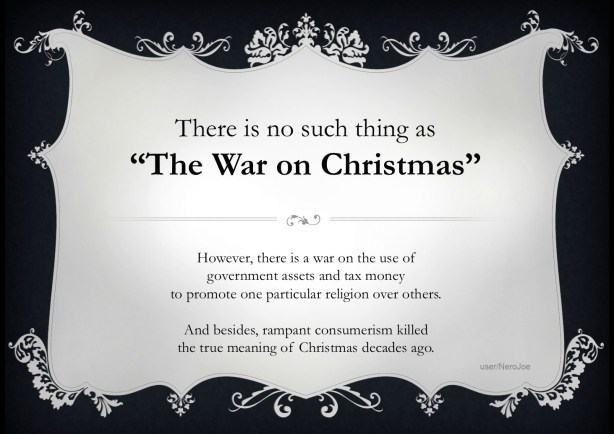
As a Muslim, I identify with the sentiments of the secular population. Most governments have holidays for Christmas, use state funds to purchase Christmas decorations and host Christmas parties. For us Muslims, we don’t have this luxury for ‘Eid, for our Hindu brothers in humanity, they don’t have this privilege for their religious festivals either. Even Jews don’t get a holiday for Hannukah or Passover. Christmas, or the Celebration of Jesus the Christ is solely a Christian holiday, not a secular holiday such as a Republic Day or Independence Day holiday.

Islam has no qualms with Christians celebrating Christmas, but as a Muslim, I do wish that governments would stop showing favour to one religion’s festivals and celebrate all accordingly.

War on Christmas

wa Allaahu ‘Alam.

Refutation: Jesus says that the Father is greater than he is, proving that he is not God.

بِسۡمِ ٱللهِ ٱلرَّحۡمَـٰنِ ٱلرَّحِيمِ ,

Question:

Jesus says that the Father is greater than he is, proving that he is not God. There is no one who is greater than God.

Answer:

Sam introduces the passage upon which the question is based, it reads:

“You heard that I said to you, ‘I go away, and I will come to you ‘ If you loved Me, you would have rejoiced because I go to the Father, for the Father is greater (meizon) than I.” John 14:28

His immediate response is to confuse himself, he says and I quote:

Yet, if God is a Trinity, a Trinitarian Being (i.e. one eternal God existing in three distinct, yet inseparable Persons), then it is quite possible for one member or Person of the Godhead to be greater in some sense than the other members. It would be true that nothing outside of the Holy Trinity’s own existence could ever be greater, but this doesn’t necessarily imply that there cannot be some type of authority structure or ranking within the internal life and relationships of the Trinity itself.

Logically speaking, this form of reasoning is highly fallacious. Since each member of the Godhead is fully God, and God is perfect in each and every way, to have one God being superior to another God, has to mean that the definition and understanding of God has to change. We must accept that God is perfect, one perfect being cannot be superior to another unless one is less perfect than the other. If a being who is assumed to be a God is not absolutely perfect, then this being cannot by very definition, be considered a God. Hence for there to be a hierarchy within the Godhead, we are dealing with one superior God and two lesser Gods. This presents a theological conundrum, as it must be understood that if the first God in the hierarchy is perfect and there is a second God, then this second God is less perfect than the first, thus it logically follows that the third God would therefore be less perfect than both the first and second Gods. With this in mind, it would be best that Sam disuse the premise that their could possibly be a hierarchy within the Godhead. Notwithstanding the evidential fact that the Godhead in itself is polytheistic in nature.

Polytheistic in the sense that if God is one, then in what sense is this God, multi-personal? In what way is God considered a ‘person’ (an individual of specified character)? If I am to believe that God has specific traits, how can God then be multi-personal without increasing or decreasing His traits amongst distinct individuals, exclusive of Himself? Thus, consequentially, by this very description of God being multi-personal (i.e. the nature of the Godhead), God has been relegated to a person among other persons, therefore equating to multiple Gods. Rather, to foster a more comprehensive and accurate understanding of the Godhead in light of personhood, it would equate itself to God with gods. Seeing that I have aptly demonstrated the incredulous nature of a hierarchy within the Godhead and the illogical and polytheistic nature of the Godhead, let’s continue to examine Sam’s fallacious reasoning:

“For now, let us deal with what Jesus intended to convey to his disciples that the Father was greater than he. In the first place, the term for “greater” (Greek – meizon) does not necessarily imply one who is greater in nature or essence. It can refer to someone or something being greater in position and/or authority

Since God’s nature is to be all powerful and all perfect, how does Sam seek to qualify his statement in the response he has given? If God is perfect, then he cannot increase or decrease in position, without losing or gaining Godly traits, thus becoming a lesser God or greater god. Therefore the notion that God increasing or decreasing in position or authority means that it does not affect His nature, is highly erroneous and non-sensible. He continues:

“A careful look at the entire chapter of 14 shows the Lord Jesus claiming to have all of God’s omni-attributes:

“And I WILL DO whatever you ask IN MY NAME, so that the Son may bring glory to the Father. You may ask ME for anything in my name, AND I WILL DO IT.” John 14:13-14

Christ is capable of personally answering all prayers that are directed to him or are addressed in his name. The only way that Christ can both hear and answer all these prayers is if he is both omniscient and omnipotent!”

Sam contradicts himself. At first he claims that their is a hierarchy, now he claims Christ is equal to God. After he has spent a lengthy period demonstrating that the word meizon in Greek can be used to differentiate in power and authority, to promote the understanding that it does not refer to nature (which I have demonstrated is quite ridiculous), he then makes an about turn, negates his previous arguments and tries to demonstrate that Christ is equal to God. This is a sign of a clearly confused individual, trying to reconcile an imperfect doctrine. If Jesus does have all of God’s attributes, then how is he distinct from the person of the Father? Sam’s statement, therefore negates the logic behind the Godhead, well done Sam. On that note, let’s see what the Greek of the verse also indicates. We must be reminded that the Greek of the Biblical text, as with all other languages, has depth. Subsequent to this depth, translations are often consequent to their context. In the case of the Bible, which is a religious scripture, it is quite obvious that the Christian rendition of the text, would attempt to signify Christ’s importance and stature. However, when examining the Greek, as a Muslim, I am able to explore the depth of the text and consider alternate renditions in accordance with the definitions of the words thereby employed. It is with this in mind, that I present an alternate translation based on the Greek of the text:

“And I will do whatever you ask (αιτέω) by (εν) my (μου) authority (ονομα), so that the Son may glorify to the Father. You may ask me for certain things (τίς) by (εν) my (μου) authority (ονομα), and I will do it.” – John 14:13-14, based on the GNT of the Nestle Aland 26th Codex, by way of Strong’s Greek Lexicon.

A Christian would obviously disagree with this rendition because of his presupposed theological views. However, a person who is objective and willing to examine the text for what it is, without biased presuppositions, will be able to accept this English rendition based on the depth of the words used in the verses. This is not perverting the text, as it is normal to find one Biblical verse being rendered in various ways throughout the multitude of Bible translations available to us. In fact, Sam accepts this rendition of the words from the verse used above, as he demonstrates in this article:

I have come in My Father’s name, and you do not receive Me; if another comes in his own name, you will receive him.” John 5:43

Just as the late, renowned NT Greek grammarian and scholar, A.T. Robertson noted in his comments on Matt. 28:19:

… The use of name (onoma) here is a common one in the Septuagint and the papyri for power or authority… (Robertson’s Word Pictures of the New Testamentonline source; underline emphasis ours)

Thus, Sam’s reliance on one translation is very narrow minded and negates other interpretations of the Greek text, which removes Jesus’ alleged assumption of deity. It is clear from the Greek rendition provided above, that Christ is saying he can do only what he can, by which his authority allows him, therefore he is not omnipotent. Sam does say that Christ is capable of answering all of a Christian’s prayers, so I am going to apply the principle of proof by contradiction and challenge Sam to pray to Christ and ask for a unicorn to appear in front of me, as his rendition of the verse claims that you can ask Christ for anything and he would do it. Since this is not true, and a unicorn will not appear, it is then quite understandable that the verse’s rendition and the conclusions of which Sam has derived from it, are highly inaccurate. He continues by appealing to another verse:

“On that day you will realize that I am in my Father, and you are in me, AND I AM IN YOU. Whoever has my commands and obeys them, he is the one who loves me. He who loves me will be loved by my Father, and I too will love him and show myself to him.” John 14:20-21″

Again, with returning to the Greek of the text, Sam’s conclusions can be easily negated:

“On that day you will know that I am before/ wherewith (εν) my Father, and you are before/ wherewith (εν) me, and I am before/ wherewith (εν) you. Whoever has my commandments and obeys them, he is the one who loves me. He who loves me will be loved by my Father, and I too will love him and show myself to him”. – John 14:20-21, based on the GNT of the Nestle Aland 26th Codex, by way of Strong’s Greek Lexicon.

The word “before” is used in the sense that you are in the presence of someone (e.g. I can’t talk now, I’m before the judge), hence the inclusion of the alternate word, wherewith, meaning with a person.This makes the most sense, as Jesus would show himself to those persons and therefore will be before (in the presence of) them and the Lord. Sam makes an interesting interpretation of the verse, he says:

“Christ says that he is IN all the disciples, an impossible claim if he was only a man, or even an angel. But since Jesus is God, and since God is omnipresent, it therefore makes perfect sense for Christ to say he is able to dwell in all the believers at the same time.”

What does he mean that God will be ‘in the disciples’? Does he mean physically? Spiritually? This doesn’t prove Christ’s deity, rather it raises a rather serious theological issue, what does God mean that He will be ‘in’ us? This clearly brings to the forefront, more questions than answers, but if it is one thing Sam’s statements does in this case, it is clearly not proving Jesus’ deity. Sam continues:

“Jesus replied, ‘If anyone loves me, he will obey my teaching. My Father will love him, and WE will come to him and make OUR home with him.’” John 14:23

Both the Father and the Son make their home with all true believers! Christ is clearly claiming co-equality with the Father since he is present with every believer in the same way that the Father is!”

Sam’s logic is that if God accompanies the believers with Christ, then Christ is claiming he is co-equal to the Father. Using Sam’s logic, since the believers are going to be present with the Lord in the same way Christ is present with the Lord, then the believers are all ‘clearly claiming co-equality’ with the Father. Since the latter is nonsensical, how can the former be true? Sam’s logic is clearly infantile, if it cannot work both ways, why does he expect it to work one way? This then, manipulates the full meaning of the text beyond its intended scope. Sam spends the rest of his time trying to equate Christ with the Lord, all of which are easily explained and debunked with employing basic logic and reasoning.

One problem with Sam’s understanding, is that if Sam is promoting the belief that their is a hierarchy, why is he investing so much time into explain ways in which Christ is equal to the Father? Does he not understand how a hierarchy works? By claiming the Father can be greater than the Son, and then demonstrating how the Father is not equal to the Son, Sam is actually contradicting himself. Therefore, in light of Sam’s rivalling explanations, I must ask him, do you believe that the Son is equal to the Father or that the Son belongs in a hierarchy with the Father? The both cannot be true, as either the Son is on par with, or below or greater in rank and authority than the Father. Lastly, Sam claims:

“Thus, the Father was greater in position and rank, not in essence and nature. The questioner is, therefore, committing a categorical fallacy. He/she is confusing the category of position and rank with the category of essence and nature, erroneously assuming that if one is greater in one way, i.e. position and authority, than he/she must be greater in every way, i.e. essence and nature. In light of these clear biblical truths, such is not the case at all.”

Sam’s conclusion is beyond absurd and borders dogmatic arrogance. How can the Father’s rank not describe his essence? How can the Father be greater in rank, but equal in nature? This is like saying, in a track race, the three fastest runners are equal, but the one track runner is first, another second and another third. There clearly is a contradiction in his reasoning and the more he tries to explain it, the more he seems to put his foot in his mouth.

Think of it this way, if the Father is the exact same to the Son in essence and nature, in what way does the Father differ to be superior (greater) than the Son? Sam’s answer is that being greater means that the Son is still the same with the Father, therefore it is either that Sam does not understand the meaning of the word ‘greater’, or the word ‘hierarchy’ or he does not understand the meaning of both those words and the logic behind them. Since this is the case, consider this to be another case of Shamounian logic.

wa Allaahu ‘Alam.

« Older Entries Recent Entries »